Schools and academic achievement have a powerful influence on the lives of children and adolescents. Specifically, for adolescents, school has a prominent position in defining their understanding of society (Kia-Keating & Ellis, Reference Kia-Keating and Ellis2007). School belonging is defined as the extent to which students feel personally respected, accepted, and included by others — that is, peers and teachers — in the school environment (Goodenow, Reference Goodenow1993). School belonging is associated with numerous psychological and academic outcomes in children and adolescents. Evidence has revealed that school belonging is correlated with adolescent psychological adjustment and functioning (Arslan & Allen, Reference Arslan and Allen2020; Pittman & Richmond, Reference Pittman and Richmond2007), prosocial behaviours (Arslan & Tanhan, Reference Arslan and Tanhan2019; Demanet & Van Houtte, Reference Demanet and Van Houtte2012), psychological wellbeing (Jose, Ryan, & Pryor, Reference Jose, Ryan and Pryor2012), self-esteem and self-identity (Nutbrown & Clough, Reference Nutbrown and Clough2009; O’Rourke & Cooper, Reference O’Rourke and Cooper2010), lower levels of internalising problems (Arslan & Tanhan, Reference Arslan and Tanhan2019; Arslan, Allen, & Ryan, Reference Arslan, Allen and Ryan2020; Anderman, Reference Anderman2002), and academic performance and motivation (Neel & Fuligni, Reference Neel and Fuligni2013; Sari, Reference Sari2012). For example, Hallinan (Reference Hallinan2008) reported that school belonging was associated with improved school retention rates and less school misconduct. Furthermore, belongingness was positively related to attitude toward self-efficacy and learning (Battistich, Solomon, Kim, Watson, & Schaps, Reference Battistich, Solomon, Kim, Watson and Schaps1995). A study by Gonzalez and Padilla (Reference Gonzalez and Padilla1997) indicated that for Mexican students, the sense of school belongingness was the only predictor of academic performance, even when considering other variables such as cultural loyalty or supportive academic environment. Smerdon (Reference Smerdon2002) showed that academic grades were associated with a sense of belonging in students. Williams and Downing (Reference Williams and Downing1998) examined the characteristics of classroom membership perceived by students from urban and rural schools using a focus group and interviews. Their results revealed that interacting with friends and having a friend, classroom participation and good grades were associated with a better sense of belonging in school.
The education system in Iran is divided into two main levels, elementary schools and high schools. All children are required to spend the first six years of their educational life in elementary schools and attend high school from ages 12 to 18. There are many free public schools as well as private schools with high tuition fees. There are also schools called ‘Nemuneh Mardomi’, which are believed to be better than public schools and more affordable than private schools. Similar to almost all other countries, in Iran, schools are an essential learning context for children and adolescents. Improving the learning environment in educational settings depends on the extent to which educational settings can develop a positive emotional environment for both students and teachers. In addition to the international outcomes, several studies have been conducted to examine school belonging and academic, psychosocial and behavioural outcomes among Iranian students. For example, Hakimzade, Dorani, Abolghasemi, and Njati (Reference Hakimzade, Dorani, Abolghasemi and Njati2014) investigated the relationship between school belonging, academic motivation and academic achievement among high school students of Isfahan, Iran. They reported that school belonging was significantly associated with student academic motivation. Sharifi, Marzieh, and Jenabadi (Reference Sharifi, Marzieh and Jenabadi2018) examined the relationship between achievement goals and the sense of connectedness with school among students. Their study showed that mastery attitude orientation was able to predict a sense of belonging to the school.
Similar to defining school belongingness, there are also differences in the method used to measure the construct. Research has shown that while different researchers have employed different definitions to describe school belonging, they all refer to a similar concept (Arslan & Duru, Reference Arslan and Duru2017; Demanet & Van Houtte, Reference Demanet and Van Houtte2012; Osterman, Reference Osterman2000; Sari, Reference Sari2012). These measures also differ based on the sources from which the data is collected (e.g., teachers or students) and the design methodology from which information is gathered (e.g., interview, questionnaire, observation, or survey (Arslan, Reference Arslan2018a). Literature has indicated that conceptualisation of school belonging includes academic performance, extracurricular activities, interpersonal relationships, classroom behaviour, and school community (Allen & Kern, Reference Allen and Kern2017). For instance, students are asked about the quality of their relationship with their peers, teachers and other school staff, such as willingness to discuss issues and problems with teachers (Battistich et al., Reference Battistich, Solomon, Kim, Watson and Schaps1995), liking of teachers (Murray & Greenberg, Reference Murray and Greenberg2001), respecting teachers (Goodenow, Reference Goodenow1993), and ideas (Sugai & Horner, Reference Sugai and Horner2008).
Additionally, previous research has indicated that the self-report method is one of the most common methods to measure students’ sense of belonging in school settings (Allen & Kern, Reference Allen and Kern2017). Although many self-report measures were developed to assess student feelings of school belonging, few scales have been translated and validated for Iranian students about school belonging. In one of these studies, Makian and Kalanarkoshe (Reference Makian and Kalanarkoshe2015) investigated the psychometric properties of the Student Sense of Connectedness Scale (Brew, Beatty, & Watt, Reference Brew, Beatty and Watt2004) among Persian students. The study outcomes demonstrated that the scale provided a strong internal reliability estimate (α = .88) and concurrent validity with academic burnout (r = –.57) with Iranian students. Another study by Safaie and TalePasand (Reference Safaie and TalePasand2018) investigated the psychometric properties of the Student Engagement Instrument, which was developed to measure student psychological and cognitive engagement with Iranian students. Results of this study showed that the scale had a multidimensional structure (i.e., cognitive, emotional, behavioural and agency factors) characterised by adequate-to-strong internal reliability coefficients ranging from .65 to .82 and concurrent validity with several school-based outcomes. In other studies, researchers investigated the validity of other measures for Iranian studies, including the Psychological Sense of School Membership Scale (PSSM; Babakhani, Reference Babakhani2014). This study showed that this 18-item scale is valid for Iranian students as the alpha coefficients for subscales of belonging (0.71), acceptance (0.73), respect (0.82), and the whole scale (0.75) are acceptable. Specifically, although the PSSMS has been used in different cultures, various factor structures have been proposed and the discussion of its structure continues (see Abubakar et al., Reference Abubakar, Van de Vijver, Alonso-Arbiol, Suryani, Pandia, Handani and Murugumi2016). Given the literature noted above, no other research investigating the potential screeners has been undertaken with Iranian students; thus, this study was performed in an attempt to examine preliminary validity evidence for the SBS that might prove useful for measuring school belongingness in Iranian adolescents.
Purpose of the Study
Although belongingness is crucial for student academic, social, emotional and behavioural functioning (Arslan, Reference Arslan2018b; Quinn & Oldmeadow, Reference Quinn and Oldmeadow2013), school belonging is primarily associated with the particular need for belonging of adolescents compared to other age groups. The need for belonging helps adolescents’ successful transition into early adulthood (Tanti, Stukas, Halloran, & Foddy, Reference Tanti, Stukas, Halloran and Foddy2011). Therefore, it is a critical step to measure students’ sense of belonging in school and develop prevention and intervention services to foster youth school belongingness. The purpose of the current study is to investigate the psychometrics of the cultural adaptation of the School Belongingness Scale (Arslan & Duru, Reference Arslan and Duru2017) with a sample of Iranian students. Based on the literature and theoretical frameworks, Arslan and Duru (Reference Arslan and Duru2017) have reported that school belongingness can be measured as a function of person-environment interactions, and therefore it is conceptualised as a construct related to individuals’ self-concept. Their outcomes indicated that the scale provided excellent data-model fit statistics, strong internal reliability estimates, and concurrent validity with several school-based and quality-of-life measures. The original development and validation research of the SBS was performed with a sample of Turkish children and adolescents; thus, there are no outcomes available regarding the cultural adaptation of the SBS in other countries. In addition, as two neighbours, Iran and Turkey share many cultural issues, and through our primary investigation, it is evident that the conceptual model and items in the SBS, which was developed by Turkish scholars, is likely to be an appropriate conceptualisation for Iranian students. Given that school belonging has been shown to be consistently associated with students’ academic functioning and psychosocial adjustment outcomes, this study is timely.
Method
Participants
Participants of this study included 324 students enrolled in Grades 9–12 in a high school located in an urban city in Iran. Students were 161 females (49.7%) and 163 males (50.3%), and they ranged in age from 12 to 18 years (M = 14.68, SD = 1.39). In selecting the participants, schools were selected from different socio-economic classes so that the sample could be a representative selection of the society. Cluster sampling was utilised to have access to the participants and schools, and different classes were used as a pre-existing cluster. The participants completed a pencil-and-paper survey, which was created using demographic items (measuring only the characteristics reported on above), the school belonging, and the concurrent validity measures (i.e., Strengths and Difficulties Questionnaire and Student Self-Reported Academic Achievement) during school hours. Students were first asked to complete an informed consent form, and they were told their participation was voluntary. Each student was given enough time to answer the questionnaires. After administering the questionnaire, 16 were excluded from the final analysis because they were incomplete. After the analysis, all questionnaires were kept in a safe closet provided by the University of Isfahan for confidentiality reasons.
Measures
School Belongingness Scale (SBS)
The SBS is a 10-item self-report measure comprised of two 5-item subscales, one representing school inclusions and the other representing school exclusion, which are intended to be used for screening students’ sense of belonging at school. All scale items are directly worded to measure the constructs of school belonging, requiring five reverse scorings, and are arranged along a 4-point Likert-type scale: 1 = almost never, 2 = sometimes, 3 = often, 4 = almost always (Arslan & Duru, Reference Arslan and Duru2017). Previous research indicated that responses to the SBS were characterised by an adequate-to-strong internal (α range = .70–.86) and latent construct reliability estimates (H range = .72–.87), and concurrent validity with measures of school-based and quality-of-life outcomes (e.g., joy of learning, educational purpose, life satisfaction; Arslan & Duru, Reference Arslan and Duru2017).
For the purposes of the current study, the translation and back-translation approach were used to create the Iran version of the SBS (Maneesriwongul & Dixon, Reference Maneesriwongul and Dixon2004). First, the English version of the scale was sent to two independent language experts studying school psychology in Iran to translate the measure into Persian. Subsequently, the Persian version of the SBS was provided to an independent expert who reviewed the wording of the measure for readability considerations. The Persian version of the SBS was next translated back into English by two additional experts, after which another expert compared the back-translation with the original English version of the measure. Similar to the original version of the measure, all items were arranged along the same 4-point Likert-type scale ranging from (1) almost never to (4) almost always.
Strengths and Difficulties Questionnaire (SDQ)
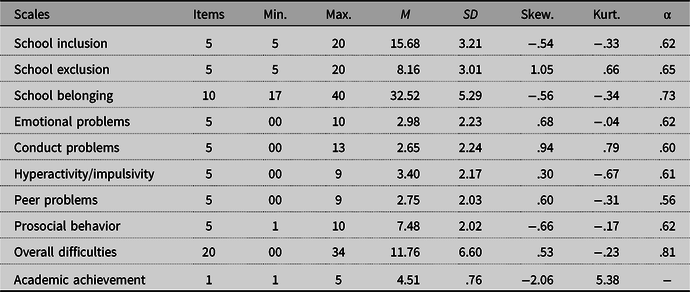
The SDQ was used as concurrent validity measures of emotional and behavioural problems. The SDQ is a 25-item, self-report rating scale developed to assess childrenʼs and adolescents’ behavioural and emotional difficulties, as well as strengths (Goodman, Reference Goodman2001). The SDQ is comprised of five scales, with five items for each scale measuring emotional problems, conduct problems, peer problems, hyperactivity and prosocial behaviour (e.g., ‘I am rather solitary’, ‘I usually do as I am told’, ‘I am considerate of others’, ‘I am constantly fidgeting’). All items are responded to using a 3-point Likert-type scale (0 = not true to 2 = certainly true). Previous research showed that the SDQ and its scales had adequate internal reliability coefficients (α range = .67 and .79), with the exception of the peer problems that provided lower internal reliability estimates (α = .28) than the other scales in Iranian children and adolescents (Ghanizadeh, Izadpanah, & Abdollahi, Reference Ghanizadeh, Izadpanah and Abdollahi2007). In the present study, descriptive statistics of the measures are presented in Table 1.
Observed Scale Characteristics of the Scales

Student academic achievement
In addition to the SDQ, self-reported academic achievement was used as a concurrent validity measure of academic achievement. Student academic achievement was measured using a single item scale (‘During the past year, how would you describe the grades you received in school?’) adapted from previous research (Arslan, Reference Arslan2019a; Furlong, You, Renshaw, Smith, & O’Malley, Reference Furlong, You, Renshaw, Smith and O’Malley2014). Students scored this item using a 5-point grade-range response scale (5 = very good, 4 = good, 3 = average, 2 = poor, 1 = very poor), and higher scores indicated higher academic achievement. Previous studies revealed that there was a strong association between student self-reported academic achievement and school-reported achievement (Arslan, Reference Arslan2019b; Shaw & Mattern, Reference Shaw and Mattern2009). Descriptive statistics of the scale with this sample are presented in Table 1.
Data Analyses
Confirmatory factor analysis was first conducted to examine the latent factor structure of the measure, which was described in previous SBS validity studies (Arslan & Duru, Reference Arslan and Duru2017). Several data-model fit statistics and their associated decision scores were used to evaluate the goodness of fit of the measurement model, including the root mean square error of approximation (RMSEA) and standardised root-mean-square residual (SRMR) ≤ .08 = adequate data-model fit; Tucker-Lewis index (TLI), goodness-of-fit statistic (GFI), and comparative fit index (CFI) ≥ .90 = adequate data-model fit (Hooper, Coughlan, & Mullen, Reference Hooper, Coughlan and Mullen2008; Hu & Bentler, Reference Hu and Bentler1999). After testing the SBS factor structure, descriptive statistical analyses were also performed on the observed scores for all measures used in this study to examine the internal reliability estimate and normality assumption. Normality assumption was examined using kurtosis and skewness scores and their associated decision values (Curran, West, & Finch, Reference Curran, West and Finch1996).
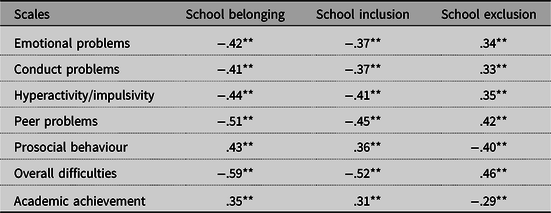
Concurrent validity was then explored by first performing bivariate correlations between the observed SBS scores and the criterion variables (e.g., emotional problems, prosocial behaviour, and academic achievement; see Table 2), and second, extending the SBS measurement model into a latent variable path analysis (LVPA) that predicted each of the theoretically relevant difficulty and strength outcomes. Findings from the LVPA were interpreted using squared-multiple correlations (R 2), which indicated the amount of variance accounted for in the predicted variables by the measurement model. The magnitude of these correlations was evaluated using traditional effect size ranges, as recommended by Cohen (Reference Cohen1988): .00–.009 = negligible, .01–.059 = small, .06–.139 = moderate, ≥.14 = large. All statistical analyses were conducted with IBM SPSS Statistics 25 and AMOS Statistics 24.
Bivariate Correlations between the SBS and Criterion Variables

Note: **p < .001.
Results
Latent Structure
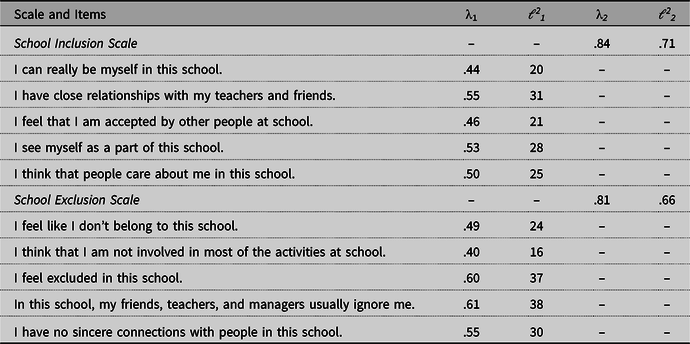
Confirmatory factor analysis was conducted to examine the factor structure of the previously known SBS (Arslan & Duru, Reference Arslan and Duru2017). Findings from this analysis for the SBS measurement model, which structured each of the 10 items as indicators of the two latent factor structures (i.e., school inclusion and exclusion) as indicators of a higher-order latent construct (i.e., school belongingness), provided adequate data-model fit statistics, χ2 = 90.74, df = 34, p < .001, CFI = .92, TLI = .90, GFI = .94, SRMR = .057, RMSEA (95% CI) = .072 [.054, .090]. Further findings from the higher order model indicated that factor loadings (λ) were adequate to strong for each first-order factor, ranging between .40 and .61, with robust indicator reliabilities (ℓ 2), ranging from .16 to .38; see Table 3. Observed scale characteristics of the Iranian version of the SBS showed that all scales had a relatively normal distribution (skewness and kurtosis ≤ |1|) and had adequate internal reliability coefficients (α), ranging from .62 to .73; see Table 2.
Factor Loadings and Indicator Reliability Coefficients (N = 324)

Note: λ1 = item loadings for first-order factors; ℓ 21 = indicator reliability for first-order factor items; λ2 = first-order factor loading for second-order factor; ℓ 22 = indicator reliability for second-order factor indicators.
Concurrent Validity Analyses
Bivariate correlation analysis results revealed that there are negative and moderate-to-large associations between school belonging and social, emotional and behavioural problems: emotional problems (r = –.42, p < .001), conduct problems (r = –.41, p < .001), hyperactivity/impulsivity (r = –.44, p < .001), and peer-relationship problems (r = –.51, p < .001). Additionally, school belonging was positively and moderately to largely correlated with wellbeing indicators: prosocial behaviour (r = .59, p < .001) and student self-reported academic achievement (r = .35, p < .001), as shown in Table 1.
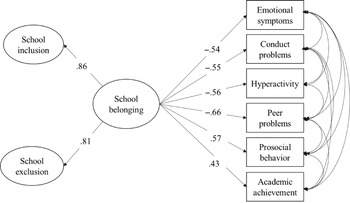
After examining the associations between school belonging and criterion measures, the measurement model was extended into an LVPA that predicted each of the concurrent validity variables (see Figure 1). Findings from this analysis showed that the SBS higher order measurement model significantly predicted student academic achievement (β = .43, p < .001, R 2 = .19), emotional problems (β = −.54, p < .001, R 2 = .30), conduct problems (β = −.55, p < .001, R 2 = .30), hyperactivity (β = −.56, p < .001, R 2 = .32), peer problems (β = −.66, p < .001, R 2 = .44), and prosocial behaviour (β = .57, p< .001, R 2 = .32). The SBS measurement model predicted large proportions of the variance in all of the concurrent validity strength and difficulty variables (see Figure 1). Overall, these results provide validity evidence in favour of the Iran version of the SBS as a brief multidimensional measure of students’ feelings of belonging at school.
LVPA model for the School Belongingness Scale.

Discussion
Although many self-report measures have been developed to assess student sense of school belonging, few have been translated and validated for Iranian students (e.g., PSSM; Babakhani, Reference Babakhani2014). Additionally, previous studies have supported that school belonging is closely associated with school-based and quality-of-life outcomes (Allen, Kern, Vella-Brodrick, & Waters, Reference Allen, Kern, Vella-Brodrick and Waters2017; Arslan, Reference Arslan2018b; Pittman & Richmond, Reference Pittman and Richmond2007; Slaten, Ferguson, Allen, Brodrick, & Waters, Reference Slaten, Ferguson, Allen, Brodrick and Waters2016). Given these outcomes, there is a critical need to measure the sense of school belonging to provide prevention and intervention services for adolescents in school settings. There is therefore a need for studies to examine the reliability and validity of measures of school belonging. The purpose of the present study was to investigate initial psychometrics and cultural adaptation of the SBS with a selected sample of adolescents in Iran. Confirmatory factor analysis results indicated that the SBS provided adequate data-model fit statistics with adequate-to-strong factor loadings (λ) for each first-order factor. Observed scale characteristics of the Iran version of the SBS showed that all scales had adequate internal reliability coefficients. Concurrent validity analyses revealed the moderate-to-significant associations between school belonging and social, emotional and behavioural problems (e.g., emotional problems, conduct problems and hyperactivity/impulsivity) and moderately to mostly correlated with wellbeing indicators (i.e., prosocial behaviour and academic achievement). Further, the measurement model was extended into an LVPA that predicted each of the concurrent validity variables. Findings from this analysis showed that the SBS higher order measurement model predicted large proportions of the variance in all of the concurrent validity strength and difficulty variables.
Findings from the study supported the study hypothesis, demonstrating that the Iran version of the SBS was a psychometrically adequate two-factor measurement model and that the measure had moderate-to-large associations with both strengths and difficulties of adolescents. These outcomes were consistent with previous results supporting the technical adequacy of the SBS (Arslan & Duru, Reference Arslan and Duru2017), as well as the larger body of research indicating the significant association between school belonging and wellbeing indicators and adjustment difficulties among adolescents (Anderman, Reference Anderman2002; Asanjarani, Abadi, Ghomi, & Mesman, Reference Asanjarani, Abadi, Ghomi and Mesman2018; Demanet & Van Houtte, Reference Demanet and Van Houtte2012; Jose et al., Reference Jose, Ryan and Pryor2012; Nutbrown & Clough, Reference Nutbrown and Clough2009; O’Rourke & Cooper, Reference O’Rourke and Cooper2010; Pittman & Richmond, Reference Pittman and Richmond2007). Therefore, the SBS might be a useful instrument for measuring childrenʼs and adolescents’ sense of belonging in school settings. Moreover, considering the psychometrically good measurement model of the SBS in this study, further research could be performed to examine the psychometric properties of the measure within other cultures for supporting youth sense of belonging within the school context. Overall, these results provide initial validity evidence in favour of the Iran version of the SBS as a brief multidimensional measure of students’ feelings of belonging at school.
Given the literature, there are only a limited number of scales designed to measure adolescent sense of belonging within the school context. Therefore, school counsellors and psychologists could use the SBS as a brief measure for identifying student psychosocial and emotional difficulties due to the lack of school belonging or exclusion (Arslan, Reference Arslan2018c; Arslan & Duru, Reference Arslan and Duru2017; Ye & Wallace, Reference Ye and Wallace2014). Prevention and intervention services might be provided for these students in school settings. For example, adolescents who had a lack of belonging or higher levels of exclusion at school could be promoted through programs targeting the improvement of relationships and affiliations with others within the school context (Arslan & Duru, Reference Arslan and Duru2017; Shochet, Smith, Furlong, & Homel, Reference Shochet, Smith, Furlong and Homel2011). School counsellors could develop intervention strategies for students who are socially excluded or poorly included at school. Positive interpersonal experiences (e.g., positive teacher-student relations, social activities) could be improved through these intervention strategies (Arslan, Reference Arslan2019b). Additionally, school counsellors and psychologists could use the SBS to measure the effectiveness of the prevention and intervention services and to understand changes in levels of students’ school belonging. Similarly, school counsellors could evaluate the counselling process and establish goals related to a clientʼs challenges, including loneliness, exclusion and lack of school connectedness using the SBS (Arslan & Duru, Reference Arslan and Duru2017). School counsellors could also provide counselling services (e.g., group counselling) to promote their social bonds and inclusion experiences and decrease students’ sense of exclusion.
Despite these significant findings, the present study should be considered in light of several methodological limitations. First, given the sample size of the present study, including students from a public high school located in an urban city in Iran, further research is warranted to replicate these results with more representative and larger samples. Second, self-reported measures were used to assess concurrent outcomes, suggesting the possibility of common method bias (Podsakoff, MacKenzie, Lee, & Podsakoff, Reference Podsakoff, MacKenzie, Lee and Podsakoff2003). Therefore, additional research could investigate the validity of the measures using different data-collection approaches, such as teacher ratings of youth functioning and school-based academic achievement (Renshaw & Arslan, Reference Renshaw and Arslan2018). Similar to the original development study of the SBS performed with the Turkish sample (Arslan & Duru, Reference Arslan and Duru2017), data collection was conducted using the convenience method, and generalisation studies are thus warranted with more diverse and larger samples.
Financial support
This research received no specific grant from any funding agency, commercial, or not-for-profit sectors.
Conflict of interest
None.