Introduction
In most countries in the world, the highest suicide rates are in the elderly, particularly individuals over the age of 65 years (OECD, 2014). Moreover, being old has been identified as a significant risk factor for death by suicide (Turvey et al., Reference Turvey2002). Given that the population is aging at an unprecedented rate in several countries, the absolute number of deaths by suicide is expected to rise (Christensen et al., Reference Christensen, Doblhammer, Rau and Vaupel2009). Thus, suicide among the elderly is a public health concern, particularly in East Asian countries, such as South Korea, Singapore, and Japan, where at least 14% of the population is 65 years of age or older (OECD, 2013). As a country with one of the world's fastest aging populations, Korea must seek ways to control the incidence of suicide in this population. The suicide rate among elderly Koreans is the highest among the 34 nations of the Organization for Economic Cooperation and Development (OECD, 2014). A previous study found that suicidal ideation was the main thought process leading to suicide, indicating that individuals who did not contemplate suicide rarely attempted it, whereas 34–42% of individuals who imagined committing suicide subsequently attempted suicide (Kessler et al., Reference Kessler, Borges and Walters1999). Thus, it is necessary to approach suicide prevention in terms of identifying and preventing the factors that influence suicidal ideation.
Previous studies have investigated psychiatric illness and physical illness as factors affecting suicidal ideation among the elderly (Chiu et al., Reference Chiu2004; Juurlink et al., Reference Juurlink, Herrmann, Szalai, Kopp and Redelmeier2004). Furthermore, socioeconomic status has been identified as a significant factor affecting suicidal ideation among older adults (Almeida et al., Reference Almeida2012), and previous research has found that suicidal behavior in the elderly is associated with the unique experiences of aging, including social isolation, loss of spouse, and living alone (Conwell et al., Reference Conwell, Duberstein and Caine2002). Moreover, suicide and poverty have been found to be closely related in the elderly population (He and Lester, Reference He and Lester2001), and socioeconomic disadvantages, such as low income and living alone, food insecurity status are associated with psychological distresses and increase the risk of suicidal behavior among elderly individuals (Johnson et al., Reference Johnson, Sharkey and Dean2011; Huisman et al., Reference Huisman, Read, Towriss, Deeg and Grundy2013; Draper and Fenton, Reference Draper and Fenton2014). These issues are particularly relevant in Korea, where elderly individuals tend to have a low socioeconomic status. The recent rise in the elderly population has increased concerns related to low socioeconomic status, such as poverty, in Korea (OECD, 2014). In fact, Korea has the highest poverty rate among elderly individuals, with one-half of Koreans aged 65 years or older living in relative poverty (poverty rate: 49.6% in Korea; 12.6% average in the OECD) (Jones and Urasawa, Reference Jones and Urasawa2014). Additionally, the number of older Korean adults living alone has risen 2.5-fold since 2000 and currently accounts for a quarter of the elderly population (Statistics Korea, 2014). Thus, it is important to examine the effect of socioeconomic status on suicidal ideation among elderly Koreans.
Although the association between suicidal ideation and socioeconomic status has been widely investigated in Eastern and Western countries (Almeida et al., Reference Almeida2012; Huisman et al., Reference Huisman, Read, Towriss, Deeg and Grundy2013), few studies have been conducted in Asian countries, including Korea. Moreover, the few studies conducted in Korea focused on the general adult population (Chin et al., Reference Chin, Lee and So2011; Moon and Park, Reference Moon and Park2012) and measured only well-known components of socioeconomic status, such as educational attainment and household income. Considering that the poverty rate among elderly Koreans is one of the highest among developed countries (OECD, 2014) and that food insecurity is associated with poverty and economic hardship (Johnson et al., Reference Johnson, Sharkey and Dean2011), food insecurity is as important an indicator of socioeconomic status as household income and living arrangement.
Thus, it is necessary to view suicide in the elderly population in terms of socioeconomic status: low socioeconomic status is associated with poverty in elderly individuals and, subsequently, poverty may lead to suicide (Shah et al., Reference Shah, Bhat, MacKenzie and Koen2008). Thus, we included socioeconomic variables, such as food insecurity, household income, and living arrangement, in our analysis of the factors associated with suicidal ideation among elderly Koreans. Our hypotheses were: (i) low socioeconomic status is associated with suicidal ideation among elderly individuals; and (ii) suicidal ideation is strongly associated with a combination of low socioeconomic factors.
Materials and methods
Study population
For this study, we used raw data from the 2013 Korean Community Health Survey (KCHS), conducted by the Korea Centers for Disease Control and Prevention (KCDC). The KCHS is a cross-sectional study that collects reliable health-related data. The survey is conducted annually, and it collects information through in-person interviews. Because the population sample is extracted from the national survey data, samples are representative of the Korean population.
The study included individuals who were 65 years or older. Respondents who did not provide data on food insecurity, household income, living arrangement, age, education level, employment status, receipt of basic livelihood aid, perceived health status, limits on activities of daily living, smoking, and alcohol intake, awareness of stress, physician-diagnosed depression, frequency of contact with a neighbor, or number of chronic diseases and those who were under the age of 65 years were excluded (Figure 1). A total of 58,590 eligible participants were included in the study. Moreover, because sex has been shown to have an effect on mental health, the male and female data were analyzed separately (Jeon et al., Reference Jeon, Jang, Rhee, Kawachi and Cho2007; Chin et al., Reference Chin, Lee and So2011).
Flow chart of participant selection process.

Measures
Suicidal ideation
We used a self-report suicidal ideation questionnaire. Suicidal ideation was assessed based on the single question “Have you thought about killing yourself in the past 12 months?” Responses were provided on a two-point scale (yes, no). Despite the limitations of using one question to assess suicidal ideation, several studies, including an epidemiological review and international report (World Health Organization World Mental Health Composite International Diagnostic Interview), have assessed suicidal ideation using a single item (Kessler and Üstün, Reference Kessler and Üstün2004). Furthermore, previous studies have shown that the single-item assessment of suicidal ideation is consistent with previously validated scales for suicidal ideation and is predictive of suicidal behavior (Desseilles et al., Reference Desseilles2012; Green et al., Reference Green, Brown, Jager-Hyman, Cha, Steer and Beck2015).
Food Insecurity
Food insecurity was assessed using the single question, “Which one of the following most accurately represents your family's food circumstance in the past 1 year?” The following four structured response options were provided: “Food secure” (The amount of food available to all members of my household was sufficient in terms of quality and variety and The amount of food available to all members of my household was sufficient in terms of quantity but limited in variety), and “Food insecure” (There was an occasional shortage in the amount of food needed for all members of my household due to lack of resources and There was a frequent shortage in the amount of food needed for all members of my household due to lack of resources). Respondents were categorized as food secure or food insecure according to the financial resources factor (Alaimo et al., Reference Alaimo, Briefel, Frongillo and Olson1998; Chun et al., Reference Chun, Ryu, Park, Ro and Han2015).
Household income
Household income was the sum of all the household members’ incomes. We divided household income into quartiles (high, middle–high, middle–low, and low) such that each group represented one-fourth of the population. We categorized household income as: “High,” “Middle” (middle–high and middle–low), or “Low.”
Living arrangement
Living arrangement was assessed by the question “What is the makeup of your household?” Possible responses included “Living alone” (single-person household). All other responses (couple, couple + unmarried brothers and sisters, couple + relatives, couple + single children, single parent + single children, couple + parents, couple + single parent, grandparents + single grandchildren, single grandparent + single grandchildren, couple + parents + single children, couple + single parent + single children) were categorized as “All others.”
Covariates
The following demographic characteristics were examined: age (over 65), sex (male, female), education level (uneducated, middle school, or less, high school, or more), employment status (employed, unemployed), and receipt of basic livelihood aid (not applicable, current recipient, or past recipient). Health behavior variables were smoking (yes, no) and alcohol intake (yes, no); health status variables were awareness of stress (low, high), perceived health status (healthy, normal, unhealthy), and limits on activities of daily living (present, absent). Physician-diagnosed depression was assessed using the question “Have you ever been diagnosed with depression by a doctor?” Responses were given on a two-point scale (yes, no). Frequency of contact with a neighbor was grouped into “Rare” (less than once a month, once a month), “Moderate” (two or three times a month, once a week), and “Very frequent” (two or three times a week, four, or more times a week). The number of chronic diseases category included diagnoses of hypertension, diabetes, dyslipidemia, stroke, myocardial infarction, angina pectoris, arthritis, and osteoporosis given by a doctor.
The KCHS survey items and output indices were determined by the operating committee after receiving feedback from policy makers and local governments. The survey items and output indices were based on the results from the Ministry of Health and Welfare, cities, provinces, community health centers, and trusted universities (Kang et al., Reference Kang2015). Moreover, a previous study that assessed the test–retest reliability of the health behavior items used in the CHS, including age, sex educational level, smoking, alcohol intake, nutrition, and mental health (Kim et al., Reference Kim2015). The study report that health behavior items had a highest kappa value in the test–retest reliability. Thus, despite the limitations of dichotomous responses (yes, no), the KCHS provides useful data for public health research and clinical practice.
Statistical analysis
We first examined the distribution of each categorical variable using the χ 2 test to calculate the frequency and percentage of variables and to identify significant differences between groups. The incidence of suicidal ideation was analyzed according to sex. Next, a multivariate logistic regression analysis was used to examine the association between socioeconomic status (food insecurity, low income, living alone), and suicidal ideation while controlling for potential confounding variables such as age, sex, education level, employment status, receipt of basic livelihood aid, perceived health status, limits on activities of daily living, smoking, alcohol intake, awareness of stress, physician-diagnosed depression, frequency of contact with a neighbor, and number of chronic diseases. Subgroup analyses were conducted to evaluate the association between socioeconomic status and suicidal ideation according to household income and living arrangement. Additionally, we assessed possible multicollinearity using statistical tests of collinearity. Multicollinearity was tested using a variance inflation factor (VIF), which provided an index to measure the degree to which the variance of an estimated regression coefficient increased due to collinearity. If the value of the VIF exceeded 10, a model was considered to indicate collinearity. All of the analyses were performed using SAS 9.4, and the statistical significance level was set at a p value < 0.05.
Results
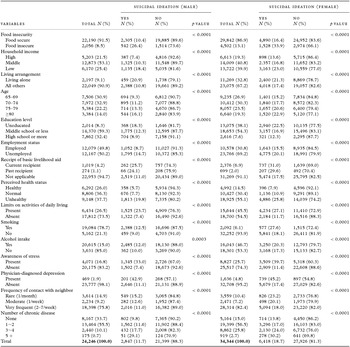
Our study of the association between socioeconomic status and suicidal ideation included 58,590 participants (24,246 males and 34,344 females). Table 1 shows the characteristics of the elderly population according to gender and suicidal ideation. Of the 58,590 subjects, the prevalence of suicidal ideation in male subjects was 11.7% (n = 2,847), and it was 18.7% (n = 6,418) in female subjects. Food insecurity was reported by 2,056 (8.5%) males and 4,502 (13.1%) females, low income was reported by 25.4% (n = 6,170) of males and 39.9% (n = 13,722) of females, and 9.1% (n = 2,197) of males and 32.8% of females (n = 11,269) reported living alone.
General characteristics of participants by gender and suicidal ideation

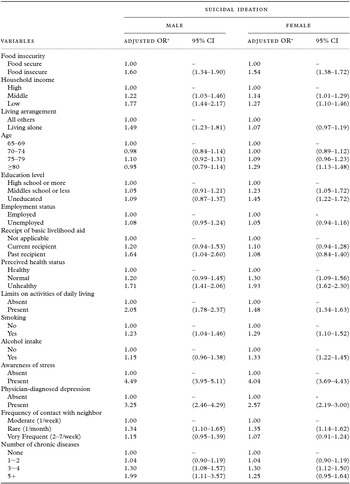
Table 2 shows the results of the logistic regression analysis of the association between socioeconomic status and suicidal ideation after multivariate adjustment. Food insecurity was significantly associated with suicidal ideation. Males who reported food insecure had a 1.60-fold higher risk of suicidal ideation compared with those who reported food secure (OR = 1.60; 95% CI, 1.34–1.90). Our findings were similar for females (OR = 1.54; 95% CI, 1.38–1.72). Males with a low household income had a 1.77-fold higher risk of suicidal ideation than those with a mid- to high household income (OR = 1.77; 95% CI, 1.44–2.17), and we found a similar trend in females (OR = 1.27; 95% CI, 1.10–1.46). Males living alone had a 1.49-fold higher risk of suicidal ideation than those in the “all others” category (OR = 1.49; 95% CI, 1.23–1.81), whereas the association between living arrangement and suicidal ideation was not significant in females. All VIFs were lower than 2, indicating the absence of multicollinearity. The highest VIF identified in our model was 1.47 (female – household income group).
Multivariate logistic regression analysis of the association between socioeconomic status and suicidal ideation

Notes: *Adjusted odds ratios (ORs) were calculated using logistic regression analysis and adjusted for food insecurity, household income, living arrangement, age, sex, education level, employment status, employment status, receipt of basic livelihood aid, perceive health status, limits on activities of daily living, smoking, alcohol intake, awareness of stress, physician-diagnosed depression, frequency of contact with a neighbor, and number of chronic diseases.
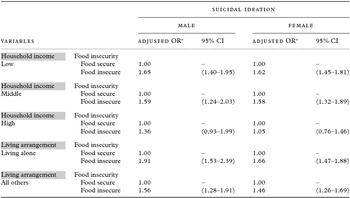
Subgroup analysis results are shown in Table 3. The subgroup analyses were stratified by household income or living arrangement. Males reporting food insecure and low household income had a 1.65-fold higher risk of suicidal ideation than those reporting a low household income and food secure (OR = 1.65; 95% CI, 1.40–1.95). A similar trend was found for females (OR = 1.62; 95% CI, 1.45–1.81). Males reporting food insecure and living alone were at a 1.91-fold higher risk of suicidal ideation compared with those who were living alone and food secure (OR = 1.91; 95% CI, 1.53–2.39). A similar trend was found for females (OR = 1.66; 95% CI, 1.47–1.88).
Subgroup analysis of the relationship between socioeconomic status and suicidal ideation by household income or living arrangement

Notes: *Adjusted odds ratios (ORs) were calculated using logistic regression analysis and adjusted for food insecurity, household income, living arrangement, age, sex, education level, employment status, employment status, receipt of basic livelihood aid, perceive health status, limits on activities of daily living, smoking, alcohol intake, awareness of stress, physician-diagnosed depression, frequency of contact with a neighbor, and number of chronic diseases.
Discussion
The aim of the present study was to investigate the association between socioeconomic status (food insecurity, household income, living arrangement) and suicidal ideation in elderly individuals. Low socioeconomic status was significantly related to suicidal ideation. In elderly males and females, those who had food insecurity, had lower household incomes, and were living alone were also more likely to have self-reported suicidal ideation. We found that suicidal ideation was more strongly associated with the combination of food insecurity and low household income than with either factor alone. Similarly, the combination of food insecurity and living alone was more strongly associated with suicidal ideation than either factor alone. These findings indicate that older adults with a low socioeconomic status are more likely to contemplate suicide than are those in a higher income bracket. This result supports the conclusion that low socioeconomic status aggravates mental health issues.
Many previous studies about suicidal ideation both in Korea and many other countries showed gender differences (Chin et al., Reference Chin, Lee and So2011; Vasiliadis et al., Reference Vasiliadis, Gagné and Préville2012) and our study had similar results. Elderly females were more likely to self-report suicidal ideation than were elderly males. Notably, among male subjects, suicidal ideation was more strongly associated with financial factors (i.e. food insecurity, household income). This finding can be explained by the traditional ideals of Korean society. In Korea, males are traditionally expected to be breadwinners. Thus, loss of economic status due to retirement or other reasons may be more harmful to the mental health of elderly males than it is to that of elderly females (Möller-Leimkühler, Reference Möller-Leimkühler2003).
We found that food insecurity was associated with suicidal ideation in elderly males and females. We defined food insecurity as not eating enough food because of difficult economic circumstances. Thus, in our study, food insecurity might be associated with poverty and served as an indicator of economic hardship. Previous studies have shown that individuals experiencing food insecurity are more likely to experience enhanced anxiety, depression, and common mental disorders than are those who are food secure (Weaver and Hadley, Reference Weaver and Hadley2009; Johnson et al., Reference Johnson, Sharkey and Dean2011). Taken together, these findings indicate that being elderly and poor as a result of low socioeconomic status has a negative effect on mental health factors such as suicidal ideation. Our findings suggest that suicide prevention programs are necessary for elderly people living in poverty. Furthermore, our finding that suicidal ideation was more prevalent among respondents who had a low household income and lived alone was consistent with those of previous studies (Conwell et al., Reference Conwell, Duberstein and Caine2002; Yen et al., Reference Yen2005). Our subgroup analysis confirmed that food insecurity was strongly associated with suicidal ideation among individuals with a low socioeconomic status. It may be that a low socioeconomic status affect quality of life and psychological well-being, thus increasing the risk of suicidal behavior in elderly populations (Huisman et al., Reference Huisman, Read, Towriss, Deeg and Grundy2013; Draper and Fenton, Reference Draper and Fenton2014).
Our findings suggest that efforts to reduce the high suicide rate should target elderly people with a low socioeconomic status. Given that Korea has one of the fastest aging populations and the highest elderly poverty rate among developed countries, elderly people with a low socioeconomic status are an important target group for intervention (OECD, 2014). Thus, our study has provided several important insights for improving mental health in elderly individuals. First, low socioeconomic status has a detrimental effect on the mental health of elderly individuals. Additionally, suicidal ideation increased markedly in individuals with a low socioeconomic status and food insecurity, indicating that interventions that ensure food and income security and promote community programs for those living alone are particularly important for elderly individuals in lower socioeconomic groups. Furthermore, the government should focus on the socioeconomic security of elderly individuals in the lowest socioeconomic strata to ensure that they are not living in absolute poverty. Moreover, policy-makers should develop strategies to ensure socioeconomic security among these individuals. For instance, the government could encourage elderly individuals to work longer by creating new jobs exclusively for those in lower socioeconomic groups. Such an initiative would allow elderly participants to share their skills and expertise while providing a worthwhile way for them to improve their socioeconomic security.
In conclusion, the present study found that factors related to low socioeconomic status were associated with suicidal ideation in the elderly Korean population. Because the aging population has the highest suicide rate of any group, any suicide prevention program that is developed should focus on poor elderly individuals. In particular, countries with rapidly aging populations, such as South Korea and Japan, need to develop prevention programs that focus on the management of poverty in elderly individuals who live alone. For elderly populations, suicide prevention programs need to focus on social support, such as the creation of job opportunities for elderly, food commodity supplementation programs for elders living alone, and public pensions for individuals who are economically insecure. Moreover, countries with aging populations need to improve the welfare of elderly individuals by increasing their socioeconomic stability.
Our study has several strengths compared with previous investigations. First, we used a large and nationally representative sample. Second, to our knowledge, our study is the first to investigate the association between a variety of socioeconomic variables and suicidal ideation among elderly Koreans. Moreover, we considered food insecurity as well as household income and living arrangement as socioeconomic variables.
Our study has several limitations. First, the present study was unable to identify a causal relationship between the variables identified and suicidal ideation because the study design was cross-sectional. Second, the variables we used to reflect economic insecurity among elderly Koreans have limited ability to represent socioeconomic status. In particular, an accurate assessment of food insecurity should include food usability, accessibility, and use; however, we used a single question to determine food insecurity. Third, we could not accurately measure suicidal ideation because the question about suicidal ideation required only a yes or no answer. Therefore, respondents’ responses could have underestimated the presence of suicidal ideation. In addition, we could not accurately assess food insecurity because of the subjectivity of the answers; thus, we could not determine whether respondents were very poor.
Despite these limitations, ours is the first study to investigate the association between a variety of socioeconomic variables (food insecurity, household income, and living arrangement) and suicidal ideation in an elderly Korean population. Given that Korea has the highest elderly poverty rate among developed countries and a high prevalence of suicide among elderly individuals, our findings provide valuable insights that will allow health policy-makers to identify solutions for preventing suicide in elderly Koreans.
Conflicts of interest
None.
Author's contributions
YJ managed and analyzed data and wrote the manuscript. EC, KT, JW, JL, and KH contributed to analysis the data and manuscript writing. SH designed and supervised the present study. All member contributed to the implementation and quality assurance of the study. All authors read and approved the final manuscript.
Funding
The authors received no specific funding for this work.
Acknowledgments
The authors received no specific funding for this work. We thank KCDC that provided meaningful data.
Ethical approval
Ethical approval for this study was granted by the institutional review board (IRB) of the KCDC Seoul, Korea (IRB #: 2013-06EXP-01-3C). Because the KCHS data does not contain private information and is openly available to researchers in de-identified format, we did not have to address ethical concerns regarding informed consent. In addition, informed consent was obtained from all participants.
All procedures performed in studies involving human participants were in accordance with the ethical standards of the institutional and/or national research committee and with the 1964 Helsinki declaration and its later amendments or comparable ethical standards.
Informed consent
As the Korean Community Health Study data does not contain private information and is openly available to researchers in de-identified format, we did not have to address ethical concerns regarding informed consent.
Language
The English in this document has been checked by at least two professional editors, both native speakers of English. For a certificate, please see: http://www.textcheck.com/certificate/003bWL.