INTRODUCTION
Batoids fish of the order Torpediniforms are classified into two families: Torpedinidae and Narcinidae (Nelson, Reference Nelson2006). Those belonging to the family Narcinidae possess a flattened body with rounded pectoral fins attached to the head, shaping an enlarged disc with soft edges. They have a small protrusible mouth surrounded by a groove with well-developed labial cartilage. Their skin is smooth with electric organs visible on both sides of the head (McEachran & Notarbartolo, Reference McEachran, Notarbartolo, Fischer, Krupp, Schneider, Sommer, Carpenter and Niem1995). Three valid species of the family Narcinidae in the Eastern Pacific Ocean have been described: Narcine entemedor, Narcine vermiculatus and Narcine leoparda. Narcine leoparda was the first to be described, based on 17 specimens collected in four localities in the South Colombian Pacific (de Carvalho, Reference de Carvalho2001), and Payán et al. (Reference Payán, Mejía-Falla and Navia2011) recorded the presence of the species in the central Colombian Pacific. This species are found in waters up to depths of 35 m and it can be distinguished from others species of the same genus by its unique dorsal colour pattern (de Carvalho, Reference de Carvalho2001). This species has been classified as Near Threatened by the IUCN due to the intense fishing pressure that exists throughout its narrow inshore range, evidence for a decrease in its abundance and the low reproductive potential of the species (de Carvalho et al., Reference de Carvalho, Navia, Mejia-Falla and McCord2007). Therefore, increasing our knowledge on their distribution, abundance and biology is vital to accurately assess the conservation status of Narcine leoparda. The diversity of chondricthyes species in Ecuador has been previously reported by Béarez (Reference Béarez1996), Jiménez-Prado & Béarez (Reference Jiménez-Prado and Béarez2004) and Martínez-Ortíz & García-Domínguez (Reference Martínez-Ortíz, García-Domínguez and Martínez-Ortíz2013), however, these authors did not include Narcine leoparda in their reports. The importance of the present report resides in the fact that it expands the distribution of the electric ray southwards into the Ecuadorian coast.
MATERIALS AND METHODS
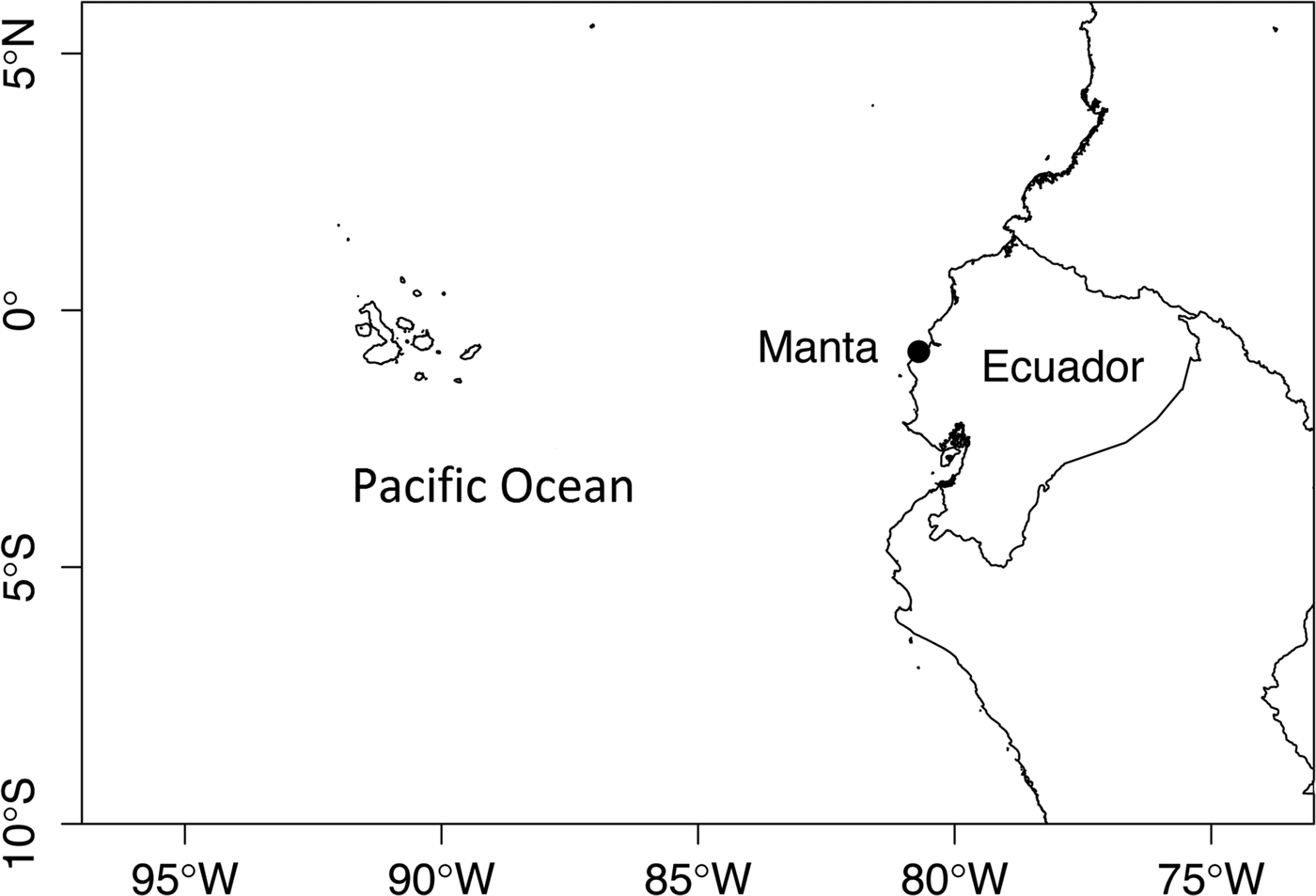
Six specimens were collected during August and October 2013 and January 2014 in the fishing camp ‘Playita mía’ in Manta city (0°57′S 80°42′W) (Figure 1). This area presents a shallow and sandy bottom where the artisanal fishermen use beach seine nets of 330–365 m in length and 4–5 m in height, with a mesh size of 3″, which is deployed from a boat and towed by fishermen from the beach. After being captured, the specimens were fixed in 10% formalin and later preserved in 70% alcohol. The identification was made using guides and descriptions provided by de Carvalho (Reference de Carvalho2001) and Navia & Caldas (Reference Navia, Caldas, Mejía-Falla, Navia and Puentes2011). According to the guidelines set out by de Carvalho (Reference de Carvalho2001) and Rubio et al. (Reference Rubio, Pedraza and Zapata2005), several morphometric measurements were taken for each individual and the maturity stage was determined based on the criteria proposed by Payán et al. (Reference Payán, Mejía-Falla and Navia2011). The specimens were stored in the Laboratory of Marine Resources at the ‘Universidad Laica Eloy Alfaro de Manabí (ULEAM)’ in Manta, Manabí, Ecuador, with the following catalogue numbers: LRMNL001; LRMNL002; LRMNL003; LRMNL004; LRMNL005; LRMNL006.
Capture site of Narcine leoparda in Ecuadorian waters.

RESULTS
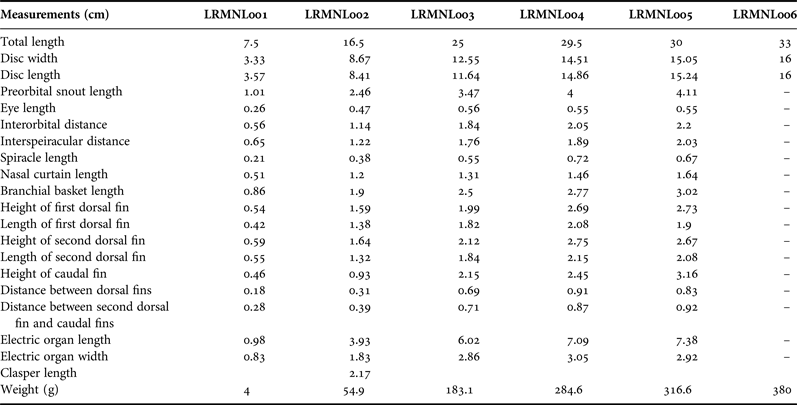
Narcine leoparda presents a unique dorsal colour pattern; a brown background and numerous white spots in small individuals, while in larger animals, the spots change to ocelli with a brown centre. The ventral part of the body is white. The smallest individual measured 7.5 cm in total length (TL) and the largest was a pregnant female of 33 cm TL (Table 1), for which it was not possible to take all of the morphometric measurements.
Morphometric measurements of individuals of Narcine leoparda.
The smallest female (7.5 cm TL) presented a creamy white colour in its ventral part and dark edges in its pectoral and pelvic fins (Figure 2A). Only one immature male was recorded and measured 16.5 cm TL (Figure 2B). The three mature females recorded have the same dorsal colour pattern with a great number of white ocelli (Figure 2C–E). In the pregnant female, both uteri were functional, containing a total of 12 embryos (two females and ten males) measuring between 6.2 and 6.8 cm TL; their sex was identified and they had consumed almost all of the yolk.
Colour patterns of the Narcine leoparda specimens, labelled (A)–(E).
DISCUSSION
According to Payán et al. (Reference Payán, Mejía-Falla and Navia2011) Narcine leoparda is distributed in the central and southern Colombian Pacific Ocean. The present report extends its known geographical distributions southwards in the Pacific Ocean. In Colombian waters, the specimens were captured at depths of up to 35 m, but the highest concentration was found in estuarine waters of up to 10 m (de Carvalho, Reference de Carvalho2001; Payán et al., Reference Payán, Mejía-Falla and Navia2011). This description is similar to the results found in the coastal waters of Manta where the fishermen captured this species at depths between 10 and 15 m.
The colour pattern changed accordingly with an increase in the size of the individuals. Thus, our observations are consistent with that described by de Carvalho (Reference de Carvalho2001). Moreover, the length interval found in Ecuadorian waters is similar to that reported by Payán et al. (Reference Payán, Mejía-Falla and Navia2011) off the Colombian coast, observing free living individuals at small sizes (7.5 and 8.6 cm TL, respectively).
The sexual maturity characteristics are also similar to that found by the authors mentioned above, however, in the single pregnant female that we reported (33 cm TL), the fecundity was significantly higher than that recorded in Colombian waters (six embryos in a 26 cm TL female).
The results of this report are crucial, as they enhance our knowledge of the distribution, abundance and biology of Narcine leoparda in the Pacific Ocean. More research needs to be conducted in this area in order to assess their conservation status.
ACKNOWLEDGEMENTS
We are grateful to the fishermen in ‘Playita Mía’ for their collaboration and for allowing us to collect the individuals. We thank the students of the Laboratory of Marine Resources and Laura Cervera for editing the English version of this manuscript. We thank ‘Universidad Laica Eloy Alfaro de Manabí’ for the financial support of the project ‘Biología Reproductiva de Elasmobranquios en el Pacífico Ecuatoriano’.