Introduction
While the structure of Antarctic food webs is relatively well described, many essential interactions remain unknown as basic information on either autecology or synecology of many of the phototrophic organisms from Antarctic seas is missing (Fiala & Oriol Reference Fiala and Oriol1990, Al-Handal & Wulff Reference Al-Handal and Wulff2008a). Up to 75% of the Southern Ocean primary production is contributed by diatoms (Mohan et al. Reference Mohan, Quarshi, Meloth and Sudhakar2011). These unicellular microalgae play an essential role in carbon and silicon oceanic cycles, controlling the uptake of atmospheric CO2 and being a basic element of the so-called silicate pump. The downward flux of silicified diatom cells is a major mechanism of transfer of upper water column elements incorporated into microalgal bodies (C, Si, Ra, Ba, Ge etc; Bargagli Reference Bargagli2004 and references therein). Studies on Antarctic diatoms from the southern Ross Sea led by Di Tullio et al. (Reference Di Tullio, Garrison and Mathot1998) indicated that diatoms may also be responsible for oceanic emission of DMS (dimethylosulphide) and the largest biogenic flux of sulfur to the atmosphere. It is therefore imperative for the sake of the future of Antarctic marine ecosystems to thoroughly investigate and well understand the ecology, taxonomy and biogeography of these microalgae.
Diatoms are reported to be excellent ecological indicators. They have been used for palaeoenvironmental reconstructions as well as for assessment of recent water bodies’ ecological status (Spaulding & McKnight 1999, Mohan et al. Reference Mohan, Quarshi, Meloth and Sudhakar2011). In the light of rapid climate change and global warming, Antarctic research has never been more important than it is today and there has been an increasing interest in Antarctic diatoms. While ecological preferences of some common diatom species from lower latitudes are relatively well known, the present state of our knowledge of the autecology of modern Antarctic diatom taxa disables us from using the diatom communities to interpret recent changes or foresee possible anomalies in the Antarctic marine ecosystem (Sabbe et al. Reference Sabbe, Verleyen, Hodgson, Vanhoutte and Vyverman2003, Karsten et al. Reference Karsten, Schumann, Rothe, Jung and Medlin2006). Although microalgae (including diatoms) have been long collected from the Southern Ocean (e.g. Van Heurck Reference Van Heurck1909, Peragallo Reference Peragallo1921, Hustedt Reference Hustedt1958, Bargagli Reference Bargagli2004 and references therein), many habitats and geographical areas have been at best poorly explored (Webster et al. Reference Webster, Negri, Munro and Battershill2004). Moreover, most studies on Antarctic marine diatoms have dealt with planktonic, ice-associated or benthic species found in the sediment cores. Little is known about the epiphytic communities regarding either their ecology or taxonomy, or species relative abundance (Thomas & Jiang Reference Thomas and Jiang1986, Al-Handal & Wulff Reference Al-Handal and Wulff2008a), although existing reports indicate that these microalgae may be the most important primary producers at certain times of the year (Dayton et al. Reference Dayton, Watson, Palmisano, Barry, Oliver and Rivera1986, Gilbert Reference Gilbert1991 and references therein, Ahn et al. Reference Ahn, Chung, Kang and Kang1997, Karsten et al. Reference Karsten, Schumann, Rothe, Jung and Medlin2006).
In this paper, we report data on epiphytic diatom communities on different macroalgal species collected from Terra Nova Bay (Ross Sea) during the eight Italian Antarctic campaigns spanning form 1990–2004. Emphasis was placed on understanding the potential effect of the host macroalga on the epiphytic diatom community composition and structure. This study is a complement to previous investigation focused on a structural analysis of diatom growth form distribution in the same area (Majewska et al. Reference Majewska, Gambi, Totti, Pennesi and De Stefano2012b).
Materials and methods
Study area
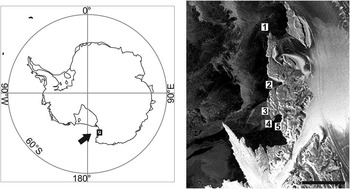
The study area is situated in Terra Nova Bay (74°42′S, 164°46′E), between the Campbell Glacier Tongue and Drygalski Ice Tongue, along northern Victoria Land (Fig. 1). It encompasses the coastal waters between Tethys Bay and Cape Russell, including the waters adjacent to the Italian Mario Zucchelli Station. The shoreline is formed mainly by rocky cliffs, with occasional tracts of gently sloping cost scattered with large boulders (e.g. Adélie Cove). Tides range from 1.5–2 m and sea surface is covered by 2–2.5 m thick pack ice for 9–10 months each year (Stocchino & Lusetti Reference Stocchino and Lusetti1990). Most of the sea floor of the area is composed of granitic rocks, with a variable admixture of gravels, coarse sands and muddy sediments (especially in the vicinity of Adélie Cove). Benthic algae exhibit a characteristic pattern of zonation: epilithic cyanobacteria and diatoms colonize the supralittoral hard substrates, green algae Urospora penicilliformis (Roth) Areschoug and Prasiola crispa (Lightf.) Kütz. dominate sheltered areas of the intertidal zone (1.5–2.0 m wide) (Cormaci et al. Reference Cormaci, Furnari and Scammacca1992), while red algae form expanded mats below a depth of 2–3 m. Amongst them, Iridaea cordata (Turner) Bory fully colonizes bottom to a depth of 10–12 m, receding rapidly below this level and yielding to Phyllophora antarctica Gepp & Gepp (Gambi et al. Reference Gambi, Lorenti, Russo and Scipione1994), often densely covered by sessile organisms such as hydroids, serpulids and bryozoans (Celleporella antarctica Moyano & Gordon and Harpecia spinosissima (Calvet)) (Rosso & Sanfilippo Reference Rosso and Sanfilippo2000). Smaller and more delicate Plocamium cartilagineum (L.) Dixon seems to be less frequent and have a distribution range overlapping those of the two previously mentioned red macroalgal species. An Adélie penguin rookery (Pygoscelis adeliae (Hombron & Jacquinot)) located at Adélie Cove is proven to affect the adjacent marine environment during breeding period by leaving a huge amount of faeces which naturally fertilize shallow coastal waters (Povero et al. Reference Povero, Chiantore, Misic, Budillon and Cattaneo-Vietti2001). Documented human impact within the area is described as “minimal”, although extensive marine research of Terra Nova Bay has been carried out since 1986/87 (Bargagli Reference Bargagli2004).
Study area and sampling sites location: 1 = Cape Russell, 2 = Adélie Cove, 3 = Faraglione, 4 = Molo, 5 = Tethys Bay. Scale bar: 10 km.

Collection and preparation of samples
Samples of macroalgae were collected during Italian Antarctic campaigns in the summers of 1990–2004 (1989/90, 1993/94, 1994/95, 1997/98, 1999/00, 2000/01, 2002/03 and 2003/04). For the purpose of the study, five locations were selected as sampling sites, each characterized by different coastal features. All sites are typically accessible in summer, as the part of the bay remains ice-free at a certain time of the year, which is rare in this part of Antarctica (Gambi et al. Reference Gambi, Lorenti, Russo and Scipione1994, Reference Gambi, Buia, Mazzella, Lorenti and Scipione2000). Thalli of three macroalgal species (Iridaea cordata, Phyllophora antarctica and Plocamium cartilagineum) from various depths (from 0.5–17 m) were collected by SCUBA divers (on fixed 40 x 40 cm quadrats) and immediately preserved with 4% formaldehyde solution in seawater. Relatively small molecules of formaldehyde penetrate deep into diatom adhesive mucilaginous substances and fix well all the elements of complex attachment mechanism, including the simple layer of mucilage interposed between the microalgae and its substrate and morphologically distinct structures (pads, envelopes, stalks, tubes etc.), as well as internal organic components of the diatom cell envelope, making the cells permanently attached to the surface. Once preserved, a diatom cell remains in its original position on the host tissue for years.
For the quantitative study of attached diatoms, macroalgal thalli were cut into small pieces (c. 1 cm2), dehydrated by immersion in alcohol solution at increasing gradation, and processed in a critical point drier with four cycles of solvent extraction. After these treatments, macroalgal pieces were mounted on specimen stubs and sputter coated with gold. Three replicates were prepared for each sample. Parallel samples for taxonomic and diagnostic purposes were treated with concentrated nitric and sulfuric acids (in the ratio of 1:3), rinsed thoroughly with several sets of distillate water and subsequently centrifuged. Obtained sediment was placed on stubs, dried, and coated. Observations were carried out with JEOL JSM 60/60 LW and SUPRA 40 (Zeiss) scanning electron microscopes. Diatoms originally settled on the host macroalgae were identified to the lowest taxonomic level possible (species/genus) and counted at a magnification of at least 400 x on the surface of at least 1 mm2 of each replicate.
Statistics
All analyses were performed using the PRIMER v6 computer program (Clarke & Gorley Reference Clarke and Gorley2006), including the add-on package PERMANOVA+ (Anderson et al. Reference Anderson, Gorley and Clarke2008). Analysis of similarities (ANOSIM) was applied to test for significant differences between the groups of samples due to algal host, sampling site, depth, year, and month of collection, and non-metric multidimensional scaling (nMDS) plots were used to exhibit patterns found. The matrix used for the nMDS was calculated with a Bray-Curtis similarity index based on species abundance (number of cells per mm2) data. To identify diatom species responsible for the similarity within groups, similarity percentage analysis (SIMPER) was performed. The average contribution of each diatom taxa was compared to the average Bray-Curtis similarity within samples of a cluster. Commonly used community quality indicators such as the Margalef's species-richness d (d = (S - 1)/(logeN), where S = number of species, N = number of individuals) and Shannon-Wiener diversity indices H’ (loge) were calculated for each of the samples.
Results
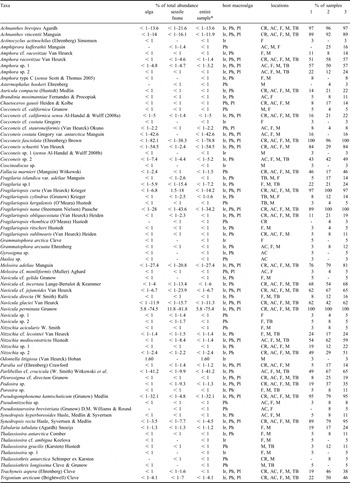
Seventy-three diatom taxa belonging to 32 genera were distinguished during this study, but more than 87% of the total number of microalgal cells counted was contributed to by only the 20 most abundant taxa (11 genera) in every sample analysed (Table I). Some of the diatom specimens found present problems in their taxonomic identification (in particular forms belonging to Navicula and Nitzschia genera). In these cases, the dubious taxa are indicated by a “cf.” or designated as “sp. 1” and “sp. 2” (if the specimen could not be matched with any described taxon), still each name stands for a single separate species. A more detailed taxonomic analysis of the material is in progress.
List of taxa present in the studied samples, percentage of total abundance, percentage of samples in which taxa occurred, and sites where they were present.

Ir = Iridaea cordata, Ph = Phyllophora antarctica, Pl = Plocamium cartilagineum.
CR = Cape Russell, AC = Adélie Cove, F = Faraglione, M = Molo, TB = Tethys Bay.
1 = samples of epiphytic diatom communities, 2 = samples of epizooic communities, 3 = entire samples (including epiphytic and epizooic communities found within a sample).
*entire diatom community found within a sample (including epiphytic and epizooic communities).
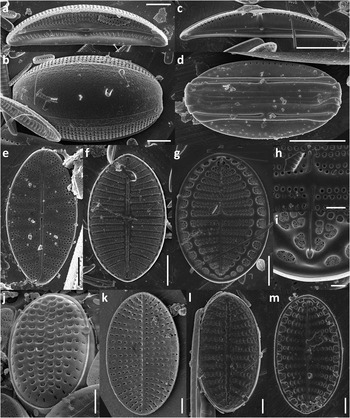
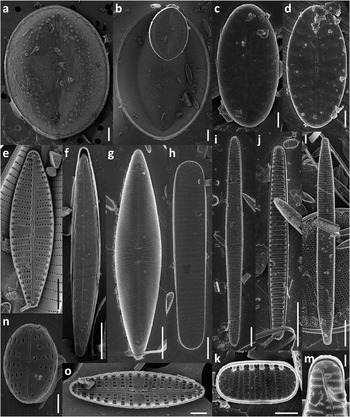
Amongst the recorded diatoms, three species exceeded 50% of the total count: Cocconeis schuettii (one sample), C. fasciolata (six samples), and Navicula perminuta (11 samples) (Figs 2 & 3). Another five species (Cocconeis costata var. antarctica, Fragilariopsis nana, Melosira adeliae, Parlibellus cf. crucicula, and Pseudogomphonema kamtschaticum) counted for over 25% (in at least one sample), while the most numerous group (43 taxa) were taxa that did not exceed 1% relative abundance in any of the examined samples. Ten taxa were noted relatively frequently (50–90% of samples), and another seven taxa were present in more than 90% of samples, including Cocconeis fasciolata, Fragilariopsis nana, and Navicula perminuta that appeared in every case studied. Fifty taxa were noted in less than 25% of samples. Twenty-four taxa were found associated with all three host macroalgal species, and 22 were noted at all five sampling sites (Table I).
Epiphytic diatoms from Terra Nova Bay, Antarctica (scanning electron microscopy). a. & b.Amphora racovitzae, a. internal valve view, and b. cell in dorsal view. c. & d.Amphora sp. 1, c. internal valve view, and d. view of ventral surface. e.Achnanthes vincentii, external surface of raphe-valve. f.–i.Cocconeis fasciolata, f. rapheless-valve (pseudoraphe-valve), external view, g. raphe-valve, internal view, h. detail of central raphe endings and central area (internal view), and i. internal view of terminal raphe ending. j. & k.Cocconeis cf. californica sensu Al-Handal & Wulff (Reference Al-Handal and Wulff2008a), j. raphless-valve, external view, and k. raphless-valve, internal view. l. & m.Cocconeis cf. stauroneiformis, l. rapheless-valve, external view, and m. raphe-valve, internal view. Scale bars: a.–d.=5 μm; e., h. & j.–m.=2 μm; f. & g.=10 μm; i.=1μm.

Epiphytic diatoms from Terra Nova Bay, Antarctica (scanning electron microscopy) a. External view of Cocconeis schuettii pseudoraphe-valve. b. Internal view of Cocconeis schuettii and C. fasciolata raphe-valves. c. & d.Cocconeis sp. 2, c. external view of rapheless-valve, and d. external view of raphe-valve. e. Internal view of Navicula glaciei valve. f. External view of Navicula cf. jejunoides valve. g.Parlibellus cf. crucicula, external view. h.Fragilariopsis curta, external view. i.Fragilariopsis obliquecostata, internal view. j.Fragilariopsis sublinearis, internal view. k.Fragilariopsis nana, internal view. l. & m.Brandinia mosimanniae, l. internal valve view, and m. internal view of apex with labiate process. n. & o.Navicula perminuta, n. external valve view, and o. internal valve view. Scale bars: a., b., g., i., j. & l. = 10 μm; c., d., k. & m.–o. = 1 μm; e., f. & h. = 5 μm.

As more than a half of the samples (especially Phyllophora antarctica blades) were densely covered by epiphytic sessile fauna (e.g. calcareous bryozoans and hydroids), and the occurrence of this animal component seemed to strongly influence the diatom community composition and structure, we decided to distinguish between diatom community developed directly on the macroalgal thalli, and epizooic microalgae associated with the animal surface.
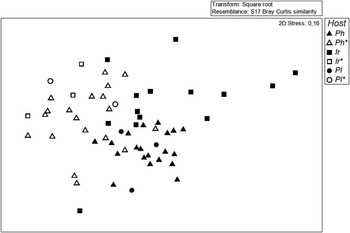
The nMDS performed on species abundance data visualized overlapping groups of samples of diatoms recorded on different hosts, however, the general pattern was visible (Fig. 4). Epizooic samples tended to be placed towards one side of the plot and closer to each other than epiphytic ones, which suggested higher floristic heterogeneity of the latter. The ANOSIM test of substrate (host organism) factor on epibiotic diatom community composition indicated statistically significant differences between host organisms (global R = 0.484, P = 0.001). Differences between depths, locations and seasons of sampling were less important (global R < 0.2, P > 0.05), explaining little of the variations.
Non-metric multidimensional scaling (nMDS) graph based on the species abundance data. Ph = samples of epiphytic diatom communities associated with Phyllophora, Ph* = samples of epizooic diatom communities associated with sessile fauna found on Phyllophora, Ir = samples of epiphytic diatom communities associated with Iridaea, Ir* = samples of epizooic diatom communities associated with sessile fauna found on Iridaea, Pl = samples of epiphytic diatom communities associated with Plocamium, Pl* = samples of epizooic diatom communities associated with sessile fauna found on Plocamium.

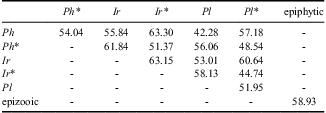
Comparing the communities, the highest extent of the average dissimilarity occurred between those found on the surface of Phyllophora antarctica thalli and the sessile fauna epiphytic on Iridaea cordata (63.3%), while the most similar were diatom communities associated with P. antarctica and Plocamium cartilagineum (42.3%). In general, epizooic communities differed clearly from epiphytic ones. Higher level of similarity was revealed between the communities associated with P. antarctica and P. cartilagineum than between those found on I. cordata and other macroalgal species (Table II).
Average dissimilarity (%) between diatom communities associated with the investigated hosts organisms.
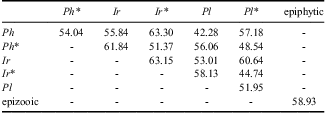
Ph = samples of epiphytic diatom communities associated with Phyllophora, Ph* = samples of epizooic diatom communities associated with sessile fauna found on Phyllophora, Ir = samples of epiphytic diatom communities associated with Iridaea, Ir* = samples of epizooic diatom communities associated with sessile fauna found on Iridaea, Pl = samples of epiphytic diatom communities associated with Plocamium, Pl* = samples of epizooic diatom communities associated with sessile fauna found on Plocamium.
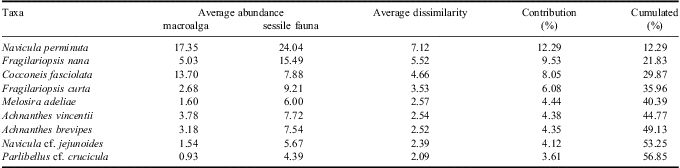
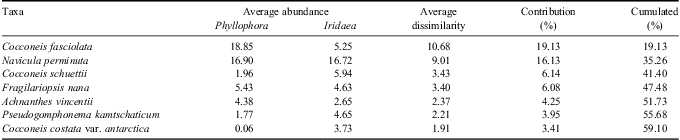
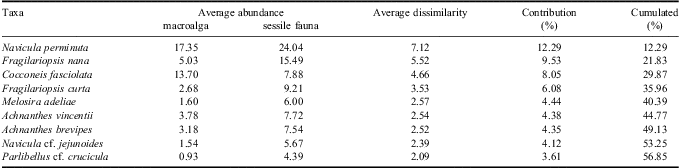
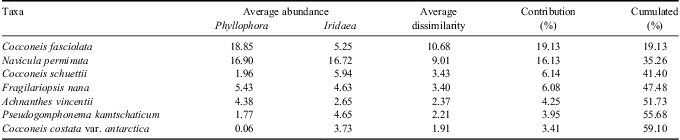
Navicula perminuta appeared in abundance in epizooic as well as epiphytic communities, but was more numerous on the animal surface, where they dominated together with Fragilariopsis nana, and Fragilariopsis curta. In epiphytic communities Fragilariopsis species were less important and a greater contribution of large-sized Cocconeis valves (C. fasciolata and C. schuettii) was noted. According to the SIMPER analysis, the above-mentioned taxa together with Melosira adeliae, Achnanthes vincentii, Achnanthes brevipes, Navicula cf. jejunoides and Parlibellus cf. crucicula were responsible for more than 60% of the dissimilarity between the epibiotic communities (Table III; for more details see Table S1, which will be found at http://dx.doi.org/10.1017/S0954102012001101). In the case of epiphytic complexes, Navicula perminuta, Cocconeis fasciolata, C. schuettii, and C. costata var. antarctica brought about 45% of total input into the average dissimilarity between the communities associated with different macroalgal species. Analyses of the diatom community species composition suggested that the main differences observed between the analysed communities were not caused by presence or absence of some taxa, but rather by the differential dominance of common species changing somewhat with the host organism and substrate type, and thus determining the general structural features of each complex. Based on the obtained results, a general trend could be seen, as average relative abundance of C. fasciolata was markedly higher in samples of Phyllophora and Plocamium than in those of Iridaea, while C. schuettii presented the opposite pattern (Tables IV–VI; for more details see Tables S2–S4, which will be found at http://dx.doi.org/10.1017/S0954102012001101).
Average abundance of diatoms associated with macroalgae and sessile fauna surfaces, and their contribution to the dissimilarity found between the groups.
Average abundance of diatoms associated with Phyllophora and Iridaea thalli, and their contribution to the dissimilarity found between the groups.
Average abundance of diatoms associated with Phyllophora and Plocamium thalli, and their contribution to the dissimilarity found between the groups.

Average abundance of diatoms associated with Iridaea and Plocamium thalli, and their contribution to the dissimilarity found between the groups.

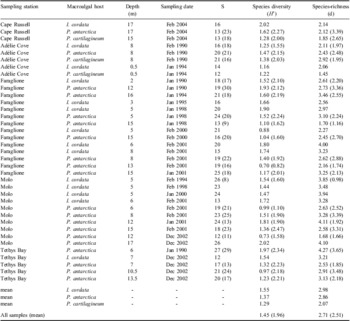
Table VII presents values of species-richness (d) and Shannon-Wiener diversity (H’) indices of the examined microalgal communities. From 12–27 diatom taxa were found in each macroalgal sample (excluding those composing the epizooic community on the sessile fauna). Samples of Iridaea tended to have slightly greater species-richness (ranging from 2.06–4, mean value 2.98) as well as diversity (0.88–2.02, mean value 1.55) in comparison with Phyllophora (1.68–4.27 (mean value 2.86) and 0.7–2.02 (mean value 1.37), for the species-richness and diversity indices, respectively) and Plocamium (1.45–2.92 (mean value 2.07), and 1.22–1.38 (mean value 1.29)) samples. The difference between epiphytic and epizooic communities was more distinct. Although number of recorded epizooic species varied greatly between samples (9–30), thus controlling substantially the species-richness value that changed in an analogous manner, the diversity index values were higher (often significantly) for communities associated with the animal substrate (ranging from 0.82–2.47, mean value 1.96), compared with those associated with the host macroalgal thalli (mean value 1.45), in every analysed case.
Values of the Shannon-Wiener diversity index (H’) and Margalef's species-richness (d) calculated for each of the epiphytic and epizooic (values in brackets) samples. For sampling site locations see Fig. 1.

Discussion
The total number of taxa recorded (73) on the three red macroalgal species studied, was higher than that reported from Potter Cove, King George Island (62°14′S, 58°41′W) by Al-Handal & Wulff (Reference Al-Handal and Wulff2008a). These authors examined diatoms associated with 19 macroalgal species recording 50 diatom taxa. This is somewhat in discordance with the previously reported trend for the Antarctic ecosystems diversity where the species number decreases moving southward. However, the phenomenon of lower biodiversity at higher latitudes has been described and formulated rather in the context of Antarctic inland waters and attributed mostly to the harsh conditions and geographic isolation (Sabbe et al. Reference Sabbe, Verleyen, Hodgson, Vanhoutte and Vyverman2003), while Antarctic seas, especially in the vicinity of research stations, are isolated to a considerably lesser degree (Bargagli Reference Bargagli2004). In addition, the previously mentioned authors collected their material during three months in a single year, which is a much shorter sampling period than that considered in our study. The number of macroalgal host species examined by them, on the other hand, was much higher, so it is difficult to judge to what extent these two sets of data are comparable. The fact that more than a half of the diatom taxa (including all the species belonging to Arachnoidiscus, Entopyla, Isthmia, Licmophora, Lyrella, Petroneis, Pinnularia, Planothidium, Rhabdonema, and Rhoicosphenia genera) recorded at Potter Cove did not occur in the material collected from Terra Nova Bay may suggest that a substantial fraction of epiphytic diatoms from the Southern Ocean do not have a circum-Antarctic distribution. Considering the high number of rare species (< 1% of total abundance) found during our studies (43), we suspect that many other species, less common and abundant, might have been overlooked. Still, this might be the case also for the Potter Cove's samples, as the “very rare” and “rare” (up to ten frustules noted) taxa clearly prevailed (Al-Handal & Wulff Reference Al-Handal and Wulff2008a).
In the present study, individuals of the 20 most abundant diatom taxa contributed between 87% and 100% of the total count, which might be indicative of potentially relatively high homogeneity of epiphytic communities. Amongst them, Cocconeis schuettii, C. fasciolata, and Navicula perminuta exceeded 50% of total relative abundance. The two last mentioned species, as well as Fragilariopsis nana, were the most common, appearing in every sample. Cocconeis fasciolata as well as Cocconeis schuettii, are both well known from Antarctic waters (Scott & Thomas Reference Scott and Thomas2005 and references therein). Al-Handal & Wulff (Reference Al-Handal and Wulff2008a) also reported that C. fasciolata was one of the most common epiphytic diatom taxa found, although it appeared only on four rhodophyte species, while C. schuettii was “rare or frequent” on most rhodophytes and on three species of phaeophytes. Sutherland (Reference Sutherland2008) found C. fasciolata to be the dominant species on Phyllophora antarctica collected under the ice at Cape Evans (McMurdo Sound, Ross Sea) at 10–15 m depth.
A small naviculoid species, preliminarily named Navicula cf. perminuta, was reported by Al-Handal & Wulff (Reference Al-Handal and Wulff2008b) to be one of the most common benthic diatom taxa found at Potter Cove (King George Island). As specimens of this taxon exhibited a wide range of valve shape and seemed to not perfectly correspond to the lectotype material, the question has been raised whether the identity of this small species had been established correctly. Most probably, the same taxon was the most frequent one in the ecological studies on grazing and ultraviolet (UV) radiation effects performed on Antarctic intertidal microalgal assemblages by Zacher et al. (Reference Zacher, Hanelt, Wiencke and Wulff2007). The authors related N. perminuta prevalence to its rapid adaptation and recovery from UV-B induced stress reported previously by Waring et al. (Reference Waring, Underwood and Baker2006). Also McLachlan et al. (Reference McLachlan, Brownlee, Taylor, Geider and Underwood2009) found a strong light-induced response of this diatom and indicated phototaxis of Navicula perminuta as an important adaptation to living in benthic environments. Specimens observed in our samples exhibited even wider range of valve length (< 5 μm to > 18 μm) than that reported by Al-Handal & Wulff (Reference Al-Handal and Wulff2008b). Navicula perminuta is often described as a cosmopolitan, brackish/marine, mezotraphentic, mezo- to polisaprobous species with salinity optimum estimated at 10–30‰ (Underwood & Provot Reference Underwood and Provot2000, Majewska et al. Reference Majewska, Zgrundo, Lemke and De Stefano2012a and references therein). It seems that its morphology changes with stress treatments (e.g. changing temperature or salinity, R. Majewska, personal observation). Therefore, it remains unclear whether Antarctic and European specimens are two distinct species. A careful morphological analysis of this taxon, including the comparison of material collected from different geographical regions and thorough revision of previous publications, is in progress.
Fragilariopsis nana was another common and abundant specious species found during this study. This taxon was listed by Kawamura & Ichikawa (Reference Kawamura and Ichikawa1984) as occurring in the subsurface waters of the Indian sector of the Southern Ocean. It was pointed out, however, that due to the difficulties in distinction between Fragilariopsis cylindrus and Fragilariopsis pseudonana Hasle under the light microscope, these two species were combined and expressed as “Fragilariopsis ‘nana’”. The term was used again by Kang et al. (Reference Kang, Kang, Lee, Chung, Kim and Park2001), who included under the name “Fragilariopsis ‘nana’” all Fragilariopsis specimens with valve length < 20 μm. While Scott & Thomas (Reference Scott and Thomas2005) stated that “Fragilariopsis nana is now separated into two taxa”: the linear-valved Fragilariopsis nana, that is a synonym of Fragilariopsis cylindrus, and the elliptical-lanceolate-valved Fragilariopsis pseudonana, Cefarelli et al. (Reference Cefarelli, Ferrario, Almandoz, Atencio, Akselman and Vernet2010) demonstrated that F. cylindrus and F. nana are in fact two different taxonomic entities. Although the morphological and molecular studies of Lundholm & Hasle (Reference Lundholm and Hasle2008) supported the latter thesis, many authors seem to maintain the concept presented by Scott & Thomas (Reference Scott and Thomas2005) (Leanne Armand & Amy Leventer, personal communication 2011). Subsequently, we decided to distinguish between F. cylindrus and F. nana, as the great majority of isopolar, linear-valved Fragilariopsis cells found in the studied material were characterized by valve length of 2.5–10 μm and valve width < 2.4 μm. Cells longer than 15 μm (identified as F. cylindrus) were rare. Moreover, intermediate transitional forms with valve length > 10 μm and < 15 μm were not observed.
The ANOSIM test indicated a clear relationship between the epiphytic diatom community structure and the host organism type, while the nMDS analysis provided a visual representation of the observed similarities/dissimilarities between samples. Although stress function value of the nMDS model (0.16) higher than 0.15 may indicate that some distances in the two-dimensional map are distorted (Kruskal & Wish Reference Kruskal and Wish1978), analysis allowed organization of data in a useful manner and the “first-glance” conclusions could be drawn. A marked difference between the communities associated with various host macroalgae was evident. In addition, the epiphytic communities differed significantly from epizooic ones. This observation is also confirmed by the fact that the estimated diversity index was always higher for the latter. A similar trend was not observed for species-richness. Here, however, a difference in the surface of examined substrate must be taken into account, as we did not search for sessile fauna, but randomly examined the thallus portion. Thus, the studied surface of the faunistic component observed in certain samples was often lower than the viewed surface of the host macroalgae (3 mm2). Smaller examined-surface most probably negatively influenced the number of diatom taxa found, which, in turn, led to the lower species-richness. As the diversity index does not directly depend on the species number, in this case mentioned discrepancy was negligible. Higher values of diversity index correspond to more even distribution of diatom taxa, which might possibly be due to the higher number of niches provided by sessile fauna with its numerous external surface protuberances (Huston Reference Huston1979). This effect has already been noticed and more fully discussed in a previous work (Majewska et al. Reference Majewska, Gambi, Totti, Pennesi and De Stefano2012b).
Interestingly, contrary to previous studies focused on epiphytic diatom growth forms, the host macroalgal species appeared to be a major factor influencing epiphytic diatom community structure. Depth, site, as well as time of sampling (year and month) seemed to be of secondary importance. Although we cannot exclude that due to the high number of factors that differentiated the examined samples, some relations might have been blurred.
Previously reported growth form analysis showed no overall distinction between communities associated with different macroalgal species (Majewska et al. Reference Majewska, Gambi, Totti, Pennesi and De Stefano2012b), largely because most of the differences occurred between diatom species with the same growth form. This tendency was most pronounced for the samples of Iridaea and Phyllophora: while the latter was densely covered by Cocconeis fasciolata, and a few valves of C. schuettii were usually noted, the opposite pattern was found on Iridaea blades. Considering a significant difference in size of the observed specimens belonging to two Cocconeis species (Figs 2 & 3), we suppose that the relation could be even better expressed by biomass than by abundance. Rather homogenous surface of macroalgal thalli, providing more uniform microenvironment for associated microalgae, favours competitive exclusion of species sharing similar niches. Thus, observed preferences for a specific host macroalga might be an example of adaptation enhancing competitiveness (Huston Reference Huston1979 and references therein, Martin Reference Martin1998).
With this study, we hope to contribute to knowledge regarding ecology and biogeography of Antarctic marine diatoms. As the discourse centring on Antarctic diatom species endemism/cosmopolitanism is still very much alive (e.g. Vanormelingen et al. Reference Vanormelingen, Verleyen and Vyverman2008), we are fully aware of the profound influence of taxonomic practice on the various theories and perception of not only single taxon distribution patterns but also whole ecosystem structure and functioning. Trivial taxonomic errors, often overlooked and underestimated, create misleading hypotheses and ideas affecting our knowledge within the field of all environmental sciences (Saabe et al. 2003, Bortolus Reference Bortolus2008). Although modern microscopic techniques (including scanning electron microscopy) provide detailed information on the diatom frustule structure and allow for its more accurate interpretation, recently obtained results are usually not comparable to those reported in old publications (e.g. Mangin Reference Mangin1915, Hustedt Reference Hustedt1958). In many cases, the paucity of relevant information in the original descriptions and a lack of adequate illustrations makes identification based on these materials a doubtful procedure (Al-Handal & Wulff Reference Al-Handal and Wulff2008a, Reference Al-Handal and Wulff2008b, Vanormelingen et al. Reference Vanormelingen, Verleyen and Vyverman2008). Therefore, emerging need for supplementation of missing data must be highlighted.
Most of the species listed here have already been found in Antarctica, although not necessarily in the Ross Sea (e.g. Scott & Thomas Reference Scott and Thomas2005, Al-Handal & Wulff Reference Al-Handal and Wulff2008a, Reference Al-Handal and Wulff2008b), and not necessarily as epiphytes. Nevertheless, some of them are probably new records. Relatively high number of uncertain or unidentified species indicates the need for further taxonomic studies. Some of the specimens we have tentatively identified as Cocconeis cf. californica and Cocconeis cf. costata presented a very wide range of morphological variability and new species or varieties can be possibly erected from this complex. Moreover, the gradual decrease in cell size and significant differences in valve dimensions within each taxon related to the diatom life cycle, led often to the prominent changes in valve morphology (e.g. Achnanthes brevipes, Pseudogomphonema kamtschaticum). Forms exhibiting only a few morphological characters useful for identification (e.g. small fragilarioid diatoms, Nitzschia genus), were another challenging group. Taking into consideration the “notoriously messy” diatom taxonomy (after Vanormelingen et al. Reference Vanormelingen, Verleyen and Vyverman2008), as well as a general scarcity of explicit references, it was tempting to indicate most of the diatom forms found as “dubious”. We believe that further investigation that is currently being undertaken, will provide reliable information and throw more light on the aforementioned taxonomic problems.
Acknowledgements
We acknowledge financial support from the Second University of Naples and from the Italian National Program of Research in Antarctica (PNRA) co-ordinated by the Italian National Research Council (CNR). We thank our colleagues who contributed to the collection of macroalgae from Terra Nova Bay during the summers considered in this study: M.C. Buia (collection in 1995), M. Nigro and F. Regoli (1997/98, 1999/2000), G. Micaletto (2000/01), S. Piraino (2001/02), and F.P. Patti (2004). The constructive comments of the reviewers are also gratefully acknowledged. This work is dedicated to the memory of Lucia Mazzella (1947–1999), who collected the samples in the summer of 1993/94, and contributed initially to the study of benthic diatoms from Terra Nova Bay.
Supplemental material
Four supplemental tables will be found at http://dx.doi.org/10.1017/S0954102012001101.