Antimicrobial resistance (AMR) has continued to be a global concern since the World Health Assembly endorsed the Global Action Plan on Antimicrobial Resistance in 2015. In 2016, the Japanese government released its strategy in addressing antimicrobial resistance, called the “National Action Plan on AMR (2016–2020)”. 1 This plan aimed to reduce both the proportion of antimicrobial-resistant organisms and the volume of antimicrobial use.
Interventions aimed at outpatient clinic healthcare providers are crucial for reducing overall antimicrobial usage; oral antimicrobials account for >90% of antimicrobials prescribed over the past decade in Japan. Reference Muraki, Yagi and Tsuji2,3 However, the most effective interventions or combinations that persistently reduce the number of antimicrobial use in the outpatient setting remain unclear. Similar to that in the United States and European countries, most antimicrobials prescribed for acute respiratory tract infection (ARTI) and acute gastroenteritis were deemed unnecessary. Reference Jindai, Kusama, Gu, Honda and Ohmagari4,Reference Fleming-Dutra, Hersh and Shapiro5 In addition, young patients, particularly those aged ≤15 years, are prescribed more antimicrobials than are adults, 3 and this finding hightlights the need for age-specific interventions to improve the prescription of antimicrobials across each age group. The Japanese government has established a range of antimicrobial stewardship interventions for healthcare providers in outpatient settings where oral antimicrobials are often prescribed.
One such intervention, introduced in April 2018, was the financial incentive that enabled providers to claim additional fees when they conducted both education and shared decision making with the parents of children aged ≤2 years for uncomplicated ARTIs and acute diarrhea. 6 This intervention was followed by an educational intervention for providers through the publication of guidance about antimicrobial prescribing that also promoted judicious outpatient use of antimicrobials in outpatients aged ≥6 years. 7 Several countries have adopted financial incentives provided directly to providers or indirectly to community centers geared toward reducing antimicrobial use in outpatient settings, Reference Balinskaite, Johnson, Holmes and Aylin8,Reference Ellegård, Dietrichson and Anell9 although a paucity of data exist regarding how financial incentives aimed at promoting patient education and shared decision making could affect overall antimicrobial prescription.
In this study, we examined the relationship between financial incentives and oral antimicrobial prescription rates in outpatient settings across each age group, with the use of a large claims database. The educational intervention for providers that targeted different age groups, published 10 months before the financial incentive implementation, may have affected the outpatient oral antimicrobial prescription practice; hence, we also analyzed this effect.
Materials and methods
Data source
Data from April 1, 2013, to March 31, 2020, were obtained from the JMDC Claims Database (JMDC, Tokyo, Japan), 10 an epidemiological receipt database that has accumulated receipts and medical examination data from multiple health insurance associations since 2005. As of October 2019, this database included 9.4 million corporate employees and their dependents, representing 7% of the Japanese population. Demographic data, consultation data, prescription data, and facility data were collected. Additional details on the JMDC Claims Database methods and data collection are described elsewhere. 10,Reference Nagai, Tanaka, Kodaira, Kimura, Takahashi and Nakayama11 This database has been used widely in various fields of epidemiological research, including infectious diseases and pharmacoepidemiology of antimicrobial use. Reference Kimura, Fukuda and Hayakawa12,Reference Sato, Goto, Uda, Kumazawa, Matsui and Yasunaga13 This study was approved by the institutional review board of Kyoto University, who waived the need for consent given that this study involved secondary data analysis of publicly available and anonymously processed data.
Database development
We first identified all health insurance associations registered in the JMDC database during the Japanese fiscal year 2013 (April 1, 2013, to March 31, 2014). We then included all antimicrobials prescribed and dispensed from April 1, 2013, to March 31, 2020, derived from the aforementioned health insurance associations. We used the World Health Organization’s Anatomical Therapeutic Chemical classification to identify antimicrobials for systemic use (code J01; Supplementary Table 1 online). 14 Individuals with missing values for 1 or more components of the dispensed date or date of birth were excluded. Parenteral and topical antimicrobials were then excluded. Finally, inpatient oral antimicrobial prescriptions were excluded, and as a result, oral antimicrobials were retained. Demographic data, including age, sex, and facility where antimicrobial agents were prescribed, were collected for analysis.
Study design
To assess the effect of the interventions, we used a quasi-experimental interrupted time-series analysis. Reference Shadish, Cook and Campbell15 We analyzed data on oral antimicrobial prescription rates among children aged ≤2 years because the incentive targeted prescriptions primarily for patients at those ages. We also analyzed data on patients of different age groups: namely, children aged 3–5 and 6–18 years and adults aged ≥19 years. Antimicrobial prescriptions among children >2 years of age and adults were not subject to the intervention, although they were in the same communities during the study period.
The primary outcome was the oral antimicrobial prescription rate (ie, the number of monthly antimicrobial prescriptions divided by the number of outpatient visits in the JMDC database for the respective month). All prescriptions were counted even when the same individuals received multiple antimicrobial prescriptions in a month. In terms of the denominator, all monthly outpatient clinic visits were determined from JMDC and were stratified according to age group.
Interventions
The primary exposure of interest was the implementation of the financial incentive on April 1, 2018. 6 This intervention aimed to reduce antimicrobial usage in uncomplicated ARTIs, including the common cold, acute rhinosinusitis, pharyngitis, and acute bronchitis, and in cases of acute diarrhea, including gastroenteritis and enteritis, observed in outpatient settings. 7 Specifically, this incentive allows outpatient clinic providers to claim an additional fee (¥800, ∼US$7.3) on the condition that they provide patient education and shared decision making with the parents of children aged ≤2 years without comorbidities when uncomplicated ARTI and acute diarrhea that did not warrant antimicrobial prescription were diagnosed. The provision of education to the providers (eg, improving patient communication techniques) and audit and feedback were left to local levels (eg, local medical associations).
In addition, we analyzed an educational intervention that was implemented in June 2017, 10 months before the financial intervention. The government published antimicrobial stewardship guidance, which offered primary care providers not only diagnostic and treatment choices for uncomplicated ARTI and acute diarrhea but also tips for patient–provider communication. 7,Reference Saito, Noda, Takakura, Jindai, Takahashi McLellan and Asanuma16 Target of this intervention was a healthy population aged ≥6 years in outpatient settings. The digest version of the guidance was also published to improve the acceptance and utilization of the guidance. 17
Statistical analysis
Segmented linear regression with autoregressive error models was fit to account for baseline trends, autocorrelation, seasonality, and trends before and after the interventions were implemented. Reference Gillings, Makuc and Siegel18,Reference Wagner, Soumerai, Zhang and Ross-Degnan19 The number of antimicrobial prescriptions per 1,000 clinic visits each month was the dependent variable. We incorporated times after the financial incentive implementation and the provider education to the model as independent variables to assess the trend changes with the interventions along with the baseline trend. Thereafter, dummy variables for the fulfilments of the interventions were included to allow the model to detect immediate changes secondary to the interventions. To ensure the appropriateness of the models, model diagnostics, such as residual plots and autocorrelation function, were examined, and 95% confidence intervals (CIs) were calculated. We also conducted an analysis in which the 2 interventions were treated as 1 bundled intervention, which began in the month when the educational intervention was implemented and ended in the month when the financial incentive was rolled out.
All data sets were merged into a final data set from JMDC and were maintained in BigQuery. 20 To perform statistical analyses, we used R version 4.04 software (R Foundation for Statistical Computing, Vienna, Austria) and SAS version 9.4 software (SAS Institute, Cary, NC).
Results
Study population demographics
During the study period, data for 84 months were available for analysis: 50 months before and 10 months after the educational intervention and 24 months after the implementation of the financial incentive.
Supplementary Figure 1 (online) details the flow of database development. From April 2013 through March 2020, 21,647,080 unique antimicrobials among 2,920,381 unique outpatients were analyzed in this study. The characteristics of the oral antimicrobials according to fiscal year are summarized in Table 1. Over the 7-year study period, the number of prescribed oral antimicrobials decreased and the number of outpatient visits was stable. Clinic visits by adults (aged ≥19 years) accounted for most of the total clinic visits (∼69%), followed by those aged 6–18 years (∼18%) and 0–5 years (∼14%). After stratifying the total number of antimicrobials according to age group, the proportion of antimicrobials prescribed to adults aged ≥19 years accounted for more than half. Moreover, the proportion of antimicrobial prescriptions among adults aged ≥19 years followed an upward trend over the study period, whereas those among younger age groups followed an downward trend. Healthcare facilities with 0–19 beds (defined as a clinic in Japan) most frequently prescribed oral antimicrobials (>90%).
The Numbers of Clinic Visits and Oral Antimicrobials Prescription in the Outpatient Setting, by Fiscal Year a , April 2013 through March 2020 b

Note. Percentages are rounded in the table and the sum of the individual number may not add up to 100%.
a A Japanese fiscal year starts on April 1 and ends on March 31 in the following year. For instance, fiscal year 2019 started on April 1, 2019, and ended on March 31, 2020.
b We analyzed outpatient visits and prescriptions linked to health insurance associations enrolled in JMDC database during the Japanese fiscal year 2013 (April 1, 2013, to March 31, 2014).
c Healthcare facilities with 0–19 beds (defined as clinics in Japan).
Effect of financial incentives on monthly antimicrobial prescription rates according to age group
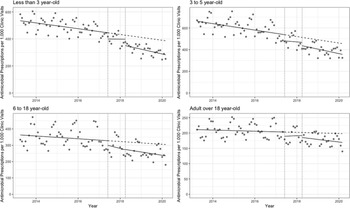
Antimicrobial prescription rates, that is, monthly antimicrobial prescriptions stratified according to per clinic visits per age group, are detailed in Table 2 and Fig. 1 . At baseline, the rate for all age groups (0–2, 3–5, 6–18, and ≥19 years) revealed a downward trend throughout the study period: −1.8 prescriptions per 1,000 clinic visits each month (P < .001), −2.5 prescriptions per 1,000 clinic visits each month (P < .001), −0.7 prescriptions per 1,000 clinic visits each month (P = .044), and −0.2 prescriptions per 1000 clinic visits each month (P = .337), respectively (Table 2 and Fig. 1).
Monthly antimicrobial prescription rate, by age group, April 2013 to March 2020. (Upper left) antimicrobial prescription rate among children aged <3 years; (upper right) antimicrobial prescription rate among children aged 3–5 years; (lower left) antimicrobial prescription rate among those aged 6–18 years; and (lower right) antimicrobial prescription rate among adults aged >18 years. Solid slope lines are slopes estimated by autoregressive models; break slope lines are estimated slopes without effects of interventions; and vertical dotted lines represent the months when the reimbursement system (April 2018) and educational interventions (June 2017) were implemented.

Effect of the Initiatives on Monthly Antimicrobial Prescription Rates, by Age Group, From April 2013 to March 2020

Note. CI, confidence interval
The slope of the line representing the monthly antimicrobial prescription rate revealed a reduction in the rate among those aged 0–2 years (who were the main target of the intervention) immediately after the incentive was implemented (Fig. 1). However, immediate reductions in prescription rates among other age groups were not observed (Fig. 1). Specifically, immediately after financial incentive implementation, a substantial reduction in prescription rates was observed among those aged 0–2 years (−47.5 prescriptions per 1,000 clinic visits each month; 95% CI, −77.3 to −17.6; P = .003) (Table 2 and Fig. 1). During the postimplementation period, no substantial change in the slope was observed among children aged 0–2 years (−2.8 prescriptions per 1,000 clinic visits each month; 95% CI, −7.0 to 1.3; P = .187). Likewise, a considerable and sustained reductions in antimicrobial prescription rates were not observed among patients aged 3–5 years (−2.2 prescriptions per 1,000 clinic visits each month; 95% CI, −7.4 to 3.1; P = .420), among patients aged 6–18 years (1.1 prescriptions per 1,000 clinic visits each month; 95% CI, −3.0 to 5.1; P = .610), or among patients aged ≥19 years (−0.9 prescriptions per 1,000 clinic visits each month; 95% CI, −3.1 to 1.2; P = .402).
Effect of provider education on monthly antimicrobial prescription rates according to age groups
As for the effect of provider education, all of the age groups showed immediate changes. For patients aged 0–2 year, prescriptions decreased by 46.0 per 1,000 clinic visits each month (95% CI, −71.1 to −20.9; P < .001). For patients aged 3–5 years, prescriptions decreased by 57.6 prescriptions per 1,000 clinic visits each month (95% CI, −88.8 to −26.5; P < .001). For patients aged 6–18 years, prescriptions decreased by 28.1 prescriptions per 1,000 clinic visits each month (95% CI, −52.4 to −3.7; P = .027). And for patients aged ≥19 years, prescriptions decreased by 13.8 prescriptions per 1,000 clinic visits each month (95% CI, −26.7 to −0.8; P = .040) (Table 2 and Fig. 1). No slope change was observed in any age group.
Discussion
Our analysis of a large claim database on oral antimicrobial prescriptions in outpatient settings over 7 years revealed that financial incentives to providers for patient education and shared decision making were associated with an immediate decline in antimicrobial prescription rates among those aged 0–2 years, who were targeted by the intervention. The provider education with antimicrobial stewardship guidance immediately reduced the prescription of all age groups uniformly, regardless of the target age group (ie, those aged ≥6 years). These interventions were performed to enhance outpatient antimicrobial stewardship. Despite a declining trend before sequential interventions, antimicrobial prescriptions were lower after the interventions than before the interventions. However, we did not detect a long-term downward trend.
Our findings are consistent with those presented in studies assessing financial incentives in different countries. For instance, the United Kingdom introduced a national quality premium that provided financial remuneration to clinical commission groups (CCGs) responsible for the healthcare planning in their region. Reference Wise21 Accordingly, CCGs received extra funding when they reduced antimicrobial prescriptions to some extent in the outpatient setting. This initiative affected antimicrobial prescribing practice in primary care settings, with a sustained reduction in the total and broad-spectrum antimicrobial prescriptions. Reference Balinskaite, Johnson, Holmes and Aylin8,Reference Bou-Antoun, Costelloe and Honeyford22 In Sweden, financial incentives through a pay-for-performance intervention had been provided to primary care centers (groups of primary care providers) when they achieved a particular share of narrow-spectrum antimicrobials (ie, penicillin V) to treat ARTI among children aged 0–6 years. Reference Ellegård, Dietrichson and Anell9 The intervention resulted in increased use of narrow-spectrum antimicrobials among children with ARTI. Despite previous evaluations on financial incentives in different healthcare systems, the intervention assessed in the current study was unique. The intervention compensates providers for not prescribing antimicrobials and for spending more time educating their patients on appropriate antimicrobial use. This intervention encourages providers to conduct patient education and shared decision making, which plays an essential role in improving patient awareness of unnecessary antimicrobials, leading to a future reduction in AMR.
The government of Japan implemented serial policy interventions to reduce oral antimicrobials. As such, guidelines for antimicrobial stewardship in outpatient settings were published in June 2017. 7,Reference Saito, Noda, Takakura, Jindai, Takahashi McLellan and Asanuma16 The goal of intervention is similar to that of the financial incentive: to reduce antimicrobial use for ARTI and acute diarrhea in outpatient settings. However, the patients targeted for this guideline were those aged ≥6 years, which differed from the patients targeted for the financial incentive (ie, 0–2 years of age). In various antimicrobial stewardship interventions for providers and patients, collateral effects on control groups or unintended populations were not uncommon. Reference Jindai, Goto and MacKay23,Reference Persell, Doctor and Friedberg24 Because most primary care providers and pediatricians care for children in all age groups, collateral effects could explain the broader effect of the educational intervention. The implementation of financial incentives, in contrast, had been strictly limited to those aged 0–2 years; therefore, it is unlikely to influence prescription practice on the other age groups. Notably, the Japanese government added children aged 3–5 years to those aged 0–2 years as the targets of financial incentives in April 2020 25 (outside the current study period), while revising the guidelines to reinforce illness descriptions among younger children (namely, those aged ≥3 months). 26
Accordingly, monitoring trends in antimicrobial prescriptions would be valuable in further assessing the effects of interventions. Nevertheless, the financial incentive assessed in this study, as well as the published guidelines, had no sustained effect on antimicrobial prescriptions. Because serial interventions were implemented within a relatively short timeframe, (ie, 10 months after the guidance was published), we conducted an additional analysis in which we treated the 2 interventions as 1 intervention. This approach also revealed the immediate change in all age groups but no persistence of this effect. We speculated that the incentives were not paired with other interventions, including ongoing education about rational antimicrobial use, performance feedback, and audits, all of which have been shown to improve the prescription of antimicrobials. Reference Gerber, Prasad and Fiks27,Reference Gerber, Prasad and Fiks28 A continuing medical education course with this educational intervention material that was given by a local medical association succeeded in enhancing the providers’ willingness to reduce the prescription of antimicrobials. Reference Yamamoto, Gu and Fujitomo29 Hence, both the quantitative and qualitative evaluations of facilitators of and barriers to sustainability of interventions at local and provider levels are warranted.
This study was distinct from others in terms of methodology. In previous studies, investigators employed the International Classification of Diseases, 10th Revision (ICD-10) to assess how policy changes, such as financial incentives and national guidance, affected antimicrobial prescription rates for a particular diagnosis. Reference Balinskaite, Johnson, Holmes and Aylin8,Reference Sato, Goto, Uda, Kumazawa, Matsui and Yasunaga13,Reference Bou-Antoun, Costelloe and Honeyford22,Reference Muraki, Kusama and Tanabe30 The estimated quantity of prescriptions per diagnosis could be overestimated or underestimated because of the nature of the administrative claims database. Reference Hashimoto, Saito and Sato31–Reference Horsky, Drucker and Ramelson35 However, we used data about drugs that had been prescribed and dispensed. This approach could result in a more objective quantification of overall antimicrobial usage. Reference Jindai, Goto and MacKay23
This study had several limitations. First, given the retrospective nature of the study, additional external factors other than the assessed interventions might have affected the study results. However, we utilized interrupted time-series analysis, which is considered optimal among other quasi-experimental designs, especially when randomization is not possible. Reference Kontopantelis, Doran, Springate, Buchan and Reeves36 Moreover, we were not aware of other upstream outpatient antimicrobial stewardship interventions from either the government or Japanese professional societies. Reference Jindai, Kusama, Gu, Honda and Ohmagari4 Second, the JMDC database had been developed for corporate employees and their dependent insurance claims. Therefore, in our analysis, we might have underestimated antimicrobial prescription rates among elderly individuals. Third, our findings may not be generalizable to other countries. However, the concept of providing educational material to providers and an incentive for patient education and shared decision making with providers could increase the opportunity to reduce unnecessary antimicrobial prescriptions in any country. Similar incentives and educational interventions could be adopted by other countries. Furthermore, antimicrobial prescribing varies by provider specialty, Reference Hicks, Bartoces and Roberts37,Reference Uda, Kinoshita, Morisaki, Kasai, Horikoshi and Miyairi38 and although our database does not allow accurate estimation this factor, identification of different prescribing patterns by specialty would be helpful in creating tailored antimicrobial stewardship interventions in the future. Another limitation could be the relatively short postimplementation period for financial incentives, which might have decreased the power of the study. Reference Bernal, Cummins and Gasparrini39
In conclusion, financial incentive was associated with a substantial reduction in antimicrobial prescription rates in children aged 0–2 years. Our findings suggest that monetary incentives can improve antimicrobial prescription practice in outpatient settings. In addition, the guidance of antimicrobial stewardship to primary care providers can help reduce antimicrobial usage for common illnesses. However, these incentives did not accelerate the downward trend in antimicrobial consumption that had existed before those interventions, and additional measures may be required to establish strategies that bolster the effects of such interventions in outpatient settings.
Supplementary material
To view supplementary material for this article, please visit https://doi.org/10.1017/ice.2022.49
Acknowledgments
We thank Dr. Hiroki Saito at the St. Marianna University School of Medicine, Yokohama City Seibu Hospital, and Ms. Yuki Kimura and Drs Noriko Kinoshita, Yoshiki Kusama, and Shinya Tsuzuki at the National Center for Global Health and Medicine for helpful feedback in the overall study concept. The research and views represented in this article are that of the authors alone, and they do not necessarily reflect those of the institutions with which they are affiliated. Funding sources had no role in study design, data collection and analysis, decision to publish, or preparation of the manuscript.
Conflicts of interest
All authors report no conflicts of interest relevant to this article.
Financial support
This research was funded by Institute for Health Economics and Policy and the Health Care Science Institute. Y.O. is supported by Japan Society for the Promotion of Science KAKENHI (grant no. 19K10661). M.G. receives supports from the US Agency for Healthcare Research and Quality (grant no. 5K08HS027472), the US Centers for Disease Control and Prevention (grant no. U54CK0006), and the US Department of Veterans’ Affairs.