Implication
Lameness is a welfare problem in sows. It may lead to treatment, or early culling, which can be costly and leave the farmer with an economic loss. This study showed that wounds, bursitis and abscesses should be avoided and that the body condition of the sow should not exceed body condition score 3 if lameness is to be avoided in organic sows. It also showed that organic sows have a lower risk of lameness than conventional sows. The questions that arise concern the factors that decrease lameness in organic sow herds and the possibility to improve animal welfare in conventional herds.
Introduction
Lameness in sows is an animal welfare problem for the sows. It can also bring unwelcome costs into pig production, because it requires increased labour and medical treatment (Pluym et al., Reference Jensen, Bonde, Kongsted, Toft and Sørensen2011). An expert panel in 2003 suggested that leg disorders and other clinical diseases were underestimated in outdoor sow herds (Bonde and Sørensen, 2003). In Denmark in 2008 mean herd lameness prevalence of 29% in 2989 sows from 33 conventional herds was reported (Jensen et al., Reference Heinonen, Oravainen, Orro, Seppä-Lassila, Ala-Kurikka, Virolainen, Tast and Pletoniemi2010). Heinonen et al. (Reference Engblom, Lundeheim, Strandberg, Schneider Mdel, Dalin and Anderson2006) found that on-farm lameness prevalence varies from 0% to 27.3%. They estimated mean herd prevalence of 8.8% in Finnish conventional herds. Similar results were found by Pluym et al. (Reference Jensen, Bonde, Kongsted, Toft and Sørensen2011) in conventional herds in Belgium, where mean herd prevalence of 9.7% was estimated with a range between 2.4% and 23.1%. Studies of the prevalence of sow herd lameness are relatively scarce. Studies in which lameness is given as a main culling reason – and which therefore offer an indirect measure of lameness – are more frequent.
A Swedish study (Engblom et al., Reference Dyrenes2008) showed that 9% of all cullings in conventional systems were due to lameness; and in US herds the proportion of sows culled in response to locomotive problems was 15.2% in 2006 (USDA, Reference Stalder, Knauer, Baas, Rothschild and Mabry2007). In Danish herds lameness is again one of the main reasons for culling sows. Vestergaard et al. (2004) reported that 10% of culled Danish sows were euthanized, and that 56% of these cases involved locomotive disorders. In a Swedish review the proportion of conventional sows culled as a result of locomotive problems ranged from 6% to 15% of the culled sows (Stalder et al., Reference Pluym, Van Nuffel, Dewulf, Cools, Vangroenwegne, Van Hoorebeke and Maes2004). Cox and Bilkei (Reference Bonde, Rousing, Badsmand and Sørensen2004) reported that 19% of conventional and 26% of outdoor sows were culled in responses to locomotive disorders in Croatian herds. Akos and Bilkei (Reference Akos and Bilkei2004) found higher levels than Cox and Bilkei (Reference Bonde, Rousing, Badsmand and Sørensen2004), and also identified a disparity in the occurrence of locomotive disorders in conventional and outdoor-housed sows, with 25% of cullings in indoor systems and 39% of cullings in outdoor systems being attributable to lameness. Thus a significantly lower percentage of sows were culled in indoor herds as a result of locomotive problems.
Information about not only the herd prevalence of lameness, but also the rate of cullings caused by locomotive disorders (lameness) and the risk factors involved is scarce for outdoor-housed sows. Bonde et al. (Reference Bonde and Sorensen2004) found that lameness was associated with skin and hoof wounds, bursitis and abscesses in conventional lactating sows and that thin sows had an increased risk of lameness.
The first aim of this study was to establish the prevalence of sow lameness, and identify its risk factors, in Danish organic sow herds by analysing the association between risk factors and sow and herd-level and clinical recordings of lameness. Second, the study examined differences between outdoor organic and indoor conventional herds in prevalence of sow lameness. An additional aim here was to identify risk factors associated with clinical records of sow lameness in Danish sow herds by analysing the association between risk factors with lameness at sow and herd level.
Material and methods
Selection of herds and animals
Data from two visits to nine organic herds were used (Study A) in connection with the first aim. To achieve the second aim, data from the second visit to the nine organic herds together with data from 44 selected conventional herds, each visited once, were used (Study B). The target population in Study A was the entire population of Danish organic sows and target population in Study B was the entire population of sows in Denmark. The organic sow herds were recruited via an organic adviser group that covers Denmark and produces 70% of all organic slaughter pigs. In all, nine herd owners (Herd size 348, range 110 to 1200 sows) in a study population of 16 herds (Herd size 335, range 50 to 1200 sows) voluntarily agreed to participate in the study. Organic gestation sows in this study had access to pasture all year and were group-fed. For insemination, the sows were loose-housed indoors with access to an outdoor run. The farmers followed standards defined by a company called Friland, the animal rights organization Dyrenes Beskyttelse, and the farmers themselves. The following two features are of particular interest in the present study: (1) the earliest the piglets were weaned was 7 weeks of age, and (2) all sows farrowed in huts on individual pasture paddocks of at least 300 m2 (Beskyttelse, 2010). The organic sows in this study had access to roughage all year and were erysipelas vaccinated. The organic herds were visited twice: the first visit was made 14 June to 20 October 2011, and the second was made 19 January to 16 March 2012. The period between these two visits was 5 to 9 months, with a median of 7 months. During each visit, ~100 sows (range 88 to 125 sows) were selected by systematic random sampling ((n total sow gestation or lactating)/n sample=every n animal was examined) for clinical examination (Dohoo et al., Reference Cox and Bilkei2009). The selected sample was stratified so as to include 30% to 40% of lactating sows and 60% to 70% sows in gestation in the organic herds.
The conventional herds were selected from a random sample of 797 Danish sow herds (Jensen et al., Reference Heinonen, Oravainen, Orro, Seppä-Lassila, Ala-Kurikka, Virolainen, Tast and Pletoniemi2010) obtained from the central Danish farm database, from which 261 herds were randomly selected. The inclusion criteria were: (1) the herd was located in Jutland or Funen (87% of all live pigs were located here in 2011). This criterion was applied for logistic and cost reasons. (2) The farmer was willing to participate in the investigation. With these criteria applied, 51 herds agreed to participate. It proved impossible to register lameness in seven of these herds as a consequence of the housing system being used. (Briefly, six herds had gestation sows in stalls, where there was insufficient room to get the sow out and into the stalls, and a further herd was group-housed with one eating box per sow, which meant that the sow would not leave the feeding stalls). This left 44 herds for the study with an average herd size of 572 ranging between 130 and 2500 sows. This is comparable to an average conventional herd size of 615 sows with a range up to 3000 sows. Danish conventional sows are housed indoors, mainly in various kinds of gestation group-housing system. However, data on the nature and frequency of the systems were not available. In the present study eight herds had gestation sows in stalls and 36 herds comprised loose-housed gestation sows. The gestation sows were fed separately in feeding stalls or electronic sow feeders if they were not housed in stalls. All sows farrowed in farrowing pens with crates. The piglets were weaned 4 weeks post-partum. Each herd was visited once in the period autumn 2010 to spring 2011; and in each herd ~30 sows were selected by systematic random sampling in the gestation section and examined (Dohoo et al., Reference Cox and Bilkei2009).
Registration methods
During the summer/autumn visit to the organic herds farmers were interviewed by a scientist or technician about management strategies used for feeding (home-mixed v. brought-in), gestation group size (⩽15 v. >15 sows), and batch system (⩽3 v. >3weeks). In a follow-up during the winter/spring visit farmers was asked if they had changed the management strategies. None of the farmers had changed anything regarding lameness management. Furthermore, the herd size (⩽250 v. >250), soil type (sand v. clay) and visit time (summer/autumn v. winter/spring) were recorded. During the winter/spring visit sow status (gestation v. lactating) was also recorded.
Clinical examination
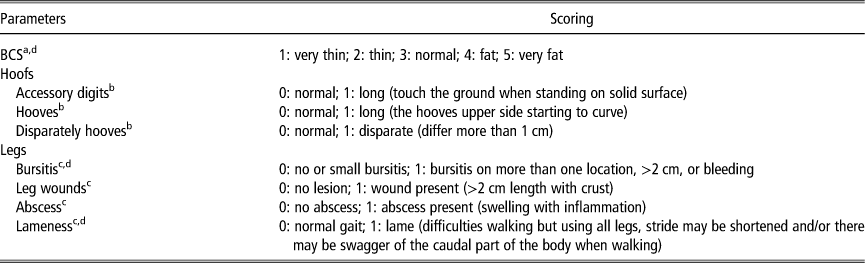
Conventional and organic sows were inspected visually from the closest possible distance (0 to 3 m) from the front, behind and both sides in the field, the hut, the barn, or indoor pen, by one out of four trained scientists or technicians. Those involved in this inspection visited eight to 26 herds. Clinical scores were assigned according to Table 1. Where lameness was observed during movement sows were required to walk a minimum of 20 steps, over a 5 to 10 m distance, before the lameness was scored. Indoor the animals were always scored on a concrete surface with or without slatted floor, while outdoor animals were scored on a flat surface with a low level of plant growth. In Study A clinical scores were summarized in three ‘new’ variables: (1) the accessory digits, hooves and disparately hooves scores were summarized to a dichotomous variable labelled ‘hoofs’; (2) the bursitis, wound and abscess scores relating to the legs were summarized to the dichotomous variable ‘legs’. Both ‘hoofs’ and ‘legs’ scores could be recorded as ‘no problem’, meaning that the summary score did not exceed a total of zero or ‘problem’; (3) the body condition score (BCS) 1 to 5 was divided into two subgroups: fat (BCS>3) and non-fat (BCS⩽3). At sow level, in Study A, the following potential risk factors were selected for the analysis: ‘hoof’, ‘legs’ and BCS at sow level. At herd level risk factors included ‘visit’, ‘herd size’, ‘soil type’, ‘feed’, ‘batch system’ and ‘gestation group size’. In Study B, body condition was likewise divided into two subgroups: fat (BCS>3) and non-fat (BCS⩽3). In Study B, BCS (fat v. non-fat), bursitis and production system (conventional v. organic) were analysed as risk factors for lameness.
Scores for clinical parameters included in the study

BCS=body condition score.
a Scoring definition according Welfare Quality® (Reference Vestergaard, Christensen, Petersen and Wachmann2009).
b Scoring definition modified after Bonde et al. (Reference Bonde and Sorensen2004).
c Scoring definition modified after Welfare Quality® (Reference Vestergaard, Christensen, Petersen and Wachmann2009).
d Scores used in conventional herds.
Statistical analysis
In both Study A and Study B a univariable logistic analysis not accounting for clustering was performed for each variable at herd or sow level using GLM in R 2.12.2(R 2.12.2). Variables with a P-value <0.25 were retained in the following multivariable analysis after testing the cross correlation of individual variables. Biologically meaningful interactions were inserted in the start model using the GLMER procedure in R 2.12.2 (R 2.12.2) from the lme4 package. The multivariable analysis was carried out by logistic regression with herd and observer as random effects. For model reduction, backwards elimination with a 5% significance level was used. Variables that were removed were reinserted to test for confounding in both studies. The initial multivariable model for analysis took the form:
 $${\rm Logit}\left( {P_{{ij }} } \right)=\beta _{0} {\plus}\beta _{{1Xij}} {\plus}\beta _{{2Xj}} {\plus} h_{j} {\plus}o_{{ij}} $$
where P i is the probability of sow lameness, β 0 is the model intercept, β 1 represents a vector of fixed effects at sow level, β 0 represents a vector of fixed effects at herd level, x ij is a vector of sow-level variables for sow i in herd j, x j is a vector of herd variables for herd, h j represents the random effect of herd and o ij represents the random effect of the observer.
To assess the variation explained by herd and observer in the analysis an interclass correlation of the kind described by Dohoo et al. (Reference Cox and Bilkei2009) was calculated. It was formulated:
 $$\rho = \sigma ^{2} /(\sigma ^{2} {\plus}\pi ^{2} /3)$$
where ρ represents the interclass correlation and σ 2 is the cluster variation.
Results
Descriptive results and herd lameness prevalence
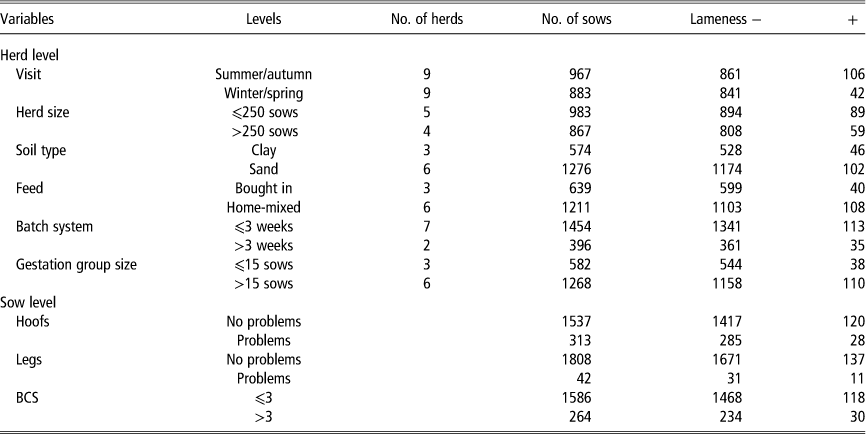
When the farmers in Study A were asked at second interview if they had changed management of lameness it was found that none had done so. In Study A 1850 sows were clinically examined. The average number of examined sows per herd was 103 with a range of 82 to 125. The descriptive analysis of the herd-level and sow-level dependent variables (risk factors) is presented in Table 2.
Descriptive statics of herd- and sow-level explanatory variables stratified with output variable lameness in 1850 sows from nine organic herds

BCS=body condition score.
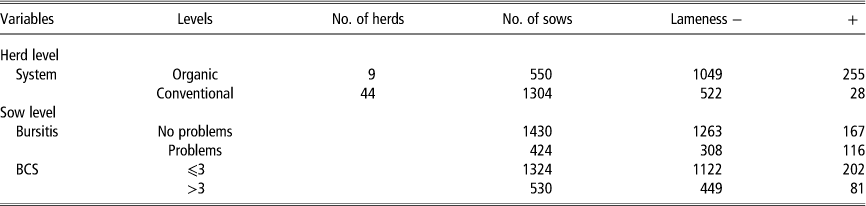
In Study B a total of 1854 gestation sows were clinically examined. The average number of animals examined was 61 in organic herds and 30 in conventional herds, with an overall average of 35 with a range of 28 to 71 sows. The descriptive analysis of herd and sow dependent variables is presented in Table 3.
Descriptive statics of herd- and sow-level explanatory variables stratified with output variable lameness in 1854 gestation sows from nine organic and 44 conventional herds

BCS=body condition score.
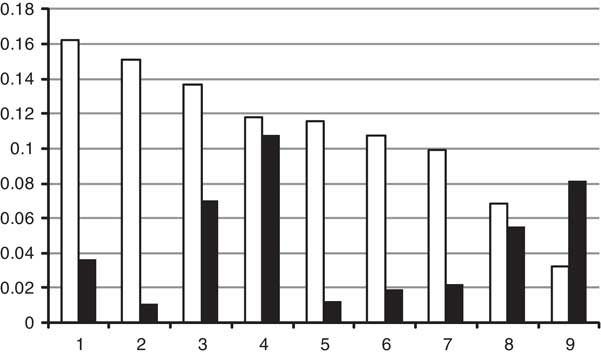
In Study A the mean herd prevalence of lameness among nine herds of gestation and lactation sows was 11%, ranging from 3.2% to 16.2%, at the summer/autumn visit. It was 4.6%, ranging from 1.2% to 10.8%, at the winter/spring visit (see Figure 1). In Study B the herd prevalence of lameness in gestation sows was 17%, with a range of 0% to 46.7%. The herd gestation sow prevalence of lameness was 24.3% and 5.4% in the conventional and organic herds, respectively.
Lameness prevalence (y-axis) at herd level in Danish outdoor herds (one to nine are different herds). The white column is the prevalence recorded during the summer/autumn visit; the black columns indicate prevalence during the winter/spring visit.

Univariable and multivariable analysis
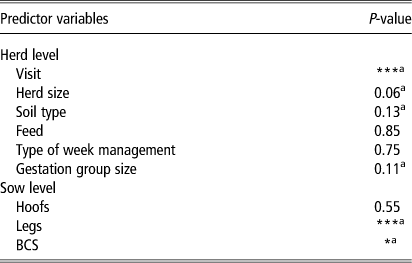
The herd-level risk factors ‘visit’, ‘herd size’, ‘soil type’ and ‘gestation group size’, and the sow-level risk factors ‘legs’ and BCS were retained from the univariable analysis and incorporated in the in the hierarchical multivariable logistic model in Study A, as shown in Table 4. System as herd-level variable and bursitis as sow-level variable were retained in the model in Study B.
Results of univariable analysis of risk factors associated with lameness in organic sows

BCS=body condition score.
Predictor variables with P-value <0.25 were included in the multivariable model. Logistic analyses with χ 2 test.
a Used in multivariable model.
* P<0.05;
*** P<0.001.
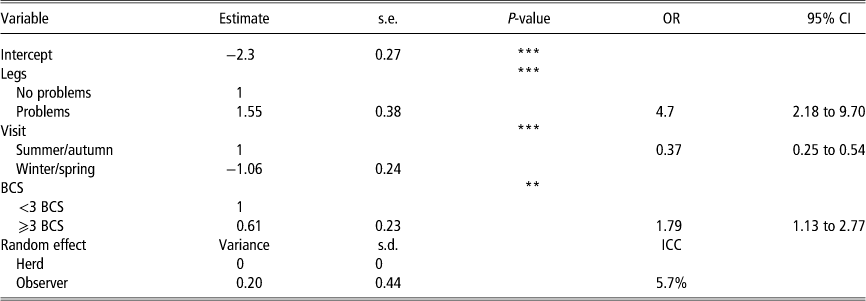
The risk factors ‘visit’, ‘legs’ and BCS were significant (P<0.05) in the final model of Study A. In the analyses no two-way interaction effect was found. Nor was confounding observed. Calculation of the interclass correlation herd explained 0%, and observer explained 5.7%, of total variation. The odds ratio of lameness among the levels of each significant risk factor is presented in Table 5.
Estimates of the significant effects in the model describing lameness among 1850 sows from nine organic herds

BCS=body condition score; ICC=interclass correlation.
** P<0.01;
*** P<0.001.
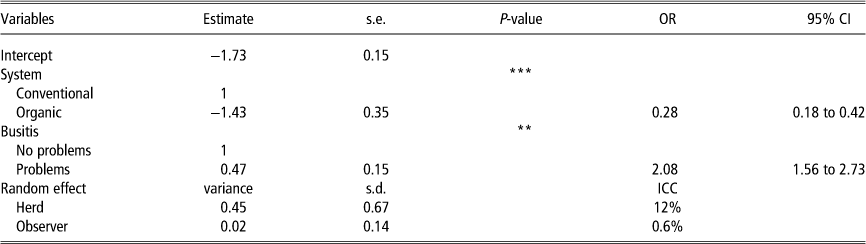
The risk factors ‘system’ and ‘bursitis’ were significant (P<0.05) in the final model in Study B, as shown in Table 6. In the analyses neither a two-way interaction effect nor confounding were found. Here the calculation of the interclass correlation herd explained 12%, and observer 0.6%, of total variation.
Estimates of the significant effects in the model describing lameness among 1854 gestation sows from 44 conventional and nine organic herds

ICC=interclass correlation.
** P<0.01;
*** P<0.001.
Discussion
Herd lameness prevalence
The mean herd prevalence of lameness in organic sows in summer/autumn was 11%. It was 4.6% in gestation and lactation sows in winter/spring. Heinonen et al. (Reference Engblom, Lundeheim, Strandberg, Schneider Mdel, Dalin and Anderson2006) and Pluym et al. (Reference Jensen, Bonde, Kongsted, Toft and Sørensen2011) reported similar herd prevalence in conventional gestation sows, while Bonde et al. (Reference Bonde and Sorensen2004) reported higher prevalence in conventional lactating sows. Mean herd prevalence was 5.4% in organic gestation sows; it was 24.3% in conventional gestation sows, which is very similar to the 29% reported by Jensen et al. (Reference Heinonen, Oravainen, Orro, Seppä-Lassila, Ala-Kurikka, Virolainen, Tast and Pletoniemi2010) for group-housed gestation sows in 33 Danish conventional herds, but higher than the 9.7% reported by Pluym et al. (Reference Jensen, Bonde, Kongsted, Toft and Sørensen2011) in gestation sows in eight Belgian herds.
Herd-related risk factors
The risk of being lame in winter/spring was significantly lower than it was in summer/autumn for organic sows. Figure 1 shows the prevalence and variation of the two seasons. In eight of the nine organic herds the prevalence of herd lameness decreased between summer/autumn and winter/spring. This could indicate that lameness is less of a problem between January and March than it is between June and October.
The management of sows in summer/autumn might have been given a lower priority than that in winter/spring. The main priority in summer/autumn is the harvest, and this might lead to less time being spent on surveillance, which in turn increases the risk of lameness which is not managed correctly.
It might be suggested that the variation in lameness was also a consequence of changes in management resulting from farmers’ increased awareness of lameness problems following the first visit. However, the farmers were asked whether they had made any management changes before second visit, and none had done so.
Another possible explanation is the climate, and in particular the condition of the walking surface on the pasture. When the surface is slippery, the risk of lameness is presumably greater, especially if the sows are group fed, as they were in this study, and thus more aggressive. The rainfall in July and August in 2011 was twice the average for these months. This may indeed indicate that the risk of slippery pasture increased, and with it the risk of lameness (DMI, Reference Dohoo, Martin and Stryhn2013).
Organic gestation sows had a lower risk of lameness than indoor conventional sows. The lower risk in outdoor organic herds is the outcome primarily of the softer surface both in the huts and on pasture. The risk of lameness caused by barn equipment or concrete floors injuries is likely to be less, or zero, in outdoor organic production.
Sow-related risk factors
Leg disorders increased the risk of lameness in organic sows. They have also been found to be a risk factor in conventional sows. Bonde et al. (Reference Bonde and Sorensen2004) found a significant association of lameness with skin and hoof wounds, bursitis and abscesses in indoor conventional lactating sows. This may be due to the fact that the sows live in very different environment in which the risk factors are different.
Fat sows (BCS>3) have an increased risk of lameness in organic herds. In a study of conventional lactating sows, Bonde et al. (Reference Bonde and Sorensen2004) found that fat sows do not have a significantly increased risk of lameness. The association between BCS and lameness may be explained by the fact that the feeding, in outdoor sow herds, is a very competitive affair. It is also relevant that a heavy animal puts more weight on its legs, which in itself is a risk factor in lameness, and that this will increase when the sows walk on a hard (frozen) or slippery (wet or icy) surface, or have to fight other sows for the feed. BCS is a risk factor for lameness in organic sows, but not conventional gestation sows. This may be because conventional sows are fed individually and a lower BSC variation is expected in them than that found in organic herds, where they are group-fed and high variation is the norm.
In the present study, hoof length and symmetry was not associated with lameness. This confirms the findings of Bonde et al. (Reference Bonde and Sorensen2004), who examined conventional lactating sows using the same scales as were used here.
We found that sows with bursitis had an increased risk of lameness across systems. Bonde et al. (Reference Bonde and Sorensen2004) found that hind feet lesions, which were caused most often by bursitis, increased the risk of lameness (OR=2.5 for slightly lame sows and OR=4.3 for markedly lame sows), a finding that is in keeping with the present study. It could be also argued that lame sows spend more time lying down, and that therefore they are more likely to develop bursitis and/or wounds – in other words, the causality might run in both directions here.
Conclusion
Herd prevalence of lameness in organic sows was lower in winter/spring, and leg problems increased the risk of lameness. Lameness was less prevalent in organic sow herds than it was in conventional herds, and sows with bursitis had an increased risk of being lame in both organic and conventional sow herds.
Acknowledgements
The study is part of the project ‘Lameness and leg disorder in outdoor sows’ and was supported by funds from Knowledge Centre for Animal welfare. The authors wish to thank the technicians and farmers who participated in the project.