INTRODUCTION
Chaetoceros, a marine planktonic diatom, was first described by Ehrenberg in 1844 (Rines, Reference Rines1999). It is the most diverse, widespread, and important marine planktonic diatom (Cupp, Reference Cupp1943). Its species are distributed globally and they often dominate in coastal ecosystems (Evensen & Hasle, Reference Evensen and Hasle1975; Guillard & Kilham, Reference Guillard, Kilham and Werner1977; Rines & Hargraves, Reference Rines and Hargraves1988; Hernández-Becerril, Reference Hernández-Becerril1996; Hasle & Syvertsen, Reference Hasle, Syvertsen and Tomas1997; Bérard-Therriault et al., Reference Bérard-Therriault, Poulin and Bosse1999). Around 400 spp. are recorded. The genus Chaetoceros is one of the most important of the diatom genera, with a great variety of species found in estuarine and coastal waters around the world (Hasle & Syvertsen, Reference Hasle, Syvertsen and Tomas1997). The genus is characterized mainly by the possession of setae and the formation of chains of cells that are joined in different manners and by different structures associated principally with the setae (Hernández-Becerril & Aké-Castillo, Reference Hernández-Becerril, Aké-Castillo, Jahn, Kociolek, Witkowski and Compere2001). One of their most conspicuous characteristics is the possession of four setae per cell (Rines & Hargraves, Reference Rines and Hargraves1988; Round et al., Reference Round, Crawford and Mann1990; Hasle & Syvertsen, Reference Hasle, Syvertsen and Tomas1996; Hernández-Becerril, Reference Hernández-Becerril1996). In spite of these taxonomic characteristics, solitary living species exist, and some of the species possess reduction in the number of setae (Shevchenko et al., Reference Shevchenko, Orlova and Hernández-Becerril2006). In the present study, a centric diatom Chaetoceros minimus is reported for the first time from the Indian waters. This record will contribute to the phytoplankton checklist of the Indian seas.
MATERIALS AND METHODS
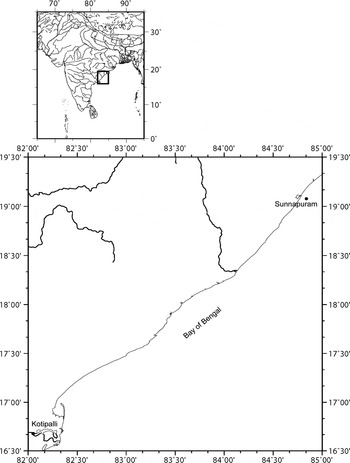
Phytoplankton samples were collected from off the Sunnapuram coast (Orissa State) (19°05′.606″N 84°49′.863″E) and at Kotipalli (Godavari estuary, Andhra Pradesh State) (16°41′50.41″N 82°2′9.64″E). The location of the sampling area is shown (Figure 1). Surface water samples (1l) were collected using a plastic bucket. The samples were fixed with Lugol's solution and stored in the dark until analysed. A settling and siphoning procedure was followed to concentrate samples from 1l to 100 ml. 1 ml of concentrated sample was transferred to a Sedgwick–Rafter counting chamber and examined using a L × 400 research microscope (Labomed, Germany).
Location map showing the stations (•) off Sunnapuram and at Kotipalli whose surface waters contained Chaetoceros minimus (Levander).

RESULTS AND DISCUSSION
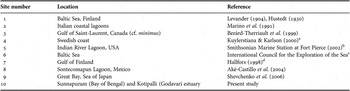
A total of 15 species of Chaetoceros have been identified from the study area (Indian Ocean). Of these, Chaetoceros minimus is the first record in the Indian Ocean. We studied detailed phytoplankton distribution of water samples collected from all along the western Bay of Bengal shown in Figure 1, up to 30 m isobath, at monthly intervals during August 2009–March 2011, as part of our regular monitoring programme. We encountered C. minimus only in the October 2009 sample at Sunnapuram and in the February 2010 sample at Kotipalli (Godavari estuary). The abundance in both cases was 3 cells ml−1. Chaetoceros minimus was very rare. At the global level also, the species is quite rare, and limited to the few locations shown in Table 1.
The distribution Chaetoceros minimus.

a, www.marbot.gu.se; b, www.sms.si.edu; c, www.ices.dk; d, www.fimr.fi
SYSTEMATICS
Chaetoceros minimus.

Chaetoceros minimus (Levander) Marino, Giuffré, Montresor & Zingone. Marino et al. (Reference Marino, Giuffré, Montresor and Zingone1991, pp. 318–319). Basionym: Rhisozolenia minima Levander (Reference Levander1904, pp. 115–116).
SYNONYM
Monoceros isthmiiforme (van Goor, Reference Van Goor1924).
MATERIAL EXAMINED
3 cells ml−1 (Sunnapuram—October 2009) and 3 cells ml−1 (Kotipalli (Godavari estuary)—February 2010).
MEASUREMENTS
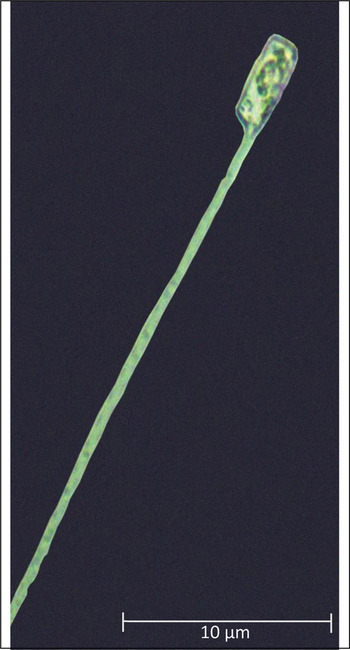
The apical axis measures 3.8 µm. The length of the setae is 42 µm.
DIAGNOSIS
Solitary cylindrical and isovalvar cells, with one chloroplast and two long setae orientated in opposite directions. Usually the two setae emerge from the same side of the same valve, but also rarely from opposite sides. Resting spores ellipsoidal; primary valve with scattered protuberance, knobs, and sometimes spines, secondary valve with regularly arranged numerous small knobs, a strong stud-like central protuberance, a wide flange, and a marginal collar.
CONCLUSIONS
This is the first report of Chaetoceros minimus in Indian waters and contributes to the knowledge about the morphological and ecological features of this species.
ACKNOWLEDGEMENTS
We are grateful to the Ministry of Earth Sciences (MoES), New Delhi and Indian National Centre for Ocean Information Services (INCOIS), Hyderabad of the Government of India for financial assistance (MoES/11-MRDF/1/39/P/07, INCOIS/093/2007 respectively). The authors thank Dr Subba Rao V. Durvasula, Dartmouth for confirming the identification of Chaetoceros minimus.