In an increasingly resource-strained and networked environment, health care coalitions have been identified as a fulcrum upon which emergency response and recovery activities are centralized and directed. A health care coalition is defined as a formal collaboration among hospitals, public health departments, emergency management, response agencies, and possibly other types of health care entities in a community that are organized to prepare for and respond to mass casualty and catastrophic health events.Reference Courtney, Toner and Waldhorn 1 Health care coalitions often serve as the entity to oversee and coordinate health care, both in routine and disaster times, connecting hospitals, emergency response organizations, and ancillary health support agencies to manage and triage high volumes of disaster-affected populations, facilitate communications about resources and personnel, and ensure restoration of routine health care functions as expeditiously as possible.Reference Nelson, Lurie and Wasserman 2 - Reference Hossain and Kuti 5
Reflections from recent disasters demonstrate the criticality of coalitions in supporting the health care sector’s response and recovery from disasters (eg, Joplin tornado, Hurricanes Katrina and Rita), yet there has been limited analysis of the current state and role of health care coalitions in the changing disaster climate. Given the expansion of health care partnerships, as articulated in national frameworks focused on “whole of community” response as well as in targeted grant guidance (eg, Centers for Disease Control and Prevention public health emergency preparedness capabilities, Hospital Preparedness Program [HPP]), there is a gap in understanding how health care coalitions are currently functioning and where opportunities exist to strengthen and better support their activities and capabilities.
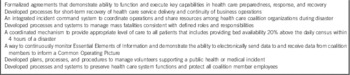
The HPP, a program of the Preparedness and Response Division of the US Department of Health and Human Services (HHS) that began in 2002, has been a catalyst for hospital involvement in emergency preparedness and has awarded states about $2.2 billion. 6 When the HPP began, it was largely hospital focused but has shifted to being more coalition focused. This is new territory for the HPP and not much analysis has been done at the coalition level. 7 As of 2012, HPP monitors 8 unique performance measures to help hospitals tell the story of their progress in meeting goals and achieving outcomes, each with a distinct role for health care coalitions (Table 1). 8
Hospital Preparedness Program Performance MeasuresFootnote a

a Source: Assistant Secretary for Preparedness and Response. Hospital Preparedness Program (HPP) Performance Measure Manual: Guidance for Using the New HPP Performance Measures. 8
To support these aims, it is important to understand the ways in which health care coalitions build surge capacity and support improved preparedness. Prior research has identified the core dimensions of successful public health collaborativesReference Varda, Chandra, Stern and Lurie 9 but has not focused on health care coalitions centered on emergency preparedness. Health care coalitions dealing with emergency preparedness are unique from other public health collaboratives in that they must maintain flexibility because they function during routine situations as well as during uncertain, resource-constrained situations in which coalition, member, and community needs are unanticipated and unknown.
The purpose of this article was to describe how the HPP and other health care coalitions conceptualize and measure progress or success, to identify strategies to improve coalition success, and to assess coalition leaders’ perceptions of progress towards addressing known barriers to success. This study extends the literature on health care coalitions that engage in disaster preparedness, which to date has defined health care coalitions, identified their structure, and provided examples of accomplishments and challenges faced by coalitions.Reference Courtney, Toner and Waldhorn 1
Methods
Literature Review
We conducted a structured search to identify existing literature (both peer-reviewed and gray) on health care coalitions in the context of emergency preparedness, as well as literature focused on public health collaboratives more broadly including existing measures, survey items, frameworks, and findings related to measuring coalition relationships. During October and November 2011, key search terms were identified by RAND research team members, and the JSTOR, PubMed, and Web of Science databases were searched. The search string included (coalition OR partnership OR coordination OR network) AND (effectiveness OR emergency preparedness OR hospitals OR public health OR meta-leadership). A total of 205 articles were initially identified. We reviewed all titles and abstracts and excluded those that did not incorporate one or more of the following topics: elements of collaborations, health or health care coalitions focused on emergency preparedness, advantages and disadvantages to collaboration, benefits of emergency preparedness coalitions, network structure, governance, capacity building, conflict management, emergency preparedness coalitions measurements of effectiveness, value of performance measurement and benchmarking, social network analysis, social network analysis and the effectiveness of a health care coalition, and other evaluation methods/strategies/tools. A total of 43 articles met this inclusion criterion. Each article was then categorized by its primary topic and summarized for inclusion in the review.
Key Informant Interviews
Sample
Health care professionals from a variety of sectors (hospitals, public health, emergency management, public safety, etc) who were actively engaged in health care coalitions were recruited to participate in 45- to 60-minute phone-based interviews between December 2011 and February 2012. The goal of the interviews was to obtain insight from the experiences of individuals managing or organizing health care coalitions into what factors contributed to coalition success and challenges and where opportunities for coalition measurement exist. Approximately 46 active, US-based health care coalitions were initially identified from Internet searches and previous research studies, through consultation with colleagues at the HSS and the HPP and from a 2009 HHS report. 10
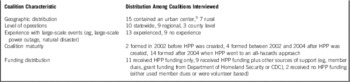
Coalitions were initially stratified along geographic boundaries, types of potential hazards, experience with large-scale events, and date of formation. Our goal was to develop a representatively stratified sample of coalitions with a range of maturity and potential hazards, geographically distributed by region of the US. We continued to interview coalitions until we secured participation of coalitions in every category and reached saturation on interview themes. This was achieved after 22 interviews. Respondents included 5 coalitions from the West, 5 from the Midwest, 4 from the Northeast, and 8 from the Southern regions of the United State. A brief description of sample diversity can be found in Table 2. 11
Characteristics of Coalitions InterviewedFootnote a

a Abbreviations: CDC, Centers for Disease Control and Prevention; HPP, Hospital Preparedness Program.
b Metropolitan Statistical Area define “urban” as “having at least one urbanized area of 50,000 or more population, plus adjacent territory that has a high degree of social and economic integration with the core as measured by commuting ties.” Source: US Office of Management and Budget. OMB Bulletin No. 10-02: Update of Statistical Area Definitions and Guidance on Their Uses. 11
Additionally, “coalition function” provided some additional detail on the main goal of the coalition with regards to preparedness, whether it was primarily a preparedness-only coalition (n=5; ie, no active or formal role in response), a preparedness and response coordination coalition (n=9; ie, plays a supported role in response such as communication or information sharing), or a preparedness and decision-making coalition (n=8; ie, takes part in the incident command structure).
Data Collection
The RAND research team utilized a structured interview protocol to elicit information about the nature and quality of relationships among organizational members of health care coalitions and information about how to best measure coalition relationships and effectiveness. The interview protocol was derived from the structured literature review and contained questions that purposefully probed on factors deemed essential to the success of other types of coalitions. All materials and procedures were approved by the Human Subjects Protection Committee at the RAND Corporation. Each participant provided oral consent at the time of the interview.
Analysis
We analyzed the interview data by use of constant comparative analysis to qualitatively identify themes that would describe how health care coalitions typically function and ascertain measures to assess coalition effectiveness. To identify themes, 2 research team members marked blocks of interview notes pertaining to the major topical domains of interest outlined in the interview protocol. From the marked text, team members developed themes that corresponded with each of the major domains. Next, team members reviewed the themes and then systematically went through each of the interview notes finding other instances of this subtheme and generating frequencies for each theme. To ensure the accuracy of assigned themes in each interview, 10% of the interviews were double-coded by a second team member. Percentage agreement was calculated at 92%, a level deemed reliable enough to independently analyze the remainder of the interviews.
Results and Discussion
Interview themes were grouped into 3 broad categories: how HPP coalitions define success, barriers to HPP coalition success, and strategies to mitigate the barriers to coalition success. A summary of the interviews and findings from the literature review are included under each theme.
Analyses identified that the primary function of the coalition influenced both the way in which coalitions defined their success and their perceptions of the most effective strategies to mitigate barriers to success.
How HPP Coalitions Define Success
Dimension 1: Active Member Participation
Over half of the coalitions interviewed indicated that they considered their coalition successful if members participated in coalition activities and helped each other in routine and/or disaster times. Participation was described as attending coalition meetings, gathering input and drafting disaster plans (including creation of tailored plans for pediatric and aging populations), and helping to organize and facilitate disaster drills and exercises.
“I know we are successful when members rise to the occasion and help each other .”
Specifically, attendance was an indicator of success noted by almost half of the coalitions. In prior analyses, membership attendance was deemed critical to the success of the coalition because coalitions leverage an array of resources and expertise from each member to achieve common outcomes, and frequent attendance at meetings is critical for relationship-building.Reference Kelly, Meurer and Lachance 12 , Reference Agranoff 13
Coalitions more actively involved in the incident command system (ICS) most often characterized success as members participating in coalition activities, which can include coordination during a response. There are currently no corresponding HPP performance measures capturing this dimension of success.
Dimension 2: Diversity of Members
Participants noted that each coalition member from public health, hospitals, primary care, and other health care provider organizations brings a unique perspective (eg, point of care provider, administrator), specialization (eg, psychiatry, vulnerable populations, infectious disease), and knowledge of the resources available at their organization (eg, staff expertise, space, equipment).
“Businesses are able to supply us with resources and supplies that may not be available by other means. Wal-Mart, Kmart, Target – those types of entities – have been extremely helpful.”
Coalitions can access resources above and beyond those possessed by any single organization.Reference Kelly, Meurer and Lachance 12 - Reference Eisenman, Glik and Gonzalez 14 As such, participant diversity allows coalitions to solve complex problems that would typically overwhelm a single organization.Reference Luke and Harris 15 - Reference Mays, Halverson, Baker, Stevens and Vann 17 Resource sharing is a motivating factor for members of interorganizational collaborationReference Mays and Scutchfield 16 , Reference Bailey 18 ; in HPP health care coalitions maximizing and leveraging resources is a vital activity.Reference Chen, Roberts and Xu 19 , Reference Honeycutt and Strong 20 Although this is an important dimension mentioned by coalitions, there are currently no corresponding HPP performance measures capturing this dimension of success.
Dimension 3: Sharing Information and Resources
Exchanges among the diverse membership of coalitions can also spur innovation and new ideas, allowing the coalition to address difficult problems.Reference Kamensky, Burlin and Abramson 21 - Reference Butterfoss and Francisco 27 In particular, coalitions that supported disaster response, but were not in a decision-making role, most often characterized success as members sharing information and resources as well as helping one another. For example, one coalition pooled funds to purchase a mobile water purification system to be shared by all coalition members and used where needed in an emergency.
There are currently no corresponding HPP performance measures capturing this dimension of success. However, measures of coalition success could assess whether these coalitions are effective at encouraging collaboration among members to leverage resources when needed.
Dimension 4: Increases in Members’ Capacity to Respond to or Recover From Disaster
Many interviewees also discussed the benefits of participating in a coalition: improved capacity to respond and recover from disaster in a timely manner, and improved self-sufficiency of member organizations.
“[Most of our emergency] situations are handled within hours without involving the state.”
Coalitions not directly involved in disaster response most often characterized success as timely local response and recovery efforts. Success was based on whether coalitions were able to build local capacity and then translate that capacity into more efficient response or recovery at the local level. Commensurate with this function, measures of coalitions not involved directly in disaster response success should focus on the impact of training and the effectiveness of planning efforts. For example, an assessment of response capacity at the local level could help determine the impact of training and planning at the local level. Participants also noted that coordination among coalition members to direct patient flow during a disaster is critical to handling the patient surge and enabling all individuals requiring medical intervention to receive high-quality care. This has been corroborated in other analyses of coalitions.Reference Eisenman, Glik and Gonzalez 14
Current HPP performance measures assess a number of response and recovery capabilities (eg, developed processes for short-term recovery of health care service delivery), which may help provide insight into this capacity building. Coalitions actively involved in disasters may use these performance measures to report on their coalition’s capabilities, while HPP coalitions focused primarily on training may use these performance measures to report on the results of their capacity building efforts. This has important implications for how HPP aggregates and interprets these measures.
Dimension 5: Coalitions Perceived as a Trendsetter or Model for Surrounding Communities
“[Surrounding] districts look to us for what is going on, how to proceed forward, what policies, programs, procedures have been developed.”
Interviewees described how the external perceptions of success contributed to the coalition’s overall recognition as a leader in local emergency preparedness and was useful in ensuring they were asked to be part of the local emergency preparedness planning committee, which includes a variety of stakeholders outside of the health care sector (eg, emergency medical services, first responders, local government). Prior research did not identify this key indicator of success and there are currently no corresponding HPP performance measures capturing this dimension of success.
Barriers to Coalition Success and Potential Strategies to Mitigate These Barriers
Barrier 1: Lack of Funding
Consistent with the findings from Courtney et al,Reference Courtney, Toner and Waldhorn 1 the barrier coalitions cited most frequently as impacting their success was a lack of funding. This barrier persists, particularly as funding for the HPP declines. In Courtney et al,Reference Courtney, Toner and Waldhorn 1 a recommendation was made to ensure HPP coalitions receive adequate, stable, and sufficient levels of funding. This recommendation will be particularly important as HPP and Public Health Emergency Preparedness (PHEP) grant programs align funding. Participants noted that the lack of funding was compounded by the lack of incentives for members to participate.
“Most of the members are not compensated for the time taken away from their organizational duties.”
Research has also shown that ample funding is needed to build coalition capacity.Reference Petersen, Minkler and Vasquez 28 , Reference Kapucu, Arslan and Collins 29 With declining funding to motivate participation it may become increasingly difficult for HPP coalitions to keep members engaged. To mitigate this barrier, coalitions suggested emphasizing the economies of scale and efficiencies gained through collaboration. Coalitions explained that the efficiencies of not having to work independently on all preparedness activities helps to save money that can be pooled to support “sharing of best practices, networking, training, and [to purchase] incident management software.”
Barrier 2: Staffing Shortages and Leadership Difficulties
Also consistent with findings from Courtney et al,Reference Courtney, Toner and Waldhorn 1 HPP coalitions indicated that staffing shortages were a major barrier to their success. Interviews suggested members were already overburdened with competing responsibilities making it difficult to find time in their busy schedules to fully engage in coalition activities (eg, serve as chair of subcommittees). To gain access to staff, interviewees indicated that engaging organization leadership was important to ensure that the leaders valued and helped staff to prioritize coalition activities.
“If middle management knows their boss cares about this enough to want it to happen, it makes a big difference. This is really important because preparedness can fall to the end of a long list of priorities.”
A strong and well-connected coalition leader can also help to build the networks needed for coalition success.
“I have built a lot of connections in different counties…..[through which] I pass on a lot information. [Although there are] no formal processes for sharing information across counties, because of my personal background and connections, I am able to do this.”
Identifying a leader and developing a structure to ensure leadership responsibilities are appropriately distributed helps a coalition to run smoothly.Reference Cigler 30 Interviewees from coalitions primarily involved in training indicated that strong leadership was one of the most effective strategies used to mitigate barriers to coalition success.
Barrier 3: Lack of Trust
Consistent with prior research,Reference Varda, Chandra, Stern and Lurie 9 interviewees described the challenges created by a lack of trust among coalition members. This lack of trust could be a result of competition among hospitals. Strategies to build trusting relationships among coalition members included hosting open, collaborative, and productive coalition meetings. Achieving small successes also demonstrated that working together could be effective and helped to build trust. Interviewees from coalitions primarily involved in training indicated a series of small successes was one of the most effective strategies to address a lack of trust among members. However, coalitions more actively involved in support and response indicated that established and committed relationships were the most effective strategy to mitigate the lack of trust among members.
Memoranda of agreement helped to formalize the boundaries of collaboration. This is consistent with one of the HPP performance measures, which requires coalitions have formalized agreements that demonstrate ability to function and execute key capabilities in health care preparedness, response, and recovery.
Research also underscores the importance of trust and shared commitment to coalition success.Reference Petersen, Minkler and Vasquez 28 , Reference Kapucu, Arslan and Collins 29 Regular communication between members helps to build trust and break down barriers among health care providers.Reference Kamensky, Burlin and Abramson 21 , Reference Provan, Veazie, Staten and Teufel-Shone 23 - Reference Scearce, Kasper and McLeod Grant 25 Health care coalitions can help to minimize duplication of efforts and services by improving trust and communication among previously competing groups.Reference Butterfoss and Francisco 27 Trust among coalition members is needed to address some of the difficult problems that emerge while planning for disaster, particularly problems without a clear solution (eg, when to adopt altered standards of care).Reference Powell and Grodal 22
Barrier 4: Cultural/Organizational Differences
Another barrier that interviewees felt impeded success was differences in policies, procedures, and priorities among members from differing cultural or organizational sectors. These can include, for example, differences between rural and urban centers and differences between large and small organizations. Interviewees argued that differences in the level of resources, staffing, etc between large and small organizations make it difficult to establish standardized procedures. Interviewees also indicated that issues like H1N1, which are relatively slow-moving compared to an immediate mass casualty event like a bombing, can reveal these cultural and organizational differences because they “give people time to have different opinions.”
To help improve collaboration between organizations regardless of size or differences, interviewees suggested that coalitions leverage existing collaborative technologies. For example, HavBed (US Department of Health and Human Services, Washington, DC) allows organizations to share inventories of materials and bed capacity, whereas WebEOC (Intermedix Corp, Fort Lauderdale, FL) allows organizations to interface with the larger command and control structure. Other communication technologies rapidly alert hospitals and key staff if an incident occurs (eg, LiveProcess [LiveProcess, Burlington, MA]), facilitate communication across community sectors (eg, radio roll calls), and provide backup communication channels if phones or electricity are not working. Breaking down the barriers created by organizational differences is a first step needed to develop the coalition capacity for success.Reference Petersen, Minkler and Vasquez 28
Barrier 5: Limited Data Collection
Despite its importance,Reference Butterfoss and Francisco 27 , Reference Francisco, Paine and Fawcett 31 - Reference Varda 36 few coalitions were collecting data needed to inform an evaluation of coalition effectiveness or quality improvement activities. Two of the most common types of data collected were the HPP performance measures, which coalitions are required to report to the Office of the Assistant Secretary for Preparedness and Response, and coalition fiscal data (eg, how much money is being spent and where). A handful of coalitions indicated that they conduct coalition-level disaster response exercises and draft a corresponding after-action report. Although after-action reports are useful for quality improvement, the interviewees noted that they are difficult to use as an evaluation tool, in part because they primarily focus on gaps or challenges, rather than highlighting accomplishments. To improve data collection and subsequent quality improvement, interviewees suggested enhancing HPP performance measures to include outcome measures that can be used for evaluation and tracking progress, as well as improving HPP performance measures to better account for the variation in coalition primary functions (eg, training vs disaster response).
Performance measurement fosters accountabilityReference Butterfoss and Francisco 27 , Reference Varda 36 and contributes to an understanding of what does and does not work.Reference Kaji, Langford and Lewis 34 , Reference Butterfoss and Francisco 27 In turn, this understanding allows coalitions to modify existing activities in order to achieve greater impact.Reference Francisco, Paine and Fawcett 31 , Reference Burkle 32 , Reference LeRoux and Wright 35 Performance measurement is invaluable to building and sustaining coalition effectiveness.Reference Asch, Stoto and Mendes 33
Limitations
Although this study provides critical insights, a few limitations should be noted. First, we used a relatively small subsample of coalitions. The sample represented approximately one-third of the total number of HPP and other health care coalitions we identified. In addition, 2 of the coalitions we interviewed were not currently receiving HPP funding. These coalitions, however, could provide useful insight to the HPP program about the structure and functions of coalitions that organically emerge from community partnerships as compared with those that initiate to receive grant funding from HPP. Further analysis may benefit from a representative sample to comprehensively describe coalition relationships and enumerate barriers to successful engagement.
Conclusion
Dimensions of coalition success and strategies to mitigate barriers to success varied by how directly the coalitions were involved in the disaster response via the ICS. These variations suggest that a typology of coalitions may be useful in providing a common language to classify coalitions and their relative capabilities, tailoring support to coalitions of varied type and informing how coalition success is measured. Currently, the term health care coalition is a one-size-fits-all term. In reality, this umbrella term describes a variety of different configurations, member bodies, and capabilities. Developing a common terminology that could be used to specify capabilities or functions of coalitions may be helpful to advancing their development. For example, trauma centers in the United States are classified by using a Level I to Level 3 designation. That designation is based on certain capabilities such as the availability of specialized diagnostic equipment and having trauma specialists on staff. This classification is important for connecting patients in need with appropriate levels of care. Similarly, classifying coalitions into groupings or a typology, as we have suggested, may provide a common language alerting public health departments, hospitals, and emergency planners of the local capabilities available in their community (eg, who to connect with for training vs engagement in the ICS).
To help highlight differences by primary function, we propose a typology that aligns with the disaster-related functions identified by the HPP coalitions interviewed (Figure 1) and that falls along the disaster continuum from preparedness to response.
Typology of Hospital Preparedness Program Coalitions Based on Primary Function During Disaster Response.

Type 1 includes coalitions whose primary function is training members on various aspects of disaster response and recovery and supporting their members’ planning efforts. For example, Type 1 coalitions share templates for risk communication materials, planning, and exercising and offer training on topics such as new technologies or volunteer management.
Type 2 encompasses coalitions that primarily have a supporting function during response, such as providing communication to coalition members and leveraging needed resources in response to requests from an incident commander or other local leaders (eg, through pre-established mutual aid agreements), as well as an active role in preparedness and training.
Type 3 describes coalitions actively involved in disaster response through the ICS. These coalitions have defined response roles that can include providing coordinated medical care both onsite at a disaster and at their respective health care facilities and transfer or evacuation of medically vulnerable individuals. Type 3 coalitions can also have decision-making authority to control patient transfer patterns, transfer resources such as staff or equipment, and respond to mass casualty events.
Technical assistance and training resources could be tailored on the basis of coalition type or on the basis of specific barriers or dimensions of success. For example, Type 3 coalitions may want technical assistance on how to retain or increase member participation given that it was identified as an important driver of success for that type of coalition.
Measures of coalition success and HPP performance measures could also be tailored by coalition type. For example, one of the HPP performance measures asks coalitions to provide bed availability 20% above the daily census within 4 hours of a disaster. Whereas this measure is directly relevant for Type 3 coalitions, it may be less relevant for Type 1 or 2 coalitions that do not support these types of response efforts. In addition, coalition measures should assess the presence of barriers to coalition success as well as the extent to which coalitions are using strategies that help mitigate these barriers. For example, PARTNER (www.partnerool.net) is a network analysis tool that assesses many of these barriers and mitigation strategies including coalition membership, member interactions, level of trust, and the extent to which members share resources.Reference Varda, Chandra, Stern and Lurie 9 With this information, coalitions can better identify member contributions and benefits, identify the gaps where additional members should be recruited, track barriers to coalition success (eg, lack of trust), and identify strategies to mitigate these barriers (eg, strong coalition leadership). Assessment tools like PARTNER can augment HPP performance measures to ensure that the dimensions of network relationships critical to coalition effectiveness are tracked, in addition to performance, allowing for quality improvement.
Future research is needed to further define expectations for success and identify appropriate performance measures for coalitions (eg, should performance measures be based on a coalition’s primary function as defined by the typology?). Research is also needed to explore whether there is an optimal mix of coalition types needed for a community to be prepared (eg, all communities need at least one Type 3 coalition and one Type 1 or 2 coalition), or whether the different types of coalitions are along a developmental continuum, with Type 3 being the ultimate goal for all coalitions. Further testing and validation of the strategies that are most effective for mitigating barriers to coalition success, based on the typology, would also provide valuable information to coalitions as they continue to operate and achieve sustainability in a resource-limited environment.
Acknowledgments
We thank our project officer (for ASPR HHSP233200800565G) Jonathan Ban for his support of this study. In addition, we appreciate Cynthia Hansen, Debjani Das, and Monica Lathan for their insights during interview protocol development. Finally, we extend our gratitude to the participating coalitions, who shared their experience and recommendations.
Funding
This work was performed under contract for the Assistant Secretary for Preparedness and Response, US Department of Health and Human Services (contract number: HHSP233200800565G). However, the manuscript was developed independently by the authors.