Introduction: Business History and Contexts
Business history is a discipline shaped both by the contexts with which it is concerned and by those in which it is produced. For much of its history, the discipline overwhelmingly relied on evidence from and focused on issues related to the historical experiences of North America, Western Europe, and Japan. This resulted in a literature that often presupposed the existence of well-functioning market institutions, granted special ontological and epistemological privilege to firms, and minimized the role of informal business systems. More recently, however, business history has expanded in scope to include scholarship related to and produced by scholars situated within other regions, especially the Indian subcontinent, Latin America, and China.Footnote 1 This disciplinary expansion has presented challenges as well as opportunities. As scholars begin to explore the business histories of the rest of the world, they must reckon with histories of foreign domination, state intervention, social unrest, and institutional inefficiency— forces that evoked entirely different sets of business responses and organizational adaptations.Footnote 2 They must also bridge gaps between sub-fields that are rooted in different historiographical traditions and are being produced within different academic contexts.Footnote 3
Chinese business history resides at the intersection of these two discipline-shaping trends. First, it is a field concerned with sociopolitical contexts wherein business was shaped by different prevailing forces than those in developed markets. As the business historian Hao Yen-p'ing once put it, “Chinese business history studies cannot follow the paradigm of the Western, especially American, studies of business history, because China has different problems and different historical contexts.”Footnote 4 Second, Chinese business history was born not of the discipline of business history, but of that of “area studies.” The initial questions and concerns of Chinese business history were products of Cold War politics, and they evolved in response to the changes in the political economy of the People's Republic of China. While China's rising position in the global economy has bolstered interest in Chinese business history, the legacies of the field's institutional and historiographical origins continue to present obstacles to its integration into the broader discipline of business history. The history of Chinese business has thus been at once marginal and of special concern.
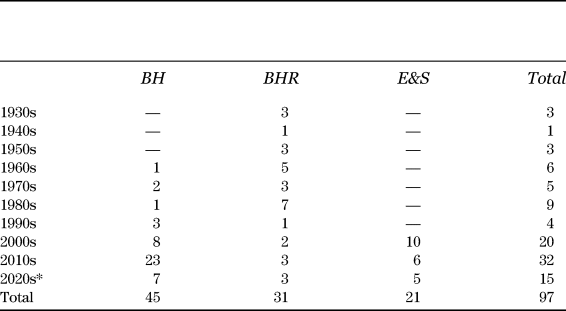
The unique positionality of the field is evidenced by the publication patterns of Chinese business history articles in mainstream business history journals. To illustrate this, I have conducted a comprehensive survey of Chinese business history articles (broadly construed as any article that engages substantively with business in greater China or with Chinese business abroad) published in the three leading business history journals—Business History Review (1926–present), Business History (1958–present), and Enterprise & Society (1999–present).Footnote 5 The results of this survey are presented in Table 1. The data spans the entire publication histories of the three journals and has been aggregated by decade.
China-Related Articles in Business History Journals

* Includes articles available for search as of September 2021. Notes:
1. Business History Review (1926-present) ran the 1982 special issue “East Asian Business History,” which included six China-related articles.
2. Enterprise & Society (1999-present) ran the 2005 special issue “Business History in Modern China,” which included 4 articles.
3. Business History (1958-present) ran the 2015 special issue, “History and Evolution of Entrepreneurship and Finance in China,” which included 4 articles.
The data yields several important findings. First, we observe that these three journals have publish a total of only 97 China-related articles published over their entire publication histories. For the purpose of comparison, a quick search of the online databases for articles that include the words “Japan” or “Japanese” in their titles yields 167 unique results (50 from Business History, 46 from Business History Review, and 71 from Enterprise & Society). Although this figure provides only a lower-bound estimate of the total number of Japan-related articles, it suggests nearly a two-fold difference in publication volume between the two fields. Second, we find that while the field of Chinese business history may be comparatively small, there is a strong upward trend in the total number of articles being published since the 2000s. From the 1930s to the 1990s, the overall engagement with Chinese business history remained low, with the exception of a special issue of Business History Review published in 1982. However, since the 2000s, there has been a sizable uptick, driven in large part by the growing number of articles published in Business History. This trend holds even when we take into account the launch of Enterprise and Society in 1999 and the subsequent publication of two special issues on Chinese business history (see Table notes).
A similar trend can be observed for conference papers presented at the annual meetings of the Business History Conference (BHC). In Figure 1, I have illustrated the total numbers of Chinese business history presentations at the BHC since 1990. I divided the papers into two cohorts based on whether they were presented as part of a “China-specific” panel (defined here as a panel explicitly focused on China or East Asia) or a “general” panel. While there is a large degree of year-to-year variability, we can again observe two general trends. First, while Japanese business history has commanded a strong presence in the BHC since the 1960s, it was only in the early 2000s that Chinese business history gained footing; only two articles were presented throughout the 1990s, but the number grew to twenty in the 2000s and thirty in the 2010s. Second, while the inclusion of Chinese business history papers was initially driven by the formation of China-specific panels, there has been a gradual increase in the number of papers presented in general panels, especially since 2014. In other words, the data suggests that within the past two decades, Chinese business history has both gained greater representation and become more mainstream within the BHC.
Figure 1.

This analysis, while illuminating, speaks only to Chinese business history's reception within mainstream business history. A cursory analysis of general reviews of the field reveals that scholarship published under the aegis of Chinese business history is in fact much broader and more voluminous. Since 1982, scholars have produced, by my tabulation, no fewer than seventeen substantive English-language reviews of Chinese business history scholarship.Footnote 6 The sheer number of general reviews in relation to the number of aforementioned articles and conference presentations immediately suggests that the majority of cited scholarship has been published outside of major business history venues. And upon deeper analysis we find that this is indeed the case. For instance, in her two authoritative reviews published in Enterprise and Society, Madeleine Zelin cites 80 unique works on business practice in late imperial and early modern China, including one dissertation, 22 articles, and 57 books or book chapters— only four of which (i.e. five percent of the total) were published in business history journals or book series; the other 95 percent of citations reference works published in the disciplines of economics, sociology, law, and area studies. Even the general reviews themselves follow a similar trend: of the seventeen listed general reviews, only five were published in business history journals. Collectively, this data suggests that while Chinese business history is rapidly gaining acceptance in mainstream business history conferences and journals, much of the field remains distal to the discipline.
In this article I will explain why this is the case and outline some of the key challenges and opportunities of further integration. I will do so by first offering a historiographical account of Chinese business history that outlines how it was born of the discipline of area studies and was powerfully shaped by geopolitical forces, but gradually developed its own internal dynamic. I will then discuss several areas of novel inquiry that emerged from this particular historiographical tradition. As we will see, the influence of area studies remains strong in present-day scholarship, which has developed around a different set of questions and concerns than mainstream business history. Finally, I will conclude by arguing how, by engaging with Chinese business history's past and present, we may reflect upon the discipline of business history as a whole and reimagine its future.
A Brief Historiography of Chinese Business History
The study of Chinese business history was born not of the discipline of business history nor of the institutional context of business schools; rather, it emerged in the wake of the Second World War, as part of an effort within the humanistic and social sciences to satisfy the needs of US foreign policy. With the announcement of the Truman Doctrine in 1947 and the Chinese Communist's victory over their Nationalist rivals in 1949, producing China experts came to be understood as a matter of urgent national security. In an “act of national policy’’ and with congressionally approved funding, academic institutions established area studies centers, such as the Center for East Asian Research at Harvard University, with the explicit aim of ‘‘creating a body of knowledge and a corps of teachers that the country needed.”Footnote 7 These institutions fostered a new generation of scholarship that broke with the earlier Sinological tradition by applying the theories of history and the social sciences to situate the “study of China within a discipline.”Footnote 8 It was within this disciplinary project that histories of Chinese business were first produced.
The foremost concern of early area studies scholarship was explaining why China, a once-prosperous civilization with a long history of business and commerce, had “failed” to experience indigenous capitalist industrialization. Building upon Max Weber's theory of capitalist rationality, historians and social scientists emphasized the cultural, technological, and managerial backwardness of Chinese enterprises.Footnote 9 For example, in his study of “government-owned, merchant managed” (guandu shangban) industrial firms in the late Qing, Albert Feuerwerker argued that China had failed to produce a “genuine industrial revolution” because Confucian bureaucrats, who continued to operate within the framework of a “traditional society and its system of values,” dominated managerial decision-making.Footnote 10 Marion Levy similarly argued that the efficiency of Chinese firms was crippled by the cultural centrality of kinship, which compelled business owners to recruit workers and managers on the basis of nepotistic ties rather than talent.Footnote 11
Others lay the blame at the feet of the Chinese state. Scholars such as Karl Wittfogel outlined the inhibitory effects of despotic rule on development, while Joseph Levenson and Mary Wright emphasized how the traditionalism of Confucian bureaucrats constrained the development of industrial capitalism.Footnote 12 As Ray Huang and Joseph Needham would later argue, this despotism and traditionalism limited innovation and gave rise to a hyper-stable order in which economic institutions had “changed little during the past two thousand years.”Footnote 13 In essence, area studies scholars viewed China as a stagnant society with a “simplex industrial commercial structure” that was culturally and institutionally unequipped to compete in an increasingly globalized economy.Footnote 14 The consensus was that short of a revolution, Chinese business was doomed to languish in the face of competition with modern corporations. Such arguments were not fundamentally different from those of R.H. Tawney, who in the 1930s had written:
“In technique and organization, the major part of [China's] industry belongs either to the pre-capitalist era or to the first infancy of capitalism. Its characteristics are not power-driven machinery, joint-stock finance, and a hierarchy of economic authority, but primitive tools, handicraft methods, and minute investments of capital by merchants or small masters controlling a multiplicity of tiny undertakings.”Footnote 15
Scholars in Mainland China also fixated on China's supposed “failure” to develop but shifted focus to the impact of foreign imperialism. After the Communists defeated their Nationalist rivals in 1949 and assumed control over the Mainland, the Chinese Communist Party promoted business history as part of an effort to “find legitimization in China's past for the domestic and external developments of her most recent present.”Footnote 16 With the explicit support of Mao Zedong, scholars produced a voluminous body of research on commodity circulation, labor differentiation, and the rise of new forms of economic organization. This scholarship sought to identify within China's past “sprouts of capitalism,” i.e. nascent capitalist institutions and organizational forms, and show how these sprouts were trampled upon by foreign imperialism.Footnote 17 Such state-sponsored business history, which would continue to be produced until the closure of universities in 1966, provided historical justification for the Communist revolution as well as for China's withdrawal from the global economy.Footnote 18 Therefore, while Chinese and Western scholars found themselves on opposite sides of a debate, both shared the assumption that China's past was void of indigenous capitalist innovation.
It was only in the late 1970s, when the CCP initiated the “Reform and Opening Up” of the Chinese economy, that Mainland Chinese scholars were provided with the freedom and impetus to overturn this enduring status quo. Under the growing power of political moderates, the CCP initiated a series of structural economic reforms and took tentative steps towards reintegration with the global economy. These changes, in turn, afforded new opportunities to reassess the history of Chinese business. Academic institutions such as Chinese Academy of Social Sciences and the Shanghai Academy of Social Sciences were allowed to publish newly curated collections of company records, and the Chinese Business History Association began organizing conferences and funding research.Footnote 19 With the support of these institutions, pioneering scholars such as Xu Dixin, Wu Chengming, and Li Bozhong led the way in publishing revisionist histories of capitalism in late imperial China.Footnote 20 Others, such as Li Shiyue and Hu Bin, reassessed the legacies of early industrial enterprises and emphasized their positive influence on domestic business.Footnote 21 Others still repackaged old ideas in new frameworks, substituting modernization for class struggle as the guiding theme of history.Footnote 22 Virtually overnight, theories of imperialism-induced stagnation were cast aside in favor of new studies which emphasized China's developmental success and provided historical legitimacy to market-oriented reforms.Footnote 23 This body of scholarship perfectly illustrates how historical narrative is not simply a device imposed on the past to make sense of it, but a “guide to purposeful action directed towards the future.”Footnote 24
The political and economic transformations within China triggered a concurrent revolution in the study of Chinese business abroad. In the summer of 1982, Business History Review ran a special issue on “East Asian Business,” the first institutionalized attempt to outline the contours of Chinese business history and bring it into dialogue with the business histories of Japan, Western Europe, and the United States. In the special issue, historian Hao Yen-p'ing lamented the paucity of the scholarship on Chinese business as well as the dominance of the paradigm that framed change as resulting primarily from China's confrontation with foreign powers; what was needed, Hao argued, was a new generation of scholarship that could confront Chinese business on its own terms, exploring both the “internal” and “external” forces of change.Footnote 25 Two years later in his seminal work, Discovering History in China, Paul Cohen arrived at much the same conclusion and similarly criticized area studies scholars, including Albert Feuerwerker and Mary Wright, for operating within an “impact and response” framework that viewed changes in Chinese society as reflexive responses to challenges posed by “the West.”Footnote 26 Like Hao, Cohen called for a “China-centered” approach that would be more sensitive to Chinese historical trajectories and ascribe greater agency to Chinese historical actors.Footnote 27
Embracing this China-centered approach and drawing upon newly available archival sources, a new generation of scholarship revealed that the late imperial China was in fact a deeply commercialized society, largely unconstrained by traditionalism and state regulation.Footnote 28 In direct opposition to earlier theories of oriental despotism, scholars such as Jing Junjian, Liang Zhiping, and Madeleine Zelin demonstrated that few articles in the Ming and Qing legal codes dealt directly with the regulation of business, and that, by the late Ming, the Chinese state had “all but withdrawn from regulation of business activity.”Footnote 29 Far from stifling innovation, this laissez faire approach to governance facilitated the growth and evolution of private enterprise and commercial institutions. For example, in his seminal study of 19th century Hankou (part of present-day Wuhan), William Rowe showed that business institutions which had evolved according to “the internal logic of China's own socioeconomic development” were completely “modern” in the Weberian sense— they operated on the basis of universalistic principles, enforced private contracts, and were supported by privately-regulated credit markets.Footnote 30 Other scholars challenged Weberian ideal-type comparisons that exaggerated cultural differences between business practices in premodern China and Europe. In their reexaminations of the interaction between Confucianism and traditional business practices, Du Xuncheng, Tang Lixing, and Richard Lufrano each showed that Confucian practices posed few challenges to business and that merchants actively adapted Confucian ideology to their own ends.Footnote 31 Prasenjit Duara similarly challenged characterizations of state-regulated brokers (yahang) as stultifying Confucian bureaucrats, demonstrating how they promoted commercial exchanges through innovative means.Footnote 32 Huang Shaolun and Gordon Redding made bolder claims still, fully inverting the Weberian narrative to argue that Confucian values enabled Chinese merchant networks to better mobilize human and material resources and provided them with key competitive advantages in global markets.Footnote 33
While this China-centered scholarship did much to dismantle constraining paradigms, it also suffered its own limitations: it operated within an intellectual tradition that “seemed to gravitate towards intellectual, cultural, and psychological forms of historical explanation, at the expense of social, political, and economic ones”; it continued to treat business as playing “a passive rather than an active role in shaping late imperial and modern Chinese history”; and it remained narrowly focused on the questions and concerns posed by an earlier generation of area studies scholars.Footnote 34
Beginning in the 1990s though, there were institutional efforts to redefine the study of Chinese business as a distinct field of inquiry and bridge the divide with mainstream business history. In 1990 the Chinese Business History Research Group, an affiliate of the Association for Asian Studies (AAS), created the Chinese Business History Newsletter, an influential community bulletin that published short articles on topics, methods, and sources of Chinese business history as well as information on venues for its dissemination.Footnote 35 In issues of the Newsletter, which continued to be published annually or bi-annually until 2005, scholars reflected on recent developments in the field, articulated its scope and aims, and imagined possible future trajectories. Workshops and conferences also played a key role in forging connections with business historians of Europe, North America, and Japan. For example, a roundtable at the 1991 meeting of AAS organized by Sherman Cochran brought together leading business historians, including Alfred Chandler, Albert Feuerwerker, Madeleine Zelin, Andrea McElderry, and Hamashita Takeshi, to discuss the significance of Chinese business history for the discipline of business history as a whole. Building upon this initial dialogue, many of the same scholars reconvened at a workshop hosted by the University of Akron in 1995, where they presented essays on Chinese business history and its intersections with Western business history.Footnote 36 These exchanges opened up new areas of inquiry and fostered the development of more theoretically-engaged scholarship.
We see the influence of these efforts most clearly in the “markets versus hierarchies” debate. Influenced by Chandler's theory of the American managerial revolution, scholars such as Wellington Chan, Mira Wilkins, and Alice Amsden used organizational capabilities frameworks to explain the dynamics of competition between Chinese firms and foreign multinationals and to echo the claim of earlier area studies scholarship that “traditional Chinese organizational methods stifled modern development.”Footnote 37 However, in the late 1990s, a new body of China-centered research challenged the teleological conceptions underpinning these frameworks. In Encountering Chinese Networks, Sherman Cochran showed that there was no linear evolution of business organization from “traditional” networks to “modern” managerial hierarchies. Rather, both domestic and foreign firms experienced heterogenous, non-linear development with “corporations and networks all engaged in long-term dynamic interaction.”Footnote 38 In her study of the China's first business conglomerate, Elisabeth Köll expanded on Cochran's thesis, demonstrating that even though Chinese industrial enterprises became corporations with shareholders and managerial hierarchies, they continued to be shaped by traditional business practices and retained a “paternalistic, autocratic form of management.”Footnote 39 Kwan Man Bun and, later, Peng Juanjuan similarly highlighted the co-existence of corporate hierarchies and personal networks, showing how they were used in parallel to different ends.Footnote 40 And others demonstrated the relative efficiency of Chinese business networks vis-à-vis Western managerial hierarchies.Footnote 41 These debates not only helped forge stronger connections between Chinese business history and the discipline of business history, but also demonstrated the importance of China-centered perspectives on the evolution of business.Footnote 42
Since the early 2000s, research on Chinese business history, in both English and Chinese, has exploded. Scholars have begun to explore the rich diversity of business institutions and practices in China's past, highlight the local and transnational forces that shaped their evolution, and situate these accounts more squarely in the global history of capitalism. In just the last few years, business history has also experienced something of a revival within China. In 2017 the China University of Political Science and Law established the first research center dedicated to the study of Chinese business history, and scholars at Xiamen University launched the Chinese Business History Workshop, Mainland China's first business history conference. Currently in its third iteration, the workshop has grown to include a consortium of universities, and has brought together, under the banner of business history, scholars working on topics as diverse as family business, factory politics, and infrastructural development.Footnote 43 There are also institution-building efforts in Hong Kong. Ghassan Moazzin and John Wong at the University of Hong Kong recently organized a business history sub-group and an international Chinese Business History Webinar series. Such initiatives have provided critical platforms for Mainland scholars to disseminate their research to larger audiences and dialogue with business historians from around the world.
Rather than attempt an exhaustive survey of these past twenty years of scholarship, in the remainder of this article I will selectively explore a few promising areas of inquiry that I believe hold the greatest potential to build broad generalizations and reshape the discipline of business history as a whole.
Indigenous Business Institutions
For much of the past millennium, the center of the global economy resided not in Europe, but in China. Beginning in the 16th century, the global demand for tea, silk, and porcelain caused silver bullion to flow out of Western Europe and the Americas and into China.Footnote 44 This influx of silver triggered a commercial revolution.Footnote 45 Markets proliferated, productionwas increasingly specialized, and households became enmeshed in regional systems of exchange. By the mid-Qing, China had developed a robust market economy in which “no segment of the population was divorced from the world of business.”Footnote 46 This commercialization also generated tremendous economic growth. According to Angus Maddison's estimations, between 1700 and 1820, China's share of global GDP rose from around 22.3 percent to 32.9 percent.Footnote 47 Indeed, it was only around the turn of the 19th century that the pace of development in Western Europe began to noticeably eclipse that of China.Footnote 48
During China's long commercial revolution entrepreneurs developed sophisticated institutions to facilitate private investment and exchange. Written contracts, originally used for the transfer of land and property, had, by the early Qing, not only become ubiquitous, but had evolved to encompass a wide range of business activities. People used them for making investments, lending money, remitting funds, and establishing business partnerships.Footnote 49 In the absence of a well-defined commercial law, impersonal contracting and investment were carried out through ritual institutions, such as ancestral and religious trusts (tang).Footnote 50 While initially established to provide for the maintenance of ritual sacrifices and to protect property from household division, trusts gradually developed into “an analogue of the business corporation that evolved in the West.”Footnote 51 Trusts enabled investors to pool their capital, share risk, and make large-scale investments in business and real estate.Footnote 52 The returns on these investments were distributed in accordance with the ownership of shares, which, by the mid-Qing, had evolved into fungible assets that could be bought, sold, transferred, or leased.Footnote 53 These indigenous business institutions “offered Chinese businesspeople a rich menu of options that could effectively substitute for many of the critical functions of the corporation.”Footnote 54
While scholars universally acknowledge the diversity and novelty of late imperial business institutions, they continue to debate the degree to which they facilitated or constrained macroeconomic development. Most prominently, David Faure has argued that the business institutions that brought China unprecedented economic growth from the sixteenth to the eighteenth century were also the cause of its subsequent decline.Footnote 55 According to Faure, business in late imperial China was conducted by merchants who “transacted with one another with little resort to the law,” and that innovations in shareholding and contracting occurred within the context of “patronage and incorporation facilitated by ritual” rather than by commercial law.Footnote 56 Because the central aim of ritual corporations was the “promotion of ritual power” instead of the accumulation of profits, “the rules of worship defined the corporation, and substituted for rules that might govern the management of equity.”Footnote 57 This adherence to ritual, Faure argues, stifled financial and organizational innovation. Chinese businesses failed to develop key managerial technologies, most notably double-entry bookkeeping, that might have enabled rational economic calculation, the efficient preservation of capital, and professionalized management— all requisite building blocks for large-scale capitalist enterprise.Footnote 58 In short, Faure concludes that while indigenous institutions were excellent for enabling cooperation and mobilizing resources on a small scale, they ultimately proved inadequate for meeting the greater demands of “railway, mines, steamers, or even factories in the world of steam.”Footnote 59
Other scholars, however, have painted portraits of late imperial business that are at odds with key elements of this narrative. One point of tension concerns the degree to which business was divorced from law. As Madeleine Zelin argues, although imperial governments may have had little interest in setting the “rules of the game” for economic exchange, they still supported the private order by enforcing contractual obligations.Footnote 60 When business disputes arose, aggrieved parties could, and did, turn to legal institutions for recourse. As Phillip Huang and Thomas Buoye show in their studies of local litigation, by the 18th century, magisterial courts were inundated with cases of an economic nature.Footnote 61 The records of these cases indicate a well-defined scheme of property rights, albeit one where property vested to the household rather than to the individual. Qiu Pengsheng and Maura Dykstra have gone further still, demonstrating that Qing magistrates routinely accepted contracts as evidence in their courts, cooperated with merchant associations in judging acceptable business practices, and adjudicated complex business disputes, such as cases of brand name violation.Footnote 62 Collectively, this scholarship suggests that late imperial legal institutions were not an overly limiting factor in the development of capitalist enterprise.
Another vein of scholarship drew upon newly available archival sources to retrace innovations in Chinese accounting. Pioneering research on merchant account books revealed that Chinese businesses maintained sophisticated ledgers that tracked all the necessary information for managing large-scale enterprises.Footnote 63 However, because of their reliance on late 19th and early 20th century sources, these studies were unable to determine whether such techniques emerged indigenously or were imported from abroad. It was only with the rediscovery of accounting documents from earlier periods that scholars could begin to access the capabilities of definitively indigenous accounting practices.Footnote 64 For example, in their analyses of an exceptionally complete collection of accounting books from a single business group (some 475 extant volumes in total), Yuan Weiping, Ma Debin, and Richard Macve meticulously reconstruct the process by which financial statements were produced in the late 18th and early 19th centuries; they show that while indigenous businesses may not have developed double-entry bookkeeping, Chinese accounting was able to adapt to the increasing complexity of commercial and financial transactions.Footnote 65 Cao Shuji and Matt Lowenstein advance the yet bolder claim that Chinese merchants did in fact possess knowledge of double-entry bookkeeping; through a novel cross-analysis of the accounting primers and accounting books of Shanxi merchants, they illustrate how every transaction generated two bookkeeping entries that tracked profits and losses, not just cash flows.Footnote 66 While much more research is needed in this area, and while the more general debate over the significance of accounting to the development of capitalism in China and Europe continues to rage, these works at least show that Chinese accounting did not pose a barrier to the calculation of profits or the rational allocation of capital in late imperial China.Footnote 67
The theoretical conclusions of the aforementioned scholarship find empirical grounding in the work of Madeleine Zelin, who demonstrates that indigenous institutions could, and did, rise to the demands of early industrialization. In her decades of careful research on salt producers in early modern Sichuan, Zelin demonstrates how business partnerships structured through lineage trusts facilitated the growth of China's first “privately owned high-capital, high-throughput industrial enterprises.”Footnote 68 These firms developed novel financial and legal instruments that enabled them to sell shares of future output, attract investors from outside their immediate kinship networks, and pool the massive quantities of capital required for deep-well mining operations.Footnote 69 Although salt yards remained, to a large extent, reliant on personal networks, in this regard they were not so different from contemporaneous firms in New England's textile industry. Indeed, as Zelin shows, the two were comparable along a number of dimensions: both relied heavily on private merchant capital; both evolved from family firms into complex organizations with managerial hierarchies; and both became increasingly vertically integrated through the development of interlocking directorships and partnerships.Footnote 70 While Sichuan's salt yards were exceptional within the late imperial economy, the fact that they achieved such levels of investment and output in the absence of foreign influence poses a serious challenge to the idea that indigenous institutions stifled Chinese industrialization. This, however, remains an area of lively debate, one that will continue to evolve as new archives enable scholars to retrace the evolution of business institutions in greater detail.
Business in Semi-Colonial Context
From the First Opium War (1839–1842) until the end of World War II, business in China operated within the framework of semi-colonialism.Footnote 71 A series of ignoble military defeats at the hands of European powers, and later Japan, forced China to open up “treaty ports,” pay indemnities, and participate, on unequal footing, in a rapidly expanding system of global capitalism. While structural inequalities and a growing technological divide make it difficult for domestic firms to compete with foreign multinational enterprises, many reformers came to believe that the only way for China to resist full-scale colonization was through the development of domestic industrial and commercial capacity; as the prominent intellectual and entrepreneur Zheng Guanying put it, “practicing armed warfare is not as good as practicing commercial warfare.”Footnote 72
Recent scholarship has begun to explore the emergence and evolution of Chinese industrial enterprise within this semi-colonial context. In Empires of Coal, Shellen Wu retraces how the discovery of large coal deposits in the North China Plain by German explorers in 1886 led to the introduction of new technologies, technical knowledge, and managerial practices into China, as well as new fears of imperial conquest. According to Wu, under the influence of German imperialism, the Qing state came to embrace a vision for modern China that was driven by industrial development and fueled by coal. While Qing reformers readily accepted and absorbed European scientific knowledge, they vied with German colonial agencies, such as the Shandong Mining Company, for the control over mineral resources, which they came to see as an “irrefutable part of sovereign power and responsibility.”Footnote 73 This contestation would continue well into the Republican era, when Chinese intellectuals denounced colonial business and championed the advancement of a specifically Chinese geological science.Footnote 74 Wu's work thus reveals the highly entrepreneurial strategies that Chinese agents employed to navigate the constraints of their situated context to promote their local and national interests.
In her book, Navigating Semi-Colonialism, Anne Reinhardt similarly explores the Chinese experience of industrial imperialism through the lens of steam navigation—China's first and only modern transportation network until the introduction of railways in the 1890s.Footnote 75 Reinhardt shows how, within the semi-colonial framework of China's treaty system, Qing officials and businesspeople successfully collaborated with foreign business entities to promote national interests and circumscribe imperialist expansion. When they did voice opposition, it was generally on the basis of economic and political concerns rather than a rejection of modern technologies or foreign business practices. Reinhardt also illustrates how, after the founding of the Republic, rising Chinese nationalism posed new challenges to the system of domestic/foreign collaboration that held together steam navigation networks.Footnote 76 When the Nationalist government came into power in 1927, it legislated new regulations for the shipping industry, established educational institutions to train Chinese officers and engineers, and promoted the development of domestic steamship companies. Reinhardt's findings add to a body of literature which demonstrates the centrality of the state in the development of China's early industrial enterprise.
Most recently, in Railroads and the Transformation of China, Elisabeth Köll retraces the institutional evolution of railroad companies from the late Qing to the post-Mao era, showing how their development was shaped as much by political as economic forces.Footnote 77 Because railways (like steamships) were introduced to China within the context of semi-colonialism, they developed as a collection of independent regional networks and not as a unified national system. Each network was under the control of a different railroad bureau, whose distinctive organizational structure and managerial practices were derived, in part, from the foreign powers involved in their construction. Köll shows how these regional bureaus experimented with new forms of industrial management and successfully resisted government attempts to create an integrated national network (until the creation of the Ministry of Railroads under the PRC). Köll also demonstrates how railways and railroad workers became deeply politicized. In the Republican era, the creation of professional engineering programs in Chinese universities produced cohorts of Chinese engineering graduates with strong ties to the Nationalist Party. After 1949, railroads became an object of state propaganda, being used by the Communists as a symbol of efficiency and punctuality—core social values of New China.
Taken together, the work of Wu, Reinhardt, and Köll overturn enduring characterizations of China's early industrial sector as one of modern technologies anachronistically layered atop a conservative Confucian social structure, or as R.H. Tawney so memorably put it, “a modern fringe stitched along the hem of an ancient garment.”Footnote 78 The industrial capitalism that emerged in the 19th century was modern in every sense. Chinese-controlled mining operations, steamship companies, and railroad bureaus deftly navigated the situated political context, readily absorbing scientific knowledge and adapting foreign practices while promoting their own interests. Moreover, their resistance to industrial imperialism, when it did manifest, was born not of a Luddite response to technological change, but from specific concerns about political and economic sovereignty. These findings also help explain how, in spite of political unrest and ceaseless conflict, China managed to achieve rapid growth, particularly in its modern industrial sector.Footnote 79
A closely related strand of literature explores the entangled histories of business and Chinese nationalism. In China Made, the first book in a trilogy on the history of Chinese consumerism, Karl Gerth retraces the emergence of nationalized consumer culture in Republican China and shows how it “became the site where notions of “nationality” and of China as a “modern” nation-state were articulated, institutionalized, and practiced.” In the “National Products Movement,” entrepreneurs promoted the idea of “product-nationality,” dividing commodities into the conceptual categories of “foreign” and “national,” and making the consumption of the latter a key criterion of Chinese citizenship. By advocating for the patriotic consumption of China-made goods, these entrepreneurs shaped the way Chinese consumers viewed themselves as citizen-participants of a modern nation. As Gerth argues, “Chinese products” and the “Chinese nation,” thus experienced a complex co-evolution, with “consumerism playing a fundamental role in defining nationalism, and nationalism in defining consumerism.”Footnote 80
Other scholars have explored the business strategies adopted by Chinese entrepreneurs to survive in this complex and shifting political landscape. For example, in his research on Chinese businesses under Japanese occupation, Parks Coble shows how many entrepreneurs, in an effort to reclaim property expropriated by the Japanese, cooperated with the Wang Jingwei puppet regime, even while maintaining contact with and supporting the Nationalist regime based in Chongqing.Footnote 81 In a recent article, “Taxi Shanghai: Entrepreneurship and Semi-Colonial Context,” Shuang Frost and I demonstrated how Chinese entrepreneurs co-opted nationalist symbols to create competitive business advantages in Shanghai's foreign-dominated taxi industry; we showed, for example, how one businessman linked the consumption of domestic taxi services to imaginaries of a strong and independent China by running a series of patriotic advertisements and selecting as his company's telephone number the digits 4-0-0-0-0 (a reference to Sun Yat-sen's estimation of the population of China at the founding of the Republic, i.e. 400 million people).Footnote 82 While such strategies had a powerful impact on the shaping of Chinese consumer culture, they were probably motivated as much by profit as by patriotism. As Yao Liang shows in his reexamination of the National Products Movement, Shanghainese beverage companies launched an anti-foreign campaign targeting Coca-Cola, even though the local bottler was Watson's Mineral Water Company, a Chinese-owned firm; this inconsistency, Yao contends, shows how nationalism was sometimes used as a pretext for competition.Footnote 83
Other scholars have examined more directly the business of cultural production. Christopher Reed and Robert Culp each retrace the birth of China's print industry and the evolution of print capitalism from the late Qing to the socialist era.Footnote 84 Reed's work focuses on the central role that entrepreneurs played in bringing together mechanical, managerial, and organization technologies in the building of China's domestic print industry. By approaching prominent historical figures such as Cai Yuanpai, Mao Dun, and Hu Shi as entrepreneurial participants in the print industry, Reed demonstrates the powerful cultural influence these individuals exerted through their business activities as well as the inseparability of “mental” and “material culture.”Footnote 85 Culp's study adopts an organizational approach, following the development of three major publishing houses—the Commercial Press, the Zhonghua Book Company, and the World Book Company—from their founding to the early years of the People's Republic of China (PRC). Culp retraces how cultural production was transformed into industrialized intellectual labor and how economic considerations drove the production of new forms of knowledge, such as dictionaries, textbooks, and serial publications. Culp's findings complement those of Reed, showing how ordinary intellectual laborers played important roles as cultural producers and how “the emergence of industrial capitalism played a huge role in shaping scholarship and culture.”Footnote 86
Collectively, this body of scholarship elevates the concerns of Chinese business history above questions of business success and failure to instead explore how business and nationhood were mutually constructive. Whereas scholarship too often assumes a “one-way relationship” between entrepreneurship and context, focusing on how contextual factors influence and constrain the nature and extent of entrepreneurial activity, the aforementioned works reveal how Chinese entrepreneurs actively reshaped their situated contexts and redefined what it meant to be “Chinese.”Footnote 87 This remains a fertile area of exploration with much work yet to be done. While scholars have begun to reveal the dynamic interplay between business and semi-colonial context, there is more to be known about the mechanisms by which these processes of mutual influence played out. Scholars might explore, for example, how guilds continued to promote the economic interests of their members in the face of efforts to modernize their industries, how business leaders negotiated industrial policies with the Nationalist and Communist governments, and how foreign and domestic firms participated in and reshaped the war effort. Moreover, more effort could be made to connect this research with related studies of other contexts, such as Richard White's seminal study of American “transcontinentals.”Footnote 88
Business and Empire
Another small, yet fruitful, body of work has begun to show how, at the same time as Chinese actors navigated the global framework of semi-colonialism, they also imposed their own form of imperialism upon minority populations in the hinterlands. Though modern China is often written about from the perspective of Han people living along China's eastern coastline, it is a nation-state born of a multilingual and multiethnic empire.Footnote 89 During the Qing dynasty, China's Manchu rulers (an ethnic minority hailing from the Manchurian steppe) engaged in a series of conquests that brought new lands and peoples under their imperial rule. In the second half of the 18th century, during the reign of the Qianlong emperor, the Qing greatly extended its control into Inner Asia, including Mongolia, Xinjiang, and parts of present-day Kazakhstan, Pakistan, and India.Footnote 90 When the Republic of China was founded in 1912, it largely inherited the de jure boundaries of the Qing. And whereas other empires, such as the Ottoman, disintegrated into a collection of ethnically homogenous nation-states, China succeeded in reconstituting and retaining the territory of the former multiethnic empire.Footnote 91
The politics and economics of empire powerfully shaped the evolution of business along China's periphery. In his study of Xinjiang in the century after Qing conquest, James Millward retraces how the imperial state attempted to simultaneously subdue and develop the predominantly Muslim, Turkic-speaking region.Footnote 92 While the Qing initially ran large annual deficits to maintain control, officials employed creative strategies to bolster the self-sufficiency of the region; they innovated new financial institutions, including military-run pawnshops, and encouraged the expansion of business networks. Based on his analysis, Millward concludes that while the conquest of Xinjiang was imperialist, the Qing's relationship with the conquered territory did not fit well into the typical colonial mold: the imperial state initially invested more resources than it extracted from the region and adopted fiscal and ethnic policies that placed Uyghur on par with Han Chinese.
In the more recently published book, Natural Resources and the New Frontier, Judd Kinzley revisits the fiscal crises faced by Qing officials in Xinjiang, but ultimately offers a less optimistic assessment of the motives and legacies of imperialism. Kinzley shows how successive Chinese (and later Soviet) administrations built an extractive infrastructure that exploited Xinjiang's natural resources and gave rise to enduring patterns of inequality. Xinjiang, Kinzley argues, was a territory fundamentally reshaped by “layered” state formation. In order to pursue their extractive interests, imperialist regimes conducted geological surveys, made fixed capital investments in extraction technologies, and built transportation systems to haul away extracted minerals. When subsequent regimes established control in the area, rather than build anew, they expanded upon the existing “layer” of physical and institutional infrastructure. This process of layering created path-dependent imbalances in capital investment that resulted in ever-widening standards of living between the Han-dominated north and the Uyghur-controlled south. By retracing this infrastructural transformation, as well as the subsequent state-sponsored migration of Han peoples into urban industrial centers, Kinzley's work reveals the imperialist roots of economic inequalities and ethnic tensions in present-day Xinjiang.Footnote 93
Imperialism's influence was not, however, limited to China's northern frontier. In Corporate Conquests, Patterson Giersch retraces the rise and fall of private corporations in Yunnan, China's southwestern-most province. In the 19th century, as the regional economies of the Qing empire were growing increasingly commercialized and integrated, Yunnanese entrepreneurs formed shareholding trading companies with Chinese managerial practices.Footnote 94 By using innovative profit-sharing and bookkeeping techniques, these corporations were able to operate business networks across vast distances while maintaining disciplined centralized governance. However, as Giersch shows, beginning around the turn of the century, they were gradually displaced by successive Chinese regimes that wished to expand their control over minority populations and absorb them into a unitary national community. For example, during World War II, Nationalist economic planners attempted to integrate Yunnanese corporations into state development plans. After the Communist revolution in 1949, the CCP used the corporations to consolidate power over the borderland economies, bringing people and resources more fully under its control and channeling them into Han-centric development.Footnote 95 Giersch's work thus reveals how Chinese states co-opted indigenous businesses along the borderlands and suppressed local developmental autonomy.
By taking China's borderlands and its peoples as the loci of their analyses, Millward, Kinzley, and Giersch decenter narratives of Chinese development and fill a critical void in a field that has focused overwhelmingly on China's economic core. Each of these scholars shed new light on the entwined histories of imperialism and business along China's frontier, and the latter two reveal the deep historical roots of present-day ethnic and spatial inequality. When reading Giersch in particular, one cannot help but ponder paths not taken and imagine what China might have been like had indigenous communities had greater autonomy to pursue their own developmental aims. Far more research is needed on the histories of business among cultural, ethnic, and religious minorities and their entanglements with Chinese imperialism. More scholarship should also be done on the history of capitalism and business along China's frontier and its relationship with economic, ecological, and demographic change.
Business in Socialist Transition
Prior to the 2000s, the political economic transformations of China in the 20th century rigidly framed the temporal scope of business history research. For example, nearly all scholarship on Republican Era business, with the notable exception of William Kirby's studies of the wartime economy, took the outbreak of the Second Sino-Japanese War (1937–1945) as their end point.Footnote 96 In these histories, the Japanese invasion was a natural terminus because the advent of the wartime economy was thought to represent a definitive break in the evolution of business organizations and practices. Fewer studies still attempted to bridge the “1949 divide.” Like the Second World War, the Communist victory over their Nationalist rivals was understood as a radical breach in the continuity of Chinese history.Footnote 97 The result was a rather fragmented body of scholarship that emphasized transformations over continuities. However, recent work has begun to fill these gaps by focusing explicitly on how business adapted to periods of uncertainty and change, especially China's socialist revolution.
After the CCP defeated its Nationalist rivals and assumed control over the Mainland, it carried out the “socialist transformation” of the economy in a bid to achieve rapid industrial growth.Footnote 98 In the countryside, households were re-organized, at first voluntarily and later compulsorily, into agricultural collectives that tied them to the land and forced them to produce goods of strategic importance to the state.Footnote 99 At the same time in the cities, small-scale artisans and merchants were collectivized into cooperatives, while larger businesses were gradually nationalized. Intersectoral price policies and a state monopsony over essential agricultural commodities forced rural producers to “sell cheap” and urban consumers to “buy dear.”Footnote 100 Wage controls and formal rationing suppressed urban consumption and helped maintain the disequilibrium between the prices of agricultural and manufactured goods. The resultant surplus was captured by the state and used to finance investments in industry.Footnote 101 By the late 1950s, the preponderance of urban and rural business had been “brought within the orbit” of these socialist institutions, which, despite the CCP's professed commitment to egalitarianism, would give rise to enduring patterns of rural/urban inequality that persist until this day.Footnote 102
While this “socialist transformation” of the Chinese economy has long been written about as a linear, top-down process, new scholarship is revealing that the transition to socialism was far more contingent and negotiated than was previously thought. For instance, while it is often assumed that China's present-day state enterprise system was created by Communist leaders transplanting Soviet institutions, new research shows that it actually arose from “an assemblage of Chinese and imported practices amassed from the 1860s through the 1950s.”Footnote 103 In his analysis of the development of heavy industries from the late Qing until the end of World War II, Morris Bian reveals that the defining elements of the Chinese state-owned enterprise system—bureaucratic governance, distinctive incentive structures, and comprehensive worker welfare—were not adaptations of the Soviet model, but were rather institutional legacies that could be traced as far back as the Self-Strengthening Movement in the Qing dynasty.Footnote 104 Bian argues that the CCP readily built upon institutions that had been established by past regimes, while also taking advantage of political instability to bring about important institutional reforms.Footnote 105 Moreover, even as state-owned enterprises laid the foundations of the socialist economy, they also relied on the support of illicit capitalist networks. As Philip Thai shows, state-owned enterprises depended on smuggled goods to stay profitable in the face of high tariffs and the smuggling business served as an important “lubricant that smoothed the frictions generated by the tumultuous transition to socialism.”Footnote 106
Other scholarship demonstrates that even when the CCP did enact original policies and institute large-scale economic reforms, it often did so reflexively, as responses to newly emerging crises rather than as calculated steps in a socialist masterplan. Even after the creation of the “General Line for the Transition to Socialism” in 1953, party leaders continued to disagree about how best to implement state administration of the economy and how quickly to do so.Footnote 107 The degree to which capitalism should be allowed to exist in service of the socialist economy remained a key point of contention, and that party leaders even went to great lengths “to allay capitalists’ fears, to restore the private sector to health, and to guarantee a certain level of profit for capitalist industry.”Footnote 108 Such concessions enabled many enterprises to continue functioning largely unchanged during the period of socialist transition. For example, in her study of the private lives of Beijing tailors, Antonia Finnane shows that many tailors continued to own and operate their own businesses and even realized new profit opportunities well into the 1950s.Footnote 109
In Red Silk, which similarly explores private textile production in 1950s’ China, Robert Cliver demonstrates that while the process of “socialist transformation” may have been initiated by the central government, its pace and practical implementation was heavily influenced by the actions of local entrepreneurs.Footnote 110 Factory owners and managers adopted an array of strategies to manipulate the socialization of private enterprises and, until 1957, openly criticized shortcomings in its implementation. Most surprisingly, some entrepreneurs even agitated to accelerate the nationalization of the industry, though their reasons for doing so varied. As Cliver argues, some found it difficult to remain profitable under the new system of state-contracting and sought an exit; others found it difficult to enforce labor discipline and hoped to transfer managerial responsibilities to the state; and still others saw a greater opportunity in becoming socialist apparatchiks. To be sure, socialization had its discontents. But, as Cliver shows, it was not a cut-and-dry story of state coercion and private resistance.
Within the transition economy there was even a limited space for capitalists. As Sherman Cochran argues, for many Chinese capitalists the decision of whether or not to flee the Mainland after 1949 involved a complicated calculus; some, like the industrialist Liu Hongsheng, chose to stay, motivated by the belief that their “own brand of capitalism was compatible with communism.”Footnote 111 For some the strategy even paid some dividends. As Christopher Leighton reveals in his doctoral dissertation and forthcoming book, certain capitalists were co-opted by the CCP as powerful instruments of propaganda. The Communist Party made efforts to brand a thin stratum of major industrialists, including the thousand or so “red capitalists” living in Shanghai, as loyal exemplars who had embraced socialist values. There were government directives regarding what photos of capitalists could be used in newspapers, how they should be portrayed in books and films, and how they should be spoken of to the masses. Even after socialist transformation was completed in 1957, red capitalists continued to play important symbolic functions; they were often paraded in front of visiting diplomats to show how well the regime (in contrast to the Soviets) treated its capitalists.Footnote 112
Collectively, this scholarship reveals important threads of continuity that ran throughout mid-20th century China. It shows that China's transition to socialism did not represent an immediate break with the past, nor did it unfold in accordance with plans made inside the walls of Zhongnanhai (the CCP's seat of power in Beijing). Rather, it was a contingent and negotiated process that, initially, “amounted to little more than changing the name of the factory and calling the former owner ‘comrade’ instead of ‘boss.’”Footnote 113 By exploring how this process unfolded, and by reconstituting the uncertain and ad-hoc nature of reforms in the early PRC, these works offer an important corrective to scholarship that exaggerates the power of the socialist state. They also lay the groundwork for a periodization of Chinese business history independent of (or at least not wholly subjugated to) the history of political transitions and have direct implications for theories of how entrepreneurs and firms operate under conditions of Knightian uncertainty.
However, it is important to note that this body of scholarship also suffers from its own temporal limitation: it either takes as its endpoint the completion of “socialist transformation” in 1958 or draws a thin line from the late 1950s to the start of economic reforms in the late 1970s. As a result, the ways in which business operated during China's socialist era (1958–1978) remain a black box.
Business Under Socialism
The launch of the Great Leap Forward in 1958 represented a turning point in the political economy of China. Under the command of Mao Zedong, the CCP attempted to rapidly develop China's agricultural and industrial sectors in parallel and thereby “leap forward” into a more advanced stage of socialism. Under the banner of this utopian scheme, the Party implemented policies to bring the economy more fully under state control. Private farming was prohibited.Footnote 114 Labor markets were abolished.Footnote 115 Cash was withdrawn from circulation.Footnote 116 And “puppet-like micro-management institutions” were established to supervise and coordinate exchange.Footnote 117 According to scholars, such measures “totally squeezed out the market” and transformed China's commercial economy into a “cellular” one with highly atomized production and exchange.Footnote 118 They were also the proximate cause of the Great Famine (1959–1961), the largest such disaster in recorded history.Footnote 119 Although the most radical policies were walked back in the aftermath of the famine, many were revitalized during the Cultural Revolution (1966–1976) and would persist until the liberalizing reforms of the 1980s.
While recent scholarship has shed light on the evolution of business and state-business relations during the first decade of the PRC, the subsequent period of socialist experimentation, bookended by the launch of the Great Leap Forward in 1958 and the start of reform and opening up in 1978, remains the principal domain of political scientists, sociologists, and economic historians whose work has focused on topics related to ideology, political institutions, and class identity. There are, for example, robust literatures on workers as political actors and their ever-shifting relationship with the party-state;Footnote 120 the history of danwei (work units) as political organizations that not only provided welfare and wages, but also implemented mass surveillance and investigated crimes;Footnote 121 the long-term effects of political violence on economic development;Footnote 122 and the ways that institutional incentives in agricultural collectives and state-owned enterprises shaped worker performance.Footnote 123 However, while much of this scholarship is of direct relevance to business history, it does not share the central concerns or frameworks of the discipline. For example, Dorothy Solinger's seminal text on socialist business, Chinese Business Under Socialism, approached the topic through the lens of political science, focusing on high-level policy debates and the possibilities of political coalition formation.Footnote 124 As a consequence, issues such as the evolution of management practices and everyday business practices under socialism remain largely uncharted territory.
Only recently have historians begun to address this lacuna. One such attempt is presented in Unending Capitalism, the third in a trilogy of histories of consumerism in 20th century China. In it Karl Gerth argues that the economic system that the CCP engineered was not a true socialism, but a form of industrial capitalism that moved along the spectrum of private-to-state control. During China's socialist era, consumerism remained core to industrial development because the state required a consumer base for the products it manufactured. The socialist state developed its own versions of mass-produced branded products, such as bicycles, sewing machines, and wristwatches, and attempted to manage how they were promoted and consumed. However, as Gerth argues, consumerism became self-expanding and quickly grew beyond the state's power to control. Consumers had unpredictable desires, used goods in novel ways, and attached value to things on purely aesthetic grounds. Eventually, even political objects, such as Mao badges, became commodified, and new identities were formed around the desire for and acquisition of said goods. Thus, the CCP's policies had the opposite of their intended effect. Consumerism, Gerth argues, “was in fact a structural consequence of the state's social and economic policies,” and this partially explains why after three decades of efforts to build socialism, capitalism ultimately won out.Footnote 125
While Unending Capitalism has been commended for shedding new light on socialist consumption and bringing the historical experience of China into stronger dialogue with that of the Soviet Union and Eastern Germany, it has also elicited charged responses from PRC historians.Footnote 126 In a recent issue of PRC History Review a roundtable of nine scholars offered reflections on Gerth's work, with most focusing on what they viewed as the book's conceptual slippages. Rebecca Karl, for example, accuses Gerth of employing a “double sleight of hand,” first substituting capitalism for consumerism, and then declaring that consumerism is incompatible with socialism.Footnote 127 Laurence Coderre puts her critique in equally strong terms, arguing that by reframing the Maoist era “as part of an integrated world history rather than an isolated ‘socialist interlude’,” Gerth completely negates recent efforts to “take Chinese socialism seriously.”Footnote 128 These critiques highlight the potential pitfalls of attempting to integrate China into the global history of capitalism before the requisite empirical foundations have been laid.
In order to avoid such theoretically abstract debates, Madeleine Zelin has suggested that business historians begin by “asking the smaller questions” such as “how did business work? What mechanisms, institutions, and patterns of interaction were used to solve what problems, and to what new problems did they give rise?”Footnote 129 Philip Scranton's Enterprise, Organization, and Technology in China provides a prime example of how such an endeavor might be carried out for the study of business under socialism. Drawing upon recently-opened US government archives to retrace the mundane and innovative practices within four sectors of China's planned economy—agriculture, infrastructure, industry, and commerce—Scranton shows that “communist business” was not a contradiction in terms, but a “project in motion.”Footnote 130 What distinguished business in socialist China from that of communist central Europe was its commitment to ceaseless experimentation. Firms experimented with new production methods and new technologies, and this “recurrent willingness to try novel approaches” instilled in the Chinese economy “far more creativity in matching resources to needs than Central European socialisms developed.”Footnote 131 Moreover, as Scranton points out, these businesses actually shared many similarities with their capitalist counterparts: both sought to produce goods cheaply, provide services, pay their workers, and respond to crises. While Scranton's work is somewhat limited by its reliance on US government sources, it provides a valuable framework for the study of formal socialist business and poses important questions that will help guide the future development of the field.Footnote 132
Other scholars have adopted an alternative approach, shifting attention from formal business systems to informal business practices. For example, in his study of traveling storytellers, He Qiliang shows how market forces continued to shape popular culture throughout the 1960s and 1970s. Despite the repeated efforts of the CCP to suppress cultural markets during the Cultural Revolution (1966–1976), the state's lack of financial resources and limited administrative capacity meant that market-based cultural consumption continued unabated.Footnote 133 So too did other types of illicit production and exchange. In his research on the history of Chinese printing shops, Feng Junqi has shown how the industry was established by entrepreneurs in Hunan who acquired the requisite skills and knowledge by launching illicit typewriter repair businesses in the 1960s; by gradually expanding their operations through localistic networks, these entrepreneurs came to control roughly 85 percent of the contemporary printing and copying services market in China.Footnote 134 In my own work, I draw upon grassroots sources collected from flea markets to show how, within the interstitial spaces of the socialist economy, private entrepreneurs, ranging from petty ration coupon traders to underground factory owners, continued building productive assemblages of capital, labor, and knowledge. Over time these private activities grew in scale and scope, and by the mid–1970s, had become pervasive and normalized at the grassroots level.Footnote 135
While still sparse, this nascent body of scholarship is revealing important threads of continuity that ran through the early decades of the PRC as well as unique characteristics of business under Chinese socialism. These works help explain, for example, why China continued to experience a reasonable rate of GDP growth after “socialist transformation,” and why the nation was able to rapidly transition from a collectivist to a market-oriented economy, whereas other socialist societies failed to achieve similar results. Scranton and Gerth's work also highlight the opportunities and challenges of adopting comparative perspectives in the study of socialist business. However, far more questions than answers remain. What, for example, were the managerial and accounting practices of socialist enterprises? To what extent did formal socialist enterprises engage in illicit profit-making activities? To what degree did China's “first generation of entrepreneurs” in the 1980s adapt informal business practices and networks that had formed during the socialist period? These and other basic questions will need to be answered before scholars can begin to bridge the chasm that continues to divide China's pre-socialist and post-socialist eras.
Conclusion: The Promise of Chinese Business History
In this article I have developed a revised historiography of Chinese business that attempts to bring together a diverse body of scholarship and situate it within a shared intellectual tradition. As I have shown, Chinese business history emerged from the context of the early Cold War and developed within the confines of area studies.Footnote 136 For decades, the scholarship was principally motivated by geopolitical concerns and devoted itself to explaining why China “failed” to achieve the same developmental outcomes as Europe. Indeed, when Business History Review ran its first special issue on East Asian Business in 1982, Chinese business history remained, in the words of Hao Yen-p'ing, a “less developed subfield of America's postwar China studies” that was constrained by the frameworks employed by earlier generations of scholars.Footnote 137
It was only with the “China-centered” turn in area studies circa the mid-1980s, that scholars began grappling with the evolution of Chinese business on its own terms. In a somewhat ironic twist, as the People's Republic of China grew more economically prosperous, the field that was originally unified by the goal of explaining China's developmental failure became preoccupied with identifying the factors underlying its success. Old histories were rewritten through the lens of post-socialist development. And through this process of reevaluation, scholars displaced retrospective rationalizations of failure with more nuanced narratives that highlighted the uncertainty, contingency, and unrealized possibilities of Chinese business history. At the same time, widening archival access facilitated more detailed and more diverse research. By the mid-1990s a critical density had been reached such that scholars began synthesizing formerly fragmented research and engaging in constructive theoretical debates. While Chinese business history remained small in relation to the business histories of North America, Europe, and Japan, the field was, as prominent scholars predicted, poised to take-off.Footnote 138
In the second part of the article, I highlighted five novel research trajectories that have emerged from this intellectual tradition. I first showed how, in the past two decades, scholars have explored in unprecedented detail the evolution of China's indigenous business institutions, the strategic decisions of early industrial firms, and the dynamic relationship between business and imperialism. Research in these areas has revealed new aspects of the dynamic interplay between business and context in China and has enriched our understanding of the historical antecedents of present-day developmental inequalities. Next, I explored the nascent bodies of research on the dynamics of business under socialist transition and Chinese socialism. Whereas earlier studies tended force their periodizations, nesting histories of Chinese business within the contours of China's political transformations, this more recent research has challenged old temporal boundaries by exploring how business responded to uncertainty and systemic change. Equally important, it has begun to revel how businesses and businesspeople operated within contexts where institutions were unsupportive or even antithetical to capitalist activity. Collectively, these clusters of scholarship have not only pushed the field in new and exciting directions, but also, in the words of Christopher Reed, have been “actively involved in revising the canon of international business history as well as the master narrative of Chinese history itself.”Footnote 139
In retracing the unique genealogy of Chinese business history, we find that the field has anticipated many “future agendas” laid out by prominent business historians. In Reimagining Business History, a wide-ranging prospectus for new directions in business history research, Philip Scranton and Patrick Fridenson highlighted the need for the discipline to reorient its focus from histories of businesses and towards “business in history.” They urged scholars, for example, to eschew “privileging the firm” by instead examining non-traditional business enterprises and considering the “broader ecology of organizational life forms” (p. 27). They also suggested that historians deconstruct traditional private-public boundaries by exploring the co-evolution of business and government and the changing relationship between business and society.
As I have shown, it is in these particular areas that Chinese history has excelled. Scholars of Chinese business have focused more on government enterprises, ritual institutions, and business networks, than on modern corporations. This difference in analytic orientation has enabled them to highlight entirely different sets of business practices that were shaped primarily by political and cultural (rather than legal) institutions. We have seen, for example, how practices of incorporation and shareholding emerged from ritual institutions that were originally designed to provide for the maintenance of sacrifices for ancestors and deities. This created a different set of path dependencies that in some ways enabled and in other ways constrained the development of large-scale business activities. Exploring the strangeness of these corporations that were organized on the basis of ritual functions enables us to reevaluate our shared assumptions about the nature of business and what we, as business historians, ought to include in our scope of inquiry.
Chinese business history has also been attuned to the dynamic interaction between business, government, and society under conditions of relentless change. China is a civilization that has undergone a remarkable series of transformations in a concatenated span of time. In less than a century, a “semi-colonized” empire was dethroned by a republic, which in turn, was invaded by foreign imperial powers and then displaced by a socialist state. This contextual metamorphosis continually altered the landscape of risks and opportunities for businesses and continually evoked new sets of adaptive responses. We have seen, for example, how Republican era entrepreneurs harnessed nationalistic symbols to their advantage and, in so doing, helped reshape collective imaginaries about what it meant to be Chinese. We have also seen how ideas about the relationship between consumption and identity were reborn within the context of socialism and continued to influence consumer habits and desires. By juxtaposing these radically different histories of business and retracing the co-evolution of business and context over time, we can better theorize the roles of business in historical change as well as its relationship to societal transformation. In these ways, the historiography of Chinese business history serves as a useful mirror with which to creatively reflect on mainstream business history.
Even more importantly though, engaging with Chinese business history affords an opportunity to reimagine the scope and ambition of the discipline. A decade ago, in “Business History: Time for Debate,” Walter Friedman and Geoffrey Jones argued that business history, as a discipline, has been overly modest in its attempt to pose “big questions” and define transdisciplinary debates, such as those surrounding the Industrial Revolution and the Great Divergence.Footnote 140 There was, and remains, much truth in this statement. However, as I have shown, the field of Chinese business history has at least participated in trans-disciplinary debates, and not without some degree of impact. Having developed within the tradition of “area studies,” Chinese business history was never regarded as being wholly distinct from the economic, political, and social history of China. This was enabling in the specific sense that scholars were motivated by many of the same questions and concerns that motivated researchers in adjacent disciplines (especially economic history, sociology, and political science). I have shown, for example, how the field has long been preoccupied with explaining the relationship between political institutions and business systems, the role of the state in fostering industrialization, and the divergence in the developmental outcomes of China and Western Europe; these have been and continue to be vibrant areas of debate, with competing explanations now ranging from the cultural, to the material, to the organizational and institutional. This interwoven body of research thus provides one possible template of inter-disciplinary engagement that business historians working on other contexts might find useful to emulate.
Chinese business history's prominence will likely continue to grow in tandem with the rising geopolitical and economic power of the PRC. China is, after all, too big to ignore. Anything that happens to one-fifth of the global population in the world's second-largest economy simply cannot be waved away as an outlier. The importance of understanding Chinese business also grows with the increasing significance of Chinese firms in the global economy. Gone are the days when western scholars can casually deride Chinese entrepreneurial innovations as merely products of copycatting and IP infringement; increasingly in today's digital economy, it is the US, European, and Japanese firms that are emulating the innovative business models and technological systems of their Chinese counterparts. Indeed, the field now faces a future in which, sometime within the next few decades, Chinese firms will likely dominant the ranks of the Fortune Global 500 and China will resume its historical place as the largest global economy. These unfolding realities will inevitably make engaging with China's past more central in business history.
However, in order for Chinese business history to realize its potential it must also break from the constraints of its intellectual tradition, engage more directly with scholarship being produced within the discipline of business history, and work to build broad generalizations that apply beyond China. Chinese business history is, to be sure, a field with high barriers to entry. The linguistic demands and the idiosyncrasies of Chinese archives alone make it difficult for non-specialists to engage at a non-superficial level. While this represents a major challenge for single-author comparative work, it also implies opportunities for greater collaboration. By working together with specialists of business history's traditional core (i.e., North America, Europe, and Japan), as well as those working in newly emerging fields (e.g., emerging markets, post-socialist societies, non-capitalist contexts), Chinese business historians can co-define and co-explore new “big questions,” such as: How have businesses interacted with and reshaped different institutional contexts? In what ways did businesses contribute to the rise of nation-states and the construction of modern national identities? What roles have non-traditional businesses (e.g., cooperatives, mutual aid societies, illicit enterprises) played in the stabilization and/or transformation of economic systems? Through such collaborative engagement, scholars of Chinese business history can move beyond the limitations of area studies and play a central role in the reimagining of business history as a global discipline with trans-disciplinary influence.