1 Introduction
In this paper
 $G=(V(G),E(G))$
will represent a connected simple graph whose order is
 $n(G)=|V(G)|$
. We will indicate that vertices u and v are adjacent by writing
 $u \sim v$
. A
 $u,v$
-path of length
 $\ell $
is a sequence
 $u=u_0,u_1,\ldots ,u_{\ell -1},u_{\ell }=v$
of distinct vertices of G such that
 $u_i \sim u_{i+1}$
for
 $0 \leq i < \ell $
. The distance
 $d_G(u,v)$
between two vertices
 $u,v\in V(G)$
is the length of a shortest
 $u,v$
-path. A clique of G is a set
 $S\subseteq V(G)$
of mutually adjacent vertices, that is, S induces a complete graph. The clique number, denoted by
 $\omega (G)$
, is the cardinality of a largest clique in G. For a given set
 $S\subset V(G)$
, the subgraph induced by S will be written
 $G[S]$
. For a positive integer k we will use the notation
 $[k]=\{1,\ldots ,k\}$
.
General position sets in graphs have been widely studied in recent years (see, for example, [Reference Anand, Chandran, Changat, Klavžar and Thomas3, Reference Ghorbani, Klavžar, Maimani, Momeni, Rahimi-Mahid and Rus5, Reference Klavžar, Patkós, Rus and Yero6, Reference Patkós10–Reference Tian, Xu and Klavžar12, Reference Yao, He and Ji15]). The concept was independently introduced in [Reference Manuel and Klavžar8, Reference Ullas Chandran and Parthasarathy13]; the terminology and set-up of the present work follow the former paper. The general position sets of hypercubes and integer lattices were investigated earlier in a different context in [Reference Körner7, Reference Pálvölgyi and Gyárfás9], respectively.
One of the original motivations of the general position problem in [Reference Manuel and Klavžar8] was to place a set of robots in a graph such that any pair of robots situated at vertices
 $u,v$
can exchange signals by any shortest
 $u,v$
-path without being obstructed by another robot. This static concept can be transformed into a dynamic one which is more closely related to practical problems in robotic navigation and transport. In fact this research was inspired by the delivery robots belonging to Starship Technologies
 $\circledR$
[14] that deliver groceries to the inhabitants of cities including Milton Keynes, home of the Open University. For some related studies on robot mobility in computer science see [Reference Aljohani, Poudel and Sharma1, Reference Aljohani and Sharma2, Reference Di Luna, Flocchini, Chaudhuri, Poloni, Santoro and Viglietta4]. We introduce a variant that describes the largest number of robots that can travel through a network such that each vertex of the network can be visited by a robot, while at every stage any pair of robots can see each other through any shortest path between their positions without being obstructed by another robot. We now describe this concept in greater detail.
A set of vertices S of a graph G forms a general position set if no three distinct vertices from S lie on a common shortest path. The general position number
 $\operatorname {\mathrm {gp}} (G)$
of G is the cardinality of a largest general position set. Assume that to each vertex of a general position set
 $S\subseteq V(G)$
one robot is assigned. The robots can move through the graph one at a time. We say that a move by a robot is legal if the robot moves to an adjacent unoccupied vertex such that the new set of occupied vertices is also in general position. If there exists a sequence of legal moves such that every vertex of G can be visited by at least one robot, then we say that S is a mobile general position set. The mobile general position number
 $\operatorname {\mathrm {Mob_{gp}}}(G)$
of G is the cardinality of a largest mobile general position set of G. Such a set will be briefly called a mobile gp-set of G. We will also abbreviate the term ‘mobile general position set’ to mobile set and ‘mobile general position number’ to mobile number. A move by a robot from vertex u to a neighbour v will be denoted by
 $u {\,\rightsquigarrow \,} v$
.
The paper is organised as follows. In the rest of this introduction we give some preliminary results and examples. In Section 2 we consider graphs with cut vertices, in particular block graphs, rooted products and unicyclic graphs. In Section 3 the mobile number is determined for Kneser graphs
 $K(n,2)$
and line graphs of complete graphs. We conclude the paper with some open problems.
1.1 Preliminaries
We begin with the following bounds.
Lemma 1.1. If G is a graph with
 $n(G)\ge 2$
, then
 $2\le \operatorname {\mathrm {Mob_{gp}}}(G) \leq \operatorname {\mathrm {gp}}(G)$
. Moreover, for any integers
 $a,b$
with
 $2 \leq a \leq b$
there exists a graph with
 $\operatorname {\mathrm {Mob_{gp}}} (G) = a$
and
 $\operatorname {\mathrm {gp}} (G) = b$
.
Proof. As the set of occupied vertices at any stage must be a general position set of G, we have
 $\operatorname {\mathrm {Mob_{gp}}}(G) \leq \operatorname {\mathrm {gp}}(G)$
. Any set of two vertices is in general position. Let
 $S = \{ u,v\} \subset V(G)$
be any set of two vertices of G; then for any vertex w of G the robot closest to w (say,
 $d_G(u,w) \leq d_G(v,w)$
) can move along a shortest path to w without crossing the robot at vertex v, so that
 $\operatorname {\mathrm {Mob_{gp}}}(G) \geq 2$
. To prove the second assertion, we claim that if
 $r_1 \geq \cdots \geq r_t$
, where
 $t \geq 2$
and
 $r_1 \geq 2$
, then
 $$ \begin{align} \operatorname{\mathrm{Mob_{gp}}}(K_{r_1,\ldots ,r_t}) = \max \{2,t-1\}\,. \end{align} $$
Let S be the set of occupied vertices in the initial configuration of
 $\operatorname {\mathrm {Mob_{gp}}}(K_{r_1,\ldots ,r_t}) $
robots. It is trivial that two robots can visit every vertex and remain in general position, so assume that
 $|S| \geq 3$
. Assume that S contains at least two vertices from the same partite set W. Hence, there can be no robots in the other partite sets and, furthermore, if there are at least three robots, then no robot can move from W to a different partite set. Therefore, if
 $\operatorname {\mathrm {Mob_{gp}}}(K_{r_1,\ldots ,r_t}) \geq 3$
, then the set of occupied vertices at any stage contains at most one vertex from each partite set. If each partite set contains an occupied vertex, then no robot can move without making a partite set containing at least two robots. So it follows that
 $|S| \leq t-1$
. On the other hand, clearly
 $t-1$
robots can remain in general position and visit every vertex of
 $K_{r_1,\ldots ,r_t}$
.
The second assertion now follows from (1.1) upon taking a complete a-partite graph with largest part of order b.
We conclude this introduction with some examples. First,
 $\operatorname {\mathrm {Mob_{gp}}}(C_4) = \operatorname {\mathrm {Mob_{gp}}}(C_6) = 2$
and if
 $n\ge 3$
and
 $n\ne 4,6$
, then
 $\operatorname {\mathrm {Mob_{gp}}}(C_n) = 3$
. Since
 $\operatorname {\mathrm {gp}}(C_4) = 2$
, Lemma 1.1 yields
 $\operatorname {\mathrm {Mob_{gp}}}(C_4) = 2$
. In
 $C_6$
, a general position set of order
 $3$
is an independent set. But such a set is not a mobile set, hence
 $\operatorname {\mathrm {Mob_{gp}}}(C_6) = 2$
. Assume now that
 $n\ge 3$
and
 $n\ne 4,6$
. Set
 $V(C_n) = \mathbb {Z}_n$
. When
 $n=2r+1$
, consider the general position set
 $\{0,r,r+1\}$
. The sequence of moves
 $r+1 {\,\rightsquigarrow \,} r+2$
,
 $0 {\,\rightsquigarrow \,} 1$
and
 $r {\,\rightsquigarrow \,} r+1$
keeps the property of being in general position. By iterating this procedure, each vertex of
 $C_n$
will be visited by a robot. As
 $\operatorname {\mathrm {gp}}(C_n) = 3$
, Lemma 1.1 implies that this set is a mobile gp-set. The second case to consider is when n is even. Then consider a set of three vertices that are as equidistant as possible. By moving robots sequentially along the cycle in the same direction, all vertices will be visited by the robots.
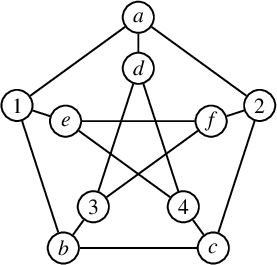
Consider next the Petersen graph P. A scheme that allows four robots to visit every vertex of P in general position is shown in Figure 1; robots are initially positioned at the vertices labelled 1, 2, 3 and 4. The robot at position 1 can visit vertices a, b and e, the robot at
 $3$
can visit vertex d and the robot at 2 can visit vertices c and f.
Four robots traversing the Petersen graph in general position.

To see that four robots is optimal, suppose for a contradiction that
 $K \subseteq V(G)$
is an initial configuration of at least five robots in general position. Observe that as
 ${\alpha (P) = 4}$
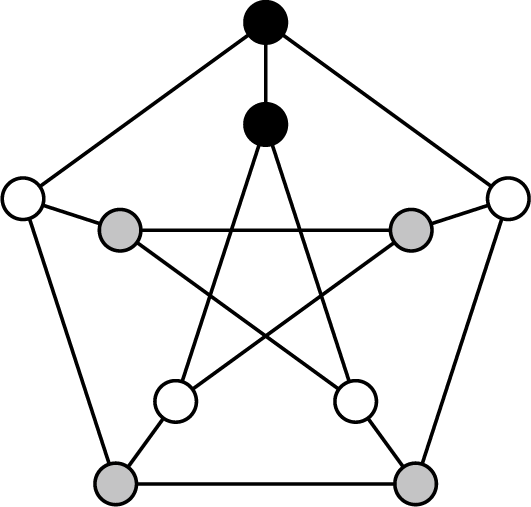
and P is edge-transitive, we can assume that K contains the two black vertices in Figure 2. It is easily verified that the remaining robots must be situated on a subset of the grey vertices. If all four grey vertices are occupied, then no robot can move at all without creating three-in-a-line. If there are just five robots, then in the two independent edges joining the grey vertices one edge must have both incident vertices occupied by robots, while the other edge has just one robot on it. However, in this configuration the only move that can be made is by the robot on the edge containing one robot and this robot can only move to the unoccupied grey vertex and back, so that not all vertices of P can be visited. We have thus shown that
 $\operatorname {\mathrm {Mob_{gp}}}(P) = 4$
.
Five robots cannot visit every vertex of the Petersen graph.

Note that
 $\operatorname {\mathrm {Mob_{gp}}}(G) = n(G)$
if and only if G is complete. Moreover,
 $\operatorname {\mathrm {Mob_{gp}}}(G) = n(G)-1$
if and only if G is obtained from
 $K_{n-1}$
by attaching a leaf to one of its vertices. The latter result can be deduced from [Reference Ullas Chandran and Parthasarathy13, Theorem 3.1] in which the graphs G with
 $\operatorname {\mathrm {gp}}(G) = n(G)-1$
are characterised; among the two families described there, the above stated graphs are the only ones with the mobile number equal to their general position number. To characterise all graphs with the mobile number equal to their general position number seems to be difficult.
2 Graphs with cut-vertices
In this section we first give a technical lemma about mobile sets in graphs with cut-vertices. Then we apply it to block graphs and to rooted products.
Lemma 2.1. Let v be a cut-vertex of a (connected) graph G and let
 $C_1, \ldots , C_k$
be the components of
 $G-v$
. Let
 $G_i = G[V(C_i)\cup \{v\}]$
,
 $i\in [k]$
. Let S be a mobile gp-set of G.
-
(i) If
 $v\in S$
, then
$S\subseteq V(G_i)$
for some
$i\in [k]$
.
-
(ii) If
$v\notin S$
, then
$S\subseteq V(C_i)\cup V(C_j)$
for some
$i,j\in [k]$
. Moreover, either
$|S\cap V(C_i)|\le 1$
and
, or
$|S\cap V(C_j)|\le 1$
and
. In addition, if
$|S\cap V(C_i)|=1$
, then
.


Proof. (i) Suppose that
 $v\in S$
,
 $v_j \in S\cap V(C_j)$
and
 $v_k \in S\cap V(C_k)$
, where
 $j\ne k$
. Then v,
 $v_j$
and
 $v_k$
are not in general position.
(ii) Assume
 $v\notin S$
. Suppose that there exist vertices
 $v_i \in S\cap V(C_i)$
,
 $v_j \in S\cap V(C_j)$
and
 $v_k \in S\cap V(C_k)$
, where
 $|\{i,j,k\}| = 3$
. Consider now the moment when the vertex v is visited for the first time by some robot. At that moment we get a contradiction with (i). It follows that
 $S\subseteq V(C_i)\cup V(C_j)$
for some
 $i,j\in [k]$
. By a similar argument we see that S has at most one vertex in
 $C_i$
or
 $C_j$
; without loss of generality assume
 $|S\cap V(C_i)|\le 1$
. If
 $|S\cap V(C_i)| = 0$
, then
 $S = S\cap V(C_j)$
and hence S is in particular a mobile gp-set of
 $C_j$
. Thus,
 $|S| = |S\cap V(C_j)| \le \operatorname {\mathrm {Mob_{gp}}}(G_j)$
.
Assume next that
 $|S\cap V(C_i)| = 1$
. The statement clearly holds if
 $|S\cap V(C_j)| = 1$
, hence we may consider the case when
 $|S\cap V(C_j)| \ge 2$
. Then the vertex v must be visited by the unique vertex from
 $S\cap V(C_i)$
, for otherwise we are in contradiction with (i). At that moment,
 $(S\cap V(C_j))\cup \{v\}$
is a mobile gp-set, which in turn implies that
 $|S\cap V(C_j)| < \operatorname {\mathrm {Mob_{gp}}}(G_j)$
.
Corollary 2.2. Let v be a cut-vertex of a (connected) graph G, let
 $C_1, \ldots , C_k$
be the components of
 $G-v$
and let
 $G_i = G[V(C_i)\cup \{v\}]$
,
 $i\in [k]$
. Then there exists an
 $\ell \in [k]$
such that the following statements hold.
-
(i) There exists a mobile gp-set S of G such that
$S \subseteq V(G_\ell )$
and
$v\in S$
. -
(ii)
$\operatorname {\mathrm {Mob_{gp}}}(G) = \operatorname {\mathrm {Mob_{gp}}}(G_\ell )$
.


Proof. Let S be an arbitrary mobile gp-set of G. Assume first that
 $S\subseteq V(G_i)$
for some
 $i\in [k]$
. If
 $v\in S$
, there is nothing to prove. And if
 $v\notin S$
, then moving one robot to v yields a required mobile gp-set when
 $\ell = i$
. In the second case, Lemma 2.1 implies that
 $S\subseteq V(G_i)\cup V(G_j)$
for some
 $i,j\in [k]$
, where
 $i\ne j$
. Then by Lemma 2.1(ii) we have, without loss of generality,
 $|S\cap V(G_j)| = 1$
. Moving the robot from
 $S\cap V(G_j)$
to v yields a required mobile gp-set which lies completely in
 $G_i$
. This proves (i) by taking
 $\ell = i$
.
The proof of (i) also implies that
 $\operatorname {\mathrm {Mob_{gp}}}(G_\ell ) \ge \operatorname {\mathrm {Mob_{gp}}}(G)$
. Since
 $\operatorname {\mathrm {Mob_{gp}}}(G_\ell ) \le \operatorname {\mathrm {Mob_{gp}}}(G)$
, assertion (ii) follows.
Theorem 2.3. If G is a block graph, then
 $\operatorname {\mathrm {Mob_{gp}}}(G) = \omega (G)$
.
Proof. Let Q be a clique of G with
 $n(Q) = \omega (G)$
. Then we can easily see that
 $V(Q)$
is a mobile gp-set, hence
 $\operatorname {\mathrm {Mob_{gp}}}(G) \ge \omega (G)$
.
To prove that
 $\operatorname {\mathrm {Mob_{gp}}}(G) \le \omega (G)$
, we proceed by induction on the number of blocks of G. If G has only one block, then G is a complete graph for which we know that
 $\operatorname {\mathrm {Mob_{gp}}}(G) = n(G) = \omega (G)$
. Suppose now that B is an end block of G. Then B contains exactly one cut-vertex of G; denote it by v. Let S be an arbitrary mobile gp-set of G. If
 $v\in S$
, then the assertion follows by Lemma 2.1(i) and induction. Assume, secondly, that
 $v\notin S$
. Let H be the subgraph of G induced by
 $(V(G)\setminus V(B))\cup \{v\}$
. By Lemma 2.1(ii),
 $|S| \le 1 + (\operatorname {\mathrm {Mob_{gp}}}(H) -1)$
or
 $|S| \le 1 + (\operatorname {\mathrm {Mob_{gp}}}(B) -1)$
. The induction assumption now gives
 $|S| \le 1 + (\omega (H) -1) = \omega (H) \le \omega (G)$
, or
 $|S| \le 1 + (\omega (B) -1) = \omega (B) \le \omega (G)$
.
Theorem 2.3 clearly implies that
 $\operatorname {\mathrm {Mob_{gp}}}(K_n) = n$
for
 $n\ge 2$
and that
 $\operatorname {\mathrm {Mob_{gp}}}(T) = 2$
, where T is a tree of order at least
 $2$
.
A rooted graph is a connected graph with one chosen vertex called the root. Let G be a graph and let H be a rooted graph with root x. The rooted product graph
 $G\circ _x H$
is the graph obtained from G and
 $n(G)$
copies of H (say,
 $H_1,\ldots , H_{n(G)}$
) by identifying the root of
 $H_i$
with the ith vertex of G. If
 $w\in V(H)$
, then the vertex from
 $H_v$
corresponding to w will be denoted by
 $(v,w)$
.
Theorem 2.4. If G and H are graphs and
 $x\in V(H)$
, then
 $$ \begin{align*}\max\{ \operatorname{\mathrm{Mob_{gp}}}(G), \operatorname{\mathrm{Mob_{gp}}}(H)\} \le \operatorname{\mathrm{Mob_{gp}}}( G\circ_x H) \le \max\{ \operatorname{\mathrm{Mob_{gp}}}(H), n(G)\}.\end{align*} $$
Moreover, the bounds are sharp.
Proof. Let S be a mobile gp-set of G. Then we claim that S considered as a subgraph of
 $G\circ _x H$
is a mobile set of
 $G\circ _x H$
. Indeed, if
 $v\in S$
, then v can be moved to every vertex of
 $H_v$
by maintaining the general position property. On the other hand, if
 $v\notin S$
, then in the subgraph G of
 $G\circ _x H$
, some robot can move to v and then continue visiting all the vertices of
 $H_v$
. Hence
 $\operatorname {\mathrm {Mob_{gp}}}( G\circ _x H) \ge |S| = \operatorname {\mathrm {Mob_{gp}}}(G)$
.
Let S be a mobile gp-set of H. Then a copy of S in an arbitrary
 $H_v$
is a mobile set of
 $G\circ _x H$
. Indeed, after a robot inside
 $H_v$
visits the vertex
 $(v,x)$
, this robot can freely move around
 $V(G\circ _x H)\setminus V(H_v)$
while maintaining the general position property. Thus,
 $\operatorname {\mathrm {Mob_{gp}}}( G\circ _x H) \ge |S| = \operatorname {\mathrm {Mob_{gp}}}(H)$
. This proves the lower bound.
Suppose now that
 $S\subseteq V(G\circ _x H)$
, where
 $|S|> n(G)$
, is a mobile set. By the pigeonhole principle there exists
 $v \in V(G)$
such that
 $|S \cap V(H_v)| \ge 2$
. By Lemma 2.1 we have
 $|S\cap (V(G\circ _x H)\setminus V(H_v))|\le 1$
. If
 $S\cap (V(G\circ _x H)\setminus V(H_v)) = \emptyset $
, then clearly
 $|S| \le \operatorname {\mathrm {Mob_{gp}}}(H)$
. Otherwise, let
 $\{y\} = S\cap (V(G\circ _x H)\setminus V(H_v))$
. Then the vertex
 $(v,x)$
must be visited by the robot from y and at this point the robots form a mobile set of
 $H_v$
. We conclude again that
 $|S| \le \operatorname {\mathrm {Mob_{gp}}}(H)$
.
Noting that
 $\operatorname {\mathrm {Mob_{gp}}}(K_n \circ _x K_2) = \operatorname {\mathrm {Mob_{gp}}}(K_2 \circ _x K_n) = n$
for
 $n\ge 2$
, we infer that the bounds are sharp.
The next result shows in particular that the mobile position number of a rooted product can lie strictly between the bounds of Theorem 2.4. Let G be a unicyclic graph with unique cycle C of length
 $\ell $
; we will identify the vertex set of C with
 $\mathbb {Z}_{\ell }$
in the natural manner. Let
 $k \leq \ell $
be the number of vertices of C that have degree at least
 $3$
; we will call such a vertex a root. If
 $\ell \notin \{ 4,6\}$
, then it is trivial that
 $\operatorname {\mathrm {Mob_{gp}}} (G) \geq 3$
, as three robots can traverse C in general position as described in Section 1.1, visiting the vertices of any pendent tree on their way.
We note, firstly, that if x is a root of C, with attached trees
 $T_1, \ldots , T_r$
, then there can be at most one robot on the vertices in
 $\{ x\} \cup (\bigcup _{j=1}^{r}V(T_j))$
at any time if
 $\operatorname {\mathrm {Mob_{gp}}}(G) \geq 3$
. By Theorem 2.3 there can be at most two robots on
 $\{ x\} \cup V(T_j)$
for any
 $1 \leq j \leq r$
. When a robot visits x for the first time there will be a robot in a tree attached to x (say,
 $T_1$
). Since x is a cut-vertex there can be no robots on the vertices of
 $V(G) \setminus (\{ x\} \cup V(T_1))$
, so that there are only two robots on G. Therefore, when analysing unicyclic graphs, we can assume without loss of generality that G is a subgraph of a sun graph, that is, any vertex on the cycle of G has degree
 $2$
or
 $3$
and any attached tree is a leaf. For simplicity in the following result we only deal with the case where both
 $\ell $
and k are even; similar results are possible in the other cases by a slightly more involved argument.
Theorem 2.5. Let G be a unicyclic graph with cycle length
 $\ell $
such that there are
 $k\geq 2$
vertices of the cycle with degree at least
 $3$
. If both k and
 $\ell $
are even, then
 $\operatorname {\mathrm {Mob_{gp}}} (G) \leq {k}/{2}+2$
and this is tight.
Proof. As described previously, we can assume that G is a subgraph of a sun graph. For any
 $i \in \mathbb {Z}_{\ell }$
we call the set
 $\{ i,i+1,\ldots ,i+{\ell }/{2}-1\} $
and any attached leaves the i-section of the cycle. Observe that if a robot is stationed at a vertex x of C, then the shortest
 $x_1,x_2$
-path containing x must be of length at least
 ${\ell }/{2} + 1$
, for otherwise there would be a shortest
 $x_1,x_2$
-path in G through x.
Suppose for a contradiction that
 $\operatorname {\mathrm {Mob_{gp}}}(G) \geq {k}/{2}+3$
. Either the
 $0$
-section or
 ${\ell }/{2}$
-section must contain fewer than
 ${k}/{2}$
roots of C; we shall assume that the
 $0$
-section has this property. If there are
 ${k}/{2} +2$
robots contained in the
 $0$
-section, then
 ${k}/{2}$
of them must be positioned on leaves and the other two on vertices of the cycle; then it can easily be seen that there are three robots not in general position, possibly considering another robot from the
 ${\ell }/{2}$
-section. Hence there are at most
 ${k}/{2}+1$
robots on the
 $0$
-section. Furthermore, if there are
 ${k}/{2}+1$
robots in the
 $0$
-section, then we can assume that there are robots stationed on leaves attached to vertices
 $i_1,i_2, \ldots , i_{{k}/{2}}$
(where
 $0 \leq i_1 <i_2 < \cdots < i_{{k}/{2}} \leq {\ell }/{2}-2$
) and a robot on a vertex
 $i_{{k}/{2}+1}$
of C, where
 $i_{{k}/{2}} < i_{{k}/{2}+1} < {\ell }/{2}$
.
Firstly, suppose that there are at least
 ${k}/{2}+4$
robots. Then as the
 $0$
-section contains at most
 ${k}/{2}+1$
robots, there are at least three robots on the
 ${\ell }/{2}$
-section. Consider the middle robot R among any such three robots and suppose this robot is at the vertex y or at a leaf attached to y. Then R must be stationed on the leaf attached to y, otherwise it is on a shortest path between the other two vertices of the
 ${\ell }/{2}$
-section. Then no robot can visit the vertex y, a contradiction.
Now suppose that there are exactly
 ${k}/{2}+3$
robots. If any section contains fewer than
 ${k}/{2}$
roots, then the above argument yields a contradiction, so we can assume that every section of C contains exactly
 ${k}/{2}$
roots. This implies that if
 $x,x'$
is any pair of antipodal vertices on C, then either both of
 $x,x'$
are roots or neither of
 $x,x'$
is a root. As the
 $0$
-section of G contains
 ${k}/{2}$
roots, there must be at least two robots
 $R_1$
and
 $R_2$
at vertices
 $x_1,x_2$
of C or attached leaves in the
 ${\ell }/{2}$
-section. If
 $R_1$
is stationed on a leaf at some point it must descend to a vertex of C in order to visit the root, so we can assume that
 $R_1$
is on C. When this occurs, we consider the two robots at shortest distance from
 $R_1$
on either side of
 $R_1$
with respect to the cycle. Since they must be at distance bigger than
 ${\ell }/{2}$
, at least one of then must be in the
 $0$
-section. As the
 $0$
-section can hold at most
 ${k}/{2}+1$
robots, we can assume that
 $R_1$
is on C and
 $R_2$
is on a leaf attached to
 $x_2$
in the
 ${\ell }/{2}$
-section. Now by the preceding argument the vertex
 $x_2'$
antipodal to
 $x_2$
on C is also a root in the
 $0$
-section; as there are
 ${k}/{2}$
roots and
 ${k}/{2} + 1$
robots in the
 $0$
-section, there must also be a robot
 $R_2'$
on the leaf attached to
 $x_2'$
. However, this implies that the robot
 $R_1$
lies on a shortest path between the robots
 $R_2$
and
 $R_2'$
. As a conclusion we get that
 $\operatorname {\mathrm {Mob_{gp}}} (G) \leq {k}/{2}+2$
.
We now show that this bound is tight. For
 $\ell \geq k$
we define the
 $(\ell ,k)$
-jellyfish to be the unicyclic graph with order
 $\ell +k$
formed from an
 $\ell $
-cycle
 $C_{\ell }$
(with vertex set identified with
 $\mathbb {Z}_{\ell }$
) with leaves attached to the vertices
 $0,1,\ldots ,k-1$
. We will denote the leaf attached to vertex i by
 $i'$
. We describe how
 ${k}/{2}+2$
robots can visit every vertex of the jellyfish while staying in general position. We begin with robots at the vertices
 $0',1',\ldots ,({k}/{2}+1)'$
(call the robots
 $R_0,R_1$
, etc.). The first robot
 $R_0$
makes the move
 $0' {\,\rightsquigarrow \,} 0$
and then moves around
 $C_{\ell }$
in the direction
 $0 {\,\rightsquigarrow \,} \ell -1 {\,\rightsquigarrow \,} \ell -2 {\,\rightsquigarrow \,} \cdots {\,\rightsquigarrow \,} {k}/{2}+2$
. When robot
 $R_0$
visits vertices
 $k-1,k-2,\ldots ,{k}/{2}+2$
it can also visit the attached leaves
 $(k-1)',(k-2)',\ldots ,({k}/{2}+2)'$
. Finally, robot
 $R_0$
moves to the leaf
 $({k}/{2}+2)'$
. We now send robot
 $R_1$
around the cycle in the same direction and station it at leaf
 $({k}/{2}+3)'$
, and in general for
 $1 \leq i \leq {k}/{2}-3$
we send robot
 $R_i$
around the cycle to leaf
 $({k}/{2}+2+i)'$
in sequence. At this point there are robots at the leaves
 $({k}/{2}-2)', ({k}/{2}-1)',\ldots ,(k-1)'$
and all vertices of G have been visited with the exception of the leaves
 $({k}/{2}-2)',\ldots ,({k}/{2}+1)'$
. Now robot
 $R_{{k}/{2}-2}$
moves
 $({k}/{2}-2)' {\,\rightsquigarrow \,} {k}/{2}-2$
and moves around the cycle in the same direction
 $$ \begin{align*}\frac{k}{2}-2{\,\rightsquigarrow\,} \frac{k}{2}-3 {\,\rightsquigarrow\,} \cdots 0 {\,\rightsquigarrow\,} \ell -1 {\,\rightsquigarrow\,} \cdots {\,\rightsquigarrow\,} k,\end{align*} $$
stopping at vertex k. Next, robot
 $R_{{k}/{2}-1}$
performs the move
 $({k}/{2}-1)' {\,\rightsquigarrow \,} {k}/{2}-1$
. Finally, by symmetry, it follows that vertices
 ${k}/{2}$
and
 ${k}/{2}+1$
can also be visited.
Note that if
 $\ell = k$
then the graph in question is a rooted product.
3 Kneser graphs and line graphs of complete graphs
If
 $n\ge 2k$
, then the Kneser graph
 $K(n,k)$
has all k-subsets of
 $[n]$
as vertices, two vertices being adjacent if the corresponding sets are disjoint. In [Reference Ghorbani, Klavžar, Maimani, Momeni, Rahimi-Mahid and Rus5, Theorem 2.2] it was proved that
 $\operatorname {\mathrm {gp}}(K(n,2)) = 6$
for
 $n\in \{4,5,6\}$
and
 $\operatorname {\mathrm {gp}}(K(n,2)) = n-1$
for
 $n\ge 7$
. For additional results on the gp-number of Kneser graphs see [Reference Patkós10].
The Kneser graph
 $K(5,2)$
is the Petersen graph for which we have seen in Section 1.1 that
 $\operatorname {\mathrm {Mob_{gp}}}(K(5,2)) = 4$
. This fact generalises as follows.
Theorem 3.1. If
 $n\geq 5$
, then
 $\operatorname {\mathrm {Mob_{gp}}}(K(n,2)) = \max \{ 4, \lfloor {(n-3)}/{2} \rfloor \} $
.
Proof. For
 $n \geq 5$
the diameter of
 $K(n,2)$
is
 $2$
. It follows from [Reference Anand, Chandran, Changat, Klavžar and Thomas3] that a set S of vertices of
 $K(n,2)$
is in general position if and only if it is an independent union of cliques. Moreover, from the proof of [Reference Ghorbani, Klavžar, Maimani, Momeni, Rahimi-Mahid and Rus5, Theorem 2.2] we recall that the structure of S is one of the following: (1) S consists of a clique of order at least
 $3$
; (2) the largest clique of S is of order
 $2$
, in which case
 $|S|\le 6$
; and (3) S induces an independent set. We now discuss these structures in turn.
Case 1: S contains a clique of order at least
 $3$
. We can assume that S is of the form
 $\{ \{ 1,2\} ,\{3,4\} ,\ldots ,\{ 2r-1,2r\}\} $
for some
 $r \geq 3$
. If
 $2r \geq n-1$
, then none of the robots can move, whereas if
 $2r = n-2$
, then any robot of S can only move to the vertex
 $\{ n-1,n\} $
and back again, so that not every vertex can be visited.
However, if
 $2r \leq n-3$
then S is a mobile gp-set. There are three forms of vertex that need to be visited: (i)
 $\{ a,b\} $
, where
 $a,b \notin [2r]$
; (ii)
 $\{ c,d\}$
, where
 $c \in [2r]$
and
 ${d \notin [2r]}$
; and (iii)
 $\{ e,f\} $
, where
 $e,f \in [2r]$
, but
 $\{ e,f\} \notin S$
. Without loss of generality we can assume that
 $\{ a,b\} = \{ n,n-1\} $
,
 $\{ c,d\} = \{ 1,n\} $
and
 $\{ e,f\} = \{ 1,3\} $
. These vertices can respectively be visited by the following sequences of moves.
-
(i)
$\{ 1,2\} {\,\rightsquigarrow \,} \{ n-1,n\}$
. -
(ii)
$\{ 1,2\} {\,\rightsquigarrow \,} \{ n-2,n-1\} {\,\rightsquigarrow \,} \{ 1,n\} $
. -
(iii) The robot at vertex
$\{ 1,2\} $
moves according to
$\{ 1,2\} {\,\rightsquigarrow \,} \{ n-1,n\} {\,\rightsquigarrow \,} \{ 2,n-2\} $
, so that the robots now occupy the set
$\{ \{3,4\} ,\{5,6\} ,\ldots , \{2r-1,2r\} \} \cup \{ \{ 2,n-2\} \}$
. Now the robot at
$\{ 3,4\} $
makes the moves:
$\{ 3,4\} {\,\rightsquigarrow \,} \{ n-1,n\} {\,\rightsquigarrow \,} \{ 1,3\} $
.


In summary, if S contains a clique of order at least
 $3$
, then since
 $|S|=r$
and
 ${r\le (n-3)/2}$
, we deduce that
 $|S| \le \lfloor (n-3)/2\rfloor $
. The aforementioned procedure also shows that a mobile general position set of cardinality
 $\lfloor (n-3)/2\rfloor $
exists, hence
 $\operatorname {\mathrm {Mob_{gp}}}(K(n,2)) \ge \lfloor (n-3)/2 \rfloor $
.
Case 2: S contains an induced clique of order
 $2$
(and no triangle). By the result of [Reference Ghorbani, Klavžar, Maimani, Momeni, Rahimi-Mahid and Rus5], if S contains an induced copy of
 $K_2$
(say, on the vertices
 $\{ 1,2\} ,\{ 3,4\}$
) then all vertices of S are subsets of
 $\{ 1,2,3,4\} $
. Firstly, we show that there is such a mobile set with four robots. For any distinct
 $a,b,c,d \in [n]$
, if robots are positioned at the vertices
 $\{ a,b\}$
,
 $\{ c,d\} $
,
 $\{ a,c\} $
and
 $\{ a,d\} $
then by the moves
 $\{ a,c\} {\,\rightsquigarrow \,} \{ b,d\} $
and
 $\{ a,d\} {\,\rightsquigarrow \,} \{ b,c\} $
the robots can visit every vertex that is a subset of
 $\{ a,b,c,d\} $
while remaining in general position. Suppose that we start with the robots at
 $\{ 1,2\} $
,
 $\{ 3,4\} $
,
 $\{ 1,3\} $
and
 $\{ 1,4\}$
. Let
 $a,b \notin \{ 1,2,3,4\} $
. The move
 $\{ 1,2\} {\,\rightsquigarrow \,} \{ 3,a\} $
transforms the set of occupied vertices into a general position set of the same form, so that all subsets of
 $\{ 1,3,4,a\} $
can be visited. Furthermore, starting with robots at
 $\{ 1,2\} $
,
 $\{ 3,4\} $
,
 $\{ 1,3\} $
and
 $\{ 1,4\}$
the sequence of moves
 $\{ 1,2\} {\,\rightsquigarrow \,} \{ 3,a\}$
,
 $\{ 3,4\} {\,\rightsquigarrow \,} \{ 1,a\} $
and
 $\{ 1,4\} {\,\rightsquigarrow \,} \{ a,b\} $
allows any vertex of the form
 $\{ a,b\} $
to be visited.
Suppose for a contradiction that there exists such a mobile set with
 $|S| \geq 5$
. At some point a robot has to move to a vertex
 $\{ a,b\} $
that is not a subset of
 $\{ 1,2,3,4\} $
; we can assume that immediately before this step there are robots on the vertices
 $\{ 1,2\} $
,
 $\{ 3,4\} $
,
 $\{ 1,3\}$
,
 $\{ 2,4\} $
and
 $\{ 1,4\} $
(and possibly
 $\{ 2,3\} $
) and we let
 $S'$
be the set of occupied vertices immediately after this step. Then
 $S'$
cannot contain any induced copy of
 $K_2$
on subsets of
 $\{ 1,2,3,4\} $
(otherwise we would have
 $\{ a,b\} \subset \{ 1,2,3,4\} $
) and we can also assume by Case 1 that
 $S'$
does not contain a clique of order at least 3. Clearly this is impossible.
In summary, if S contains an induced
 $K_2$
and no triangle, then
 $|S|\le 4$
. Moreover, in this case we also have
 $\operatorname {\mathrm {Mob_{gp}}}(K(n,2)) \ge 4$
.
Case 3: S is an independent set. There are two possible structures for an independent set in
 $K(n,2)$
. Either S is of the form
 $\{ \{ 1,2\}, \{ 1,3\}, \{ 2,3\}\}$
, or else of the form
 $\{ \{1,2\}, \{1,3\}, \ldots , \{1,r\}\}$
for some
 $r \in [n]$
. In the first case
 $|S| \leq 3$
. Suppose that
 ${|S| = r-1 \geq 4}$
. Let
 $a,b \notin [r]$
. Without loss of generality we can assume that the robot at
 $\{ 1,2\} $
makes the first move. Without loss of generality there are three types of move that the robot can make: (i)
 $\{ 1,2\} {\,\rightsquigarrow \,} \{ a,b\} $
; (ii)
 $\{ 1,2\} {\,\rightsquigarrow \,} \{3,a\}$
; and (iii)
 $\{ 1,2\} {\,\rightsquigarrow \,} \{ 3,4\} $
. In cases (i) and (ii)
 $\{ 1,3\} \sim \{ a,b\} \sim \{ 1,4\} $
and
 $\{ 1,4\} \sim \{ 3a\} \sim \{ 1,5\} $
respectively would be shortest paths containing three robots, a contradiction. For case (iii), if
 $r \geq 6$
, then
 $\{ 1,5\} \sim \{ 3,4\} \sim \{1,6\} $
shows that there would be three robots in a line, whereas if
 $r = 5$
this move returns us to case 2 above.
All possibilities have been considered, hence
 $\operatorname {\mathrm {Mob_{gp}}} (K(n,2)) = \max \{ 4, \lfloor {n-3}/{2} \rfloor \}$
holds for
 $n \geq 5$
.
We now determine the mobility number of the complement of the Kneser graphs
 $K(n,2)$
, that is, the line graph
 $L(K_n)$
of
 $K_n$
. Recall that the line graph
 $L(G)$
of a graph G has
 $V(L(G)) = E(G)$
, vertices being adjacent if the corresponding edges are incident in G. By the result of [Reference Ghorbani, Klavžar, Maimani, Momeni, Rahimi-Mahid and Rus5] the general position number of this graph is n if
 $3\mid n$
and
 $n-1$
otherwise; we will show that the mobile gp-number of these graphs is very close to the general position number.
Theorem 3.2. If
 $n \geq 4$
, then
 $\operatorname {\mathrm {Mob_{gp}}} (L(K_n)) = n-2$
.
Proof. Let S be a largest mobile set in
 $L(K_n)$
. By [Reference Anand, Chandran, Changat, Klavžar and Thomas3, Theorem 3.1] each component of the subgraph induced by S is a clique. Call these cliques
 $W_1,\ldots , W_k$
,
 $k \geq 1$
, with orders
 $n_1, \ldots , n_k$
, respectively. Each of these cliques corresponds to either an induced star in
 $K_n$
or an induced
 $C_3$
. We identify the vertex set of
 $K_n$
with
 $[n]$
and a vertex of
 $L(K_n)$
(that is, an edge
 $ij$
of
 $K_n$
) with the pair
 $\{ i,j\} $
.
Suppose that S contains a clique W that corresponds to a
 $C_3$
in
 $K_n$
, so that without loss of generality W is the clique on the edges
 $\{ 1,2\} $
,
 $\{ 2,3\} $
and
 $\{ 1,3\} $
. No robot can be positioned at an edge
 $\{ 1,i\} $
, where
 $4 \leq i \leq n$
. Consider the edge
 $\{ 1,4\} $
. Observe that no robot on an edge of W can move to
 $\{ 1,4\} $
without creating three-in-a-line. Similarly, any robot on an edge
 $\{ i,j\} $
,
 $4 \leq i,j \leq n$
, would create three-in-a-line if it moves to
 $\{ 1,4\} $
. Therefore, no robot can ever visit the edge
 $\{ 1,4\} $
in this scenario, a contradiction, so we can assume that each clique in S corresponds to an induced star in
 $K_n$
.
Following the convention of [Reference Ghorbani, Klavžar, Maimani, Momeni, Rahimi-Mahid and Rus5], for
 $1 \leq i \leq k$
we write
 $$ \begin{align*} X_i = \bigcup _{\{ i,j\} \in V(W_i)}\{ i,j\} \end{align*} $$
and set
 $x_i= |X_i|$
. As each
 $W_i$
corresponds to a star of
 $K_n$
we have
 $x_i = n_i+1$
for
 ${1 \leq i~\leq k}$
. It follows that
 $$ \begin{align*} |S| = \sum _{i=1}^{k}n_i = \sum _{i=1}^{k}(x_i-1) \leq n-k.\end{align*} $$
Thus,
 $|S| \leq n-1$
and we have equality if and only if
 $k = 1$
and
 $W_1$
corresponds to an induced star of order n in
 $K_n$
; however, in this case no robot is free to move without violating the general position property. Therefore,
 $|S| \leq n-2$
.
Conversely, there is a mobile set of
 $L(K_n)$
of order
 $n-2$
, namely
 $$ \begin{align*} \{ \{1,2\} ,\{ 1,3\} ,\ldots ,\{ 1,n-1\} \} .\end{align*} $$
The move
 $\{ 1,2\} {\,\rightsquigarrow \,} \{ 1,n\} $
is valid, so all edges adjacent to
 $1$
can be visited. Also for
 $2 \leq i \leq n-1$
the move
 $\{ 1,i\} {\,\rightsquigarrow \,} \{ n,i\} $
is valid. Therefore, the only vertices that must still be visited are those of the form
 $\{ i,j\} $
, where
 $2 \leq i \leq j$
; without loss of generality we show how to visit
 $\{ 2,3\} $
. This can be done by performing the move
 $\{ 1,i\} {\,\rightsquigarrow \,} \{ i,n\} $
for
 $4\leq i \leq n-1$
, followed by
 $\{ 1,2\} {\,\rightsquigarrow \,} \{ 2,3\} $
. This completes the proof.
4 Concluding remarks
In conclusion, we list a few interesting open problems that arise naturally.
-
• Since it is not even clear whether checking if a given set of vertices of a graph is a mobile general position set is in NP, the computational complexity of computing the mobile general position number seems to be a challenging and interesting problem.
-
• Determine the mobile general position number for all unicyclic graphs.
-
• Determine
$\operatorname {\mathrm {Mob_{gp}}}(K(n,k))$
for
$k\ge 3$
. -
• Based on Theorem 3.2, it would be interesting to investigate the mobile general position number of arbitrary line graphs.
-
• In view of Theorems 3.1 and 3.2, since
$L(K_n)$
is the complement of
$K(n,2)$
, we propose to investigate
$\operatorname {\mathrm {Mob_{gp}}}(G) + \operatorname {\mathrm {Mob_{gp}}}(\overline {G})$
for an arbitrary G, that is, the additive Nordhaus–Gaddum inequalities. -
• Is there a general relationship between the mobile general position number and the clique number?
-
• Finally, in our model it suffices that each vertex is visited by one of the robots. However, possible applications can also be imagined in which each vertex must be visited by every robot while still maintaining the general position property at all times. We believe this variant of mobility deserves independent investigation.


Acknowledgments
This investigation was developed while James Tuite and Ismael Yero were visiting the University of Ljubljana, and these authors thank the university for their hospitality; Ismael Yero received support for this visit from the Ministerio de Educación, Cultura y Deporte, Spain, under the José Castillejo programme for young researchers (reference number CAS21/00100). Aditi Krishnakumar received funding to work on this project as part of a research internship at the Open University. Finally, the authors would especially like to thank Sumaiyah Boshar and Benjamin Wilkins for their help on this project as part of a Nuffield research internship at the Open University.