Introduction
Violence is an increasing feature of emergency healthcare presentations (Nikathil et al., Reference Nikathil, Olaussen, Symons, Gocentas, O'Reilly and Mitra2018) with a substantial negative impact on patient care and staff wellbeing. The association between illicit drug and alcohol use, mental health problems and violent behaviour in the emergency department is consistently reported by clinical staff (Pich, Kable, & Hazelton, Reference Pich, Kable and Hazelton2017; Speroni, Fitch, Dawson, Dugan, & Atherton, Reference Speroni, Fitch, Dawson, Dugan and Atherton2014; Yalcin & Bilgin, Reference Yalcin and Bilgin2019), but most patient-focused studies have been purely descriptive (Kaeser et al., Reference Kaeser, Guerra, Keidar, Lanz, Moses, Kobel and Ricklin2018; Nikathil et al., Reference Nikathil, Olaussen, Symons, Gocentas, O'Reilly and Mitra2018; Svoboda, Reference Svoboda2014; Unadkat, Subasinghe, Harvey, & Castle, Reference Unadkat, Subasinghe, Harvey and Castle2019; Wicomb, Jacobs, Ebrahim, Rensburg, & Macharia, Reference Wicomb, Jacobs, Ebrahim, Rensburg and Macharia2018). Systematic reviews of in-patient psychiatric patient samples have demonstrated an increased risk of violence associated with schizophrenia, a history of illicit drug use and a history of alcohol misuse and violence (Cornaggia, Beghi, Pavone, & Barale, Reference Cornaggia, Beghi, Pavone and Barale2011; Dack, Ross, Papadopoulos, Stewart, & Bowers, Reference Dack, Ross, Papadopoulos, Stewart and Bowers2013; Iozzino, Ferrari, Large, Nielssen, & de Girolamo, Reference Iozzino, Ferrari, Large, Nielssen and de Girolamo2015). Community studies report that a lifetime diagnosis of schizophrenia is associated with a two-fold increased risk of violence while comorbid substance use increases the risk further to eight-fold (Fazel, Gulati, Linsell, Geddes, & Grann, Reference Fazel, Gulati, Linsell, Geddes and Grann2009), although the interaction between the two is not well characterised. However, these studies have not distinguished between alcohol and different illicit substances. They have also not considered how acute substance use interacts with acute psychiatric symptomatology. The risk conferred by substance use in the emergency or acute psychiatric setting may be complicated by the propensity of illicit drugs such as cannabinoids and stimulants to precipitate psychosis (Lecomte, Dumais, Dugré, & Potvin, Reference Lecomte, Dumais, Dugré and Potvin2018; Marconi, Di Forti, Lewis, Murray, & Vassos, Reference Marconi, Di Forti, Lewis, Murray and Vassos2016), which also confers risk of violence (Fazel et al., Reference Fazel, Gulati, Linsell, Geddes and Grann2009).
There is also little evidence regarding the risk of violence and specific substances. A recent meta-analysis of epidemiological data concluded there was a moderate association between both cannabis use and cannabis misuse and violence in patients with a diagnosis of severe mental illness, but established that the field to date did not distinguish between chronic and acute use, or take into account use of alcohol or other drugs (Dellazizzo et al., Reference Dellazizzo, Potvin, Beaudoin, Luigi, Dou, Giguère and Dumais2019). In the emergency context, one study found that patients who had used synthetic cannabinoids with or without cannabis, or cannabis alone were more violent than those who had not used either (Bassir Nia, Medrano, Perkel, Galynker, & Hurd, Reference Bassir Nia, Medrano, Perkel, Galynker and Hurd2016), while another found a 14-fold increased risk of violence prior to psychiatric admission in those who reported using novel psychoactive substances (Shafi, Gallagher, Stewart, Martinotti, & Corazza, Reference Shafi, Gallagher, Stewart, Martinotti and Corazza2017). Although high proportions of patients presenting to emergency departments with methamphetamine intoxication are reported to be violent (Unadkat et al., Reference Unadkat, Subasinghe, Harvey and Castle2019), only one small study examined the relationship between methamphetamine and violence in acute psychiatric care and found no significant association (Vos, Cloete, Le Roux, Kidd, & Jordaan, Reference Vos, Cloete, Le Roux, Kidd and Jordaan2010). Thus, data on substance-specific association with violence in emergency medical or psychiatric settings are limited. Additionally, the interaction between recent use of specific substances and acute psychotic symptoms has not been examined.
One clinical context in which risk factors for violence can be investigated in detail is psychiatric emergency services. Patients in this context have high levels of substance use, and thus represent a group in which some of the key risk factors for physical violence intersect (Zisman & O'Brien, Reference Zisman and O'Brien2015). International evidence regarding those detained by police using emergency powers to facilitate emergency psychiatric assessment indicates that they are frequently experiencing acute psychotic symptoms and have a high frequency of substance intoxication (Maharaj, Gillies, Andrew, & O'Brien, Reference Maharaj, Gillies, Andrew and O'Brien2011; Zisman & O'Brien, Reference Zisman and O'Brien2015). They are also more likely to behave aggressively (Maharaj et al., Reference Maharaj, Gillies, Andrew and O'Brien2011).
In the UK, there have been recent improvements in the pathway for people detained by under Section 136 of the Mental Health Act (1983 amended 2007), which is an emergency power allowing police to detain people they were believed to be suffering from a psychiatric disorder and in immediate need of care or control. Previously, such people would be taken to police cells, A&Es, or isolated ‘136 suites’ often attached to psychiatric wards, and staffed ad hoc, for psychiatric assessment. Since 2016, Places of Safety, dedicated units for care and assessment of people detained under Section 136 with dedicated staffing, have been built. It is now recommended that patients are taken to a Place of Safety following detention under Section 136, and only to A&E if they require medical evaluation, for example, overdose (Healthy London Partnership, 2017). They should no longer be taken to police stations. People may be detained in a centralised Place of Safety (cPoS) for 24 h, potentially extended to a maximum of 36 h on clinical grounds, to facilitate emergency psychiatric assessment. The SLaM centralised Place of Safety is such a unit, covering four London boroughs with a population of around 1.3 million people as well as transport hubs and river crossings where suicide attempts are common. It receives between 80 and 100 people per month – providing a large sample enriched for both acute psychiatric presentations and acute substance use.
We investigated the relationship between acute psychotic symptoms, recent use of alcohol and illicit drugs, and physical violence using data from over 1000 individuals from the UK who were detained by police under Section 136 of the Mental Health Act (1983 amended 2007) to the South London and Maudsley cPoS. Using these data, we investigated specifically the hypothesis that recent use of cannabinoids and/or stimulants, or acute psychotic symptoms, would be associated with an increased risk of physical assault on other patients or staff, or damage to property (pre-registration of our analysis plan is available at DOI https://osf.io/acpxr). Further, we hypothesised that recent use of cannabinoids or stimulants in patients with acute psychotic symptoms would be associated with a higher risk of physical assault on other patients or staff, or damage to property.
Methods
Sample
We analysed data from detentions of individuals in the South London and Maudsley NHS Foundation Trust (SLaM) cPoS under Section 136 of the Mental Health Act (1983 amended 2007; MHA). Under the MHA individuals can be detained for 24 h, with a maximum extension to 48 h. The cPoS is a purpose-built clinical facility designed to replace four separate, local, Places of Safety and consequently provides care for a large number of detainees – between 80 and 100/month. All detentions of individuals aged 18 and over between the 1 February 2017 and the 4 October 2018 were eligible for inclusion in the study. Detentions of service users with a diagnosis of dementia or learning disability recorded during the detention or in the year prior were excluded as these individuals are very rarely detained in the cPoS and present a disparate risk profile. Similarly, those detained to the cPoS under Section 135 of the MHA (<10%) were excluded as these individuals are detained to the Place of Safety as part of the process of a planned MHA assessment and as such represent a distinct group.
Data were drawn from the pseudonymised electronic health record (EHR) collection of SLaM patient records that is available via the SLaM Biomedical Research Centre (BRC), Clinical Records Interactive Search system (CRIS), which is based on the electronic Patient Journal System used by SLaM clinical staff (Perera et al., Reference Perera, Broadbent, Callard, Chang, Downs, Dutta and Stewart2016). We used information from structured forms and unstructured text notes – that is, free text notes entries – completed by clinical staff (See Supplementary Material Section 1.1 for more detail).
Information from unstructured fields was extracted using natural language processing (NLP) algorithms and manual review. Previously created NLP algorithms were used to extract information on diagnoses and prescribed medications (Perera et al., Reference Perera, Broadbent, Callard, Chang, Downs, Dutta and Stewart2016). Manual review of unstructured fields where long-form clinical entries were recorded was used to extract sociodemographic information, psychiatric symptoms, and substance use. All patient identifiable information was removed prior to use by the CRIS application, including patient, family or friends' names, and location information. All data remained within the NHS firewall during analysis. Unstructured fields were reviewed by investigators and data were entered into a database using a custom data entry interface. A subset of the sample was re-scored by NJK, a consultant psychiatrist, to estimate inter-rater reliability; estimates of Cohen's kappa differed by variable but were generally strong, ranging from 0.72 to 0.94. Database queries and data extraction, processing, entry and analysis were implemented in the R software (version 3.5.1) (R Core Team, 2016).
Approvals
The authors assert that all procedures contributing to this work comply with the ethical standards of the relevant national and institutional committees on human experimentation and with the Helsinki Declaration of 1975, as revised in 2008. All procedures involving human subjects/patients were approved via the Oxford C Research Ethics Committee (NRES: 08/H0606/71 + 5), which covers all uses of CRIS as an anonymised database for secondary analysis (Perera et al., Reference Perera, Broadbent, Callard, Chang, Downs, Dutta and Stewart2016). Approval from the CRIS oversight committee was obtained for this specific project under the title ‘Project 17-104 Alcohol and drugs of abuse in the Place of Safety’. Written or verbal consent from patients was therefore not required as the data used were pseudonymised, however, the use of these data for research via CRIS is widely publicised across the SLaM NHS trust, including the option for service users to opt-out of such involvement. A pre-registration for this study is available (DOI https://osf.io/acpxr).
Measures
For this research, we focused on recent substance use rather than long-term patterns of use. Information on substance use could be drawn from multiple sources including structured fields based on service user report and/or observations of police or clinical staff, physical measurements (breathalyser readings for alcohol, urine drug screens for other drugs), records in unstructured fields of self-reported substance use, and presence of scores for alcohol withdrawal and/or administration of chlordiazepoxide. We developed hierarchical algorithms for integrating this information to determine whether there was evidence for recent use of each substance of interest. Further details are provided in the Supplementary Material Section 1.
For descriptive analyses, binary indicators were used for recent use of the following substances: alcohol, cannabis, stimulants (amphetamines, cocaine, mephedrone), synthetic cannabinoids, and other drugs (opiates, benzodiazepines, gamma hydroxybutyrate, MDMA). For other analyses focused on the use of cannabinoids (including synthetic cannabinoids) and stimulants, a single variable was derived with the following categories: neither, cannabinoids only, stimulants only, cannabinoids and stimulants. Synthetic cannabinoids were combined with cannabis because there were only 26 reported instances of use in the dataset, and only nine of these involved the use of synthetic cannabinoids alone.
A binary indicator was used for the presence of acute psychotic symptoms, defined by recorded nursing observations or Mental State Examination by the assessing psychiatrists during the cPOS spell of care. Delusions, reported hallucinations or responding to unseen stimuli, or Formal Thought Disorder was the indicative symptoms of interest. This procedure has been used previously in EHR research to compare symptoms in acute psychiatric illness in drug users (Bassir Nia et al., Reference Bassir Nia, Medrano, Perkel, Galynker and Hurd2016). The presence of observed psychotic symptoms was chosen rather than a previous diagnosis of the psychotic disorder as the focus of the study was the relationship between the acute mental state and recent substance use. Based on a manual review of the unstructured fields, we recorded the presence or absence of evidence of physical violence by a detained individual towards patients, staff, or property. This included direct physical contact (e.g. punching, kicking, biting) and/or use of projectiles (e.g. throwing bottles at people or objects, damaging windows, doors or furniture). Self-harm was not included. Age in years was treated as a continuous variable, derived from individual month and year of birth (exact date of birth is not provided to facilitate anonymity), and the date of detention at cPoS. Gender was a binary variable, female or male, as recorded by clinical staff.
Statistical analysis
Initial descriptive analyses of variables were conducted using means, standard deviations, counts and proportions as appropriate for variable type. Bivariable associations with the primary outcome variable, violent events, were conducted using t tests, chi-squared tests or Fisher's exact test as appropriate. For the primary analysis, multivariable binomial logistic regression was used to model the association between violent events during detention and the interaction between cannabinoid/stimulant use and psychotic symptoms, adjusting for age, gender, and recent alcohol use. This interaction term was pre-specified; pre-registration for this study can be found at https://osf.io/acpxr. As this study is not focused on developing a prediction model, all variables were all included in the model and no further selection strategies were implemented. The full model results are reported as regression coefficients with 95% confidence intervals (CI), with the odds ratios (OR), 95% CI, and p values for the interaction between cannabinoid/stimulant use and psychotic symptoms reported separately.
We imputed missing covariate values using Multiple Imputation by Chained Equations (MICE) as implemented for the R software (Van Buuren & Groothuis-Oudshoorn, Reference Van Buuren and Groothuis-Oudshoorn2011), following previously published guidance for implementation and reporting (see Supplementary Material Section 2 for further details) (White, Royston, & Wood, Reference White, Royston and Wood2011). A total of 50 imputed datasets were generated. Variable distributions from observed and imputed datasets were compared and results from analyses of the individual datasets combined using Rubin's rules. We conducted two types of sensitivity analysis to investigate the robustness of our results. First, we assessed the impact of departures from the Missing At Random assumption on results (van Buuren, Reference van Buuren2018). Second, we examined the impact of analysing data from all detention episodes in the dataset (i.e. some service users were detained more than once during the time period); note that this is only a simple sensitivity analysis and does not account for correlations between multiple detentions of the same person. Further details are provided in Supplementary Material Sections 2 and 3. All analyses were conducted using the R software (version 3.5.1) (R Core Team, 2016). All tests were two-tailed but thresholds for declaring statistical significance were not applied; effect estimates, CI, and p values were evaluated together to determine the importance of results (Greenland et al., Reference Greenland, Senn, Rothman, Carlin, Poole, Goodman and Altman2016).
Results
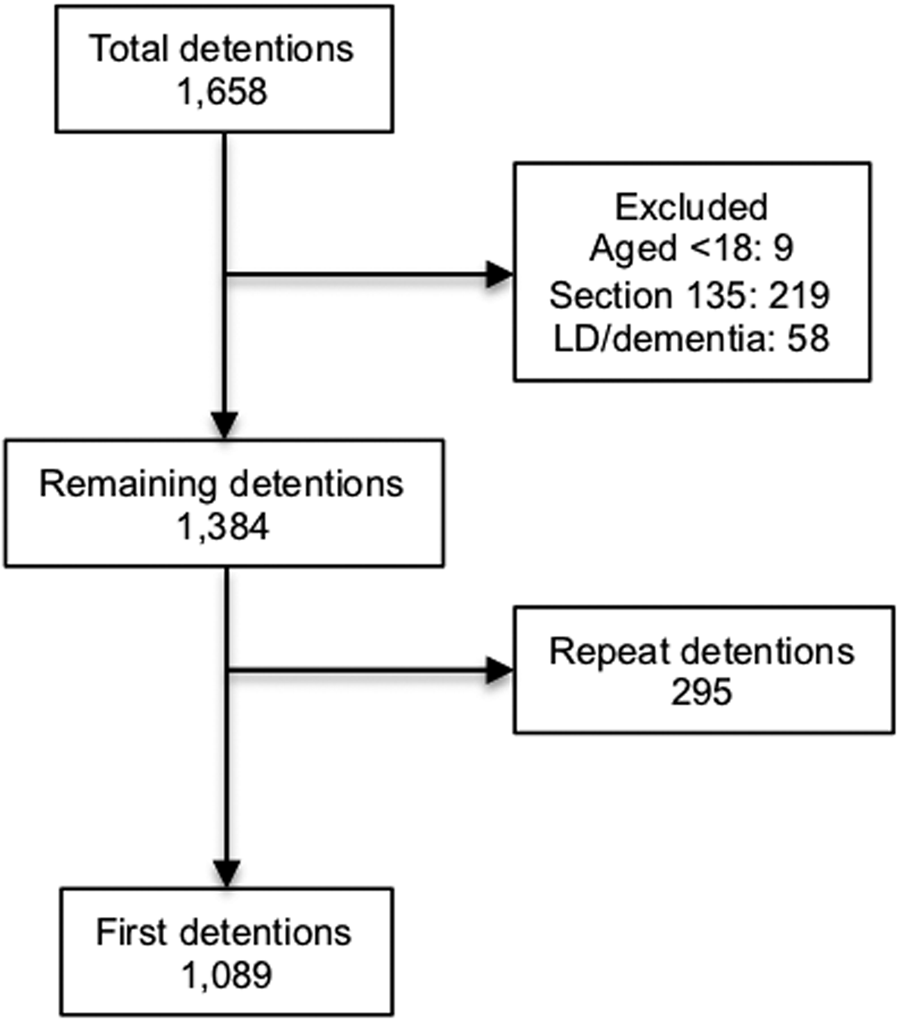
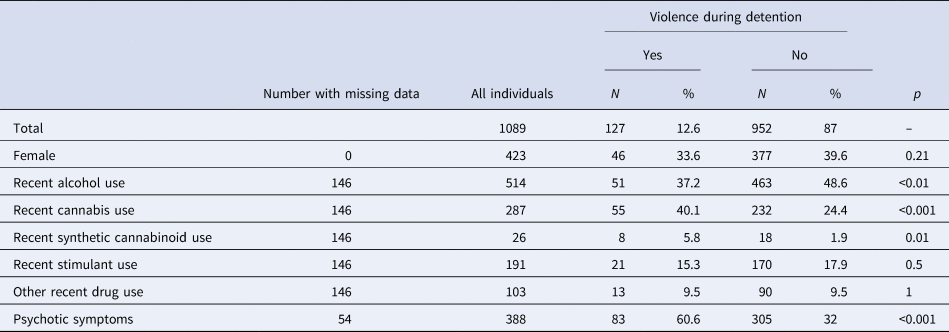
After applying inclusion/exclusion criteria (Fig. 1), the sample included 1089 unique individuals involved in 1384 detentions; only the first detention episode was included in the main analyses. A violent incident was recorded in 12.6% (n = 127) of detentions (Table 1), with the majority (75.5%) of incidents involving the physical assault of staff or rarely, other patients. Women were detained in 38.8% of cases (n = 423) and the average age of individuals was 35 years (s.d. 11 years).
Flowchart of cPoS detainees with those excluded and included in the sample for analysis. LD indicates learning disability.

Sample characteristics for complete analysis sample (1089 detentions) and by violence to person or property during detention

Data are presented as number and percent; p values are from chi-squared test excluding missing values.
Most detentions (64.5%; n = 702) involved recent use of alcohol and/or other drugs. Alcohol was most commonly used (47% of detentions), followed by cannabis (23%), and stimulants (17%). Other drugs such as heroin, benzodiazepines, and party drugs were reported in 7% of detentions, with heroin and benzodiazepines most commonly used. Use of multiple substances was recorded in 40% detentions involving alcohol or other drugs. Synthetic cannabinoid use was recorded in 2.4% of detentions (n = 26) and its use in isolation was only recorded in nine detentions. There was a negative association between recent use of alcohol and violence, and a positive association between recent use of cannabinoids (cannabis or synthetic cannabinoids) and violence (see Table 1). Acute psychotic symptoms were recorded in almost a third of detentions (36%; n = 388) and associated with violence during detention.
In total 900 of 1089 people (83%) had complete data for substance use, psychotic symptoms, age, gender, and the outcome of a violence event during the detention. The incomplete cases were due to missing data on substance use (13% missing) and psychotic symptoms (5%). The characteristics of incomplete cases did not differ substantially from complete cases apart from being more likely to be female (50.5% v. 41.8%).
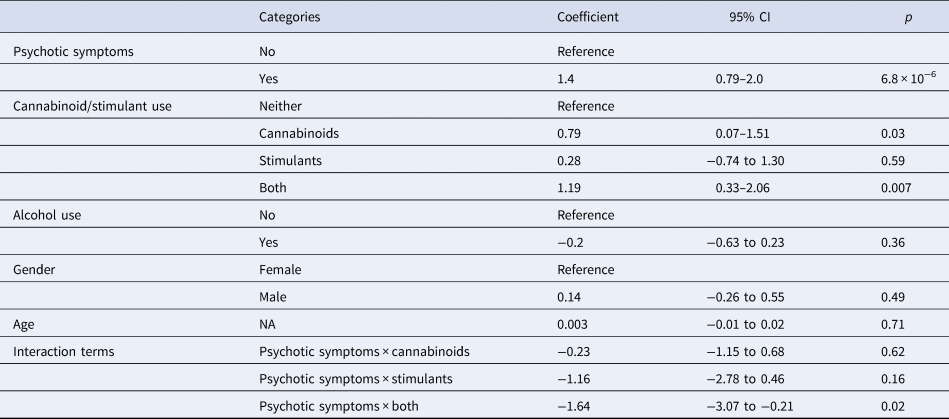
Estimates from the multivariable model (see Tables 2 and 3) indicated a strong association between psychotic symptoms and violent events that was increased in the presence of recent cannabinoid use. Compared to individuals who did not display psychotic symptoms and for whom there was no record of cannabinoid/stimulant use, the odds of a violent event were three-fold higher for individuals displaying psychotic symptoms (OR 4.0, 95% CI 2.2–7.4; p < 0.0001). The odds of a violent event were five-fold higher if recent cannabis use was also recorded (OR 7.1, 95% CI 3.7–13.6; p < 0.0001). There was limited evidence for an association between stimulant use without cannabis use and violent events, regardless of the presence of psychotic symptoms. However, stimulant use combined with cannabinoid use in the absence of psychotic symptoms was associated with increased odds of violence (OR 3.3, 95% CI 1.4–7.9; p < 0.0001). There was no evidence for an association with either gender or age, suggesting that although these demographic risk factors are associated with violence in the general population that is not the case in this setting. Alcohol use was not associated with violence.
Estimates for the interaction between acute psychotic symptoms and recent cannabinoid/stimulant use from the model for physical violence during detention, based on the multiply imputed data (1098 individuals)

Data are presented as odds ratio (95% confidence interval); p value.
Estimates from the full multivariable logistic regression model for physical violence during detention, fitted to the multiply imputed data (1098 individuals)
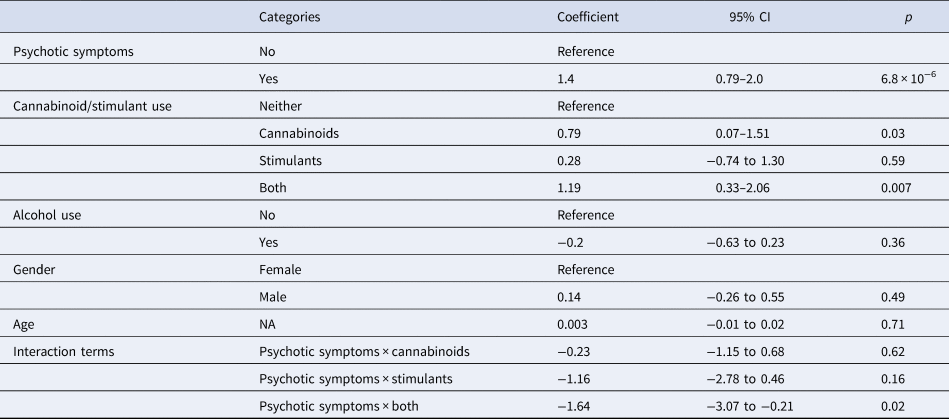
Data are presented as regression coefficients with 95% confidence intervals (CI) and associated p values.
Results from the complete case analysis did not differ substantially from the multiple imputation results (see Supplementary Material Section 2). Including multiple detentions per person produced similar results to the full dataset, although with attenuated effect size estimates (see Supplementary Material Section 3). In particular, the effect sizes for cannabinoid use and combined cannabinoid/stimulant use in the absence of psychotic symptoms were lower with a lower confidence interval bound closer to the null (OR 1.7, 95% CI 0.9–3.1, p = 0.1; OR 1.9, 95% CI 0.83–4.1, p = 0.13 respectively).
Discussion
Our findings suggest that the odds of physical violence by patients in an emergency psychiatric context are increased four-fold in those with acute psychotic symptoms, and over seven-fold if cannabinoids have also recently been used. Recent use of cannabinoids in combination with stimulants in those without psychotic symptoms may increase the odds of violence three-fold. This is the first study to investigate the relationship between recent use of different illicit substances, as well as polysubstance use, and acute psychiatric symptoms in a large emergency psychiatric sample. Recent use of substances was common in service users detained to the Place of Safety, with nearly a quarter having evidence of recent use of cannabinoids, making the finding of an associated increase in violence an important consideration in this context. Neither gender nor age was associated with violence, suggesting that the clinical factors of cannabinoid use in the presence of psychotic symptoms, or polysubstance use of cannabinoids and stimulants, are more important in determining risk in this setting.
Our findings are relevant to any setting where people present with acute psychiatric symptoms in the context of drug intoxication, for example, emergency departments, and perhaps of increasing relevance in North America, where cannabis legalisation could see increased use (Hall & Lynskey, Reference Hall and Lynskey2016). Previous studies of this topic have primarily only described the frequency of a history of substance use in those who have acted aggressively in emergency or acute psychiatric settings. Further, most previous research has only considered a history of substance use, rather than acute use, and has not distinguished between classes of drugs (Cornaggia et al., Reference Cornaggia, Beghi, Pavone and Barale2011; Dack et al., Reference Dack, Ross, Papadopoulos, Stewart and Bowers2013). A recent meta-analysis confined their analysis of violence on in-patient wards to patients with a history of alcohol use disorder because the history of drug use disorder was not commonly reported (Iozzino et al., Reference Iozzino, Ferrari, Large, Nielssen and de Girolamo2015). Alcohol was associated with violence in the meta-analysis but not in our study. This may relate to the fact that a substantial proportion of our sample who were alcohol-intoxicated were detained for psychiatric assessment due to exhibiting suicidal behaviour, rather than behavioural disturbance (unpublished observations). Alcohol use in association with suicidal acts has also been reported in other Section 136 cohorts (Bendelow, Warrington, Jones, & Markham, Reference Bendelow, Warrington, Jones and Markham2019). Those intoxicated with alcohol who are behaving aggressively may be understood as drunk rather than mentally disordered by police and may therefore be arrested or detained in police custody, rather than being detained in a healthcare setting for psychiatric assessment (Bendelow et al., Reference Bendelow, Warrington, Jones and Markham2019). Further, the meta-analysis showing a positive association between alcohol and violence on acute wards used historic rather than acute use. Wards are also the places where access to alcohol would be eliminated, so the association may reflect alcohol withdrawal delirium, which is associated with violence. Alcohol withdrawal delirium would not have had time to develop during the short duration of Section 136 detention, as it typically develops after 48 h of alcohol withdrawal (Haber, Lintzeris, Proude, & Lopatko, Reference Haber, Lintzeris, Proude and Lopatko2009; Tomlinson, Brown, & Hoaken, Reference Tomlinson, Brown and Hoaken2016). The association between alcohol and violence in mental health settings is also not universal: a recent study by Bassir Nia et al. (Reference Bassir Nia, Medrano, Perkel, Galynker and Hurd2016) in a dual diagnosis setting also found a reduced odds of violence in those who had used alcohol prior to admission.
This study also adds to the broader literature concerning psychotic disorders, substance misuse, and violence. Most cohort studies relating lifetime diagnosis to convictions and cross-sectional self-report studies investigating this relationship have found that comorbid substance misuse increases the risk of violence in people with psychotic disorders. Most such studies, reviewed in a systematic review by Nederlof and colleagues, have used an aggregated term encompassing alcohol and drug misuse rather than distinguishing by the substance (Nederlof, Muris, & Hovens, Reference Nederlof, Muris and Hovens2013). A recent meta-analysis of cannabinoid use in patients with severe mental illness found that both use and misuse increased the risk but no distinction was made between historical and recent use and the relationship was with diagnosis rather than acute symptoms (Dellazizzo et al., Reference Dellazizzo, Potvin, Beaudoin, Luigi, Dou, Giguère and Dumais2019). Rasanen and colleagues found that comorbid alcohol dependence alone increased the risk of violence in people with a lifetime diagnosis of schizophrenia (Räsänen et al., Reference Räsänen, Tiihonen, Isohanni, Rantakallio, Lehtonen and Moring1998). This is in contrast to our study and may reflect the disparate handling of aggressive behaviour in alcohol intoxication as described above.
EHR data have inherent limitations. Missing data are inevitable due to staff not recording information, such as substance use, or patient reluctance to disclose. However, missing data for our primary outcome, violence towards people or property, is likely to be very limited as such events are cited to explain decision-making regarding restrictive interventions such as manual restraint. The impact of missing data on our results was minimised via multiple imputations, and the results obtained from the imputed dataset were very similar to those from the complete case analysis. Another potential limitation is the incorporation of urine testing into the algorithm for defining recent use of cannabis, as in daily users this can remain positive for up to 15 days, and in heavy daily users, 30 days (Moeller, Kissack, Atayee, & Lee, Reference Moeller, Kissack, Atayee and Lee2017).
The nature of EHR data also provides many of the strengths of this study. Our sample is one of the largest and most well-characterised datasets of people detained under Section 136 of the MHA, a population with high rates of both psychotic symptoms and acute substance use. Environmental factors contributing to violence were minimised as all episodes of care took place in the same emergency setting with a dedicated team. We used multiple data sources to classify substance use, given known under-reporting in EHR data (Bell et al., Reference Bell, Kilic, Prabakaran, Wang, Wilson, Broadbent and Curtis2013) and data from unstructured fields that contained a contemporaneous evaluation of substance use and psychiatric symptoms rather than relying on retrospective reports from staff or patients. Violence was stringently defined as actual physical aggression: either assault or damage to property. Finally, acute psychotic symptoms were evaluated rather than a diagnosis of psychotic disorder, which is more informative in understanding how acute mental state and substance use interact.
In conclusion, psychotic disorders and a history of substance are recognised risk factors for aggression in emergency and acute psychiatric settings. This study extends the literature by demonstrating how acute psychotic symptoms and recent use of cannabinoids are associated with greater risk in combination than either alone. This finding is of relevance to emergency settings where patients in psychotic crisis with recent cannabinoid use are cared for as understanding of this increase in risk could inform tailored management plans and reduce the use of restrictive interventions. Given that cannabis use is likely to become more common in several countries as a result of legalisation (Hall & Lynskey, Reference Hall and Lynskey2016), management of patients who have recently used cannabis is likely to be of increasing relevance to clinicians in emergency services.
Supplementary material
The supplementary material for this article can be found at https://doi.org/10.1017/S0033291720003451.
Data
The dataset is made up of National Health Service (NHS) patient records and therefore cannot be directly shared. The ethical approval to access CRIS data (Oxfordshire Research Ethics Committee C 08/H0606/71 + 5) requires the data to be stored behind an NHS firewall with access governed by a patient-led oversight committee. For this reason, the data cannot be made available in the manuscript, Supporting Information files or a public repository. However, subject to approval from the oversight committee, data access for research purposes is encouraged. More information about accessing data held by the NIHR Maudsley Biomedical Research Centre can be found here: https://www.maudsleybrc.nihr.ac.uk/facilities/clinical-record-interactive-search-cris.
A pre-registration for this study is available (DOI https://osf.io/acpxr). All authors had access to the study data during the period of data analysis.
Acknowledgements
The authors wish to thank all service users and staff from the SLaM centralised Place of Safety who provided the data for this study. This work was supported by a grant from the Wellcome Trust [109823/Z/15/Z] to KIM; NJK was supported by a NIHR Clinical Lectureship. JER was supported by a Society for the Study of Addiction student bursary.
This manuscript represents independent research part-funded by the National Institute for Health Research (NIHR) Biomedical Research Centre at South London and Maudsley NHS Foundation Trust and King's College London. The views expressed are those of the authors and not necessarily those of the NHS, the NIHR or the Department of Health and Social Care.
Author contributions
The literature search was conducted by NJK, JER and KIM. NJK, KRR, VC, and KIM were involved in the conception and design of the study. NJK, MP, and KIM created the data extraction protocol. Manual scoring of the unstructured fields was performed by NJK, JER, KRR, and KIM. Data analysis was performed by KIM. Data interpretation was by NJK, MTL, VC, and KIM. NJK and KIM drafted the manuscript with input from all other authors. All authors approved the final version of the article. NJK is the guarantor.
Conflict of interest
None.