

As constitutionalism has gone global, different dimensions of constitutional justice such as the structure of and access to courts, and methods of interpretation have been objects of diffusion across various municipal jurisdictions eager to establish their credentials as democratic societies. One of the most important aspects of global constitutionalism in recent years has been the spread of various means of direct access to constitutional courts ranging from actio popularis to individual constitutional complaint. The expansion of methods of individual access to constitutional courts comes as no surprise since modern constitutionalism has increasingly taken up the protection of fundamental rights and freedoms as one of its most crucial tasks.
Ever since the publication of Alan Watson’s Legal Transplants (1974), the spread of legal ideas has attracted a large amount of scholarly attention, which has recently influenced the study of diffusion of constitutional norms and tools. Footnote 1 Although these studies have examined both large and small units of diffusion ranging from the introduction of a new constitution to a new rule concerning such as constitutional amendments, they have largely neglected analysing the transfer of procedures of direct access to constitutional courts by individuals. Among these procedures, individual constitutional complaint has recently become a widely acclaimed constitutional export item, particularly in Europe. It is prescribed as an effective remedy by supranational bodies such as the European Commission for Democracy through Law of the Council of Europe (the Venice Commission) for countries which lack effective human rights protection instruments. Footnote 2
A constitutional complaint offers a subsidiary legal remedy where the individual may file a case against judicial or administrative decisions that allegedly violate his or her basic rights and liberties. Footnote 3 It can be regarded as a form of ‘judicialisation from below’ as it is lodged by the right claimant who challenges these decisions. Footnote 4 However, it can equally be seen as a manifestation of judicialisation from above as it is promoted by a supranational organ. Footnote 5
The constitutional complaint procedure is predicated on reviewing constitutional aspects of applications rather than examining the merits of a case. To a large extent, this enables constitutional courts to avoid conflicts with other courts in the context of proceedings on constitutional complaints. The procedure usually calls for strict admissibility conditions such as the exhaustion of all other legal remedies or the requirement of constitutional significance of the case lodged before the court. Otherwise, the courts may be overwhelmed by applications. Constitutional complaint comprises the main part of the dockets of the constitutional courts in such countries as Germany and Spain. Footnote 6
The constitutional complaint systems can be divided into two main groups on the basis of the act under review: normative constitutional complaint and full constitutional complaint. Footnote 7 The former rests on challenging allegedly unconstitutional laws by the individual who argues that the application of a normative act (a law or other general regulation) infringes his or her constitutional rights. Footnote 8 It mainly exists in Austria, Armenia, Belgium, Croatia, Georgia, Hungary, Latvia, Russia and Ukraine. Footnote 9 Under the normative constitutional complaint, the constitutional court reviews the law rather than rulings of ordinary courts. If the court holds the law unconstitutional, it repeals the law and remands the case to the last instance ordinary court for retrial.
With regard to full constitutional complaint, the applicant here challenges a last instance court ruling or a decision of an administrative body, which allegedly violate his or her constitutionally-recognised human rights. Under this system, the constitutional court does not normally have the power of repealing the unconstitutional law. Footnote 10 This model exists in countries such as Austria, Belgium, the Czech Republic, Germany and Spain. Whereas the normative constitutional complaint often fails to provide satisfactory remedy, full constitutional complaint metes out individuals with a more effective bulwark against unconstitutional applications of constitutional laws as most human right violations arise from the unconstitutional application of a constitutional law rather than an unconstitutional law.
The transfer of such a global constitutional commodity as constitutional complaint requires an analytical framework that reflects the dynamic nature of the process. Although a variety of metaphors and concepts such as transplant, borrowing and migration have been used in the comparative constitutional law literature that describes cross-constitutional interactions, they suffer from some deficiencies. While the transplant metaphor has ‘mechanistic overtones’, Footnote 11 borrowing has been criticised as a misleading metaphor because it implies ‘a voluntary bargaining among rough equals and the return of the borrowed item to the lender in an unmodified form’. Footnote 12 The migration metaphor seems better to reflect the fluidity of ideas and the interaction between the giver and the recipient in a more flexible way. Footnote 13 It does not, however, provide a robust empirical framework in a way that accounts for connections among different stages of the spread of constitutional items. By contrast, the transfer concept indicates a process of ‘conscious and unconscious movements’ of ideas, institutions and rules from one domain to another capturing ‘the varieties of the compactness of the transferred information’ and ‘its commodification’. Footnote 14 We suggest that the IKEA theory of constitutional transfer developed by Günter Frankenberg provides a powerful framework to study the spread of particular constitutional methods. Footnote 15 As we shall critically discuss in the following section, it has the advantage of offering clearly delineated steps in examining constitutional transfer. In this regard, it also tallies well with the suggestion that there is a need for micro-level analysis of particular cases of constitutional diffusion to gain a better understanding of interaction and perceptions of the main actors involved in the transfer process. Footnote 16
The main purpose of this study is to apply the IKEA theory to analyse the transfer of individual application remedy to the Turkish Constitutional Court (TCC). A consideration of the Turkish experience in the transfer of individual application system serves the aim of illustrating empirical suitability of the concept of constitutional transfer. However, our use of the IKEA theory is far from an uncritical application. We offer a reinterpretation of the theory to highlight the significance of interaction among the different steps of constitutional transfer through the prism of the case study. The piece thus feeds into the evolving discussion on the global spread of constitutional ideas and methods by way of a critical application of the IKEA theory.
Examining the spread of a particular constitutional idea usually revolves around a range of issues. To this end, we seek to address the following questions: What are the main motives lying behind the introduction of the individual application remedy? Who are the agents of the transfer? Is there any resistance to the new institution? How do domestic actors articulate and modify the imported ideas during the institutionalisation process? Which parts of the original model are omitted from a transfer? What is its impact? Are the agents and the end-users of the transfer satisfied with initial outcomes?
The paper proceeds by way of four sections. The first section introduces and evaluates Frankenberg’s constitutional transfer model. While the following section provides an account of the introduction of the individual application procedure to the TCC, the third section explores the ways in which the individual application is transferred to the Turkish constitutional system by applying Frankenberg’s model. The final section assesses outcomes of the transfer and discusses views of the key actors.
I. The IKEA theory of constitutional transfer
Combining Edward Said’s ‘four stages of travels of theory’ with the management model of the IKEA Corporation, Günter Frankenberg has developed a theory of the transfer of constitutional ideas. The IKEA theory, as he calls it, offers a clear methodological approach by identifying ‘the processes and practices of how constitutional ideas, norms, institutions and opinions come to be transferred to and then contained in the global reservoir and from there to a new host environment’. Footnote 17 The theory is operationalised on the basis of four steps of the transfer process: A point of origin, the decontextualisation of the constitutional idea, and the transfer process from the local to the global constitution, and the recontextualisation of the constitutional idea into a new environment. Footnote 18 The first step refers to a point of origin where the would-be constitutional item is developed. In the second step, the constitutional idea is decontextualised so that it could become detached from its original juridical and social environment. This process may, however, create unforeseen complications on the part of the recipient as the imported constitutional item may have conflicting meanings or be surrounded by controversies regarding its functioning in its original home. Footnote 19 The third step involves marketisation and clarification of the meanings of the transferred idea as a component of global constitutionalism through processes of reification, formalisation, and idealisation. Footnote 20 Recontextualising constitutes the final step, which modifies certain pieces of the imported ideas in a way that would suit conditions of its new habitat. Footnote 21 For Frankenberg, this is an open-ended phase of the transfer because the recipients operate under imperfect knowledge about the original meaning and functioning of the imported commodity. Hence, the recontextualising usually necessitates reinterpretation and redesign of the transferred items.
The IKEA theory represents an important phase in understanding and explaining how constitutional ideas, applications and institutions are transferred from their original locations and habituated into an unfamiliar milieu. It provides a step-by-step empirical framework for a discussion of diffusion of constitutional ideas, and it has fruitfully been used in analysing constitutional transfers. Footnote 22 On the other hand, the step-by-step approach should not be construed to mean that each step or stage of the transfer process as described by Frankenberg is sharply separated from each other. For example, decontextualisation of a constitutional idea involves a process of marketisation and idealisation to convince the importer of the necessity of the transfer. Although the IKEA theory offers a coherent model in analysing movements of constitutional items and ideas, it is marred by its assumption of the existence of a clear-cut separation among the different phases of the constitutional transfers. We suggest that there is no watertight division among the four stages of constitutional transfer as implied by the model. Decontextualisation, marketisation, idealisation and recontextualisation stages are all connected and interwoven with each other.
In addition, unlike Frankenberg’s argument of imperfect knowledge in the recontextualisation phase, the importers may have almost perfect knowledge of the item. In such case, they can manipulate the item to achieve their policy objectives. Just as the end-product may not go further than becoming a mere replica or copy of the original, it may also represent an original innovation. Therefore, a conscious decision to use a constitutional idea from a foreign system calls for a process of constitutional re-engineering which refers to ‘the deliberate, as opposed to the accidental or inevitable modification of foreign ideas upon their incorporation into a domestic system’. Footnote 23 It involves the amendment or replacement of at least one important element of a constitutional idea in order to meet the objectives of the recipient. Footnote 24
What motivates a transfer of a constitutional idea? The literature suggests that ‘externally-dictated, legitimacy generating, cost-saving and entrepreneurial incentives’ lie behind the process. Footnote 25 In a similar vein, functionalist, reputational, normative and sociological motivations also account for movements of constitutional ideas. Footnote 26 Functionalist reasons emphasise effectiveness of the diffused item in its home location. Legitimacy generating and reputational elements are important especially when the Constitutional Court itself is the main agent and user of the transferred item. Internal and external prestige of the court could be enhanced through the transfer. Political actors also seek for increasing their legitimacy and reputation by virtue of the idea. Footnote 27 Internalisation of values that the imported item brings with it and the means to realise them are also significant for the habituation of the new item. Footnote 28 Normative motivations include the spread of rights consciousness and the rising power of constitutional courts as a protector and promoter of human rights. Many constitutional transfers are an amalgam of all these factors. It is within this context that constitutional complaint has latterly become a successful and thus marketable constitutional commodity due to its reputation as a valuable and effective tool for the protection of human rights. Footnote 29
II. The introduction of individual application to the Turkish Constitutional Court
At the origins of the constitutional review in Turkey lies the idea of protecting the political order from legislative majorities whose activities are feared to corrode republican principles created by Ataturk. Footnote 30 Following the 1960 military coup, a new constitution was promulgated in 1961, which established a constitutional court to review the constitutionality of laws beginning in 1962. The need for founding a constitutional court resulted from the ruling elites’ views that, taking the experience in the 1950s into consideration, Footnote 31 legislative activities of popularly elected governments should be subject to constitutional review by an independent supreme judicial body. The new court was largely modelled after Italian and German experiences, making it one of the oldest examples of constitutional review by a specialised supreme court in the non-Western world. In a relatively short period of time, the TCC on which the 1961 constitution vested important powers became a powerful judicial actor to be reckoned with by political players as it did not hesitate to challenge the parliament. The 1982 constitution preserved the TCC with minor changes in terms of its competence.
The assessment of the complaints is subject to a two-tiered process: admissibility and review on the merits. Admissibility decisions are rendered by the two-judge composed commissions. The sections are responsible for examining both admissibility and merits of constitutional complaints. The aim of the admissibility examination is to control whether the application is within the jurisdiction of the Court. If an application is found admissible, it is then examined by a section on the merits. The only role of the plenary of the Court in this regard is to resolve possible conflicts that may arise among judgments of the sections. The sections are also entitled to bring the case before the full court if the case in question has the potential of creating a precedent and landmark ruling.
The individual application is based on the principle of subsidiarity, which means that the application can be lodged only after all other legal remedies have been exhausted. If the TCC finds a violation of a right or freedom it may only declare the unconstitutionality of the judicial decision or acts of public bodies as it lacks the competence of annulling the law and declaring it null and void in the individual application cases. This makes the Turkish system a full constitutional complaint. The system does not lead simply to the finding of a violation but restores the complainant’s constitutional rights. In order to prevent a conflict between the TCC and other courts both the Constitution and the relevant law explicitly state that examination of the sections on the merits of a complaint is limited to determine whether a fundamental right has been violated. Even if the complaint is successful, the Court may not replace the ruling of the ordinary court with its own, but it may only ascertain the violation of the constitution and refer the case back to the ordinary court giving the opportunity to the latter to reassess the case. In the retrial, the ordinary court is expected to consider the opinion of the TCC finding a violation of the constitution. If the Court finds a retrial unnecessary, then it may order compensation to be paid to the applicant or state that the applicant may file a claim before the competent court to seek redress for damages suffered. The TCC is also empowered to order interim measures for the safeguarding of the constitutional rights of the complainant.
III. The transfer of individual application procedure to Turkey
The individual application system imported to Turkey drew inspiration from the German verfassungbeschwerde, the ECtHR application procedures, and to a much lesser degree, Spanish amparo models. We suggest that the first two foreign systems constitute the point of origin in the transfer process of the procedure to Turkey. Although direct individual access to courts known as the writ of amparo for the protection of constitutional rights has its roots in the Latin American constitutional tradition, constitutional complaint is an innovation of German constitutional order. Footnote 32 When the Federal Constitutional Court (FCC) was established in 1951, one of its competences was to review individual complaints on the grounds of constitutionality. It was, however, only in 1969 that the individual’s right of constitutional complaint was recognised in the German Basic Law. Footnote 33 The German experience has demonstrated that the remedy of constitutional complaint provides a highly effective means of legal protection of fundamental rights and freedoms because it was particularly devised to protect constitutionally recognised rights of individuals affected by an act of a public authority. Footnote 34 As an increasingly popular way of enhancing individual access to constitutional justice, constitutional complaint has spread across many jurisdictions in Europe, Latin America and Asia. Although the expansion of the system to various countries attests its success as a marketable and fashionable commodity in the global constitutional marketplace, the recipients do not often pay enough attention to the fact that the rate of successful applications is less than two per cent annually in Germany. Footnote 35 The constitutional complaint is thus decontextualised to become an important item of the global constitutional marketplace where it can be adopted by various importers to suit their own agendas. In the course of its transfer from the local to the global arena, the constitutional complaint procedure calls for strong and capable supporters and mediators who endeavour to present it in an idealised form.
Supranational institutions usually play a salient role in the diffusion of legal ideas by acting as a promoter. In the case of the importing of the constitutional complaint system to Turkey, the Venice Commission and the ECtHR acted as strong proponents of the idea. The Venice Commission was a particularly active supporter of the individual application procedure and noted with satisfaction that it was introduced into the Turkish constitutional review system. Footnote 36 Why did the Commission as an organ of the Council of Europe strive for encouraging the adoption of the individual petition? As is well known, the Commission has the duty of assisting states in issues of constitutional law by means of consultative work and its activities are closely connected with the ECtHR system. Footnote 37 Being the main promoter of the idea, the Venice Commission praised the constitutional complaint as offering the most comprehensive and effective way of protecting and securing fundamental rights in Turkey. Footnote 38 It strongly backs the full constitutional complaint, arguing that it is probably the most suitable way of addressing human rights issues at the national level if one considers the subsidiary nature of the relief provided by the ECtHR. Footnote 39 An effective constitutional complaint system nurtures democratic governance by providing ordinary people with a relatively easy access to constitutional justice and thus creating rights-consciousness among the populace. This procedure of direct access to constitutional courts suits well to realisation raison d’étre of the Commission. Furthermore, the Commission highlights that such complaint mechanisms can function as a kind of filter by way of providing an effective local remedy for violation of the ECHR by public authorities. It can, therefore, be maintained that for the Venice Commission reducing the number of applications to the Strasbourg Court is one of the main motives for its encouragement and support for the recourse. In this way, the observance of the Convention can be achieved at the national level, thus saving the ECtHR from influx of applications. On the other hand, it would be unfair to the Commission to see all of its activities solely in the functionalist limelight. The normative goal of contributing to human rights protection and the functionalist purpose of reducing the number of applications to the ECtHR are not disconnected as they complement each other.
The Commission augments its support for the constitutional complaint by identifying successful country examples. It points out that compared to countries where the system does not exist, countries with full individual constitutional complaint systems are less likely to have a case against them before the ECtHR. Footnote 40 Similarly, countries with a full individual complaint procedure have significantly lower levels of violation found by the Strasbourg Court than those with normative complaints. Although the Commission presents an idealised version of the procedure, it also draws attention to the danger that Constitutional Courts endowed with such a power may be perceived as a super-Supreme Court by other high courts, leading to inter-judiciary rivalry and conflict. However, in its review of the draft individual complaint procedure, the Venice Commission argued that that the TCC could not act as a ‘super supreme court’ since the scope of its competence was restricted to the rights and freedoms protected by the ECHR. Footnote 41 Arguably, this was an optimistic view, which did not, to a large extent, distil doubts about the position of the TCC among the other high courts.
In the course of its transfer to Turkey, the individual application was modified to meet the needs of the importer, which necessitated a radical change in one of the vital aspects of the original idea. The scope of the rights under the procedure is confined to rights and freedoms listed in the ECHR rather than covering all human rights enumerated in the Constitution of Turkey. The Turkish approach to constitutional complaint has been characterised as unusual since the constitutional complaint is generally introduced to protect the rights defined in the Constitution, not in an international instrument. Footnote 42 As we have seen, social and economic rights listed in the Turkish constitution do not fall under the protection of constitutional complaint as it is feared that they would stretch the system to a point where it would lose its effectiveness and meaning due to the heavy workload of constitutional courts.
We maintain that it is not only promoters but also importers that paint an idealised and almost reified picture of the procedure as a kind of panacea for all human rights problems. Prior to the adoption of the system, the TCC mostly dealt with constitutional review of laws, constitutional amendments and political party banning cases and it was largely perceived as a bastion of protecting state ideology with little interest in protecting fundamental rights and liberties. While the government, for its part, aimed to increase the country’s prestige and democratic credentials in the European human rights system, the TCC regarded the procedure as an historical opportunity to revamp its much-tarnished image insensitive to rights and basic freedoms.
No less important than the motivation behind the imported idea and institutional factors are the role of key individuals in the transfer process. Haşim Kılıç, the president of the TCC between 2007 and 2015, was well aware that individual application would enable the Court to become a defender of human rights. Footnote 43 He played a vital role in convincing key political actors of the necessity of individual application and his efforts have not gone unnoticed by the main sponsor of the individual application procedure. In a co-authored paper, the president of the Venice Commission did not hesitate to spare his praises for Haşim Kılıç for his endeavours in the introduction of the individual applications procedure ‘for shaping it to be a bulwark against the excesses of the other state powers’. Footnote 44
Courts and judges may be viewed as strategic actors to the extent that they seek to increase their influence and institutional position vis-à-vis other major national decision-making bodies. Footnote 45 They may also wish to enhance the court’s symbolic power and international and national prestige by fostering its alignment with prestigious international bodies like the ECtHR. Constitutional courts seek institutional and social legitimacy to bolster their respectability and compliance with their rulings and judges seem to care about popular perceptions of the court and its landmark rulings. Footnote 46 For example, deeply instilled in the German constitutional system, constitutional complaint has been an important contributory factor to the FCC’s high prestige in Germany and abroad.
The decontextualised and marketised individual application needs to be recontextualised to meet requirements of the importer. The process of recontextualisation keeps many aspects of the transferred constitutional item almost intact but it also necessitates some vital changes in the original model.
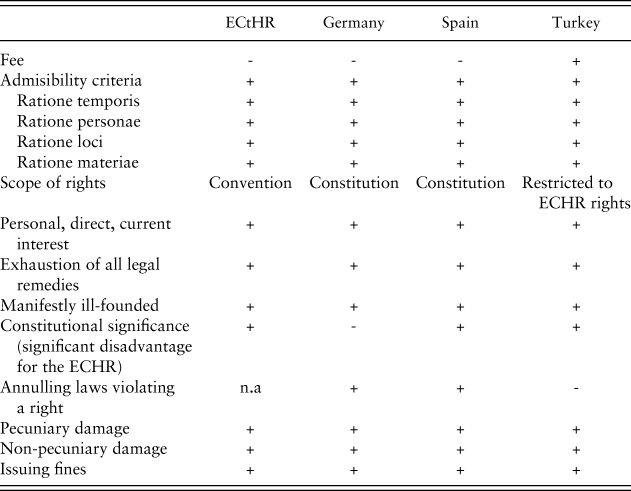
Table 1 below shows that all three individual application models include admissibility requirements before the complaint can be examined on the merits. In order to stem the flux of applications, the establishment of an efficient filter system is often deemed inevitable. The Venice Commission also considers a number of filters acceptable, such as time limits, possible courts fees, and the exhaustion of ordinary remedies. Footnote 48 The Turkish system requires that the individual application is brought to the TCC within 30 days following the exhaustion of all legal remedies and notification of the complained decision to the applicant. The German and the Spanish systems have also the same time limitation. Footnote 49 Although both real and legal persons have standing, public legal persons are not entitled to bring an individual application lawsuit in Turkey, whereas private-law legal persons may only lodge an application provided that their rights regarding their legal personality have been violated. By contrast, public legal persons are allowed to individual recourse in Germany but they only have the right of complaint to the Federal Constitutional Court (FCC) for the protection of fundamental procedural rights. Footnote 50 In the Turkish system, foreigners may not file an individual complaint for a breach of rights that are exclusively bestowed upon Turkish citizens.
A comparison of the main features of the Turkish individual application system with the German, Spanish and ECtHR models Footnote 47

The German system restricts the subject matter of complaints to those rights specified in the Basic Law, excluding only those international rights which do not appear in the Basic Law. Similarly, the Spanish model covers all fundamental rights and freedoms regulated in Articles 14 to 30 of the Spanish Constitution. Footnote 51 The FCC has recently embraced a judicial disposition of examining cases with regard to violations of the ECHR, provided that these violations emanate from ‘arbitrary ignorance’ of public authorities. Footnote 52 More importantly, both the German and Spanish approaches allow the annulment of the statute if the basis for the challenge is a judgment which violates fundamental rights because it was founded on an unconstitutional law. Footnote 53 In other words, the FCC’s competence in cases of constitutional compliant allows it to annul laws if it reaches the conclusion that the relevant law infringes constitutional rights. Unlike the German system, when the TCC issues a violation verdict, it does not have the power of annulling the law, engendering the violation.
In the German system, the applicant must show that violation of his/her constitutional rights has resulted in personal and real harm. Footnote 54 The harm should be personal, real and immediate as the applicant is not allowed to use the system for the protection of others. The procedure is thus not directed to covering possible future harms. The Turkish system also requires the same conditions as part of its admissibility criteria. In addition, it also imported the criteria of bearing constitutional significance and manifestly ill-founded from Germany, Spain and the ECtHR, respectively as part of the admissibility procedure. These two criteria were deemed important for the TCC so that it could eliminate constitutionally insignificant individual suits as the Court does not have a discretionary docket. It may thus decide that an application is inadmissible if it is manifestly ill-founded or has no bearing on the interpretation or application of the Constitution. While the German system puts the burden of proof of constitutional significance on the applicant, its Turkish counterpart leaves this to the Court itself, which has not, so far, issued any inadmissibility decision on the grounds of constitutional significance.
IV. The jury is still out?
As mentioned before, the ECtHR’s excessively high caseload from Turkey was one of the main reasons for the introduction of the individual procedure to the TCC. An analysis of pending applications and violation judgements against Turkey can be illustrative in this regard. A cursory analysis of the statistical data regarding Turkey’s position before the ECtHR will reveal the relevance of this practical purpose.
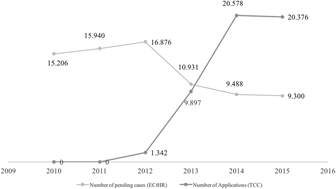
When the individual application became fully operational in September 2012, Turkey was among the countries with the highest number of applications before the Strasbourg Court. Since then, the number of applications before the Strasbourg Court has dramatically declined. Just before the introduction of the procedure in 2012, there were about 15000 cases on average against Turkey. The number of application currently revolves around 1500 applications. Footnote 56 As can be clearly seen from Figure 1, the aim of reducing the number of Turkish applications to the ECtHR has been realised. The individual application procedure seems to have led to a considerable decrease in the number of cases against Turkey brought before the Strasbourg Court.
Pending cases in the ECtHR of Turkey and applications to the TCC Footnote 55

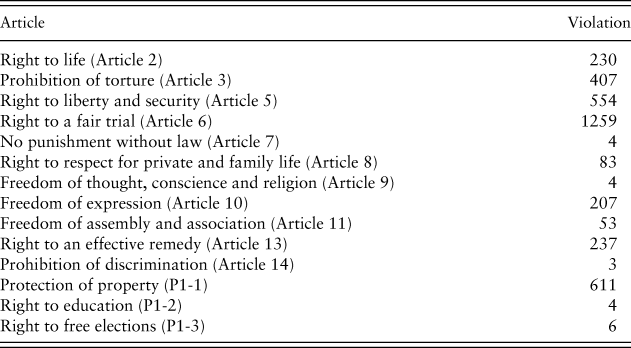
The subject matter of violations by Turkey is similar to those of other contracting states. As Table 2 indicates, among the most violated rights by Turkey are right to fair trial, right to property and right to liberty and security. As we shall see later, violation judgments rendered by the TCC in the individual application also follow a similar pattern.
Violations by Turkey on the basis of the Convention Rights (1959–2011) Footnote 57

Since the individual application system is entering its fourth year, it is already possible to draw some conclusions on its efficiency. Because the system provides people with reasonably easy access to the TCC to bring a case, it has resulted in a huge increase in the court’s docket. The TCC has concluded about 60 per cent of all applications since September 2012 when it began to receive petitions. The annual intake of the applications revolved around 20000 in the last two years. The TCC has been able to speed up proceedings. While it concluded 50 per cent of the applications filed in 2013, the corresponding completion rate went up to 77 per cent for the applications in 2015. All in all, the TCC has finalised about 60 per cent of all individual applications it has received. The vast majority of the cases have been found inadmissible for various procedural bars including lack of standing, ratione temporis, lack of subject-matter jurisdiction, non-exhaustion of all other remedies and being manifestly ill-founded. The Court has not yet invoked the admissibility criteria of constitutional significance, which proved to be an effective means of filtering in some countries like Spain. Footnote 58
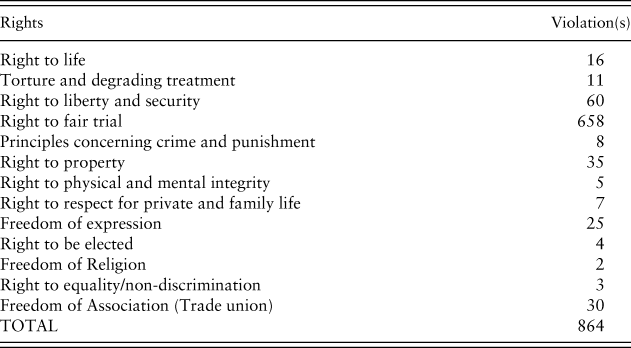
Approximately 2 per cent of all applications (952 cases) were reviewed on the merits and the TCC has so far delivered 864 violation judgments, corresponding to a success rate of about 2 per cent. Footnote 59 It is interesting to note that the FCC receives more than 6000 applications annually and the success rate of constitutional complaint in Germany also fluctuates around 2 per cent of all cases. Footnote 60 The TCC seems to have taken a strict stance in dealing with the applications, especially in the admissibility stage. If an application is declared admissible, its success rate amounts to 94 per cent on the merits review conducted by the sections, and to a lesser extent, by the general plenary. The strict interpretation of the admissibility requirements by the TCC is understandable in the light of the concerns about huge numbers of applications.
Subject matter of violation judgments of the TCC (2012–16) Footnote 61

The bulk of violation judgments include the rights to fair trial, personal liberty and security, property, and freedom of association and freedom of expression. As in the case of applications to the ECtHR, the most common grievances of applicants to the TCC are related to the right to a fair trial. Especially lengthy, pre-trial detentions exceeding maximum periods as stipulated in the Criminal Procedure Law are brought before the Court. The TCC has been able to establish leading cases and its judgments have been in line with the case law of the ECtHR. The Court was being criticised for not following the ECtHR jurisprudence and in cases where it referred to ECtHR rulings, it used them to supplement domestic law. Footnote 62 The Venice Commission was concerned about a possible divergence of interpretations by the TCC based on the constitution, and on the ECHR, particularly in cases addressing a similar right. Footnote 63 The Turkish Court is fully aware that if a case was rejected in Ankara in a way that clearly diverged from ECtHR jurisprudence, the ruling would be overturned quickly if taken to the Strasbourg Court.
In addition, a much feared clash of the TCC and the other supreme courts has so far largely failed to materialise, though the latter tend to be reluctant to accept the binding force of the TCC’s rulings beyond individual cases. The TCC accords a significant degree of deference to the supreme and ordinary courts. The fact that only a tiny fraction of complaints are successful points to the careful stance adopted by the TCC in relation to quashing judgments of the other courts.
The success of the system is also, tentatively, confirmed by the ECtHR, which does not automatically consider individual application as an effective remedy against violations of the ECHR. In its first case regarding whether the individual application was an effective remedy to be exhausted, the ECtHR closely examined the accessibility of the remedy, the modalities for its exercise, the remedial powers of the Constitutional Court, and the legal effects of the TCC’s decisions. For the Strasburg Court, the individual complaints procedure before the TCC afforded, in principle, an appropriate mechanism for the protection of human rights and fundamental freedoms. At the conclusion of its review, the European Court was satisfied that the new procedure must be considered as a domestic remedy to be exhausted by applicants. Footnote 64 In addition, the Council of Europe has viewed the Turkish adoption of the individual complaint model as an exemplary case, which would be a role model for countries anxious to address their human rights problems. Footnote 65
The extensive preparations for the individual application seem to have paid off since many rulings have been well received at national and international levels, though some of them have drawn criticism from high-ranking politicians of the governing party. Thanks to the individual application, the TCC has attained a high public confidence. According to a nationwide opinion poll conducted in January 2015, the TCC is the third most trusted public body following the military and the police. Footnote 66 The Court is in the way of becoming a rights adjudicator and has begun to cast itself as the defenders and in some cases expanders of human rights. The president of the ECtHR praised the TCC’s performance in addressing violation claims, pointing out that it is one of the best practices among the European Constitutional Courts. Footnote 67
Particularly noteworthy are the Constitutional Court’s rulings concerning access to the internet and long and undue detention periods. When the government blocked access to Twitter in March 2014, it was on the grounds of several individual applications challenging the ban that the TCC was able to issue a verdict, unanimously ruling the ban to be unconstitutional. Footnote 68 In Twitter and similar Youtube Footnote 69 judgments, the Court found a violation of freedom of expression since the restriction was not prescribed by law. It also stated that the internet and social media play a crucial role in democratic societies as an extensive and efficient means of freedom of expression.
The Court did not, moreover, hesitate to find a violation of freedom of expression in the banning of a book written by Abdullah Öcalan, the imprisoned founder and leader of PKK, an internationally recognised terrorist organisation. The book was confiscated and banned on the grounds that it propagates and exalts the terrorist organisation’s ideology and actions. Several pages of the book contain a call for an armed uprising and urges people to resort to violence as a means of struggle, if a peaceful solution cannot be found on the Kurdish question. Although these are highly offensive, disturbing and shocking ideas to a large segment of society, the bulk of the book is concerned with a critical and historical analysis of the Kurdish problem and its main message is devoted to finding a peaceful solution to the problem. The TCC reached, with a large majority of 14 to 3, the conclusion that the confiscation of the book was not proportionate with the legitimate aim of protecting national security and public order and therefore the applicant’s freedom of expression was violated. Footnote 70
Not unsurprisingly, these rulings of the TCC attracted critical comments by the government representatives. In connection with the Court’s rulings on access to YouTube, the Prime Minister Erdoğan accused the Court of defending ‘the commercial rights of international companies instead of the rights of their own country and own nation’ and of issuing ‘a non-national verdict’. He also added that, despite being obliged to comply with the decision, he ‘does not respect it because the Court did not take into account the moral values of Turkish people’. Footnote 71 Furthermore, he did not hesitate to slam the TCC in the aftermath of a very recent ruling Footnote 72 which found that the pre-trial arrest of two prominent journalists charged with revealing state secrets was in breach of constitutionally protected freedom of press and expression. He reiterated that he had ‘no respect’ for the decision and would ‘not abide’ by it. Footnote 73
These judgments and their impacts on the social and political structure prove that constitutional complaint has been an effective instrument for protecting basic rights, though they were heavily criticised by the leading figures of the government. Prior to the introduction of the individual application instrument, the TCC had very little direct influence over the citizenry but now it can be plausibly argued that it sits at the forefront of human rights protection. The individual application procedure has also forced the TCC to change its long-standing precedent in some issues. For example, the TCC on two occasions in 1999 and 2011 upheld a rule in the Civil Code which prevented women from using only their maiden name after marriage and compels them to take their husbands’ surnames. In these judgments, the TCC completely ignored the relevant case law of the ECtHR, citing the importance family values of Turkish society as its reasoning. The TCC, upon an individual application in 2013, reversed its previous rulings, finding a violation of the Article 17 of the Turkish Constitution on the personal inviolability and corporeal and spiritual existence of the individual, which corresponds to the Article 8 of the European Convention. Footnote 74 Being fully aware of the importance of the adopting the ECtHR’s jurisprudence for the success of the individual application, the TCC overruled its earlier judgements on the subject. Some commentators strongly argue that the TCC felt itself compelled to do so because of reputational considerations despite the absence of strong legal grounds as the aforementioned rule is still in force. Footnote 75 The TCC thus came to the conclusion that overlooking the Strasbourg Court’s rulings would, this time, cost a heavy price in terms of domestic and international reputation. As the Court is anxious to prove its rights adjudicator credentials, it takes great strides to follow very closely the case law of the ECtHR.
On the other hand, there have been some criticisms of the TCC for not going far enough in its newly-acclaimed rights-protector position. It has so far maintained that the fundamental rights that may be invoked in an individual application are exclusively those secured both by the Constitution and the ECHR and its Additional Protocols. For example, it has been rigorously chided for not interpreting the right to remedies in accordance with the Turkish Constitution Article 36, which provides a greater guarantee compared to the ECHR’s right to fair trial. Footnote 76 For instance, the TCC rejects claims of violations related to fair trial in a dispute which is not within the scope of civil rights and liabilities. Footnote 77 In a similar vein, it does not interpret the right to fair trial covering claims of individuals who suffer damage arising from an offence or a crime committed by third parties. In other words, victims of an offence or a crime cannot bring an individual lawsuit calling for prosecution or punishment of third parties. Strictly following the ECHR and the relevant case law of the ECtHR, the TCC does not interpret such petitions’ claims within its purview. It, furthermore, tends to interpret the right to free elections along the ECtHR’s jurisprudence, which restricts it to legislative elections. As a result, the TCC issued a number of inadmissibility decisions for applications related to local and presidential elections. Footnote 78 The TCC has thus avoided the incorporation of the rights guaranteed by the ECHR and its Additional Protocols into those secured by the Turkish Constitution largely in view of preventing the influx of petitions. Furthermore, some commentators claim that the TCC employs admissibility criteria in a rather strict manner when the application is related to sensitive political matters. Footnote 79 In the future, there is no reason for not seeing a change in the Court’s approach to the matter, if the annual intake of applications can be kept in a manageable number.
A group of international and Turkish consultants on behalf of the Council of Europe carried out a study on the implementation of the individual application system in 2014. Much as the overall tone of the report was positive, they expressed their concern about the absence of binding legislative requirements obliging the ordinary courts to follow the case law of the Court. Footnote 80 They were worried that the lack of formal mechanisms for the enforcement of the TCC’s judgments would militate against the effectiveness of the system. At the same time, the Constitutional Court judges were reported to maintain that the relevant authorities tend to respect their rulings and to comply with them, suggesting that compliance is to some degree a matter of inclination; it is not a process established and enforced by law. Footnote 81
The Court has created high expectations among the population in addressing their human rights problems as the individual application appears to be delivering effective remedies in the protection of rights and liberties. The TCC has been able to enhance its prestige by setting human rights standards in Turkey in line with the ECtHR case law. Moreover, the effective execution of its rulings, for example, immediate release of detained applicants, retrial of the cases, lifting the ban on internet access, and payment of compensation by the public authorities have led to increasing public awareness on the individual application as an effective constitutional remedy.
It seems that the future success of the individual complaint system depends on the implementation of an efficient filtering system and closely following the ECtHR jurisprudence. A relaxed and flexible understanding of admissibility criteria runs the risk of transforming the TCC into a kind of super-appeal court. As application numbers continue to increase, the TCC’s ability to deal with files in a timely manner could run into serious trouble. It may become a victim of its own success as illustrated by the experience of the ECtHR. Footnote 82 The TCC has so far strictly interpreted admissibility criteria to emphasise the principle of subsidiarity, meaning that it is, first and foremost, the duty of public authorities and other ordinary and high courts to ensure that their decisions and judgments are in tune with protecting rights and freedoms. Unless the whole legal system and public administration observe human rights in their decisions and policies, the TCC cannot bear the burden of dealing with some deep-seated human rights problems alone. One should not expect the TCC to solve Turkey’s human rights problems by means of the individual application mechanism. This point was, strongly, emphasised by the former president Haşim Kılıç who claimed that unless a radical reform of the whole judicial system was undertaken, the individual application procedure would stand little success to achieve its objective. Footnote 83 Despite this somewhat alarmist and exaggerated tone, such a collapse of the system has, so far, failed to materialise. Indeed, Haşim Kılıç himself, in a speech, extolled the TCC asserting its positive role in ‘expanding the fields of freedoms for the people of Turkey’. Footnote 84 This role has acquired a new significance in the light of recent criticisms of human rights organisations increasingly concerned about human rights violations, especially in the field of freedom of expression. Footnote 85
V. Conclusion
The article has critically applied the IKEA theory of constitutional transfer to the Turkish experience of the individual application to the Constitutional Court, demonstrating the dynamic and multifaceted nature of the process. We have argued that different levels of the constitutional transfer should be regarded as interconnected and interwoven movements rather than disconnected and separate flows of techniques. In doing so, we hope to demonstrate that such an understanding strengthens the explanatory power of the IKEA theory.
Turkey has proved a useful case to demonstrate the relevance of pragmatic considerations in understanding of transfer of constitutional ideas by pointing out how legal diffusion processes are intermingled with the promoters’ and the importers’ own agendas. The primary aim behind the adoption of the individual application mechanism was the goal of reducing the number of applications filed with the ECtHR rather than truly to enhance the protection of rights in Turkey as the individual application system does not include all constitutionally protected rights. For the Venice Commission, the main promoter of the idea, the introduction of a full constitutional complaint procedure is seen as an efficient means of human rights protection, thus saving the ECtHR from an overflow of applications. As for the TCC, it has enhanced its popularity and prestige in the country and abroad. Before the introduction of the system, the Court was largely perceived as a bastion of protecting state ideology with little interest in protecting fundamental rights and liberties. Since the introduction of the constitutional complaint in 2012, the TCC has largely been regarded as an effective institution to remedy human rights violations.
Individual application has been the latest imported constitutional item along with a long list of legal transfers since the early days of the Republic. The individual application in Turkey is becoming a more accepted legal instrument that helps citizens to realise the protection of their constitutionally guaranteed rights and freedoms. The Constitutional Court interprets the provisions of the Turkish Constitution defining and conferring the rights and freedoms in light of the ECHR and the case law of the Strasbourg Court. The success of the TCC in protecting human rights will help not only to restore and consolidate its long weakened democratic legitimacy, but also to revamp Turkey’s international reputation by decreasing the number of violation judgments rendered by the ECtHR.
Turkey successfully transferred the idea of constitutional complaint but it re-engineered it in certain vital aspects to meet its own needs. The peculiarity of the Turkish case lies in the fact that the scope of the rights protected by individual application is determined by an international instrument. The Turkish approach confines the subject matter of the individual application to the violation of those rights and freedoms guaranteed both by the Constitution and the ECHR and its Additional Protocols rather than including all rights enumerated in its Constitution. The imported constitutional commodity is thus recontextualised in its new environment with an important innovation.
While adoption of the individual constitutional complaint has enhanced the protection of individual rights and freedoms, some recent rulings of the TCC have drawn heavy criticisms from senior government officials accusing the Court of overstepping its competency. The TCC may become a victim of its success not only in the sense of dealing with a rising number of individual applications but also in the sense of being subject to a move by the government to restrict the scope of the individual application.
It remains to be seen whether the individual application procedure will have an enduring impact in remedying human rights violations as the success or the failure of any item of constitutional transfer depends on the extent to which it is absorbed by the host environment including all the major political actors.
Acknowledgement
We are grateful to the anonymous referees for their helpful and constructive comments.