INTRODUCTION
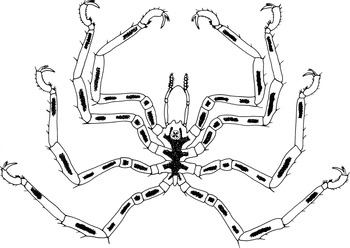
The pycnogonid Ammothea hilgendorfi (Böhm, Reference Böhm1879) (Figure 1) is a common littoral to infralittoral ammotheid species around the coasts of Japan, and has also long been known from the Pacific coasts of California and Mexico (for many years under the junior synonym Lecythorhynchus marginatus Cole, Reference Cole1904).
Ammothea hilgendorfi (Böhm, Reference Böhm1879), adult female (after Bamber, Reference Bamber2010). Dark stippling on the trunk and legs indicates dark-brown pigmentation patches.

While normally found free-living in epizoan and epiphytic communities and in heterogeneous sediments, this species has been recorded ectocommensally on the holothurian Holothuria (Selenkothuria) moebii (Ludwig) (Ohshima, Reference Ohshima1927, as Lecythorhynchus) and on the starfish Coscinasterias acutispina (Stimpson) (Nakamura & Fujita, Reference Nakamura and Fujita2004). It is often associated with hydroids, such as species of Abietinaria Kirchenpauer (e.g. Hedgpeth, Reference Hedgpeth1940); the protonymphon larvae have been found endoparasitically in association with the campanulariid Orthopyxis everta (Clark) (Russel & Hedgpeth, Reference Russel and Hedgpeth1990, as Eucopella everta). The overall recorded depth-range for A. hilgendorfi is 0 to 15 m.
This Pacific species was discovered in the Lagoon of Venice in 1979 to 1981, where its presence was attributed to anthropogenic introduction via ships'-hull fouling (Krapp & Sconfietti, Reference Krapp and Sconfietti1983). In August 1978, two specimens were collected in Hampshire, UK (Bamber, Reference Bamber1985), on the south coast of England, the second record outside the Pacific; this occurrence of A. hilgendorfi was also attributed to anthropogenic dispersion by shipping. Subsequent records in the UK, including its most recent discovery on the east coast, are discussed herein.
DISTRIBUTION
Western Pacific records
The type locality of Ammothea hilgendorfi is at Enoshima, Honshū, Japan, at 5 to 7 m depth (Böhm, Reference Böhm1879, as Corniger Hilgendorfi gen. nov. sp. nov.), since when it has been recorded throughout Japan in littoral to shallow waters (Helfer, Reference Helfer1938, as Lecythorhynchus marginatus; Hedgpeth, Reference Hedgpeth1949, as Lecythorhynchus; Utinomi, Reference Utinomi1951, as Lecythorhynchus; Utinomi, Reference Utinomi1954, as Lecythorhynchus; Stock, Reference Stock1954, as L. marginatus; Utinomi, Reference Utinomi1959, as Lecythorhynchus; Utinomi, Reference Utinomi1971, as Lecythorhynchus; Nakamura & Child, Reference Nakamura and Child1983; Nakamura, Reference Nakamura1987 [with synonymy and literature]; Nakamura & Child, Reference Nakamura and Child1991; Nakamura, Reference Nakamura1994; Turpaeva, Reference Turpaeva, Kuznetsov and Zezina2001, as Leionymphon marginatus; Nakamura & Fujita, Reference Nakamura and Fujita2004). In addition, sparse records exist from Korea (Kim, Reference Kim1984; Kim & Hong, Reference Kim and Hong1986; Hong & Kim, Reference Hong and Kim1987), from China (Lou, Reference Lou1936, as Lecythorhynchus) and from the east coast of Russia (Losina-Losinsky, Reference Losina-Losinsky1933, as Lecythorhynchus marginatus), again in littoral to shallow waters.
Mid-Pacific records
From mid-oceanic islands in the Pacific, Ammothea hilgendorfi has been recorded twice in the Society Islands (Child, Reference Child1970; Müller, Reference Müller1989) as well as in Hawaii (Hilton, Reference Hilton1942, as Lecythorhynchus ovatus sp. nov.).
Eastern Pacific records
Ammothea hilgendorfi has been recorded frequently along the coasts of California and Mexico (Cole, Reference Cole1904, as Lecythorhynchus marginatus sp. nov.; Hall, Reference Hall1913, as L. marginatus; Schmitt, Reference Schmitt1934, as L. marginatus; Hedgpeth, Reference Hedgpeth1940, as L. marginatus; Hedgpeth, Reference Hedgpeth1941, in key, as L. marginatus; Hilton, Reference Hilton1943, as L. marginatus; Hedgpeth, Reference Hedgpeth1951, as L. marginatus; Hedgpeth, Reference Hedgpeth and Light1975; Child, Reference Child1979; Hedgpeth & Haderlie, Reference Hedgpeth, Haderlie, Morris, Abbott and Haderlie1980; Russel & Hedgpeth, Reference Russel and Hedgpeth1990; Bain, Reference Bain1991).
OCCURRENCE AS A XENOBIONT
The first published record of Ammothea hilgendorfi outside the Pacific, as an anthropogenically-introduced species, was by Krapp & Sconfietti (Reference Krapp and Sconfietti1983; see also Candela et al., Reference Candela, Sconfietti and Torelli1983), who discovered A. hilgendorfi in the Lagoon of Venice amongst fouling communities in 1979 to 1981, in nearly fully-marine conditions. These authors attributed its presence to arrival from East Asian waters in the hull-fouling of ships: there is an extensive shipping trade from the Far or Middle East via the Suez Canal to the port of Venice (e.g. Galil, Reference Galil2000; Streftaris et al., Reference Streftaris, Zenetos and Papathanassiou2005). There have been no subsequent records of A. hilgendorfi on the adjacent shores of the Adriatic Sea.
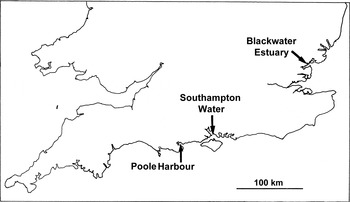
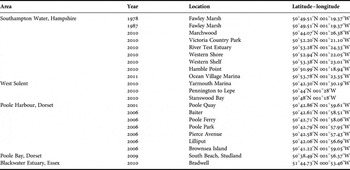
United Kingdom records are listed in Table 1, with a map showing the key locations as Figure 2.
Map of southern England showing locations of the UK records of Ammothea hilgendorfi.

Dates and locations of Ammothea hilgendorfi records in UK waters.

Ammothea hilgendorfi was first recorded in UK waters by Bamber (Reference Bamber1985), from two immature specimens collected in August 1978 in Southampton Water, Hampshire (~50°49.5′N 01°19.3′W), in fully marine conditions. Southampton Water is a ria on the south coast of England, about 13 km long and 2 km wide at its widest; its southern (seaward) end connects with the Solent, a strait separating the Isle of Wight from the Hampshire mainland, while at its northern end lies Southampton, a major port with an extensive shipping trade, including with Japan. This area of coastline now supports resident populations of a number of Japanese species, including the tunicate Styela clava Hedman and the serpulid tube-worms Pileolaria (P.) berkeleyana (Rioja) and Hydroides ezoensis Okuda, although the latter may have crossed the English Channel from French coasts where the Japanese oyster Crassostrea gigas (Thunberg) had been transplanted. The establishment of A. hilgendorfi in Southampton Water was first confirmed with the discovery of an adult in October 1987 (Bamber, Reference Bamber1988).
Ammothea hilgendorfi was subsequently found in large numbers in Poole Harbour, Dorset (~50°41.8′N 01°59.0′W) (mistakenly cited as Portland HarbourFootnote 1 in Bamber, Reference Bamber2010). The initial record was in July 2001, amongst epifaunal fouling material on a marina pontoon; by 2006, A. hilgendorfi was regularly found under boulders around the Harbour, in densities ranging from ‘occasional’ to ‘superabundant'. In Poole Harbour, it now (2011) seems to be present intertidally (mid-tide level) virtually wherever there is suitable habitat, i.e. under small, rough boulders lying on medium to coarse sand, where several tens of animals may aggregate (L. Baldock, personal communication). By 2009, it had also been recorded outside Poole Harbour, at South Beach, Studland Bay, where it was certainly absent in 2006.
Meanwhile, by 2010, the Southampton Water population was well-established, with numerous intertidal records around the northern half of the ria particularly under boulders, but also subtidal records down the western shore to the mouth of the ria. In the same year Ammothea hilgendorfi was recorded elsewhere in the Solent, including Yarmouth on the Isle of Wight (~50°43.0′N 01°35.5′W), again amongst epifaunal fouling on a marina pontoon. In the spring of 2011, large numbers of A. hilgendorfi were taken from pontoon epifauna in Ocean Quay Marina, the site of the old Southampton Outer Dock (~50°53.7′N 01°23.3′W), as well as elsewhere in Southampton Water (Horton et al., Reference Horton, Robbins and Bamber2011).
In 2010, specimens of Ammothea hilgendorfi were collected for the first time from the southern North Sea on the east coast of England. During a benthic survey of the River Blackwater Estuary in Essex, in the vicinity of Bradwell Power Station (~51°44.7′N 0°53.5′E), A. hilgendorfi was the second-most-common of nine species of pycnogonid collected, with twenty individuals taken at six sites. These specimens were collected in grab samples from sedimentary habitats comprising mud with fine sand and shell, at depths between 6 and 31.5 m. The Blackwater Estuary is also an area of recreational yachting, with numerous moorings around Mersea Island to the north of the sampling area and at Bradwell Marina to the south-east. This area was subject to some intensive surveying in relation to existing and proposed power stations from the 1960s to the mid-1980s (e.g. Bamber & Henderson, Reference Bamber and Henderson1981), and again in the late 1990s: A. hilgendorfi was certainly absent then.
DISCUSSION
Pycnogonids do not have an obligate dispersive phase in their life history. A few species have been observed swimming (e.g. Cole, Reference Cole1901; Fage, Reference Fage1932; Clark & Carpenter, Reference Clark and Carpenter1977), but this appears to be a method of maintaining a position above the sea-bottom rather than for directional movement; it may allow for tidal dispersion (Morgan, Reference Morgan1977, Reference Morgan1978). Thus, achieving a wide distribution requires either a long time, or some assistance in dispersal, either in drifting algae or by anthropogenic transport. Pycnogonids have been recorded in ships'-hull fouling (e.g. Bamber, Reference Bamber1979), a habitat in which they might be expected to be able to complete their life-cycle.
As well as being the location of a major port, Southampton Water and the adjacent Solent house the greatest concentration of marinas and recreational yachts in the UK. Poole Harbour is also a significant site for yacht marinas, and in easy sailing distance from Southampton. It is notable that the majority of the records of A. hilgendorfi from sites in Dorset, Hampshire and the Isle of Wight are from marinas. The River Blackwater Estuary is home to some commercial fishing (trawling) and a nuclear power station, but currently is largely a centre for recreation, notably with yacht marinas. Galil (Reference Galil2000) notes that the increase in spread of xenobiont species in the Mediterranean is associated with increases in seafaring, commercial and tourism activities, and cites lagoons, estuaries and marinas as habitats particularly susceptible to invasions.
It thus seems likely that A. hilgendorfi was first introduced to the UK by international shipping into Southampton, and has subsequently spread westwards along the south coast to Dorset and eastwards to Essex with the assistance of recreational yachting. Other likely sites for the appearance of this species are Brighton (East Sussex) and the Channel Islands, both common destinations for short-distance recreational yachting from the Solent area.
Climatically, the UK is amenable to a species originating in Japan, as can be seen from the current distribution of the tunicate Styela clava around the British Isles (Davis & Davis, Reference Davis and Davis2004). It appears to have taken A. hilgendorfi some two decades to spread from Southampton to Poole Harbour (where it has since proliferated), and three decades to reach the southern North Sea coast of England; the main dispersion (so far) of this species in the UK seems to have occurred during the past decade. It will be interesting to see how long it takes to achieve a similar spread around the UK as has Styela clava. Fortunately, while a successful anthropogenically-introduced species, A. hilgendorfi cannot be considered an ‘invasive' species, as no threat to the local ecology is conceived (Eno et al., Reference Eno, Clark and Sanderson1997).
ACKNOWLEDGEMENTS
I am very grateful to Lin Baldock for the records from Poole Harbour, to Jenny Mallinson and Peter Henderson for the records around Southampton Water and in the Solent, and to SeaStar Survey, Rosie Kelly of Haskoning UK Ltd and Magnox South Ltd for permission to publish their data on the material from the River Blackwater. Also I am grateful to the anonymous referee for the as-yet unpublished information that A. hilgendorfi has persisted in low numbers in the Lagoon of Venice.