Introduction
A history of childhood trauma (CT), including experiences of neglect and abuse and other traumatic events during childhood, has been linked to a greater risk of developing mental illness and health-risk behaviors later in life (Afifi et al., Reference Afifi, Mather, Boman, Fleisher, Enns, Macmillan and Sareen2011; Dube, Anda, Felitti, Edwards, & Croft, Reference Dube, Anda, Felitti, Edwards and Croft2002; Grilo & Masheb, Reference Grilo and Masheb2002; Kessler, Davis, & Kendler, Reference Kessler, Davis and Kendler1997; Khoury, Tang, Bradley, Cubells, & Ressler, Reference Khoury, Tang, Bradley, Cubells and Ressler2010; Lindert et al., Reference Lindert, von Ehrenstein, Grashow, Gal, Braehler and Weisskopf2014; Lotzin, Grundmann, Hiller, Pawils, & Schäfer, Reference Lotzin, Grundmann, Hiller, Pawils and Schäfer2019; Varese et al., Reference Varese, Smeets, Drukker, Lieverse, Lataster, Viechtbauer and Bentall2012). About half of the adult population report some form of CT (Afifi et al., Reference Afifi, Mather, Boman, Fleisher, Enns, Macmillan and Sareen2011; Kessler et al., Reference Kessler, Davis and Kendler1997), underscoring the importance of these experiences in shaping population-level mental health.
One way by which CT may increase the liability to mental illness is increased sensitization to stress (Dienes, Hammen, Henry, Cohen, & Daley, Reference Dienes, Hammen, Henry, Cohen and Daley2006; Hammen, Reference Hammen2005; Hammen, Henry, & Daley, Reference Hammen, Henry and Daley2000; Heim & Nemeroff, Reference Heim and Nemeroff2001; McLaughlin et al., Reference McLaughlin, Koenen, Bromet, Karam, Liu, Petukhova, Kawakami and Kessler2017; Myin-Germeys & van Os, Reference Myin-Germeys and van Os2007; Read, Perry, Moskowitz, & Connolly, Reference Read, Perry, Moskowitz and Connolly2001; Reininghaus et al., Reference Reininghaus, Gayer-Anderson, Valmaggia, Kempton, Calem, Onyejiaka and Morgan2016). As a severe early-life stressor, CT has been shown to induce enduring alterations at the neurobiological level changing the stress response, including elevated subjective experience of stress and enhanced threat anticipation (Carpenter et al., Reference Carpenter, Tyrka, Ross, Khoury, Anderson and Price2009; Dannlowski et al., Reference Dannlowski, Stuhrmann, Beutelmann, Zwanzger, Lenzen, Grotegerd and Kugel2012; LoPilato et al., Reference LoPilato, Addington, Bearden, Cadenhead, Cannon, Cornblatt and Walker2019; McLaughlin, Conron, Koenen, & Gilman, Reference McLaughlin, Conron, Koenen and Gilman2010; Teicher & Samson, Reference Teicher and Samson2016). Heightened awareness of and reactivity to stressors may be conceptualized as lasting functional adaptations to childhood adversity as a chronically stressful environment (Wadsworth, Reference Wadsworth2015). Simultaneously, these adaptations of stress perception constitute one potential mechanism by which CT predisposes a broad range of psychopathological phenotypes emerging later in life, including mood and anxiety disorders, but also psychotic phenomena (Hammen, Reference Hammen2005; Heim & Nemeroff, Reference Heim and Nemeroff2001; Isvoranu et al., Reference Isvoranu, van Borkulo, Boyette, Wigman, Vinkers, Borsboom and Investigators2017; McLaughlin et al., Reference McLaughlin, Conron, Koenen and Gilman2010, Reference McLaughlin, Koenen, Bromet, Karam, Liu, Petukhova, Kawakami and Kessler2017; Myin-Germeys & van Os, Reference Myin-Germeys and van Os2007; Reininghaus et al., Reference Reininghaus, Gayer-Anderson, Valmaggia, Kempton, Calem, Onyejiaka and Morgan2016; Rössler, Ajdacic-Gross, Rodgers, Haker, & Müller, Reference Rössler, Ajdacic-Gross, Rodgers, Haker and Müller2016; van Nierop et al., Reference van Nierop, Lecei, Myin-Germeys, Collip, Viechtbauer, Jacobs and van Winkel2018).
Given that different domains of CT represent vastly different social experiences, it is advisable to differentiate between different types of adversity to delineate the effects of CT on the subjective experience of stress (McLaughlin, Sheridan, & Lambert, Reference McLaughlin, Sheridan and Lambert2014; Sheridan & McLaughlin, Reference Sheridan and McLaughlin2014; Wadsworth, Reference Wadsworth2015). In line with this idea, a recent study showed a specific pathway from childhood abuse to a generalized measure of stress perception in the female subgroup of a cohort at-risk for psychosis (LoPilato et al., Reference LoPilato, Addington, Bearden, Cadenhead, Cannon, Cornblatt and Walker2019). Similarly, previously undifferentiated domains of CT have been shown to exert distinct effects on neurobiological, socio-emotional and cognitive development (Busso, McLaughlin, & Sheridan, Reference Busso, McLaughlin and Sheridan2017; Cecil et al., Reference Cecil, Smith, Walton, Mill, McCrory and Viding2016, Reference Cecil, Viding, Fearon, Glaser and McCrory2017; Hildyard & Wolfe, Reference Hildyard and Wolfe2002; Kuhlman, Geiss, Vargas, & Lopez-Duran, Reference Kuhlman, Geiss, Vargas and Lopez-Duran2015; LoPilato et al., Reference LoPilato, Addington, Bearden, Cadenhead, Cannon, Cornblatt and Walker2019; McLaughlin et al., Reference McLaughlin, Sheridan and Lambert2014; Sheridan & McLaughlin, Reference Sheridan and McLaughlin2014; Teicher & Samson, Reference Teicher and Samson2016). Differential links have also been found between distinct domains of childhood adversity and symptoms in psychiatric populations (Cecil, Viding, Fearon, Glaser, & McCrory, Reference Cecil, Viding, Fearon, Glaser and McCrory2017; Isvoranu et al., Reference Isvoranu, van Borkulo, Boyette, Wigman, Vinkers, Borsboom and Investigators2017). Overall, it seems likely that different domains of CT pose varying functional demands on the stress system, with ultimately different consequences for behavior (LoPilato et al., Reference LoPilato, Addington, Bearden, Cadenhead, Cannon, Cornblatt and Walker2019; McLaughlin, DeCross, Jovanovic, & Tottenham, Reference McLaughlin, DeCross, Jovanovic and Tottenham2019; Soffer, Gilboa-Schechtman, & Shahar, Reference Soffer, Gilboa-Schechtman and Shahar2008; Wadsworth, Reference Wadsworth2015).
However, until now little is known about the putative psychological stress-processes underlying distinct types of trauma, as prior research has assessed the impact of CT on perceived stress in adulthood in a way that restricted specificity on one side of the association: The analyses either confined to a selected, rather than a comprehensive group of experiences of CT (Soffer et al., Reference Soffer, Gilboa-Schechtman and Shahar2008), or used a generalized, rather than a specific measure of stress perception (LoPilato et al., Reference LoPilato, Addington, Bearden, Cadenhead, Cannon, Cornblatt and Walker2019; Rössler et al., Reference Rössler, Ajdacic-Gross, Rodgers, Haker and Müller2016). Characterizing how distinct domains of CT influence specific aspects of perceived stress may allow to design interventions that target these mechanisms directly to reduce the intensity of psychopathological burden and, ultimately, foster resilience to mental illness (Reininghaus et al., Reference Reininghaus, Gayer-Anderson, Valmaggia, Kempton, Calem, Onyejiaka and Morgan2016). Given the high prevalence of CT and its strong implication in mental, but also physical health (Goodwin & Stein, Reference Goodwin and Stein2004), such targeted interventions come with the potential to reduce the negative personal and socioeconomic impact associated with CT.
In the present study, we aim to further explore how distinct domains of CT shape different aspects of subjective experiences of stress in adult life. One methodological difficulty in assessing the impact of distinct domains of CT is that they are typically highly interrelated and frequently co-occur (Baker & Festinger, Reference Baker and Festinger2011; Cecil et al., Reference Cecil, Viding, Fearon, Glaser and McCrory2017; Dong et al., Reference Dong, Anda, Felitti, Dube, Williamson, Thompson and Giles2004). Considering one or a selected group of childhood adversities in isolation may likely result in an overestimation of their effects on adult experiences of stress, just as generalizing different domains of CT into one broad category may obscure important insights into mechanisms linking CT with developmental outcomes (Cecil et al., Reference Cecil, Viding, Fearon, Glaser and McCrory2017; McLaughlin et al., Reference McLaughlin, Sheridan and Lambert2014). To account for these difficulties, we use network analysis, a statistical framework that allows to quantify the unique associations among many variables simultaneously (Epskamp, Borsboom, & Fried, Reference Epskamp, Borsboom and Fried2018a; Epskamp, Waldorp, Mõttus, & Borsboom, Reference Epskamp, Waldorp, Mõttus and Borsboom2018b; Koller & Friedman, Reference Koller and Friedman2009). This property makes network analysis an ideal choice for assessing the specific impact of co-occurring, strongly interrelated domains of CT. Typically, researchers apply network analysis as a tool to model psychopathology from a network perspective (Isvoranu et al., Reference Isvoranu, van Borkulo, Boyette, Wigman, Vinkers, Borsboom and Investigators2017; Rhemtulla et al., Reference Rhemtulla, Fried, Aggen, Tuerlinckx, Kendler and Borsboom2016). The components of such a network are conceptualized as active components of a dynamic system of symptoms or psychobiological factors that can mutually influence and maintain each other (Borsboom, Reference Borsboom2017; Borsboom & Cramer, Reference Borsboom and Cramer2013). In the present analysis, we model the interrelations of five domains of CT and items measuring perceived stress in a large, general-population sample in middle adulthood. Following a growing call for replicability investigations (Borsboom, Robinaugh, Rhemtulla, & Cramer, Reference Borsboom, Robinaugh, Rhemtulla and Cramer2018; Fried et al., Reference Fried, Eidhof, Palic, Costantini, Huisman-van Dijk, Bockting and Karstoft2018), we assessed the replicability of the findings in a second sample. Given recent indications for sex effects in the association between CT and subjective experience of stress (LoPilato et al., Reference LoPilato, Addington, Bearden, Cadenhead, Cannon, Cornblatt and Walker2019), we also assessed if networks of associations between CT and perceived stress differed between men and women. With the suggested network analysis, we aim to provide novel insights into the pathways by which CT impacts experiences of stress, thus paving ways to ameliorate the negative health consequences of CT.
Method
Participants
We used data from the Biomarker Project of the Midlife Development in the United States (MIDUS) Survey, a nationally representative longitudinal panel study of health and aging in the noninstitutionalized civilian population of the 48 contiguous USA (Ryff et al., Reference Ryff, Almeida, Ayanian, Carr, Cleary, Coe and Williams2017, Reference Ryff, Seeman and Weinstein2019). The original MIDUS sample comprised English-speaking adults aged 25–74 years whose household included at least one telephone (recruited by random digit dialing), with oversampling of five metropolitan areas, twin pairs and siblings (Brim, Ryff, & Kessler, Reference Brim, Ryff and Kessler2019). MIDUS I (N = 7108) was conducted from 1995 to 1996, and a follow-up study (MIDUS II) was conducted 10 years after the baseline assessment in N = 4963 MIDUS I respondents (70% response rate) between 2004 and 2005. Of those who participated in MIDUS II, 1255 (23% of MIDUS II) were able and willing to participate in the more comprehensive Biomarker Project Substudy, which was used for the main analysis reported in this paper (original sample). Details on the study protocol and scientific aims are available elsewhere (Dienberg Love, Seeman, Weinstein, & Ryff, Reference Dienberg Love, Seeman, Weinstein and Ryff2010).
As a replication sample, we used the Refresher Biomarker Project (Weinstein et al., Reference Weinstein, Ryff and Seeman2019) that emulates the original MIDUS Biomarker Project, employing the same assessments in an additional N = 863 participants between 2012 and 2016. The Refresher Biomarker Study was designed to parallel the five decadal age groups contained within the original MIDUS I baseline cohort. The Institutional Review Boards at the University of Wisconsin–Madison, the University of California–Los Angeles, and Georgetown University approved both Biomarker Projects. Research participants were admitted to or studied on the University of Wisconsin-Clinical and Translational Research Core (UW-CTRC).
Assessments
Childhood trauma
CT (up to age 18) was assessed with the English version of the Childhood Trauma Questionnaire-Short Form (CTQ-SF, Bernstein et al., Reference Bernstein, Stein, Newcomb, Walker, Pogge, Ahluvalia and Zule2003). The CTQ-SF is a self-report measure of CT, including five items within each of five different domains of CT: (1) physical neglect (failure of a caretaker to provide basic necessities for a child such as food, clothing, shelter); (2) physical abuse (bodily assault on a child posing a risk of or resulting in injury); (3) emotional neglect (failure of caretaker basic emotional and psychological needs for a child, such as love and nurturance); (4) emotional abuse (verbal assaults on a child, such as humiliation); and (5) sexual abuse (unwanted sexual contact or conduct between a child and an adult). Responses for each item are recorded on a 5-point-Likert scale, ranging from 1 (never true) to 5 (very often true). We computed total scores for each domain that were used in the construction of the networks. Possible total scores of each domain ranged from 5 to 25.
Perceived stress
In MIDUS, perceived stress was measured using the 10-item version of the Perceived Stress Scale (Cohen, Kamarck, & Mermelstein, Reference Cohen, Kamarck and Mermelstein1983). Participants are asked to rate the occurrence of stress-related thoughts and feelings over the past month on a 5-point-Likert-scale, ranging from 1 (never) to 5 (very often). To facilitate interpretation in the present analysis, we reverse-coded the positive items so that higher values are indicative of more perceived stress.
Data analytic strategy
We ran all analyses in the R language for statistical computing, version 3.6.1 (R Core Team, 2019). Participants with completely missing data in the network variables of interest were excluded from the analysis. We calculated descriptive statistics for the original, replication and combined sample. To evaluate differences between the original and replication sample, we used permutation tests implemented in the R package ‘coin’, version 1.3 (Hothorn, Hornik, van de Wiel, & Zeileis, Reference Hothorn, Hornik, van de Wiel and Zeileis2008). Throughout, we considered a significance level of α = 0.05. Code to reproduce the analysis is available online (https://github.com/LindaBetz/Network_CT_Stress).
Network analysis
Network Estimation. We fitted networks in the form of a partial correlation network, also known as Gaussian graphical model (GGM), to the data (Epskamp et al., Reference Epskamp, Waldorp, Mõttus and Borsboom2018b; Koller & Friedman, Reference Koller and Friedman2009). In this undirected network, the five CTQ-domains and the 10 stress-experience items from the PSS questionnaire are represented as nodes. A connection (called ‘edge’ in the network literature) between two nodes indicates a partial correlation between the two variables, i.e. the association between these two variables that remains after controlling for all other variables under consideration (Koller & Friedman, Reference Koller and Friedman2009). In other words, edges can be interpreted as predictive effects, representing the share of the pairwise association that cannot be explained by any other variables in the model (Epskamp et al., Reference Epskamp, Waldorp, Mõttus and Borsboom2018b; Isvoranu et al., Reference Isvoranu, van Borkulo, Boyette, Wigman, Vinkers, Borsboom and Investigators2017). The stronger the partial correlation between two nodes, the thicker the edge drawn in the network. Whenever the partial correlation between two variables is exactly zero, these variables are independent after controlling for all other variables in the model, and no edge is drawn between the two corresponding nodes in the network (Epskamp et al., Reference Epskamp, Waldorp, Mõttus and Borsboom2018b; Koller & Friedman, Reference Koller and Friedman2009).
To account for the ordinal distribution of the items and missing data, we estimated the partial correlation matrix based on Spearman correlations using pairwise complete observations (Epskamp et al., Reference Epskamp, Borsboom and Fried2018a). We determined the optimal network model by using stepwise, unregularized model selection. This approach returns the best-fitting model by minimizing the Bayesian information criterion (BIC) of unregularized GGM models. In the final network model, no edge can be added or removed to improve fit. For plotting the network, we generated a force-directed layout using the Fruchterman-Reingold algorithm (Fruchterman & Reingold, Reference Fruchterman and Reingold1991). To facilitate comparison, the same network layout (generated based on the original data set) was used for visualizing networks throughout the paper. We constructed and visualized the networks using the package ‘qgraph’, version 1.6.3 (Epskamp, Cramer, Waldorp, Schmittmann, & Borsboom, Reference Epskamp, Cramer, Waldorp, Schmittmann and Borsboom2012). Weighted adjacency matrices containing the set of partial correlation coefficients corresponding to the depicted networks are available in the supplement and in the linked github repository.
For methodological details, we refer the interested reader to available tutorial and overview articles (Epskamp et al., Reference Epskamp, Borsboom and Fried2018a, Reference Epskamp, Waldorp, Mõttus and Borsboom2018b).
Community detection. For a data-driven identification of highly connected subgroups (termed ‘communities’) in the generated network of CT and perceived stress, we used the walktrap algorithm (Pons & Latapy, Reference Pons and Latapy2005) as implemented in the R package ‘igraph’, version 1.2.4.1 (Csardi & Nepusz, Reference Csardi and Nepusz2006). The walktrap algorithm detects communities within a network by using random walks. Results were compared to an alternative community detection approach, the spinglass algorithm (Reichardt & Bornholdt, Reference Reichardt and Bornholdt2006), as implemented in the R package ‘igraph’.
Robustness analyses
We performed several follow-up analyses on the calculated networks to assess their robustness using the R package ‘bootnet’, version 1.2.4 (Epskamp et al., Reference Epskamp, Borsboom and Fried2018a; Epskamp & Fried, Reference Epskamp and Fried2015). These analyses (a) show how accurately the edges in the network are estimated by constructing a 95% bootstrapped confidence interval (CI) around them, and (b) indicate how stable centrality is estimated via the centrality-stability (CS) coefficient (Costenbader & Valente, Reference Costenbader and Valente2003). This coefficient indicates the maximum proportion of observations that can be dropped while confidently (95%) retaining results that correlate highly (r > 0.7) with the results obtained in the original sample. A CS coefficient of 0.25 or above indicates adequate stability and a coefficient of 0.50 or above indicates high stability (Epskamp et al., Reference Epskamp, Borsboom and Fried2018a). For all robustness analyses, we used 1000 bootstrap samples.
Replicability analyses
Using the same workflow as described above, we estimated the network of CT and perceived stress in the replication sample. Following procedures described by Fried et al. (Reference Fried, Eidhof, Palic, Costantini, Huisman-van Dijk, Bockting and Karstoft2018), we aimed to quantify the replicability of the network. First, we correlated the individual edge weights contained within the partial correlation matrices of the two networks, which provides a coefficient of similarity (Borsboom et al., Reference Borsboom, Robinaugh, Rhemtulla and Cramer2018; Rhemtulla et al., Reference Rhemtulla, Fried, Aggen, Tuerlinckx, Kendler and Borsboom2016). Second, we used permutation tests (1000 permutations) to formally assess whether the networks differed from each other in their network structures and global strength (i.e. the sum of all absolute edge values) using the R package ‘NetworkComparisonTest’, version 2.2.1 (van Borkulo et al., Reference van Borkulo, Boschloo, Kossakowski, Tio, Schoevers, Borsboom and Waldorp2017). Third, based on the results from the permutation test, we examined post-hoc how many of the 105 edges differed across the networks. This was done using the false discovery rate (FDR) corrected p-values (Benjamini & Hochberg, Reference Benjamini and Hochberg1995). Finally, we estimated and visualized the network based on the combined data set. Detailed results for this analysis are available in the supplement.
Comparison of networks in men and women
To investigate the moderating role of sex on associations between CT and perceived stress, we compared the networks of men and women using the same permutation-based approach (1000 permutations) detailed above (van Borkulo et al., Reference van Borkulo, Boschloo, Kossakowski, Tio, Schoevers, Borsboom and Waldorp2017). When comparing individual edges of the network of men and women, we considered FDR-corrected p-values (Benjamini & Hochberg, Reference Benjamini and Hochberg1995). To retain a similar level of power for detection of edges in the subgroup networks, we merged data from the Biomarker Study (original sample) and the Biomarker Refresher Study (replication sample) for both analyses.
Results
Sample characteristics
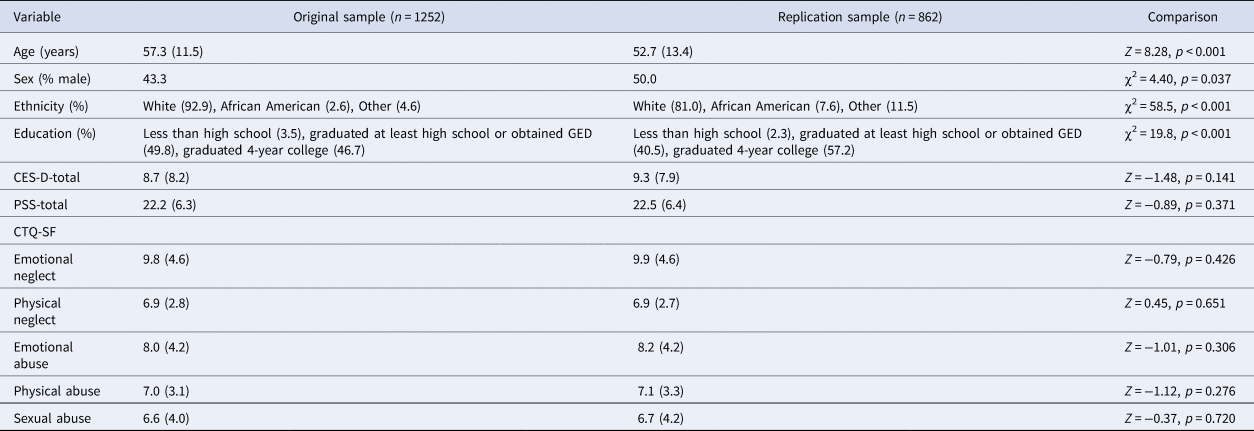
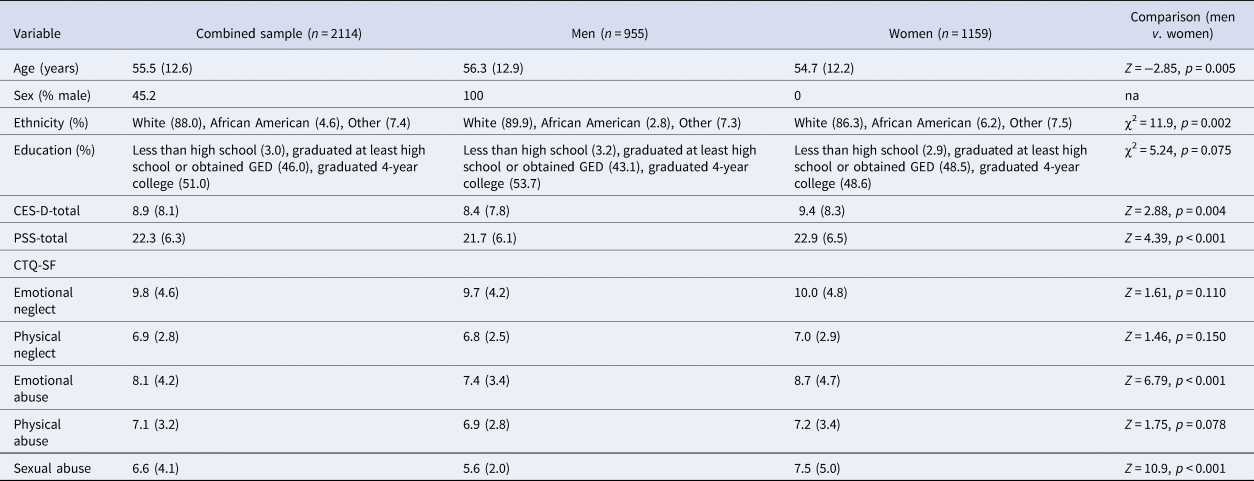
Of the 1255 participants in the original sample, three had completely missing data in the variables of interest and could not be included in the analysis. Hence, the final sample comprised 1252 individuals (43.3% male), with a mean age of 57.3 (s.d. = 11.5) years. On average, 0.2% of the network variables of interest were missing. Table 1 summarizes the demographic and clinical sample characteristics. The replication sample (one participant excluded due to completely missing data, n = 862) was overall similar in relevant clinical characteristics, but had more males, was younger, and better educated. The average amount of missing values was 0.1%. For the subgroup analysis, the combined original and replication sample (N = 2114) was split into male (n = 955) and female (n = 1159) participants. Table 2 presents the demographic and clinical sample characteristics of the combined sample as well as the subgroups. Women were on average younger, less White, showed more depressive symptoms and global perceived stress, and scored higher on CT domains of emotional and sexual abuse.
Demographic and clinical characteristics of the original and replication sample

Means (s.d.) unless stated otherwise.
CES-D, Center for Epidemiological Studies Depression Scale; CTQ-SF, Childhood Trauma Questionnaire-Short Form; GED, General Education Diploma; PSS, Perceived Stress Scale.
Demographic and clinical characteristics for men and women

Means (s.d.) unless stated otherwise.
CES-D, Center for Epidemiological Studies Depression Scale; CTQ-SF, Childhood Trauma Questionnaire-Short Form; GED, General Education Diploma, PSS, Perceived Stress Scale.
Network
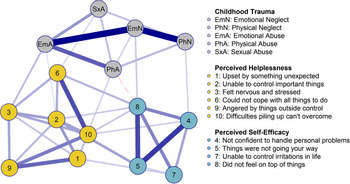
The network depicted in Fig. 1 illustrates the relationships between the different domains of CT and perceived stress (for the partial correlation coefficients, online Supplementary Table S1; centrality plot in online Supplementary Fig. S1). Of 105 possible edges, 35 were retained after the unregularized model selection procedure. All except one edge were positive. Sensitivity analyses suggested that the network model was very stable (all CS-coefficients r = 0.75, online Supplementary Figs S2–S3) and network parameters were estimated with good accuracy (online Supplementary Fig. S4).
Network of five domains of childhood trauma and perceived stress. Solid edges indicate positive relationships and dashed edges indicate negative relationships. The thicker the edge, the stronger the association between two variables. Node coloring represents the three communities detected with the walktrap algorithm (Pons & Latapy, Reference Pons and Latapy2005). The force-directed layout for plotting the network was generated by the Fruchterman-Reingold algorithm (Fruchterman & Reingold, Reference Fruchterman and Reingold1991). To facilitate interpretation of connections in the network, we recoded and reworded the positive items for the present analysis.

Within the network, all CT domains, as well as items reflecting perceived stress, are highly interconnected, suggesting that the associations within each construct are larger than between the two constructs. Evidently, CT domains are differentially associated with perceived stress. Emotional neglect is positively associated with ‘did not feel on top of things’. Physical neglect connects to ‘not confident to handle personal problems’. Emotional abuse has an edge to ‘felt nervous and stressed’. A second, smaller edge connects emotional abuse to feeling ‘unable to control important things’. Physical abuse makes feeling ‘upset by something unexpected’ more likely. Additionally, there is a small edge from sexual abuse to ‘could not cope with all things to do’. Finally, there is a small, negative edge between physical abuse and not feeling ‘on top of things’. Due to its unexpected, negative sign, this edge is likely indicative of conditioning on a collider (Epskamp et al., Reference Epskamp, Waldorp, Mõttus and Borsboom2018b; Koller & Friedman, Reference Koller and Friedman2009): in an undirected network like the one present, a negative edge is falsely introduced between two variables that have positive, directed effects on a common third variable (here, likely node 10: ‘difficulties piling up can't overcome’).
Community detection
The walktrap algorithm detected three communities (Fig. 1). The five domains of CT form the first, strongly interconnected community. The second and third community detected within the items of the PSS fully align with a two factor-solution identified in several healthy and clinical samples using factor analysis (Leung, Lam, & Chan, Reference Leung, Lam and Chan2010; Reis, Hino, & Añez, Reference Reis, Hino and Añez2010; Roberti, Harrington, & Storch, Reference Roberti, Harrington and Storch2006). These two factors have been labelled ‘perceived self-efficacy’ and ‘perceived helplessness’ (Roberti et al., Reference Roberti, Harrington and Storch2006), which is the labeling we will also use here. These two identified stress communities show differential associations with CT: perceived self-efficacy primarily relates to CT dimensions of neglect, and perceived helplessness exclusively relates to CT dimensions of abuse. Communities obtained with the spinglass algorithm were identical to results from the walktrap algorithm.
Replicability
Paralleling results for the original network, sensitivity analyses suggested that the network model based on the replication data was very stable (all CS-coefficients r = 0.75, online Supplementary Figs S6 and S7) and network parameters were estimated with good accuracy (online Supplementary Fig. S8). Pearson's correlation of the edge weights of the original and replication network was 0.92, suggesting a strong similarity between the two networks (Borsboom et al., Reference Borsboom, Robinaugh, Rhemtulla and Cramer2018; Fried et al., Reference Fried, Eidhof, Palic, Costantini, Huisman-van Dijk, Bockting and Karstoft2018). Pearson's correlation between strength centrality of individual nodes was similarly high (r = 0.96; for centrality plots online Supplementary Figs S1 and S5). In line with this, permutation-based comparison suggested no significant differences in structure (Test statistic M = 0.15, p = 0.418) nor global strength (Test statistic S = 0.24, p = 0.165) between the original and the replication network. Post-hoc comparisons of individual edges showed that none of the 105 edges differed significantly between the two networks. In sum, we conclude that both networks are highly similar and results from the analysis reported in this paper are replicable. The replication network estimated based on the Biomarker Refresher data as well as the cross-sample network are available in online Supplementary Fig. S9, and the corresponding weighted adjacency matrices in online Supplementary Tables S2 and S3.
Comparison of networks in men and women
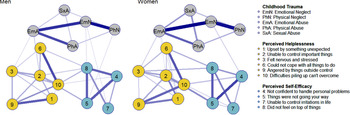
Figure 2 depicts the networks estimated for men and women separately (for weighted adjacency matrices, online Supplementary Tables S4 and S5). Permutation-based comparison of the networks revealed a significantly stronger connected network in women than in men (Test statistic S = 0.35, p = .037). Conversely, no differences emerged in overall network structure (Test statistic M = 0.14, p = 0.595) nor individual connections between any of the network variables when applying FDR correction for multiple comparisons (all ps > 0.705).
Network of five domains of childhood trauma and perceived stress estimated in men (n = 955) and women (n = 1159). Solid edges indicate positive relationships. The thicker the edge, the stronger the association between two variables. Node coloring represents the three communities detected with the walktrap algorithm (Pons & Latapy, Reference Pons and Latapy2005). Both networks were plotted with the force-directed layout of the original network, generated by the Fruchterman-Reingold algorithm (Fruchterman & Reingold, Reference Fruchterman and Reingold1991). To ease interpretation of connections in the network, we recoded and reworded the positive items for the present analysis. To facilitate visual comparison of the networks, minimum and maximum of edge weights were scaled identically across the two networks.

Discussion
Understanding potential mechanistic cognitive pathways by which CT impacts mental health is central to ameliorate its manifold negative consequences. To achieve this goal, it has been argued to distinguish between different types of trauma (McLaughlin et al., Reference McLaughlin, DeCross, Jovanovic and Tottenham2019, Reference McLaughlin, Sheridan and Lambert2014). In this study, we estimated a network of five domains of CT and items measuring experiences of perceived stress in a large general-population sample. We found that distinct domains of CT are specifically related to two identified network communities reflecting different aspects of perceived stress. Our results support the notion that different domains of CT represent different functional demands for the developing stress system, with differential consequences for the perception of stress in adulthood (Wadsworth, Reference Wadsworth2015): In the identified network, domains of child neglect exclusively connect to experiences of stress reflecting lowered perceived self-efficacy, i.e. reduced belief in one's competence to successfully accomplish the desired objective (Lawrance & McLeroy, Reference Lawrance and McLeroy1986). All domains of child abuse, on the other hand, mainly connect to items from a community representing increased perceived helplessness. These findings add to an accumulating body of research documenting associations between CT and perceived stress in adulthood (LoPilato et al., Reference LoPilato, Addington, Bearden, Cadenhead, Cannon, Cornblatt and Walker2019; McLaughlin et al., Reference McLaughlin, Conron, Koenen and Gilman2010; Rössler et al., Reference Rössler, Ajdacic-Gross, Rodgers, Haker and Müller2016; Soffer et al., Reference Soffer, Gilboa-Schechtman and Shahar2008), but extend the literature by delineating specific effects of core dimensions of CT on different aspects of perceived stress in a network approach. Notably, the two network communities of perceived stress fully align with factor solutions obtained in previous studies (Leung et al., Reference Leung, Lam and Chan2010; Reis et al., Reference Reis, Hino and Añez2010; Roberti et al., Reference Roberti, Harrington and Storch2006). As expected based on previous work, network analysis identified one strongly connected community of CT domains suggesting high interrelatedness and co-occurrence of the different domains of CT (Baker & Festinger, Reference Baker and Festinger2011; Cecil et al., Reference Cecil, Smith, Walton, Mill, McCrory and Viding2016, Reference Cecil, Viding, Fearon, Glaser and McCrory2017). Overall, our findings could be replicated in an independent, large population sample which suggests that our results are robust despite several differences in demographic variables. Subgroup analysis comparing networks of men and women showed no differences in network structure, but a significantly stronger connected network of CT and perceived stress in women.
The grouping of CT into neglect and abuse by differential network associations with perceived stress resonates well with a proposed distinction of early traumatic experiences into core dimensions of deprivation and threat (McLaughlin et al., Reference McLaughlin, Sheridan and Lambert2014; Sheridan & McLaughlin, Reference Sheridan and McLaughlin2014). Based on evidence and mechanisms derived from basic neuroscience and animal research, primarily sensory deprivation and fear learning, it has been suggested that childhood adversity dimensions of deprivation and threat have a distinct impact on neurodevelopment and ultimately behavior (McLaughlin et al., Reference McLaughlin, Sheridan and Lambert2014). In the context of CT, the dimension of deprivation involves neglect of any form, e.g. emotional or physical neglect, experienced during childhood. Experiences of threat include events that involve verbal assaults, any harm to one's physical integrity, and sexual violation (Sheridan & McLaughlin, Reference Sheridan and McLaughlin2014). Our data suggest that CT domains of deprivation, represented by emotional and physical neglect, specifically connect to stress-experiences representing reduced perceived self-efficacy. CT domains of threat, represented by emotional, physical, and sexual abuse, by contrast, are primarily associated with experiences of stress reflecting perceived helplessness. This pattern of results is consistent with a previous structural equation modeling study in an Israeli college sample (Soffer et al., Reference Soffer, Gilboa-Schechtman and Shahar2008). The study reported specific associations between emotional neglect and a measure of self-efficacy on the one hand, and emotional abuse and depressive vulnerability on the other hand. The specificity of the connections between CT and adult stress experience identified in the present study underscores the call for assessing different domains of CT simultaneously rather than in isolation or lumped under a single big category (Cecil et al., Reference Cecil, Viding, Fearon, Glaser and McCrory2017; Hildyard & Wolfe, Reference Hildyard and Wolfe2002; LoPilato et al., Reference LoPilato, Addington, Bearden, Cadenhead, Cannon, Cornblatt and Walker2019; McLaughlin et al., Reference McLaughlin, Sheridan and Lambert2014; Teicher & Samson, Reference Teicher and Samson2016).
Children experiencing severe deprivation have been shown to hold only very restricted positive beliefs about themselves (Hildyard & Wolfe, Reference Hildyard and Wolfe2002; Toth, Cicchetti, Macfie, & Emde, Reference Toth, Cicchetti, Macfie and Emde1997). Restricted positive self-representations are likely aligning with a domestic environment giving little attention to basic emotional and physical needs, offering only very few opportunities to experience the self as positive (Toth et al., Reference Toth, Cicchetti, Macfie and Emde1997). Results from the present network analysis suggest that such restricted positive views following experiences of child neglect may carry over into adulthood, presenting themselves as beliefs of being less competent to successfully master demanding situations.
Experiences of abuse can be conceptualized as early exposure to a series of highly negative, uncontrollable events (McLaughlin et al., Reference McLaughlin, Sheridan and Lambert2014; Volpicelli, Balaraman, Hahn, Wallace, & Bux, Reference Volpicelli, Balaraman, Hahn, Wallace and Bux1999). Our findings indicate that such repeated threat is linked to a perceived lack of control to be effective in other aversive situations, even extending into adulthood. This pattern of behavior is well-known as ‘learned helplessness’ (Foa, Zinbarg, & Rothbaum, Reference Foa, Zinbarg and Rothbaum1992; Overmier & Seligman, Reference Overmier and Seligman1967; Seligman & Maier, Reference Seligman and Maier1967; Volpicelli et al., Reference Volpicelli, Balaraman, Hahn, Wallace and Bux1999). Individuals that have experienced uncontrollable trauma may learn that their efforts will have no effect, leaving them notably passive and helpless in future aversive situations, even if they are potentially controllable (Pryce et al., Reference Pryce, Azzinnari, Spinelli, Seifritz, Tegethoff and Meinlschmidt2011; Volpicelli et al., Reference Volpicelli, Balaraman, Hahn, Wallace and Bux1999). Increased perceived helplessness following experiences of uncontrollable threat, such as emotional, physical and sexual abuse, may constitute one pathway by which CT makes depressive symptoms more likely, as implicated by prominent cognitive models of depression (Abramson, Seligman, & Teasdale, Reference Abramson, Seligman and Teasdale1978; Kendler, Hettema, Butera, Gardner, & Prescott, Reference Kendler, Hettema, Butera, Gardner and Prescott2003; Pryce et al., Reference Pryce, Azzinnari, Spinelli, Seifritz, Tegethoff and Meinlschmidt2011; Soffer et al., Reference Soffer, Gilboa-Schechtman and Shahar2008).
Notably, the present network analysis showed many connections between items from the two communities of stress experience, suggesting that perceived self-efficacy and perceived helplessness are not independent from each other. Some authors have suggested that low self-efficacy may be a determinant of learned helplessness (Filippello, Sorrenti, Buzzai, & Costa, Reference Filippello, Sorrenti, Buzzai and Costa2015). Conceptually, these constructs differ in that perceived helplessness has been theorized to represent the consequences of exposure to uncontrollable events, while self-efficacy refers to one's expectation to be able to perform actions (Lawrance & McLeroy, Reference Lawrance and McLeroy1986). The differential connections of perceived helplessness and self-efficacy to CT dimensions of threat and deprivation evidenced in our network support this distinction. Importantly, this observed pattern of connections also offers a first insight on how to direct preventive or therapeutic interventions towards reducing experiences of helplessness and/or improving self-efficacy, depending on the predominant domain of CT experienced. Such targeted interventions come with the potential to attenuate the personal burden and negative impact of CT on mental and physical health by disrupting pathways via increased stress perception. Given the high prevalence of CT, such measures also have economic relevance for population-level healthcare.
Our results suggest that the overall network structure of associations between CT and perceived stress does not vary as a function of sex, contrasting previous work that reported a positive association between CT domains of abuse and a generalized measure of perceived stress unique to women (LoPilato et al., Reference LoPilato, Addington, Bearden, Cadenhead, Cannon, Cornblatt and Walker2019). However, the network of women in our sample showed stronger global connectivity than the network of men. This could suggest that in women, individual domains of CT and perceived stress may more frequently co-occur, and also more easily activate and sustain each other. Sex differences in the overall strength of associations may arise due to differences in the predominant domain of CT experienced: women reported higher levels of emotional and sexual abuse in the present sample, consistent with previous work (Tolin & Foa, Reference Tolin and Foa2006). Exposure to more experiences of threatful abuse during childhood may enforce stronger associations with and within perceived stress during adulthood in women. Moreover, sex differences in initial physiological and psychological appraisal processes of trauma (Irish et al., Reference Irish, Fischer, Fallon, Spoonster, Sledjeski and Delahanty2011; Perry, Pollard, Blakley, Baker, & Vigilante, Reference Perry, Pollard, Blakley, Baker and Vigilante1995) may predispose differences in strength of the impact of CT on perceived stress in adulthood. However, with the present data, it cannot be excluded that the stronger network connectivity observed in women is an artifact of previously reported sex-specific reporting tendencies in CT and perceived stress (Davis, Matthews, & Twamley, Reference Davis, Matthews and Twamley1999; Tolin & Foa, Reference Tolin and Foa2006). Thus, the need to continue the investigation on the moderating role of sex on CT-related stress experience in adulthood remains.
A limitation of the current analyses is that they are based on cross-sectional data. Hence, the identified networks do not necessarily generalize to the individual level and conclusions regarding causality of the resulting connections cannot be definite. An additional critical point is that the CTQ, as a retrospective, self-report measure of CT, may be prone to biases in memory and social desirability. Self-report questionnaires, however, also promote feelings of privacy and are generally considered less invasive than face to face interviews (Bernstein et al., Reference Bernstein, Stein, Newcomb, Walker, Pogge, Ahluvalia and Zule2003).
In conclusion, the present network analysis highlights the complex and specific associations between dimensions of deprivation and threat of CT and different types of stress experienced in adulthood in two large general population samples. These results may be yet another indicator for distinct developmental impact following different domains of CT (Hildyard & Wolfe, Reference Hildyard and Wolfe2002; McLaughlin et al., Reference McLaughlin, Sheridan and Lambert2014; Sheridan & McLaughlin, Reference Sheridan and McLaughlin2014; Teicher & Samson, Reference Teicher and Samson2016; Wadsworth, Reference Wadsworth2015). Even though often overlooked, subjective experiences of stress may be essential for understanding the negative long-term impact of CT on a wide range of mental health outcomes. Future work should assess how the specific effects of distinct domains of CT on perceived stress might relate to different kinds of psychopathological expression. Further research also needs to disentangle the cognitive and biological mechanisms underlying the functional roles of distinct domains of CT in psychological stress mechanisms to pave the way for the development of targeted interventions. These may be the road to lower intensity of psychopathological burden and higher resilience to mental illness.
Supplementary material
The supplementary material for this article can be found at https://doi.org/10.1017/S003329172000135X.
Acknowledgements
The authors would like to thank all the participants and research staff of the MIDUS Study. The authors are also grateful for the opportunity to use these publicly available data. The MIDUS study has been funded by the following: John D. and Catherine T. MacArthur Foundation Research Network, National Institute on Aging (P01-AG020166), National Institute on Aging (U19-AG051426). MIDUS Biomarker data collection was further supported by the National Institutes of Health National Center for Advancing Translational Sciences (NCATS) Clinical and Translational Science Award (CTSA) program as follows: UL1TR001409 (Georgetown), UL1TR001881 (UCLA) and 1UL1RR025011 (UW).
Conflicts of interest
None.