Introduction
This is an account of a historically informed realization of Karlheinz Stockhausen's Studie II (1954). Whilst the engagement with problems encountered during this realization process will be of interest to specialists in electronic music and in the history of science and technology, it also provides a new perspective on issues surrounding performance practice, authenticity and the agency of technology across a wider musical landscape.
In tackling a realization of such an early piece of electronic music, the questions that arise include the following. What is the work in this case? If the score and the tape differ, which takes precedence? Is this dependent on context? How should contemporaneous and subsequent commentaries be judged and incorporated? How do historical assumptions about technology affect the realization process? Can an effective methodology reveal otherwise undocumented details of practice?
In addressing these questions by engaging in a new realization of Studie II, three strong themes emerge: technology, temporality and ontology. These match three of Georgina Born's four topics for a relational musicology (perhaps implying that the fourth topic, the social, could also be used to frame certain aspects of the process).Footnote 1 Although this research deals with highly specific examples of technologies and associated practices, I use these three topics to translate the issues encountered into more general terms that can then go on to inform research in other areas of musical practice.
All three topics relate to questions of authenticity, whether directed towards the work, the means of production or what both of these mean at the moment of realization. I use temporality as a way of categorizing elements, characteristics or problems that change their nature over time: for example, the composer's differing attitudes to the use of particular technologies used in the realization process; and the different capabilities and affordances of technologies of the 1950s, on the one hand, and of the second decade of the twenty-first century, on the other. The technological and ontological topics are self-evident, but invariably there is significant overlap between all three, which I highlight where necessary.
My central claim is that there is an instrumental practice at the heart of realizations of this early electronic music which has been somewhat obscured by the apparent differences between them and more traditionally documented instrumental works, stemming mainly from the technical nature of the scores and the subsequent uses of very different technologies to make new realizations. The performance practice and, by association, the instruments used clearly exert a significant influence over the way that these realizations sound, and therefore over how they are perceived. A practical realization of such a piece helps to bring to the fore important questions of the ontology of early electronic music. Given the claim that this is instrumental music, any insights gained can also be used to re-examine other more traditional musics.
The first practical question that arises even before the realization process has begun is whether Studie II, the work, is primarily a score or a fixed-media recording.Footnote 2 Without creating a new realization, it is almost impossible to find out whether there are any differences between what one says and what the other does. If no differences are discovered between the two, then a new realization needs only to address sound qualities such as transients, reverberation, amplitude-envelope shaping, mixing and editing. If there are differences between the score and the recording, this raises more serious ontological questions. Technological questions are inherent, and choices of technology can be influenced or guided by aesthetic concerns or by the pursuit of authenticity in one of its many guises. But also, if the argument is concerned with instrumental practice using electronic instruments, then the historical techniques could be used to access and assess some of these techniques. Authenticity may mean using all original techniques, but this may conceivably yield a sounding result that is identical to the original recording. This method could be useful for assessing techniques, but would be less useful as a musical output or as an act of interpretation.
If Studie II is identified as the recording, then the new realization may be of only academic interest. However, if Studie II is identified as the score, then it should be possible to add something in its interpretation, even if there seems at first to be very little, if any, room for interpretation of such a specific score. A more reasonable option is to consider the identity of Studie II as consisting of a combination of the recording and the score, possibly together with other elements including sketches, commentaries, interviews and further related archival material. This then demands a great deal of judgment by the realizer not just in terms of whether or not to be faithful to the original, or whether or not to make an authentic realization, but also, and most importantly, in terms of the ontology of the particular piece of electronic music concerned. Decisions must be made at every turn as to whether to remain faithful to the score, the master recording or another element. In this way, a case for the authenticity of the new realization must be built slowly, with critical reflection at every step.
I argue that this judgment is a reflexive process which must be engaged throughout the realization and which cannot be set out in advance, because many facets of what constitutes Studie II can be discovered only through practice. I have tried below to set out and account for all of the facets that I discovered through my own realization, but it must be acknowledged that there may be others that I missed. My approach has been to use the most appropriate technology to interpret the score according to my own criteria of being as faithful as possible to what I believe to be the composition as expressed through both the score and the recording in the context of other documented resources. This is based on and is part of my research into historical performance practice in electronic music, but is also deeply concerned with producing a valuable musical output that I believe may have overcome many of the weaknesses perceived by the composer in other realizations of this piece.
Background and questions
In much the same way as a traditional score, an electronic music realization score purports to provide all the instructions necessary for someone without direct access to the composer or original technician to make a new version of the piece. There has been a tendency to consider a realization score as a set of technical instructions to be followed by a technician in order to produce a musical output. Writing in the first issue of Die Reihe, the serialist publication set up around the Westdeutscher Rundfunk Studio for Electronic Music (WDR Studio), Hans Stuckenschmidt defined electronic music by contrasting it with instrumental music. He even singled out certain electronic instruments not favoured by Stockhausen, Gottfried Michael Koenig, György Ligeti and others as belonging to the instrumental tradition. For example:
It need hardly be stressed that we are not concerned with works for the Trautonium or Ondes Martenot concert instruments, but with music conceived purely for the electronic sound generator and which for its realisation does not require, indeed excludes, human interpreters.Footnote 3
Stuckenschmidt declares that electronic music characterizes a third stage of music which ‘retains human participation in the compositional process, but excludes it from the means of realisation’,Footnote 4 liberating music from the interference of the performer/interpreter. This idea had appeared as early as 1916 in Evgeny Scholpo's science-fiction essay ‘The Enemy of Music’, in which he described a sound machine ‘capable of synthesizing any sound and producing music according to a special graphical score without any need for a performer’.Footnote 5 This attitude seems to align itself with the use of electronic instruments by composers at the WDR Studio in the mid-1950s, particularly in the realization of compositions in which each and every parameter including frequency, amplitude and duration were determined to a fine degree of accuracy.
Stockhausen's Studie II is significant because it was the first example of a fixed-media piece that was also published as a realization score rather than being published solely as an audio recording. Stockhausen wrote in the introduction to the score that it ‘provides the technician with all the information necessary for the realisation of the work’.Footnote 6 He differentiates between the technician who might realize the piece and the musician or lover of music who might wish to study the score, ‘preferably in connection with the music itself’.Footnote 7 Perpetuating this idea, Koenig's score for his electronic piece Essay (1957) is described as a ‘technische Arbeitsanweisung’ (a set of ‘instructions for realization’).Footnote 8 This implies that the technician need not be a musician at all, and certainly need not be equipped with interpretative skills commensurate with those of an instrumental musician.
Comments like these suggest that electronic music affords the removal of the performer/interpreter and that therefore the composer's musical ideas can be translated into music without external influence. This idea would have been implicit in earlier practice surrounding composition for the player piano,Footnote 9 barrel organ, music box and other mechanically sequenced devices, but in these early electronic music pieces the composition and realization extends past the arrangement of notes to the level of the individual sounds. The way in which these scores are written, presented and commented upon leaves the reader with the impression that technical ability is more important for their realization than musical ability. It seems as though the early pioneers were imposing on this new kind of music a nineteenth-century model of creativity with the composer in a position of ultimate control, and attempting to use technology as a way of replacing or eliminating all musical practice external to themselves. The task of realization was to be executed by technical workers following instructions and operating machinery rather than by skilled musicians playing instruments, the implication being that if it could be automated, it should be. The technicians were not assumed to be unskilled, but the assumption was that the composer had become the sole source and vessel of musical creativity, overseeing and commanding the means of production and engaging purely technical agents to translate his compositions into a musical product.
This attitude was neither universal nor long-lived. Koenig had started working in the WDR Studio in 1954, employed as a technical assistant to other composers, but also active as a composer himself in the evenings and at weekends. By 1957, having composed and realized several electronic pieces as well as assisted Stockhausen to realize Gesang der Jünglinge, he had begun to understand that the relationship between composition and realization was more complicated, and described the ‘dual musical-technical’ conditioning process that acted between the two.Footnote 10 Koenig recognized that whilst some methods and techniques of production were being demanded by composers, others were being developed by technicians. The latter then impacted on the compositional process by affording new possibilities to composers, and new ideas and practices were often due to a synthesis of the two approaches. Partly thanks to his own role in helping composers such as Franco Evangelisti, Ligeti and Stockhausen to realize their compositions, he recognized the creative contribution of the technician.
In talking about his own piece, Essay (which, like Studie II, was published by Universal Edition as a realization score), Koenig relates that he also believed at the time that only a technician was required to make a new realization.Footnote 11 In his introduction he presents the score in terms of an ontological duality as both a musical score and a technical instruction manual for realization. However, buried in the footnotes is a telling comment that directly addresses the role of technician as performer: ‘Not only must parameters defined in fields be “performed”. For technical reasons the process of realization continually requires decisions on which the result (and not only with regard to technical quality) is thoroughly dependent.’Footnote 12
If these decisions which need to be made by the technician are not only questions of technical accuracy, then what are they? The implication is that they must be aesthetic or musical decisions. This small footnote on the penultimate page of Koenig's score opens the door to a re-examination of the role of technician as performer/interpreter, and introduces the possibility of considering this type of early electronic music in terms of instrumental music, with all that that implies regarding issues of interpretation and performance practice.
Revisiting the piece in 1999 and making a new digital realization forced Koenig to reflect on the nature of the realization score:
Sean Williams: There's an awful lot of detail, so there's not much space for interpreting.
Gottfried Michael Koenig: No, no, no, no. Yes, that depends on how you look at it because the moment you make a digital registration (realization), you have to interpret the score because you can't do it the same way it was done in the first place, so you have to distil actually the composing structure, the composed structure and translate it into a digital medium. That's not a live performance, but it is an interpretation, because you have to think about it and plan how to do it and how to achieve the same kind of audio structure which you know from the analogue version.Footnote 13
These comments directly address the idea of interpretation and move away from the idea of the realization score as a set of purely technical instructions. Koenig's use of the terms ‘composed structure’ and ‘audio structure’ neatly addresses two of the main ontological elements that define the electronic work. In order to address the ‘audio structure’, the most important area is that of performance practice surrounding the realization of these early electronic pieces at the time they were made. Intimately linked to this is the role of the technician. Even if it were possible to do things in the same way as they were done in the first place, Koenig's comments in the Essay score lead us to expect that interpretation will be necessary nonetheless. Exploring this area through a practical realization of Stockhausen's Studie II affords an insight into many of the questions surrounding the interpretation, performance practice and musical skills needed in the production of early electronic music, which show many parallels with acoustic instrumental practice.
Realizing Studie II
Stockhausen's Studie II is an obvious candidate for realization, since, as already mentioned, it was the first electronic piece to be published in the form of a realization score, and since it uses only one type of sound material. Realization primarily demands control over frequency, duration and amplitude, and the limited number of parameters and variation allow clear comparisons to be made between different realization techniques. Seppo Heikinheimo, Heinz Silberhorn, Joachim Heintz and others have contributed incredibly detailed analyses of the ‘composed structure’ of Studie II,Footnote 14 but little has been written about the influence and impact of the practical realization or the ‘audio structure’. Whereas other realizations have focused on the structure and algorithmic qualities of the piece,Footnote 15 my concerns have been much more about the aesthetic qualities.
As well as using the realization process to address issues of authenticity, performance practice and interpretation, I wanted to produce a new version of Studie II that had a wider frequency range, less background noise and a greater clarity for performance in concert. Rather than judging the original tools and techniques to be obsolete by default and replacing them with digital models, wherever possible I wanted to identify and test each original technique and make empirical judgments about its efficacy and its contribution towards the sound and identity of the piece without prejudice. The value judgments around this kind of statement are significant and will be examined in much more detail throughout my account.Footnote 16
The method of producing sound is set out in the score as follows: sine waves of specific frequencies should be generated and edited together in 193 groups of 5. These are then played through a loudspeaker into a reverberation chamber and re-recorded, with all but the reverberated portion of the recording being discarded. These remains are cut to precise lengths and given precise amplitude envelopes before being edited together in the final arrangement. Many of the reverberated groups appear several times throughout the score, and up to seven of these groups may sound at once.
A useful resource that has recently come to light is the discovery of some of the original realization tapes for Studie II hidden amongst those for Gesang der Jünglinge.Footnote 17 On one and a half digitized reels of tape I was able to identify two-thirds of the complete series of reverberated sine-wave groups, edited together to form one reel of tape, with the remaining third having been edited together and joined with another tape of sound elements from Gesang der Jünglinge. This material was not essential to my own realization, but it has been a useful reference point in several places.
Sine-wave groups
Stockhausen provides a compositional rationale for the specification of frequencies for the sine waves, which is based around an interval ratio of 25√5. However, he states that ‘the frequencies are rounded off to the values obtainable from the RC oscillator used’.Footnote 18 This exemplifies Koenig's comment about electronic music being conditioned by a two-way relationship between compositional ideas and technology,Footnote 19 but it is also reminiscent of the kinds of adjustment a composer needs to make when writing for any acoustic musical instrument.Footnote 20
In the score, the sine-wave frequency values above 1 kHz are rounded to the nearest 10 Hz, whilst values above 10 kHz are rounded to the nearest 100 Hz. This strongly suggests the use of an oscillator with three decade controls and a three-position 10x multiplier. A photograph of a Wandel & Goltermann MG-60 oscillator appears in the later score for Stockhausen's Kontakte, realized in 1958–60,Footnote 21 and it seems likely that this may also have been used for the realization of Studie II in 1954. The MG-60 listed in the WDR Studio equipment list for 1960 would have been able to produce exact frequencies without rounding, but would not have been able to produce frequencies above 11 kHz. This would cover every single frequency used in Studie II except two – 12,500 Hz and 17,200 Hz. Morawska-Büngeler lists a ‘Dekaden-Sinusgenerator’ borrowed from the Measuring Department in the WDR (probably the MG-60) and a Schwebungssummer (sine-sweep generator) on the equipment list for the studio from 1954. It is conceivable that the sine-sweep generator could have been used to create the two high-frequency sine waves, although its accuracy would be far inferior to the decade sine-wave generator.
Groups 172 and 193 (see Table 1) are the only two groups in which frequencies higher than 11 kHz appear. An examination of the recorded reverberation signal of these groups from the realization tapes shows a systematic inaccuracy in the two high-frequency sine waves, in stark contrast to the precision of the others. In fact, we do not find any sine-wave frequency above 10.74 kHz, so it is probable that the decade oscillator with an upper limit of 11 kHz was the only instrument used, and that the two high frequencies remain theoretical only. It appears that an attempt was made to create these two higher frequencies, possibly with different equipment, but there is an error of a factor of ten for the values below the 10,000 decade. 12,500 becomes 10,250, and 17,200 becomes 10,720 (with some rounding), which points to the correct numbers being set on the oscillator but with the least significant two digits out by a factor of 10. This may have been a simple technical error, of which we shall see more below, but its impact on the sound of the piece is negligible.
| Frequency (Hz) | |||||
|---|---|---|---|---|---|
| group 172 | |||||
| score | 3,450 | 4,760 | 6,570 | 9,060 | 12,500 |
| measured | 3,430 | 4,740 | 6,570 | 9,060 | 10,240 |
| group 193 | |||||
| score | 4,760 | 6,570 | 9,060 | 12,500 | 17,200 |
| measured | 4,760 | 6,570 | 9,070 | 10,260 | 10,740 |
What is significant, however, is that this admitted technical limitation confronts today's realizer with another choice: do we use the rounded values in the table, or do we use the interval value formula to calculate idealized accurate values? Would an authentic interpretation be faithful to the composed idea, the values in the score, or even the measured values from the master audio recording, with all of its limitations? This is a rare example of intentions of the composer that were impossible to realize at the time but nevertheless appeared in the score. Rather than use the given table of values, I chose to interpret the principle by calculating the precise values according to Stockhausen's formula and used contemporary technology to generate sine waves of the precise value dictated by the compositional idea. I ran some experiments using an RC generator, but found that it was almost impossible to set the frequency with an equivalent degree of accuracy to the nearest Hz across the full audio spectrum, so I made the decision to generate the sine waves digitally using Max/MSP. There are still questions about the different quality of the sine waves produced on the one hand by an RC generator of the type used in the WDR Studio and on the other by a digitally synthesized sine wave created in Max/MSP and played through a particular sound card. I felt, though, that any such differences in stability or timbre would be less significant than the advantage gained by producing accurate frequency values. The sine-wave frequencies, once set, are left static, so that enough tape can be recorded to edit together the sine-wave groups. This means that there is no dynamic manipulation of frequency, and therefore no significant performance element which can differ between analogue and digital realization at this stage.
To calculate the frequencies I created a spreadsheet and was then able to copy and paste frequency values accurate to eight decimal places from the spreadsheet directly into a Max/MSP patch to control the frequency of a cycle object. This level of accuracy goes far beyond what the human ear can differentiate but, as the technology afforded this level of accuracy, I felt it was consistent with the idea of fidelity to the composer to use it.
Once the five sine waves have been generated and recorded onto lengths of tape, they must be spliced together in 4 cm sections to make the stimulus for the reverberation chamber. The score naturally deals with tape as the only available recording medium at the time, but the obvious choice today would be to use digital recording technology. It was clear to me that the editing of the sine waves was a crucial factor in determining the kind of sound that was to be produced in the reverberation chamber, so this decision needed to be made very carefully. Hard edits are likely to result in more pronounced transients, as zero crossings (with no clicks) are highly unlikely to occur. Soft edits will greatly reduce the impact of such transients, but the effect will not be equal across the frequency spectrum. Using a digital audio workstation (DAW) would allow for complete control of zero crossings and fades, and it is common practice to use such control automatically to eliminate clicks when editing in the digital environment. Stockhausen was not able to use any visual cues such as wave-form displays, so there would have been an inherently aleatoric influence on the nature of the transients at the start and end of each tiny section of tape containing each sine wave. This is easily achievable on a DAW by disabling any automatic ‘search zero-crossings’ feature, but that is not the only substantive difference between tape and digital editing.
Clicks are neither specified nor prohibited by the score, but the choice of technique and technology to create the stimulus material will have significant aesthetic implications for the sound of the whole realization. The clicks generated by splicing tape do not have the same quality as those generated by digital editing. There are other physical factors which may influence the sound of tape edits, including (but not limited to): the accuracy of the splicing angle on each side of the join; any overlap at the splice which may slightly lift the tape away from the heads at the splice point; any gap between the spliced tapes; and any stray magnetism induced by a slightly magnetized razor blade. Using a DAW to eliminate editing clicks is the obvious choice, and should therefore be subject to greater scrutiny. The intention (which will be examined below) is not obvious: the score contains no detailed clues other than a diagram of tape edits which does not indicate clearly any splicing angle, and the master recording exhibits a certain sound quality that contributes to the identity of the piece, so there is no conclusive indication about how to approach this fundamental problem of interpretation. Rather than avoid clicks altogether, I made the decision to create the stimuli using tape, so that any of these factors might still be allowed to exert their influence, and so that the fundamental sound material of the piece could be as close as possible in character to that created by Stockhausen.
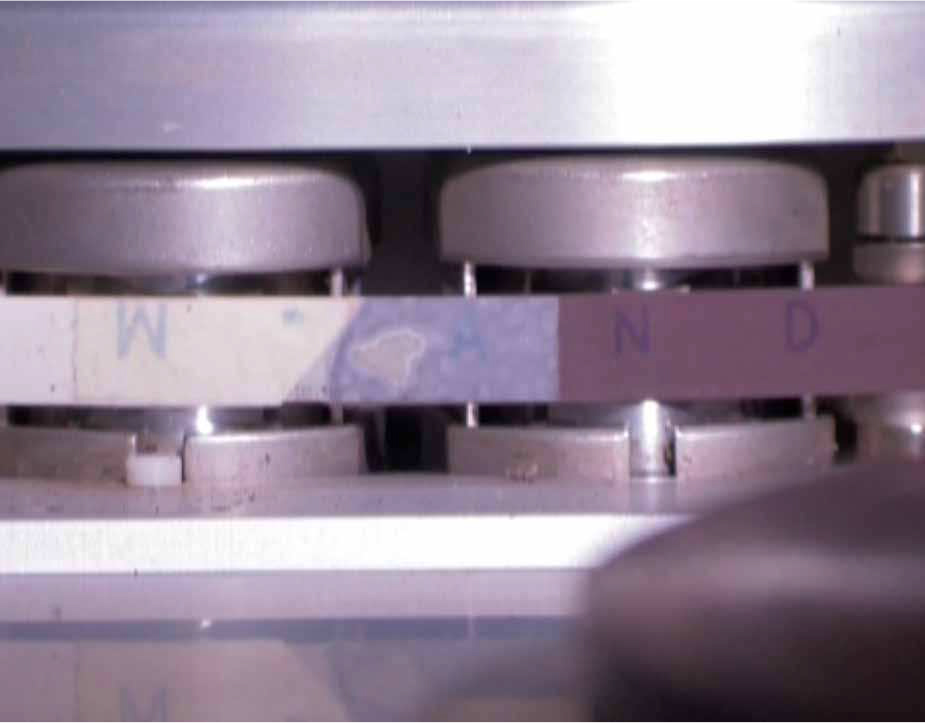
The tape speed used at this time in the WDR Studio was 76.2 cm/s (30 ips). In the late 1950s the standard tape speed changed to 38.1 cm/s (15 ips), and consequently it is very hard to find tape machines of professional quality that run at the higher speed. My constraint in this respect is that the Studer A80RC machines that I use run at a maximum of 38.1 cm/s, so in order to use tape for this project I had to divide all the lengths specified in the score by two. In terms of editing, this makes a difference with regard to the effective duration of the splice dependent on the splicing angle, and therefore affects the sonic quality of the transients. A splicing angle of 90° would yield the same result at any tape speed, as the whole of the join passes across the tape playback head at the same instant, but this was an angle that was seldom used for tape splicing.Footnote 22 Video documentation of original tape being digitized at the WDR Studio allows us to see the angle of the splices in many instances, including between each sound element in the Studie II realization tapes, but crucially we do not have evidence of the actual edits used to make the sound groups. From this and from Koenig's comments,Footnote 23 we can make an assumption that the default splicing angle used at this time in the WDR Studio was 45°, with slight variations being also possible. Figure 1 shows the splicing angle of a tape from the edited collection of raw material from Studie II.
Still from video recording of tape digitization process of realization tapes for Stockhausen's Gesang der Jünglinge. Image courtesy of WDR mediagroup GmbH.

A non-zero crossing results in an audible click, the strength and character of which is determined by the variation in level and direction between wave forms before and after the splice. If there is a tiny gap between the two sections (caused by an imprecise splice, for example) then there could be a two-step click, although this will be so fast as to be perceivable only as a single click, albeit with a different timbre. The quality of the click will be affected mainly by the material on either side of the splice, and by the amount of crossfade, controlled digitally or by selection of the tape-splicing angle (see Table 2).
| 90° | 60° | 45° | |
|---|---|---|---|
| 76.2 cm/s | 0 | 5 | 8 |
| 38.1 cm/s | 0 | 10 | 16 |
In the 1950s, mono tape was used. The machine to which I had access, however, was a stereo machine equipped with butterfly heads. Using one channel of this effectively reduced the crossfade time by about half, so bringing it back in line with the equivalent time at the faster tape speed. The remaining sonic difference could be caused mechanically by the speed at which the splice (and any gap or overlap) passes over the heads. The sound of such a click is equivalent to a broadband noise, and when sent through a loudspeaker into a reverberation chamber it will also be reverberated along with the programme material – in this case, five different sine waves of 0.053 seconds duration, with the potential for six clicks of variable quality and amplitude.
The quality of single stimulus groups was very difficult to judge by listening to each raw group out of context, so I made two versions of one group (group 67) using different splicing angles, and recorded the reverberated signal for each in order to make comparisons. Listening to a nine-second reverberation tail gives a much better impression of the character of the sound material, and I was satisfied that a splicing angle of 60° would work best. The crossfade resulting from a 60° splice at 38.1 cm/s is very close to that resulting from a 45° splice at 76.2 cm/s. Three different versions can be heard in sound clips 1–3: clip 1 presents Stockhausen's original version, clip 2 my version using a 60° splice, and clip 3 my version using a 90° splice.Footnote 24
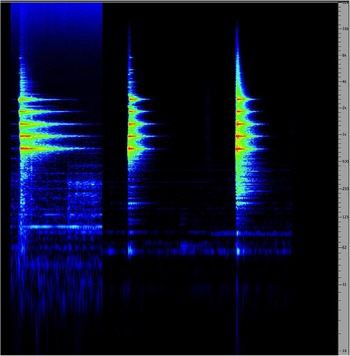
Figure 2 shows that my reverberation time was considerably shorter than that obtained using the WDR reverb chamber. It is also apparent that the high-frequency noise is much reduced in my versions, and that the overall frequency pattern is more closely matched by my 60° version than by my 90° version. Listening to one reverberated group is still sufficiently out of context to form an overall qualitative judgment, and in the interests of providing enough context for a wider audience to judge I made two different versions of every stimulus group for pages 5 and 6 of the score – one using 90°, the other using 60° splices – so that the two versions could be compared in context.
Spectrogram of three versions of sound group 67. From left to right: original from realization tapes; author's version with 60° splicing angle; author's version with 90° splicing angle. © Sean Williams 2016. This figure is distributed under the terms of the Creative Commons Attribution License (http://creativecommons.org/licenses/by/4.0/), which permits unrestricted use, distribution, and reproduction in any medium, provided the original work is properly cited.

On auditioning each of these versions of pages 5–6, it soon became apparent that, as predicted, a 90° angle yielded results which had far too great a noise component. 60° splices gave results in line with what we hear in Stockhausen's original realization, with a good balance between the sine-wave and the noise content. Realistically, I was limited by the splicing blocks to which I had access, which had options only for 45°, 60° and 90°. I did not use splicing angles of 45°, as the resulting reverberated sound did not have an adequate noise component, except in special circumstances, as described below. Sound clips 4 and 5 present my version of pages 5–6 using a 60° splicing angle and a 90° splicing angle respectively.Footnote 25
Since this decision about splicing angles was to have a huge impact on how my realization sounded, it was worth examining some subsequent commentary to find more background to any possible intentions that might have helped inform my own interpretation. On the one hand, Koenig has suggested that the technique of reverberation was used primarily as a convenient way of mixing several sine waves together without build-up of tape hiss caused by overdubbing,Footnote 26 whereas Heikinheimo suggests that the technique was used by Stockhausen in order deliberately to inject some noise into the signal, thereby deviating from the pure sine wave.Footnote 27 Heikinheimo interprets Stockhausen's note referring to an ‘aleatory modulation of the sequence of sinusoidal notes after reverberation’Footnote 28 as an explanation for using this technique to produce noise.Footnote 29 My own interpretation is that in using the term ‘aleatory’ Stockhausen is referring to the non-linear way in which the sine waves are reflected around the reverb chamber and mixed together with multiple echoes of themselves in different time and, more importantly, different phase relationships. A spectrographic analysis of the sound materials shows a significant element of broadband and filtered noise in the reverberated group sounds (see Figure 2), but this may or may not have been deliberate, and is not adequately explained by Heikinheimo. Temporality is a factor here, with Koenig's claim supporting some post-rationalization by Stockhausen. Despite the confusion about whether or not this exact noise is deliberate, and at what stage it was decided what it should be, the realizer is still left with a decision to make.
My feeling is that, as Koenig suggests, Stockhausen was enamoured of the idea of using the reverberation chamber to mix the sine waves on a single occasion rather than to build up several layers and therefore several generations of tape hiss, and that there was no great intention to add noise to the process – quite the contrary. It may be that during the realization process he came to understand that the transients caused by the tape edits contributed a significant amount of noise of a particular quality, and that this noise served a purpose in alignment with his intentions for the composition. I noted elsewhere that the intrinsic noisy clicks of the Maihak W49 filter used in Mikrophonie I were initially found to be infuriating, but were later deemed an essential part of the instrument's sound and the sound of the piece itself.Footnote 30 All of this work was highly experimental, and we must remember that composers at the WDR Studio in the 1950s were discovering totally new ways of making music. This post-rationalization and acceptance of what was initially a technical limitation or imperfection could well be happening here, too, with Stockhausen's subsequent explanation implying that the sound-realization process ‘made it possible to integrate the family of noises into composition’.Footnote 31 I further believe that that is an area where the affordances of the processes and tools used had a significant impact on the nature of the sound of the music that was produced, acting as an interpretative agency. The composer was able to accept this agency into his idea for the piece, and subsequently we see an incomplete explanation leading to very different theories by musicologists. In the context of arguments being offered on both sides (both adding and reducing noise), my own decision was focused on finding a balance by creating the right kind of noise, interpreting the score by being faithful to the ‘audio structure’ in the master recording. I do not believe that this noise was necessarily intended at the outset, but having noted Stockhausen's tendency to re-evaluate such phenomena in other pieces I do feel that, in this case, the recording exhibits an essential sonic quality not expressed in the score. This helped me to decide to make my own sounds resemble those in the recording by trying to replicate the conditions for their production.
Reverberation
Although Stockhausen specified ‘a room with about 10 seconds reverberation time and a regular frequency response’,Footnote 32 in practice such conditions are almost impossible to find. The WDR Studio had two reverberation chambers available, but they were used extensively for radio-play sound design and were in high demand.Footnote 33 In order to add reverberation to a sound, each studio would telephone the switchroom and ask for some reverb, and the engineer in the switchroom would patch the signal from the studio through a loudspeaker in one of the available reverb rooms to be picked up by a microphone and then routed back to the studio. There was little or no influence that could be exerted over which room would be used, or over the damping characteristics of that room.Footnote 34 When Stockhausen specifies a regular frequency response he is requesting an ideal situation, like the 25√5 frequency intervals, that could not be accurately realized at the time, but which perhaps may be achievable with contemporary technology.
In a real reverberation chamber, different frequencies decay at different rates, and various non-linear responses occur owing to the shape, dimensions and materials that make up the chamber. The only way to achieve a perfectly regular frequency response would be to use a digitally modelled reverberation, of which there are many to choose from. Most realizations of Studie II have used digital reverberation, and so this could also be one of the most serious drawbacks and another reason for Stockhausen's criticism. Substitution of one instrument for another with similar but improved characteristics is not a new phenomenon. Just as Bach's Goldberg Variations played on a grand piano may elicit reactions ranging from high praise to accusations of infidelity, so may the choice of digital convolution over an acoustic reverberation chamber. There is no single correct choice, unless the score direction for linearity is being followed in absolute terms.
I interpret this specification more as a guide than an absolute rule, and since it is predominantly the quality of the reverb coupled with the transients and sine waves of the stimuli groups that defines the overall sound-world of the realization, I chose to use an acoustic reverberation chamber for the great majority of the sound-material creation. I tried to make its response as linear as possible, in the same way that an instrumental player will try as far as possible to play in time, but will never be as accurate as a computer. Because this choice aligns well with the idea of using contemporaneous techniques, it also allowed me to experience some of the related phenomena for myself, especially the kinds of problem thrown up by the non-linear frequency response.
The frequency response of tape, and especially the band width of radio broadcasting and receiving equipment in the early 1950s, extended reliably up to about 10 kHz. Above that it was not considered particularly important, because it could not be transmitted or received effectively. The highest frequency specified in Studie II appears in group 193 and is 17.2 kHz. It is unlikely that even with fresh tape these high frequencies would have been reproducible with anything like a linear response, especially after several bounces from one tape to another (even if these high frequencies were not actually generated in the original realization). Although my own upper limit of audibility is around 14 kHz, my equipment is able to record and play back higher frequencies, so even though I could not hear them, I was able to make sure they were being recorded. Although not exactly specified in the score, the clicks generated by the tape edits in the stimuli groups are likely to create noise which extends across the whole frequency spectrum, and I felt it also was important to capture this for my version. The physical characteristics of the reverberation chamber combine with the damping effect of the atmosphere to produce a frequency-dependent reduction in reverberation time, with higher frequencies naturally decaying more quickly than lower ones. This imposes its own character on the results of all the reverberated stimuli groups, just as the reverb chamber used in 1954 would have done.
In addition to this, although the reverberation chamber is constructed with no parallel surfaces, its small size results in a significant non-linearity of frequency response towards the lower end of the frequency spectrum. Using an RC generator to sweep manually through the frequency spectrum, I noted several resonant peaks at 112, 160, 175, 195, 222, 310, 372, 960 and 3,500 Hz. I used a combination of loudspeaker and microphone repositioning to combat most of these peaks, and also placed two stiff wooden boards at strategic locations in the room, using trial and error to arrive at the flattest frequency response. Finally, using an equalizer,Footnote 35 I was able to get a fairly flat response across most of the frequency spectrum within about +/−6 dB.
The signal path was as clean as possible,Footnote 36 and the loudspeaker was set to be as loud as possible without overdriving, so that a good signal-to-noise ratio could be produced. Although the lowest frequency in any sine-wave group is 100 Hz, the wide-band noise resulting from the transients could produce lower-frequency components but, owing to the small size of the room and the pronounced non-linearity at low frequency (before corrections), it was not thought prudent to use a subwoofer.
The sonic characteristics of the reverberated signal are heavily dependent on the method by which the sine-wave groups are created. Tape editing and its affordances are integral to this, so, as discussed above, replacing the tape-editing process with a digital process would have produced very different results. For the next stage of the process, however, I felt that recording the reverberated signals onto a DAW instead of onto tape was a valid choice for two reasons: one practical and one aesthetic.
First, in practical terms, I wanted (1) to be able to try alternative methods for realizing some sounds; (2) to substitute various results at different places; (3) to be able to make corrections easily; (4) to spend the right amount of time on each stage of the process; (5) to communicate my results to a wider audience; and (6) to analyse and compare some of the sound materials. All of this would have been far harder to achieve if my materials had all been contained on short lengths of tape as opposed to small digital files on a hard disk.
The second reason was aesthetic. In the original realization, tape was used to record the reverberated material and then copied, cut to length and looped, and the output was given an amplitude curve whilst being recorded to another tape. This involves another three generations of tape-to-tape transfer with the inevitable build-up of hiss and accumulation of non-linearities associated with the process. Using a well-calibrated Studer A80RC could minimize this (although the Telefunken T8 machines used at the WDR were also of very high quality), but in some cases the highest specified amplitude level is −30 dB, making it impossible to capture this dynamic range without a substantial build-up of noise. In addition to this, there are some passages which require layering up to seven sounds on top of one another. Using tape to assemble these sections would inevitably result in a build-up of hiss and a reduction of high-frequency response that would be on the one hand consistent with the historical practice, but on the other hand inconsistent with my aim of producing a version as faithful to the score as possible but with much improved clarity and definition. Although realizing this part of the process using tape would have had a pronounced effect on the sound, I judged this to be an undesirable effect in direct contrast to the desirable non-linearities resulting from using tape to make the stimuli groups. The score certainly does not indicate that tape hiss should be introduced, and the composed structure is also absent of any such instruction. The master recording contains tape hiss, but rather than taking an active role in the production of sound elements like the tape edits described above, this hiss masks the whole recording to a greater or lesser degree. For these reasons I chose to record the reverberated sound groups directly into a DAW.
Amplitude – dB levels
The use of both digital and analogue technology prompted a line of enquiry most useful to my own practice: that of dB levels. Each sine wave is to be ‘recorded at 0 dB on tape’.Footnote 37 Once assembled, each group of five sine-wave frequencies is ‘played and recorded at 0 dB in a room with about 10 seconds reverberation time’.Footnote 38 Although Stockhausen also writes that ‘the loudness of 0 dB depends on the room size but should not be less than 80 phons’,Footnote 39 the actual dB scale used is not specified. The elementary error that I first made was to use the 0 dB level of my sound card as the reference level, but this 0 dBFS was immediately found to be problematic when interfacing with analogue technology, causing the input to the tape machine to overload and distort. Tests confirmed that to get a signal output at 0 dBu from the sound card in order to record without distortion on the tape machine, it was necessary to set the output level to −18 dBFS. This error on my part made me challenge my assumptions about output levels learnt through working mainly in the digital domain.
Since all of the amplitude levels in the score are specified to an accuracy of a single dB, it was necessary to be able to make accurate measurements in order to follow the directions in the score. Amplitude measurements can be made according to peaks using a peak programme meter (PPM) or by some kind of averaging method (usually involving a VU meter), but several different standards exist.
The WDR Studio was equipped with Siemens J47 Lichtzeigerinstrumente, so the historically accurate option was to source one of these with a driver unit, in order to test whether use of this instrument may have had any effect on the realization process. Designed in 1950,Footnote 40 these meters work by focusing a beam of light from a 12-volt bulb through a lens via a tiny mirror suspended in a coil and back up to a display. The inertia of the mirror is negligible, so the rise and fall time of the meter can be made to be very precise by calibration of the separate electronic driver unit.Footnote 41 I expended some effort in finding a suitable bulb for the meter, and troubleshooting, repairing and calibrating a broken U370b driver unit, and this was ultimately successful.Footnote 42
The Siemens U370b, in common with the other driver units, has two settings for meter response: Spitzenwert and Mittelwert (peak and average). The Mittelwert setting is frequency-compensated to measure loudness (using an approximated Fletcher Munson curve), and so is not to be used for absolute dB level measurements. It is not entirely clear whether this setting may have been used by Stockhausen, but former WDR Studio technicians Volker Müller and Werner Scholz both recall that this setting was not used in the studio in their time (1967–2000).Footnote 43 Koenig's memory of this is less clear, but the general impression I have gathered is that the default setting was the Spitzenwert (peak) setting, which has a flat frequency response. We cannot categorically rule out the possibility that the Mittelwert setting may have been used, but it seems unlikely. Using that setting would result in the low and high frequencies appearing to be quieter, and so they would end up being boosted in the realization process, but that is not what we hear in the master recording.
The range of the J47 meter gives good accuracy with single dB markings from −5 to +5 dB, and enough range easily to measure from a single dB down to −30 dB. The +20 dB button on the U370b (and the older U70) driver allows low-level signals to be boosted temporarily by 20 dB so that their level is easier to measure at the higher end of the scale.
Preparing the individual sounds
To record the reverberated sounds I spliced an already assembled group of five sine waves onto a 20-second length of leader tape, then played it through the loudspeaker in the reverberation chamber, monitoring the result in order to set appropriate pre-amp levels for a good, clear, loud signal, and not limiting the input gain to 0 dBVU (−12 dBFS), but rather allowing the signal to peak at around −2 dBFS. Even though the frequency response of the chamber was reasonably well balanced, some groups produced quite different levels from others when played in the chamber. Using two omnidirectional microphonesFootnote 44 at different positions allowed me to choose the most appropriate monophonic signal for further processing, but it was interesting to note that despite my best efforts, achieving Stockhausen's desired ‘regular frequency response’Footnote 45 was far from straightforward and was subject to a certain amount of judgment, tolerance and compromise. It is very important to use this specification as a desirable goal to try to achieve, rather than an absolute rule. In the latter case, a digital model may be chosen, but, like regular computer-based quantization of rhythm to ‘perfect timing’, an absolutely linear digital model risks removing all the life from the sounds created. Several groups had to be recorded a number of times before an appropriate recording was made. Making the sine-wave groups and recording them in the reverberation chamber took several weeks of continuous work.
After having recorded the reverberated sine-wave groups, the next step was to remove the direct signal of the sine waves from the start and then cut them to length. Using a tape speed of 38.1 cm/s, my sine-wave groups consisted not of five 4 cm sections, but of five 2 cm sections. Since I had recorded the results to a DAW, this notional tape length of 10 cm needed to be converted to a time measurement – 0.26 s – so that I knew how much to remove from the beginning of each recording. When working with tape, the method for removing the direct signal portion was to cut off the first 20 cm of the recorded tape. I devised an efficient way of editing to this precise length by working out a suitable tempo to which to set the DAW so that this time length fell on a natural barline or beat. At a tempo of 114.3 bpm this equates to exactly one beat in the bar. This made it far quicker to trim the right amount from the start of each reverberated sound, as all I needed to do was to trim the start point of each file and then cut the part to the equivalent of the first quantized beat. Subsequent editing at the construction stage revealed the precision here to be far less important than the need to guarantee the elimination of the original sine waves, so it turned out that this level of accuracy was not necessary. However, this could only be learnt by experience, and we may infer that a similar learning process went on in the studio in 1954. The consequences of cutting too little from the start of the recording are that a small portion of the last, highest-frequency sine wave will be included, thereby giving a different attack to the resulting edited sound. The consequences of cutting too much are negligible.
Performing amplitude curves
Stockhausen's own views concerning some new realizations are a matter of record, particularly his comments after a concert in Stockholm in the 1970s in which a new realization of Studie II had been played. Stockhausen was adamant that this new version was unsatisfactory – he described it as ‘a farce’ in an interview with Mya TannenbaumFootnote 46 – because only he knew how to shape the amplitude curves properly. He explained that ‘they let the computer handle the dynamic curves of the sound [“Hüllkurven”] which I had regulated, on the contrary, with manual controls’.Footnote 47 In the same interview he acknowledges that musicians and technicians should be able to make a successful realization of this work, but at the same time stresses the near impossibility of describing how to make the correct curves.Footnote 48 If we take this comment at face value it rather defeats the purpose of trying to make a new realization, but I believe that approaching the amplitude-curve production using contemporaneous tools may allow us to replicate those techniques used by the composer. Although he can no longer pass judgment on the results, these techniques when aligned with the appropriate practice may provide the means with which to craft the right kind of amplitude curves. The technology is an agent in the realization process, so using the original technology should guide the technique needed to achieve the right results. It may be possible to model the curves digitally, but only after a proper analysis of the performance practice behind their realization.
Each page of the score covers about six seconds of music, and consists of between 7 and 27 individual sound elements (see Figure 3). Each element is derived from a reverberated stimulus group, and has a precisely defined length and amplitude curve.Footnote 49 The minimum amplitude at the start or end of most curves is 40 dB, which means that amplitude levels never fade out completely, but either fade out to 40 dB and then stop, or fade up from −40 dB to another set level. For amplitude curves which increase in amplitude the reverberated group is played backwards, although this by no means accounts for the overall shape of the amplitude curve in most situations. The amplitude must be shaped by using a volume fader. In the WDR Studio, the original faders used were Maihak W44s, consisting of a switched network of resistors, but these were quickly replaced by the Maihak W66c faders, which used continuous carbon composite resistors for completely smooth operation.
Page 1 of the realization score for Studie II. © Stockhausen Foundation for Music, 51515 Kürten, Germany, www.karlheinzstockhausen.org.

I used a W66c faderFootnote 50 for shaping the amplitude curves of each sound after editing it to its specific length and direction in the DAW. This meant sending the signal out of the computer, through the Maihak fader, and then splitting the signal so that it could be monitored via the J47 meter at the same time as being re-recorded into the DAW via the sound card. In order to shape the amplitude it was necessary to loop the edited sample with enough space between each iteration and then to adjust the fader until the correct dB reading was found on the meter from start to end between the specific dB levels. For forward sounds, finding the correct starting level was straightforward, as the rise-time of the meter is very fast; however, the fall-time from 100% to 10% is about 1.5 s, so short or medium-length sounds needed to be faded out much faster than the meter was able to respond. Simply trying to read the end value from the meter in these cases would therefore give an incorrect result, as the meter would still be recovering from an initial peak and would display a value higher than the actual value. To overcome this problem I developed a technique of keeping the fader at a very low or zero setting and bringing up the level only at the last possible moment before the end of the sound so as to accurately find the correct point on the fader scale that matched with the end value of the sound. The shorter the sounds, the harder this was to achieve, until for the shortest sounds it became impossible. With forward sounds the end value is almost always −40 dB, and the more sounds I made the more I realized that this usually correlated with the −40 dB scale marking on the fader. There were enough exceptions to make it unsafe to rely on this, but it was nevertheless a useful guide.
Reversed sounds were much easier to shape, as the peak amplitude is at the end, so the slow fall-time of the meter does not affect the measurement. Whether shaping forward or reversed sounds, the process for identifying start and end points of the fader settings was essential, so that the movement of the fader between these limit points could then be practised in order to get the timing right. The easiest way of creating physical limits was to use the index finger of my left hand to stop the fader at its upper limit, and the thumb of my left hand to stop the fader at its lower limit, leaving my right hand free to adjust the fader. With the sound looping, I would keep recording until I felt I had performed the right fader movement between the right levels in the right time. At first I watched the screen to see when the loop was coming, but after some experimenting with different loop lengths, I found it more comfortable to work with the rhythm of the repeated loop and to time my fader movements by ear rather than by eye.
When performing sometimes as few as one, sometimes as many as 20 versions, I found that I could almost always recognize the best take in the moment of performance. It was always necessary to monitor the levels of the recorded amplitude curves on playback to make sure that what had felt right was actually aligned with the value as specified in the score. There were several occasions where what I had judged to be a perfect shape was actually a few dB lower or higher than it should have been, in which case I had to do it again, although there was a real temptation to keep some of the more difficult curves which somehow just sounded right. I wondered whether Stockhausen might have had similar thoughts. This could represent an additional ontology, one of physical performance, beyond composition, score and master recording. To measure the end value of forward sounds it was necessary to use the same technique for measuring as when finding the end-value limit level. It must be acknowledged that this is not a precise method, but, short of reversing every single sound in order to measure them, it was the only available method given the technological constraints. Digital audio could be applied to gain much greater fidelity to the score, but I felt that it was far more important to explore the performative aspects of manually shaping and judging the amplitude curves using contemporaneous technology for the main tools in order to achieve greater fidelity to the preferences expressed after the passage of time by the composer. I did, however, check the end values of one or two very short sounds by using the DAW to play the sound starting from very near to its end, using the J47 meter to measure the level. This was done to test whether my judgment regarding these sounds was reliable, which it was, so I did not need to use this method again.
Two separate issues arose from this process. First, although the amplitude curves are all represented by straight lines, there is still a certain amount of expression that can be put into the shaping of these sounds when the performer relies only on fixed start and end points. It is impossible accurately to measure the shape of each curve using 1950s technology without making the realization process last far longer than the 200 plus hours it actually took me to complete my realization. These curves must therefore be judged more subjectively, but the difficulty is that at this stage of the process there is still no context within which to judge them. The door must therefore be left open to revisit some of these curves once the later stages of arranging the sounds have been completed. Because there are so many individual sounds to be shaped, one starts to develop an isolated aesthetic, and getting the shapes to be measurably correct as well as to sound right according to this aesthetic becomes really important. This is well and truly within the territory of interpretation rather than measurable technical realization.
Secondly, very short sounds are very difficult to shape correctly. The shortest sound is about 0.06 s in duration and still needs to be shaped according to a specific start and end amplitude value. The fastest human reaction times are not quick enough to allow the fader to be moved before the sound has already passed through. In athletics sprint competitions, any runner starting to move within 0.1 s of the starting pistol is deemed to have made a false start. The shortest sound in Studie II is half that time, so it is clear that the rhythm of the loop is vital for the correct performance of these amplitude curves. Sound clip 6 illustrates several attempts at shaping sound 7 on page 15 of the realization score.Footnote 51
This raises another subtle but interesting issue for the longer sounds. When dealing with a longer sound it is natural to wait until the sound starts before moving the fader. This results in curves which can sound absolutely fine, but in fact there is a very short flat spot at the start of each such curve before the fader is adjusted, which lasts until the minimum reaction time threshold has been crossed, that is, about 0.1 s. This means that there is possibly a two-tier classification of amplitude-envelope shapes to be found both in my realization and in the original, but at such a microlevel as to be imperceptible unless actively sought out and measured.
With hindsight this idea seems straightforward and logically derived. However, Koenig himself raised this point in the context of how to create digital envelopes with a similar feel to those made manually using analogue technology.Footnote 52 He suggested that if a flat spot is inserted at the start of a digital envelope before starting a curve it will come very close to emulating the feel of a human performer precisely because it emulates the delay in reaction times. Perhaps this is a technique that could have improved the Stockholm realization mentioned earlier. Koenig also confirmed, by holding up his left hand with his forefinger and thumb in a span, that he himself marked the upper and lower limit points on the fader in exactly the same way as I had done in my realization, confirming the agency of the technology, at least in this instance. What follows is an excerpt of my interview with Koenig in which we discuss these issues of studio practice in terms of instrumental technique:
Sean Williams: And some of the sounds, I'm looking at the Lichtzeigerinstrument to go from −12 to −40 in however long. The short sounds – because the Lichtzeigerinstrument it has a very fast rise-time and then a one-and-a-half-second fall-time – so to do these very short sounds …
Gottfried Michael Koenig: You must have fixed points. You use your hand or books or something.
SW: That's what I was doing!
GMK: A heavy weight to fix the position.
SW: That's what I was doing, I'd find where the high point was, but then I'd have to get, [GMK: Yes.] for the lowest point, [GMK: Yes.] I'd have to sort of creep up to it [GMK: Yes.] so that I know that that's where it stops. [GMK: Yes, yes.] Does that sound familiar?
GMK: Yes.
SW: That sort of practice?
GMK: Yes, yes.
SW: And then I'd have my two fingers like this …
GMK: Yes, yes, we did it the same way. You can't do it otherwise I would say, to be exact. Because with the long sound it is no problem, but short sounds are the problem.
SW: Because with the long sounds you can follow the meter.
GMK: Yes, exactly.
SW: What I found was where the fader says −40 dB was very often −40 on the meter as well. Maybe at the high end of the range it was a little different [GMK: Yes.] but −40 on the fader was almost always about right, [GMK: Yes.] so you get familiar with the fader [GMK: Yes.] in terms of the, how you perform with it.
GMK: Indeed, indeed.
SW: It's like practising an instrument.
GMK: Yes, yes. Yes, yes. [laughs]
SW: So you … right! I'm really glad that you are familiar with this aspect.
GMK: Yes, yes, I can confirm that, absolutely. The real problem came when you had prepared a sound between a leader tape, and you had to make your Hüllkurve [envelope] during a recording. You see the tape coming up and exactly the moment when the tape reaches the head you have to do your fader. That's very hard to do.
SW: Yes. And so you made loops. And you watch it coming round.
GMK: Yes, you have to, of course you have your loop running, 20 times or so, and you do it as often as, until it's, yes.
SW: And in that case you're actually, you're getting the rhythm of the loop, aren't you? The loop repeats.
GMK: Yes, you make it not too long.
SW: Yes, so it's short enough so that you know when it's coming.
GMK: Exactly, exactly. It's like playing the violin or something, yes. [laughs]
SW: This is what I had to do for Studie II.
GMK: You have to rehearse.
SW: Yes! That's it! It is rehearsal, isn't it?
GMK: Yes, yes. Absolutely.Footnote 53
Video clip 1 is a video which demonstrates this practice.Footnote 54
Arranging sounds
One further consideration concerning the use of tape in the original realization is that a 45° splice on ¼” tape running at 76.2 cm/s gives a fade length of about 8 milliseconds. This value has an impact not just on the creation of the sine-wave groups, but also on editing the processed groups together for the final arrangement.
A DAW was used to assemble and precisely arrange the individual sounds into their final positions so that multiple tracks could be layered more or less ad infinitum with no consequent build-up of noise. The main concern that arose during the arrangement process was how to decide on the fade values for the start and end of each sound. The start and end amplitude values are all at least −40 dB, and the potential impact that different splicing angles can have on the sound has been discussed above. Initially it made sense to be consistent and use a fade value of 8 ms. Using this value eliminated any clicks, but it also seemed to detract from the impact and initial onset of many of the shorter sounds. Eventually, I settled on using a fade-in/out value of 2 ms, which allowed me to be sure about eliminating any digital editing artefacts and at the same time to create the maximum impact and clarity at the start and end of each sound. When splicing tape at an angle other than 90° the tape should be measured from the cutting point on one edge of the tape only. This means that half of the fade length at the start and end will effectively overhang the nominal length of the tape. In a DAW the region length is equivalent to the tape length, but when applying a fade-in or fade-out to a region, the fade length is included in the total region length. When editing the duration of each sound before applying the amplitude curve I therefore added 2 ms to the duration, so that when the 2 ms fades were applied later, the region would retain the correct length, whilst allowing for a crossfade equivalent to that which would have been afforded by using tape.
In the end I refrained from crossfading between sounds, a decision that resulted in the addition of 2 ms duration to certain sounds appearing contiguously on the same track. By using blank regions as spaces I was able to adjust these exactly, and I often reduced the duration of these blank regions by 2 or 4 ms in order to compensate for this extra 2 ms per sound. Because of the way I distributed sounds across several tracks, these inaccuracies were not allowed to accumulate, and I was able to create a consistent and high degree of accuracy in my arrangement. Tape editing in the WDR Studio was done using wet splicing until at least 1955, and this meant that edits would often stretch by as much as 1 mm on initial playback. With many edits, these errors would accumulate, influencing the accuracy of exact timings.
Mistakes
From my account so far, it may seem that the realization process was carried out in linear fashion, starting with the assembly of all the sound groups, running them through the reverb chamber, editing and shaping the amplitudes and then arranging them in the right order. This was not how it worked in practice for many reasons, not least because each technique needed to be tested and often run through multiple steps with one example in order to do so. This process would often result in changes to the initial approach. An undetected mistake at an early stage could have been disastrous, especially if it was technique-based and repeated in every single group, but once reliable techniques had been properly tested within the context of how the sounds worked together, then the more repetitive stretches of the realization process could be carried out with confidence.
At this stage it might be helpful to illustrate a number of areas in which I detected mistakes of different magnitude and character. I want to backtrack a little and describe how I worked out what values to use for each parameter. First I went through every page and numbered each sound according to the order of its starting position. When multiple sounds started together, I used the order of their end points to number them, with those ending first being numbered first. I arranged all of the 193 sound groups in a vertical column of a spreadsheet with each of the five sine-wave frequencies for each group in the next five columns. I then made a column for each page, placing the event number for each event on that page in its column, and in the row corresponding to its sound-group identity. Another spreadsheet was compiled from all of the duration information, given in centimetres. These values were converted into seconds, accurate to the nearest millisecond, and then the length of each sound group was calculated on the basis of its appearance and its relationship to each of the line measurements. This process took several days, and the sheer amount of measuring, data entry and calculation virtually guaranteed some level of error. Spreadsheets 1–3 show all of these stages of data collection and manipulation in detail.Footnote 55
Pages 9 and 10 have many overlapping sounds which are very hard to decipher and match up with amplitude envelopes and durations, leaving scope for error. Considerable diligence must be used accurately to ascribe each horizontal sound block to its respective group identity, and in a serial composition there is by no means any guarantee that mistakes made in frequency groups will be identifiable to the ear. When dealing with such a large array of data, let alone pieces of physical media, it is inevitable that some errors will be made at different stages of the realization process. Some may be easily audible, whilst others may be impossible to detect.
There is also a great deal of repetitious work in the studio: recording the sine waves, selecting five waves for each of 193 groups,Footnote 56 splicing them together, splicing them into the leader tape, recording the reverberated results, labelling all of these, then selecting the appropriate group, having worked out from the score exactly which group is indicated (a tricky and time-consuming exercise), cutting each section to length, arranging forwards or backwards, re-recording it with the correct gain envelope, arranging it in its final position and mixing it down. At any of these stages it is possible to make a small error, and the way the work is divided into groups of tasks, all of which must be done in the correct order, usually focusing on completing one stage for all sounds before starting the next, means that such errors may not be immediately detectable, with no contextual setting on which to rely.
The errors I made that were the easiest to discover concerned missing sine waves in one or two stimuli groups. The missing sine waves were heard to be missing at the reverberation stage, so were easily fixed. Another more serious error made at this stage was detected only much later in the process. When I had made all of the 149 sine-wave stimuli groups that were used, and had recorded them through the reverb chamber, I started the next phase of editing each sound to its correct length and applying the amplitude envelopes for sounds on a page-by-page basis. When all the sounds for a particular page were ready, I arranged them in the correct order and positions. After constructing page 14, hearing it back and comparing it with the master recording, it became apparent that my group 109 sounded different. Sounds 8–11 rise in evenly spaced frequency steps. These events equate to group numbers 25, 67, 109 and 151, each of which is separated by two group steps. Each group removes the lowest two tones from the previous group and adds two higher tones in the series, and these steps should therefore be very easy to hear. My version of group 109 sounded higher than group 151, thereby ruining the effect here. This mistake could have had a number of different causes: perhaps the sample rate was originally wrong and the group had been transposed up an octave; perhaps the spliced group had been mislabelled, the recording mislabelled, or the sine tones selected incorrectly. On re-realizing group 109 and comparing my first version with other sound groups, it appeared that my original version was possibly a mislabelled version of group 179, or that I had read the values of group 179 or 191 instead of 109. Sound clip 7 is my version after correction.Footnote 57
This had further repercussions, as group 109 features in almost half the pages, and I had already used the material on pages 1, 5, 8, 9, 10, 11 and 13 without noticing the mistake. I was able to identify this error partly by comparing my version of the piece with the master recording, but mainly by referring to the very clear staircase pattern in the score, which is one of the easiest passages to identify. If this group were wrong, how many others could I have got wrong without noticing? It also raises further questions: was Stockhausen himself able to identify similar mistakes without having reference to any ‘original’ version, particularly when multiple groups sound together or appear with fast durations? Does the serial method even allow such mistakes to be identified by the composer, and does it matter if they cannot be identified?
I also discovered a transcription error which I had made at the stage of mixing together the final sounds from pages 1 and 2 of the score. This was a mistaken labelling of event 5 on page 2, and was noticed only on comparing my version of these pages with the master recording and recognizing that my event 3 sounded too high in frequency. Double-checking the score revealed that it should have been group 111 instead of group 114. In the absence of any prior version, we must entertain the possibility of such a mistake also having occurred in Stockhausen's original realization process.
Engaging with the score at this level has enabled me to identify a number of mistakes made by Stockhausen himself, which correlates well with apocryphal stories of conversations he had with people about this very topic. The master recording has a gain value for event 7 on page 1 which is around 10 dBVU louder than the score indicates. On page 8, events 4 and 5 are realized with the opposite envelope shapes to the score, that is, sound 4 is forward instead of reversed, and sound 5 is reversed instead of forward. On page 18, sound 10 is much louder in the master recording than it is notated in the score, as are sounds 5, 8 and 9 on page 21. The presence of deviations from the score, and therefore from the serial scheme, is demonstrated in these differences, but there may well be many other less obvious deviations that are so far undetected. Koenig suggests that the exact values generated by the serial process are unimportant – there is no real sense of a mistake in the same sense of a mistake in a tonal or harmonic system – and that the important factor is not the exact value as such, but the striving for achieving an exact value within a defined system.Footnote 58 In this way, according to Koenig, any error or deviation from the system is not important as long as the system is being followed in good faith. If, however, they are not actually mistakes, then we must consider these observed deviations from the score as being indicative of a level of interpretation on the part of the realizer – in this case, the composer himself. They may conceivably be errors made in the production of the score, but an analysis as detailed as that carried out by SilberhornFootnote 59 is beyond the scope of this article. These identified differences between the score and the master recording emphasize the ontological problem surrounding this and other similar pieces of electronic music.
Some of my own errors arose as a direct result of my choice of technology, particularly the DAW. On producing and checking the final mix, it transpired that at some point I had inadvertently changed the length of a large number of parts simultaneously. This was hard to notice just visually, but on playback some sections sounded wrong. Again, I identified this error more because I was able to compare it with the master recording than by reading the score.
Another small error was noticed only after five mixes of the completed piece. I had placed sound 7 from page 5 on a muted track, and so it was missing from the mix. This sound is in a complex and overlaps with other sounds, so it was not obviously missing on playback. Had it been missing from a bounced tape without the benefit of an associated visual display, I would not have noticed it. These errors, particular to DAW use, would not have been made in the 1950s, but both the technology and the working methods used then would undoubtedly have afforded an alternative suite of errors not identifiable by my own choice of technology.
There is one significant deviation from the score which can really be understood only as an interpretation designed to achieve a more convincing musical gesture, and that is the final sound. Sound 7 on page 26 (group 2) is much longer in the master recording than in the score. Realized according to the score, this final sound stops very abruptly, and to me sounds wrong because it leaves the end of the piece sounding as if it has just been cut off rather than deliberately ended. In the master recording, this sound is allowed to decay naturally to its end, thus marking the end of the piece. This is a deviation, but because of its place and significance it is impossible to read as a mistake, in which case it must be read as an interpretative choice made on aesthetic grounds. Heikinheimo's ‘recording technician’Footnote 60 may not have taken the opportunity to interpret this outside the bounds of the written score, but, small as it is, this is nevertheless a significant site for interpretation that demands musical and creative input from the realizer. In this case, after realizing the final sound according to the score, and being disappointed by it, I deferred to the master recording and allowed this final sound to decay naturally to silence after that point, rather than stopping it abruptly, thus relying on the authenticity of the composer's own interpretation.
Isolated problems
I encountered a unique problem with the very long, predominantly high-frequency sounds on page 17 (sounds 11–13). Although it has a nominal Rt60 of about 9 s, the decay time of the reverberation room I used made it very hard to get a clear signal without much noise after a five-second decay at higher frequencies. Because the high frequencies are absorbed by the air and materials in the reverberation chamber much faster than the lower frequencies, the long sounds disappeared into the noise floor too quickly. Achieving an initial level of the reversed envelopes at −40 dBVU in these cases (especially that of the longest sound, sound 11), meant significantly increasing the initial gain and thus making the noise content very noticeable, especially in comparison with other sounds on the page. There is a temptation simply to fade these sounds up from their natural starting level, way below −40 dB, and I tried this, but without a distinct start to each sound the rhythmic element of this section is lost. This is clearly important, as the other sounds in the pattern – sounds 12 and 13 on page 17 and sounds 4 and 5 on page 18 – start from an increasingly high stepped value above −40 dB. To combat this problem, and to start sound 11 at −40 dB, I used a high-pass filter with 24 dB/octave slope and a cut-off frequency of 395 Hz to remove rumble, and a low-pass filter with a 12 dB/octave slope and a cut-off frequency of 4,850 Hz to remove hiss above and below the frequency band of the sine waves of sound 11 (group 127). Sound 13 (group 171) has a much higher frequency content, so the signal-to-noise ratio was much worse. I used a high-pass filter with a 12 dB/octave slope at 850 Hz and a low-pass filter with a 12 dB/octave slope at 3,850 Hz, as well as a high-shelving filter at 3,150 to reduce the hiss even more, but automated the gain of the high-shelving EQb to level out gradually from −12 dB to 0 dB after the first 700 ms of the sound. This was done in order to reduce the loud hiss at the boosted start of the sound whilst preserving the natural frequency balance for the main part of the sound. A shelving EQ was used because it is much less intrusive to change gain than to sweep a filter frequency.Footnote 61
On listening to the master recording, it is apparent that this problem was encountered but not dealt with by Stockhausen, and although there was no necessity to go further than the score instructed, I believe that my solution represents an improvement, as it allowed me to keep my interpretation closer to the ideas expressed in the score rather than being restricted by following the exact instructions and no more. Ontologically, in this case, I favoured the compositional idea over both the score and the master recording.
The low-frequency groups at the end of the piece – events 3–7 (groups 3, 5, 1, 4 and 2) on page 26 – represented a greater challenge. On playing back my first mixes it was very difficult to distinguish between my original versions of each group on the basis of their frequency content. They all sounded the same. I suspected that this might be a blurring due to the frequencies being close to the resonant nodes of the reverberation room. These groups contain frequencies from 100 Hz to 190.37 Hz, which all fall into the area of most non-linear response in the reverberation room I used for my realization. It could also be that the length of the segments of tape did not really allow the lower frequencies to establish themselves with many wave-form cycles. The impact of non-zero crossings is more evident at lower frequencies, and this, combined with the non-linearity of the reverberation room, gave these low-frequency groups a far greater proportion of noise than other, higher-frequency groups. The piece needs to end well, as it contributes disproportionately to the listener's final impression, and I was not at all satisfied with the way these groups sounded. The obvious solution to reduce the noise content was to make a new set of sine-wave groups using a shallower splicing angle of 45° to give a longer crossfade (8 ms) and therefore less pronounced transients. Although this reduced the noise considerably, the low-frequency content was still not satisfactory, and it was still difficult to differentiate between the groups. There was a certain amount of warbling, and no consistent sense of weight to the resulting reverberated sounds. This first version can be heard in sound clip 8.Footnote 62
My decision to use acoustic reverberation was the root cause of the problem with these last groups, so I chose instead to create them using a digitally modelled reverb courtesy of Stefan Bilbao's NESS project.Footnote 63 Working with Craig Webb, I specified a large room size with the smoothest possible diffusion, so that the low frequencies would be mixed with each other and their reflections in an even way, without too much interference. These models took some hours to run, and I had to make several requests to change various aspects of the sound character before settling on a final version. The length of time taken for each model to be rendered made it impossible to experiment with as many different parameter values as I would have liked, and I was limited to making only four different versions. The first versions had much clearer lower frequencies but there was still too much warbling and unevenness; however, by the fourth adjustment the results were much closer to my requirements. Unsurprisingly, the new digitally modelled sounds were of a sufficiently distinctive character to be recognizably different in the context of the piece, and therefore direct replacement was not a viable option. The solution was to use a mixture of the original acoustic reverberation sounds and the digitally modelled reverberation sounds. The former were sent through a high-pass filter to remove the very lowest frequencies whilst the latter were sent through a low-pass filter with a slope of 12 dB/octave at 220 Hz, so that the resulting blend retained the characteristic sound-print of the reverb chamber whilst also having a well-defined and clear low-frequency content that had been missing from my original versions. The final version of page 26 can be heard in sound clip 9.Footnote 64
The discovery of the realization tapes was made after I had completed my own realization of the piece, but there were a number of interesting details to be found on close inspection. The striking feature is that in almost all cases the sine waves are played into the reverberation chamber in descending order of frequency, whereas the score stipulates that ‘the five 4 cm lengths of tape are stuck end to end onto a blank tape loop in order from the lowest to the highest note’.Footnote 65 In the realization tapes, the exceptions to this are groups 109, 130, 151, 172, 187, 188 and 191–3, which are all played in ascending order. Groups 109, 130, 151, 172 and 193 all belong to the same meta-group that seems to be a fundamental key to the piece, which may be of some significance as such a coincidence seems unlikely; however, it may just be that changing the direction provided an easily identifiable reference point with all the groups edited together, end to end, on two tapes. In terms of the ascending/descending order of sine waves, such a detail may have been changed between realization and the publication of the score. On the following page of the score a diagram illustrates the five 4 cm sections of tape in descending order with the reverberation tail to the right, so in fact we do have conflicting information in the score itself.Footnote 66 This is also a slightly odd illustration: whilst it attempts to depict the tape lengths of each sine wave plus the reverberation tail, the latter, if the diagram really were analogous, should be to the left of the sine waves because the tape would run from left to right. Despite this inconsistency, there is a justification for arranging the sine-wave sections in ascending order. Given that higher frequencies decay more quickly, saving the higher frequencies until last will gain for them a fraction of a second of extra reverberation time, thus helping to flatten the frequency response just a little. This benefit will be marginal, but nevertheless positive, and may well have occurred to Stockhausen between the completion of the realization and the publishing of the score.
Aesthetic adjustments
One frustrating characteristic of the score is that whenever there is a group consisting of low-frequency sounds it is almost always notated for a low volume. This particularly struck me with sound 10 on page 18. On listening to the sound in context in the original, it appears that this sound is much louder than the notation indicates. Sounds 5, 8 and 9 on page 21 are also much louder in the recording than in the score. Silberhorn and Heintz both discovered some departures from the strict serial method behind the composition, Heintz attributing some to calculation errors, but others to musical judgment.Footnote 67 The published score is a snapshot of the piece after it had been realized, so these differences may in fact be inaccuracies in the score rather than mistakes in the realization; these ‘mistakes’ could, however, be examples of musical judgment made in the moment of realization.
The best test by which to judge the effectiveness of this kind of realization is a public performance. In July 2013 I was able to hear my version through a Meyer Sound system at the Stockhausen Summer Courses in Kürten. The first public performance took place in November 2013 at the Reid Concert Hall in Edinburgh using a Meyer Sound system, in a programme with other early electronic pieces and solo piano pieces by Stockhausen and Ligeti. Whilst generally judged a success, this showed up some problems which can best be thought of as mastering issues.Footnote 68 Although the mix was faithful to the dB levels in the score, this very authenticity was problematic and a further level of interpretation had to be applied. I felt that two or three sounds in particular were far too prominent in the mix, some with particularly piercing characteristics. It was possible that the flatter frequency response of my overall realization process was to blame, making these higher frequencies more audible. It is customary to subject any recording to the mastering process before declaring it complete, and my new version of Studie II had not been mastered for fear of transforming the amplitude values out of alignment with the score. The simple solution was to identify the offending sounds and apply some equalization to change the frequency balance without changing the overall amplitude too much. This was possible only because of the earlier decision to use a DAW to assemble the piece. There is no caveat in this score (or in any other of Stockhausen's realization scores) about how the piece should be mastered, but it is perhaps the final site for interpretation, and the final responsibility of the ‘technician’. The final version represents the culmination of my realization, and I consider this to be valuable not only for the insights it has afforded into the historic practices of the 1950s WDR Studio but also as an individual interpretation of the first realization score for electronic music of a quality fit for public performance. This can be heard as sound clip 10.Footnote 69
Conclusion
In giving as detailed an account as possible of my practices and decision-making processes throughout this new realization of Stockhausen's Studie II I have tried to connect my methods to Born's categories of technology, temporality and ontology. My main aim has been to dispel the idea that all that is needed to realize this and other similar pieces is a technician without musical ability to carry out instructions. Instead, I hope it is clear that in order to create a useful, interesting, faithful, authentic or otherwise worthwhile realization, the realizer must combine considerable technical skill with an equal level of interpretative and performative ability. Decisions must constantly be made about authenticity, and these must be informed by the mercurial ontology of the piece itself. Each decision requires a degree of interpretation, and careful choices about what kind of technology and practices should be used are intricately bound up with these questions too. If we think for a moment of the devices in the electronic studio as constituting a kind of meta-instrument, or even consider each item as a discrete instrument, then we can understand that such a technician/performer/interpreter can be considered as much an instrumental musician as a violinist, an organist or a pianist.
The instructions in this score are as complete as in many other scores – that is, they will allow reproduction of the piece, but the quality of that reproduction is highly contingent on the skills of the individual following the instructions. The large number of realizations of highly variable quality is testament to this. A technician could carry out a realization, but there is clearly a need for a kind of cultural knowledge similar to that needed by an instrumentalist working from a traditional musical score. As expected, the instructions are not intrinsically complete. The mistake here has been to assume a rather limited definition of the technician without fully appreciating the cultural, musical and aesthetic background needed for realizing this kind of electronic music.
Whilst they are not reliant on particular instruments, the different kinds of technological options do by their nature have a significant effect on the character of the sound material generated. This is exemplified by comparing my two realizations of pages 5 and 6,Footnote 70 the only difference being the tape-splicing angle of the sine-wave groups. This adjustment of one technique amongst many results in a profound difference in sonic character, and this shows that these technological decisions, as Koenig points out,Footnote 71 can indeed have profound musical consequences.
Such repetitive practice, especially during the amplitude-curve shaping process, is directly equivalent to an instrumental practice, and that brings with it all kinds of attitudes relating to practice, quality, judgment and motivation which are not necessarily within the normal domain of the technician.
An instrumental musician could no more attempt a useful realization of this score than a technician could approach a performance of a piece for solo violin. Both have technical skills, but there is something implied in the current usage of the term that limits its scope to objective decision-making. It appears, therefore, that the technicians who worked on the realization of electronic music in this period had to combine a wide range of musical and technical abilities, but were still referred to only as technicians, and were rarely if ever acknowledged for their musical expertise. It is perhaps no coincidence that Koenig, Stockhausen's technician during the realization of Gesang der Jünglinge and Kontakte, is himself a most accomplished composer and musician as well as one of the most adept and imaginative technicians. If Stockhausen had had to rely on a technical assistant without Koenig's musical ability to interpret and perform his instructions, those two landmark pieces of electronic music may well have sounded very different indeed. An examination of this music as instrumental music and the attendant performance practices that that involves is overdue, and may offer a new way of appreciating this remarkable period of musical invention. In this way we can consider the electronic music of the 1950s and 1960s not as an entirely new paradigm, but as a continuation of traditional instrumental musical practice, and we can put forward the date of any paradigm shift, as heralded by Stuckenschmidt at least to the introduction of computers and other automated systems in the late 1960s.
Given the disparities between score and master recording, can we claim that one has an authority over the other? Serial composition suggests that deviations from the plan may be philosophical deviations. First, is there a process at work here that is similar to that in the case of Gesang der Jünglinge, where research has shown that Stockhausen made numerous deliberate small inserts, deviating from the serial durational structure? Stockhausen is not the only composer to have allowed aesthetic concerns to trump serial rules. Or, secondly, in the context of my own work, particularly highlighting the many different opportunities for errors to be incorporated at different stages, could we argue that the elimination of such deviations better serves the concept behind the composition and organization of the piece? Thirdly, there is a time-dependent factor: although Stockhausen knew about many of these errors he did not attempt to make a new realization with corrections (and, unlike in other pieces, he did not correct the score either). His attitude towards the four-channel version of Gesang der Jünglinge was that, by dint of so many performances in four instead of the originally intended five channels, that version had become the absolute and final version. A similar attitude is expressed regarding the orientation of loudspeakers for performances of Kontakte, and through his eventual acceptance and even demands for a stepped filter with audible clicks for performers of Mikrophonie I, despite advice in the score to the contrary. All of this suggests that he would have continued to regard the tape version, not the score, as the master expression of the piece. My account shows that the ontology of this and other such pieces is so confused that it effectively becomes uniquely defined for each participant, whether realizer or listener. At different stages of my own realization I have relied on the primacy of the score, the master recording, the performance practice, subsequent commentary, ethnographic research and my own aesthetic judgment. My own realization is clearly an interpretation of Studie II, but this work, for me at least, is exclusively defined neither by the score nor by the tape, but exists in a more distributed manner across several domains, thus destabilizing the question not just of its own ontology, but of that of the whole class of electronic compositions.
The key factor remaining concerns technology. Stockhausen famously regarded the many different realizations of this piece by others in a less than favourable light. It seems that most versions have been made using computers, but rather than advance a technologically deterministic explanation and blame computer use for the failings, Hill's concept of culture/technology alignmentFootnote 72 may be a more useful tool with which to understand how technology has been brought to bear in this area.
A purely historical realization may faithfully replicate original performance practices but be subject to similar compromises. Alternatively, an entirely state-of-the-art digital realization may overcome all kinds of limitations and deliver a ‘high-fidelity’ audio result, perfectly translating the score values and amplitude curves more accurately than it is possible to do by hand. These are technical extremes which illustrate the scope in which authenticity can be interrogated. I have provided an account of an approach which has incorporated wider musicological concerns, which acknowledges the scope and impact of the different interpretations of authenticity and fidelity, and which actively engages with the relationship between performance practice and technology, providing a strong foundation on which to build a consistent musical interpretation of this early electronic music.