Introduction
Suboptimal adherence to combination antiretroviral therapy (cART) remains common among people infected with HIV, with prevalence estimates suggesting that 40–50% of the population is non-adherent (e.g., Nieuwkerk et al., Reference Nieuwkerk, Sprangers, Burger, Hoetelmans, Hugen and Danner2001). cART non-adherence poses several potentially serious health consequences, including higher viral loads, faster progression to AIDS, and a heightened risk of viral mutations and transmission (e.g., Bangsberg, Reference Bangsberg2008). A host of clinical factors are associated with cART non-adherence, including demographics (e.g., younger age), psychiatric co-morbidity (e.g., bipolar disorder), psychosocial factors (e.g., social support), and active substance use disorders (see Ammassari et al., Reference Ammassari, Trotta, Murri, Castelli, Narciso, Noto and Antinori2002 for a review). Additionally, HIV-associated neurocognitive impairment is associated with lower adherence to cART (e.g., Hinkin et al., Reference Hinkin, Castellon, Durvasula, Hardy, Lam, Mason and Stefaniak2002), particularly in the domains of executive functions, psychomotor speed, and episodic memory.
Prospective memory (PM), or remembering to do something in the future, is a component of episodic memory that plays a potentially important role in medication management (Zogg, Woods, Sauceda, Wiebe, & Simoni, Reference Zogg, Woods, Sauceda, Wiebe and Simoni2012). Deficits in PM are uniquely predictive of healthcare compliance in HIV, including poorer medication management (e.g., Woods, Moran, Carey, et al., Reference Woods, Moran, Carey, Dawson, Iudicello and Gibson2008) and cART non-adherence (e.g., Woods et al., Reference Woods, Dawson, Weber, Gibson, Grant and Atkinson2009). PM is a complex, multilevel process that consists of both automatic and strategic components. The most widely studied are the relatively automatic event-based intentions (EB; i.e., the intention is due at a specific event, such as picking up groceries when you pass a grocery store) compared to the more strategic time-based (TB; i.e., the intention is due at a specific time, such as taking a medication at 8-hr intervals). Within this distinction, TB intentions are hypothesized to play a more salient role in adherence. For example, Woods and colleagues (2009) demonstrated that HIV-infected individuals with impairment in TB PM were nearly six times more likely to be non-adherent to their prescribed cART regimen as measured by a 1-month period of medication event monitoring system tracking. Importantly, PM deficits appear to possess incremental predictive value for cART non-adherence, even as compared to established risk factors such as other neurocognitive deficits (e.g., executive functions), psychiatric distress, and psychosocial variables (e.g., Zogg et al., Reference Zogg, Woods, Sauceda, Wiebe and Simoni2012).
We are unaware of any theoretically driven examinations of the predictive value of PM in the context of non-adherence to cART medications among HIV-infected individuals. The delay between the encoding of the intention to execute a given behavior (e.g., take the medication) and the cue signaling its execution (e.g., a specific event or time) is a cardinal feature of PM that may have particular relevance for medication adherence. The influential multi-process PM theory by McDaniel and Einstein (Reference McDaniel and Einstein2000) hypothesizes that delay intervals of increasing length place greater demands on strategic (e.g., executive), as opposed to automatic, processes. More specifically, individuals are required to retain the intention-cue pairing and simultaneously monitor the environment for the target cue for a greater length of time in the face of ongoing activities. Support for the strategic PM delay hypothesis comes from studies showing differential deficits in longer PM delays in older adults (e.g., Martin, Brown, & Hicks, Reference Martin, Brown and Hicks2011), ecstasy users (Weinborn, Woods, Nulsen, & Park, Reference Weinborn, Woods, Nulsen and Park2011), and persons with HIV-associated neurocognitive disorders (HAND; Morgan et al., Reference Morgan, Weber, Rooney, Grant and Woods2012). Time-based PM appears to be particularly vulnerable to longer ongoing task delay intervals in HAND and is uniquely associated with executive dysfunction (Morgan et al., Reference Morgan, Weber, Rooney, Grant and Woods2012). Accordingly, it was hypothesized that baseline deficits in PM tasks with longer ongoing task delay intervals, particularly on time-based cues, would be strongly and uniquely associated with cART non-adherence as measured by electronic monitoring systems at 30-day follow-up.
Method
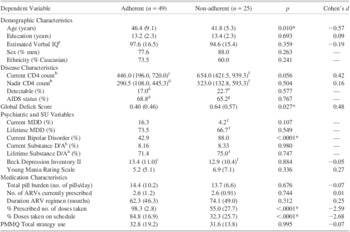
Seventy-four participants were recruited from ongoing studies at the UCSD HIV Neurobehavioral Research Program (HNRP). Our cohort was recruited from studies at the HNRP that had used the Memory for Intentions Screening Test (MIST; Woods, Moran, Dawson, et al., Reference Woods, Moran, Dawson, Carey and Grant2008) and electronic monitoring of adherence, primarily a study aimed to understand medication adherence among people with bipolar disorder. Eligibility requirements included the capacity to provide informed consent, age 18 years or older at enrollment, documented HIV infection, and prescription of at least one antiretroviral (ARV) medication. Participants were excluded from the study if they met diagnostic criteria for psychotic spectrum disorder (e.g., schizophrenia), or if they had a neurological condition known to impact cognitive functioning (e.g., stroke, seizure disorder, closed head injury). The demographic and clinical characteristics of the study participants are provided in Table 1, which reveals high rates of lifetime major depressive (n = 18), bipolar (n = 43), and substance use (n = 53) disorders.
Participants’ demographic, disease, neurocognitive, psychiatric, and medication characteristics

Note. aVerbal IQ was derived from the total Summary Score on the WRAT-4; bMedian (interquartile range). cn = 47; dn = 48; en = 22; fn = 24; gn = 23; hReflects any prior substance. SU = Substance Use; MDD = Major Depression Disorder; D/A = Dependence/Abuse; PMMQ = Prospective Memory for Medications Questionnaire.
Participants were classified as “Adherent” or “Non-adherent” on the basis of their ARV adherence, measured by participant use of the medication event monitoring system (MEMS) TrackCaps (see Moore et al., Reference Moore, Posada, Parikh, Arce, Vaida and Riggs2011) over a 30-day period. Individuals showing less than 90% of their expected MEMS TrackCap openings were classified as “Non-adherent” (n = 25). The adherent group was found to have a mean adherence rate of 98.3 (2.8)% and the non-adherent group had a mean adherence of 55.0 (27.7)% (see Table 1). Table 1 shows that the “Adherent” and “Non-adherent” groups were largely comparable for demographic, HIV disease, and psychiatric factors, with the exception that the Non-adherent participants were younger, more likely to have bipolar disorder, and had worse overall neurocognitive functioning as measured by the Global Deficit Score (GDS). As such, these three factors were included in the relevant statistical models. Participants were also classified on the basis of their self-report of medication adherence, as determined by the well-validated AIDS Clinical Trials Group (ACTG) questionnaire, where the participants are asked about missing a dose of their medication in the past 4 days.
All participants completed the research version of the MIST. The MIST includes eight PM trials that are completed in the context of an ongoing word search puzzle. Of primary interest in this study were the short- (i.e., 2-min) and long- (i.e., 15-min) delay scales. Four of the cues elicit an action after a 15-min delay, and four after a 2-min delay. The 2- and 15-min delay scales are balanced on time- and event-based cues (TB and EB, respectively), and action and verbal responses. Responses are coded from 0 to 2 for each item, such that each of the 2- and 15-min delay scale total scores range from 0 to 8, where higher scores indicate better performance. We further derived a 2- and 15-min TB score and a 2- and 15-min EB score, such that the total subscore ranged from 0 to 4. Each PM trial is scored (range = 0 to 1) with the following error types: (1) no response (i.e., omission errors), (2) task substitution (e.g., perseverations or intrusions), (3) loss of content (e.g., acknowledging that a response is required, but failing to recall the content), and (4) loss of time (i.e., executing the correct response ≥ or ≤ 15% of the target time). Participants are also administered an eight-item, three-choice recognition post-test. MIST data were non-normally distributed (Shapiro-Wilk W < .01), but given the nature of the study design (i.e., involving both between-subjects and within-subjects factors) and the relative robustness of analysis of variance (ANOVA) procedures, a parametric approach was used. Of note, all findings regarding group differences were consistent when verified with nonparametric Wilcoxon Ranked Sum Tests.
Participants also received comprehensive neuropsychiatric, neuromedical, and laboratory evaluations at baseline, which included the Young Mania Rating Scale (YMRS) (Young, Biggs, Ziegler, & Meyer, Reference Young, Biggs, Ziegler and Meyer1978), the Beck Depression Inventory-II (BDI-II), Composite International Diagnostic Interview for substance use disorders [The World Health Organization. Composite International Diagnostic Interview, 1998 (CIDI, version 2.1)], the Structured Clinical Interview for DSM-IV for mood disorders (SCID; see Moore et al., Reference Moore, Posada, Parikh, Arce, Vaida and Riggs2011 for details), and a well-validated neuropsychological battery. The specific tests in this battery included the Controlled Oral Word Association Test (COWAT-FAS; Benton, Hamsher, & Sivan, Reference Benton, Hamsher and Sivan1983; Gladsjo et al., Reference Gladsjo, Schuman, Evans, Peavy, Miller and Heaton1999); Action (Woods et al., Reference Woods, Scott, Sires, Grant, Heaton and Troster2005) and Animal (Gladsjo et al., Reference Gladsjo, Schuman, Evans, Peavy, Miller and Heaton1999) Fluency; Trail Making Test, Parts A and B (TMT-A/B; Heaton, Grant, & Matthews, Reference Heaton, Grant and Matthews1991; Reitan, Reference Reitan1979); Wisconsin Card Sorting Test – 64 Card version (WCST-64; Kongs, Thompson, Iverson, & Heaton, Reference Kongs, Thompson, Iverson and Heaton2000); Digit Symbol, Symbol Search, and Letter-Number Sequencing tests from the Wechsler Adult Intelligence Scale – Third Edition (WAIS-III; Heaton, Taylor, & Manly, Reference Heaton, Taylor and Manly2002; The Psychological Corporation, 1997); Brief Visuospatial Memory Test-Revised (BVMT-R; Benedict, Schretlen, Groninger, & Dobraski, Reference Benedict, Schretlen, Groninger and Dobraski1996), Hopkins Verbal Learning Test- Revised (HVLT-R; Benedict, Schretlen, Groninger, & Brandt, Reference Benedict, Schretlen, Groninger and Brandt1998); Grooved Pegboard (Heaton et al., Reference Heaton, Grant and Matthews1991; Kløve, Reference Kløve1963); Paced Auditory Serial Addition Test – 50 item version (Diehr et al., Reference Diehr, Cherner, Wolfson, Miller, Grant and Heaton2003); WMS-III Spatial Span (Wechsler, Reference Wechsler1997); and the Stroop Color-Word Test (Golden, Reference Golden1978). These tests were used to assess the domains of executive functions, learning and memory, attention/working memory, verbal fluency, information processing speed, and motor skills. Raw scores were converted to demographically adjusted T-scores using published normative standards and were subsequently combined to derive a GDS, which is a computed approach to analyze neurobehavioral data that considers both the number and severity of deficits. For each test in the battery, the t-scores are converted to deficit scores for each individual neuropsychological test, which range from 0 (t-score ≥ 40) to 5 (t-score ≤ 19). These deficit scores are averaged to derive the GDS, and a score of ≥0.50 indicates neuropsychological impairment (Carey et al., Reference Carey, Woods, Gonzalez, Conover, Marcotte and Grant2004).
The UCSD Human Research Protection Program approved the current study. Participants received monetary compensation for both the initial and follow-up assessments.
Data Analysis
The primary study hypotheses were tested with a repeated measures mixed-model ANOVA with Adherence as the between-subjects factor and MIST delay interval scale as the within-subjects factor. Age, bipolar status, and GDS were included as covariates. Although the MIST variables were non-normally distributed (Shapiro-Wilk p < .05), findings did not change when a non-parametric approach was used to test the hypothesized interaction. Non-parametric Wilcoxon-Rank Sums tests and Cohen's d effect size estimates were used for planned follow-up comparisons of MIST subscales between the Adherent and Non-adherent groups. To demonstrate the clinical value of the MIST subscales, a follow-up logistic regression was conducted to predict MEMS-based adherence group from PM and self-report adherence as measured by the ACTG. The critical alpha level was set at .05. After careful consideration, we elected not to correct our critical alpha for multiple comparisons because: (1) our analyses were hypothesis driven and supported by established neuropsychological theory; (2) we limited the number of analyses conducted by restricting our statistical tests to variables critical to answering the study questions based on that theory; and 3) with only 25 participants in the non-adherent study group, a more conservative alpha level would greatly increase our risk of Type II error.
Results
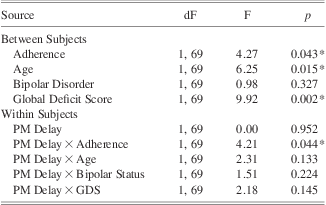
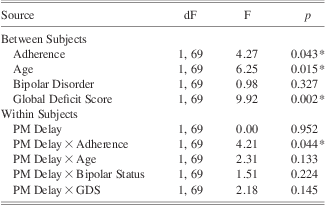
A repeated measures mixed-model ANOVA controlling for age, bipolar status, GDS, with group (i.e., Adherent vs. Non-adherent comparison) as the between-subjects variable and MIST delay interval (i.e., 2-min vs. 15-min) as the within-subjects factor revealed a main effect of group [F(1,69) = 4.27; p = .04], but not a main effect of MIST delay interval [F(1,69) = 0.00; p = .95]. Notably, there was a significant adherence group by MIST delay interval interaction [F(1,69) = 4.20; p = 0.04], as shown in Table 2, but no significant interaction for the other variables (ps > .10). Moreover, the interaction term for Adherence and MIST Delay remained significant when we substituted the domain-specific deficit scores for executive functions (i.e., WCST-64; TMT-B, Stroop Color-Word Interference) or memory (i.e., BVMT-R, HVLT-R) for the GDS.
Results of mixed-model ANOVA predicting PM using the MIST in HIV
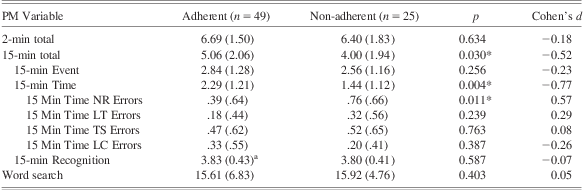
Planned follow-up group comparisons revealed no effect of adherence group on the 2-min delay MIST scale (p = 0.63; Cohen's d = −0.18); however, there was a significant adherence by group effect on the 15-min delay MIST scale such that individuals who were Non-adherent performed significantly worse than the Adherent comparison group (p = 0.03; d = −0.52). As shown in Table 3, planned group comparisons showed that there was no difference between the groups for the MIST 15-min EB scale (p = 0.26, d = −0.23), but the Non-adherent group performed significantly worse on the MIST 15-min TB trials than the Adherent comparison group (p = .004, d = −0.77). An analysis of error types on the MIST 15-minute TB tasks showed that the Non-adherent group had significantly higher rates of omissions (p = 0.03; d = 0.42), but were comparable to the Adherent group on all other MIST error types (ps > .10).
MIST performance in the Adherent and Non-adherent groups
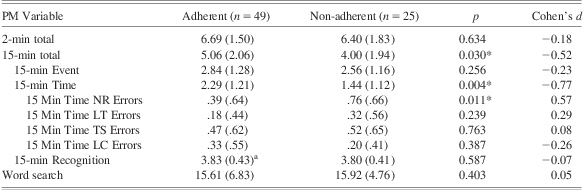
Note. NR- No Response; LT- Loss of Time; TS- Task Substitution; LC- Loss of Content; an = 48.
Finally, to examine the unique clinical contribution of PM, we conducted a logistic regression predicting adherence group from MIST 15-min TB trial score above and beyond self-reported adherence as measured by the ACTG. Results showed an overall significant model (χ2 = 11.8; p = .003) in which the MIST 15-min TB PM was an independent predictor [χ2 = 7.16; p = .007; odds ratio = 1.78 (95% confidence interval = 1.16, 2.85)], whereas self-report adherence was associated with MEMS-based adherence group status at the level of a trend [χ2 = 3.73; p = 0.054; odds ratio = 0.2 (0.02, 1.03)].
Discussion
HIV-associated deficits in PM have been previously established as important predictors of cART non-adherence (Woods et al., Reference Woods, Dawson, Weber, Gibson, Grant and Atkinson2009), but the specific cognitive mechanisms of this association are not well understood. The multi-process theory of PM by McDaniel and Einstein (Reference McDaniel and Einstein2000) posits that a longer delay between intention formation and execution places greater demands on executive resources for strategic monitoring and retention of the cue-intention pairing. Individuals with HAND are at particular risk for PM deficits on tasks with longer delay intervals (Morgan et al., Reference Morgan, Weber, Rooney, Grant and Woods2012), which may portend a vulnerability to suboptimal medication adherence in daily life. Consistent with this hypothesis, results from the current study showed that HIV-infected individuals who are non-adherent to their cART regimen over a 30-day observational period evidenced disproportionately worse baseline PM performance on the 15-min versus the 2-min subscale of the MIST as compared to their adherent counterparts. The longer PM delay effect on adherence status as measured by the MIST was associated with a medium-to-large effect size and was not better explained by competing factors, including demographics, psychiatric status, self-reported adherence, or treatment characteristics.
Also commensurate with the predictions of multi-process theory, the differential effects of longer delay intervals as measured by the MIST on cART non-adherence were more pronounced for time- versus event-cued tasks. Non-adherent individuals evidence poorer abilities to monitor their environment for the passage of prolonged periods of time, but performed comparably on the less strategically demanding EB cues. It is widely held that, all other factors being held constant, TB PM places greater demands on executive control of monitoring and cue detection (e.g., Raskin et al., Reference Raskin, Woods, Poquette, McTaggart, Sethna, Williams and Tröster2011). Further evidence for the strategic dysregulation hypothesis in this study is provided by profile analysis showing higher rates of omission errors in the setting of intact PM post-test recognition. This profile is consistent with the working hypothesis of HIV-associated PM deficits, which are thought to reflect deficits in the strategic aspects of cue monitoring and detection (Zogg et al., Reference Zogg, Woods, Sauceda, Wiebe and Simoni2012). Morgan et al. (Reference Morgan, Weber, Rooney, Grant and Woods2012), for example, recently reported that executive dysfunction was the strongest cognitive predictor of long delay PM deficits in a separate sample with HAND. Accordingly, this study illustrates the potential value of applying cognitive theory to enhance the prediction of everyday functioning problems in HIV infection, by extending the findings of Morgan et al. study to cART non-adherence using a longitudinal design in a separate participant sample.
In addition to providing theoretical insight regarding non-adherence, these data are also of direct clinical relevance. Component process assessment of PM with tests such as the MIST, which is now publically available, may be of value for clinical cases in which treatment adherence risks are being evaluated. In our analysis, odds ratios showed that score decreases of 1 point on the MIST long delay scale were associated with a nearly two-fold increased risk of non-adherence. The predictive value of PM in this regard was independent of self-reported adherence and other well-established clinical factors that were either included in the statistical models (i.e., age and global cognitive deficits) or were comparable between the two study groups (e.g., mood, substance use disorders, compensatory strategy use). As such, these data provide further evidence of the incremental ecological validity of PM as a predictor of medication non-adherence (Zogg et al., Reference Zogg, Woods, Sauceda, Wiebe and Simoni2012). The requisite time investment for reliable and valid clinical assessment of PM therefore may be of considerable prognostic value in some cases.
Consideration of deficits in long delay PM intervals may be especially relevant to the development of more effective remediation strategies to overcome problematic real-world medication taking behaviors. Identifying those persons most likely to experience failures of PM over longer intervals could be vital for improving functional outcomes by informing medication adherence interventions that align with individual profiles of PM failures. Formulating interventions that incorporate a shorter delay and thus decrease the need for strategic monitoring might improve adherence in this at-risk population. Likewise, an intervention that uses a conspicuous event as a cue for medication dose timing might prove to be beneficial by making the behavior more dependent on the unimpaired automatic processes. For example, a tailored text messaging or other automated reminder system that is tied to the specific timing of a particular medication-taking event, would theoretically decrease time-based PM demands and improve medication adherence. Such technologically based interventions have been used and have shown the ability to improve adherence behaviors in HIV at least over relatively short periods of time (Andrade et al., Reference Andrade, McGruder, Wu, Celano, Skolasky, Selnes and McArthur2005).
This study is not without methodological limitations. Our sample was relatively small and had a high proportion of confounding psychiatric co-morbidities, which may restrict the generalizability of these findings; however, we were adequately powered to detect the expected effects and, as noted above, the primary findings were not confounded by the high rates of co-morbidities. Notably, the heightened prevalence of co-morbidities among an HIV population is common and could be representative of higher risk individuals. Additionally, despite the differences in ARV adherence between groups, our groups did not differ on disease outcome variables. While this can be explained by the relatively short monitoring period and younger age of the non-adherent group, future studies would benefit from a longer monitoring period that could potentially show the impact of non-adherence between groups over time.
From a measurement perspective, the MIST only allows for delays of 2- and 15-min, whereas real-time delays between medication doses are usually on the order of hours, rather than minutes. And while the MIST demonstrates considerable ecological validity, it does not allow subjects to take notes or provide individualized prompts that elicit a response to an aspect of one's daily routine. Another limitation is that there was an absence of a measure of cue monitoring (e.g., clock checking). Considering the influence of strategic monitoring on PM, it would have been interesting to examine this aspect of PM in conjunction with adherence.
Another limitation of this study is its retrospective design and use of subscales from a standard clinical measure of PM, in this case the MIST, rather than a more classic experimental approach using a prospective, randomized and counterbalanced approach. The MIST includes overlapping items across pre-set delays (i.e., 2- and 15-min) and cue types (i.e., time- and event-based), which means that specific item content and administration order was not subject to experimental manipulation and therefore may have affected the results. That said, we also believe that there is sufficient scientific justification and clinical value for using the MIST in this regard. The MIST is a well-validated measure of prospective memory whose 2- and 15-min scales have been previously examined in substance users (Weinborn et al., Reference Weinborn, Woods, Nulsen and Park2011), Parkinson's disease (Raskin et al., Reference Raskin, Woods, Poquette, McTaggart, Sethna, Williams and Tröster2011), and HAND (Morgan et al., Reference Morgan, Weber, Rooney, Grant and Woods2012). Importantly, the 2- and 15-min scales are balanced on cue (i.e., time- and event-based) and response (i.e., action and verbal) type, which helps minimize interpretive psychometric or design concerns. Moreover, the 2- and 15-min TB cues are well balanced in content; for example, the first 15-min TB cue is, “In 15 minutes, tell me it is time to take a break,” and the first 2-min TB cue is, “In 2 minutes, ask me what time the session ends today.” Finally, from a clinical perspective, the MIST is now a proprietary instrument, which enhances the potential value of these findings to practitioners. Future investigations on this topic may nevertheless rectify the above-noted methodological issues by using a parametric design and randomized, separate trials of psychometrically comparable tasks across systematically manipulated PM delay intervals.
In conclusion, this study used a clinical task to provide the first evidence of more pronounced long delay PM deficits in non-adherent individuals as compared to otherwise generally similar adherent individuals. Future studies could further inform this finding by monitoring medication adherence in a larger sample of HIV-infected individuals and by examining a greater range of time-based PM delays. Additionally, assessing the ability of interventions that decrease time-based prospective memory demands (e.g., tailored technologic interventions) may serve to improve medication adherence among HIV-infected individuals.
Acknowledgments
The authors report no conflicts of interest. This work was supported by National Institute of Mental Health grant R03 MH078785 and the California HIV/AIDS Research Program IDEA Award ID06-SD-201 to Dr. Moore, as well as R01MH073419, P30MH62512, P01DA012065, and T32AA013525. The views expressed in this article are those of the authors and do not reflect the official policy or position of the Department of the Navy, Department of Defense, nor the United States Government. The authors thank the study volunteers for their participation, and Dr. Sarah Raskin for providing us with the MIST.
*The San Diego HIV Neurobehavioral Research Program [HNRP] group is affiliated with the University of California, San Diego, the Naval Hospital, San Diego, and the Veterans Affairs San Diego Healthcare System, and includes: Director: Igor Grant, M.D.; Co-Directors: J. Hampton Atkinson, M.D., Ronald J. Ellis, M.D., Ph.D., and J. Allen McCutchan, M.D.; Center Manager: Thomas D. Marcotte, Ph.D.; Jennifer Marquie-Beck, M.P.H.; Melanie Sherman; Neuromedical Component: Ronald J. Ellis, M.D., Ph.D. (P.I.), J. Allen McCutchan, M.D., Scott Letendre, M.D., Edmund Capparelli, Pharm.D., Rachel Schrier, Ph.D., Terry Alexander, R.N., Debra Rosario, M.P.H., Shannon LeBlanc; Neurobehavioral Component: Robert K. Heaton, Ph.D. (P.I.), Steven Paul Woods, Psy.D., Mariana Cherner, Ph.D., David J. Moore, Ph.D., Matthew Dawson; Neuroimaging Component: Terry Jernigan, Ph.D. (P.I.), Christine Fennema-Notestine, Ph.D., Sarah L. Archibald, M.A., John Hesselink, M.D., Jacopo Annese, Ph.D., Michael J. Taylor, Ph.D.; Neurobiology Component: Eliezer Masliah, M.D. (P.I.), Cristian Achim, M.D., Ph.D., Ian Everall, FRCPsych., FRCPath., Ph.D. (Consultant); Neurovirology Component: Douglas Richman, M.D., (P.I.), David M. Smith, M.D.; International Component: J. Allen McCutchan, M.D., (P.I.); Developmental Component: Cristian Achim, M.D., Ph.D.; (P.I.), Stuart Lipton, M.D., Ph.D.; Participant Accrual and Retention Unit: J. Hampton Atkinson, M.D. (P.I.), Rodney von Jaeger, M.P.H.; Data Management Unit: Anthony C. Gamst, Ph.D. (P.I.), Clint Cushman (Data Systems Manager); Statistics Unit: Ian Abramson, Ph.D. (P.I.), Florin Vaida, Ph.D., Reena Deutsch, Ph.D., Anya Umlauf, M.S.