Introduction
Increased human–pet interactions lead to concerns related to the prevention and treatment of ectoparasites' infestations, among other issues. Therefore, the search for new active compounds with ectoparasiticide activity has great relevance. On the other hand, the overuse of these products is associated with numerous side-effects, such as resistance and environmental pollution (Sadaria et al., Reference Sadaria, Sutton, Moran, Teerlink, Brown and Halden2017; Teerlink et al., Reference Teerlink, Hernandez and Budd2017) and has been a matter of concern for both scientists and the public in recent years (Tripathi and Mishra, Reference Tripathi and Mishra2017). In this scenario, the use of natural products could be an excellent alternative to synthetic compounds as a mean to reduce the negative impact to human health and environment. Some medicinal plants (Artemisia vulgaris, Citrus x limon, Juniperus communis, Lavundula officinalis, Melissa officinalis and Thujaplicata) had their uses as ethnoveterinary insecticides against fleas in cat and dogs already reported (Lans et al., Reference Lans, Turner and Khan2008). Efforts all over the world have been performed in an attempt to develop prospects for essential oils (EOs) for insect control (Bakkali et al., Reference Bakkali, Averbeck, Averbeck and Idaomar2008).
An EO is a complex mixture of compounds, which may be obtained from different plant organs (Cavalcanti et al., Reference Cavalcanti, de Alves, da Silva, dos Patrocínio, Mirza Nalesso Sanches, de Chaves and de Souza2015) and may be extracted by hydrodistillation. Their chemical composition is based mainly on terpenes (mono and sesquiterpenes) and/or phenylpropanoids. EOs have shown to be very promising due to their insecticidal potential, due to the different bioactive compounds present in them. However, the major body of research on EOs describes their activity against mosquitoes and ticks (Benelli and Pavella, Reference Benelli and Pavella2018). The use of EOs extracted from plants for the control of veterinary ectoparasites received peculiar attention since they show high efficacy, multiple mechanisms of action and low toxicity on non-target vertebrates, including aquatic ones (Ellse and Wall, Reference Ellse and Wall2014). Mite mortality using EOs of Cinnamomum zeylanicum (Na et al., Reference Na, Kim, Bang, Kim and Ahn2011), Laurus novocanariensis (Macchioni et al., Reference Macchioni, Perrucci, Cioni, Morelli, Castilho and Cecchi2006) and Cymbopogon nardus (Magi et al., Reference Magi, Jarvis and Miller2006) has been reported. Tick and flies mortality has been described using two different Mentha species, M. longifolia (Koc et al., Reference Koc, Oz, Aydin and Cetin2012) and M. piperita (Morey and Khandagle, Reference Morey and Khandagle2012), respectively. Cymbopogon nardus EO has also been used for many years as an insect repellent (Zaridah et al., Reference Zaridah, Nor Azah, Abu Said and Mohd Faridz2003). However, there is a lack of studies involving EO and fleas (Ellse and Wall, Reference Ellse and Wall2014), both related to insecticidal activity or repellency, as well as the relationship between EO composition and its activity (Benelli and Pavella, Reference Benelli and Pavella2018).
Ctenocephalides felis felis (Bouché, 1835), the cat flea, is an ectoparasite of warm-blooded hosts, which affects mostly mammals in general. It is currently widespread around the world, with a preference for temperate regions (Lehane, Reference Lehane2005). It is the most important ectoparasite in dogs and cats (Dryden, Reference Dryden1993), due to its vector competence and geographical distribution (Linardi and Santos, Reference Linardi and Santos2012). Its biological cycle can be divided into the following stages: egg, three larval stages, inactive pupae and adult (Blagburn and Dryden, Reference Blagburn and Dryden2009). Ctenocephalides felis felis is frequently associated as a vector or an intermediate host of bacteria, protozoa and helminths (Rust and Dryden, Reference Rust and Dryden1997; Avelar et al., Reference Avelar, Melo and Linardi2011; ESCCAP, 2015). Additionally, it promotes irritation especially in dogs and cats, such as allergic dermatitis, the most common veterinary dermatologic condition in the world (Carlotti and Jacobs, Reference Carlotti and Jacobs2000). The goals of the flea control are to provide adulticidal effectiveness, eliminating the adult fleas on all the animals in the house as well as environmental life-stage control, eliminating immature fleas in the environment (Halos et al., Reference Halos, Beugnet, Cardoso, Farkas, Franc, Guillot, Pfister and Wall2014). For example, previously published results pointed to the flea activity of the S. molle EO (Batista et al., Reference Batista, Cid, Almeida, Prudêncio, Riger, Souza, Coumendouros and Chaves2016) that led to the formulation of products based on that EO with verified efficacy for the treatment of fleas in cats and dogs (de Almeida et al., Reference de Almeida, Chaves, Coumendouros, Batista, Rosado, de Souza and Cid2016).
Based on this information, and in the search for new and less aggressive insecticides to humans, animals and the environment, aligned with the one health concept, the aim of this study was to evaluate the in vitro activity and to establish the LC50 of several EOs. In this way, Alpinia zerumbet, Cinnamomum spp., Laurus nobilis, Mentha spicata, Ocimum gratissimum and C. nardus EOs were tested against immature stages (eggs and larvae) and adults of C. felis felis. Some of them also had their toxicity evaluated against Saccharomyces cerevisiae yeast cells, unicellular eukaryotic organism with great orthology to mammalian cells; especially with regards to the macromolecules, organelles and cellular metabolism (Fikry et al., Reference Fikry, Khalil and Salama2019).
Material and methods
Plant material
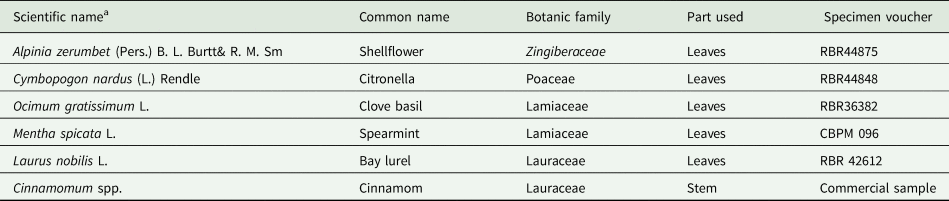
Leaves of A. zerumbet (Pers.) B. L. Burtt & R. M. Sm, C. nardus (L.) Rendle, Ocimum gratissimum L., M. spicata L. and L. nobilis L. were collected at the Botanical garden of the Universidade Federal Rural do Rio de Janeiro (GPS 22°31′36.23S; 44°04′31.62W), dried in an over chamber at 37°C for 72 h and manually pulverized. All specimen vouchers (Table 1) were deposited in the Herbarium of the Institute of Botany (UFRRJ, Brazil). Stems of Cinnamomum spp. were purchased commercially from the company (Marca do Sabor®, Nova Friburgo/Rio de Janeiro state).
Main information about the plant species used in this study

a The scientific names were proposed according to The Plant List 2019 (http://www.theplantlist.org) and Reflora 2020 (http://floradobrasil.jbrj.gov.br/reflora).
Extraction, content and chemical characterization of the essential oils
EOs from both dried leaves and Cinnamomum spp. stems were obtained by hydrodistillation in a Clevenger apparatus for 3 h and dried over anhydrous Na2SO4. GC analysis was carried out on a Hewlett-Packard 5890 II (Palo Alto, USA) apparatus equipped with flame ionization detection (FID) and a split/splitless injector. Substances were separated into the fused silica capillary column HP-5 (30 m × 0.25 mm i.d., 0.25 μm, Agilent J &W). The oven, injector and detector temperatures were programmed as reported by Adams (Reference Adams1995). Helium was used as the carrier gas (1 mL min−1). Injected volume was 1 μL on a 1:20 split ratio. Percentage of EO compounds was calculated from the relative area of each peak analysed by GC-FID. EOs were also analysed on a GC/MS QP-2010 Plus (Shimadzu, JPN). Carrier gas flow, capillary column and temperature conditions for GC/MS analysis were the same as those described for GC/FID and reported by Adams (Reference Adams1995). Mass spectrometer operating conditions were ionization voltage at 70 eV and mass range 40–400 m/z and 0.5 scan/s. The compounds retention index was calculated based on co-injection of samples with a C8-C20 hydrocarbon mixture as reported by Van Den Dool and Kratz (Reference Van den Dool and Kratz1963). Constituents were identified by comparison of their mass spectra with the NIST library (2008) and with those reported by Adams (Reference Adams1995).
In vitro activity of essential oils against Ctenocephalides felis felis
Bioassays were performed using the filter paper impregnation method. Stock solutions at a concentration of 200 mg mL−1 of EOs from A. zerumbet, Cinnamomum spp., L. nobilis, M. spicata, O. gratissimum and C. nardus were prepared using acetone as a diluent, which was also used as a negative control. Fipronil at 8 μg cm−2 was used as a positive control.
Serial dilutions (1:2) were performed from stock solutions allowing for 10 solutions in a concentration range varying from 40 000 to 78.125 μg mL−1. Each concentration was evaluated in duplicate, with filter paper strips measuring 10 cm2 (1 cm wide and 10 cm long). Each strip was impregnated with 0.2 mL of the respective dilution reaching final concentrations in the range of 800–1.5625 μg cm−2. After the treatment, the strips were left in the open to dry for 30 min.
Mortality of adult stage
In vitro insecticidal activity against C. felis felis adults was tested using the filter paper tests against unfed fleas obtained from the laboratory colony. The impregnated and dried strips were inserted into glass tubes containing 10 unfed adult cat fleas (five males and five females). The tubes were sealed with non-woven tissue and rubber bands and kept in the climatized chamber at 28 ± 1°C and 75 ± 10% relative humidity. The evaluation criterion used was motility, any flea that presented minimal movement was considered alive. The mean number of live adult fleas per concentration was evaluated at 24 and 48 h using a stereoscopic microscope. The tests were performed in duplicates for each concentration.
Mortality of immature stages (egg and larvae)
In vitro activity of the EOs against immature stages of C. felis felis was tested using the filter paper tests against fleas' eggs obtained from the laboratory colony. The impregnated and dried strips were then placed in test tubes containing 10 C. felis felis eggs along with a substrate necessary for larval development, consisting of sand, wheat bran and fecal material from adult fleas. The tubes were sealed with non-woven tissue and rubber bands and kept in a climatized chamber at 28 ± 1°C and relative humidity of 75 ± 10%. The evaluation criterion used was egg hatching, where each hatching egg was considered alive. For the larvicidal test, the same procedure was performed using 10 C. felis felis larvae per tube. The evaluation criterion used was motility, any larva that presented minimal movement was considered alive. The mean number of live eggs and larvae per concentration was evaluated in periods of mainly 24 h with the help of a stereoscopic microscope. The tests were performed in duplicates for each concentration.
Efficacy evaluation and LC50 establishment
The Abbott's formula (Reference Abbott1987) was used to calculate the efficacy: per cent efficacy = [(mean number of fleas (adult, egg or larvae) of the control group – mean number of fleas (adult, egg or larvae) from the treated group)/(mean number of fleas (adult, egg or larvae) from the control group)] × 100.
The calculation of LC50 (concentration that kills 50% of the treated population) for both mature and immature stages was performed by probit analysis using Minitab® 16 (2013, Minitab Inc. LEADTOOLS, LEAD Technologies, Inc., State College, PA, USA). Statistical significance was set at 5% (P < 0.05).
Cell viability
The S. cerevisiae strain used in this study was BY4741 (MATa; his3Δ1; leu2Δ0; met15Δ0; ura3Δ0) acquired from Euroscarf (Frankfurt, Germany). Stock solution of the yeast strain was maintained on solid 2% YPD (1% yeast extract, 2% glucose, 2% peptone and 2% agar) at refrigerated temperature. Media components were obtained from Difco (EUA). A stock solution of EOs (2000 μg mL−1) was prepared with DMSO at 50%. For all experiments, cells were cultivated in liquid 2% YPD using an orbital shaker at 28°C and 160 rpm, until growth to stationary phase (4.0 mg dry weight per mL), measured by optical density at 570 nm. Only two EOs were analysed in this experiment with yeasts, the one with the best results (O. gratissimum) and one of the worst results (C. nardus) in the in vitro bioassays. Thymol and fipronil were used as parameters in the cell viability assay. Cells were treated for 24 and 48 h with O. gratissimum and C. nardus at 10 and 100 μg mL−1 concentration for each EO and 100 μg mL−1 for thymol or fipronil (three independent experiments at least). The control (no EO addition) was used as the basal value. After incubation, an equivalent volume corresponding to 4 μg cells was collected, diluted (1000×) in buffer phosphate (50 mm, pH 6.0), plated on YPD 2%, incubated at 28°C/72 h and the colonies were counted (de Sá et al., Reference de Sá, de Castro, Eleutherio, de Souza, da Silva and Pereira2013).
Results
Content and chemical characterization of the essential oils
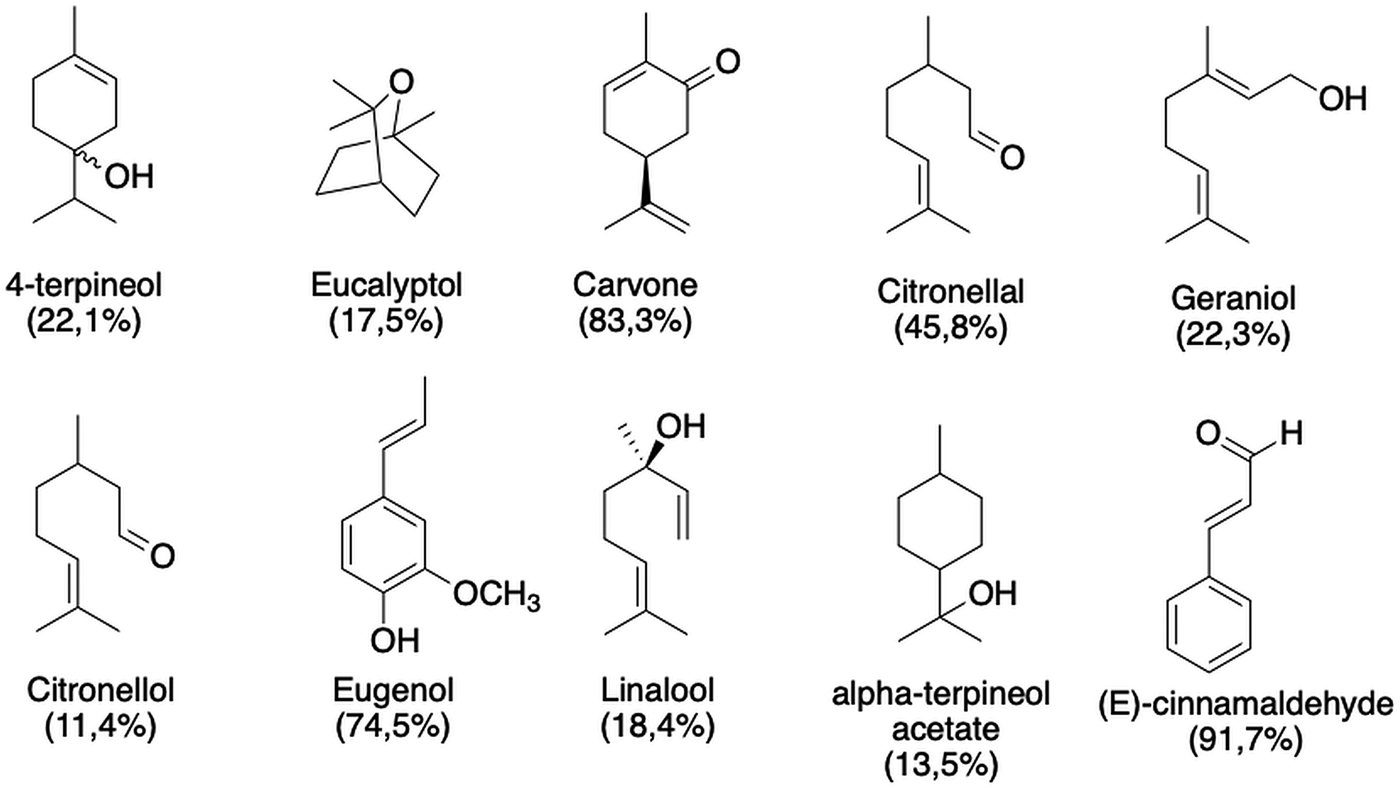
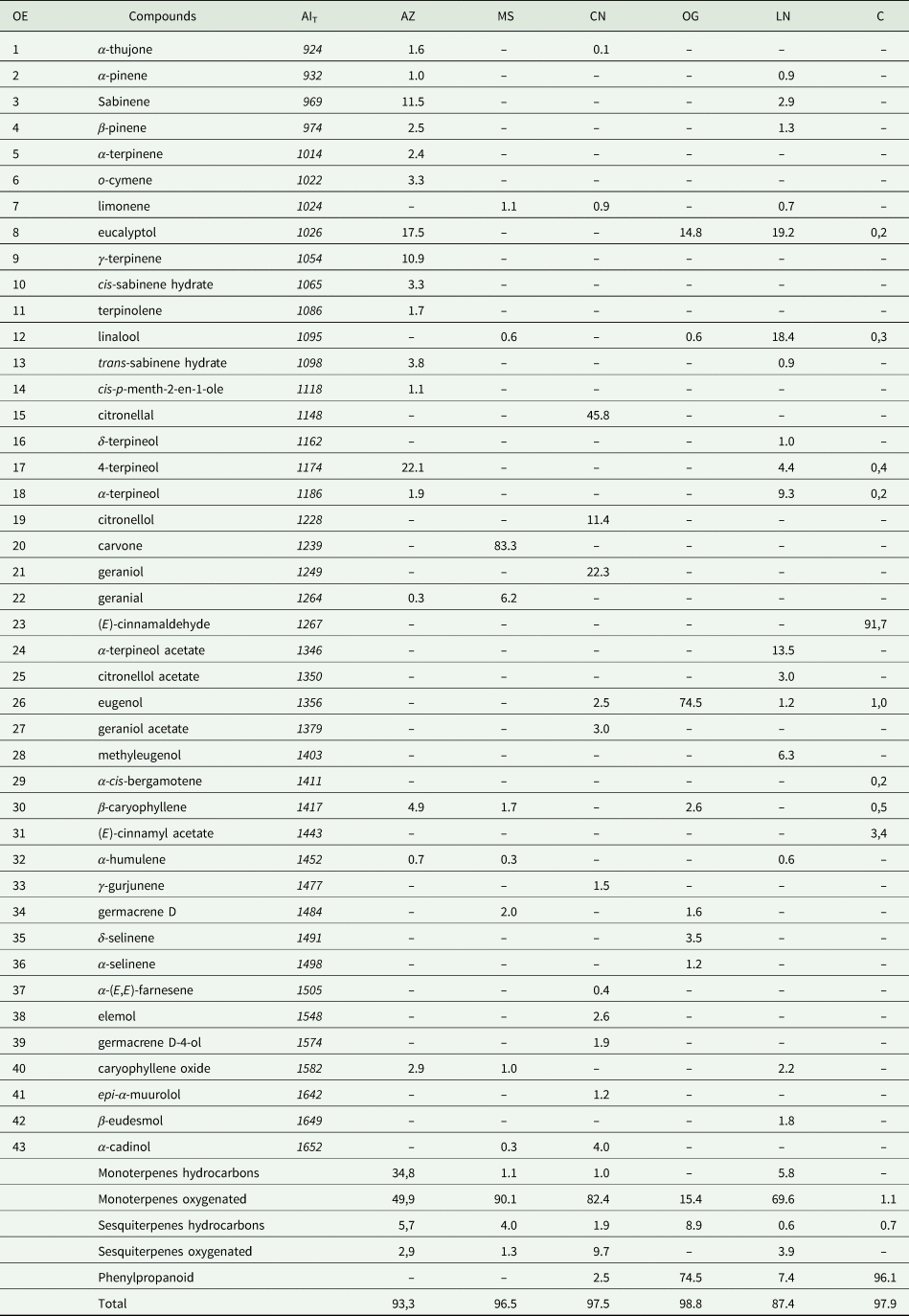
The analysis of the EOs from the studied species showed differences in their content and chemical composition (Table 2). The major compounds (Fig. 1) found in the studied species were: 4-terpineol (22.1%) and eucalyptol (17.5%) in A. zerumbet; carvone (83.3%) in M. spicata; citronellal (45.8%), geraniol (22.3%) and citronellol (11.4%) in C. nardus; eugenol (74.5%) and eucalyptol (14.8%) in O. gratissimum; eucalyptol (19.2%), linalool (18.4%) and α-terpineol acetate (13.5%) in L. nobilis and (E)-cinnamaldehyde (91.7%) in Cinnamomum spp.
Major compounds identified in the essential oil of the studied plant species.

Essential oils chemical profile from plant species obtained by hydrodistillation

The chemical composition was analysed by GC-MS and organized in the table by order of elution (EO) in the chromatographic column. The concentration (%) was calculated based on the total area of the peak by GC-FID. Tabulated arithmetic index (AIT). Not detected (–). Essential oil of Alpinia zerumbet (AZ), Mentha spicata (MS), Cymbopogon nardus (CN), Ocimum gratissimum (OG), Laurus nobilis (LN) and Cinnamomum spp. (C).
Mortality of adult stage
All EOs tested presented activity against the mature stage of C. felis felis in the concentration range tested. The negative control (acetone) was 0% effective and the positive control (fipronil at 8 μg cm−2) was 100% effective, demonstrating that the method was employed correctly. The best efficacy results were found for the EO from O. gratissimum, which achieved 100% of efficacy in the concentration of 25 μg cm−2. Cinnamomum spp. also presented good results with 100% of efficacy at 200 μg cm−2. The other EOs presented 100% of efficacy only at the maximum concentration tested (800 μg cm−2), except for M. spicata that achieved a maximum of 75% of efficacy at the concentration range tested (Table 3).
Essential oils in vitro activity through filter paper test (% mortality) against mature stage (adults) of Ctenocephalides felis felis after 24 and 48 h

Essential oil of Alpinia zerumbet (AZ), Mentha spicata (MS), Cymbopogon nardus (CN), Ocimum gratissimum (OG), Laurus nobilis (LN) and Cinnamomum spp. (C).
Mortality of immature stages (egg and larvae)
Immature stages were more sensitive to EOs when compared with mature stage, achieving 100% of efficacy in lower concentrations for all EOs tested. Ocimum gratissimum and Cinnamomum spp. EOs also presented the best results for immature forms with 100% of efficacy in the concentration of 12.5 and 6.25 μg cm−2, respectively, against eggs and larvae. Cymbopogon nardus achieved 100% of efficacy at higher concentrations (400 μg cm−2) and the other EOs presented 100% of efficacy only at the maximum concentration tested (800 μg cm−2) (Table 4). The negative control (acetone) was 0% effective and the positive control (fipronil at 8 μg cm−2) was 100% effective, demonstrating that the method was employed correctly.
Essential oils in vitro activity through filter paper test (% mortality) against immature stages (eggs and larvae) of Ctenocephalides felis felis

Essential oil of Alpinia zerumbet (AZ), Mentha spicata (MS), Cymbopogon nardus (CN), Ocimum gratissimum (OG), Laurus nobilis (LN) and Cinnamomum spp. (C).
LC50 estimative
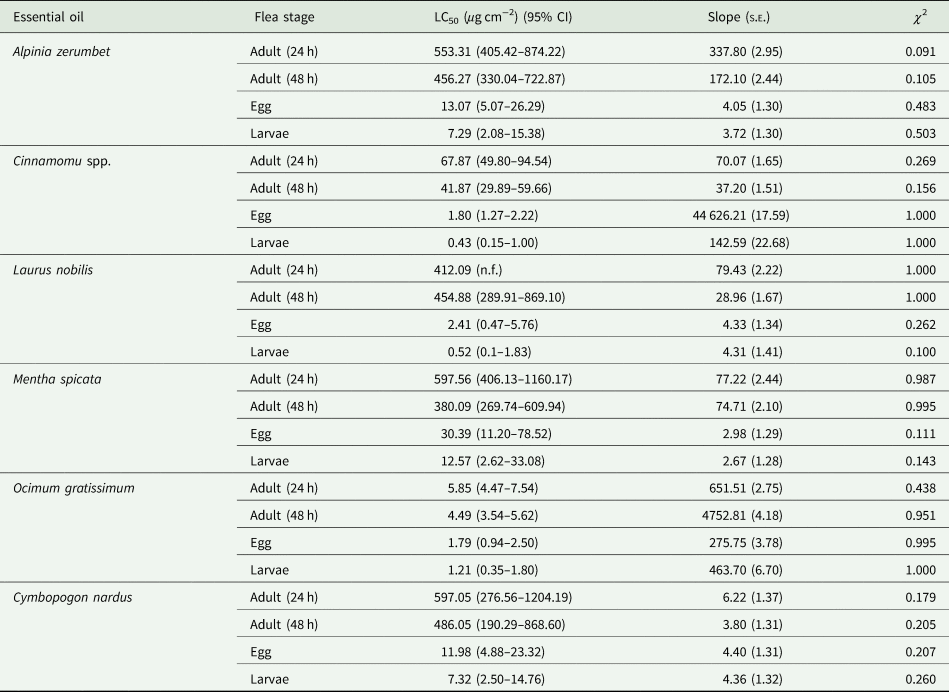
Lc50 and slope values of EOs for all stages evaluated are demonstrated in Table 5. Alpinia zerumbet, L. nobilis, M. spicata and C. nardus EOs presented LC50 values for adult stage varying between 412.09 and 597.56 μg cm−2 after 24 h and between 380.09 and 486.05 μg cm−2 after 48 h of exposure. Cinnamomum spp. and O. gratissimum EOs presented LC50 values at different concentration ranges of the other EOs evaluated for both 24 and 48 h of exposure, presenting relative potency of 10 and 100-fold higher, respectively.
LC50 (μg cm−2) establishment and slope of essential oils against mature (adults) and immature stages (eggs and larvae) of Ctenocephalides felis felis

Probit analyses were performed for all data using Minitab® 16 (2013, Minitab Inc., LEADTOOLS, LEAD Technologies, Inc.); LC50 (μg cm−2) (95% CI): 50% lethal concentration values together with their 95% confidence interval; Slope (s.e.): slope of the concentration curve and standard error; χ 2: goodness of fit test as accuracy of data fitting to probit analysis. Values showed no significant heterogeneity at the level of P ⩾ 0.05); n.f., not found.
LC50 values found for the immature stages varied between 1.79 and 30.39 μg cm−2 and 0.43 and 12.57 μg cm−2 for eggs and larvae, respectively, demonstrating a greater sensitivity of the larva stage to EOs (Table 5).
Cell viability
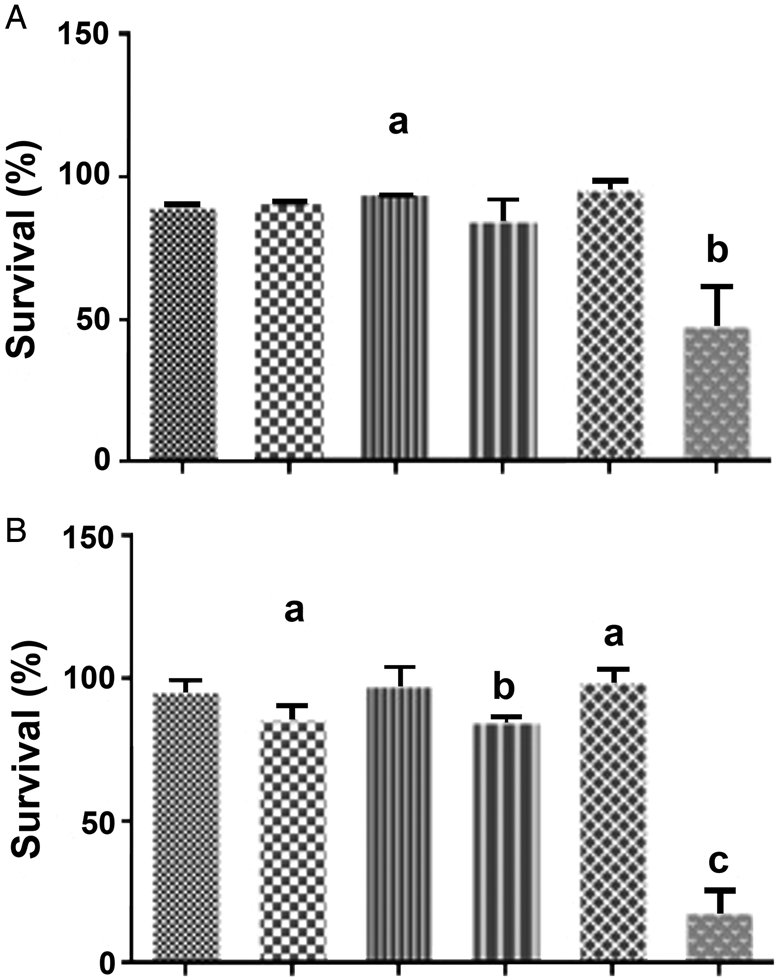
The results observed for the viability cell assay with O. gratissimum and C. nardus EOs on yeast cells showed no toxicity at the tested concentrations of 10 and 100 μg mL−1 after 24 h of exposure (Fig. 2A). Fipronil and thymol were also used at the concentration of 100 μg mL−1. Fipronil, a synthetic compound widely used in flea combat, showed a statistically similar result to both oils evaluated; however, thymol was proven to be more toxic to the BY4741 strain. Thymol (2-isopropyl-5-methyl-phenol), a known natural repellent, found abundantly in oregano and thyme EOs, has antibacterial and antifungal properties (Marchese et al., Reference Marchese, Orhan, Daglia, Barbieri, Di Lorenzo, Nabavi, Gortzi, Izadi and Nabavi2016). The results (Fig. 2A and B) showed its higher toxicity compared to the EOs evaluated.
Cell viability after incubation with O. gratissimum (OG) and C. nardus (CN) essential oils at 10 or 100 μg mL−1 for 24 h (A) and 48 h (B). Results are the average from, at least, three independent experiments. Statistical significance was calculated by analysis of variance (ANOVA) followed by Tukey post-test. P values <0.05 (*P < 0.05) were considered significant. Fipronil (Fip) and thymol (Tym) were used as positive controls. Different letters mean statistically different results.

In the period of 48 h of exposure to yeasts, there was a decrease in cell viability in the treatment with C. nardus at the concentration of 100 μg mL−1; while O. gratissimum EO remained non-toxic to the cells. This reveals that besides O. gratissimum being the most effective in the in vitro assays, it also presents an excellent result in a eukaryotic model, making it promising for the tests in higher mammals. It is important to emphasize the high sensitivity of this assay, since direct exposure of the substances to the cells occurs, increasing the probability of toxicity when compared to topical use in animals. Fipronil maintained the same profile of results in 48 h of incubation; however, there was an increase in toxicity with thymol.
Preliminary tests on the toxicity of compounds with high potential for topical use in animals are important and necessary. In our case, we used the direct exposure of O. gratissimum and C. nardus to S. cerevisiae cells. This cell type has been widely used for the evaluation of toxicity of substances, including assays with EOs (Zhang et al., Reference Zhang, Yang, Chen, Huang, Li, Lan, Su, Pan, Zhou, Zheng and Du2017; Armijos et al., Reference Armijos, Valarezo, Cartuche, Zaragoza, Finzi, Mellerio and Vidari2018).
Discussion
Our species showed classical chemotype classification (CT) according to the data published in the literature; A. zerumbet CT eucalyptol (syn. 1,8-cineole) (Pinto et al., Reference Pinto, Assreuy, Coelho-de-Souza, Ceccato, Magalhães, Lahlou and Leal-Cardiso2009), M. spicata CT carvone (Morcia et al., Reference Morcia, Tumino, Ghizzoni and Terzi2016), C. nardus CT citronellal (Weng et al., Reference Weng, Latip, Hasbullah and Sastrohamidjojo2015), O. gratissimum CT eugenol (Chimnoi et al., Reference Chimnoi, Reuk-Ngam, Chuysinuan, Khlaychan, Khunnawutmanotham, Chokchaichamnankit, Thamniyom, Klayraung, Mahidol and Techasakul2018), L. nobilis CT 1,8 cineole (Merghni et al., Reference Merghni, Marzouki, Hentati, Aouni and Mastouri2015) and Cinnamomum sp. CT (E)-cinnamaldehyde (Jeyaratnama et al., Reference Jeyaratnama, Noura, Kanthasamya, Nourb, Yuvaraj and Akindoyo2016).
The bioassay results suggest that the method of evaluation of insecticidal activity was able to perform a pre-screening of several EOs and to estimate the LC50 values for both mature and immature flea stages. Moreover, the results showed that immature stages (eggs and larvae) presented greater sensitivity to all EOs evaluated.
Ocimum gratissimum EO (74.5% of eugenol) exhibited great insecticidal activity against adult fleas (LC50 = 5.85 μg cm−2), with relative potency up to 100-fold higher when compared to the other EOs evaluated in this work and also more potent than previously reported by Batista et al. (Reference Batista, Cid, Almeida, Prudêncio, Riger, Souza, Coumendouros and Chaves2016) with Schinus molle L. EO. This EO also showed great results for larvicidal (LC50 = 1.21 μg cm−2) and ovicidal (LC50 = 1.79 μg cm−2) activities. EOs containing eugenol have had their mortality (Yones et al., Reference Yones, Bakir and Bayoumi2016) and repellence (Iwamatsu et al., Reference Iwamatsu, Miyamoto, Mitsuno, Yoshioka, Fujii, Sakurai, Ishikawa and Kanzaki2016) activity against P. humanus capitis already described. Eugenol itself had its insecticide and repellence activity against Sitophilus zeamais (Huang et al., Reference Huang, Shuit-Hung Ho, Lee and Yap2002), Dinoderus bifloveatus (Ojimelukwe and Adler, Reference Ojimelukwe and Adler2000), Ixodes ricinus (Bissinger and Roe, Reference Bissinger and Roe2010) and C. maculatus (Ajayi et al., Reference Ajayi, Arthur and Henry2014) described nevertheless its activity in flea mortality had not been reported yet.
Cinnamomum spp. EO [91.7% of (E)-cinnamaldehyde] showed 10-fold higher adulticide mortality compared to the remaining EOs (LC50 = 67 μg cm−2) and also great results for larvicidal (LC50 = 0.43 μg cm−2) and ovicidal (LC50 = 1.80 μg cm−2) activities. Cinnamaldehyde insecticide activity and repellence efficacy against cats and dogs ectoparasites have already been reported (Tripathi and Mishra, Reference Tripathi and Mishra2017). EOs containing (E)-cinnamaldehyde as their major compound have had their mortality activity against head and body lice already described (Yones et al., Reference Yones, Bakir and Bayoumi2016).
Eucalyptol and Linalool, compounds of L. nobilis EO, have their insecticide and repellent activity described for several insects (Aggarwall et al., Reference Aggarwal, Tripathi, Prajapati and Kumar2001; Toloza et al., Reference Toloza, Zygadlo, Mougabure Cueto, Biurrun, Zerba and Picollo2006; Sfara et al., Reference Sfara, Zerba and Alzogaray2009) including against fleas (Hink et al., Reference Hink, Liberati and Collart1998); however, our results show good activity only against immature forms, not achieving such great activity for adults.
Citronellal (CT of C. nardus) is a popular insect repellent in formulations that have been used for many years (Zaridah et al., Reference Zaridah, Nor Azah, Abu Said and Mohd Faridz2003). Despite its recognized repellency, C. nardus EO did not achieve the best mortality results both against mature and immature stages in our study. Moreover, it caused a decrease in S. cerevisiae cell viability at higher concentrations (100 μg mL−1).
Therefore, some EOs such as O. gratissimum and Cinnamomum spp. demonstrated the activity against different stages of fleas' maturity. Although these are encouraging results, further studies including in vivo assays must be performed to evaluate pulicide activity. Further studies must also be performed with major oil compounds such as eugenol, (E)-cinnamaldehyde, linalool and eucalyptol. Insecticide activity of these compounds both isolated and in association (synergistic effect) should be evaluated to explore its uses as possible candidates for alternative control of fleas.
Conclusion
Ocimum gratissimum EO was the most effective in the in vitro assay against all flea stages and also presented an excellent result in the toxicological assay using a eukaryotic model, making it promising for further tests using higher mammals. These results are promising as they point out to the development of alternative herbal products for flea control, minimizing the use of synthetic products.
Financial support
This study was supported by Fundação de Apoio à Pesquisa Tecnológica da Universidade Federal Rural do Rio de Janeiro (FAPUR), Coordenação de Aperfeiçoamento Pessoal de Nível Superior (CAPES) and Conselho Nacional de Desenvolvimento Científico e Tecnológico (CNPq).
Ethical standards
The experiments followed the standards established by the Ethics Committee for Animal Use of the Institute of Veterinary (CEUA/IV n° 091/14). Fleas (adults, eggs and larvae) used in the experiment were obtained from a colony maintained since 1998 in the Laboratory for Experimental Chemotherapy in Veterinary Parasitology of Federal Rural University of Rio de Janeiro (UFRRJ).
Conflict of interest
None.