Introduction
The coronavirus disease 2019 (Covid-19) outbreak emerged first in China and is still affecting the whole world. Cough, fever and shortness of breath are common clinical symptoms for patients.Reference Guan, Ni, Hu, Liang, Ou and He1,Reference Wang, Hu, Hu, Zhu, Liu and Zhang2 In addition to these, features such as loss of smell and taste are reported and used as the distinguishing diagnosis for Covid-19.Reference Agyeman, Chin, Landersdorfer, Liew and Ofori-Asenso3,Reference Rocke, Hopkins, Philpott and Kumar4 Less frequently, different neurological findings and systemic complications can be seen in patients.Reference Mao, Jin, Wang, Hu, Chen and He5 Vestibular or audiological symptoms may also be seen in a small group of patients, but these symptoms are often ignored and sequelae changes that may occur are neglected.Reference Almufarrij, Uus and Munro6–Reference Jafari, Kolb and Mohajerani8
Significant improvements in mortality rates have been achieved because of various factors, such as the emergence of low virulence variants, widespread vaccination and increased efficacy of treatments. As a result of this situation, we encounter the sequalae of the disease more frequently, requiring us to do more research on treatments.
Various viral agents cause inflammation in the cochlea or vestibule and may result in audiological losses or vestibular dysfunction. These conditions and their mechanisms of formation are investigated and discussed in the literature. Researchers attributed this situation to the influence of the central nervous system pathways as well as peripheral effects to the cochlea. Cytomegalovirus, rubella or measles are examples of viral agents that can often affect the audio-vestibular system.Reference Cohen, Durstenfeld and Roehm9,Reference Young10 With the increase in studies with a high level of evidence today, it is thought that Severe acute respiratory syndrome coronavirus-2 (SARS-CoV-2) may be among the viral agents that affect the audio-vestibular system.
It has been shown in some studies that the virus can spread to the olfactory bulb and brain via the neuroepithelial pathway, causing memory loss or neurocognitive disorders.Reference Meinhardt, Radke, Dittmayer, Franz, Thomas and Mothes11,Reference de Melo, Lazarini, Levallois, Hautefort, Michel and Larrous12 Although the central hypothesis is more plausible and possible, peripheral involvement of the cochlea is not completely excluded. In addition to this, there is a separate hypothesis that thrombotic focus in the audio-vestibular pathways may cause this situation.Reference Chen, Jiang, Han, Guan, Fang and Yan13,Reference Hanff, Mohareb, Giri, Cohen and Chirinos14
In our study, we aimed to determine whether the Vertigo Symptom Scale questionnaire or videonystagmography testing can detect any evidence of vestibular dysfunction in those who have recently experienced Covid-19 infection.
Materials and methods
The study was approved by the Ethical Committee of Haseki Training and Research Hospital (number: 141-2022), and all participants signed written consent in which they approved the use of their data for this scientific study. The study was performed in accordance with the Declaration of Helsinki ethical standards.
Between November 2021 and January 2022, those who were diagnosed with Covid-19 from a positive polymerase chain reaction test in our clinic or our hospital's pandemic clinic, as either in-patients or out-patients, were studied. For in-patients, patients who successfully completed the Covid-19 treatment and whose polymerase chain reaction test was negative, and for out-patients, patients with a negative Covid-19 polymerase chain reaction test were accepted into the study.
Patients who developed a need for intensive care during hospitalisation, and patients with a previous history of middle-ear pathology or ear surgery were excluded from the study. The patients included in the study went to the ENT clinic for examination and evaluation at 2–6 months after discharge or the negative polymerase chain reaction test.
Treatment of in-patients and out-patients was organised by the co-operation of ENT, infectious diseases and pulmonary diseases departments. Antiviral, prednisolone, antiaggregant, antibiotic, analgesic and vitamin treatments were given for in-patients. The standard treatment recommended by the ministry of health was applied in the out-patient group. This treatment included antiviral, analgesic and antiaggregant treatments, according to age. Control polymerase chain reaction tests were performed 7–14 days after the initiation of treatment in out-patients, and in-patients were discharged.
The patients were called to the ENT clinic and evaluated at least two months after discharge or after the polymerase chain reaction test turned negative. After a detailed ENT examination, the Vertigo Symptom Scale questionnaire and the audio-vestibular evaluation forms that we prepared were filled in, and audiometric, tympanometric and stapedial reflex examinations were performed.
As a result of the evaluations, patients with middle-ear pathology were excluded from the study. The Vertigo Symptom Scale questionnaire consists of 15 questions, and its validity and reliability have been tested in the Turkish language, and it is evaluated as a minimum score of 0 and a maximum score of 60.Reference Yanik, Külcü, Kurtais, Boynukalin, Kurtarah and Gökmen15 When we examined the questions included in the Vertigo Symptom Scale questionnaire carefully, it can be seen that some of the questions are related to vestibular symptoms and the rest are mostly related to anxiety symptoms, including questions related to difficulty breathing, shortness of breath, and pain in the heart or chest region. Because it is thought that anxiety symptoms may be intense in patients with Covid-19, we found it more appropriate to divide and evaluate the Vertigo Symptom Scale questionnaire into subsections. Thereupon, we divided the seven questions in the Vertigo Symptom Scale questionnaire into the anxiety symptom category and the remaining eight questions in the vertiginous symptom category into two parts. We therefore obtained the Vertigo Symptom Scale-Anxiety and Vertigo Symptom Scale-Vestibular scores, and we named the sum Vertigo Symptom Scale-Total.
The sample Vertigo Symptom Scale questionnaire form is shown in Appendix 1. Videonystagmography examinations were performed in patients with a Vertigo Symptom Scale-Total score of 15 and above and those who specifically complained of dizziness. All patients were examined for gaze, saccades, pursuit, optokinetic response, spontaneous nystagmus and the Head Impulse, Nystagmus, Test of Skew tests. The Head Impulse, Nystagmus, Test of Skew examination is a valuable tool for distinguishing a central cause of vertigo from peripheral vestibulopathy. All videonystagmography examinations were performed with the same Otometric® ICS Chartr 200 model device for each patient.
Statistical analysis
For statistical analysis, SPSS® (version 15.0) was used. Descriptive statistics were shown as number and percentage for categorical variables, and mean, standard deviation, minimum, maximum and median were used for numerical variables. Two independent group analyses of numerical variables were performed using the Mann–Whitney U test because the normal distribution condition was not met. The rates in the groups were compared with the chi-square test. Alpha significance level was accepted as p < 0.05.
Results
There were 47 patients who were hospitalised in our clinic within the study period; 11 of these patients were transferred to the intensive care unit after their condition worsened. Unfortunately, four of these patients who were transferred to the intensive care unit died. Twenty-six patients who were accepted to participate in the study were discharged from the pandemic service and met the inclusion criteria to be included in the hospitalisation group of the study. In-patients were hospitalised for 5 to 21 days (mean, 8.07 days) depending on the severity of the disease. A total of 66 patients who were diagnosed with Covid-19 in the pandemic out-patient clinic of our hospital on the same dates, but did not have an indication for hospitalisation, were treated as out-patients. The out-patient treatment group was treated for five days as recommended by the Turkish Ministry of Health. Twenty-five healthy volunteers with similar demographic characteristics, who did not have Covid-19 and agreed to participate in the study, were included in the control group. A total of 92 patients in the Covid-19 group and 25 volunteers in the control group were included in the study. The number of patients in each group is summarised in Table 1.
Number of patients in each group

*n = 92; †n = 25. Covid-19 = coronavirus disease 2019
There were 42 men and 50 women in the Covid group, and there were 12 men and 13 women in the control group. The mean age was 41.3 ± 12.4 years in the Covid-19 group and 35.7 ± 13.0 years in the control group. There was no difference between the groups in terms of age and gender (p = 0.085, p = 0.835). The frequency of additional diseases was found to be significantly higher in the Covid-19 group (p = 0.022). Hypertension was the most common co-morbid condition in the Covid-19 group.
The mean Vertigo Symptom Scale-Total score was 11.45 ± 6.09 in the Covid-19 group, and it was 2.36 ± 2.16 in the control group; this difference was found to be statistically significantly higher (p < 0.001). When the Covid-19 group was examined within itself, the mean Vertigo Symptom Scale-Total score was 12.15 ± 4.88 for the in-patient group and 11.17 ± 6.52 for the out-patient group, and there was no significant difference between the in-patient and out-patient groups (p = 0.214).
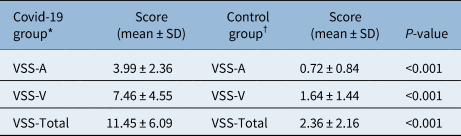
In addition, in the sub-scale evaluation, mean Vertigo Symptom Scale-Anxiety scores were found to be 3.99 ± 2.36 in the Covid-19 group and 0.72 ± 0.84 in the control group. On the other hand, mean Vertigo Symptom Scale-Vestibular scores were 7.46 ± 4.55 in the Covid-19 group and 1.64 ± 1.44 in the control group. In both evaluations, Vertigo Symptom Scale-Anxiety and Vertigo Symptom Scale-Vestibular scores were found to be significantly higher in the Covid-19 group (p < 0.001 and p < 0.001, respectively). Comparison of each group in terms of Vertigo Symptom Scale scores is given in Tables 2 and 3.
Vertigo Symptom Scale scores for Covid-19 and control groups and their statistical comparison

*n = 92; †n = 25. Covid-19 = coronavirus disease 2019; SD = standard deviation; VSS-A = Vertigo Symptom Scale-Anxiety; VSS-V = Vertigo Symptom Scale-Vestibular
Vertigo Symptom Scale scores for Covid-19 in- and out-patient groups and their statistical comparison

*n = 26; †n = 66. Covid-19 = coronavirus disease 2019; SD = standard deviation; VSS-A = Vertigo Symptom Scale-Anxiety; VSS-V = Vertigo Symptom Scale-Vestibular
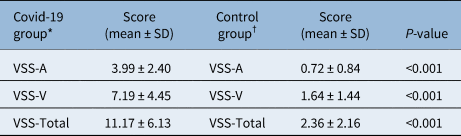
Because the prevalence of hypertension was significantly higher in the Covid-19 group and because of the possibility of hypertension mimicking vestibular symptoms, statistical comparison was repeated after excluding patients with co-morbid conditions for a more reliable assessment. In this evaluation, the mean Vertigo Symptom Scale-Total score was 11.17 ± 6.13 in the Covid-19 group and 2.36 ± 2.16 in the control group, and this difference was found to be significantly higher (p < 0.001).
When the Covid-19 group was examined within itself, the mean Vertigo Symptom Scale-Total score was 12.35 ± 5.16 for the in-patient group and 10.75 ± 6.44 for the out-patient group, and there was no significant difference between the in-patient and out-patient groups (p = 0.133). In addition, in the sub-scale evaluation, mean Vertigo Symptom Scale-Anxiety scores were 3.99 ± 2.40 in the Covid-19 group and 0.72 ± 0.84 in the control group. On the other hand, mean Vertigo Symptom Scale-Vestibular scores were 7.19 ± 4.45 in the Covid-19 group and 1.64 ± 1.44 in the control group. In both evaluations, Vertigo Symptom Scale-Anxiety and Vertigo Symptom Scale-Vestibular scores were found to be significantly higher in the Covid-19 group (p < 0.001, p < 0.001, respectively). The comparison of each group after the elimination of co-morbid conditions in terms of Vertigo Symptom Scale scores is given in Tables 4 and 5. Statistically, Vertigo Symptom Scale-Anxiety scores were found to be significantly higher for the in-patient group (p = 0.025).
Vertigo Symptom Scale scores for Covid-19 and control groups and their statistical comparison, after the exclusion of patients with co-morbid conditions

*n = 75; †n = 25. Covid-19 = coronavirus disease 2019; SD = standard deviation; VSS-A = Vertigo Symptom Scale-Anxiety; VSS-V = Vertigo Symptom Scale-Vestibular
Vertigo Symptom Scale scores for Covid-19 in- and out-patient groups and their statistical comparison, after the exclusion of patients with co-morbid conditions

*n = 20; †n = 55. Covid-19 = coronavirus disease 2019; SD = standard deviation; VSS-A = Vertigo Symptom Scale-Anxiety; VSS-V = Vertigo Symptom Scale-Vestibular
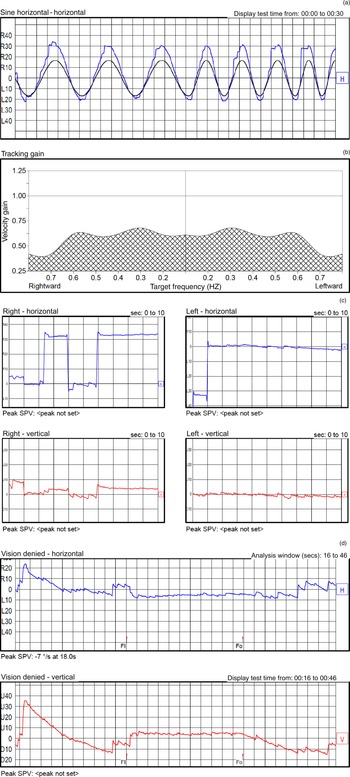
One of our hospitalised patients had complaints of nausea, vomiting and dizziness in addition to respiratory complaints. Besides the non-specific and mild respiratory complaints, hospitalisation was deemed appropriate because of the complaints of dizziness and vomiting that started within the first 2–3 days of the disease. In the videonystagmography evaluation, 7 degrees/second spontaneous nystagmus was detected in the right horizontal gaze, which was suppressed by fixation. In the tracking (smooth pursuit) test, tracking difficulty is observed because of spontaneous nystagmus. Because the patient was in the active period, no gains could be obtained in the tracking test. In the evaluation of right horizontal gaze, the amplitude of nystagmus decreased, and right horizontal nystagmus was observed. No nystagmus was observed in the left horizontal gaze evaluation. Examples from the patient's videonystagmographic examination are shown in Figure 1. The patient, whose neurological examination was normal, was started on in-patient treatment, with possible vestibular neuritis. In addition to the Covid-19 treatment, the patient was also followed up and treated for vestibular neuritis.
(a) In the tracking (smooth pursuit) test, tracking difficulty is observed because of spontaneous nystagmus. (b) Because the patient was in the active period, no gains could be obtained in the tracking test. (c) In the evaluation of right horizontal gaze, the amplitude of nystagmus decreased, and right horizontal nystagmus was observed. No nystagmus was observed in the left horizontal gaze evaluation. (d) Right horizontal spontaneous nystagmus measured at 70/second in the primary gaze is suppressed by fixation. H = horizontal; SPV = slow phase velocity; sec = second(s); FI = fixation starts; Fo = fixation ends; V = vertical

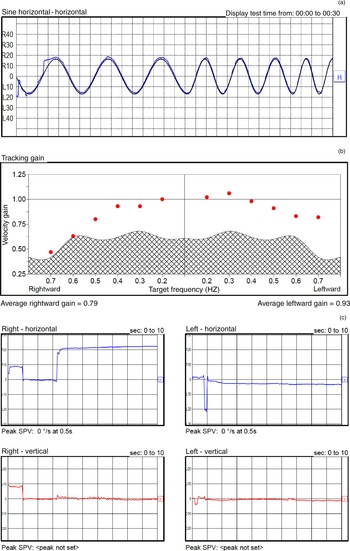
The patient was recovered completely at the end of seven days. After the patient's third month follow-up, the configurations on videonystagmographic examination seemed to have improved, and the gains in the tracking test were within normal limits. No nystagmus was observed in the right or left gaze in the horizontal gaze evaluation. Normal videonystagmography images of the patient are shown in Figure 2.
(a) After the patient's follow-up, the configurations seem to have improved in the tracking test. (b) After the patient's follow-up, the gains in the tracking test were within normal limits. (c) No nystagmus was observed in the right or left gaze in the horizontal gaze evaluation. H = horizontal; SPV = slow phase velocity; sec = second(s); FI = fixation starts; Fo = fixation ends; V = vertical

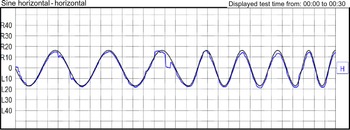
Videonystagmography was performed on a total of 28 of patients with a Vertigo Symptom Scale score of 15 and above. Of these patients, 11 of them were in the in-patient group and 17 of them were in the out-patient group. Except for the patient mentioned above, all videonystagmography tests performed were normal. Some examples of videonystagmography records considered as normal are shown in Figure 3.
Configurations obtained in tracking test for both eyes. H = horizontal

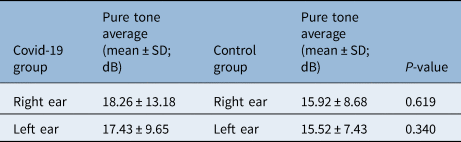
According to the audiometric examinations of the patients, the pure tone averages in the Covid-19 group were 18.26 ± 13.18 dB in the right ear and 17.43 ± 9.65 dB in the left ear. In the control group, pure tone averages were measured as 15.92 ± 8.68 dB in the right ear and 15.52 ± 7.43 dB in the left ear. There was no statistically significant difference between the groups (p = 0.619; p = 0.340). Data are summarised in Table 6.
Pure tone averages and statistical comparison according to groups

Covid-19 = coronavirus disease 2019
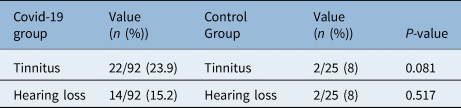
In addition to comparing the means, mild sensorineural hearing loss (SNHL) was detected in 2 of the patients (2 of 25; 8 per cent) in the control group, and mild or moderate SNHL hearing loss was detected in 14 of the patients (14 of 92; 15.2 per cent) in the Covid-19 group. Similarly, while 2 of the patients (2 of 25; 8 per cent) in the control group had subjective tinnitus, 22 of the patients (22 of 92 23.9 per cent) in the Covid-19 group had subjective tinnitus. However, these differences do not show a statistically significant difference (p = 0.517, p = 0.081). Data are summarised in Table 7.
Frequency of tinnitus and hearing loss and statistical comparison according to groups

Covid-19 = coronavirus disease 2019
Discussion
We can say that Covid-19 is full of surprises in many ways, such as the emergence process, clinical findings, treatment process and the economic difficulties it creates. Although a significant portion of patients survive the disease asymptomatically, respiratory system findings, such as shortness of breath, sore throat and cough are considered to be the major and most common findings of the disease.Reference Guan, Ni, Hu, Liang, Ou and He1,Reference Wang, Hu, Hu, Zhu, Liu and Zhang2 In addition to respiratory symptoms, clinical findings affecting different systems are also seen. It is seen as an important finding in the differential diagnosis of the disease all over the world with its serious smell and taste disorders with high specificity.Reference Agyeman, Chin, Landersdorfer, Liew and Ofori-Asenso3,Reference Rocke, Hopkins, Philpott and Kumar4 Audio-vestibular symptoms are also expressed less frequently by patients, and we think that they are ignored when they are alongside respiratory system symptoms.Reference Almufarrij, Uus and Munro6–Reference Jafari, Kolb and Mohajerani8 In the literature, nine studies were examined in the meta-analysis published by Jafari et al., and with the help of the analysis and evaluation of the data in these studies, the frequency of dizziness was found to be 12.2 per cent in Covid-19 patients.Reference Wang, Hu, Hu, Zhu, Liu and Zhang2,Reference Mao, Jin, Wang, Hu, Chen and He5,Reference Jafari, Kolb and Mohajerani8,Reference Viola, Ralli, Pisani, Malanga, Sculco and Messina16–Reference Özçelik Korkmaz, Eğilmez, Özçelik and Güven22 Although dizziness does not indicate a complete vertigo, different clinical conditions, such as disequilibrium, presyncope and light-headedness may also be included in this definition.Reference Gelfand23 Therefore, asking the patient whether they have dizziness or vertigo will lead to different results in different studies. In our study, we provided a more standardised and meaningful evaluation of symptoms by using the Vertigo Symptom Scale, whose validity and reliability were tested. In our study, both the Vertigo Symptom Scale-Anxiety and Vertigo Symptom Scale-Vestibular score were found to be significantly higher in the Covid-19 group compared with the control group.
The prevalence of co-morbid conditions, especially hypertension, was significantly higher in the Covid-19 group. The possibility of hypertension mimicking vestibular symptoms may affect Vertigo Symptom Scale score; because of this, the statistical comparison was repeated after excluding patients with co-morbid conditions for a more reliable assessment. After the elimination of co-morbid conditions, the comparison of each group shows similar results. The Covid-19 group has significantly higher Vertigo Symptom Scale-Anxiety, Vertigo Symptom Scale-Vestibular and Vertigo Symptom Scale-Total scores.
Another issue that needs to be evaluated is the existence of asymptomatic cases. Volunteers in the control group were questioned verbally on whether they had had Covid-19 before. However, there is always the possibility that they can present asymptomatically, and unfortunately this situation is not controlled by immunoglobulin testing.
Vestibular neuritis can be defined as a viral or post-viral inflammatory disease in which the vestibular part of the eighth nerve is affected. Resistant vertigo accompanied by nausea and vomiting is the most important finding and usually affects the 8th nerve solely, and other cranial nerves may be affected by viral inflammation.Reference Hegemann and Wenzel24 In the literature, some cases of vestibular neuritis triggered by Covid-19 have been reported.Reference Malayala and Raza25,Reference Mat, Noël, Loiselet, Tainmont, Chiesa-Estomba and Lechien26 In these cases, as in our patient, nausea or vomiting and severe vertigo complaints are at the forefront, and mild respiratory system symptoms are present. It was stated in the literature that one of these patients was a 13-year-old girl, and the other was a young adult, and they were discharged and recovered without any problems. Our patient was a 44-year-old adult and was discharged on the 7th day of his treatment without any problem. In the third month follow-up after discharge, the patient did not have any complaints, and the videonystagmography examination was evaluated as normal (shown in Figure 2). The normal videonystagmography findings of our patient at the third month suggest that the disease healed without sequelae and that this condition might be benign in nature. Detection of vestibular neuritis in only one patient may also be coincidental, considering the frequency of vestibular neuritis in the normal population. Therefore, although we do not defend the claim that Covid-19 and vestibular neuritis are linked, it will be beneficial for patient management to keep in mind that such a situation may occur.
Systemic steroids were used in the treatment of the patient, and clinical improvement was achieved. Although there were reservations about the use of steroids in the first period of the Covid-19 pandemic, they are now used in every patient with an indication for hospitalisation, and beneficial results are provided.Reference Sterne, Murthy, Diaz, Slutsky and Villar27,Reference Li, Yan, Gao, Ren and Yang28
At the same time, the videonystagmography test, which is normal in most of the patients, provides negative evidence that Covid-19 affects the vestibular system. This may be because of the inadequacies of videonystagmography testing in the evaluation of the peripheral vestibular system. For this reason, we think that it would be beneficial to add alternative tests, such as the caloric test, rotational chair test or Video Head Impulse Test in future studies.
Significantly higher Vertigo Symptom Scale scores and detection of vestibular neuritis in a patient with Covid-19 are considered as positive evidence suggesting that the vestibular system may be affected. On the other hand, normal videonystagmography findings were detected in most of the patients apart from one patient with vestibular neuritis and Covid-19, and this is considered as negative evidence for the vestibular system being affected.
In addition to the effect on the vestibular system, there are many studies in the literature about the relationship between Covid-19 and hearing loss,Reference Jafari, Kolb and Mohajerani8,Reference Viola, Ralli, Pisani, Malanga, Sculco and Messina16,Reference Özçelik Korkmaz, Eğilmez, Özçelik and Güven22,Reference Elibol29,Reference Freni, Meduri, Gazia, Nicastro, Galletti, Aragona, Galletti, Galletti and Galletti30 and many articles are presented in the form of case reports.Reference Degen, Lenarz and Willenborg31,Reference Karimi-Galougahi, Naeini, Raad, Mikaniki and Ghorbani32 Although Dror et al. Reference Dror, Kassis-Karayanni, Oved, Daoud, Eisenbach and Mizrachi33 could not detect a difference in the control group in terms of otoacoustic emissions and auditory brainstem response findings, there are also case reports or seriesReference Degen, Lenarz and Willenborg31,Reference Karimi-Galougahi, Naeini, Raad, Mikaniki and Ghorbani32,Reference Kılıc, Kalcioglu, Cag, Tuysuz, Pektas and Caskurlu34 showing the association of Covid-19 and SNHL in the literature. However, because of circumstances that reduce the level of evidence, such as the heterogeneity of the participants in the studies and the subjective collection of data, it is necessary to study and collect new evidence about the ototoxicity triggered by Covid-19. Also in our study, as a result of the audiometric evaluation, no significant difference was found in terms of pure tone averages between the Covid-19 group and the control group. In addition to pure tone audiometry, a more detailed assessment of hearing with otoacoustic emissions and/or auditory brainstem response may be more helpful in objectively assessing potential effects on the audio-vestibular system.
Another symptom that should not be forgotten in the examination of the audio-vestibular system is tinnitus. Subjective tinnitus can be defined as the patient's feeling of sound without an external focus. In the literature, the frequency of tinnitus is reported as 10–15 per cent in the normal adult population.Reference Jafari, Copps, Hole, Kolb and Mohajerani35,Reference Omidvar, Mahmoudian, Khabazkhoob, Ahadi and Jafari36 In our study, tinnitus was present in 22 of the patients (22 of 92, 23.9 per cent) in the Covid-19 group, and tinnitus was present in 2 of the patients (2 of 25, 8 per cent) in the control group. Although it seems to be slightly higher than the prevalence in the Covid-19 group, this difference does not show a statistically significant difference when it is compared with the control group (p = 0.081).
In our study, it can be clearly said that the vestibular symptom scores were found to be significantly higher in those patients who had Covid-19, and as a result, the vestibular system was affected, but ways in which the virus could affect this system and the possible pathophysiological mechanisms in the development of this situation still remain unclear.
• Severe acute respiratory syndrome coronavirus-2 (SARS-CoV-2) may be among the viral agents that affect the audio-vestibular system
• Vertigo Symptom Scale scores for both anxiety and vestibular symptoms were found to be significantly higher in the Coronavirus disease 2019 (Covid-19) group
• The vestibular system may also be affected in some Covid-19 patients
• With a decrease in mortality, Covid-19 sequelae, including those in the audio-vestibular system, will appear more frequently
• Videonystagmographic testing may have some inadequacies in the evaluation of the peripheral vestibular system
• It would be beneficial to add alternative tests such as the caloric test, rotational chair test or Video Head Impulse Test in future studies
The high inflammation situation triggered by Covid-19 causes an increase in reactive oxygen species and, indirectly, the release of more pro-inflammatory cytokines (interleukin (IL)-6, IL-1 and tumour necrosis factor-a), which turns into a vicious circle. This extreme inflammation picture is called a ‘cytokine storm’, and it is thought that the complications caused by the disease may be related to this situation. It is thought that excessive inflammation may cause direct dysfunction in the brain stem where the audio-vestibular pathways are located, and may cause cranial nerve paralysis, loss of consciousness and respiratory failure.Reference Benghanem, Mazeraud, Azabou, Chhor, Shinotsuka and Claassen37–Reference Masuda, Kanzaki, Minami, Kikuchi, Kanzaki and Sato39 It is known that SARS-CoV-2 spreads by a haematogeneous route as well as through inflammatory mechanisms. Severe acute respiratory syndrome coronavirus-2 can bind to tissues containing high amounts of angiotensin converting enzyme-2 receptors, such as vascular endothelium or haemoglobin and can penetrate into erythrocytes.Reference Hamming, Timens, Bulthuis, Lely, Navis and van Goor40,Reference Netland, Meyerholz, Moore, Cassell and Perlman41 With this mechanism, it is thought that the virus can spread haematogeneously and form thrombosis, and it can directly damage the regions where the auditory pathways, such as the brain or medulla oblongata, contain the angiotensin converting enzyme-2 receptor. In addition to these pathophysiological mechanisms for the complications and sequelae of Covid-19, another condition that should be kept in mind might be the possible ototoxicity of the antibiotic (azithromycin) or antiviral (favipiravir, remdesivir) treatments used.Reference Kakuda42,Reference Cianfrone, Pentangelo, Cianfrone, Mazzei, Turchetta and Orlando43 Although these conditions were not evaluated in our study, the same standard treatments were given for all of the patients, with minimisation of the drug effects, as much as possible. In addition, patients in need of intensive care were excluded from the study.
Conclusion
As a result, it should be kept in mind that the vestibular system may also be affected in some Covid-19 patients. Although this may be seen as dizziness in some patients, it may rarely cause severe issues, such as vestibular neuritis, in some patients. It is obvious that we will encounter sequelae more frequently in patients who recover with the decrease in the mortality of Covid-19, and we think that physicians dealing with Covid-19 patients should also consider the vestibular system in the treatment and follow-up of patients. Multi-centre studies with larger patient groups will be useful in demonstrating the frequency and recovery processes of these audio-vestibular sequelae.
Competing interests
None declared
Appendix 1. Turkish version of the VSS

VSS = Vertigo Symptom Scale