This article examines a prominent but little discussed central organ of the Chinese Communist Party (CCP), the Central Discipline Inspection Commission (CDIC). Very little systematic work on Party disciplinary bodies exists in China, and little is known about their function, operation and role in leadership politics. A more accurate understanding of the CCP internal control system and its key apparatuses, and a more critical evaluation of their role in Party politics is necessary. This article analyses how the CCP exerts its control over the disciplinary organizations and argues that their lack of autonomy creates problems which hinder the effectiveness of the disciplinary organizations and their efforts to root out corruption. Several studies have already gone some way to point out that it is the Party's dominant role in the affairs of the CDIC that prevents it from being able to exercise autonomy in its supervision of Party members and officials.Footnote 1 This research attempts to provide a detailed and comprehensive investigation into the disciplinary agencies' history, function, organizational structure, internal mechanisms and modes of operation, and maintains that these are the crucial factors behind their lack of autonomy.
This article is organized as follows. It begins by sketching out the historical evolution of the CCP disciplinary organizations and their efforts to reinforce the Party's control and combat corruption, taking into account the agencies' successes, shortcomings and political constraints. It then goes on to analyse the operating principles and mechanisms of the Party disciplinary organizations, including the regulations used to enforce internal supervision, the procedures used in handling cases, the steps required to open a case, the strategies employed to monitor Party organizations and their leadership members, and the tactics used to expose corrupt officials. This section focuses on the organizational structure, functions and general operation of the CDIC and its local branches. The third section of this article examines the mechanism and dynamics of internal supervision and control that are dominated by the Party through powerful Party committees and the dual leadership of Party disciplinary organizations and host Party committees. This study's analysis differs from most of the scholarship on the weaknesses and failings of the CCP's disciplinary organizations in that it appraises the practical usefulness of a set of measures used to reform the CDIC and its local branches. Lastly, the article evaluates the politics of disciplinary sanctions and concludes that structural, institutional and cultural factors hinder the effectiveness of the CCP's disciplinary agencies and their efforts to control Party members and officials, and combat corruption.
Historical Evolution and Organizations
When the PRC was founded in 1949, the CCP was sensitive to the fact that its very survival depended on it maintaining its revolutionary spirit. The establishment of the Central Discipline Inspection Commission in November 1949 was intended to “better carry out the Party's political programs and concrete policies, protect Party and state secrets, purify the Party organization and strengthen discipline, maintain close ties with the masses, eliminate bureaucracy, and ensure proper implementation of all the Party's resolutions.”Footnote 2 A compelling distinction between the newly-established CDIC and the pre-PRC Party disciplinary organizations, such as the Central Commission for Supervision, the Central Commission for Examination, and the Central Party Affairs Commission, was that the CDIC was entrusted with the additional responsibility of “enforcing internal disciplinary education,” an important initiative that imposed the Party's ideological control and guidance on its members.Footnote 3 Institutionally, the CDIC was subordinate to the Politburo leadership, while its local branches were commanded by local Party organizations.Footnote 4 Thus, after the establishment of the PRC, the new regime's disciplinary agencies were neither independent nor free from the political influence of Party committees on any level. In March 1955, the CDIC was renamed the Central Commission for Supervision (Zhongyang jiancha weiyuanhui 中央监察委员会) (CCS) as both its power and size increased following the purges of Gao Gang 高岗 and Rao Shushi 饶漱石.
During the Mao era, despite their bureaucratic rigidities, inefficiencies and irrationalities, the Party's disciplinary agencies such as the CDIC and the CCS were charged with supervising Party members and officials, and controlling corruption. The containment of corruption in government agencies and economic institutions was mainly achieved through political campaigns such as the “three-antis” and “five-antis” movements rather than by the institutionalization of the disciplinary organizations. Intra-party discipline and the absolute obedience of the individual to the Party were maintained by frequent campaign-style rectifications, which kept cadres on a tight leash and lead to a remarkably “clean” government, despite the relatively poor institutionalization of the disciplinary agencies. Under Mao's leadership, “mass supervision” was the central mechanism used by the regime to mobilize ordinary citizens to monitor and criticize Party cadres and root out corruption. While mass supervision largely took the form of political campaigns guided by important Party organizations such as the Organization Department and Propaganda Department, it also operated through large-scale mass participation controlled by the Party's disciplinary agencies. For instance, the establishment of “letters and visits offices” was intended not only to mobilize citizens to be directly involved in monitoring officials, but also to bring mass supervision into the orbit of Party control. The CDIC set the rules dealing with mass complaints based on the degree of seriousness of the case. If cases involved general Party cadres, the CDIC forwarded them to the local discipline inspection commissions (DICs) where the complainants or offenders were employed. The CDIC itself dealt with cases involving high-ranking officials and serious disciplinary violations. It decided whether the cases needed to be sent to the Politburo for approval or to other Party organizations such as the Organization Department for handling.Footnote 5 The CDIC and the CCS were not created to check the CCP Central Committee, but rather to function as a subordinate department of the CCP Central Committee like the Organization Department or the Propaganda Department. The CDIC and CCS functioned as “assistants” to the Politburo. They implemented the Party leadership's directives on the supervision and control of Party members and mobilized the population to conduct “mass supervisions” to monitor Party cadres.
The Cultural Revolution was, to a certain extent, Mao's attempt to encourage a mass movement to attack bureaucratism and use the masses to supervise and control Party members and cadres. This was partially in response to Mao's dissatisfaction with the ineffectiveness of the Party's internal disciplinary mechanisms. During the Cultural Revolution, the CCS was targeted by radical Maoists and was attacked by the Red Guards and mass rebels. The death of Mao Zedong and the subsequent arrest of the Gang of Four in 1976 signified the end of the Cultural Revolution and the return of the Party bureaucracy's dominance, as well as the re-establishment of the Party disciplinary system. The large-scale purges of Maoist radicals and ringleaders of the Cultural Revolution were not conducted through a mass movement or the criminal justice system, but rather through the inner Party disciplinary system. The CCP revised its constitution in 1977 to reinstate discipline inspection committees; a year later the Central Committee re-established the CDIC with the powerful CCP veteran, Chen Yun 陈云, as its first secretary.Footnote 6 The importance of the CDIC was institutionally reinforced by a stipulation that the CDIC chief must be a member of the Politburo Standing Committee, a sign that the CDIC would be expected to play a significant role in Party politics (none of the CDIC chiefs in the past had been ranked as high as a Politburo Standing Committee member).Footnote 7 CCP leadership at the time, dominated by veteran leaders, expected the CDIC to fulfil three main objectives: conduct the purges against the Maoist radicals and Lin Biao's 林彪 followers, rehabilitate veteran cadres, and rectify Party conduct – in other words, proceed with enforcing Party discipline.Footnote 8
The CDIC was expanded greatly in the mid-1980s, to 15 bureaus/offices and 785 personnel. Between 1983 and 1987, the CDIC replaced all its ad hoc inspection teams with 21 government departments and agencies.Footnote 9 At the same time, the CDIC's power increased and its role in influencing leadership decision making became evident. In addition to discipline inspection and supervision, the CDIC also sent personnel to conduct social investigations that assisted the Party leadership's decision making regarding disciplinary education and anti-corruption policies. For example, in 1984 it sent a research team to investigate the social problems, the ideological confusion and moral degradation among government officials following the market-oriented reforms adopted in Guangdong and Shenzhen.Footnote 10
However, in 1987 the CDIC suffered a significant setback at the 13th Party Congress. With the backing of Deng Xiaoping 邓小平, the new Party chief, Zhao Ziyang 赵紫阳, initiated a series of reforms to encourage rapid economic growth, decentralize economic decision making, reform the price system, and free rural markets and farmers to grow the crops they wished. Along with these reforms, Zhao Ziyang argued that the CDIC “should not be involved in any cases related to the legal (faji 法纪) and administrative (zhengji 政纪) violations of its members, but rather should only focus on Party discipline and assisting Party committees to improve the Party's work style.”Footnote 11 Following Zhao's dictates and supported by Deng Xiaoping, the CDIC's leadership role over government legal organizations (such as the Ministry of Public Security, the Supreme People's Procuratorate and the Supreme People's Court) and administrative supervision agencies (such as the Ministry of Supervision) was rescinded. Zhao outlined a new vision of rapid economic, yet cautious political, reform, including separation of Party and state, separation of the legislative and executive branches, the promotion of the public supervision of government officials, and the abolishment of Party core groups (dangzu 党组) in most government departments. As a result, 49 discipline inspection groups in central Party organs and government departments – more than 75 per cent of all discipline inspection groups at that time – were abolished. Additionally, the CDIC chief was no longer given a seat on the Politburo Standing Committee.Footnote 12 Hence, it is likely that the reform launched by Zhao Ziyang was an attempt to give the supervision agencies and judiciary and legal system more autonomy in an effort to promote a limited separation of power and “rule of law.”
The 1989 Tiananmen incident signified an important shift away from Zhao Ziyang's cautious political reforms to promote inner-Party democracy and the checks and balances to prevent the return of unchallengeable Party dominance and control. In addition to the remaining 14 inspection groups, further CDIC inspection groups were dispatched to 16 central Party organs and government departments. By February 1993, 27 discipline and inspection teams in the central Party organs and government departments and 20 CDIC-dispatched ad hoc inspection teams resumed operation.Footnote 13 Moreover, the CDIC played a vanguard role in disciplining Party and government officials who were involved in the 1989 protests.Footnote 14
The increased powers given to the CDIC implied that the CCP would not only lead the initiatives against discipline violations and corruption itself (rather than rely on the legal system), but would also handle corruption investigations directly. This indicated that the CDIC played an increasingly important role in leadership politics and that the Party had continually relied on the CDIC to ensure its one-party rule over Chinese society. China's weak legal system had rendered legislative supervision ineffectual, and so political supervision that enforced Party discipline and developed a good Party style turned out to be a more powerful means of restraining bureaucratic behaviour.Footnote 15 Strict rules were imposed to discipline Party and government officials, including the “five forbiddens” which decreed that cadres were not allowed to (1) operate a business, (2) work in an economic entity, (3) trade in stocks, (4) accept gifts, or (5) use public funds for lavish entertainment.Footnote 16 From 1992 to 2009, China brought disciplinary sanctions against approximately 2 million personnel, 70 per cent of whom were officials.Footnote 17 Between July 2003 and December 2008, the CDIC had tried and closed 852,000 cases, resulting in 881,000 officials receiving disciplinary sanctions.Footnote 18 In the years 2009, 2010, 2011, 2012 and 2013, the CDIC imposed approximately 106,626, 146,517, 142,893, 160,718 and 182,000 disciplinary sanctions against Party members and officials.Footnote 19
The Operating Principles and Mechanisms of Disciplinary Organs
Since Deng Xiaoping launched the economic reform, the CDIC and its local DICs at different levels have played a crucial role in educating Party members about their duties to observe Party discipline, to promote the Party spirit and a good work style, and to monitor and punish corruption, abuses of power and other wrongdoings committed by Party officials. The post-Mao Party constitution gives the CDIC and the DICs priority over the judiciary branch in examining and dealing with Party members involved in criminal activities. They have become the Party's internal organ for rooting out corruption, which has been endemic in the Party throughout the post-Mao era. DIC leaders at various levels are responsible for the supervision and inspection of those under their authority; inspections are carried out within the system, both in government departments of the State Council and local Party and government organizations. The Party leadership expects the CDIC and the DICs to improve on their own abilities to enforce policies within Party ranks and intensify punishment against those who severely violate the Party's discipline and regulations.
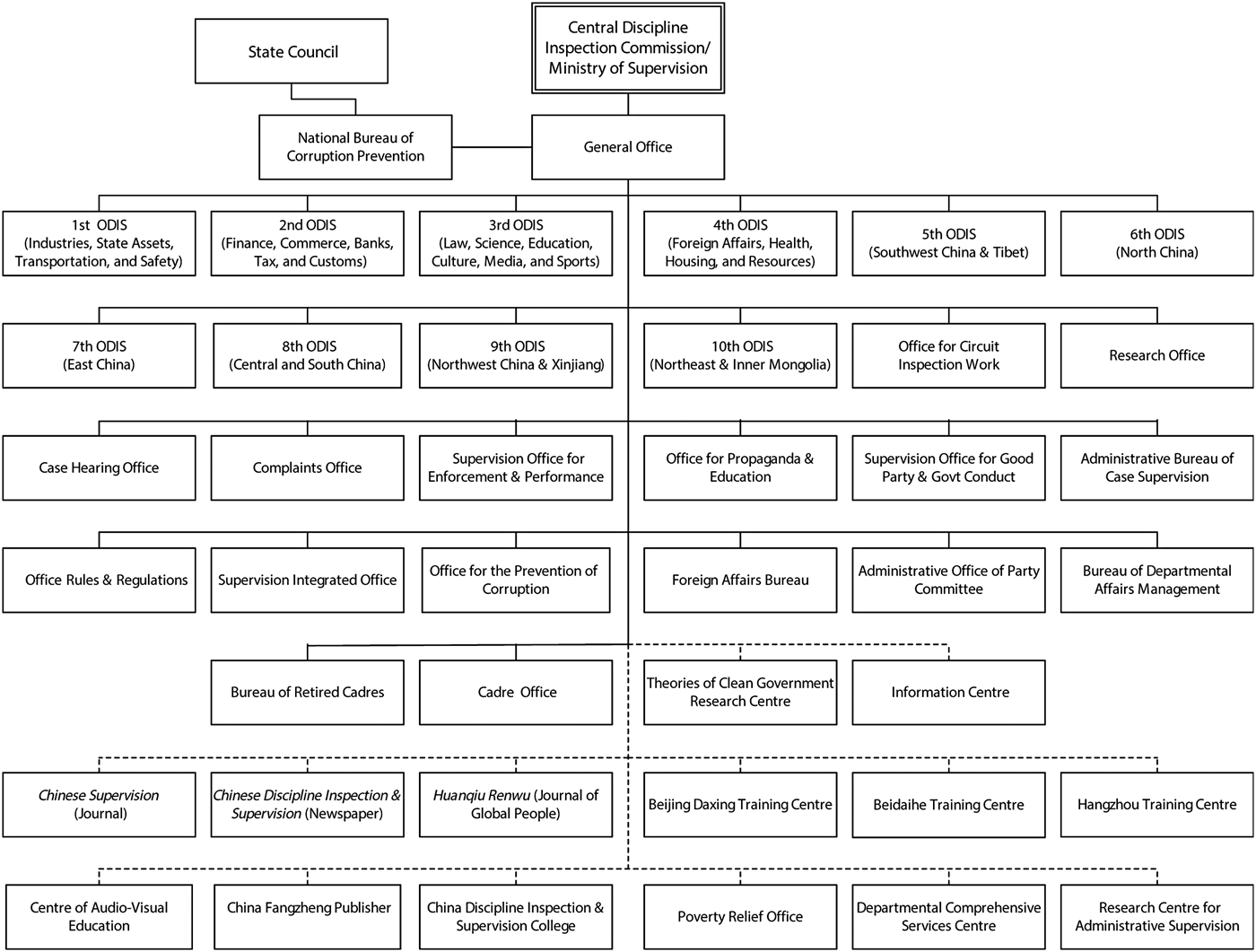
Since the Ministry of Supervision was merged with the CDIC in 1993, the CDIC has grown to encompass 27 internal departments and bureaus with more than 1,000 employees (Figure 1).Footnote 20 These offices and bureaus include ten offices for discipline inspection and supervision (ODIS), the Case Hearing Office and the Office for Circuit Inspection Work (which commands the circuit inspection teams), which together form the most important units of the CDIC. The ten ODIS are responsible for investigating unlawful acts and breaches of Party discipline; four of them (First Office, Second Office, Third Office and Fourth Office) are in charge of cases involving officials at vice-minister level and above. The other six are responsible for cases involving officials at the levels of provincial governor, vice-governor, chair and vice-chair of provincial standing committees of the National People's Congress, chair and vice-chair of provincial Political Consultative Conferences, city mayors and deputies. Each of the ten ODIS is then divided by its ministry type or geographical region.Footnote 21
The Organization Structure of the CDIC

In its current form, the CDIC has a much more institutionalized procedure for handling cases than it had in Mao's era and knowing this procedure is instrumental to understanding the inner workings of the CDIC. The process begins with receiving cases, which can come to the CDIC through various channels. The majority of cases come via the CDIC Complaints Office. The way that the complaints are funnelled through is based on a petitioning system for reporting acts of official wrongdoings and corruption that harks back to imperial times. It is possible that the Complaints Office's filtration system is also borrowed from the imperial system; however, most of the forwarded cases are ignored. Other cases come through the judicial or legislative bodies, such as the Supreme People's Court, Supreme People's Procuratorate, National People's Congress or the Chinese People's Political Consultative Conference.Footnote 22 Cases are even forwarded on by members of the Party leadership. In addition, cases can come via the increasingly popular online anti-corruption efforts of the many internet users who post comments, suggestions, exposures and human-powered searches. Another important channel through which the CDIC receives cases is the Office for Circuit Inspection Work, which sends inspection teams to observe and check on local Party and government officials. Since its establishment in 2003, this office and its circuit inspection teams have become prominent watchdogs in the CCP's fight against corruption, and have pushed for disciplinary inspections to have greater scope and depth. For example, Hou Wujie 候武杰 (deputy Party secretary of Shanxi) and Chen Liangyu 陈良宇 (Shanghai Party secretary) were found guilty on corruption charges after the CDIC circuit inspection teams conducted routine disciplinary inspections in Shanxi and Shanghai.Footnote 23
Having a variety of channels for complaints has given rise to the phenomenon of the same complaint being filed via more than one channel, which increases the possibility that the case is considered. For example, Li Huiren 李惠仁, former director of the Third ODIS and director of the Case Hearing Office (anjian shenli shi 案件审理室), has recounted how one case he was in charge of was sent to all leadership members and departmental directors of the ministry where the accuser was employed, several offices in the CDIC, Jiang Zemin 江泽民, Li Peng 李鹏, Zhu Rongji 朱镕基 and Wei Jianxing 尉健行.Footnote 24
Overall, the case handling procedure is made up of eight steps: preliminary evidence and complaint management, preliminary confirmation of disciplinary violations, approval for opening the case, investigation and evidence collection, case hearing, implementation of disciplinary sanctions, appeal by the disciplined official, and continued supervision and management of the case.Footnote 25 First, after a case is received, the complaint must be followed up with a confirmation of the disciplinary violation, after which the CDIC must accept it formally. The process varies according to the government or Party ranking of the accused. Before any case related to officials at or above the level of vice-minister or deputy governor is investigated, it must first be approved by the CDIC Standing Committee. The CDIC's historical lack of independence from the Party leadership continues to dominate the operating principle and philosophy of the Party's disciplinary organizations. For example, the CDIC Standing Committee must first report to the Politburo Standing Committee for approval to investigate certain cases.Footnote 26 Generally, the acceptance of a case involving officials at the deputy provincial or vice-minister level must have the approval of all members of the Politburo Standing Committee. For example, a case involving a chief provincial leader must be approved by the Politburo (Figure 2).Footnote 27 If a case involves a member of the Politburo Standing Committee, the decision to investigate that individual must come from the consensus of the incumbent and retired Party and state leaders, and veteran leaders, such as Xi Jinping 习近平, Jiang Zemin, Hu Jintao 胡锦涛, Li Keqiang 李克强, Li Peng, Wen Jiabao 温家宝, Zhu Rongji and Zeng Qinghong 曾庆红, who still maintain a powerful influence over the Party leadership.
The Process of Case Establishment, Investigation and Decision Making on Disciplinary Action
Once a case is approved, the charged official is put under “double restraint” (shuanggui 双规), which means that the accused is confined for questioning at a stipulated time and in a stipulated place under CDIC supervision, without judicial involvement or oversight. According to the official media, this policy, which gives the CDIC priority over the judiciary when investigating the criminal acts of Party officials, facilitates the gathering of evidence because high-ranking leaders are often protected by a strong guanxi 关系 network which would bear influence if the case was investigated in an open legal process.Footnote 28 Ting Gong has observed that the guanxi network in post-Mao economic reform has contributed to “collective corruption” whereby Party and government officials tie themselves to local businesses for illegal gains and provide “protective umbrellas” to shield unscrupulous businessmen.Footnote 29 Connie Meaney has pointed out that those with official connections or “a plethora of networks protected by cadres and bureaucrats, acting in secret” “could benefit from disparities in prices, inside information, and access to goods.”Footnote 30
Cadres under investigation are subjected to an off-site detention (yidi jiya 异地羁押) to prevent the interference of “local protectionism” and “factionalism” and the influence of the cadre's guanxi network and “renqing [人情] network.”Footnote 31 The confined cadre is watched by CDIC officials called “accompanying protectors” (peihu renyuan 陪护人员) to prevent him/her from committing suicide. The suicide watch is maintained 24 hours a day, with three shifts per day; each shift has six to nine CDIC officials on duty at one time. Under the shuanggui system, corporal punishment is forbidden and the defendant in question is treated well with meals and healthcare provided. Most importantly, the accused is still regarded as a comrade until the violations are proved.
Despite the absence of physical torture, the psychological pressure on a confined official is tremendous. First, the official understands that the CDIC has some evidence of the crime, although he/she is not sure how much evidence the CDIC has exactly. Second, whilst under shuanggui, the confined official is temporarily removed from his/her post and loses his/her authority. Meanwhile, involved parties or victims are asked to cooperate with the CDIC to provide evidence. At the same time, being isolated renders the confined official helpless to protect or exert influence on others involved in the case; this gives the CDIC the opportunity to gain the evidence it needs relatively easy. Being unable to interfere with the investigation or organize resistance to the CDIC's investigation, the accused official will ultimately cooperate and admit his/her guilt. Third, once an official under shuanggui, there is a battle of wills with the CDIC officials to prove that he/she is not guilty of the stated crimes. The shuanggui policy leaves the confined official at a disadvantage when it comes to defending him/herself as he/she is unable to access information. While the CDIC officers are free to gather information as the investigation proceeds, the confined cadre is helpless. Defendants usually just wait for the punishment, because they know there is little else they can do: all of their outside contacts are likely to abandon them and they are unaware of the extent of the CDIC's knowledge of the alleged wrongdoings or crimes. Experienced CDIC officers “can use this advantage to target the defendant's weaknesses by planning, collecting evidence, understanding the defendant's political considerations, and psychological pressure.”Footnote 32 The Party plays a decisive role in determining the fate of an accused official by virtue of the fact that the accused official is not allowed to hire any legal representation, and the outcome of the investigation is arbitrarily decided by the CDIC and DICs without any judicial involvement or oversight. Owing to their lack of autonomy, the CDIC and DICs have to make decisions based on the Party directive to serve the political needs of the Party.
Although torture is not permitted during shuanggui, as Flora Sapio points out, it “can easily occur because all basic procedural guarantees are removed as soon as shuanggui begins.” However, torture “clearly becomes ineffective in uncovering actual crimes” if “allegations of discipline violations or criminal behaviour are based on evidence obtained through torture.”Footnote 33 Thus, the draconian treatment of officials under shuanggui can make it difficult for a case to get started and to be resolved successfully, and to dissuade detainees from protecting their criminal associates. The opportunities to gather further information or evidence that may help to solve other cases are also restricted once the decision to put an official under shuanggui is made.Footnote 34 Moreover, torture is inflicted by the psychological pressure exerted on detainees, as their freedom and rights to be defended by an attorney are taken away under shuanggui. The lack of clear standards and the absence of institutionalized checks and balances on the CDIC and the DICs makes the shuanggui process arbitrary,Footnote 35 particularly in local DICs where officials are poorly trained, as demonstrated by cases in Huangmei 黄梅 in Hubei, Wenzhou 温州 in Zhejiang, and Sanmenxia 三门峡 in Henan.Footnote 36
The Mechanism and Dynamics of Internal Supervision and Control
Since its establishment, the PRC has confronted many impediments to Party and government supervision, many of which can be ascribed to the nature of the unilateral authority imposed by the Communist Party and its manifestation of “socialism with Chinese characteristics.” A leading priority for the Party has been to crack down on the corruption that has become the focus of public discontent. Despite the CCP's efforts to centralize an increasing number of its regulatory bureaucracies up to the provincial level, a term defined by Andrew Mertha as “soft centralization,” to incapacitate “local protectionism” and establish standardization in regard to policy implementation and enforcement, “the institutional cleavages and fragmentation that so often give rise to corruption and other pathologies of the state appear to have shifted from horizontal, geographic lines to vertical, functional ones.”Footnote 37 The Party's ineffectual corruption control, according to Manion, engenders a less stringent punishment for officials than it does for ordinary citizens, and also contributes to inadequate approaches based on patterns of intensive campaigns as anti-corruption enforcement.Footnote 38 The intensive anti-corruption campaigns, instead of anti-corruption policy, have proved to be ineffective at suppressing corruption despite the Party-state's repeated efforts.Footnote 39 China's anti-corruption institutional framework was designed under the undisputable authority of the CCP, and the lack of an independent anti-corruption body combined with weak legal and regulatory systems constitute the major factors behind the rampant corruption in China.
Party committees have traditionally remained a powerful influence on the Party's disciplinary bodies. When the Party's DICs at county level and above were established in December 1978, their members were elected by local Party congresses and were subordinate to their offices' corresponding Party committee only, and not to the upper-level DICs. Following the 12th Party Congress in September 1982, the Party constitution stipulated that the Party's DICs would be subject to dual leadership by the host Party committees and by the upper-level discipline inspection organs. This dual leadership has been a vital component of China's governing structure in which central government agencies and bodies at different sub-national levels of government are linked by a complex pattern of vertical (tiao 条) and horizontal (kuai 块) lines of authority. Since the PRC was established, the system has been highly centralized; however, its administrative duties have been shared with local governments. Although the CCP remains as the highly-centralized political power at the top, it delegates administrative power to the lower levels to stimulate the initiative of localities. The complex relationships between the vertical and horizontal bodies played an important role in the frequent changes of centralization and decentralization prior to the Cultural Revolution.
The economic reform launched by Deng was initiated through the introduction of administrative decentralization which was implemented through the separation of government from state-owned enterprises.Footnote 40 Deng's decentralization programmes were intended to reform the rigid centralized system of the Maoist era and remedy the over-concentration of economic and managerial power, which could be detrimental to good governance.Footnote 41 One of the most important measures of the reform programme was to shift some of the authority over local Party cadres from the centre to local Party committees.Footnote 42 Thus, decentralization in the post-Mao reforms enhanced the ability of the kuai-kuai authorities in the regions to resist central directives.Footnote 43 The tiao-kuai system prevented local officials from being accountable only to their superiors, which could increase the danger of despotism and bureaucratic government insensitivity to local conditions. As the tiao-kuai structure provided for a degree of local autonomy and compelled local officials to respond to local conditions, needs and interests (for better or worse), the Party's discipline and control system, which also followed the tiao-kuai structure, allowed local Party committees to exercise main leadership over local DICs at the same level.Footnote 44 Against the background of decentralization, as the official media admitted, the dual leadership in the internal supervision of the DIC system actually gave the horizontal local authorities precedence over vertical, upper-level DIC authorities.Footnote 45
At the 12th Party Congress in September 1982, a significant change took place in the disciplinary inspection system when the CCP decided that the CDIC could station its inspection teams in ministries and departments, if needed.Footnote 46 Despite these efforts by the CCP to reduce the influence of host Party committees on Party discipline inspection organs, they continued to be subjugated to the Party committees they were intended to supervise, thus they lacked efficacy as law-enforcement agencies. Not only were Party discipline inspection commissions part of the local Party organizational apparatuses, but they were also subject to the will of local Party leaders, because local leaders could easily influence the appointment of key members of the Party discipline inspection commissions. It is no surprise then that the Party discipline inspection commissions became even more ineffective without the approval, support, and cooperation of local Party committees and their leaders.Footnote 47 In addition, although the 1983 regulation stipulated that DIC officials should report directly to the next higher-level Party committee or to the next higher-level DIC officials with evidence or suspicions about the malfeasance of Party committee members at their host offices, in practice DIC officials, as fellow colleagues of the Party committee members, rarely launched cases against them. Many DIC officials might still have an understanding of their duties, and might not hesitate to admonish delinquent Party committee members in person, but they were unwilling to establish any cases against their colleagues “officially” if they received evidence of a violation. It was rare for a DIC official to investigate possible wrongdoings of a leading figure in his/her host Party committee unless directed to do so by higher authorities.Footnote 48
Before 2004, the dual leadership of the CDIC/Ministry of Supervision (MOS) and the host Party committees proved to be more advantageous for the latter in influencing local branches of the CDIC/MOS. In fact, even after the 1983 regulation was put into effect, the supervisory organs still played a very marginal role in limiting administrative misbehaviour owing to their lack of independence and authority to monitor the government agencies.Footnote 49 Similarly, because DIC agents placed in governmental departments were also under the dual leadership of the CDIC/MOS and the agents' host government agencies, the host agencies always had greater influence over the agents' behaviour by virtue of their control over appointments and other resources.Footnote 50 The fact that local DIC organs came under the dual leadership of higher-level DIC organs and host Party committees had been long criticized for the lack of real supervision and checks on power of their host Party committees. Realizing the powerful influence of the Party or government agencies on local DIC officials, in the early 1990s the CDIC began dispatching its own officials to be stationed in local Party and government organizations. This change allowed the CDIC to control its personnel directly and supervise local government and Party agencies. While the provincial-level or ministry-level DIC was required to report corruption cases involving managerial-level Party members to the central-level CDIC, it was answerable to the Party secretary at the same level for its personnel management, including recruitment and promotion of staff members.
There were many incentives for local DIC officials to develop a “close and intimate” relationship with the leaders of host Party organizations: the leaders paid the DIC officials' salaries, determined their housing and other benefits during their stay, and even determined their benefits after they retired. As a result, oftentimes local DIC officials became lobbyists and defenders of the officials whom they were assigned to supervise. Official media has pointed out that, “[DIC officers] speak on behalf of their host organizations and bargain for the host organizations' interests.”Footnote 51 More importantly, dual leadership made launching and processing a case against Party officials in the host organizations difficult. When local DICs found some evidence of foul play, they usually reported their findings and suspicions to the host Party committees. When this happened, it was common for the host organizations to deter the DIC officials or even ask them not to open the case for the sake of “protecting” the cadre in question and “maintaining stability” in the department. Knowing that their standing in the department could be in jeopardy, DIC officials often acquiesced to the will of the organizations. In this way, corrupted officials continually circumvented DIC investigations and escaped political and legal ramifications.Footnote 52 Moreover, sometimes the DIC officials became integrated into the system of the host organizations and were even assigned to certain responsibilities within the host organizations. In such cases, DIC personnel became executive members instead of impartial inspectors of the organizations they were assigned to supervise.Footnote 53 This institutional flaw caused by the dual leadership was detrimental to the overall effectiveness of corruption control.
In April 2004, the system of dual leadership of local DICs came to an end. The DIC units stationed within host Party organizations at the provincial level or the ministerial level now only come under a vertical chain of command from CDIC headquarters in Beijing. Not only does this help the DICs enforce supervision work, but it is also a signal from the leadership that any institutional ties between the DIC units and the host Party organs and government departments must be severed. Additionally, local DICs are able to initiate and conduct investigations of members of the corresponding Party committees without authorization from the host Party committees' leaders.Footnote 54 Most importantly, this change guarantees the absolute vertical control of the CDIC over their local officials by monopolizing the institutional enforcement, training, education, examinations, benefits and promotion of local DIC officials. By enhancing the power of upper-level DICs to appoint and promote lower-level DIC officials, the CCP leadership ensures that the authority of local DIC organizations would not be constrained by host Party committees. CDIC inspection teams no longer inform the leaders of the host Party organizations about plans to open cases, investigation, evidence collection, case development, or investigation results.Footnote 55 Undoubtedly, this policy is intended to enforce supervision over the host Party organizations and to weaken their influence over the disciplinary organs.
However, it is extremely difficult for the CDIC and its local branches to conduct independent investigations and mount a case without the cooperation and support of local Party committees or leaders who are “too powerful to be supervised.”Footnote 56 Although the Party constitution stipulates that “a DIC organ can conduct an initial investigation itself if it finds a leadership member of the host Party committee violates Party discipline,” in reality, this is almost impossible because the DIC organ is unable to corroborate evidence and conduct an effective investigation in the organization when the host Party leaders are still in charge. According to the official media, some DIC “officers have the jitters and others dread having to supervise if the supervised objects are the leading figures of their host Party organizations, and they feel powerless when they are assigned to investigate the disciplinary violations conducted by ordinary Party cadres because local Party committees are those who make the decisive decisions for the cases, not local DICs.”Footnote 57 Thus, the dominance of local Party committees and the DICs' lack of independence contribute to the ineffectiveness of the disciplinary organizations.
The Practical Usefulness of the Internal Control Mechanism
Although the CDIC's lack of autonomy has been a serious hindrance to its efforts to crack down on corruption, its practical usefulness in containing the strength and scope of the endemic abuse of power by Party and government officials during the period of China's rapid economic growth should not be underestimated. Since its re-emergence in 1978, the CDIC, along with its local DICs, has been an important deterrent against the abuses of power committed by Party and government officials. Between the 16th Party Congress in 2002 and the 17th Party Congress in 2007, the CDIC filed 677,924 cases against corrupt Party members and government officials, and 518,484 cadres received disciplinary or criminal punishment.Footnote 58 Corrupt officials live in constant fear that CDIC or DIC investigators will call them to attend a meeting, order them to confess, or seize their personal property and calculate its value. According to official media, the one thing that officials feared the most was an invitation to “chat” or “drink tea” with DIC agents.Footnote 59
The CDIC circuit inspection teams, including ad hoc inspection teams sent to localities and upper-level DIC ad hoc inspection teams sent to lower-level Party organizations or government agencies, have played a significant role in strengthening the vertical control within the DIC system and remedying the weaknesses inherent in inspectors supervising Party leaders at the same levels as themselves.Footnote 60 The number of CDIC circuit inspection teams has increased from five in 2003 to 12 in 2013, and in June 2010, the PLA also became subject to such oversight.Footnote 61 Since Xi Jinping took over as Party chief, the role of the CDIC ad hoc inspection teams has been strengthened and enhanced in terms of their scope, intensity, and frequency of their inspections.Footnote 62 Although the inspection teams have some limitations, including “vague institutional positions, incrementally declining effects as time goes by, vulnerability to patron-clientelism or guanxi network at the grassroots level, and the dilemma of ‘open’ or ‘undercover’ investigation',”Footnote 63 they conduct both regular and targeted inspections of Party organizations at all levels of government. The CDIC also acts as a “tribunal of justice” (from the local officials' perspective) and exonerates innocent officials after the CDIC and DICs receive public tip-offs.Footnote 64 More importantly, the CDIC is there to bolster and oversee the DICs' supervision and control over localities to remedy the problems created by local leaders attempting to exert influence over not only the Party organizations but also the local DICs.
The CDIC and DICs have become increasingly important to the regime in responding to the zealous public participation in anti-corruption action, including the growing popularity of online whistleblowing. With half a billion internet users, China's most popular microblogging site, Weibo, has become a force to be reckoned with, and has assumed the role of corruption watchdog, exposing abuses of power.Footnote 65 The Xi-Li administration's attempts to make the CDIC and DICs more independent from the local power structure and to step up the war on corruption not only help to assuage public anger and frustration, but also facilitate Xi's campaign aimed at “hitting both ‘tigers’ and ‘houseflies’,”Footnote 66 meaning targeting both the Party leaders at different levels and the lower-ranking officials at the Party's grassroots who abuse their power and hurt the interests of the masses. From 2008 to 2012, the CDIC and Ministry of Supervision received more than 300,000 online public tip-offs, which was 12 per cent of total public tip-offs received during that time.Footnote 67
Today, the regime's war on corruption encounters strong resistance from various vested interest groups, including the new rich and politically powerful who are benefiting on a massive scale from China's rapid economic development and who are mostly to blame for the unfair distribution of social wealth and the tension it creates between the authorities and the population. Since Deng Xiaoping launched China's economic reform, China's elite have pursued wealth and political influence through trading power for monetary or non-monetary resources, such as inside information, career advancement, sexual favours, and guanxi. The pattern of the corruption of China's new elite has now evolved into exchanging power for power in which the vested interest groups cooperate with one another to secure or enhance their political influence or even aim for a monopoly of political power. This trade is also related to guanxi networking, in which some offer their absolute loyalty to others in exchange for protection and career growth. High-ranking leaders, especially top leaders such as Xi Jinping and Li Keqiang, were awarded their positions based on the compromise and bargaining of the political factions and vested interest groups. None of the post-Deng leaders has been capable of changing this structure and pattern in which the competing vested interest groups and political factions seek compromise and accommodation through various forms of power-sharing and benefit-sharing arrangements. Deng's legacy of power-sharing based on the balance of interests at the senior level has continued to be the dominant principle behind the stability of the CCP leadership. While Deng established a mandatory retirement age for all veteran cadres in order to make room for the new third generation leaders, he also ensured that the veterans would keep their political and economic benefits after their retirement – “their political status remains and economic benefits should be better than they were during their tenure.”Footnote 68 The CCP leadership has allowed not only the retired veteran leaders to maintain their influence over the top leadership by becoming “advisors,” but also the children of incumbent and retired top Party officials, called “princelings,” to use their guanxi and government clout to build business empires. The “princelings” in charge of the state-owned enterprises have access to huge cash flows, broad patronage systems and significant international networks; furthermore, they have a broad say in economic policy and even in setting the policy agenda from the outset.Footnote 69 Initiating an anti-corruption campaign against incumbent or retired senior cadres, their spouses and relatives, or the princelings is not only difficult but also risky for any leader since the effort might undermine the stability of the CCP leadership. The CDIC is certainly expected to play a crucial role in curbing the behaviour of China's elite while maintaining the stability of the CCP leadership under the existing system.
The Politics of Disciplinary Sanctions
The economic reform and open-door policy have made tremendous changes to the political and ideological climate for government officials and CCP members.Footnote 70 The transition from a centrally planned to a market-oriented economy has not only loosened Party control over Chinese society but has also generated the typical “politically oriented capitalism” that “involved the state's granting privileged opportunities for profit.”Footnote 71 Owing to the overwhelming emphasis on economic performance, anti-corruption cases are often initiated only when the local economy is in trouble. As corruption is perceived as the inevitable price of economic dynamism during the transition period, the fight against corruption is often a fundamentally symbolic issue; the public does not react as long as the dilution of costs is minor in comparison to the benefits of economic growth.Footnote 72
Melanie Manion has observed that the enforcement of anti-corruption measures has been highly selective.Footnote 73 According to her research, while 95 per cent of investigated cases of non-cadres were prosecuted between the late 1980s and the mid-1990s, only 57 per cent of investigated cases of cadre corruption were prosecuted.Footnote 74 Fan and Grossman point out that authorities are selectively tolerant of corruption as a method of compensation to enhance the control of the Party hierarchy over Party members and local officials.Footnote 75 Susan Shirk argues that upper-level authorities offer “lack of exposure” as special treatment to the corrupt officials who, in exchange, gratefully give their political support.Footnote 76 While those corrupt officials who are easily replaced or whose behaviour fails to correspond with the perceived values of the leadership are likely to be the victims of crackdowns on corruption, local corrupt officials who have generated more income for their regions and who have put in a good economic performance are unlikely to be punished.Footnote 77
Local corrupt officials may easily avoid becoming the targets of DIC investigations, especially when corruption in some localities serves as an incentive to support economic reform and development; this may promote profit-seeking collusion between local officials and entrepreneurs.Footnote 78 In fact, corruption is one of the unintended by-products of China's policy of economic reform,Footnote 79 which has created new opportunities and incentives for all kinds of everyday and serious corruption. Manion has identified the many patterns of corruption in “bureaucratic commerce, predatory exactions, corrupt exchanges, use of public funds as private capital, and illegal privatization of state enterprise assets.”Footnote 80 In some places, the local economy indirectly benefits from local businesses supporting corrupt officials who need “achievements” (zhengji 政绩) in order to stay in their positions of power. The exchange of interests between local businesses and corrupt officials is encouraged by both sides in order to establish long-term relationships, and is referred to as the “industrial organization” of corruption by Andrei Schleifer and Robert Vishny.Footnote 81 Corruption in this pattern becomes increasingly “organized,” and in some instances “monopolized,” when corrupt officials aim to secure a long-term income stream rather than simply maximize short-term extractions.Footnote 82 While corruption from 1980 to the early 1990s was chiefly limited to the venal behaviour of individuals, it gradually developed from individual acts into an organized pattern of behaviour from the mid-1990s onwards, and developed into systematic corruption after 1997.Footnote 83 In addition, the nature of corruption in China is a low-risk, high-yield game for many cadres, a term described by William Chan as “systemic corruption.”Footnote 84 Similar to some other Asian countries, political corruption in China has been characterized as systematic and structural, with the puzzling coexistence of corruption and economic growth.Footnote 85 Wedeman has observed that the cost of corruption during the 1990s “was less than the gains from growth, with the result that corruption was feeding off the margin rather than consuming the lion's share of gains from growth.”Footnote 86 Ultimately, as long as local officials showed a decent amount of economic growth, there was little incentive for the CCP leaders to target corrupt local officials. Without a doubt, this structural problem undermines the effectiveness of the Party's efforts to combat corruption.
A leading factor behind the DICs targeting an official is the public resentment caused by corruption. As Wedeman points out, the CCP did not seriously implement any anti-corruption measures during the initial period of economic reform until anger about corruption helped to trigger massive anti-government demonstrations in the spring of 1989.Footnote 87 In addition, campaigns against corruption are sometimes triggered by intra-Party power struggles and used as a weapon to attack political rivals.Footnote 88 Thus, crackdowns on corruption are used by the central authorities not just to appease the discontented public, but also to eliminate certain political rivals and rather than being initiated with the sole aim of tackling malfeasance, they have often been used as a means to achieve certain political purposes and as a way to solve intra-Party power struggles and conflict. Susan Shirk has observed that the issue of official corruption “has emerged as a potent weapon in leadership competition in the post-Mao era,” as demonstrated by Li Peng's offensive against Zhao Ziyang during 1988–1989. According to Li, it was Zhao's mismanagement of the economy that caused inflation, corruption and the drop in grain production during Zhao's tenure as premier.Footnote 89 Thus, “the effort to strengthen ‘democratic centralism,’ the campaign against corruption, and the power struggle among the leadership [came] together”Footnote 90 in an effort to oust Zhao, as was also witnessed in the cases of Chen Xitong 陈希同, Zhou Yongkang 周永康, Zeng Qinghong and Bo Xilai 薄熙来.Footnote 91
Politics continues to interfere in DIC cases even after they are accepted, affecting the ways in which discipline and supervision play out in reality. Not all cases that qualify for consideration are forwarded. Some cases are simple in that it is easy to identify whether a cadre has violated Party discipline and organizational norms, and what punishment should be given. But, even in those cases, personal connections play an important role, particularly when they involve high-ranking leaders. According to Li Huiren, not only is it harder to proceed with cases if they involve high-ranking leaders, but also if they are large in terms of scale and influence. Regardless of whether the cases are processed by a low-level or high-level DIC organization, they often remain unresolved and no action is taken, even after resolutions for punishment have been made. In the latter case, sanctions are often delayed and considered to be “pending.”Footnote 92 In some places, according to some official media, there is still a “lack of supervision and the efforts against the corrupt cadre are a formality,” even though DIC organizations have been installed and DIC officials have been dispatched.Footnote 93
Four factors have played a crucial role in making these cases difficult to process. First, despite the CCP's efforts to reduce the role of the Party in governmental administration and to increase governmental institutionalization since economic reform, the rule of law in the PRC is still uncertain. Although many regulations have been passed to strengthen the disciplinary supervision of Party cadres, these regulations still have many gaps and vague expressions, creating loopholes that can be easily exploited.Footnote 94 In addition, China's legal and justice system is still highly influenced by the concept of “rule by the people” (renzhi 人治) instead of “rule of law,” thus the laws, and their application, are constantly changing. Second, Chinese values purport that “[criminal] punishment should not be meted out to senior officials.”Footnote 95 This deeply held traditional idea, according to Li Huiren, still “influences the Party and government officials and even the population.”Footnote 96 Current rules and regulations used to discipline Party and government officials are limited to officials at the minister or provincial level: there are no established rules and regulations applicable to top Party and government leaders (at the levels of Politburo and above).Footnote 97
The guanxi network is the third factor that plays an important role in the processing of cases. All the multi-faceted aspects of guanxi afford a high degree of protection against vigorous enforcement efforts. In the Chinese bureaucracy, the supremacy of networks is so pervasive that guanxi has become an institutionalized form of social interaction whereby cadres can do as they please with relative impunity. Many business leaders in state-owned enterprises are given their positions after being transferred from local Party committees. These transfers are often used by the upper-level Party committees to compensate lower-level officials who have not been promoted to higher positions within the Party.Footnote 98 Thus, the exchange of favours between local Party leaders and businesses has profoundly influenced local politics. Although the CDIC and Ministry of Supervision dispatch their officers to supervise local Party and government leaders, these leaders overly interfere in the operation of local DIC units and wield a huge influence over the decision-making of local DIC officers. Realizing the power of guanxi networks in local politics to protect corrupt officials, the CDIC has increasingly taken investigations and supervision into its own hands.Footnote 99 When DIC officers conduct investigations or reach a verdict for cases of disciplinary violations, they often encounter interference, particularly in cases involving high-ranking leaders.Footnote 100 Thus, when CDIC officers deliver a verdict with a penal recommendation to the Politburo, they have to prepare several different proposals based on varying degrees of punishment. They understand that if they do not prepare several options their recommendations may be disregarded owing to the tremendous pressure the Politburo faces from the guanxi network and other outside interference (for example, senior veterans who intervene in cases and put pressure on the Politburo members).Footnote 101 Thus, the prevalence of the political and social guanxi network reduces the effectiveness of anti-corruption initiatives.
The fourth factor affecting cases and the severity of punishments has been public opinion. Some cases, such as those involving fake medicines, food tampering and environmental pollution, draw more public attention than others, and so there is more pressure for the regime to process these cases. The CDIC and the DICs have to give up other cases in order to concentrate on such high public profile cases which might otherwise trigger public outrage and “mass incidents.”
Structurally, institutionally and culturally, it can be difficult to close and pass sentence on a case. Even if a case is followed through to a verdict, a defendant who is found guilty can still appeal. Thus, one of the CDIC's principal tasks is to re-evaluate cases where the defendant has made an appeal on the grounds of unjust conviction or treatment. The proper procedure is for convicted officials to register their appeals with the CDIC or local DICs.Footnote 102 However, in reality, many cases are processed only after high-ranking leaders intervene by forwarding appeal letters to the CDIC. There are at least three reasons why leaders intervene. First, a large number of appeals are sent to the CDIC every day and the high volume far exceeds the CDIC's handling capacity.Footnote 103 Second, to re-evaluate an appealed case, the CDIC needs the cooperation and support of the local Party organization to which the convicted cadre is subordinate. Often, the involved Party organization or government agency refuses to cooperate with the CDIC and might even resist investigation and re-evaluations.Footnote 104 This demonstrates the importance of the rank of the leaders who push to rehabilitate a convicted official, and the prestige, seniority and reputation of the plaintiffs in influencing case re-evaluation proceedings and even the judgment of a case. Thus, the power dynamics involved in the establishment of the cases, the punishments of the convicted officials, and the rehabilitation of the wronged officials do play an important role in the politics of the CDIC.
Conclusion
The CCP has attempted to establish mechanisms that check corruption and abuses of power within its own political system. These mechanisms include reforms of institutional and legal frameworks, increasing transparency in the police service, public housing and other sectors of the civil service, and the implementation of a blame-taking and resignation system for leading cadres in the Party and government. Relying on its strong internal control that withstands domestic social instability and opposition, the CCP is able to stick to its course of CCP-favoured political reform. The CCP continually rejects the methods ingrained in liberal democracy of separation of power and checks and balances, and the Party's internal control structure has impeded the institutionalization of a depoliticized legal system. Instead, it strives to promote internal supervision and a mechanism of checks and balances within the system. However, the structural, institutional and cultural problems embedded in the system, such as the deeply-rooted guanxi culture and structural flaws, combine to overpower these efforts. China's disciplinary and corruption control system is hindered by its lack of autonomy, despite the fact that the CDIC and its local branches have played a crucial role in cracking down on corruption and punishing abuses of power at a time when China is making a difficult transition and facing formidable challenges, such as the monetization and the redefinition of the public sphere, the transition of control mechanisms, the emergence of non-state actors and the new regulatory role of the state.Footnote 105
While the CCP's determination to fight corruption is sincere (and not merely strategic) and the anti-corruption reform is the endeavour of a comparatively strong state with great capacity,Footnote 106 anti-corruption efforts against senior Party leaders, even convicted high-ranking leaders, is highly politicized owing to concerns about upsetting the existing balance of the power structure. The CCP is reluctant to move towards a depoliticized legal system for its high-ranking leaders. Thus, the CDIC often has to help some Party seniors escape from disciplinary punishment or criminal justice in order to maintain the stability of the leadership. Targeting a high-ranking leader often risks upsetting the balance of vested interest groups and political factions, and thus can undermine the balance of the existing structure. This goes some way to explain why selective sanctions and punishments have been a prominent feature in CCP politics. However, Xi Jinping and the CDIC chief Wang Qishan 王歧山, despite their inability to make big changes to the existing structure, have attempted to enhance the power of the CDIC and its local branches, and to increase the scope of supervision by the media and public opinion, especially through the online anti-corruption campaigns. Together, these efforts put pressure on the elite to rein in their own behaviour and target unscrupulous offenders through public channels while carefully maintaining the status quo required by the system.
The extent and scope of corruption in China have increased dramatically, and different opportunities for corruption have opened up as China's economic activities become increasingly complex. The CCP has been under growing pressure to ensure that its anti-corruption strategy relies on rule-making and law enforcement rather than on campaign-style rectification or an internal disciplinary mechanism. In accordance with an anti-corruption system based on rule of law, the CDIC should be limited to a supervisory role and the use of shuanggui should be restricted and eventually abolished. The Party anti-corruption experts have suggested that the CCP must compromise with the vested interest groups to reach a viable solution to ensure, at least, that they do not hinder China's efforts to introduce institutionalized anti-corruption measures (zhidu fanfu 制度反腐). One approach the CCP could take is to grant conditional amnesty to offenders as long as they return their corrupt gains to the government.Footnote 107 This enables the officials to support an institutionalized approach to combating corruption and prevents them from transferring money abroad and resisting the reform. Another approach worth considering would be to set up special zones to pilot political reform in order to select new officials and publish their household assets so that the establishment of an institutionalized anti-corruption system becomes possible.Footnote 108