Introduction
Executive functions (EF), which are a set of higher-order cognitive-control processes that regulate one's thoughts and actions in order to achieve a goal (Miyake, Friedman, Emerson, Witzki, Howerter & Wager, Reference Miyake, Friedman, Emerson, Witzki, Howerter and Wager2000), have been shown to be vital aspects of cognitive aging that determine older adults’ quality of life (Oh & Yang, Reference Oh and Yang2021; Toh, Yang & Hartanto, Reference Toh, Yang and Hartanto2019). Because significant declines in EF occur with age due to structural and functional changes in the brain (Fjell, Sneve, Grydeland, Storsve & Walhovd, Reference Fjell, Sneve, Grydeland, Storsve and Walhovd2017; Rhodes & Kelley, Reference Rhodes and Kelley2005), modifiable psychological factors such as physical exercise or cognitive training have been suggested to buffer against age-related decline in EF in healthy older adults (for a review, Mowszowski, Lampit, Walton & Naismith, Reference Mowszowski, Lampit, Walton and Naismith2016; Xiong, Ye, Wang & Zheng, Reference Xiong, Ye, Wang and Zheng2021). Notably, lifelong bilingualism has received substantial attention as a potential contributing factor to executive functioning, since it implicates long-term training of cognitive control imposed by the concurrent management of two language systems (for a review, see Bialystok, Reference Bialystok2017). In line with this, previous studies have demonstrated that bilingualism serves to protect against age-related cognitive decline (e.g., Bialystok, Craik & Luk, Reference Bialystok, Craik and Luk2008; Incera & McLennan, Reference Incera and McLennan2018) and is associated with enhanced structural and functional connectivity of white matter in the brain (Luk, Bialystok, Craik & Grady, Reference Luk, Bialystok, Craik and Grady2011). Further, bilingualism has been shown to delay the onset of dementia (e.g., Bialystok, Craik & Freedman, Reference Bialystok, Craik and Freedman2007; cf. Yeung, John, Menec & Tyas, Reference Yeung, John, Menec and Tyas2014) and symptoms of Alzheimer's disease (Anderson, Hawrylewicz & Grundy, Reference Anderson, Hawrylewicz and Grundy2020), both of which are characterised by marked deficits in executive functioning.
It is premature, however, to draw a firm conclusion about the link between bilingualism and EF in older adults for the following reasons. First, a paucity of research has examined the relation between bilingualism and EF in older adults; the majority of bilingualism studies has predominantly focused on either children or younger or middle-aged adults (for a review, see Gunnerud, ten Braak, Reikerås, Donolato & Melby-Lervåg, Reference Gunnerud, ten Braak, Reikerås, Donolato and Melby-Lervåg2020; Lehtonen, Soveri, Laine, Järvenpää, De Bruin & Antfolk, Reference Lehtonen, Soveri, Laine, Järvenpää, De Bruin and Antfolk2018). Second, due to a lack of theoretical, conceptual, and operational clarity surrounding the conceptualisation of bilingualism in the literature, relatively less attention has been given to disparate bilingual experiences such as the interactional contexts of daily language use. To further our understanding, therefore, we aimed to elucidate and more precisely estimate the relation between bilinguals’ interactional contexts of daily language use and different aspects of EF in older bilingual adults. To this end, we drew on the adaptive control hypothesis (Green & Abutalebi, Reference Green and Abutalebi2013) as our theoretical framework.
Bilingualism and EF
A large volume of research has examined the association between bilingualism and different aspects of EF, which comprise inhibitory control (the ability to suppress prepotent or goal-irrelevant stimuli), updating (the ability to monitor and manipulate content), and shifting (the ability to switch flexibly between different task sets; Miyake et al., Reference Miyake, Friedman, Emerson, Witzki, Howerter and Wager2000). Consistent with the language-independent activation hypothesis (Colomé, Reference Colomé2001), previous research has established that both language systems are jointly activated at all times for bilinguals, even in contexts that involve only one language (e.g., Jared & Kroll, Reference Jared and Kroll2001; Marian & Spivey, Reference Marian and Spivey2003; Thierry & Wu, Reference Thierry and Wu2007). Accordingly, it is postulated that the activation of two language systems imposes greater demands on inhibitory control to ensure successful language production and comprehension while inhibiting interference from the nontarget language (Abutalebi & Green, Reference Abutalebi and Green2008). Thus, considering that lifelong bilingual experiences demand, and likely reinforce, inhibitory control to resist intrusions from an irrelevant language, previous studies suggest that bilingual advantages in inhibitory control may be especially noticeable in older adults, given the presence of age-related cognitive decline (Ansaldo, Ghazi-Saidi & Adrover-Roig, Reference Ansaldo, Ghazi-Saidi and Adrover-Roig2015). In favour of this notion, older bilingual adults have been shown to outperform their monolingual counterparts on a range of nonverbal inhibitory control measures such as the flanker and Stroop tasks (e.g., Bialystok & Craik, Reference Bialystok and Craik2010; Bialystok, Craik, Klein & Viswanathan, Reference Bialystok, Craik, Klein and Viswanathan2004; Bialystok, Martin & Viswanathan, Reference Bialystok, Martin and Viswanathan2005; Salvatierra & Rosselli, Reference Salvatierra and Rosselli2010). On the other hand, other studies have failed to replicate such findings and detected no significant differences between lifelong bilingual seniors and their monolingual peers in terms of inhibitory control on the Stroop (Antón, García, Carreiras & Duñabeitia, Reference Antón, García, Carreiras and Duñabeitiai2016; Kousaie & Phillips, Reference Kousaie and Phillips2012) and Simon tasks (Kirk, Fiala, Scott-Brown & Kempe, Reference Kirk, Fiala, Scott-Brown and Kempe2014; Papageorgiou, Bright, Periche Tomas & Filippi, Reference Papageorgiou, Bright, Periche Tomas and Filippi2019). Therefore, the question of whether older bilingual adults exhibit advantages in inhibitory control remains unclear and requires further research.
Further, given that bilinguals’ routine practice of language switching functionally overlaps with the shifting (switching) aspect of EF, prior studies based on young adults suggest that bilinguals’ language switching may facilitate nonverbal shifting abilities (i.e., smaller switch costs; Prior & MacWhinney, Reference Prior and MacWhinney2010; Yang, Hartanto & Yang, Reference Yang, Hartanto and Yang2018). In studies of older adults, however, inconsistent evidence has been reported concerning shifting-specific bilingual advantages. Several studies have found that older bilingual adults have better shifting abilities than their monolingual counterparts in cued letter-number (López Zunini, Morrison, Kousaie & Taler, Reference Zunini, Morrison, Kousaie and Taler2019) and color-shape task-switching paradigms (Gold, Kim, Johnson, Kryscio & Smith, Reference Gold, Kim, Johnson, Kryscio and Smith2013; Houtzager, Lowie, Sprenger & De Bot, Reference Houtzager, Lowie, Sprenger and De Bot2015). In support of this evidence, neuroimaging studies indicate that bilinguals’ language switching and nonverbal domain-general shifting share a significant degree of neural overlap (Anderson, Chung-Fat-Yim, Bellana, Luk & Bialystok, Reference Anderson, Chung-Fat-Yim, Bellana, Luk and Bialystok2018). In contrast, however, De Bruin, Bak, and Della Sala (Reference De Bruin, Bak and Della Sala2015) observed no differences in switching between matched bilingual and monolingual older adults in an established task-switching paradigm (Prior & MacWhinney, Reference Prior and MacWhinney2010) when baseline differences were controlled for. Moreover, Ramos, Fernández García, Antón, Casaponsa, and Duñabeitia (Reference Ramos, Fernández García, Antón, Casaponsa and Duñabeitia2017) demonstrated that the acquisition of a second language (L2) in monolingual older adults did not facilitate switching abilities, relative to baseline, as indexed by the color-shape paradigm. As such, further investigation is needed to determine the dimensions of bilingualism, such as interactional contexts, that can better explain potential differences in shifting abilities among older adults (see Yang, Hartanto & Yang, Reference Yang, Hartanto and Yang2016b, for a review).
To be able to manage two language systems, bilinguals’ updating (i.e., working memory) abilities may be exercised and strengthened to continuously monitor and update mental representations of different language systems based on situational or task demands (Dong & Li, Reference Dong and Li2015). Although relatively less research has examined this relation, several studies have demonstrated that bilinguals outperform their monolingual counterparts on Stroop-span, backward digit span, or visuospatial-span tasks that manipulate working memory demands (Bialystok, Poarch, Luo & Craik, Reference Bialystok, Poarch, Luo and Craik2014; Macnamara & Conway, Reference Macnamara and Conway2014; Yang & Yang, Reference Yang and Yang2017), with larger effects found in older than younger adults, particularly in nonverbal working memory capacity (i.e., the recent-probe task; Bialystok et al., Reference Bialystok, Poarch, Luo and Craik2014). However, these studies underscore various extraneous factors, such as task features (e.g., verbal or nonverbal task demands) and the age of participants, that modulate bilingual advantages in updating. On the other hand, Papageorgiou et al. (Reference Papageorgiou, Bright, Periche Tomas and Filippi2019) found no evidence in favor of bilingual advantages in updating in older adults. Thus more research is warranted to clearly delineate the relation between bilingualism and the updating aspects of EF in older adults.
A possible reason for these mixed findings may be the lack of a fine-grained approach that elucidates the relation between disparate bilingual experiences and specific aspects of EF in older adults. Whereas recent studies have sought to account for diverse bilingual experiences (Beatty-Martínez, Navarro-Torres, Dussias, Bajo, Guzzardo Tamargo & Kroll, Reference Beatty-Martínez, Navarro-Torres, Dussias, Bajo, Guzzardo Tamargo and Kroll2020; Hartanto & Yang, Reference Hartanto and Yang2016, Reference Hartanto and Yang2020; Kałamała, Szewczyk, Chuderski, Senderecka & Wodniecka, Reference Kałamała, Szewczyk, Chuderski, Senderecka and Wodniecka2020) rather than treating bilingualism as a homogeneous variable, operationalising and delineating bilingualism as it manifests in varied linguistic environments has continued to be difficult (Sulpizio, Del Maschio, Del Mauro, Fedeli & Abutalebi, Reference Sulpizio, Del Maschio, Del Mauro, Fedeli and Abutalebi2020; Yang, Hartanto & Yang, Reference Yang, Hartanto and Yang2016a). For instance, bilinguals who share the same first (L1) and second (L2) languages and similar bilingual profiles (e.g., age of acquisition, language dominance, or proficiency) may still differ in their daily interactional contexts (i.e., how bilinguals use two languages in their linguistic environments), which have been suggested to yield different EF outcomes in young adults (e.g., Beatty-Martínez et al., Reference Beatty-Martínez, Navarro-Torres, Dussias, Bajo, Guzzardo Tamargo and Kroll2020; de Bruin, Reference de Bruin2019; Hartanto & Yang, Reference Hartanto and Yang2016, 2020; Verreyt, Woumans, Vandelanotte, Szmalec & Duyck, Reference Verreyt, Woumans, Vandelanotte, Szmalec and Duyck2016). Therefore, more fine-grained operationalisations of bilingualism based on bilingual interactional contexts could shed light on the broader cognitive implications of bilingualism for EF in older adults.
Bilingual interactional contexts and EF
The adaptive control hypothesis serves as a useful theoretical framework by providing new insights into bilingual interactional contexts (Green & Abutalebi, Reference Green and Abutalebi2013; for a revised model, see Green & Wei, Reference Green and Wei2014). According to the theory, bilinguals differ in the primary type of interactional contexts (recurring patterns of everyday conversational exchanges) they engage in: (a) a single-language context, (b) a dual-language context, and (c) a dense code-switching context. Within a single-language context, bilinguals speak one language in one setting and another language in another setting (e.g., English at work and Chinese at home). This naturally results in infrequent language switching. Within both dual-language and dense code-switching contexts, however, bilinguals routinely speak two languages in the same context (e.g., speaking both English and Chinese at work). Further distinction can be made according to the pattern of bilinguals’ language use. Dual-language context bilinguals predominantly switch languages across sentences (with different interlocutors), while dense code-switching-context bilinguals switch languages freely within a single utterance.
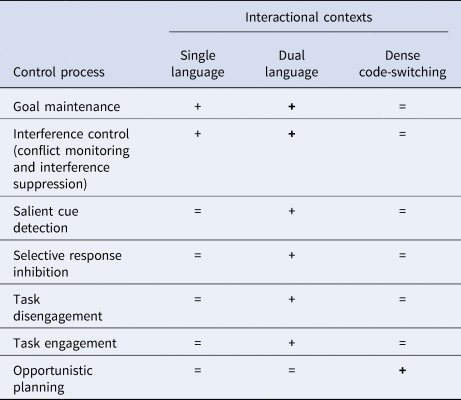
The adaptive control hypothesis (Green & Abutalebi, Reference Green and Abutalebi2013) posits that bilinguals’ interactional contexts of conversational exchanges impose differential cognitive demands on language control and thereby result in different cognitive-control outcomes, especially the inhibitory control and shifting aspects of EF; however, the theory is silent regarding updating (see Table 1). Specifically, the theory predicts that bilinguals in a dual-language context, compared with monolinguals, would experience greater demands on (a) interference control and salient cue detection (i.e., inhibitory control) and (b) task engagement and disengagement (i.e., shifting), because they are required to detect relevant linguistic cues and constantly inhibit interference from the nontarget language (by constraining its grammar and syntax) while switching between different languages in response to different interlocutors.
Language Control Processes as a Function of Each Interactional Context, per the Adaptive Control Hypothesis

Note. “+” indicates that the interactional context places greater demand on the control processes compared with a monolingual context. This is more so for the “+” symbol in bold type. “=” indicates that the interactional context is neutral in its effects (i.e., demand on the control process is similar to that in a monolingual context).
Consistent with these theoretical predictions regarding task engagement and disengagement, Hartanto and Yang (Reference Hartanto and Yang2016) found that dual-language context bilinguals, relative to their single-language-context counterparts, did better in shifting as assessed by a color-shape-switching task. Using a more rigorous latent variable approach, Hartanto and Yang (Reference Hartanto and Yang2019) replicated this finding in young adults. Similarly, Hofweber, Marinis, and Treffers-Daller (Reference Hofweber, Marinis and Treffers-Daller2020) found that dual-language-context bilinguals had inhibitory advantages over monolinguals. However, inconsistent findings have also been reported. For instance, Kałamała et al. (Reference Kałamała, Szewczyk, Chuderski, Senderecka and Wodniecka2020) tested older bilingual adults and found that the intensity of the dual-language context did not predict the latent factor of response inhibition (i.e., inhibitory control). Although these mixed findings may be due to different operationalisations of bilingual interactional contexts across studies, it is possible that the advantages of bilinguals’ interactional contexts may be limited to certain aspects of EF (e.g., shifting) and manifest differently in older adults. Given that no study to date has systematically examined the association between aging bilinguals’ unique linguistic contexts and cognitive control outcomes, more research is needed. It is vital, therefore, that we investigate the complex interplay between older bilingual adults’ three interactional contexts (single-language, dual-language, and dense code-switching contexts) with (a) each facet of EF (inhibitory control, shifting, and updating) and (b) their composite EF scores as an overall index of EF.
The present study
We hypothesised that bilinguals’ dual-language context, compared with the single-language or dense code-switching context, would positively predict inhibitory control and shifting. Although the adaptive control hypothesis is silent on the relation between bilingual interactional contexts and updating, previous studies have demonstrated the absence of a significant association (Hartanto & Yang, Reference Hartanto and Yang2019). Thus, we hypothesised that interactional contexts would not predict updating. Further, given that a multidimensional structure of EF may not be clearly apparent in older adults due to age-related dedifferentiation (Adrover-Roig, Sesé, Barceló & Palmer, Reference Adrover-Roig, Sesé, Barceló and Palmer2012; Hull, Martin, Beier, Lane & Hamilton, Reference Hull, Martin, Beier, Lane and Hamilton2008; Khoo & Yang, Reference Khoo and Yang2020), we also examined the relation of older bilingual adults’ interactional context to overall EF, as indexed by the composite score of all EF components.
In addition, previous studies on older bilingual adults have often omitted essential covariates, such as nonverbal intelligence and nonlinguistic factors (e.g., health status and education level) that have been shown to be critical for EF (Hartanto & Yang, Reference Hartanto and Yang2019). Thus, we sought to control for potential confounds – nonverbal intelligence, health condition, language proficiency, and demographic variables such as age, education level, marital status, employment status, and socioeconomic status – while examining the predictive relations of specific bilingual interactional contexts and EF in older bilingual adults.
Method
Participants
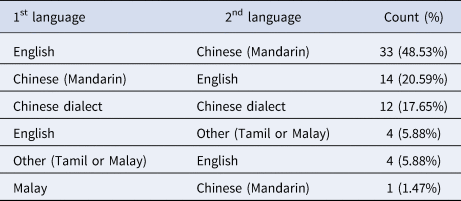
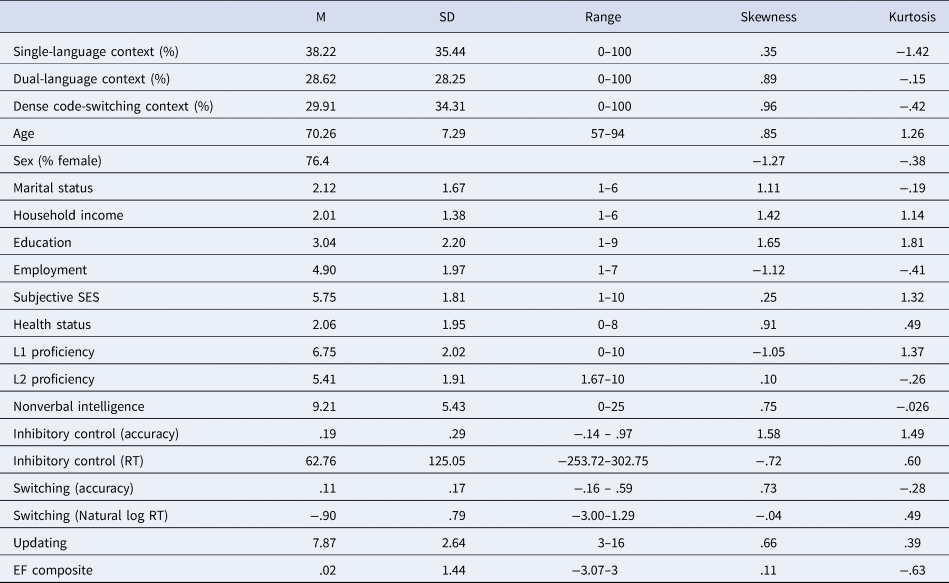
Sixty-nine healthy older adults (M age = 70.39 years, SD = 7.32; 76.8% female) were recruited from local community centers in exchange for a monetary reward. One 79-year-old female participant who spoke Cantonese and Hokkien as the first and second languages was removed from further analysis due to her self-reported medical history of head injury. The majority of our participants (69.12%) spoke English and Mandarin Chinese as either the first or second language. Another 17.65% of participants spoke a combination of Chinese dialects such as Hokkien, Teochew, and Cantonese. Detailed breakdowns of participants’ language pairs are shown in Table 2. The majority of participants were Chinese (89.39%), married (65.22%), had completed secondary education (78.79%) or received a diploma (71.21%), and had experienced fewer than two (60.6%) chronic illnesses (for descriptive statistics, see Table 3).
Bilingual Participants’ Language Pairs

Descriptive Statistics of Predictors, Criterion, and Covariates

Note. These statistics are based on our final sample of 68 participants.
Measures
Interactional context
A revised version of the Bilingual Interactional Context Questionnaire (Hartanto & Yang, Reference Hartanto and Yang2019) was used to assess the extent of each bilingual interactional context participants experienced. Participants indicated their tendency to experience three bilingual interactional contexts across home, work, and other environments: (a) a single-language context (e.g., “I speak only one language and rarely switch to the other language”); (b) a dual-language context (e.g., “I speak two or more languages when I converse with different speakers. I often switch languages, but rarely mix languages within an utterance”); or (c) a dense code-switching context (e.g., “I routinely mix two or more languages within an utterance to most speakers”). Using percentages that add up to 100, participants reported the prevalence of each interactional context and the percentage of time they spent at home, work, and other places. We then assessed participants’ prevalence of each bilingual interactional context with the following formulae:
 $${\rm Single}\hbox{-}{\rm language\ context\ index} = \mathop \sum \limits_{i = 1}^3 \displaystyle{{P_i{\rm \;}x{\rm \;}SL_i} \over {100}}^{\rm \;}$$
 $${\rm Dual}\hbox{-}{\rm language\ context\ index} = \mathop \sum \limits_{i = 1}^3 \displaystyle{{P_i{\rm \;}x{\rm \;}DL_i} \over {100}}^{\rm \;}$$
 $${\rm Dense\ code}\hbox{-}{\rm switching\ context\ index} = \mathop \sum \limits_{i = 1}^3 \displaystyle{{P_i{\rm \;}x{\rm \;}DC_i} \over {100}}^{\rm \;}$$
where Pi denotes the percentage of time spent in each situation (home, work, or other) and SLi, DLi, and DCi denote the percentage of a single-language, dual-language, and dense code-switching context within a given situation, respectively.
Inhibitory control
We adapted a selection of tasks from the MIDUS Cognitive Battery: Brief Test of Adult Cognition by Telephone (Tun & Lachman, Reference Tun and Lachman2006) to examine EF skills in older adults. To assess inhibitory control, we used the Stroop task (Stroop, Reference Stroop1935), in which participants were presented with a target word (“Red,” “Blue,” “Yellow,” or “Green”) and had to identify the color the word was printed in by pressing the corresponding key labeled with that color of tape. The meaning and color of the word were aligned (e.g., “Red” printed in red ink) in congruent trials, but not in incongruent trials (e.g., “Red” printed in blue ink). In a block of 108 trials, participants switched between congruent (67%) and incongruent (33%) trials at random. Inhibitory control was indexed by calculating the difference in accuracy scores between congruent and incongruent trials, with smaller values indicating better inhibitory control. The task was administered using E-prime software that displayed target stimuli on a computer screen and recorded the accuracy and response time of each trial. We conducted brief reading and color-blindness checks prior to the Stroop task to ensure that participants were able to read the words and identify the ink colors.
Updating
Updating was assessed by the backward digit span task from the Wechsler Adult Intelligence Scale (WAIS-IV; Wechsler, Reference Wechsler2008). Participants listened to 16 progressively longer strings of digits read by a research assistant with varying set sizes of two to eight digits and were asked to recall each series in the reverse order. The task was discontinued when participants made recall errors on two consecutive digit strings. The number of digit strings accurately recalled was recorded.
Shifting
We employed the Stop and Go Switch task (SGST) to assess shifting. On congruent trials, participants had to verbally respond “Go” and “Stop” when the target words were “Green” and “Red,” respectively. On incongruent trials, cued by a border surrounding the target word, participants had to reverse their responses (i.e., saying “Stop” and “Go” when the target words were “Green” and “Red,” respectively). Participants completed two single-task blocks and a mixed block. The first single-task block consisted of 10 congruent trials and the second single-task block consisted of 10 incongruent trials. Thereafter, the mixed-task block comprised 32 trials that required switching between congruent and incongruent trials, depending on the cue. An unpredictable task sequence was employed, in which cues to switch were presented at random intervals of 2 to 6 trials. Switch costs – the difference in accuracy between switch trials and repeat (non-switch) trials in the mixed block – were calculated to index shifting. The task was administered using PowerPoint slides displayed on a computer screen with a beep indicating the onset of target stimuli. Each participant's audio recording was transcribed to code accuracy and reaction time data thereafter.
To index overall EF, raw scores for inhibitory control, updating, and shifting were transformed to obtain z-scores, and a composite EF score was generated by averaging the three standardised scores.
Health status
Given the association between health conditions and cognitive abilities (Hartanto & Yang, Reference Hartanto and Yang2019), we assessed health status as a covariate by operationalising it as the number of chronic illnesses ever experienced in one's lifetime. Participants reported their history of chronic conditions, such as stroke, rheumatism, serious head injury, high cholesterol, asthma, etc. (0 = no, 1 = yes). A chronic illness score ranging from 0 to 22 was calculated by summing all “yes” responses.
Nonverbal intelligence
Participants’ nonverbal intelligence was assessed as a covariate using the 26-item matrix reasoning subtest of the Weschler Adult Intelligence Scale–Fourth Edition (WAIS-IV; Wechsler, Reference Wechsler2008). Participants were shown an array of printed figures with a missing piece and asked to select the most appropriate figure to complete a series of visual patterns. The task ended when three consecutive incorrect responses were given, and the number of items answered correctly was recorded as an index of nonverbal intelligence.
Language proficiency
Given that language proficiency has been implicated in cognitive performance (Hartanto & Yang, Reference Hartanto and Yang2019), bilinguals’ language proficiency scores were used as covariates. Participants identified their first (L1) and second (L2) languages and rated their proficiency with each language with regard to understanding, speaking, and reading on a 10-point scale (0 = none; 10 = perfect). L1 and L2 proficiency scores were separately computed by averaging the corresponding language's proficiency scores across all three domains.
Demographic variables
Participants reported demographic information – age, gender, marital status, and employment status. To capture the multifaceted nature of socioeconomic status (SES), we assessed educational attainment, household income, and subjective socioeconomic status. Participants’ highest level of educational attainment was rated on a scale from 1 (no school) to 12 (doctoral or professional degree). Household income was rated on a scale of 1 ($1,000 or below) to 6 ($9,000 or above), with intervals of $2,000, by combining monthly household income from all sources, including wages, allowances, and dividends. Subjective SES was recorded using the MacArthur Scale of Subjective Social Status (Adler, Epel, Castellazzo & Ickovics, Reference Adler, Epel, Castellazzo and Ickovics2000), in which participants rated their self-perceived social standing in society by selecting the most appropriate rung on a ladder (1 = lowest SES; 10 = highest SES).
Procedure
In the first half of the study, participants were asked to complete a series of EF tasks and a measure of nonverbal intelligence. The sequence of these tasks was fixed in the following order for every participant: backward digit span task, SGST, nonverbal intelligence, and the Stroop task (see Miyake et al., Reference Miyake, Friedman, Emerson, Witzki, Howerter and Wager2000). This was done to minimise the potential noise that could be introduced through the use of different task sequences and to render order effects consistent across participants so as to allow for direct comparisons of participants’ performance. All EF tasks were administered on a one-on-one basis in a quiet room, following standardised instructions and prompts provided by trained research assistants. Afterward, participants completed a series of questionnaires regarding their language background, number of chronic illnesses, and demographics. The entire session lasted approximately 90 minutes. The design and procedure of the study received relevant approvals from the university's institutional review board, and participants provided informed consent prior to the study.
Results
Analytic plan
Descriptive statistics are shown in Table 3. We performed a series of separate hierarchical multiple regression analyses to examine the predictive relations of interactional contexts to overall EF – based on the average of standardised accuracy scores for each EF component – and individual EF components of inhibitory control, updating, and shifting. To examine whether bilingual interactional contexts alone predicted overall EF or facets of EF, we entered the dual-language and dense code-switching contexts as the focal predictors in Model 1 without any covariates. Given that the three interactional contexts are bounded variables, we used the single-language context as a reference (i.e., the control group) to prevent perfect multicollinearity among the three interactional contexts. In Model 2, we added a host of covariates to examine whether interactional contexts would predict overall EF and facets of EF above and beyond the influence of key covariates of age, sex, marital status, education, household income, employment status, subjective SES, nonverbal intelligence, number of chronic illnesses, and L1 and L2 composite proficiency scores across speaking, reading, and comprehension.
Our primary analyses were based on accuracy data, instead of RT data, for two reasons. First, older adults are generally slower in reaction time relative to young adults due to their lack of familiarity with computerised tasks that require pressing on response keys. Second, accuracy scores have been found to be preferable for studying individual differences in cognitive control, since older adults prefer to respond slowly and accurately and are typically less willing to trade accuracy for speed even when instructed to respond quickly (Draheim, Tsukahara, Martin, Mashburn & Engle, Reference Draheim, Tsukahara, Martin, Mashburn and Engle2019). Given this, accuracy seems to be a more appropriate measure than RT for older adults. Nevertheless, we recorded RT data for the Stroop task and the Stop and Go Switch task (SGST) as additional ancillary indices of inhibitory control and switching, respectively; note that RT data for the backward digit span task (updating) are not available. Using similar hierarchical multiple regression analyses, we examined whether bilinguals’ interactional contexts predicted facets of EF in terms of RT.
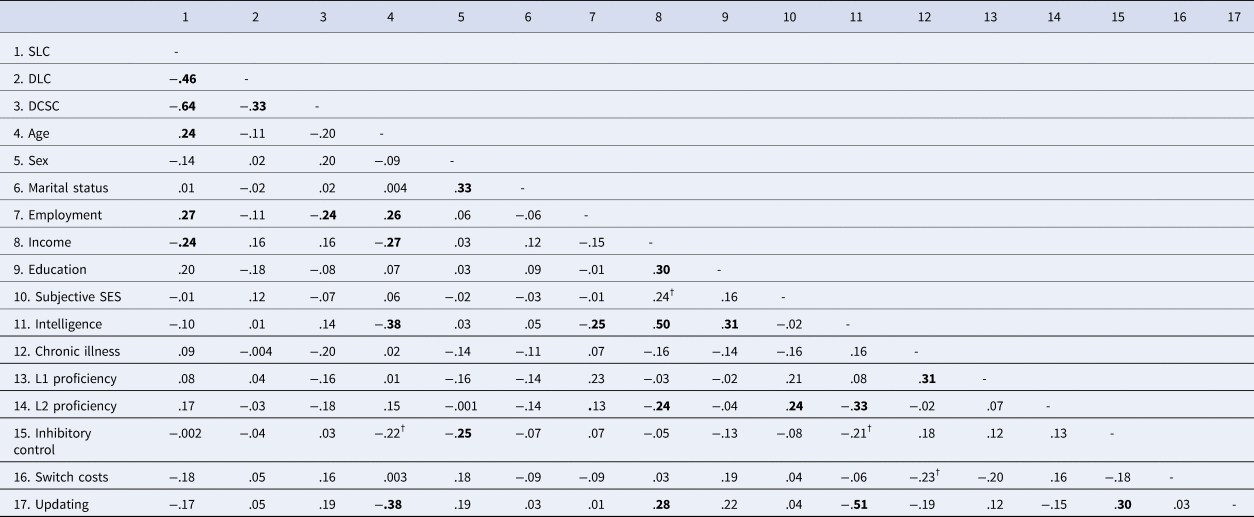
Overall, no evidence of multicollinearity was found (for zero-order correlations, see Table 4). Our post hoc power analysis for hierarchical regressions showed that we had sufficient power (>80%) to detect medium (f 2 = 0.15) to large (f 2 = 0.35) effect sizes, with α value set at .05.
Bivariate Zero-order Correlations

Note. SLC = Single-language context; DLC = Dual-language context; DCSC = Dense code-switching context.
†p < .07, * p < .05, ** p < .001
Executive functions in accuracy
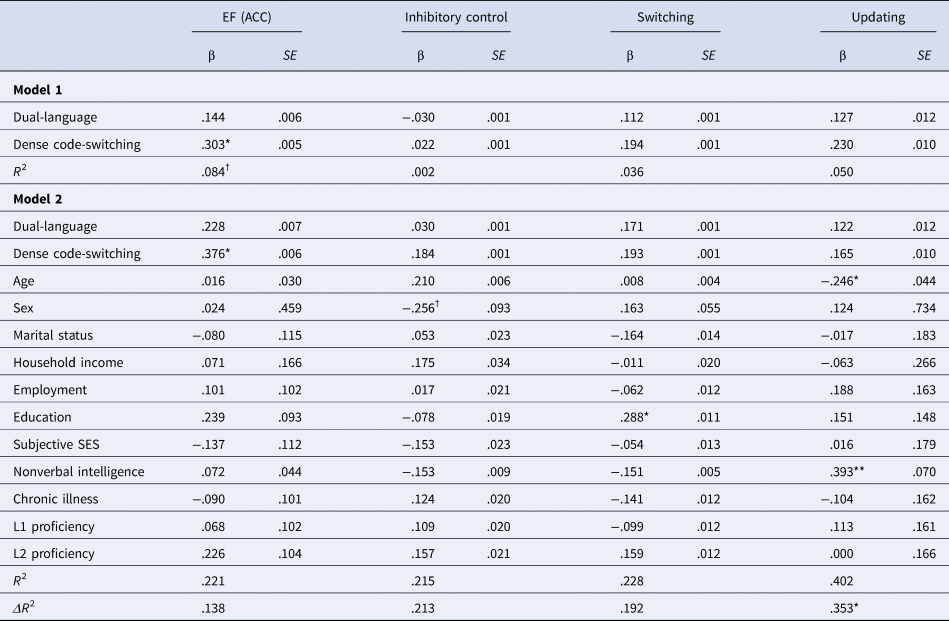
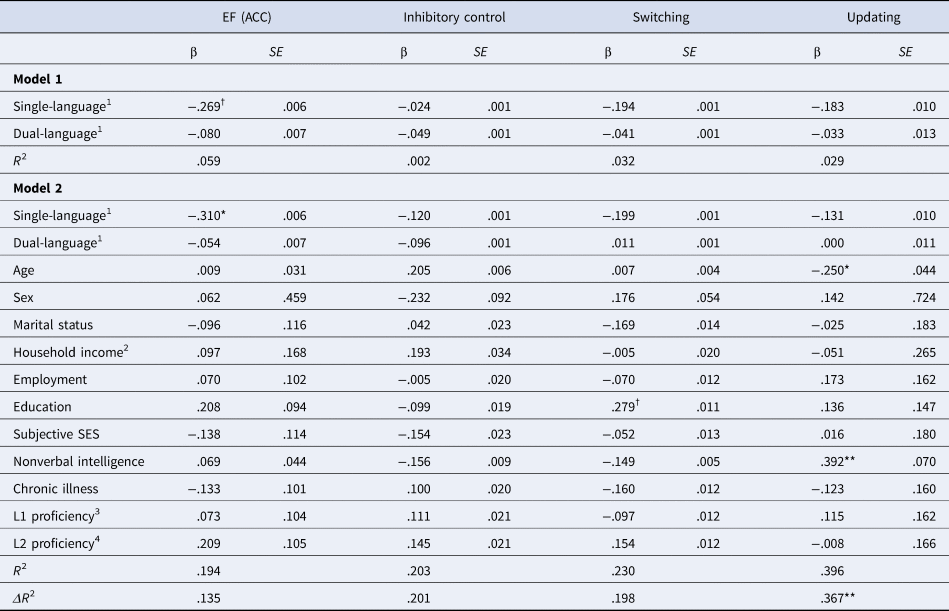
We examined the relations of bilingual interactional contexts with respect to overall EF, inhibitory control, shifting, and updating. When the single-language context was used as the reference, we found that the dense code-switching context positively predicted the overall EF score in both Model 1 (β =.303, t = 2.391, p = .020; Table 5) and Model 2, in which all covariates were taken into consideration (β =.376, t = 2.459, p = .017), but the dual-language context did not predict the composite EF in either model (p model1 >.261 and p model2 > .123; see Appendix Table A1, in which the dense code-switching context served as the reference). Contrary to our hypothesis, these results indicate that the dense code-switching, rather than the dual-language, context enhances overall EF in older adults.
Standardised Coefficient Estimates for EF Composite and Each EF, with the Single-language Context as the Reference for the Dual-language and Dense Code-switching Contexts

Note. † p < .07, * p < .05, ** p < .001
Next, we examined the predictive role of bilingual interactional contexts in each aspect of EF. When we conducted a separate set of hierarchical multiple regression analyses with respect to inhibitory control, shifting, and updating – all of which were indexed by accuracy scores – we found that none of the interactional contexts significantly predicted inhibitory control (p DC>.233 and p DL > .836); shifting (p DC>.209 and p DL > .245); or updating (p DC>.219 and p DL > .338) in Model 2, with all covariates controlled for. Similar results were found in Model 1 without any covariates (see Table 5).
Inhibitory control and switching in RT
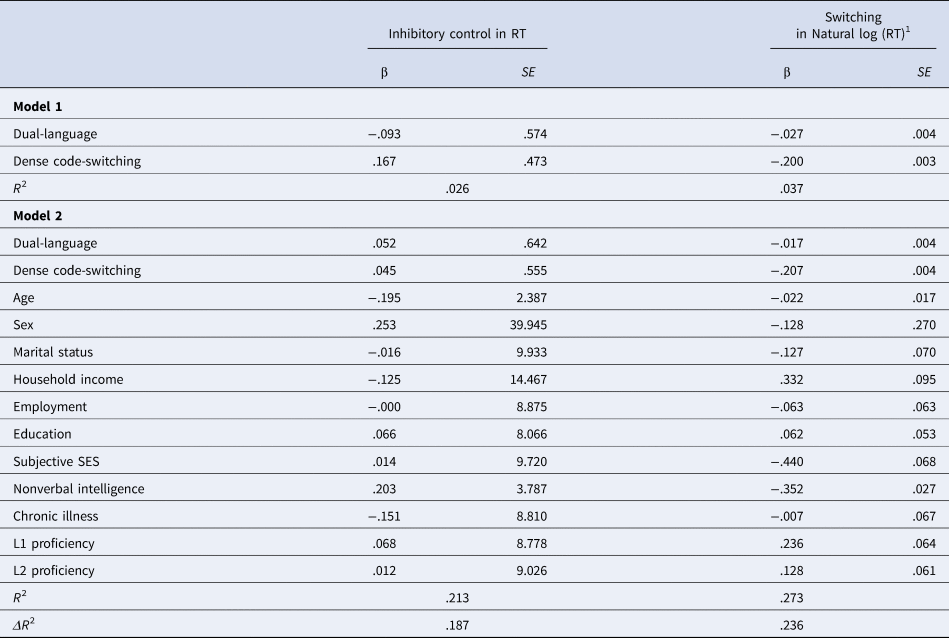
As additional ancillary analyses, we performed similar hierarchical multiple regression analyses to examine the link between bilinguals’ interactional context and RT-based scores of inhibitory control and switching obtained from the Stroop and Stop and Go Switch tasks (SGST), respectively. Inhibitory control was indexed by calculating the differences in RT between congruent and incongruent trials from the Stroop task, and switching cost was indexed in terms of RT differences between switch and repeat trials in the mixed block of the SGST. We found results similar to those of accuracy-based data; neither dual-language nor dense code-switching contexts predicted RT-based inhibitory control (p DC>.768 and p DL > .722) and switching (p DC>.281 and p DL > .778; see Table 6).
Standardised Coefficient Estimates for Inhibitory Control in RT and Switch Costs in Log-transformed RT, with the Single-language Context as the Reference for the Dual-language and Dense Code-switching Contexts

Note. 1 Since the kurtosis value for switch cost in RT (14.79) denoted non-normality, we log transformed RT data.
General discussion
Drawing on the adaptive control hypothesis (Green & Abutalebi, Reference Green and Abutalebi2013), we sought to shed light on aging bilinguals’ interactional contexts of conversational exchanges as crucial bilingual experiences that modulate overall EF and the three facets of EF. Our results emphasise the disparate impacts of bilingual interactional contexts on nonverbal EF in older adults. Our major findings are discussed below in detail.
First, we found that bilinguals’ dense code-switching context significantly predicted better overall EF. Considering that age-related decline in EF has deleterious effects for cognitive functioning and quality of life (Toh et al., Reference Toh, Yang and Hartanto2019), our findings corroborate an emerging body of research suggesting that bilingualism may serve a protective function (see Calvo, García, Manoiloff & Ibáñez, Reference Calvo, García, Manoiloff and Ibáñez2016).
Second, by distinguishing between more fine-grained, context-specific bilingual experiences among older adults, we demonstrated that bilinguals’ dense code-switching context significantly predicted the index of overall executive functioning. This suggests that a dense code-switching context, compared with a single-language context, confers benefits in control processes via the monitoring of cross-linguistic interference (Hofweber et al., Reference Hofweber, Marinis and Treffers-Daller2020). Our findings provide further insights into the impact of disparate bilingual interactional contexts in mitigating age-related cognitive decline in EF. Although our findings seemingly contradict the theoretical predictions of the adaptive control hypothesis (Green & Abutalebi, Reference Green and Abutalebi2013), a similar and more recent theoretical account – the control process model (Green & Wei, Reference Green and Wei2014) – offers a better explanation for the discrepancy.
The control process model distinguishes itself from the adaptive control hypothesis by postulating subtler variations within code-switching forms. Specifically, the control process model specifies more refined types of code switches: (a) insertion (inserting words from one language into another); (b) alternation (consecutive strings of words from one language alternating with strings of words from another language within an utterance); and (c) dense code-switching (a shared language structure with words interwoven from both languages). Given that a dense code-switching context involves cooperative control between two language schemas, this may be further broken down into a coupled control mode or an open control mode, depending on the type of code switches. Specifically, insertion involves a coupled control mode whereby the active language temporarily cedes local control to the other language to allow for an insertion before returning control to the original language, which requires more effortful cognitive control. However, dense code-switching involves an open control mode, in which neither language schema has a top-down role in controlling access to language. Given this, frequent insertion – relative to dense code-switching – is likely more beneficial for executive processes due to its reliance on a coupled control mode. In view of this, it is possible that bilinguals in our study may engage in insertion more frequently than dense code-switches within the dense code-switching context, and thereby yield greater advantages in EF than single-language or dual-language-context bilinguals. Future studies, therefore, should incorporate a more fine-grained measure of interactional contexts, particularly by differentiating between forms of code-switching (i.e., insertion, alternation, and dense code-switching) that activate distinct (i.e., coupled or open) modes of cognitive control.
Relatedly, although we found a significant relation between a dense code-switching context and an overall index of EF, it is noteworthy that we failed to confirm our hypothesis regarding the specific relations between dual interactional contexts and inhibitory control, even though these findings are consistent with recent evidence based on older adults (e.g., Kałamała et al., Reference Kałamała, Szewczyk, Chuderski, Senderecka and Wodniecka2020). The lack of association between a dual-language context and updating is also consistent with previous findings in young adults (e.g., Hartanto & Yang, Reference Hartanto and Yang2016, 2020). Lastly, the null relation between a dual-language context and shifting diverges from the positive relations obtained with previous studies of young adults (e.g., Hartanto & Yang, Reference Hartanto and Yang2016, 2020). Taken together, more research is needed to evaluate the specific relations between bilingual interactional contexts and individual facets of EF in older adults.
We offer several potential reasons for our discrepant findings. First, given that we tested older adults instead of young adults, our failure to establish relations between interactional contexts and inhibition or shifting may be because the three putative facets of EF are not clearly differentiated in older adults (e.g., Hull et al., Reference Hull, Martin, Beier, Lane and Hamilton2008; Khoo & Yang, Reference Khoo and Yang2020). Second, our incongruent outcomes can be due to the diverse measures used to assess different aspects of inhibition-related functions or shifting. For instance, we used the Stroop task to assess prepotent response inhibition, whereas other studies used flanker tasks, which are known to tap resistance to distractors (Friedman & Miyake, Reference Friedman and Miyake2004). Similarly, we used the SGST to assess shifting, while other studies used the color-shape switch task (Hartanto & Yang, Reference Hartanto and Yang2019). Lastly, in view of age-related decline in processing speed, we indexed EF performance based on accuracy scores in contrast to bin scores, which incorporate both accuracy and RT data and have been used with young adults in previous studies (Hartanto & Yang, Reference Hartanto and Yang2016, 2019). Hence, future studies should consider these developmental and methodological differences in studying the impact of older bilingual adults’ interactional contexts in EF.
Lastly, our study recruited heterogeneous bilingual participants with the majority being English–Chinese bilinguals (69.12%) and a smaller proportion being Chinese bidialectals (17.65%). Given recent studies that have put forth the notion that bilinguals’ language similarity (i.e., typological proximity) should be considered when examining their EF abilities (e.g., Coderre & van Heuven, Reference Coderre and van Heuven2014; Oschwald, Schättin, von Bastian & Souza, Reference Oschwald, Schättin, von Bastian and Souza2018; Yang, Yang & Hartanto, Reference Yang, Yang and Hartanto2019), this issue merits discussion in further detail. According to the bilingual interactive activation+ (BIA+) model, language characteristics, such as the amount of orthographic overlap (e.g., Chinese involves a logographic writing system, while English involves an alphabetic writing system), affect the degree of cross-language interference experienced by bilinguals (Dijkstra & van Heuven, 2002). Specifically, the greater the similarity in languages, the greater the cross-language interference that bilinguals have to manage, leading to better cognitive control (i.e., EF; Coderre & van Heuven, Reference Coderre and van Heuven2014).
However, empirical evidence has been mixed. Some studies have reported null (Oschwald et al., Reference Oschwald, Schättin, von Bastian and Souza2018) or even opposing results, in which bilinguals with greatly differing languages displayed greater advantages in EF (Bialystok et al., Reference Bialystok, Martin and Viswanathan2005; Linck, Hoshino & Kroll, Reference Linck, Hoshino and Kroll2008; Yang et al., Reference Yang, Yang and Hartanto2019), which suggests that the effect of language similarity on EF may not be as crucial compared with other types of bilingual experience, such as age of acquisition and frequency of code-switching (Paap, Darrow, Dalibar & Johnson, Reference Paap, Darrow, Dalibar and Johnson2015). In light of the inconsistent pattern of results, the extent and direction in which language similarity may have influenced our findings remain unclear. Further studies are therefore necessary to clarify the specific language characteristics that may implicate the magnitude of cross-language interference and how this may in turn interact with bilingual interactional contexts to shape EF abilities.
Our study is not without limitations. First is the correlational nature of the study limits causal inference regarding the direction of the relations between bilingual interactional contexts and EF. Given that the reversed pathway from EF to bilingual interactional contexts is also viable – such that EF abilities may predict engagement in certain interactional contexts more so than others – future research should employ a more rigorous design to determine the directionality of the associations.
Secondly, the majority of EF tasks have been plagued by the task impurity issue, since they implicate not only the core EF process but also non-EF processes such as reading or color discrimination (Miyake & Friedman, Reference Miyake and Friedman2012). Thus, it is possible that the true relation between bilingual interactional contexts and each facet of EF could have been masked by task-irrelevant non-EF processes. To address this issue, studies employing a latent variable approach based on a larger sample size are needed to clarify the relations between interactional contexts and EF in older adults.
Third, although our sample size is sufficient to detect either medium or large effect sizes, we acknowledge that the study lacks sufficient statistical power to detect small effect sizes, which may account for some of our null findings. Thus, more studies with a larger and more representative sample are needed to identify the link between bilingualism and EF outcomes.
Lastly, given that we did not include monolinguals as a comparison group, our study is unable to demonstrate whether bilingual interactional contexts are the locus of bilingual advantages in EF over monolinguals. Nevertheless, our findings are notable because they suggest that bilinguals’ cognitive advantages in EF could, in part, be attributed to individual differences in bilingual interactional contexts. Disregarding the key features of bilingual interactional contexts, therefore, may obscure the crucial relations between bilingualism and executive functioning.
Drawing on a sophisticated theoretical framework, our study demonstrates that individual differences in bilingual interactional contexts predict overall EF in older adults. Given that bilingualism is a multidimensional construct rather than a unidimensional variable, our study underscores the complexity of bilingualism when studying its impacts on EF. Further, in view of the inconsistent results regarding bilingual advantages in EF, our study highlights the need to focus on aspects of disparate bilingual experiences that may modulate EF outcomes.
In closing, our study implies that bilingual interactional contexts are a critical feature of bilingual experiences that engender adaptive higher-order cognitive control, and is therefore an area that warrants more extensive research.
Acknowledgements
This research was supported by a Lee Kong Chian fellowship and a grant awarded to Hwajin Yang by Singapore Management University through a research grant (17-C242-SMU-008) from the Ministry of Education Academic Research Fund Tier 1. Data and task materials will be available upon request. The study was not preregistered. We thank our research assistants, Chan Wan Rong, Danish Ramlan, Geraldine Tng, Jeanette Cheong, Lim Pei Shan, Luqman Nur Haqim Bin Wahab, and Ng Rui Bing, who assisted with data collection.
Appendix
Standardised Coefficient Estimates for EF Composite and Each EF, with the Dense Code-switching Context as the Reference for the Single-language and Dense Code-switching Contexts