Introduction
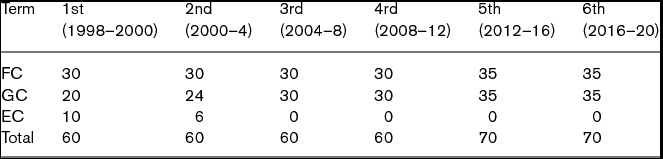
The 2014 Umbrella Movement in Hong Kong has triggered people's concern around the world for the democratization of Hong Kong.Footnote 1 Although the protests are mainly about the method of electing the Chief Executive, they also call for the abolition of functional constituencies and the implementation of universal suffrage in Legislative Council elections as.Footnote 2 According to the Basic Law of HKSAR, members of the Legislative Council are elected by three methods: the Election Committee, functional constituencies, and the rest by geographical constituencies through direct election. The composition of the Legislative Council changes over time (Table 1).Footnote 3 Direct election in geographical constituencies is the most competitive and similar to national elections in democratic countries. This article focuses on these geographical constituencies only. Despite Hong Kong's limited democracy, the direct election in Legislative Council elections is essential for the evolution of political parties and groups. In other words, the democratization of Hong Kong is related to Legislative Council elections, especially for direct election. The LRPR with Hare quota is used in the direct elections in Hong Kong.
The composition of Legislative Council after 1997

Notes: FC - functional constituencies, GC - geographical constituencies, EC - election committee.
This article sets out to explore how the two main political parties – the Democratic Party (DP) of the pro-democracy camp and the Democratic Alliance for the Betterment of Hong Kong (DAB) of the pro-China camp – enter the race and how they campaign strategically under the LRPR system. Generally speaking, in the LRPR systems, a party puts forward one single list per district and votes are pooled across all candidates. However, the LRPR in Colombia before 2006 and in Hong Kong are two exceptions: a party can endorse two or more lists in a district. As Cox and Shugart note, multiple lists in one party label in the LRPR in Colombia is a result of Colombian parties’ inability to organize and discipline their candidates (Cox and Shugart, Reference Cox and Shugart1995). While putting forward multiple lists in one party label, the LRPR resembles the SNTV system in that candidates face not only inter-party but also intra-party competition (Cox and Shugart, Reference Cox and Shugart1996; Cox, Reference Cox1997; Ma and Choy, Reference Ma and Choy2003a, Reference Ma and Choy2003b; Ma, Reference Ma, Kuan-Hsin and Wong2006; Pachon and Shugart, Reference Pachon and Shugart2010). The situation is quite similar to that of Hong Kong. In Hong Kong, multiple lists under one party label are a product of factional struggle (Ma, Reference Ma2001, Reference Ma, Hsin-chi, Siu-kai and Wang2002a, Reference Ma2002b; Choy, Reference Choy, Hsin-chi, Siu-kai and Wang2002). In other words, the presentation of multiple lists in Hong Kong is a result of the inability of political parties to control their candidates. In Hong Kong's quasi-SNTV, not only do parties campaign against other parties, but also candidates from the same party compete with each other.
In an LRPR system, seats are first allocated by quota (= total votes in a given district/district magnitude) and then by the largest remainder in descending order until all seats are filled (Cox and Shugart, Reference Cox and Shugart1995). The allocation of remaining seats by the largest remainders is determined by plurality, as is also the case in SNTV. Seats won by either two or more quotas or by more than one quota and a remainder can be regarded as vote-pooling (Cox, Reference Cox1997). In quasi-SNTV under LRPR, seats are allocated according to plurality until all of them are filled. In this vein, votes are not pooled across all candidates since votes only benefit the head of the list (Cox, Reference Cox1997). The example of Colombian quasi-SNTV, in which vote-pooling is absent, reflects parties’ inability to control the party label and the candidate-centered campaign. Although some research on Colombian quasi-SNTV demonstrates that list-splitting in some cases can help parties win more seats (e.g. the district of Huila in 1990), Colombian parties would not have committed errors and lost more seats had parties been able to coordinate around a single list.Footnote 4
This article proceeds as follows. First, it will examine the relevant research on Colombian quasi-SNTV and how it resembles SNTV since lessons from SNTV can help us understand how the quasi-SNTV system works. Second, it will briefly analyze the evolution of political parties in Hong Kong. The main political cleavage (camp) in Hong Kong is pro-China (or pro-establishment or pro-Beijing) vs. pro-democracy. It is essential to recognize the dominant political cleavage because it is associated with how a party coordinates with other parties/individuals in the same camp at the nomination and campaign levels. Third, this article calculates the actual allocation and the hypothetical allocation of seat shares of each party using Cox and Shugart's method to see whether they commit different types of errors or reach optimal performance (Cox and Shugart, Reference Cox and Shugart1995). Finally, the article concludes that quasi-SNTV in Hong Kong can help political parties reach optimal performance only if a political party can both control their party label and coordinate well with their alliances at both the nomination level and campaign level. Compared with quasi-SNTV in Colombia, a key distinction of quasi-SNTV in Hong Kong is that the strategic coordination within its alliances can help political parties succeed in this system. The DAB has done an excellent job in this regard. Otherwise, a party coordinating around a single list remains the best strategy.
The effects of SNTV and quasi-SNTV
In SNTV, voters cast a single vote for a candidate in a multimember district and votes are non-transferable. Each party may put forward more than one candidate in each district. Seats are allocated by the plurality rule until all seats are filled (Carter and Farrell, Reference Carter, Farrell, LeDuc, Niemi and Norris2010; Farrell, Reference Farrell2011). The advantages of this system are that it tends to produce a more proportional outcome and improve the representation of small parties and minority representation than a single-member plurality system (Wang, Reference Wang2008; Farrell, Reference Farrell2011). However, SNTV often suffers from the problem of super-proportionality, especially in districts of large magnitude. Election results in Japan (till 1993) and Taiwan (through 2004) demonstrate that large parties are likely to commit errors of overnomination (the party's candidates exceed the MAXS,Footnote 5 and the party ultimately gets fewer seats than the MAXS), undernomination (it could have won more seats by nominating more candidates), and misallocation (the party's candidates are equal to the MAXS, but the party obtains fewer than the MAXS), while small parties usually can benefit from this and obtains seats with small vote shares. (Lijphart et al., Reference Lijphart, Pintor, Sone, Grofman and Lijphart1984; Hsieh, Reference Hsieh1992; Wang, Reference Wang2008). In particular, when one of the large parties commits errors (loses seats), other large parties are likely to benefit from this and become over-represented (advantage ratio > 1), especially when small parties are not viable (Cox and Niou, Reference Cox and Niou1994; Wang, Reference Wang2008).Footnote 6 In this sense, SNTV is likely to be super-proportional, especially in a given district of large magnitude.
Cox and Shugart (Reference Cox and Shugart1995) have conducted extensive investigations into the effects of quasi-SNTV. According to their case study of Colombian quasi-SNTV prior to 2006, it resembles SNTV in Japan in that there are multiple lists under the same party label and votes cannot be transferred from one list to another.Footnote 7 Multiple lists under one party label is a result of weak party discipline. The absence of vote pooling in SNTV, just as in Colombian quasi-SNTV, makes it more difficult for a party to control its candidates. While the maximum of district magnitudes is six in Japan, district magnitudes in Colombia range from 1 to 29. Similar to Japan's SNTV, the larger the district magnitude, the more errors parties commit in Colombia. Errors rates of major Colombian parties are even higher than those of Japan since weak party discipline makes Colombian parties unable to control their increasing party lists (Cox and Shugart, Reference Cox and Shugart1995; Pachon and Shugart, Reference Pachon and Shugart2010). Although the quasi-SNTV emerges because of weak party discipline, Colombian parties became familiar with the quasi-SNTV and managed to win more seats by putting forward multiple lists from 1990 to 1998. Nearly all advantage ratios of major parties (Liberal Party and Conservative Party) are over 1, and those of small parties or independents are below 1. Clientelism enabled the large parties to attract voters to support particular candidates and thus made it easier for parties to allocate votes (Shugart et al., Reference Shugart, Moreno, Fajardo, Welna and Gallon2007). It is evident that large parties in Columbia are over-represented as well. The super-proportionality of Colombian quasi-SNTV substantiates that it is very similar to SNTV.
The absence of vote pooling in SNTV or quasi-SNTV has contributed to personalized electoral machines since the competition is among individuals in SNTV and those heading each list in quasi-SNTV (Cox and Shugart, Reference Cox and Shugart1995; Cox, Reference Cox1997; Pachon and Shugart, Reference Pachon and Shugart2010). There are few incentives for candidates to be loyal to their parties because the weak party discipline in SNTV enables candidates to cultivate their votes through their personal networks (koenkai in Japan) (Baerwald, Reference Baerwald1986; Hrebenar, Reference Hrebenar1986; Curtis, Reference Curtis1988; Shugart et al., Reference Shugart, Moreno, Fajardo, Welna and Gallon2007). In Taiwan's SNTV, both marginally elected and so-called national celebrities switched their partisanship or became independent in order to win reelection since they can win by their strong clientelistic networks (Chang and Tang, Reference Chang and Yen-chen2015). Scholars of Hong Kong politics such as Ngok Ma and Ivan Choy also claim that quasi-SNTV in Hong Kong is quite similar to SNTV in that many lists run in a district are under the same party label (Ma and Choy, Reference Ma and Choy2003a). Also, the study of campaign advertising in the 2004 and 2012 Legislative Council elections in Hong Kong also demonstrates that there is more advertising focusing on a candidate's image than on policies or issues (Niu, Reference Niu2008, Reference Niu2013). In this sense, quasi-SNTV can promote candidate-centered campaigns and party-switching happens frequently as well in Hong Kong's quasi-SNTV, such as Chin-shek Lau and Albert Wai-yip Chan in 2004, Albert Wai-yip Chan and Audrey Eu in 2008, and Cyd Ho and Emily Lau in 2012.Footnote 8 In particular, Kwong (Reference Kwong2010) also discovers patron–client networks facilitate candidates’ personal support in Hong Kong's Legislative Council elections.
Although the absence of vote-pooling is the major mutual characteristic between SNTV and quasi-SNTV, votes can be pooled in quasi-SNTV once there are excess votes in one list. Take the DAB in 2008 for example. The DAB put forward one list in New Territories East and got 102,434 votes. Though votes could not be transferred to the independent Scarlett Oi-lan Pong, whom the pro-Beijing united front endorsed, votes could be pooled across the candidates on its list (Cheng, Reference Cheng2010). The total votes allowed the 1st seat (Kong-wah Lau) to win by quota and the 2nd seat (Gary Hak-kan Chan) to win by remainder. Nevertheless, votes are wasted on excessively popular candidates in SNTV while other candidates under the same party label have too few votes to be elected. The example of the 1998 Legislative Council election in the South District of Taipei City can demonstrate this. While the DPP's top-ranked candidate Fu-hsiung Shen got 86,900 votes, his colleague Tien-fu Huang obtained only 28,179 votes and was defeated only by a margin of 2,324 votes (Yu, Reference Yu1999). The excessive votes in SNTV cannot be pooled and this is the distinction between quasi-SNTV and SNTV. Since the seats are more expensive in vote-pooling in LRPR, seats are cheaper while putting forward multiple lists (quasi-SNTV). This probably explains why the DAB ran multiple lists in three districts in 2012.
This article intends to explore how quasi-SNTV in Hong Kong takes place, whether the DP and DAB put forward multiple lists or cooperate with their respective alliances or not, and the aftermath of multiple lists and coordination or failure of coordination. In order to maximize seats in one district, parties may cooperate with fellow parties or independent candidates in the same camp to have one list or one party can have two or more lists. Except in 2004, the pro-democracy camp lacks an overriding authority to coordinate with different parties or candidates in the same camp. In contrast, the pro-China camp seems less divided than its rivals because it adopts the electoral strategy of a united front (Cheng, Reference Cheng2010). The quasi-SNTV in Hong Kong features the strategic coordination of the two political camps, which is different from that in Colombia.
Political/social cleavages in Hong Kong
The main political cleavage in Hong Kong is pro-China vs. pro-democracy. The major distinction between these two sides is their attitude toward political reform (especially the issue of universal suffrage) (Cheng, Reference Cheng2010). The pro-democracy camp appeals for rapid and radical political reform while the pro-China camp emphasizes the importance of political stability and advocates for political reforms to proceed gradually (Yip and Yeung, Reference Yip and Yeung2014). The emergence of this political cleavage can be traced to Hong Kong's unique political background and development. Therefore, it is important to understand the evolution of Hong Kong's political parties because this is directly related to the political cleavages.
The pro-democracy camp
The DP, which attracts middle-class voters, is the major party in the pro-democracy camp. The rise of the DP in 1994 can be traced back to the Tiananmen Square protests of 1989 (Scott, Reference Scott, Kwok, Leung and Scott1992). Also, the Hong Kong Confederation of Trade Unions (HKCTU) often supports and cooperates with the DP (Ma, Reference Ma2001). In addition, the Association for Democracy and People's Livelihood (ADPL), founded in 1986, regards itself as a party serving the lower-classes. Two other parties, the Frontier and the Citizens Party, were established before 1997. In particular, the Frontier, founded in 1996, has a simple and small organization and is more radical than the DP (Yang, Reference Yang and Cheng1997). In addition to those pro-democracy parties founded before 1997, the Civic Party and the League of Social Democrats (LSD) were established in 2006. The LSD is more radical than other pro-democracy parties or groups and is the only party in the pro-democracy camp that has been successful in attracting young voters. The LSD often attacks other pro-democracy leaders especially in campaigns (Cheng, Reference Cheng2010).
The Citizens Party did not run in elections after the first Legislative Council election in 1998. After 2000, the HKCTU has begun not to support the DP because it thinks that the DP is alienating members of the working and lower classes. Moreover, the chairman of the HKCTU, Chin-shek Lau, who had been a member of the DP, was expelled from the party as a result of a factional struggle (Ma, Reference Ma2001). Some DP members (mainly those who make up the Young Turks) withdrew from the DP and formed the New Democrats in 2010 because they did not agree with the DP's support of the political reform of HKSAR in 2010 (Ma, Reference Ma2011). The LSD fractured in 2011 and some members formed a new coalition, People Power, in 2011. The radical pro-democracy parties (LSD, People Power, and the New Democrats) often attack fellow pro-democracy parties when campaigning.Footnote 9 Also, some Frontier members formed the Labor Party in 2011, following the Frontier's merger with the Democratic Party in 2008.
The pro-China camp
The DAB, founded in 1992, is the main party of the pro-China camp and focuses on the interests of the lower classes. In addition to the DAB, other pro-China parties were established prior to 1997, including the New Hong Kong Alliance (NHKA),Footnote 10 the Liberal Democratic Federation (LDF),Footnote 11 and the Hong Kong Progressive Alliance (HKPA).Footnote 12 These new parties participated in the District Board election in 1994 and the Urban Council and Legislative Council elections in 1995. Furthermore, the Hong Kong Federation of Trade Unions (HKFTU), which represents labor interests and has a solid grassroots base, usually cooperates with the DAB in Legislative Council elections (Cheng, Reference Cheng2010).
In addition to the development of these two camps, the Liberal Party (LP), a conservative and pro-business party, was founded in 1993. Similar to the HKPA, the LP mainly stands for functional constituency seats. The LP has tried to run for geographical constituency seats, but its efforts have not been as successful as other parties. Although the LP is a pro-China party as well, it usually does not cooperate with other pro-China parties in direct elections (Cheng, Reference Cheng2010). It won two seats in the direct election in 2004, but then lost them in 2008. Some members of the LP have withdrawn from the party and formed other parties (e.g. the New People's Party in 2011 and Economic Synergy in 2009).Footnote 13
Summary
Although parties in both camps cooperate with other parties of the same camp in the legislature most of the time, they do not necessarily coordinate with each other in Legislative Council elections all of the time. Because of factional struggles and conflicts among pro-democracy parties, the pro-democracy camp is more internally fragmented than the pro-China camp. Generally speaking, the pro-China camp is more prone to cooperation than the pro-democracy camp. The internal fragmentation of the pro-democracy camp and the internal coherence of the pro-China camp have a great influence on the DP's and the DAB's strategies under quasi-SNTV.
Methodology
In order to determine whether quasi-SNTV in Hong Kong can help the DP and the DAB equalize votes and maximize seats, I explore whether each of them commits errors of undernomination, overnomination, misallocation, undernomination, and misallocation (the number of lists are fewer than MAXS, and the party wins fewer seats than the number of lists of the party) or reaches optimal performance (the number of seats a party wins is equal to the MAXS). In other words, this article analyzes and compares the strategic entry of the two parties and whether they can equalize votes well.
Hypothesis
Weak party discipline had contributed to a quasi-SNTV system in Colombia prior to 2006. As the district magnitude increases, the quasi-SNTV can lead to high error rates as is evident in Cox and Shugart's case study of Colombia. However, parties eventually became acquainted with quasi-SNTV and determined how to better allocate votes and as a result obtained more seats. Similar to Colombian quasi-SNTV, quasi-SNTV in Hong Kong emerged because of factional struggles and parties’ inability to control their candidates. Considering the special political background of Hong Kong, this article hypothesizes that a political party which facilitates coordination well with its alliances commits fewer errors and obtains more seats than a political party which lacks coordination within its political camp. In other words, I surmise that the pro-China camp's united-front strategy helps the DAB win more seats, while the DP commits more errors and obtains fewer seats because of less coordination among its alliances.
Data
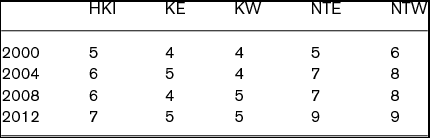
This article employs the election data from the Registration and Electoral Office in Hong Kong, and district magnitudes from 2000 to 2012 are shown (see Table 2).Footnote 14 Using this data, error rates and optimal performance rates of the DP and the DAB in quasi-SNTV in Hong Kong from 2000 to 2012 are calculated. The calculations are as follows. First, the actual allocation (of those which put forward multiple lists) and the hypothetical allocation (one single list) of the seat share of each party are calculated using Cox and Shugart's method to see whether parties commit different types of errors or reach optimal performance (Cox and Shugart, Reference Cox and Shugart1995). Second, the MAXS of each party in each geographical constituency is calculated.Footnote 15 The definition of MAXS in this article is the maximum number of seats that each party can win if they put forward multiple lists, equalize votes well, and assume that only one candidate is elected in each list and all other lists’ votes are fixed. In other words, the MAXS are the cheapest seats which are won by the remainder. According to the MAXS and the actual seat share, the analysis explores what kind of errors each party commits and whether the party reaches optimal performance. Third, the error rates and the optimal performance rates of the two parties are compared to discover which party wins more seats in quasi-SNTV.
The district magnitudes in geographical constituencies in Hong Kong Legislative Council Elections (2000–12)

Notes: HKI = Hong Kong Island, KE = Kowloon East, KW = Kowloon West, NTE = New Territories East, NTW = New Territories West.
The strategic coordination of the parties in Legislative Council elections
The direct election in Hong Kong's Legislative Council (or LegCo) election uses a closed party-list LRPR with Hare Quota. Given the similarities between quasi-SNTV and SNTV, either the DP or the DAB puts forward multiple lists in a given district. In particular, the DP has observed vote division strategies under SNTV by political parties in Taiwan. There are two main vote division strategies in Taiwan's Legislative Yuan elections. The first is the ‘vote responsibility zone’ of the Kuomingtang (KMT); the second is the vote division strategy preferred by the Democratic Progressive Party (DPP) and the New Party (NP) (Choy, Reference Choy, Hsin-chi, Siu-kai and Wang2002; Ma and Choy, Reference Ma and Choy2003a).
The KMT, which had more resources and consolidated local and social networks, usually divided a geographical constituency into several small zones and assigned different candidates to different ‘spheres of influence’ so that they could campaign and mobilize in their assigned district. In contrast to the KMT, the DPP and the NP had fewer resources and were not as well organized (Choy, Reference Choy, Hsin-chi, Siu-kai and Wang2002). Therefore, the DPP and the NP adopted different vote division strategies from the KMT. In this special vote division strategy, which was innovated for Taiwan's Legislative Council elections in 1995, the DPP and NP canvassed their supporters to equalize votes through the media.Footnote 16 This vote division strategy was shown to be very successful in 1995 because it helped to reach high rates of optimal performance. However, the vote division strategy of the DPP did not really work well in the 1998 Legislative elections in the South District of Taipei City because the division strategy was usually difficult to put into practice. The success or failure of the strategy depended on many factors, such as the changing of candidates, strengths of different candidates, factional struggles, the adherence of voters to the party's vote division strategy, and other parties’ strategies (Yu, Reference Yu1999).
The DP decided to adopt the KMT's ‘vote responsibility zone’ strategy since it began splitting lists in 2000. Occasionally, some pro-democracy marginal candidates may ask voters to vote strategically; however, this has actually shown to be ineffective since there are relatively few voters (only 7% at most) who engage in strategic voting (Choy, Reference Choy, Hsin-chi, Siu-kai and Wang2002; Ma and Choy, Reference Ma and Choy2003a).Footnote 17 In 2004, the DP cooperated with some of their pro-democracy colleagues to run in the LegCo elections by either coordinating around one list (e.g. the Diamond list in New Territories East in 2004) or putting forward multiple lists. Similar to the pro-democracy camp, the DAB has split two lists (both are under the combined label of DAB/HKFTU) in Kowloon East starting in 2004.
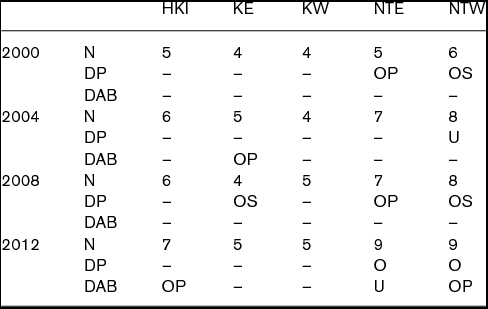
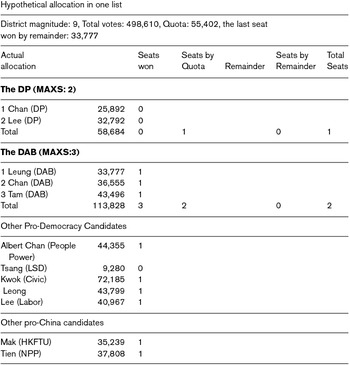
Table 3 shows errors under quasi-SNTV the parties committed by district magnitudes in five districts. First, the actual and hypothetical results of the two parties are calculated if they were to put forward multiple lists in each district to determine whether multiple lists can help to win extra seats. If any of them has engaged in vote-pooling (put one list in a given district only), then it is not counted since I assume that votes are not pooled and seats which are won by remainder are the cheapest. The strategic coordination around a single list either by a party or even by a camp (e.g. the democratic camp's Diamond list in NTE in 2004) makes votes pooled and seats the most expensive. In this sense, the party or the camp cannot commit errors. The next step is to calculate the MAXS, error rates, and the optimal performance rates for each party.Footnote 18 The 2012 LegCo election in New Territories West is an example of the calculation in Table 4. Each row shows the lists, actual vote share and seats the list got; the total votes for the DP and the DAB from column 4 to 7 are the hypothetical allocation if they ran one list. Since each election presents a different scenario with respect to coordination, the situations of each Legislative election are outlined briefly before hypothetical and actual results are calculated and errors rates and optimal performance rates of both are analyzed.
The quasi-SNTV and errors by district magnitudes

Notes: N = district magnitudes; U = undernomination, O = overnomiation, OS = overnomination but safe, OP = optimal performance, – = not applicable.
The example of actual and hypothetical results of the DP and the DAB in New Territories West in 2012

The strategic coordination of the DP
The DP began to put forward multiple lists in New Territories East and New Territories West in 2000. In fact, multiple lists of the DP are a result of factional struggles between the mainstream and the Young Turks.Footnote 19 Similar to the Quasi-SNTV in Colombia, it implies that the DP cannot effectively control the party label so it splits lists in LRPR as a result. However, the absence of vote pooling has made seats won by the remainder cheaper than those won by quota. In New Territories East, they could only win one seat if they had not split lists. In New Territories West, the DP put forward three lists but won only two; they could have reached optimal performance if they had put forward only two lists (MAXS=2). The three DP candidates’ ‘scrambling for vote-responsibility-zone’ in New Territories West reflects the weak party control of the DP (Choy, Reference Choy, Hsin-chi, Siu-kai and Wang2002).
In order to have enough bargaining/veto power in the Legislative Council, the pro-democracy camp began to coordinate at the nomination level in each geographical constituency in 2004. The liaison group (the strategic coordination organization in the pro-democracy camp) determined the number of candidates and endorsed the viable candidates according to polls, the pro-China camp's strategies and nominated candidates, and past election results (Ma, Reference Ma, Kuan-Hsin and Wong2006).Footnote 20 In New Territories East, the pro-democracy camp coordinated around one single list – the so-called ‘Diamond List’ – and two seats were won by quota and the third one was won by the remainder. In contrast to New Territories East, the pro-democracy camp endorsed five lists in New Territories West and they won five seats successfully. If the pro-democracy camp is defined as a relevant actor to put forward multiple lists or one single list, the pro-democracy camp reaches optimal performance in New Territories West. However, the DP commits the error of undernomination and could have won the third seat if it is considered as an actor to campaign strategically. For the other three districts (Hong Kong Island, Kowloon East, and Kowloon West), the pro-democracy camp won all seats they had endorsed. It seems that the liaison group worked very well on strategic coordination in 2004.
Table 3 shows that the DP split lists in Kowloon East, New Territories East, and New Territories West in 2008. In Kowloon East, the MAXS of the DP was one, but they ran two lists, eventually getting one seat. Similar to the situation in Kowloon East, the MAXS was 2, but the DP nominated three lists and got 2 in New Territories West. The DP neither committed errors of overnomination nor reached optimal performance. The situations in Kowloon East and New Territories West are overnomination but safe. Instead of coordinating around one single list in 2004, the DP ran only two lists and they reached optimal performance in New Territories East. The other pro-democracy parties, such as the Frontier, LSD, and the Civic Party won one seat each. Compared with coordinating around one list in 2004, it seemed that there was not really a liaison group to coordinate parties or candidates in the pro-democracy camp in 2008. The pro-democracy camp won more seats by splitting lists in 2008 rather than coordinating around one single list. The seats won by remainder were cheaper than those won by quota.
Five additional seats are added to the total seats of geographical constituencies in 2012, so there are more lists and candidates in the direct election, which makes this election very competitive. The DP put forward multiple lists in New Territories East and New Territories West and commits errors of overnomination in both districts. In New Territories West, the DP ran two lists but did not win any seats. The total vote share of the two DP lists (Chan and Lee) were 58,684 which was higher than the quota of 55,402. They could have won one seat if they had not split lists (Table 4). In New Territories East, the DP nominated three lists, eventually winning one seat. They would have won two seats if they had run two lists only. The split of the DP and the rise of new pro-democracy parties may account for the decline of its vote share and seat share. Some radical pro-democratic parties, such as the LSD (split from the DP), People Power (split from LSD), and New Democrats (split from the DP), adopt a radical position on the issue of political reform and seldom cooperate with other pro-democratic parties or candidates. Moreover, they have even launched a serious attack on the DP during the campaign (Niu, Reference Niu2013). In addition, candidates of the Civic Party worried they might be defeated and urged pro-democracy supporters to vote for them in the campaign (Chuang, Reference Chuang2012).
Except in 2004, when there was a liaison group to coordinate different parties and candidates in the pro-democracy camp, there was no evidence demonstrating that the DP cooperated with its alliances either in coordinating around a single list or running multiple lists in a given district. The attacks from other parties or candidates during the campaign can substantiate that there was not really a united electoral machinery to coordinate pro-democracy alliances at both the nomination level and the campaign level. This is perhaps the reason why the DP were more likely to commit errors, especially in large district magnitudes such as New Territories East and New Territories West in 2012.
The strategic coordination of the DAB
In contrast to the pro-democracy camp, the pro-China camp is more conservative and cooperative. In the 2000 LegCo election, the HKPA mainly ran for seats in committee elections and functional constituencies instead of geographical constituencies to avoid competing with the DAB (Wei, Reference Wei2001). In fact, they joined the DAB lists in the direct election in 2000 (e.g. HKPA's So-yuk Choy in Hong Kong Island and Siu-tong Tang in New Territories West) (Ma and Choy, Reference Ma and Choy2003a). In other words, the DAB and the HKPA cooperated to put forward one list in these two districts. Furthermore, Yuen Han Chan (in Kowloon East) intended to run under the HKFTU banner from the DAB. The DAB official dissuaded her from doing so and she eventually ran under the DAB banner, but she alleged that she would definitely run as a candidate of the HKFTU in 2004 (Choy, Reference Choy, Hsin-chi, Siu-kai and Wang2002).
The DAB began to split lists in Kowloon East just as Yuen Han Chan had planned in 2004. The DAB cooperated with the HKFTU and they put forward two lists in Kowloon East under the united label, DAB/HKFTU. The pro-China camp got two seats in Kowloon East as expected.
Although the DAB only ran one single list in each district, the pro-China camp adopted the united front's electoral machinery in the 2008 direct election. In addition to the DAB and HKFTU, the pro-Beijing united front also supported pro-China independents such as Regina Suk-yee Ip Lau in Hong Kong Island, Priscilla Mei-fun Leung in Kowloon West, and Scarlett Oi-lan Pong in New Territories East (Cheng, Reference Cheng2010).Footnote 21 While Pong did not win a seat, the other two independents, Ip and Leung, were successful in this election. The DAB won one seat each in Hong Kong Island, Kowloon East, and Kowloon West, and they won two each in New Territories East and New Territories West. The HKFTU also won one seat each in Kowloon East and New Territories West. The united front electoral machinery succeeded in 2008.
Except in New Territories East, the pro-China camp's united front electoral machinery seemed effective again in the 2012 direct election. Three new political parties and groups formed before the 2012 LegCo election in the pro-China camp: the New People's Party (NPP), Civic Force, and Economic Synergy (which mainly ran for seats in functional constituencies). As was the case in 2008, the Liberal Party again was not endorsed by the pro-Beijing united front machinery (see Footnote Note 22). The DAB reached optimal performance in Hong Kong Island and New Territories West. The DAB especially did an excellent job of vote allocation in New Territories West given that vote share was allocated nearly evenly across three lists. If they had run only one list, seats would be expensive and they would only have achieved two seats [Table 4]. Although the DAB ran two lists and won two seats in New Territories East, it committed the error of undernomination. The total votes of the two lists (87,116) were enough for three candidates to be elected if votes had been allocated equally.
From the perspective of the pro-China camp as a whole, however, the pro-Beijing united front machinery did not work well in New Territories East. If the pro-China camp was considered as a relevant actor to put forward multiple lists, they had committed the error of misallocation. The MAXS are four, and they endorsed four lists (2 DAB lists, 1 HKFTU, and 1 Civic Force). They eventually got 2 DAB lists only. Elizabeth Quat (DAB) was worried that she might be defeated and urged pro-China supporters to vote for her. Actually her vote share (46, 139) and Gary Chan's (40, 977) ranked second and third in New Territories East. If both of them had coordinated to release some excess votes for Wai-ming Ip (HKFTU) and Scarlett Pong (Civic Force), the pro-China camp might have won two additional seats and reached optimal performance.Footnote 22 Despite this, the pro-Beijing united front machinery succeeded perfectly in the other four districts. The candidates (DAB, HKFTU, and some pro-Beijing independent candidates) endorsed by the pro-Beijing united front were all elected.
The error and optimal performance rates under quasi-SNTV
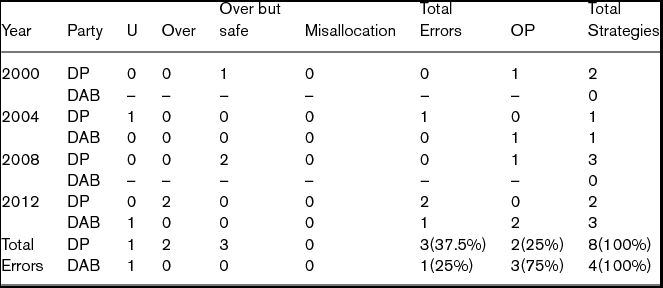
Table 5 shows the error and optimal performance rates of the DP and the DAB. Lists which are not engaged in vote pooling (multiple lists in one party label-Quasi-SNTV) are counted as the party's strategies; lists engaged in vote pooling either under any party label or a camp's coordination around a list (e.g. the ‘Diamond List’ in New Territories East in 2004) are not included since a single list under one party label is normal under LRPR globally and seats become expensive. As Table 5 shows, multiple lists do not always maximize seats for the two parties. If coordination is not done well either at the nomination level or the campaign level, the situation becomes even worse than coordination around a single list (e.g. see Table 4: the DP in New Territories West in 2012). The information in Table 3 also substantiates that parties are less likely to commit different types of errors when the district magnitudes are small, such as in Kowloon East and Kowloon West. In contrast, the error rates are higher when district magnitude increases such as in New Territories East and New Territories West (Cox and Niou, Reference Cox and Niou1994; Cox and Shugart, Reference Cox and Shugart1995; Wang, Reference Wang2008).
The error and optimal performance rates of the DP and the DAB

Notes: 1. U = Undernomination, Over = Overnomination, OP = optimal performance.
2. Overnomination but safe is not counted as an error as in Wang's definition since the MAXS is still reached.
The DP's error rate is 37.5%, and the optimal performance rate is only 25% (‘overnomination but safe’ is neither counted as an error nor optimal performance); the DAB's error rate is 25%, while their optimal performance rate is 75%. It is evident that the strategic coordination of the DAB is better than that of the DP. In particular, the pro-China camp is more internally cohesive, which helps the strategic coordination succeed. The DP's failure can be attributed to its internal conflicts and the lack of coordination among pro-democracy parties and candidates in the nomination and campaign stages. Take 2012 for example, the DP committed errors of overnomination in the nomination stage in New Territories West and in New Territories East. In the campaign stage, the Civic Party and the DP suffered from attacks by their radical colleagues in the LSD, People Power, and New Democrats (Yip and Yeung, Reference Yip and Yeung2014). In addition, the Civic Party asked the DP supporters to vote for them which caused the pro-democracy camp as a whole to lose some seats (Cheng, Reference Cheng2010).Footnote 23 This situation is especially apparent in the 2012 LegCo election, as is evident in Table 4.
Although multiple lists of the DAB starting from 2004 are the result of some candidates’ insistence (Yuen Han Chan in Kowloon East), actually the DAB has fewer internal conflicts than the DP. In addition to the DAB's long-term community service endeavors, their success can also be attributed to the pro-China camp's united-front machinery. This canvassing machinery enables the pro-China camp to allocate votes equally and maximize seats (Cheng, Reference Cheng2010). From the experiences of the DP and the DAB, quasi-SNTV is more effective whenever the political camp is more internally coherent and there is an overriding authority to boost coordination in both the nomination and campaign levels.
Conclusions
Cox and Shugart's (Reference Cox and Shugart1995, Reference Cox and Shugart1996) research on Colombia finds that quasi-SNTV is a result of parties’ inability to control their party labels and the competition is similar to that of SNTV. Moreover, quasi-SNTV and SNTV are prone to exhibit different types of errors (undernomination, overnomination, and misallocation) because a vote division strategy is often difficult to accomplish (Yu, Reference Yu1999). Lots of factors have to assist the vote division strategy simultaneously in order for it to reach optimal performance.
Cox and Shugart's argument has been substantiated in LRPR in the LegCo elections in Hong Kong. Similarly, factional struggles between the mainstream and the Young Turks of the DP led to multiple lists in one party label (Ma, Reference Ma2001, Reference Ma, Hsin-chi, Siu-kai and Wang2002a, Reference Ma2002b; Choy, Reference Choy, Hsin-chi, Siu-kai and Wang2002). Although the DP occasionally wins more seats by multiple lists than one list, their error rates are higher than the optimal performance rate. As the DP's failure in New Territories West (Table 4) shows, sometimes even coordination around one single list would be better than multiple lists. Except 2004, in which there was a liaison group to coordinate pro-democracy parties and independents, there was not really an overriding authority to organize the strategic coordination. In this sense, pro-democracy parties or independents often fail to coordinate at both the nomination and campaign levels. Moreover, the moderate pro-democracy parties such as the DP are often attacked by their radical colleagues (e.g. the LSD) during campaigns.Footnote 24 As a result, the DP often loses seats by a narrow margin and the lack of strategic coordination in the pro-democracy camp may be a main factor resulting in the DP's failure.
The DAB began to split lists in Kowloon East upon its member's request in 2004. They did not put forward multiple lists in 2008, but they ran multiple lists again in 2012. Since 2008, the pro-China camp adapted the united-front strategy and the DAB was obligated to obey it. Except New Territories East in 2012, the DAB's multiple lists succeeded. In particular, the pro-China camp's united-front strategy not only facilitates positive coordination in both the nomination and campaign stages but also helps the DAB reach optimal performance. The success of the DAB demonstrates that the pro-China camp's united front machinery can help it succeed under quasi-SNTV.Footnote 25
Quasi-SNTV appears in the pre-reform system in Colombia when Colombian parties cannot control their party label. Because of the absence of vote-pooling, which is similar to that of SNTV, parties are likely to commit errors. If parties can allocate their votes equally across their lists, multiple lists can help them obtain more seats than putting forward one single list since parties can win with the cheapest seats (won by the largest remainder instead of the quota) and gain the most seats. Similar to the experience of Colombian parties, multiple lists in the DP and the DAB in Hong Kong result from their inability to control their party label. As a result, multiple lists do not always work well. In some cases, multiple lists can sometimes result in a worse performance than coordinating around one single list. Although there was strategic coordination in the pro-democracy camp in 2004, the coordination in general was nevertheless weak among pro-democracy parties. The errors in the nomination stage and lack of coordination in the campaign stage indicate that there is not an overriding authority to coordinate pro-democracy parties and candidates and thus they are not under any obligation to coordinate strategically. In contrast, the pro-China camp's strong capability for strategic coordination – the united front machinery – has performed very well.
In conclusion, the quasi-SNTV in Hong Kong offers two important implications for the literature of electoral systems and electoral coordination. First, similar to Colombian parties, multiple lists result from the political parties’ inability to control its lists. Although the presentation of multiple lists is not a deliberate strategy in the beginning, both the DP and the DAB find that multiple lists can help them gain more seats while winning by remainders than by quotas. Second, the key difference between the quasi-SNTV systems found in Colombia and Hong Kong is that in the latter, better strategic coordination and stronger alliances among political parties lead to more successful election results than in the former. The political party can reach optimal performance not only by putting forward adequate number of lists (MAXS) and allocating votes evenly but also by strategic coordination with its alliances. The united-front machinery of the pro-China camp is a good example of strong strategic coordination in both levels which facilitates the DAB's optimal performance.
About the author
Chia-yin (Judy) Wei got her Ph.D. in political science at the University of South Carolina at Columbia in the United States in 2016. She is currently a post-doctoral research fellow in Center for East Asia Democratic Studies in National Taiwan University in Taipei, Taiwan. She specializes in economic voting, political communication, democratization, electoral system, and area studies (Taiwan, Hong Kong, and Mexico). Her dissertation entitled ‘Information Heterogeneity and Economic Voting: A Cross-National Analysis’ explores the effect of information sources (especially the media) on national economic evaluations and their subsequent voter choice in comparative perspective. In particular, her M.A. thesis completed at National Taiwan University explores the evolution of political parties in Hong Kong after 1997. This paper is an extension of her thesis and long-term interest in politics in Hong Kong.
Appendix: The Basic Law of Hong Kong Special Administrative Region
The Basic Law Annex II: Method for the Formation of the Legislative Council of the Hong Kong Special Administration Region and Its Voting Procedures.
-
Instrument 3: Proclamation of the Standing Committee of the National People's Congress (11th National People's Congress) No.15
-
Intrument 4: Amendment to Annex II to the Basic Law of the Hong Kong Special Administration Region of the People's Republic of China Concerning the Method for the formation of the Legislative Council of the Hong Kong Special Administration Region and Its Voting Procedures (Recorded at the 16th Session of the Standing Committee of the 11th National People's Congress on August 28, 2010).
-
Instrument 19: Decision of the Standing Committee of the National People's Congress on Issues Relating to the Methods for Selecting the Chief Executive of the Hong Kong Special Administrative Region in the Year 2007 and for Forming the Legislative Council of the Hong Kong Special Administrative Region in the Year 2008 (Adopted at the Ninth Session of the Standing Committee of the Tenth National People's Congress on April 26, 2004), http://www.basiclaw.gov.hk/en/basiclawtext/index.html [accessed 24 April 2014].