Introduction
In order to comply with biological cleanliness levels agreed upon in international treaties, the National Aeronautics and Space Administration (NASA) mandates that robotic spacecraft shall be assembled and encapsulated in clean-room environments (Rummel Reference Rummel1992). Clean rooms are specialized facilities that minimize both the influx and residence time of particulate matter via stringent methods of air-filtration and cleaning. High efficiency particulate air (HEPA) filters theoretically remove 99.97% of airborne particles larger than 0.3 μm (Aviation-Safety 2004). Regulation of temperature, humidity, and pressure gradients coupled with strict maintenance and cleaning regimes minimize microbial persistence (NASA-KSC 1999). Such facilities are extensively used in the pharmaceutical, medical and semiconductor industries. Clean-room environments are typically arid, nutrient availability is scarce (Moissl et al. Reference Moissl, La Duc, Osman, Dekas and Venkateswaran2007b) and the periodic use of chemical disinfectants helps to keep surfaces sanitary. However, a growing body of work has shown that even in this harsh environment diverse microbial populations persist, maintaining a suite of resistances to desiccation, oxidizing sterilants, and γ- and ultraviolet irradiation (La Duc et al. Reference La Duc, Nicholson, Kern and Venkateswaran2003; La Duc et al. Reference La Duc, Kern and Venkateswaran2004a; Newcombe et al. Reference Newcombe, Schuerger, Benardini, Dickinson, Tanner and Venkateswaran2005; Osman et al. Reference Osman, Peeters, La Duc, Mancinelli, Ehrenfreund and Venkateswaran2008b). Diverse microbial consortia have been uncovered on surfaces within both the MIR and the international space stations (Pierson Reference Pierson2001; Valadez et al. Reference Valadez, Thrasher, Ott and Pierson2002; Castro et al. Reference Castro, Thrasher, Healy, Ott and Pierson2004), robotic spacecraft (La Duc et al. Reference La Duc, Nicholson, Kern and Venkateswaran2003; Crawford Reference Crawford2005), and the facilities in which each have been assembled and encapsulated (Satomi et al. Reference Satomi, La Duc and Venkateswaran2004; Kempf et al. Reference Kempf, Chen, Kern and Venkateswaran2005; Moissl et al. Reference Moissl, Hosoya, Bruckner, Stuecker, Roman and Venkateswaran2007a,Reference Moissl, La Duc, Osman, Dekas and Venkateswaranb; Moissl et al. Reference Moissl, Bruckner and Venkateswaran2008). While knowledge pertaining to the presence of microbes on such surfaces is growing, little is known about the microbial burden contained within the air of these enclosures (La Duc et al. Reference La Duc, Stucker and Venkateswaran2007b; Moissl et al. Reference Moissl, Hosoya, Bruckner, Stuecker, Roman and Venkateswaran2007a; Osman et al. Reference Osman, Duc, Dekas, Newcombe and Venkateswaran2008a) and clean rooms. There is a well-founded concern that microbes enduring these inhospitable environments could gain access to spacecraft hardware, possibly survive an interplanetary journey, and subsequently compromise in-situ life-detection experiments on Mars.
To measure the bioburden on any given spacecraft, surface samples are obtained via swabbing, and standard culturing protocols are employed to enumerate spore-forming bacteria (Anonymous 1980). To gain a better understanding of the microbial populations associated with spacecraft surfaces, molecular microbial techniques have recently been employed (La Duc et al. Reference La Duc, Nicholson, Kern and Venkateswaran2003; La Duc et al. Reference La Duc, Kern and Venkateswaran2004a). These techniques, while powerful, are often rendered impotent by a myriad of technical hurdles not encountered in forensic or medical applications. Hardware compatibility issues, the finite amount of accessible surface available and the limited basis on which such projects occur significantly limit the ability to obtain representative samples from the surfaces of spacecraft. It has been suggested that microbial populations housed within the facilities where assembly, testing and encapsulation activities occur will roughly represent the bioburden associated with any co-located spacecraft (Puleo et al. Reference Puleo, Fields, Bergstrom, Oxborrow, Stabekis and Koukol1977; Venkateswaran et al. Reference Venkateswaran, Satomi, Chung, Kern, Koukol, Basic and White2001). To this end, researchers have placed great emphasis on the continuous assaying of microbial diversity contained within the clean-room facilities where spacecraft are assembled and tested (Venkateswaran et al. Reference Venkateswaran, Satomi, Chung, Kern, Koukol, Basic and White2001; La Duc et al. Reference La Duc, Satomi, Agata and Venkateswaran2004b).
Human activity is thought to be the principal vector for particulate entry into these environments (Favero et al. Reference Favero, Puleo, Marshall and Oxborrow1966), and as microbes accumulate, the potential for colonization, proliferation and shedding increases (Ahearn et al. Reference Ahearn, Crow, Simmons, Price, Mishra and Pierson1997; Simmons et al. Reference Simmons, Price, Noble, Crow and Ahearn1997; Verdenelli et al. Reference Verdenelli, Cecchini, Orpianesi, Dadea and Cresci2003). Air sampling is therefore a significant aid in assessing the efficacy of filtration and impact of human activity on clean-room housed microbial diversity and burden. In this study, air samples were collected from the Kennedy Space Center Payload Hazardous Servicing Facility (PHSF) prior to, during and following the assembly, testing and launch operations (ATLO) of the Mars Exploration Rovers (MERs). Both culture-based and molecular analyses were carried out as a means of comparatively assessing microbial diversity and overall bioburden.
Materials and Methods
Payload Hazardous Servicing Facility
The PHSF, located at the Kennedy Space Center, Florida, comprises both certified clean rooms and uncertified annexes. During this study air samples were collected from the hazard operations and service bay, a certified clean room used for ATLO. This 32.6 m (length)×18.4 m (width)×29.0 m (ceiling height) bay was maintained with daily cleaning regimens consisting of replacing tacky mats at all entry points, wiping surfaces and support hardware fixtures and vacuuming and mopping floors using clean-room certified sanitizing agents (disinfectants, alcohol or ultrapure water). The composition of the clean-room sanitizing agents is proprietary, but quality control and environmental measures regarding the PHSF bay were documented in an in-house publication (NASA-KSC 1999) and are summarized below. Prior to entering the clean room, staff must take appropriate actions to minimize the influx of particulate matter. Specific entry procedures varied depending on the certification level of the clean-room and the presence or absence of mission hardware. Precautions generally included the donning of clean-room certified suits coupled with the prohibition of cosmetics, fragrances, body spray and hair gels.
Environmental monitoring system of the PHSF
Temperature, relative humidity and airborne particle concentration were continuously monitored and recorded. An environmental monitoring system (EMS) provided real-time data acquisition while physical measurements by PHSF personnel supplemented the EMS data. Surface particulate matter, non-volatile residue and volatile hydrocarbons were monitored using conventional methods (NASA-KSC 1999). EMS sensor sets were located in recessed purged cabinets in the west, south and north walls of the service bay and similar recesses in the south wall of the airlock. Each set contained a temperature sensor that reads °F, a relative humidity sensor (Vaisala Model 260EX) and a laser particle counter that measures airborne particle concentration (Met One model 237A).
Air enters the PHSF through HEPA filters mounted in the ceiling, airlock and equipment airlock, providing guaranteed class 5000 air into the facilities. These systems maintain temperatures of 21.7±3.3°C with a maximum relative humidity of 60%. Air is volumetrically exchanged a minimum of four times per hour, with positive pressure maintained at all times. The PHSF is a certified Class 100K (100 000 particles >0.5 μm ft−3 air) or ISO 8 (3 520 000 particles >0.5 μm m−3) clean-room facility.
Collection of air samples
Air samples were collected from four corners and one central location within the PHSF (see Table 1). In total, 10 samples (five locations in duplicate) were collected before (MER-B), during (MER-D) and after (MER-A) MER ATLO activities. Sampling occurred between 10:00 a.m. and 12:00 p.m. in all three collection events. The BioCapture BT-550 (Mesosystems Technology Inc.) sampler employed in this study collects 0.5 to 10 μm particles (optimum for cells and other small particles) from ambient air. Previous work has characterized the sampling efficiency of the BioCapture (BT-550) sampler using monodispersed fluorescent oleic acid particles and monodispersed fluorescent polystyrene latex particles (Kesavan et al. Reference Kesavan, Carlile, Doherty, Hottell and Sutton2003). The results showed that the BT-550 sampler had a peak sampling efficiency for 2 μm particles and the average peak sampling efficiencies for the sampler was 38% (Kesavan et al. Reference Kesavan, Carlile, Doherty, Hottell and Sutton2003). The flow rate of this light-weight (4.5 kg) field deployable sampler is 150 L min−1 (5.3 ft3 min−1). Each 750 L air sample (roughly equivalent to the volume of air human lungs exchange every 2 h) was impinged into 5 ml of sterile buffered saline by operating the sampler for a standard 5-min interval. Sample cartridges were placed on ice immediately following collection and were processed immediately upon returning to the laboratory. During this study the average time between sampling and lab analysis was 2 h. The air sampler was cleaned and sterilized before and after each sampling event using specialized cartridges supplied by the manufacturer.
Microbiological characteristics of PHSF air particulates

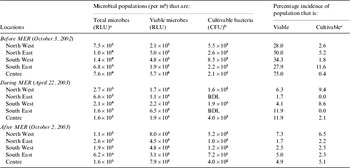
a Values represent a mean of two replicate samples.
b Values represent the mean of two replicate samples.
c RLU values were converted to cell numbers using conversion estimations from La Duc et al. 2007a. Percentage incidence values were generated by dividing viable by total values and cultivable by the viable value.
Cultivable bacterial population
Cultivable bacterial populations were estimated by plating 100 μl of the collection solution onto R2A agar (Difco) plates in duplicate. The plates were incubated at 25°C for seven days, and resulting colony forming units (CFU) were enumerated. Spore-forming bacterial populations were selected by sonicating samples for 2 min followed by heat-shocking at 80°C for 15 min. Appropriate aliquots of samples were placed into Petri dishes, in duplicate, using the pour plate technique with trypticase soy agar (TSA; Becton Dickinson and Co.) as a growth medium (Anonymous 1980). Colony-forming units were then enumerated after a seven-day incubation at 32°C. Isolates representative of both the total mesophiles and spore-forming populations were picked, purified and stored at −80°C for further processing and analysis. Identification of purified strains was determined based on 16S rDNA sequencing. Bacterial small subunit rRNA genes were PCR-amplified with eubacterially biased primers B27F and B1492R (Lane Reference Lane, Stackebrandt and Goodfellow1991). PCR conditions were followed as described elsewhere (Ruimy et al. Reference Ruimy, Breittmayer, Elbaze, Lafay, Boussemart, Gauthier and Christen1994). The PCR-amplified 16S rDNA fragments were purified using Qiaquick columns (Qiagen) and were fully bi-directionally sequenced.
Total and viable microbial population
A commercially available ATP-assay kit (Checklite HS +, Kikkoman Corporation) was used in accordance with the manufacturer's protocols to measure both intracellular and total ATP present in each air sample. A detailed description of the ATP assay to estimate total and viable microbial population was previously reported (Venkateswaran et al. Reference Venkateswaran, Hattori, La Duc and Kern2003; La Duc et al. Reference La Duc, Dekas, Osman, Moissl, Newcombe and Venkateswaran2007a). Briefly, to determine total ATP (total microbial population), 0.1 ml sample aliquots (two replicates for samples and four replicates for standards) were each combined with 0.1 ml of a cell-lysing detergent (benzalkonium chloride) and then incubated at room temperature for 1 min prior to the addition of 0.1 ml of luciferin-luciferase reagent. The sample was mixed and the amount of bioluminescence measured with a luminometer. To determine intracellular ATP (viable microbial population), 0.1 ml of an ATP-eliminating reagent (apyrase, adenosine deaminase) was added to a 1 ml portion of the sample, mixed, and allowed to incubate for 30 min to remove any extracellular ATP, after which the assay for ATP was carried out as described above. The dynamic range of this assay is from 5×10⁻¹² M to 10−7 M ATP, with one relative luminescence unit (RLU) corresponding to 2×10⁻¹⁴ M ATP as determined by linear regression analysis of standard curves with known ATP concentrations (Venkateswaran et al. Reference Venkateswaran, Hattori, La Duc and Kern2003).
Molecular bacterial community analysis
Bacterial diversity was examined via 16S rRNA gene amplification and cloning. DNA was extracted directly from 5 ml of sample using Wizard Genomic DNA Extraction Kits (Promega) and was used as a template for PCR. PCR conditions and primers were the same as described above for isolate identification. Clone libraries were generated by ligating 16S amplicons into pCR4-TOPO cloning vectors and transforming E. coli TOP-10 cells according to the manufacturer's protocol (Invitrogen). Inserts were amplified using M13R and T7 primers according to the manufacturer's protocols (Invitrogen). Purified amplification products were then digested with the restriction endonuclease Hha I (Promega) for 3 h at 37°C. Recombinant 16S rRNA gene sequences sharing similar restriction patterns were grouped and representatives from each distinct pattern group were fully bi-directionally sequenced. One representative clone was sequenced if the pattern occurred less than five times. Two recombinant 16S rRNA gene sequences were sequenced if the restriction pattern was observed from five or more clones. The phylogenetic relationships of organisms covered in this study were determined by comparison of individual 16S rDNA sequences with sequences in the public database described at http://www.ncbi.nlm.nih.gov/blast. Evolutionary trees of the cloned inserts or isolated strains were constructed via neighbour-joining, parsimony and maximum-likelihood methods described at http://paup.csit.fsu.edu. Bootstrapping (1000 replicates) analysis was performed to avoid sampling artefacts. Evolutionary trees were constructed using PAUP software (Swofford Reference Swofford1990) or MEGA 4.0 (http://www.megasoftware.net/m_con_select.html).
Statistical analysis and bacterial diversity estimation
Appropriate statistical analyses were performed as per manufacturers' instructions using software specific for each assay or with the MS Excel software package. For example, an additional measurement was taken from samples when the coefficient of variation exceeded 10% for ATP analyses, and standard deviations were calculated whenever appropriate. Rarefaction analysis (Heck et al. Reference Heck, van Belle and Simberloff1975) and coverage calculations (Good Reference Good1953) were applied to estimate the representation of the phylotypes in bacterial libraries. Operational taxonomic units (OTUs) were defined as recombinant 16S rRNA gene sequences sharing more than 97.5% sequence identity (Stackebrandt & Goebel Reference Stackebrandt and Goebel1994; Rossello-Mora & Amann Reference Rossello-Mora and Amann2001; Lawley et al. Reference Lawley, Ripley, Bridge and Convey2004). The DOTUR-1.53 program (Schloss & Handelsman Reference Schloss and Handelsman2005), which considers distance matrix in describing genetic distance between sequences and assigning them to OTUs, was used to analyse the data generated in this study. DOTUR uses the frequency at which each OTU was observed to construct rarefaction curves. The sequences were aligned by using ClustalW (http://www.ebi.ac.uk/Tools/clustalw2/index.html), and a Jukes-Cantor corrected distance matrix was constructed by using the DNADIST program from PHYLIP (http://bioweb.pasteur.fr/seqanal/interfaces/dnadist-simple.html). The rarefaction curve was produced by plotting the number of OTUs observed against the number of recombinant 16S rRNA gene sequences screened, using DOTUR as well as the Analytic Rarefaction 1.3 software (http://www.uga.edu/~strata/software/index.html). Both analyses generated identical rarefaction curves. The coverage of clone libraries was calculated according to the equation: C=[1−(n 1/N)]×100 (Good Reference Good1953), where C is the homologous coverage, n 1 is the number of OTUs appearing only once in the library and N is the total number of recombinant 16S rRNA gene sequences examined. Environmental cluster Unifrac analysis was performed (Lozupone & Knight Reference Lozupone and Knight2005; Lozupone et al. Reference Lozupone, Hamady and Knight2006) for comparing microbial communities from three different samples using phylogenetic information. P-tests were performed to test how significantly each pair of environments differs from one another. UniFrac P values were based on comparisons with 1000 randomized trees. Jackknife environment clustering was also carried out. This analysis samples a smaller number of sequences from each environment and determines whether the clusters are well supported. Finally, Principal Coordinates Analysis (PCA) was performed to understand which environments are most closely related to one another.
Controls and lower detection limits of assays employed
Appropriate controls were used at each step of the sampling and analysis to ensure high-quality data. Liquid samples from unopened sample cartridges served as negative controls in all molecular assays. In the same manner, sterilized water, free of ATP and nucleic acids, served as a blank to monitor reagent cleanliness. Standard curves for ATP analysis were generated by analysing pure ATP (Sigma) serially diluted in sterile, ATP-free water. Purified DNA from Bacillus pumilus ATCC 7061 was included in the PCR amplification protocols as a positive control. In this manner, samples containing inhibitory substances were monitored for false negative results. None of the sample matrices used in this study inhibited the PCR reaction as shown by internal DNA standards. Internal standards consisted of 1 pg extracted B. pumilus genomic DNA added to a PCR reaction. The lower detection limits were more than 30 CFU/100 μl (1.0×10³ CFU m−3) for the cultivable plate count assay and more than 50 RLU/100 μl (1.7×10³ RLU m−3) for the ATP assay.
UV254 resistance
Isolated strains were diluted in phosphate-buffered saline (PBS, pH 7.2) to a density of 106 CFU ml−1. Initial cell density was estimated via dilution plating prior to each exposure. A low-pressure handheld mercury arc-UV lamp (UVP, Inc.; model UVG-11) was placed over the sample and UV flux at the surface of the cell suspension was measured using a UVX digital radiometer (UVP, Inc.). The exposure time to produce 1000 J m−2 of energy at the sample surface was 167 s at 600 μW cm−2. The cell suspension was placed in an uncovered 100 mm glass petri dish containing a magnetic stir bar and exposed to UV254 irradiation under sterile conditions. In a qualitative screen, strains surviving 100 J m−2 irradiation were selected for quantitative lethal dose curve analysis. Sample volumes of 100 μl were removed after specific time periods, serially diluted and plated on TSA plates.
Results
Traffic into and out of the PHSF facility is strictly controlled and is limited to certified clean-room personnel. Based on the data retrieved from identification badge readers, only janitorial staff were present inside the facility on the dates when MER-B and MER-A samples were collected. However, roughly 50 engineers and scientists were busy conducting various activities on the day of MER-D sampling. It must be noted that certain personnel were granted close proximity to the spacecraft hardware for the purposes of assembly and testing, whereas the air samples discussed herein were collected at a distance in excess of 20 m removed from the assembly area.
Particle counts
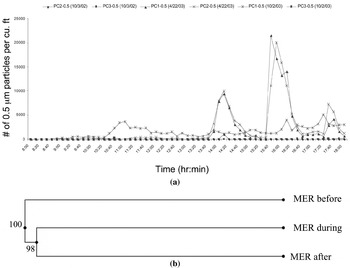
Airborne particle counts within the PHSF at the time of sample collection are shown in Fig. 1(a). In general, the PHSF housed a very low number of particles, with the number of 0.5 μm particles per ft3 rarely exceeding 23 000. The low counts observed in the morning hours were in direct correlation with little to no human activity in the PHSF. Particle counts increased throughout the day and peaked in the late afternoon, again correlating with increased human activity in the PHSF. This trend was observed for most days of MER ATLO (data not shown). Upon collection of the MER-D samples on April 22, 2003, there was a particle count spike observed in the morning hours, with counts remaining relatively high (1000 to 3000 particles ft−3) for the remainder of the day. This particle count anomaly coincided with a far greater occupancy of the PHSF by MER personnel than was witnessed when collecting the MER-B and MER-A samples.
(a) Particle counts in the PHSF bay before (10/3/02), during (4/22/03), and after (10/2/03) MER ATLO. Two individual measurements for each time period of collection are given. The particle counts are measured continuously without interruption for 24 h at a 20 min time interval throughout the year, but for convenience data measured on three particular days between 8 a.m. and 6 p.m. are depicted here. (b) Unifrac environment cluster analysis of 16S rRNA gene sequences from MER before, after and during assembly. The environment was supported by Jackknife count, which will sample a smaller number of sequences (10) from each environment and indicates whether the clusters are well-supported. Values on the node of the tree indicate Jackknife count. MER after and during the environments cluster together compared to MER before with strong Jackknife count (98 and 100 respectively).

Cultivable bacterial population
The cultivable bacterial population contained within PHSF air samples collected during this study is depicted in Table 1. Sample MER-B contained the highest number of cultivable microbes (5.5×10³ to 2.6×10⁴ CFU m−3) while much lower counts were observed in samples MER-D (0 to 1.9×10⁴ CFU m−3) and MER-A (7.2×101 to 1.2×10³ CFU m−3). Cultivable microbes were recovered in greatest frequency from the northeast corner of the bay during the MER-B sampling, and in the southwest corner during the MER-D and MER-A sampling events. The variation in cultivable counts between locations was significant throughout all sampling events. As none of the samples subjected to heat shock (80°C, 15 min) yielded colonies on TSA medium, bacterial spores, if present at all, existed in numbers below detection limits.
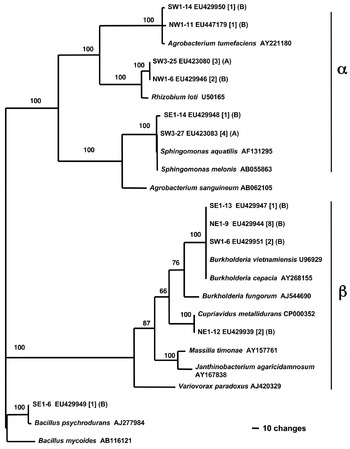
Sequence analysis of 16S rRNA genes demonstrated that nearly every isolate was of either α- or β-Proteobacterial lineage (Fig. 2). A lone relative of Bacillus psychrodurans, a Gram-positive Firmicute, was the only exception. Numerous isolates were closely related to members of the Burkholderia genus, while others exhibited great sequence similarity to species of Agrobacterium, Rhizobium and Sphingomonas. Bacteria isolated from the MER-B samples spanned the α- and β-Proteobacteria phyla, whereas isolates arising from the MER-A samples represented only β-Proteobacteria. Isolates representative of the MER-D sampling were enumerated on site, but as samples were compromised during shipping back to the lab no useful data concerning phylogenetic affiliation were generated.
Phylogenetic tree based on 16S rRNA gene sequence analysis for cultivable bacteria. The numbers after the names of the bacteria are the GenBank nucleotide accession numbers, and the number of strains sequenced are given in squared brackets. The tree is a result of a consensus topology obtained after the evaluation of multiple trees by using neighbour-joining, maximum-parsimony and maximum-likelihood algorithms. Numbers above the lines are the percentage bootstrap values of 1000 replications of that branch of the tree.

Total and viable microbial populations
Total and viable microbial populations were estimated via measurements of sample ATP content, as shown in Table 1. MER-A samples yielded the lowest values of both total and viable bioburden. MER-B samples gave rise to the greatest microbial burden, where as MER-D samples, taken while personnel occupied the PHSF for ATLO, yielded values that fell between those of MER-B and MER-A (Table 1). No discernable trends were observed spatially between samples. In all samples, except the southwest corner, total and viable microbial population estimates decreased at each sampling during the study period. Variability between locations was significant throughout the study.
Molecular bacterial diversity
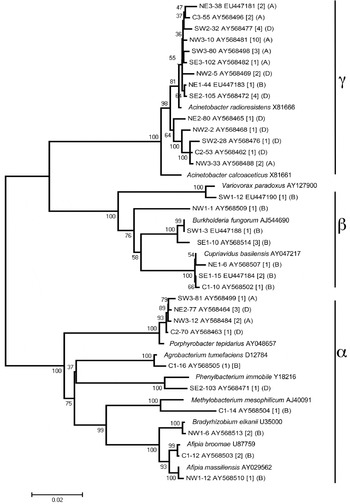
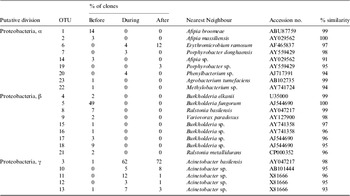
All 16S rRNA gene sequences retrieved from the air samples examined were of Proteobacterial lineage (Fig. 3). Restriction fragment length polymorphism (RFLP) patterns suggested, and sequence analysis confirmed the presence of 23 distinct OTUs collectively from all air samples. Samples collected before MER ATLO yielded 16 OTUs, while samples taken during and after MER ATLO contained eight and seven OTUs, respectively (Table 2). About 60% of the recombinant 16S rRNA gene sequences examined (16 out of 23 OTUs) exhibited greater than 97% 16S rRNA gene sequence similarity to known bacterial taxa. However, the remaining 30% of clone sequences did not contain 16S gene similarities necessary for potential species designation (91% to 96%; Table 2). The most dominant genus found in all air samples was Acinetobacter, which accounted for greater than 80% of the recombinant 16S rRNA gene sequences in the MER-D and MER-A libraries, and 2% of the MER-B sequences. The greatest bacterial diversity was observed for the MER-B clone library. The 13 OTUs present in MER-B library were dominated by Afipia broomeae and Burkholderia fungorum, 14% and 49%, respectively (Fig. 3). None of the samples yielded 16S rRNA gene sequences belonging to the Firmicutes phylum. The frequencies of unique clone insert sequences in the libraries were used as an estimate for the diversity contained within the air samples.
Molecular bacterial diversity analysis of PHSF air before (B), during (D), and after (A) MER ATLO. The numbers after the names of the bacteria are the GenBank nucleotide accession numbers and the number of clones sequenced are given in squared brackets. The tree is a result of a consensus topology obtained after the evaluation of multiple trees by using neighbour-joining, maximum-parsimony and maximum-likelihood algorithms. Numbers above the lines are the percentage bootstrap values of 1000 replications of that branch of the tree.

Affiliation and distribution of bacterial 16S rRNA gene sequences analysed in air samples taken before, during and after MER ATLO

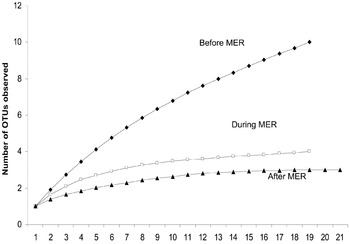
Coverage values for the MER-PHSF air samples ranged from 60% to 95%. The lower coverage index for the MER-B samples (60%) indicated that these samples possessed higher diversity than could be resolved with the number of recombinant 16S rRNA genes sequenced. Three of the MER-D OTUs were encountered only once, yielding 84% coverage, while only one OTU occurred only once in the MER-A sample, corresponding to 95% coverage. This analysis confirmed that the greatest diversity existed in MER-B samples taken before MER ATLO began. While the diversity in MER-D and MER-A samples is very similar, MER-D samples exhibited slightly more diversity than MER-A samples. Figure 4 shows the rarefaction curves generated from clone sequence data for each of the samples. A plateau, indicating more complete coverage in sampled biodiversity, was approached in the MER-D and MER-A samples. As mentioned above, clone library coverage values for MER-B samples was low and thus the rarefaction curve did not reach a plateau, indicative of an incomplete sampling of bacterial diversity.
Rarefaction curves constructed for bacterial clone libraries from PHSF air before, during, and after MER ATLO. The DOTUR-1.53 program (Schloss & Handelsman Reference Schloss and Handelsman2005), which considers distance matrix in describing genetic distance between sequences and assigning them to OTUs, was used to analyse the data. DOTUR uses the frequency at which each OTU was observed to construct rarefaction. The sequences were aligned by using ClustalW, and a Jukes-Cantor corrected distance matrix was constructed by using the DNADIST program from PHYLIP. The rarefaction curve was produced by plotting the number of OTUs observed against the number of recombinant 16S rRNA gene sequences screened using DOTUR.

UniFrac analysis found that the bacterial diversity among the three clone libraries tested was significantly different, and that the diversity from MER-D and MER-A samples clustered with each other (Fig. 1(b)). The P value for each pairwise comparison was greater than 0.03, indicative of a marginally significant difference between each environment. The Jackknife analysis conducted to assess confidence in the nodes of the environmental clustering showed that the nodes of groups MER-B, MER-D and MER-A were recovered more than 98% of the time, with 10 sequences per environment. The PCA results, with output as a scatterplot of first two principle components (data not shown), indicate that MER-D and MER-A clustered together, as compared with MER-B. Unifrac results were in agreement with those of BLAST: MER-B microbial diversity was significantly different from that of MER-D and MER-A.
Resistance to UV254
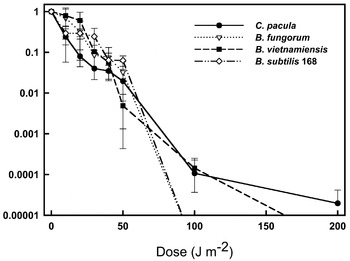
Among 26 isolates tested, three strains survived an initial 100 J m−2 UV irradiation screening and were thus selected for further quantitative inactivation studies. The results summarized in Fig. 5 show the inactivation curves for three strains, closely related to Cupriavidus paucula, Burkholderia fungorum and B. vietnamiensis respectively, as well as vegetative Bacillus subtilis cells. The starting concentration of cells was within ±10% of 106 CFU ml−1 and the data were normalized by dividing the measured cellular concentration (N) by the initial concentration (N 0). For this experiment, a 5-log reduction was considered a negative result and not significant. Vegetative cells of B. subtilis 168 were used as a control in these studies, as spores of this strain are commonly used in UV dosimetry experiments. One airborne MER isolate, the C. paucula NE1-12, survived a 200 J m−2 dose (Fig. 5). Cells of this isolate were detectable after receiving 500 J m−2 but the numbers fell below the threshold value assigned for significance.
Effect of UV254 irradiation on vegetative cells of PHSF air isolates. The error bars represent the standard deviation of three replicate samples.

Discussion
The goal of this study was to better understand the impact of human activity on airborne microbial populations within the clean-room facility in which the MERs underwent final preparations for launch. Phylogenetic affiliations of isolated bacteria, Cupriavidus sp. and Burkholderia sp. were consistent with those of the clone libraries for the α-Proteobacteria, and a β-Proteobacterial isolate was similar to Agrobacterium sp. (Figs 2 and 3). Isolated bacteria phylogenetically similar to Cupriavidus sp. and Burkholderia sp. were consistent with the β-Proteobacterial species found in the clone libraries while isolates similar to Agrobacterium sp. were the only α-Proteobacteria consistent with clone library members (Figs 2 and 3). Overall, isolates closely related to α-Proteobacteria were solely obtained from MER-B samples while isolates related to β-Proteobacteria were found in both MER-A and MER-B samples. These results indicate the utility of analysing the phylogenetic characteristics of isolates as a complement to molecular analysis. In corollary, the differences observed in microbial diversity as a function of diversity was not captured in the molecular analyses.
Analysis of airborne bacterial molecular diversity revealed both similarities and differences with respect to predominance, phylogenetic affiliation and species richness during the sampling time points (Fig. 2, Table 2, Fig. 3). MER-B air samples contained twice as many OTUs as either MER-D or MER-A air samples (Table 2), indicative of a greater airborne diversity prior to ATLO activities. MER-D and MER-A clone libraries were comprised of only five to six OTUs, generating a much flatter rarefaction curve. Only two OTUs were observed in both MER-D and MER-A libraries, whereas none of the recombinant 16S rRNA gene sequences retrieved from MER-B samples were observed in either the MER-D or MER-A clone libraries. While larger clone libraries would almost certainly have yielded more information regarding airborne diversity, technical limitations associated with low-biomass (Table 1) allowed for analysing only 100 clones (sequencing 20 to 25 clones) from each sample. Despite this limitation, it was clear that MER-B samples gave rise to the greatest biodiversity (Fig. 3), and this was confirmed significant via rarefaction. The Unifrac environmental cluster analysis also supported that MER-B clustered differently when compared with MER-D and MER-A samples.
Clones containing DNA related to β-Proteobacteria (Burkholderia, Variovorax and Cupriavidus) (Table 2, Fig. 3) were retrieved solely from libraries representative of MER-B samples. The greatest number of MER-B recombinant 16S rRNA gene sequences were related to B. fungorum. This result is not surprising since species of Burkholderia occupy remarkably diverse ecological niches, ranging from the rhizosphere to infections of the central nervous systems of deer and pigs (Coenye & Vandamme Reference Coenye and Vandamme2003). While not a member of the venerable B. cepacia complex, B. fungorum is related to the 30 known species of Burkholderia that metabolize a wide variety of complex organic compounds including trichlorophenoxyacetic acid and polycyclic aromatic hydrocarbons (References et al. Reference References, Daubaras, Hershberger, Kitano and Chakrabarty1995; Coenye & Vandamme Reference Coenye and Vandamme2003). Species of Variovorax have been shown to utilize dichlorophenoxyacetic acid and homovanillate as sole sources of carbon. Such data leads the authors to ponder the possible inadvertent supplying of microbiota with a food source in the cleaning agents employed to eradicate them. Recombinant 16S rRNA gene sequences related to species of Cupriavidus were present only in MER-B samples. Members of this genus have adapted to survive in the presence of otherwise toxic metals, degrade chlorinated aromatics, and can live a chemolithotrophic lifestyle (Steinle et al. Reference Steinle, Stucki, Stettler and Hanselmann1998; Ledrich et al. Reference Ledrich, Stemmler, Laval-Gilly, Foucaud and Falla2005). The metabolic diversity available to these α- and β-Protoebacteria could potentially facilitate the metabolism of complex organic molecules and enhance survival in these relatively dry, oligotrophic environments.
Recombinant 16S rRNA gene sequences related to species of Acinetobacter were retrieved in varying abundance from all sample libraries. Members of this genus are tolerant to desiccation, show varying resistance to γ- and UV-irradiation, and some even secrete a protein that emulsifies aliphatic and aromatic hydrocarbons (Christensen et al. Reference Christensen, Gerner-Smidt and Kristensen1991; Jawad et al. Reference Jawad, Snelling, Heritage and Hawkey1998; La Duc et al. Reference La Duc, Nicholson, Kern and Venkateswaran2003; Walzer et al. Reference Walzer, Rosenberg and Ron2006). Acinetobacter sp. recombinant 16S rRNA gene sequences were scarce (2%) in the MER-B libraries but dominated MER-D and MER-A libraries (>80%) (Table 2). Once spacecraft hardware enters the PHSF for ATLO, strict hygiene and cleaning regimes are implemented. Since floors and easily accessed surfaces are regularly cleaned with deionized water and disinfectants, observed population shifts could be a mere consequence of selection. Perhaps only the more tolerant Acinetobacter species, some capable of surviving several months in a desiccated state (Kramer et al. Reference Kramer, Schwebke and Kampf2006; Osman et al. Reference Osman, Peeters, La Duc, Mancinelli, Ehrenfreund and Venkateswaran2008b), are able to endure these more stringent conditions. Some Acinetobacter species have been shown to be opportunistic human pathogens, and the increase in their presence did correspond with intervals of elevated human activity (Poirel et al. Reference Poirel, Figueiredo, Cattoir, Carattoli and Nordmann2008). A recent study revealed that microbial populations colonizing the surfaces of several spacecraft-related clean rooms were unique to the specific room and did not phylogenetically cluster with those collected from within similar rooms at other locations, nor with samples taken outside the facilities (Moissl et al. Reference Moissl, La Duc, Osman, Dekas and Venkateswaran2007b).
One surprising result from this study was the conspicuous absence of Firmicutes. While the MER-B sample yielded a single colony of Bacillus psychrodurans on R2A agar, this result alone cannot be considered statistically significant and therefore no confidence can be assigned to the recovery of this spore-forming Gram-positive bacterium. Numerous surveys of microbial diversity contained within spacecraft assembly facilities over the past five years have revealed that 85% of the total cultivable bacteria on surfaces (spacecraft surfaces, floors, cabinets and tabletops) were Gram-positive (Venkateswaran et al. Reference Venkateswaran, Satomi, Chung, Kern, Koukol, Basic and White2001; La Duc et al. Reference La Duc, Nicholson, Kern and Venkateswaran2003; Venkateswaran et al. Reference Venkateswaran, Hattori, La Duc and Kern2003; La Duc et al. Reference La Duc, Satomi, Agata and Venkateswaran2004b). Furthermore, around 65% of these strains survived heat-shock protocols used to select for the isolation of bacterial spores. In all, 15 different species of Bacillus accounted for more than 91% of the heat-shock surviving isolates, with B. licheniformis most prevalent (25%) followed by B. pumilus (16%). During a recent comprehensive survey of bacterial diversity within the PHSF during Mars Reconnaissance Orbiter ATLO, spore-forming bacteria were readily isolated from all facility surfaces and represented a significant portion of the observed diversity in clone libraries (La Duc et al. Reference La Duc, Stucker and Venkateswaran2007b). While speculative explanations can be put forth (most relating to spore accumulation and adherence to surfaces over time), the absence of airborne spores within the PHSF environment in this study remains enigmatic. Regardless of such explanation, this disparity in spore presence between surfaces and air samples suggests that, while useful in assaying the entire biodiversity to which a spacecraft is exposed, sampling of facility air may not be a good surrogate for the biodiversity of the spacecraft itself.
The rapid intracellular ATP assay employed in this study allows for the approximate enumeration of viable but non-culturable organisms present in a sample. By comparing values representing average intracellular ATP content with those of total ATP content, inferences can be drawn regarding the contribution of intact cells to the total ATP pool of a given sample. In this study, the ATP assay was utilized to estimate the total number of airborne microbes present, and the fraction of that which was viable. In previous studies, swabbed surface samples originating from clean-room floors harboured concentrations of unbound, extracellular ATP two to three orders of magnitude greater than those of intracellular ATP (Venkateswaran et al. Reference Venkateswaran, Hattori, La Duc and Kern2003). In the current study MER-B samples maintained a very high intracellular to total ATP ratio (Table 1), where total ATP values never exceeded intracellular values by more than an order of magnitude. Surfaces might accumulate microbial cells and other ATP-rich biomatter, while air samples do not. Therefore the smaller total ATP to intracellular ATP ratio observed in air samples may be attributed to the scarcity of detritus materials and other large bioparticulates (human skin cells) in the air. Alternatively, this difference may be a consequence of bias associated with the air sampler, which optimally collects particles from 0.5 to 10 μm. The percentage occurrence of viable microbes, derived by dividing intracellular ATP values by total ATP values, was very high (28% to 75%) in MER-B samples. Both MER-D and MER-A samples harboured a significantly less viable microbial population (Table 1). This data, coupled with the observed decline in microbial diversity and cultivable bioburden as a function of time from MER-B to MER-D to MER-A strongly suggests that hygienic activities enacted during ATLO works to the benefit of the clean-room facility by decreasing the airborne microbial burden.
It is hypothesized that microbes gain entry into clean rooms via attachment to various particles (Oxborrow et al. Reference Oxborrow, Fields, Puleo and Herring1975). Particle abundances were lower in the PHSF air while MER-B and MER-A samples were obtained, and were greater during MER ATLO (MER-D; Fig. 1(b)). These results are not surprising, since significantly more personnel accessed the PHSF during ATLO. Extensive human activities associated with MER ATLO typically occurred after 1:00 p.m., consistent with observed daily peaks in particle counts. Invariably, air samples for this study were collected from 10:00 a.m. to 12:00 p.m., in an effort to minimize disruption to MER ATLO personnel. The greater occurrence of particles detected during the late afternoon and evening (MER-D and MER-A) is probably a consequence of turbulence created by the movement of personnel. Surprisingly, the lowest particle counts were obtained the day that the most microbially laden MER-B samples were collected. It appears therefore that although human presence may significantly increase airborne particle numbers, cleaning and hygiene protocols successfully manage the microbial burden. A more involved study would be required to prove this hypothesis directly.
Ultraviolet radiation is a major biocidal component of the Martian environment, and the MERs encountered this immediately after emerging from their lander modules. With this in mind, isolates collected from air samples within the PHSF were screened for the ability to withstand UV254 irradiation (Fig. 5). While exposure of isolates to the full Martian ultraviolet spectrum was not feasible at the time of the study, UV254 exposure was chosen as a surrogate as it is extremely damaging to DNA and is a significant component of the Martian ultraviolet. Vegetative cells of a sole isolate, VNE1-12, survived a dose of 200 J m−2 UV254. The Martian solar constant has been calculated at 590 W m−2, 10% of which is estimated to be attributed to the ultraviolet portion of the spectrum (Appelbaum & Flood Reference Appelbaum and Flood1990). Published ultraviolet flux calculations expected at the Martian surface show that the contribution of UV254 under a worst case scenario (τ=4; ultraviolet highly attenuated by dust and atmospheric constituents) is approximately 10−3 to 10−4 W m−2 (Patel et al. Reference Patel, Zarnecki and Catling2002; Rontó et al. Reference Rontó, Bérces, Lammer, Cockell, Molina-Cuberos, Patel and Selsis2003). Under less attenuated conditions (τ=1) cells would receive 10−2 W m−2. Therefore cells on an exposed rover surface would receive 200 J m−2 of UV254 in 30 min (τ=1) to an hour (τ=4). Since the other wavelengths of ultraviolet radiation contribute significantly to the overall biocidal effects, the actual survival time would be further diminished. The isolates from this study would not be expected to survive the ultraviolet irradiation for more than a few minutes in the Mars environment.
This study determined that cleaning and hygiene protocols enacted immediately prior to the arrival of MER hardware effectively decreased the microbial diversity and overall bioburden in the PHSF air, even in the presence of elevated human activity. Since such cleaning protocols are limited to surfaces within the clean room, it follows that a source of airborne microbes could partially originate from the natural build-up of microbes on surfaces over time. Additional airborne microbiota could gain entry through breaks in the HEPA filters or via other leaks in the filtration system. The presence of airborne microorganisms in clean rooms demonstrates the utility of air filtration as a mechanism for bioburden reduction. The impact of ATLO activity on the microbial diversity and abundance within PHSF air was nominal, results which support of NASA's practice of carrying out final launch preparations for robotic spacecraft in clean-room environments.
Acknowledgements
Part of the research described in this publication was carried out at the Jet Propulsion Laboratory, California Institute of Technology, under a contract with the National Aeronautics and Space Administration. This research was funded by NASA Research Announcement (NRA) ROSS 2003 awarded to Kasthuri Venkateswaran. We are grateful to members of the Biotechnology and Planetary Protection group for technical assistance.We also appreciate the help rendered by R. Sumner, B. Petsos, S. Pillai and D. Dickinson during sampling. We are thankful to J. Spry, K. Buxbaum, and J. Rummel for valuable advice and encouragement.