1. INTRODUCTION
Over recent decades, economists and economic historians have underlined the role played by institutions and the law in encouraging economic growth.Footnote 1 As one form of institution that regulated the markets in skills and training in past centuries, craft guilds are often viewed as having played a positive economic role. In a seminal article that appeared in the late 1990s, Stephan R. Epstein argued that by establishing, and then enforcing apprenticeship contracts, the guilds overcame information asymmetries and reduced the amount of opportunistic behaviour among masters and their apprentices.Footnote 2 By creating a positive environment for the transmission of knowledge, the guilds helped to improve the functioning of skilled labour markets and guaranteed property rights.Footnote 3 Epstein's view has not gone unchallenged. For instance, by comparing empirical findings from across Europe Sheilagh Ogilvie has argued that guild members were able to manipulate apprenticeship requirements to exclude outsiders or to favour members and their relatives, and that this restricted competition and hindered access to the guild.Footnote 4 Nevertheless, although some scholars concede that guilds sometimes used apprenticeships to preserve their monopsony in the labour market, they also emphasise the positive role played by the flexibility displayed by the guilds when disputes over contracts needed to be resolved.Footnote 5
However, studies concerning the role of guilds in the policing of apprenticeship contracts have seldom been able to provide empirical evidence apart from that derived from scattered court cases or normative and literary sources. When court cases or apprenticeship contracts are analysed in a long-term perspective, it is not always evident that the guilds did work to ensure that statutory norms and the terms of an apprenticeship contract were adhered to.Footnote 6
This article aims to shed new light on the true role of guild courts in enforcing contracts, focusing particularly on apprenticeship contracts. Drawing from a large database of empirical observations, it investigates what it was like to be an apprentice, and pays particular attention to the opportunistic behaviour of apprentices and their masters. It considers the flexibility of the guild system in dealing with this behaviour and in contract negotiations. In my research I have analysed a large corpus of court cases drawn from the court of the Woollen Guild in Padua, northern Italy. The database contains the records of 1,802 civil trials heard before the Woollen Guild court in 77 of the 130 years between 1520 and 1650; these represent all the surviving records from this period. Trials were classified on the basis of the reason behind the dispute,Footnote 7 and out of the 1,802 trials 788, or 44 per cent of all the civil cases heard before the court, involved disputes between a master and his apprentices. This percentage reflects the high priority the guild gave to cases involving apprentices.
The article is divided into seven sections. The section following this introduction presents the case study and the corpus of quantitative data used. The third section discusses the workings of the guild court and the mechanisms that could be used in resolving a conflict; particular attention is paid to judicial procedures. The fourth and fifth sections analyse how the guild in Padua dealt with the opportunistic behaviour of apprentices and their masters, when each party was bound to the other by a contract. Despite a range of assumptions to the contrary, the Woollen Guild in Padua does not appear to have enforced lengthy apprenticeships. Instead it allowed apprentices to leave early, allowed masters to poach apprentices from their rivals and did not always penalise masters for poor teaching; sections four and five discuss the reasons behind this behaviour. The sixth section discusses the flexibility that the guild could exercise when negotiating apprenticeship contracts by relating changes in likelihood that they would force either a master or his apprentice to abide by the terms of their contract over the period 1520–1650 to economic and demographic trends. In the final section of the article I compare my findings from Padua to those of other studies of apprenticeship systems and judiciary courts elsewhere in early modern Italy and across Europe and present an alternative view of the role played by guilds in enforcing the terms of apprenticeship contracts.
2. THE WOOLLEN INDUSTRY AND DISPUTES BETWEEN MASTERS AND THEIR APPRENTICES IN PADUA
In the early modern period Padua was a medium-sized town with between 25,000 and 30,000 inhabitants. It was noted for its woollen industry, which consistently produced 1,500–2,000 bolts of cloth a year throughout the early modern period, with production peaking at about 4,000 bolts a year between 1670 and 1710.Footnote 8 As in other regions, the woollen industry in the Italian peninsula was one of the most dynamic and important sectors of the economy. It involved large investments, a variety of labour relations, employed both temporary and permanent workers, was oriented towards both export and domestic consumption, and had a very heterogeneous workforce encompassing men, women, foreigners, locals, journeymen and apprentices. Its products ranged widely in quality and therefore the master craftsmen and merchant-manufacturers in the industry required both skilled and unskilled workers. Merchant-manufacturers did indeed coordinate the entire production process from the purchasing of the raw material to the selling of cloths.
From an institutional point of view, while the members of the guild council – who laid down the rules and regulations relating to production and trade – were drawn exclusively from among the merchant-manufacturers, the guild court was open to anyone who worked in the woollen trade, whatever their age, gender or status.Footnote 9 The guild's organisation was thus typical of Italian guilds of the late sixteenth century onwards,Footnote 10 described recently as a ‘sectoral’ or ‘umbrella guild’, one that drew its members from among craftsmen and merchant-manufacturers drawn from across an entire industrial sector.Footnote 11 Recent studies notwithstanding,Footnote 12 master craftsmen played an important economic role in these guilds and were able to launch economic initiatives. Moreover, because merchant-manufacturers sold the cloth produced by their workforce, they were particularly interested in ensuring that any issues related to apprentices were settled so that the production chain as a whole functioned properly.
In Padua the court of the Woollen Guild had independent jurisdiction over all matters concerning the crafts involved in the industry. Masters and apprentices could appeal to three judges appointed by the guild on matters such as opportunistic behaviour, the renegotiation of a contract, and the repayment of debt.Footnote 13 The jurisdictional autonomy that the guild enjoyed allows us to gain a clear view of how it operated as an institution, and how it dealt with cases arising from the fact that it failed to lay out a detailed training programme for its apprentices. As in many other Italian textile cities,Footnote 14 the Woollen Guild in Padua did not specify how long apprentices had to train in the various stages of the production chain, such as weaving, scouring or napping. Craftsmen took no examination or test in order to become a master; they simply paid a registration fee.Footnote 15 It was not until the 1630s that those working in the sale and manufacture of cloth and knitwear were made to serve a minimum term of apprenticeship and sit an exam before they could become members of the Woollen Guild.Footnote 16
Although the Padua Woollen Guild did not impose compulsory periods of apprenticeship, they did regulate the relationship between masters and their apprentices by insisting that the two parties agreed to private, oral contracts. The fact that many agreements were struck orally is testified to in many of the cases brought before the courts, but virtually no reference is made to contracts being laid out in a manuscript or handwritten document. Failure to draw up a written contract was not so much a matter of the cost, or the time, involved in having a notary draw up a document,Footnote 17 but rather was bound up in the nature of work in the woollen trade. Jobs were often temporary; the workforce had to be flexible and mobile, and this discouraged masters and those working for them from going to the trouble of employing a notary. In addition, parties wishing to endorse or ratify the contents of a contract were able, as we shall see below, to take their case to the guild court, where the details were recorded.Footnote 18 Unfortunately the dearth of contracts drawn up by notaries made it impossible to perform any quantitative analysis of these in Padua.Footnote 19 Whether agreed in private or written out by a notary, a contract had to contain five fundamental items: the names of the parties involved; a description of their relationship; the length of time the contract was to run; the type of trade to be followed; and the type and method of payment.
An important element of apprenticeship contracts, as in many other job contracts, was the amount of wages that were to be paid in advance to the apprentice. These advances served a range of purposes. They gave masters control over their employees and enabled them to take workers leaving their jobs before their contract had expired to court. For example, in order to free his son from his obligation to work for Domenico Rizzo, one Francesco was obliged ‘to give back to the same Rizzo the money he [Rizzo] had paid as wage of the son’.Footnote 20 Secondly, being paid wages in advance discouraged workers from attempting to find higher paid work with other masters or merchants and thus limited competition between employers. If they did seek work with another master, boys, as well as older workers, were obliged to pay back the advances they had received either personally or via a third party. Knitwear artisan Antonio made two children remain with him until they had ‘worked off and paid back’ 10 lire di piccoli that he had paid them in advance. It was only after they had ‘worked off’ this money (‘scontatis predicti lire 10’) that the children were free to go to work for someone else.Footnote 21
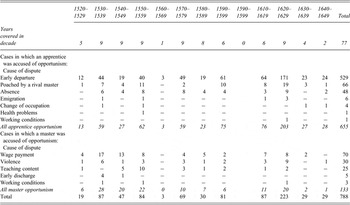
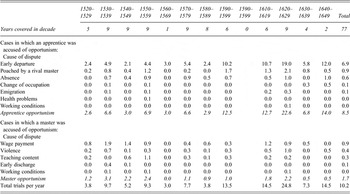
As noted previously, the 788 apprenticeship-related trials heard before the Woollen Guild court in Padua, took place in 77 of the years between 1520 and 1650, an average of 10.2 trials per year. As Tables 1 and 2 show, in 655 of the trials, or about 8.5 cases per year, an apprentice was accused of opportunism, a much higher number than the 133 (1.7 cases per year) in which a master craftsman was accused of opportunism.
The number of trials involving a dispute between a master and his apprentice heard before the court of the Woollen Guild, Padua, in each decade, 1520–1649, by cause of dispute

Sources: See endnote 7.
The annual average number of trials involving a dispute between a master and his apprentice heard before the court of the Woollen Guild, Padua, 1520–1649, by cause of dispute

Sources: See endnote 7.
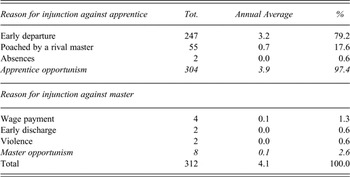
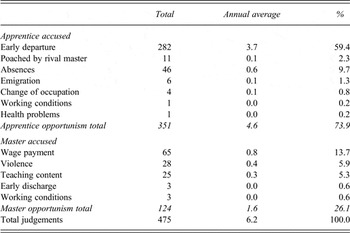
Trials in the Woollen Guild court involved a two-step legal process. In the first step an ‘injunction’ would be issued: at the request of a master or merchant-manufacturer, for example, the court would give official notification to an apprentice and his parents, or guardians, of the case against him. The second step was the ‘judgement’ when all parties involved – the master, the apprentice and his or her parent or guardian – appeared before the judges to hear their verdict. As Table 3 shows, injunctions mainly involved allegations of opportunism against an apprentice (97.4 per cent) rather than against a master (2.6 per cent). Table 4 shows that 73.9 per cent of judgements referred to cases of apprentice opportunism and only 26.1 per cent to cases of master opportunism. ‘Early departure’ of an apprentice was the main reason for disputes between masters and apprentices that ended in a guild trial (6.9 proceedings a year and 68 per cent of the total related to this cause) followed by cases where the apprentice had been ‘poached by a rival master’ (0.9 cases per year, 8.8 per cent) and issues over ‘wages payment’ (0.9 cases per year, 8.8 per cent) and apprentice ‘absences’ (0.6 cases per year, 6 per cent). Only a very few cases (0.5 per year or 4.9 per cent of all cases) referred to a master subjecting his apprentice to ‘violence’. Quite surprisingly, ‘teaching content’, the training offered to the apprentice, was the object of only 25 trials (0.3 cases per year and 2.9 per cent of all the trials in the database).
The total number, annual average and percentage of injunctions issued in trials involving a dispute between a master and his apprentice, court of the Woollen Guild, Padua, 1520–1649, by cause of dispute

Sources: See endnote 7.
The total number, annual average and percentage of cases involving a dispute between a master and his apprentice in which a judgement was reached, court of the Woollen Guild, Padua, 1520–1649, by cause of dispute

Sources: See endnote 7.
Before observing whether, and how, the Padua Woollen Guild forced apprentices or masters to follow the terms of their contracts, when one or other had broken their original agreement, let us consider how the Court of the Woollen Guild functioned.
3. JUDICIAL PROCEDURES IN THE WOOLLEN GUILD COURT
To resolve disputes relating to apprenticeship contracts, masters, apprentices, parents and guardians had access to a tool of primary importance: the court of the guild to which they belonged. The Woollen Guild court (banco della lana) enjoyed wide-reaching jurisdictional autonomy. One of its judges was elected and had to have proven professional expertise; he had to be a member of the Padua legal Collegio (one of the most important of its day) and have held the status of Doctor of Law for at least five years. The other two judges were drawn from amongst the merchant-manufacturers, elected each year by the guild's chapter, or board. The court's jurisdiction covered both civil and criminal cases.Footnote 22
A preliminary analysis of the judicial procedures adopted by the court is of fundamental importance when trying to understand the role it played in disputes between masters and their apprentices. During each trial the parties were the central figures. They chose which type of procedure the court would follow and (sometimes) also ‘issued’ the verdict. It is evident that many cases were brought to court where it would appear that the main motivation for the litigation was to certify agreements in front of the judges. The court therefore sought to bring about a settlement between the parties involved or, failing that, to make the latter suspend their dispute or, at least, define the parameters of their conflict. In doing so, the court did not always strictly adhere to existing rules, customs or practices. In civil cases most verdicts were reached by the ‘will of the parties’; an ‘agreement’ between them having been achieved. After setting out their cases in front of the judges, the parties themselves ‘as they do not want to argue, by mutual consent reached’ (‘nolentes litigare concorditer incesserunt’) an ‘agreement’ to pay off a debt, or to terminate or renegotiate the term of their relationship as they saw fit. In one dispute, knitwear artisan Giovanni Maria and Donna Giuliana, a widow, representing her son, Paolo, ‘not wishing to argue, decided in common agreement’ that Paolo should be freed from his apprenticeship contract and that Giovanni Maria owed Giuliana money for the days Paolo had worked for him.Footnote 23 As the main aim in bringing a case to court was to ‘settle’ a dispute and bring any conflict to an end, the the judges would state that their verdict was in accordance with the ‘will of the parties’ (‘stante de voluntate partium’) involved. In a dispute between master cloth weaver Alvise and master heddlemaker Valerio, the judges declared that, ‘given the will of the parties’, Andrea should be obliged to give back certain heddles and combs given him by Valerio. In a dispute between Francesco Romanetto and Gerolamo Trevisan, on the other hand, the judges decreed that, ‘according to the will of the same parties’ (‘de voluntate ipsarum partium’), Gerolamo was at liberty to decide whether to send his son to work with Franesco, in accordance with their original agreement or, alternatively, to return the money that Franco had paid in advance.Footnote 24
To have a court judgement ‘according to the will of the parties’ (‘stante voluntate partium’) often meant that the case was not drawn out, thus reducing costs. For example, after the court had already spent three days considering one workplace dispute the judges brought it to a conclusion by declaring, ‘according to the will of the parties’ (‘stante voluntate partium’), that the artisan at the centre of the case was free to work for whomever he wished, as long as he paid back the debt he owed to the other party. The two parties were to agree between themselves the amount of the debt owed.Footnote 25
If the parties in a case could not reach an agreement, there were two procedures that the court could follow to find a resolution. The two procedures, ‘summary’ and ‘ordinary’ procedure, were frequently intertwined but they attributed different importance to the provision of evidence.
In cases where summary procedure was adopted those involved in a dispute had to be present, along with any witnesses they wished to call. A summons would be issued if a required person was not present. The facts of the case and any evidence were then presented directly by each party without recourse to legal language, attorneys or lawyers. Judgements, which were passed quickly, were based not on local laws, customs or precedents but on the ‘nature of things’ and ‘social practices’ with great weight being accorded to any oaths that had been sworn.Footnote 26 A clear example of this kind of procedure is provided by some contraddittori (disputes). Such cases normally consisted of three steps: the presentation of the demands of one of the parties; the response of the other party; and the judges’ verdict based on the evidence supplied. On 7 August 1550, a case took place between Giovanni da Fiume, cloth weaver, on one side and Giovanni Maria, a cloth weaver's boy placed with the aforementioned Giovanni to learn the cloth weaving trade, on the other. A written contract agreeing the relationship between the two had been drawn up on 11 August 1549. Giovanni Senior was refusing to allow Giovanni Maria to leave his service (comeatum). Having perused the ‘aforementioned manuscript’ and taking the oath Giovanni Maria had sworn to Giovanni Senior into account, the judges declared that Giovanni Maria must stay with Giovanni but also made it clear that Giovanni must pay his apprentice his wages.Footnote 27
The quick resolution, the absence of lawyers, and the importance placed on the evidence were characteristic of cases conducted using summary procedure.Footnote 28 Great importance was placed on both written documents and sworn oaths,Footnote 29 but witnesses were very seldom called. When a witness was called their job was to compensate for the absence of written documents attesting to the nature of a relationship by testifying to any verbal agreements made between the two or more individuals involved in the dispute. For example, in a case between Andrea di Fiori, a merchant, and Giustina, a widow, witnesses testified that the merchant had said ‘if you want your child back, give me my money’ thus indicating, in principle, that the agreement between them could be dissolved.Footnote 30 Witnesses could also be called in order to corroborate customary practices around the specific fact at issue. Thus in a dispute between Francesco and Sebastiano over the apprenticeship contract of Francesco's son the witnesses called were asked to confirm current practices among heddlemakers. They attested that: ‘when someone is placed with a heddlemaker and in this placement it has not been said that the apprentice has to work at night […] the aforementioned apprentice does not have to work at night’.Footnote 31
As well as summary procedure another, rather different, procedure existed: ordinary procedure. Under the latter the usual practice was that, before questioning could begin, a libello was presented by the accuser or by the lawyer to the court containing the principal accusations (parti or capitoli – that is, chapters) and listing any witnesses who were to be called to testify.Footnote 32 The dividing line between the two types of procedure was, however, very fine in that certain cases began by following summary procedure before turning into ordinary procedure cases when there was an appeal or requests for documents to be drawn up or for the case to move to arbitration.Footnote 33
Under ordinary procedure, therefore, charters were drawn up in defence that would be corroborated by witnesses, if any were called, and by reference to customs, laws and statutes.Footnote 34 The fact that laws, statutes and customs were made use of is very revealing of the nature and consequence of the ordinary procedure. On 16 July 1529 Domenico Mandello, a hatmaker, asked that Bernardino, another hatmaker, be obliged ‘in accordance with a handwritten document’ to send his son Rocco to work in Domenico's workshop. Bernardino objected, however, that he ‘was under no such obligation because according to custom that has become law (stante consuetudine pro lege habita) no hatmaker [was] obliged to work hats for any other hatmaker (unless he wanted to)’. The judges decided that Bernardino was not obliged to send his son to work for Domenico.Footnote 35 This case highlights two key elements of the workings of the Woollen Guild's court. The first is the fact that artisans themselves had wide-ranging legal knowledge and could use laws and procedures to legitimise their arguments.Footnote 36 The second is just how localised the nature of the law was. Only those individuals with the strongest urban roots in Padua, who had the best knowledge of local laws and customs, could invoke these, using such phrases as ‘in common and general use’ or by referring to statutes relating to citizens.Footnote 37 Workers from outside the town seldom made use of such tactics.Footnote 38
Having considered the legal procedures open to individuals pursuing a case through the court, in the next section we assess the Woollen Guild's attitude, and those of the judges in its court, to disputes between masters and their apprentices.
4. ATTITUDES TO OPPORTUNISM BY APPRENTICES
It has been widely argued that the primary function of guilds was to ensure that the terms of training contracts were adhered to, thus limiting opportunism among apprentices. If there were no rules or restrictions on apprentices leaving their masters early or being poached by rival masters, it is argued, training markets would function poorly, negatively affecting the masters’ incentives to teach, and therefore the quality of the training given and the skills acquired. Such inadequacies would be avoided, the theory contends, if guild regulations required lengthy apprenticeships and had a set of formal and informal sanctions in place should these not be followed. Masters should have the legal prerogatives enjoyed by fathers, and apprentices should pay them a fee to enter training and make another payment on completion of that training,Footnote 39 in order to give the masters greater incentive to see that the apprentices were taught thoroughly. The main empirical support for this theory has mainly been drawn from those forms of guild legislation, which lay out in great detail the guild's expectations concerning apprenticeship, journeymanship and mastership examinations. There is however, considerable quantitative and qualitative evidence that casts doubt that these expectations were ever met.
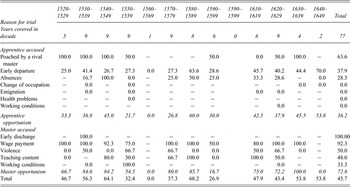
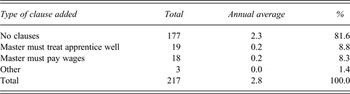
Did guilds indeed enforce apprenticeship contracts, as the theories suggest? As Table 5 shows, in the Woollen Guild court in Padua only 36 per cent of cases involving an apprenticeship-related dispute ended with the judge compelling all parties to respect the original contract. Only in 38 per cent of cases for apprentice opportunism where the judges made the parties respect the contract did the judges oblige the apprentice to return to his, or her, master, and in only 28 per cent of cases for apprentice opportunism where the judges made the parties respect the contract were they obliged to work in order to repay the master for days of work they had missed. It was thus only a minority of apprentices in Padua who were compelled to see out their contract. The majority were able to leave their master and were not even obliged to cover their absences. It is interesting that, as Table 6 shows, in those cases where the judges ruled that a contract had to be upheld, their ruling often included clauses which indicated that ‘a master (must) … pay [the apprentice's] wages’ or ‘the master (must) treat [the apprentice] well’. Some 8.3 per cent of such rulings contained the former formula, and 8.8 per cent the latter. The added clauses suggest that a charge of apprentice opportunism sometimes concealed the fact that an apprentice was refusing to continue to work without being paid or was being beaten. There are a number of examples where this is made more explicit. In one case, from 22 August 1616, an apprentice was accused of leaving his master, Gerolamo, a bonnet maker, before his contract had expired. The guild judges ruled that Gerolamo had to pay his apprentice one ducat more according to their contract. The bonnet maker did so and subsequently, on 19 September, the judges further ruled that the boy had to return to his master.Footnote 40
The percentage of trials in which the contract was upheld in a dispute between a master and his apprentice, court of the Woollen Guild, Padua, 1520–1649

Sources: See endnote 7.
The number, annual average and percentage of the total number of cases in which the judge added a clause to a contract upheld by the court in trials involving a dispute between a master and his apprentice, court of the Woollen Guild, Padua, 1520–1649, by type of clause added

Sources: See endnote 7.
Contract enforcement rates were higher in cases where an apprentice had been poached from his master by a rival. In 64 per cent of the judgements relating to such cases made in the Woollen Guild court in Padua the judges forced the parties concerned to abide by their original agreement. Only 11, or 2.3 per cent, of all verdicts fell into this category, however. In cases involving the poaching of an apprentice many more injunctions were issued (55; 17.6 per cent of all injunctions) than verdicts were reached. This may indicate that the injunctions succeeded in returning poached apprentices to their original masters. However it is possible that, in the wake of an injunction the parties involved reached an out of court settlement, as many did, which allowed the apprentice to continue working for his new master.
These findings show that the Padua's Woollen Guild did not often enforce training contracts when the apprentice had been involved in opportunistic behaviour. What might be the reasons for this?
One explanation is that, as we have seen above, judges in the guild court settled many cases first and foremost according to the ‘will of the parties’. This form of conflict resolution allowed agreements and contracts to be terminated or renegotiated. If the parties in dispute agreed, the contract between them could be temporarily suspended until compensation had been paid,Footnote 41 or sums paid in advance had been repaid,Footnote 42 or they might agree that the contract be terminated,Footnote 43 particularly if a third party was willing to pay off any debts owed under the terms of the original contract.Footnote 44 There were countless reasons why individuals might wish to terminate their contract, including a need to move on to start another job, to work in a workshop closer to home or to move to a workshop run by a master craftsmen with a higher reputation as a craftsman. Some agreements that were renegotiated before the court ‘according to the will of the parties’ contained clauses granting the apprentice sick leave until he had made a complete recovery from illness, with no obligation to return any advance pay which his master may have given him.Footnote 45
A second explanation is that, in contrast to a number of other European guilds,Footnote 46 Padua's Woollen Guild regarded any attempt to force an apprentice to work in a trade if he or she did not want to do so as a futile and pointless exercise. In some cases, the guild judges decided to allow an apprentice to suspend his contract in order to take up another trade, on the condition that he promised to return to his present master if he returned to work in the woollen industry. Francesco, who did not want his son to produce hats, is a case in point. Francesco won his case and was freed of his obligations, but the verdict included a clause to the effect that if his son should ever return to hatting that he would have to send him back to Domenico's workshop.Footnote 47
A third explanation of the Padua Guild's failure to uphold apprentice training contracts is that masters could call on measures other than the enforcement of lengthy apprenticeships to protect them from apprentice opportunism. Contracts could be terminated or suspended by returning any monies paid in advance. Under a judgement of 2 May 1526 Giovanni Favero was obliged to continue to send his daughter to work for hatmaker Antonio Molon in accordance with their agreement, or else to return all the money Molon had paid him to date.Footnote 48 Parents could also agree to pay monetary bonds or pledges (fideiussioni), which would be forfeit if an apprenticeship agreement was terminated early. On 23 October 1624, for example, Orazio Pochesino was given eight days by the guild court to give a suitable surety to Andrea di Fiori, to whom his son was apprenticed, and ordered to ensure that his son went to work.Footnote 49 Finally, if a new master agreed to pay any debts an apprentice might owe to his previous master, then the new master could retain the services of the apprentice. On 25 May 1598, for instance, the guild judges decreed that if the sons of Mattea, a widow, could not pay back the debt they owed to their previous master, knitwear artisan Giulio, their new master, Cesare dall'Onore, would have to do so or they would be obliged to return to work for Giulio.Footnote 50 Apprentices could thus change masters without difficulty, as long as any debts owing were repaid, or advance payments were refunded.
A fourth reason why the Woollen Guild may have chosen not to enforce apprenticeship contracts relates to the fact that parents did not always have authority or full control over their offspring. Lucia, a widow, was freed from her obligation to send her daughter to Domenico Rizzi, a master bonnet maker in Padua, as her daughter had now come of age.Footnote 51 When apprentices left their hometown, parents were obviously unable to make them respect their contracts and were therefore freed from any obligation to do so. In a case from 21 August 1531, for example, the judges decreed that Alessandra, Matteo Facchini's widow, was not obliged to send her son to work as he had fled from Padua, but if her son should one day return she would be obliged to send him to work with Domenico, his former master.Footnote 52 There were very few cases where a Woollen Guild court verdict stated that an apprentice who wanted to leave Padua was forced to complete their training period with their master. The most frequent solution in such cases was to oblige the apprentice's parents to return any money the apprentice had received in advance of work done. On 19 August 1616 the court agreed that Dionisio Padovano could take his son to Verona, ‘where he stated he wanted to live’, as long as Antonio Menevello, his master, was suitably recompensed for damages and expenses.Footnote 53
A final explanation for the low proportion of contracts that were enforced in apprenticeship disputes by the Woollen Guild court is that the guild in Padua recognised that extraordinary events could, and did, occur in the course of the three to five years of a typical apprenticeship contract. Apprentices could fall ill, or it could turn out that their occupation was harmful to their health. In such cases the guild court regarded it as obvious that neither the apprentice, nor his or her master should be bound by their contact. On 27 July 1575 the guild court judges decreed that Domenico Santini was liable to complete his year with knitwear artisan Gaspare Gallo and must recompense him for everything he had received from him, apart from the days he had been absent due to illness (stante eius infirmitate).Footnote 54
Why, then, did the guild enforce certain contracts? First of all they were likely to do so if the party on side of the dispute remained silent. Contracts were enforced when an apprentice, or his parents or guardians, failed to respond to, or chose to contest, his master's demands. In the absence of any defence the judges would rule that the provisions laid out in the original contract, either ‘in the agreement’ or ‘in the manuscript’, should be respected.Footnote 55
Secondly, the Woollen Guild could sometimes enforce a contract when, as a result of a trial, a new clause had been added to it. For example, in trials involving an apprentice leaving his master before a previously agreed time, the judges could, if both parties agreed, add a clause concerning the timing of payment of the apprentice's wages, or his working conditions.Footnote 56 Rather than enforcing the terms of an existing contract, such verdicts were viewed as adding a clause to an incomplete contract. The Woollen Guild may have recognised that if an initial agreement contained too many clauses, as was often the case in the apprenticeship contracts drawn up by other European guilds, this could increase the rigidity of the contract, and limit any later renegotiations.Footnote 57 The issue of incomplete contracts and the role played by courts of law in their improvement is encountered quite commonly within economic theory.Footnote 58
The Woollen Guild in Padua did not force apprentices to abide by their original contracts if they left their master early, or were poached by a rival master. However, we need to consider other side of the coin: how did the guild view opportunism by masters?
5. ATTITUDES TO OPPORTUNISM BY MASTERS
Certain studies considering guilds have suggested that training markets in the pre-industrial period might have functioned poorly because master craftsmen were able to exploit their apprentices as cheap labour before discharging them without having provided them with the craft skills they had hoped to learn. It is further suggested that the generation entering a particular trade would have had little incentive to learn their craft if their guild did not ensure that masters were proficient and could provide adequate training and security of employment. A trainee also needed to be certain that he would be placed with another master, should his first master die. The primary function of guilds, according to this way of thinking, was therefore to enforce rules, through formal or informal sanctions, which would curb opportunism by masters during lengthy apprenticeships.Footnote 59 Once again, the evidence for Padua casts doubt on these arguments.
While contracts were enforced in just 36 per cent of cases involving opportunism by an apprentice, contracts were much more likely to be enforced if it was a master who was accused of opportunism; contracts were enforced in 73 per cent of all such cases which came before the Woollen Guild court, as Table 5 shows. When the guild court ordered that a contract should be upheld, the case almost always involved wage payments; in 92 per cent of cases the parents or guardians of the apprentice had asked that the masters or merchant-manufacturers be made to pay wages owed to the apprentice. In contrast, in the tiny number of trials – fewer than six per cent of the total – where an apprentice, sometimes through their parents, asked the court to ensure that their master fulfil his role as a teacher, the court decreed that both parties should continue with their original contract in only 48 per cent of cases. The guild judges also enforced the terms of the contracts in all three cases relating to cases where a master had discharged his apprentice before the agreed time, and in 50 per cent of cases where the master was accused of beating his apprentice.
Why did the guild not make all masters adhere to the terms of their contract with their apprentices, particularly when a dispute was over the training being provided? First of all, as in cases of opportunism by apprentices, the guilds regarded it as impractical, and even pointless, to force individuals to do things that they did not want to do. If a master refused to provide the training that had been agreed in a contract then he should not be forced to do so. On 18 May 1554, for example, the judges released the son of Giovanni Antonio, a felter, from his agreement with his master Bartolomeo Vicentino, a hatmaker, because it was clear that Bartolomeo had no intention of teaching him his trade, sending him to work in other workshops instead.Footnote 60 The guild could, however, require that masters who had received money on the understanding that they were going to provide training, but failed to do so, return the money. In one such case Giacomo de Musoco asked the court to oblige Battista Mastellario, a felter, to teach him his craft in accordance with their agreement. Mastellario's only statement was that ‘it is true’ that they had made such an agreement, and on that basis the judges ruled that he was obliged to complete Giacomo's training or to give back part of the money he had received in advance.Footnote 61 This case shows that the master had received some form of payment, worked with the apprentice for some time and then decided to discharge him. We do not know how much training Giacomo had already received, but we know that apprentices and parents tended to be more worried about money than about any skills that had been learnt. In cases where the guild court did not oblige a master to repay the apprentice the wages that had been agreed, the apprentice was at least free to move to another master. In a case on 9 October 1559, the sons of Dorotea were declared free to leave master hatmaker Domenico Grimaldello because he had not kept the promises he had made regarding their salaries.Footnote 62
A second reason why Padua's Woollen Guild might not enforce agreements in cases where a master was accused of opportunism was the possibility that an extraordinary, unforeseen event might occur during a contract. If a master died, fell ill, or was reduced to vagrancy, his apprentice was free to find a new master.Footnote 63 However, despite the arguments concerning the role of the guilds in correcting imperfections in the human capital market, the guild in Padua did not offer to provide substitute trainers for abandoned apprentices.Footnote 64
Why, on the other hand, did the guild enforce contracts in cases where a master was accused of opportunism as often as they did? First of all, just as in cases where an apprentice was accused of opportunism, the guild upheld the terms of a contract when the accused offered no defence or failed to make any specific requests concerning the terms of the original contract.Footnote 65 However, as we saw earlier, such court cases appear to have served to create a documented copy of either the original contract, or an ‘improved’ version, certified by the court. This version of the agreement would supersede any previous, privately written or oral agreement. By going to court, employers and employees could both avoid the trouble and cost of going through a notary, which would have involved couching any clauses in the contract in legal terms, making the contract less flexible. Once an agreement had been reached and documented before the guild judges, it would then be available at the offices of the judiciary, should it be required to settle any future dispute.Footnote 66
A second reason why the guild might enforce a contract stems from the fact that the charge of opportunism against a master was sometimes fabricated or trumped-up. It was also a very difficult charge to prove. In cases against a master involving violence the judges only agreed that a contract could be terminated in those instances where the parents of the apprentice were able to prove that the apprentice had received an actual injury.Footnote 67
A third reason for the guild court to rule that the terms of a contract should be upheld was if the contract contained clauses allowing for previously unforeseen eventualities that might occur in what remained of the agreed apprenticeship period. In the cases before the Woollen Guild, such clauses included those referring to when wages might be paid, or the quality of an apprentice's working conditions such as how many hours he would be expected to work, whether he was to work at night, or during the winter, and whether or not he was required to have, or to learn, reading and writing skills.Footnote 68
The large collection of records from Padua's Woollen Guild court thus contains no evidence that this early modern Italian guild enforced apprenticeship contracts in cases involving opportunistic behaviour, as previous scholars might have expected. A further question needs to be addressed, however: how flexible was the Padua Woollen Guild's conflict resolution system?
6. GUILD FLEXIBILITY: CHANGES IN SUPPLY AND DEMAND
Recent studies have argued, rightly I would maintain, that guild ‘apprenticeship was undertaken as a more flexible period than the formalities of contracts … would suggest’.Footnote 69 As a result, and as Patrick Wallis has argued, although the guilds might in general seek to use apprenticeship as a means to exclude outsiders, this was more than outweighed by the advantages which apprentices could gain from training with a members of the guild, even if they never completed their apprenticeship contracts.Footnote 70 However, the cost-benefit balance of such flexibility has yet to be thoroughly investigated.Footnote 71
The evidence from the Woollen Guild court in Padua casts doubts on the flexibility of the labour market supervised by the guild. It is true that apprenticeship contracts could be terminated early and that trainees could leave their masters earlier than specified in their contracts. When a master and his apprentice decided to bring their contract to an end, their first step was to select two experts to evaluate the costs of this decision, before they then signed an out-of-court agreement. However, if they could not reach an agreement, they would go to court, the guild court being one of several options. The court judges would then either select a third expert to act as an adjudicator, or alternatively send the matter to trial where experts and witnesses would be called to evaluate the amount of damages. For example; on 1 June 1620, when a dispute between Bernardino Ortolano and Battista Pezzon was brought to court, the former was allowed to find another boy to substitute for his son whom he wished to remove from Pezzon's charge, provided that he select two experts to judge ‘how much the said boy was worth’,Footnote 72 increasing his costs, in terms of time and money. Moreover, if the courts nominated other master craftsmen as expert witnesses in such cases, it is reasonable to assume that they were unlikely to side with an apprentice involved in a dispute with his master.Footnote 73 This assumption can be supported by analysing fluctuations in the rate at which contracts were enforced by the courts. Why did these fluctuations occur and what were the economic and population dynamics underlying them?
As Table 5 shows, the contract enforcement rate in disputes concerning apprentice opportunism in Padua's Woollen Guild court averaged just under 37 per cent, but this rose considerably in some decades: to 60 per cent, in 1580–1589; 54 per cent in 1640–1649; 43 per cent in 1610–1619; and 45 per cent in 1630–1639. A number of factors explain these upward fluctuations. First of all they reflect economic trends in the woollen industry, or in related sectors of the economy. There were booms in the industry in the 1580s and 1640s, particularly in crafts involving knitting and also in related sectors, such as ribbon making. During these times apprentices were much sought after, as is also shown by increases in the number of injunctions obtained by masters against apprentices who had left their employment early or had been poached by another master. Masters had stronger incentives during these decades to restrict competition within the labour market. One way they could do this was to increase the amount of money they demanded as ‘damages and interest’ before an apprentice could be released from his contract, in the hope the apprentice, or his parents, would be unable to pay and that the apprentice would have no choice but to remain where he was.
Changes in demography were another factor that influenced rates of contract enforcement. In the 1520s, 1530s and 1630s, decades which followed plague epidemics, contract enforcement rates were higher than average. With reduced availability of labour, the labour market became more competitive. Guilds could reduce the competition by preventing apprentices from changing masters, asking for better wages, or by refusing to provide guarantees of work for those apprentices whose master had died.Footnote 74
Prices and wages might also affect the rate at which the guild court enforced contracts. In Padua in the early decades of the seventeenth century, as in many other Italian cities, food prices increased, but so did real wages.Footnote 75 Apprentices tried to negotiate better terms, and higher wages in particular, but – as the higher contract enforcement rates for these decades show – the guilds were able to restrict labour mobility and maintain their labour market monopsony, thus ensuring higher profits for master craftsmen and merchant-entrepreneurs.
At times of industrial growth, or when workers were looking for better jobs or higher wages, masters could, ultimately, resort to their guild court to demand payments which few families were able to afford in order to prevent their apprentices from leaving. Thus, even if the guild system was flexible, the costs of this flexibility have to be taken into account when considering the economic effects on labour market performance and economic wellbeing. Labour market mobility and competitiveness suffered because masters were unable to hire the workers they wanted because the costs of releasing them from their contracts were too high. Apprentices could not achieve the wages they deserved as only those who were able to repay their debts, or find a new master who would was prepared to do so, were able to break their contracts and leave one master to earn more money with another. Those who could not pay these costs were obliged to stay with their existing master and earn less than they might have. This state of affairs may well have damaged labour market performance, given that apprentices had less incentive to work hard and employers were unable to hire the best employees. It seems very probable, therefore, that such costs of flexibility had a negative impact on manufacturing activity in Padua, as many apprentices were pushed to emigrate to other cities in order to earn higher wages, often because, as Giovanni Segato's father claimed in 1552, they could not survive on the wages they were earning.Footnote 76
7. CONCLUSION
Was the court of the Woollen Guild in Padua in some way a ‘special case’? It is important to bear in mind that there are very few studies of the functioning of courts run by individual guilds, which were quite separate from any other courts in a town. The lack of studies can, in part, be explained by the fact that much of the evidence of the internal workings of these courts has largely been lost.Footnote 77 However, when we compare how guilds in other early modern Italian cities, and elsewhere in Europe, and trials in civic courts treated apprenticeship contracts this suggests that the Paduan Woollen Guild and its court were neither unique nor isolated in their attitudes concerning training contracts. As far as judicial procedures were concerned, legal pluralism could, and did, interfere in both civil and guild procedures, to modify the terms of contractual agreements in France as well as in Italy.Footnote 78 During legal proceedings, clauses could be introduced into a contract that did not substantially impinge on the original agreement.Footnote 79 The outcome of many cases before the guild courts appears to have consisted of the certification or improvement of a pre-existing, privately drawn up, written contract or oral agreement.Footnote 80
Other courts took the same approach to disputes over contracts as Padua's Woollen Guild court. Other Italian guild courts, such as that in Florence, allowed masters to clear any debts an apprentice might have owed a previous master thus allowing them to retain their new apprentices.Footnote 81 Apprentices, as we have seen, were thus able to change masters without difficulty, as long as they were able to refund any money they had been paid.Footnote 82 Apprenticeship contracts from Genoa show that apprentices in the city frequently changed workshop. Their transfer was recorded, once their value as a worker had been calculated, as an itemised transaction between the two masters.Footnote 83 In some contracts from Genoa, the apprentice was stated to be responsible for the cost of any transaction releasing him from his old master; if his new master paid this cost the apprentice would have to repay him at the end of his apprenticeship.Footnote 84 In sixteenth- and eighteenth-century Antwerp, judicial proceedings concerning breaches of contract ‘were not about enforcing corporative regulations but resolving disputes over apprentice contracts’; the final aim was to guarantee ‘a financial and economic agreement on the transfer of technical knowledge between private parties’.Footnote 85 In the eighteenth- and nineteenth-century Viennese silk industry, not all apprentices finished their training in the same workshop as they had started, and not all of them completed their training.Footnote 86 Completion rates varied across Europe.Footnote 87 In early modern London, the Lord Mayor's Court gave ‘apprentices a simple, cheap, and effective means to cancel contracts’, as Wallis has recently underlined.Footnote 88 Moreover, in London and Bristol, ‘many apprentices did not complete their terms’; late arrival, early departure and temporary absences from the master's household were widespread.Footnote 89
It was not always a straightforward matter for an apprentice to demand his or her rights from a master who had no desire to teach them. In Genoa, in 1462, an apprentice silk weaver asked for, and was granted, the right to change master because the master he had did not want to ‘put him to weave’ (ponere ipsum ad texendum) but simply ‘leave him to stretch’ (ipsum tenere ad tirandum) with the result that the apprentice was unable to ‘learn the art’ (adiscere dictam artem).Footnote 90 Sixteenth-century Florentine apprentices found it difficult to find work if their master had dismissed them, even if this had been because there was no work and the master could no longer maintain their employment.Footnote 91 In Venice, Zuanne, a master baker, did not perform his ‘trade pursuant to regulations’ thus preventing his apprentice, Valentino, from learning the craft properly. The Old Justice (Giustizia vecchia) judges ordered that Zuane must follow the rules, and if he failed to do so then Valentino should be released from his service.Footnote 92 Like the guild court in Padua, English courts did not enforce apprenticeship contracts in cases of unforeseen events such as illness.Footnote 93 Furthermore, if an apprentice returned to work after an illness and his master was unable to take him on, the apprentice would be released from his contract.Footnote 94 In England, masters were not obliged to hold to the terms of a contract and guilds did not provide substitute teachers for apprentices who had been abandoned, or whose master had proved to be a poor teacher.Footnote 95 As in Padua, parents in England and the southern Netherlands sometimes did not always have parental authority or full control over their offspring, especially if their child had migrated.Footnote 96
Although some guilds stipulated the minimum length an apprenticeship should take, the length of apprenticeships actually served varied across England, the southern Netherlands, France and Italy. For example, in Venice the duration of an apprenticeship was more closely linked to the age of the apprentice than to the terms set out in guild statutes.Footnote 97 In England and the southern Netherlands masters permitted their apprentices to be absent for extended periods, and recognised that the most able apprentices might leave their workshop early to work as journeymen.Footnote 98 In Genoa apprentices were allowed to take long periods of absence, probably to let them undertake agricultural work, but had to compensate their masters by paying them sums of up to two soldi.Footnote 99 In Venice, on the other hand, unauthorised absences were a matter for legal action and masters marked such absences down as scampi.Footnote 100 Even in the silk industry, which is often taken as an example of a highly skilled industry requiring longer apprenticeships, the actual time taken to learn a craft depended on the age and abilities of the trainee, and this was recognised both in the statutes of the guilds and in apprenticeship contracts.Footnote 101
Lastly, guarantees and sureties were widely used to limit the uncertainties in the relationship between a master and his apprentices. In Venice it was, in theory, necessary for an apprentice to have a guarantor so that the master's rights would be safeguarded should his employee run away or break their contract prematurely.Footnote 102 Grocer Bortolo Rimondo claimed that his apprentice had run off one night with a bag of loot, and insisted that the boy return to work within three days or else the guarantor would have to pay him 12 ducats to cover costs and damages.Footnote 103 In Genoa, the silk weaving officials asked that Simon de Levagio, Franciscus Forciori's apprentice, who was in prison, be freed on condition that he once again paid a surety, the large sum of 25 lire, to his master.Footnote 104
The evidence from these cities, alongside the in-depth analysis of the records from the court of the Woollen Guild in Padua enables us to shape an alternative view of how guilds regulated apprenticeship contracts at least during the early modern period. This new view implies that previous interpretations of the role played by guild courts in enforcing apprenticeships should be reconsidered. In sanctioning opportunistic behaviour when private apprenticeship relationships had broken down, Padua's Woollen Guild played a positive role; it did not rigidly enforce the existing contracts but rather tried to formalise and improve incomplete written or oral contracts. The guild was thus responding to the need of masters and apprentices to place their negotiations on a formal footing. This would suggest that the beneficial role of the guilds may not have consisted of imposing mandatory training arrangements on trainees and those training them, but rather lay in helping individuals renegotiate and redefine contractual arrangements to which they had agreed.Footnote 105 Wallis's recent statement in relation to early modern London is also true for Padua: the fact that ‘the city's institutions played a major role in facilitating apprentices’ freeing themselves of their indentures seriously complicates earlier views of institutions as agents of enforcement in apprenticeship and draws our attention away from the work of the guilds in this sphere’.Footnote 106
However, in contrast to these relatively positive effects, contract enforcement through the guild system had some negative consequences too. It unbalanced power relations in favour of the employers: the merchants and master craftsmen. When a privately agreed apprenticeship relationship broke down, the dispute between the employer and his apprentice was heard by judges who were, as merchants, either employers themselves or who nominated other employers to act as experts. The judges therefore sat disproportionately on the side of the employer.Footnote 107 This gave individual masters control over their apprentices, especially the poorer ones, and also allowed the employers as a group to promote their interests in the labour market, particularly at times when the supply of labour was limited after a demographic shock, or when their industry was expanding and there was an increasing demand for labour. It is likely that municipal or state courts, which also heard apprenticeship cases and did not have a vested interest in one particular industry, were better suited to balancing power relations and reducing social inequality than the guilds were, but further research is needed in this field.Footnote 108
ACKNOWLEDGEMENTS
This research was carried out within the framework of the FIRB ‘Futuro in Ricerca’ 2012 Project RBFR12GBQZ_002 and thanks to a Visiting Fellowship ‘Europe to Scotland’, awarded by the Royal Society of Edinburgh in 2014. I have presented this article in several seminars in Padua, Paris (ENS-Cachan), and Cambridge (UK): I would like to thank all those attending and especially Michela Barbot, Alessandro Buono, Benedetta Crivelli, Claude Didry, Amy Erickson, Angela Falcetta, Janine Maegraith, Craig Muldrew, Stefania Montemezzo and Francesco Vianello for their comments. I am most grateful to Sheilagh Ogilvie for her generous and useful comments on earlier versions of this article.