Introduction
The genus Dichanthium is represented by 20 species from tropical and sub-tropical ecosystems, of which eight are found in India (Arora et al., Reference Arora, Mehra and Hardas1975). D. annulatum and D. caricosum are indigenous to India and represent high genetic diversity (Mehra and Magoon, Reference Mehra and Magoon1974). Dichanthium covers a large proportion of Indian pasture and rangelands. D. annulatum (Marvel grass or Sheda grass) is one of the most dominant grasses of different grass covers of India and is common throughout the plains and hills, up to 1660 m (Dabadghao and Shankarnarayan, Reference Dabadghao and Shankarnarayan1973). It is also found in North Africa, Southeast Asia, China, Australia, Fiji, New Guinea and introduced to Cuba, Haiti, and Puerto Rico (Duke, Reference Duke1983). It is an excellent fodder and reported to be preferred to all other grasses by the cattle (Cook et al., Reference Cook, Pengelly, Brown, Donnelly, Eagles, Franco, Hanson, Mullen, Partridge, Peters and Schultze-Kraft2005). It can also be used in a cut-and-carry system for feeding as hay or silage (FAO, 2010). It is found almost in all habitats including lawns, wastelands, rangelands, pastures, roadsides, near cultivated lands and sand dunes. It is one of the best pasture grasses in India and Burma with biomass yield ranging from 3 to 9 t/ha (Gupta, Reference Gupta1980). D. annulatum was found to be an effective grass barrier to check soil erosion in the Konkan region of the Western Ghats in India (Mandal et al., Reference Mandal, Srivastava, Giri, Kaushal, Cerda and Alam2017). The Sehima-Dichanthium grass cover in India was estimated to have vast potential to reduce the gap between demand and availability of forage, if the productivity of these grasslands is improved (Malaviya et al., Reference Malaviya, Roy, Kaushal, Squires, Dengler, Febg and Hua2018).
Genetic improvement of most of the perennial tropical grasses has limitations because of their apomictic nature. Although, identification of sexual plants and their utilization in breeding for the transfer of desirable traits can solve the problem to a limited extent, identification of sexual plants in different filial generations to get desirable recombinants is a difficult task. The polyploid nature of the tropical apomictic grasses further restricts the success of mutagenesis and complicates the study of inheritance patterns. However, natural diversity occurring among such predominantly apomictic grasses is a valuable genetic resource that can be used directly as a cultivar or in breeding for desirable traits. Owing to inter-specific and inter-generic crossability, D. annulatum germplasm (Harlan et al., Reference Harlan, Celarier, Richardson, Brooks and Mehra1958; Bor, Reference Bor1960; Mehra, Reference Mehra1961) exhibits considerable natural diversity. In D. annulatum also genetic variation was reported for forage yield and its components as well as forage quality (Skerman and Riveros, Reference Skerman and Riveros1990). Mehra (Reference Mehra1961) also identified four distinct geographic races i.e. tropical morphotype, Mediterranean morphotype; Senegal morphotype and a southern African morphotype. Hence, selection of desirable genotypes from the available genetic diversity appears the most plausible breeding technique, which requires evaluation of an available array of natural variations from the centre of origin and diversity of the species. The development of a core set of germplasm will further help in evaluating the limited number of germplasm, representing the range of diversity, in the target environment and thus saving resources to a considerable extent. Hence, the present study was envisaged to characterize the D. annulatum germplasm collected by ICAR-Indian Grassland and Fodder Research Institute (IGFRI), over the years, from different climatic conditions of India and to develop a core subset.
Materials and methods
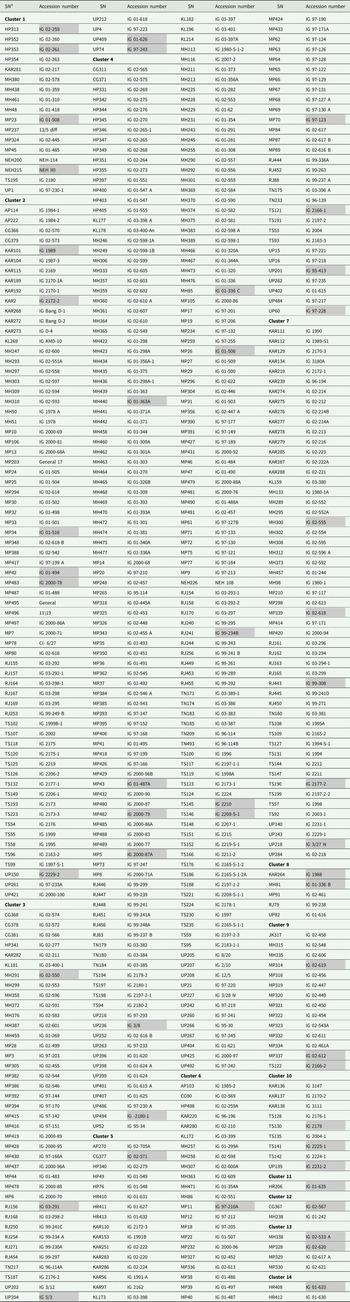
The evaluation of genotypes of D. annulatum was carried out at the experimental farm of ICAR-IGFRI, Jhansi, India (25.27 N, 78.35 E, 271 m a.s.l.) under rain-fed conditions. Scientists at IGFRI, including the authors of this study, collected seeds of the D. annulatum germplasm through explorations conducted in different parts of the country, representing varied agroclimatic conditions in India, at different times. As a practice, all the seeds collected through explorations were grown and freshly harvested seeds along with passport data were conserved in the IGFRI gene bank. The present study involved the evaluation of 498 genotypes procured from the IGFRI gene bank (Tables 1 and 2). The summary information about the province of collection and the soil and the climatic condition is given in Table 2. Six-week old seedlings, raised from seeds, were transplanted in July in 3 m long paired rows spaced 75 cm apart with 1 m distance between two pairs of rows. Twelve tussocks of each genotype were planted in a paired row at 50 cm spacing. All the blocks were uniformly planted with paired border rows and the two control genotypes in randomized position.
Dichanthium annulatum genotypes used in the study (listed as per clustering), their place of collection (Indian province) and the core subset (highlighted in grey)

AP, Andhra Pradesh; TS, Telengana; RJ, Rajasthan; MH, Maharashtra; MP, Madhya Pradesh; KAR, Karnataka; HP, Himachal Pradesh; JK, Jammu & Kashmir; NEH, North East Hilly region; CG, Chhattisgarh; HR, Haryana; TN, Tamil Nadu, UP, Uttar Pradesh; KL, Kerala.
a Serial numbers are the same as used in clustering of genotypes and the prefix to serial number represents the Indian province from where the collection was made.
Bold letters denote Cluster number.
Number of Genotypes collected from different provinces of India

AEZ, Agro Ecological Zone number as per L. Ahmad et al. (Reference Ahmad, Kanth, Parvaze and Mahdi2017); PET, Potential Evapo-transpiration.
Data on morphological traits were recorded in the second year of growth, considering the first year as the establishment year. A total of 18 quantitative metric traits were studied and data were recorded on plant height; tiller number/tussock; main tiller (i.e. tallest tiller of the tussock) thickness; inter-nodal length; a number of nodes on the main tiller; ligule length; leaf blade length; leaf blade width; leaf sheath length; leaf sheath width; flag leaf blade length; flag leaf blade width; flag leaf sheath length; flag leaf sheath width; a number of basal primary branches on panicle; a number of panicles per tiller; a number of spikes and panicle length following Roy et al. (Reference Roy, Malaviya, Kaushal, Mahanta, Tewari, Chauhan and Chandra2020). The leaf and leaf sheath width were recorded at the widest place. In addition to these traits, data were also recorded for total biomass yield per tussock at the 50% flowering stage (i.e. 50% of the inflorescence in the row have spikelets at another emergence or anthesis stage), in the 2 years and the same is presented here as total green forage yield. The samples of green forage were also oven-dried to estimate the dry matter percentage.
Data were recorded for 18 non-numeric traits such as habit, node anthocyanin colouration, node colour, node hairiness, node hair size, internode colour, basal leaf sheath colour, anthocyanin colouration on leaf sheath, anthocyanin colouration on the leaf blade, leaf colour, leaf blade attitude, leaf blade pubescence, flag leaf attitude, lemma and palea colour, panicle arrangement on primary branches, lemma and palea pubescence following the Descriptor on Dichanthium (Roy et al., Reference Roy, Malaviya, Kaushal, Chandra, Singh, Mahanta, Chauhan and Tiwari2009).
Nutritional parameters such as crude protein content (CP %); Neutral Detergent Fibre content (NDF %); Acid Detergent Fibre content (ADF %); Cellulose (%); Lignin (%); Organic Matter (OM %); Ash (%); Hemicellulose were assessed among randomly selected 181 genotypes, whereas In vitro Dry Matter Digestibility (IVDMD %) was studied among 161 genotypes following procedures as described in Roy et al. (Reference Roy, Malaviya, Kaushal, Mahanta, Tewari, Chauhan and Chandra2020), AOAC (1980), Goering and Van Soest (Reference Goering and Van Soest1970) and Tilley and Terry (Reference Tilley and Terry1963). The samples were collected on different dates to match the similar 50% flowering growth stage.
Agglomerative Cluster Analysis (based on 18 quantitative metric traits using Euclidean distance method), Principal component analysis along with PCA Biplot analysis and the Scree plot analysis was done by Statistical Tool for Agricultural Research (STAR) computer software (STAR, 2013). Sub-clustering and selection of the accessions for the core subset were done by the methods as described by Roy et al. (Reference Roy, Malaviya, Kaushal, Mahanta, Tewari, Chauhan and Chandra2020) and Brown (Reference Brown1989a). The number of accessions for the core subset was kept at 10% of the total germplasm considering a large number of germplasm studied. Pearson's correlation was calculated using the Microsoft Excel programme. Student's t-test (one tail distribution; two samples with unequal variance) was also performed using Microsoft Excel programme to compare the mean value for different traits as obtained for the core subset with that for the total germplasm to ascertain whether the core was able to capture the total diversity or not.
Results
Geographical distribution and phenotypic clustering
Clustering of genotypes based on metric quantitative data showed 14 distinct clusters. Cluster numbers 8, 11, 12, 13 and 14 were small and consisted of 1–5 genotypes in each showing their uniqueness for certain traits (Table 3). Cluster numbers 1, 9 and 14 were housed with 9–17 genotypes in each. Cluster numbers 2, 3, 6, 7 were medium-sized clusters with a number of genotypes ranging from 43 to 69 in each. Clusters 4 and 5 were among the largest clusters with 106 and 121 genotypes, respectively. The largest proportion of genotypes collected from dry tropical climates of Madhya Pradesh (MP) (60 genotypes), Maharashtra (57 genotypes), Rajasthan (16 genotypes), Telangana (24 genotypes) and Uttar Pradesh (UP) (24 genotypes) grouped in cluster numbers 4 and 5 which accounted for 36% of the total collection and 46% of the collections made from these provinces. The majority of genotypes from Himachal Pradesh (HP) grouped in cluster 4; from Telangana in clusters 2, 5 and 7; from Rajasthan in clusters 4, 5 and 7; from MP in clusters 2, 3, 4, 5 and 6; and from UP in clusters 3, 4, 5 and 6.
Cluster mean performance of morphological traits, descriptive statistics of various traits among all genotypes and the core subset of genotypes of D. annulatum

ch1, Plant height; ch2, Tiller number/tussock; ch3, main tiller thickness; ch4, Tiller intermodal length; ch5, number of nodes in main tiller; ch6, Ligule length; ch7, Longest leaf blade length; ch8, Longest leaf blade width; ch9, Longest leaf sheath length; ch10, Longest leaf sheath width; ch11, Flag leaf blade length; ch12, Flag leaf blade width; ch13, Flag leaf sheath length; ch14, Flag leaf sheath width; ch15, number of basal primary branches per panicle; ch16, Panicles: number of panicles on main tiller; ch17, number of spikes; ch18, length of panicle; EV, Eigen Values; s.d., Standard Deviation; CP, Cumulative Proportion; PV, Proportion of Variance.
* t test – core subset v. all genotypes (shows P values).
Metric trait diversity
Critical examination of morphological data of small clusters revealed that the genotype IG 01-635, forming independent cluster 11, was dwarf (plant height 19.7 cm) and characterized by possessing small and narrow leaves, few nodes, small and narrow flag leaf, and small panicles. Genotypes IG 01-633 and IG 01-630 formed cluster 14 and possessed the thickest tiller (0.8 cm) and high panicle numbers per tiller (5–8). Genotypes IG 01-242 and IG 02-567 formed cluster 12. These genotypes possessed long leaves (27–36 cm), long leaf sheath length (7–8 cm), a high number of basal primary branches (10–12), and long panicles (12–19 cm) with a high number of spikelets (9–11). Four genotypes IG 02-620, IG 02-617 A, IG 02-621 and IG 02-533 formed cluster number 13. These genotypes were noted to possess long leaves (23–32 cm), broad leaves (0.7–0.8 cm), broad leaf sheath (0.7–0.8 cm), broad flag leaf (0.7–0.8 cm), long and broad flag leaf sheath (10–14 cm long and 0.5–0.7 cm wide).
Plant height among genotypes showed a high degree of variation. It ranged from 19 to 216 cm with an average of 97 cm. Average cluster plant height was the highest in cluster 8 (150 cm) followed by cluster 7 (139 cm) whereas the minimum cluster height (19 cm) was in cluster 11 with a single genotype. Tillering behaviour (tiller number per tussock) among genotypes varied from 20 to 698 tillers per tussock with an average of 181. Among the clusters, the average minimum tiller number was less than 100 in cluster numbers 9 and 11 whereas the maximum was 295 in cluster number 8. The tiller thickness varied from 1 to 9 mm with an average of 2 mm. Among the clusters, cluster number 14 possessed the thickest tiller (8.5 mm). The internodal length ranged from 3 to 19 cm with an average of 7.9 cm. Clusters 1, 2, 12 and 13 were distinct from others with an average value of above 9 cm for intermodal length. The average internodal length of the two large clusters 4 and 5 was 7.72 and 7.93 cm, respectively. The number of nodes per tiller ranged from 2 to 16 with an average of 7.68. Clusters 11, 4 and 1 possessed 2.3, 5.6 and 5.9 nodes per tiller, respectively. Clusters 7 and 8 were noted for the highest number of nodes (>11). Leaf length and leaf width ranged from 4 to 36 cm and 0.17–0.80 cm, respectively among genotypes. Cluster number 11 possessed the smallest (4 cm) and narrow leaves (0.17 cm), whereas clusters 2, 7, 12 and 13 had leaves longer than 25 cm. Clusters 1, 2, 6, 7, 10, 12 and 13 possessed broad leaves (>6 mm). Leaf-sheath length ranged from 1 to 8 cm with an average of 5.22 cm. Longer leaf sheaths (>6 cm) were common with clusters 1, 2, 7, 10, 12 and 13. Flag leaf blade and sheath length ranged from 0.5 to 9.0 cm and 3–16 cm, respectively among genotypes. This was reflected in the average values of the trait for the clusters. Clusters 7, 10 and 12 were noted for long flag leaves (>3.5 cm) and cluster 12 for the longest flag leaf sheath (14.35 cm). Among floral traits, the number of basal primary branches varied from 1 to 12, however the average was 3.5. Clusters 1 and 12 possessed a high number of basal primary branches on panicles i.e. 8–11. Average panicle length ranged from 1.97 to 19.67 cm among the genotypes. The minimum panicle length was noted with cluster 12 (1.97 cm) and the maximum with cluster 12 (15.84 cm).
High variability was recorded for green forage yield. It ranged from 189 g to 2706 g per tussock with an average of 1118 g (Table 4). On the basis of green forage yield, the genotypes can be grouped as: <500 g – 42 genotypes; 501–1000 g – 167 genotypes; 1001–1500 g – 199 genotypes; 1501–2000 g – 70 genotypes; >2000 g – 20 genotypes. The genotypes yielding 2001–2500 g were IG 2197-2-3, IG 2177-1, IG 97-121, IG 02-623, IG 1988, IG 99-241D, IG 97-199 A, IG 1980-1A, IG 2197-2-2, IG 03-399, IG 2180-2, IG 96-194, IG 8/20, IG 01-498, IG 97-117, IG 02-618-B and IG 2172-1. The genotypes yielding more than 2501 g were IG 01-502, IG 02-614 and IG 2225-1.
Yield and its correlation with morphological traits among genotypes of D. annulatum

** = p<0.01
The genotypes also showed high genetic variation for dry forage yield. It ranged from 63 g to 1149 g per tussock with an average of 409 g (Table 4). For dry matter yield also the genotypes were grouped as: <250 g – 91 genotypes; 251–500 g – 273 genotypes; 501–750 g – 114 genotypes; 751–1000 g – 18 genotypes and >1000 g – 2 genotypes. Genotypes yielding 751–1000 g dry matter were IG 02-618-B; IG 97-293, IG 1980-1A, IG 03-396 A, IG 2197-2-2, IG 1984-2, IG 01-485, IG 5/3, IG 1988, IG 02-533, IG 03-298, IG 2197-2-3, IG 8/20, IG 01-498, IG 97-117, IG 03-399, IG 2172-1 and IG 96-194. Of these, 11 genotypes were common with the second top-ranking group for green forage yield. Two top-ranking genotypes for DMY (IG 2225-1 and IG 01-502), yielding >1000 g were also among the top-ranking genotypes of green forage yield.
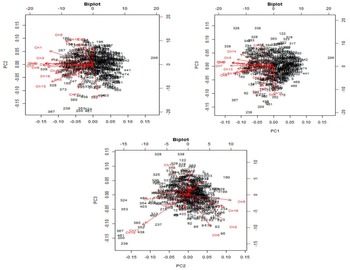
Principal Component Analysis indicated that the first eight components were cumulatively responsible for up to 81% variation (Table 3). Of these, the first three components accounted for 55% of the variation. The scree plot also reflected that most of the cumulative variation was due to the first three principal components which can explain more than half of the variability present in the germplasm (Fig. 1). Biplot figures depicted the interrelationship of the various traits. Three biplots plotting PC1 v. PC2; PC2 v. PC3 and PC1 v. PC3 showed the influence of various variables on the principal components. The biplots showed that the number of basal primary branches per panicle, number of nodes per tiller and number of spikes had a high influence on PC2 and the leaf blade length and leaf blade width on PC1 in the PC1 v. PC2 biplot (Fig. 2(a)). The basal primary branches per panicle, ligule length and the flag leaf blade width had a high influence on PC3, and the leaf blade length and leaf blade width on PC1 in the PC1 v. PC3 biplot (Fig. 2(b)). The tiller number/tussock along with the flag leaf sheath length had a high influence on PC2, and the number of basal primary branches per panicle, number of spikes and flag leaf blade width had a high influence on PC3 in the PC2 v. PC3 biplot (Fig. 2(c)).
Scree plot showing the contribution of top 10 Principal Components in variation.

Colour online. Inter-relationship of characters in Principal Component Analysis. (a) PC1 v. PC2; (b) PC1 v. PC3; (c) PC2 v. PC3.

Non-metric traits diversity
Genotypic variation for non-metric traits in D. annulatum was observed for various traits. The genotypes were grouped in four growth habit types i.e. creeping, erect, prostrate and semi-erect with 22, 168, 108 and 200 genotypes, respectively (Table 5). Node anthocyanin deposition was present among most of the genotypes except four. Node colour among 473 genotypes had purple or purple-green shade. Densely haired nodes were observed among 50 genotypes, whereas 32 genotypes were without nodal hairs and the rest had medium or scanty hairiness. Among these genotypes, the size of the node hairs, on a visual observation basis, also varied, however, most of the genotypes possessed medium to short node hairs. The internode colour among the majority of genotypes (381) was yellow-green whereas it was purple among 76 genotypes, and thirty-four genotypes had green purple or light purple coloured internodes. The most common basal leaf sheath colour was green (347 genotypes) followed with dark green in 69 genotypes. A few genotypes possessed green purple, purple or green with purple line shades. Leaf-blade anthocyanin deposition was absent among 423 genotypes. Leaf colour in different intensities of green was common among 438 genotypes. Fifty-two genotypes with blue-green leaf and eight with dark purple leaf were distinctly different. Semi-erect leaf blade character was common among 485 genotypes. Leaf hairiness was present among the majority of genotypes in different densities; however, it was absent in 121 genotypes. Flowers had some shade of purple colour except among six genotypes having green shade. Dense pubescence of lemma and palea was recorded among 143 genotypes making a velvety appearance. Panicle's primary branches were whorled among 400 and alternate among 98. Correlation of important morphological traits such as plant height, tiller number, tiller thickness, intermodal length, leaf blade length and width and flag leaf width with GFY and DMY was found to be significant and positive whereas DM% was not correlated with plant height, positively significantly correlated with tiller number and significantly negatively correlated with rest of the traits (Table 4).
Genotypic variation for non-metric quantitative traits in D. annulatum

Nutritive trait diversity
Genotypes showed a high degree of variation for nine nutritive parameters studied. Crude protein content among genotypes ranged from 4.8 to 11.3% with a mean value of 7.7%. Similarly, the range for IVDMD was 37.6–66.4% with a 56.1% mean (Table 6). The variation for NDF was 66.6–83.2% and for ADF 27.7–59.2%. Variation was also noted for ash, OM, hemicellulose, cellulose and lignin content (Table 6). Among the clusters, the mean values of different nutritional parameters were close to the mean value of total genotypes, which reflected that variation for quality parameters was distributed among clusters uniformly.
Nutritive parameters of genotypes, clusters and core subset of D. annulatum

OM, Organic matter; CP, Crude protein; NDF, Neutral Detergent Fibre content; ADF, Acid Detergent Fibre content; Cell, Cellulose; Lig, Lignin; Hemicell, Hemicellulose; IVDMD, In vitro Dry Matter Digestibility.
a t test – core subset v. all genotypes (shows P values)
Although clustering was done using metric traits only, the non-metric traits also showed some links with metric traits clustering patterns. The genotypes with less leaf hairiness grouped in cluster 1; the medium hairy leaf genotypes were distributed among many clusters such as 2, 3, 4, 5, 6, 9 and 10. Similarly, genotypes with medium and dense hairy leaves were present in cluster 5. Cluster 7 contained the diverse genotypes i.e. with glabrous and dense hairy leaves. Dark purple lemma and palea colour was distributed among genotypes in clusters 2, 3, 4 and 5 whereas purple colour was common among the genotypes with many clusters such as 1, 2, 3, 4, 5, 6, 7 and 9.
Core subset identification
A core subset of germplasm was identified by randomly selecting accessions from clusters and their sub-clusters. Thus, a total of 50 accessions were selected (Table 1). The diversity present in the core subset was compared with that present in the total germplasm collection. The comparison based on the student t test revealed that the difference between the two populations for various morphological traits was non-significant (Table 3). Similarly, the t test for comparison of nutritional parameters was also found non-significant (Table 6). The genotypes of the core subset represented most of the Indian provinces including accessions from Haryana, Chhattisgarh, Madhya Pradesh, Himachal Pradesh, Maharashtra and Uttar Pradesh. The plant habit variability was represented as erect, prostrate and semi-erect genotypes. The tiller node colour of the accessions in the core subset was uniformly light purple whereas among the germplasm it was represented as purple, green-purple and light green. Similarly, the tiller node hairiness variants i.e. without hair, medium, dense and scanty hairiness were present in the core. Tiller node hair size variability as a medium, short, very short and long was well present among core genotypes along with green-purple, yellow-green and purple tiller internode colour. Some of the genotypes evaluated in the study showed the presence of pits, and among core subset genotypes also three genotypes possessed pits whereas the remaining 47 were without pits.
Discussion
Dichanthium and Bothriochloa are morphologically very close and show intergeneric crossability. These genera form an agamic complex together with the genus Capillipedium. Hence, the natural population is also a mixture of several species and races along with various intermediate introgressed derivatives. Mehra (Reference Mehra1961) has demonstrated the presence of introgression between the D. annulatum complex and certain species of the genus Bothriochloa. In the entire Indo-Gangetic plains, active introgression is going on between B. intermedia and D. annulatum (Harlan et al., Reference Harlan, Celarier, Richardson, Brooks and Mehra1958), and some forms intermediate between these species have been described as species i.e. Bothriochloa grahamii Bor (Reference Bor1960). Cytological evidence indicates that in the Bothriochloa-Dichanthium agamic complex, the compulsive bivalent pairing was controlled by a single dominant gene in species and their hybrids (Chedda and Harlan, Reference Chedda and Harlan1962).
D. annulatum complex consists of a polyploid series with basic chromosome number as n = 10 and frequent occurrence of diploids, tetraploids and hexaploids (Celarier et al., Reference Celarier, Mehra and Wulf1958). In the Dichanthium-Bothriochloa complex, cytological studies indicate that the diploid (2n = 20) reproduces sexually whereas; tetraploids are facultative or obligate apomicts (Gupta et al., Reference Gupta, Roy and Singh1969). D. annulatum has been reported to occur in different ploidy levels (Mehra, Reference Mehra1961). However, it is predominantly naturalized in tetraploid (2n = 40) with the presence of sexual forms in India whereas in South-east Africa it is present in hexaploid forms. Despite genetically isolated diploid races of India, its tetraploid forms cross with D. aristatum and D. caricosum (Bogdan, Reference Bogdan1977).
Clustering of genotypes showed nearly one-third of the genotypes collected from dry tropical climates to cluster in two clusters only. Genotypes from temperate regions clustered together. Similarly, collections from other provinces also largely clustered together. Earlier studies involving accessions of D. annulatum indicated a wide range of diversity for different characters (Gupta et al., Reference Gupta, Roy and Gupta1996; Agarwal et al., Reference Agarwal, Roy and Gupta1998, Reference Agarwal, Gupta, Roy and Gupta1999) and the clustering pattern was observed to be independent of their geographical distribution. A smaller number of genotypes together with the morphological traits observed might have been the reason for the clustering pattern being independent of geographical distribution in earlier studies. Similar studies carried out in other largely apomictic tropical perennial grasses indicated the occurrence of wide variability independent of geographical collection in Sehima nervosum (Roy et al., Reference Roy, Agarwal and Gupta1999; Chauhan et al., Reference Chauhan, Tiwari, Roy, Kaushal, Malaviya, Chandra and Mahanta2007); in H. contortus (Roy, Reference Roy2004; Bhat and Roy, Reference Bhat and Roy2007, Reference Bhat and Roy2014) and in Guinea grass (Jain et al., Reference Jain, Roy, Kaushal, Malaviya and Zadoo2003, Reference Jain, Roy, Kaushal, Malaviya and Zadoo2006). Plant height, number of tillers and leaf length were reported to be important traits while constructing selections criterion for forage yield in another tropical perennial grass Sehima (Roy et al., Reference Roy, Agarwal and Gupta1999); tiller number, high nodal number and longer leaf in H. contortus (Roy, Reference Roy2004). Isozyme and molecular diversity analysis on D. annulatum genetic diversity revealed, at large, groupings of accessions with their regions of collections and the accessions of the arid and drier region were effectively separated (Chandra et al., Reference Chandra, Roy, Saxena and Dubey2003, Reference Chandra, Saxena, Roy and Pathak2004, Reference Chandra, Saxena and Roy2006; Saxena and Chandra, Reference Saxena and Chandra2010, Reference Saxena and Chandra2011). However, clustering based on agro-morphological attributes was found to be independent of their geographical distribution by Agarwal et al. (Reference Agarwal, Gupta, Roy and Gupta1999).
Morphologically distinct accessions formed independent small clusters. The dwarf genotype appeared to be weak in growth and short-lived perennial. In contrast, some genotypes with very thick stems and high panicle numbers per tiller also formed independent clusters. Genotypes with long leaves; and panicles with a high number of spikes and basal primary branches showed their close resemblance with Bothriocloa intermedia. High basal branching is the characteristic of B. intermedia. Hence, the genotypes with more primary branches may be examples of an inter-generic cross. High genetic variability observed for various morphological traits as well as forage yield indicated that these genotypes or subset of genotypes can be evaluated in different abiotic stress conditions such as salt, light and moisture stress, which may result in the identification and use of those genotypes in that target environment. Ram et al. (Reference Ram, Dayal and Shamsudheen2009) reported that green fodder yield and dry fodder yield were having high heritability estimates and genetic advance suggesting their additive gene control and seemed to be potentially utilized in the selection procedure.
Genotypic variation for quantitative traits can prove to be good selection criteria for identifying genotypes for stress tolerance or quality, for example plant height, tiller number, tiller thickness, intermodal length, leaf blade length and width and flag leaf width were positively correlated with green and dry forage yield. In earlier correlation studies on D. annulatum, out of the fifteen characters, the phenotypic correlation coefficients were significant for only four combinations, while the genotypic correlation coefficients were significant for nine character combinations (Yadav et al., Reference Yadav, Mehra and Magoon1976). Selection based on plant height and tillers per plant have also been advocated for further improvement in dry fodder yield and seed yield per plant (Ram et al., Reference Ram, Dayal, Meena, Kumar, Machiwal and Vyas2013).
Nutritive traits have high importance for any forage species. High genetic diversity observed for these traits in the present set of germplasm provided an opportunity for selecting genotypes with high protein or digestibility. Leaf characters, including the leaf stem ratio are important trait for quality, digestibility and palatability. In this study, several leaf related parameters were recorded. The number of nodes per tiller also reflects the number of leaves per tiller. The present study established that leaf length and the flag leaf length were positively correlated with CP% (P = <0.01 and <0.05 respectively). Thus, the genotypes with long leaves or long flag leaves may be considered as genotypes with better quality.
The samples for the nutritional parameters study were collected at 50% flowering stage, which is standard practice for forage harvesting (Bhagmal et al., Reference Bhagmal, Singh, Roy, Ahmad and Malaviya2009; Rathod and Dixit, Reference Rathod and Dixit2019). This allowed the genotypes to attain a similar and optimum vegetative growth stage. With the formation of seed, the quality of forage declines. Biomass harvesting for forage purpose at the early vegetative stage results in harvesting less biomass of better quality, whereas at the maturity stage it leads to high biomass with poor quality. Monson and Burton (Reference Monson and Burton1982) also reported that the grasses like Bermuda grass should be harvested at 4 weeks interval for high crude protein content which significantly dropped at 8-week intervals schedule. Similarly, in a quackgrass-dominated stand, maximum dry matter yield and maximum protein yield were obtained in August and July respectively, whereas reduction in protein content and the total digestible matter was observed in delayed harvest (Malhi et al., Reference Malhi, Foster and Gill2003). In an earlier study on forage grasses, the nutritive quality has been reported to decline with advancing stage of plant development (Buxton and Marten, Reference Buxton and Marten1989). In general, the grasses are reported to show a sharp decline in nutritive quality i.e. increase in fibre content and decrease in CP, at maturity (Mahala et al., Reference Mahala, Nsahlai, Basha and Mohammed2009). Hence, it is expected, in relative terms, in the present study, that the quality will be better during grazing at a younger plant stage. Johnson et al. (Reference Johnson, Hardison and Castillo1967) also reported such differences in 17 days and 75 days old crop of P. maximum for fibre content. Such variations were also attributed to multiple factors like genotype, age of grass and geographical zone, etc. (Ismail et al., Reference Ismail, Fatur, Ahmed, Ahmed and Ahmed2014). Additionally, selection of genotypes can be made as per requirement i.e. grazing, stall feeding and biofuel.
Core subset developed on the basis of morphological clustering represented the whole range of diversity measured as metric traits and thus successfully captured the range of diversity available. The genotypes of the core subset represented most of the Indian provinces from where collections were made. It also represented most of the variability recorded as non-metric traits. Among the genotypes of the core subset, the representation of genotypes with a high and low value of various nutritional parameters was noted (Table 6), reflecting that the core subset is a true representative of the germplasm collection for nutritional parameters also. Thus, the creation of 10% of the base collection as a core subset following Brown (Reference Brown, Brown, Frankel, Marshall and Williams1989b) appeared to effectively represent the whole variability of the germplasm and most of the alleles are expected to be present with no redundant entries. Charmet and Balfourier (Reference Charmet and Balfourier1995) and Bisht et al. (Reference Bisht, Mahajan, Lokknathan and Agrawal1998) have also recommended 5–10% of total germplasm for capturing 75–90% of the whole range of diversity, although Noirot et al. (Reference Noirot, Messager, Dubos, Miqucl and Lavorez1986) have suggested 15% of the base collection. Such a core once established, can be studied in detail for the desired characters (Ortiz et al., Reference Ortiz, Ruiz-Tapia and Mujica-Sanchez1998; Chandra et al., Reference Chandra, Huaman, Hari and Ortiz2002).
The present study established a high degree of phenotypic variability among genotypes for various traits. The variability so studied can further be strengthened by molecular tools. CISP molecular markers developed in sugarcane have shown a moderate degree of transferability to D. annulatum (Chandra et al., Reference Chandra, Jain, Solomon, Shrivastava and Roy2013) also and can be effectively used. Such variation might have been created in nature through the intraspecific, interspecific and intergeneric crossing. Diploid forms of D. annulatum are reported to be sexual in nature (Cruz and Reddy, Reference Cruz and Reddy1971) which could be the source of natural variation. Although, D. annulatum is predominantly apomictic, the diploid species D. aristatum and D. caricosum have sexual reproduction (Reddy, Reference Reddy1967; Reddy and D'Cruz, Reference Reddy and D'Cruz1969) which also contributes to variation. Chandra et al. (Reference Chandra, Roy, Saxena and Dubey2003, Reference Chandra, Saxena, Roy and Pathak2004, Reference Chandra, Saxena and Roy2006, Reference Chandra, Roy and Kumar2010), based on molecular studies on a collection of D. annulatum germplasm, found that accessions from Hyderabad possess higher levels of genetic variation than others, hence, further collections from the region may be more productive. In the present study, 65 accessions represented this region (Andhra Pradesh and Telangana) and exhibited considerable diversity as reflected by their grouping in different clusters. It is also possible that more sexual plants occur in natural conditions in this region that allowed recombination to occur in this predominantly apomictic grass.
Conclusions
Indian germplasm pool of D. annulatum possesses a high degree of variation for morphological traits, biomass yield and nutritional parameters. Sexual forms, through intra/interspecific and intergeneric crossing, might have contributed to the genetic variability. Plant height, tiller number, tiller thickness, leaf length and width and flag leaf width can be treated as reliable selection indices for biomass yield. The core subset could be a valuable genetic resource for evaluation in a target environment and improving the productivity of the grasslands.
Author contributions
A. K. R., D. R. M., P. K. conceived, designed research and wrote the manuscript; S. K. M. Contributed in nutritional studies and preparing manuscript; R. C. and R. T. conducted experiment, recorded data; A. C. contributed in experimentation and preparing manuscript.
Financial support
The authors are thankful to the National Bio-resource Development Board, Department of Biotechnology, Government of India and Indian Council of Agricultural Research for financial support.
Conflict of interest
The authors declare there are no conflicts of interest.
Ethical standards
Not applicable.