INTRODUCTION
The freshwater reservoir effect (FRE) is the radiocarbon (14C) age difference between the atmosphere and a contemporaneous freshwater system (Godwin Reference Godwin1951). FRE values range from hundreds to thousands of years in different lakes and can change with time (Wu et al. Reference Wu, Li, Lucke, Wunnemann, Zhou, Reimer and Wang2010, Reference Wu, Wang and Zhou2011; Long et al. Reference Long, Lai, Wang and Zhang2011; Ascough et al. Reference Ascough, Church, Cook, Dunbar, Gestsdóttir, McGovern, Dugmore, Friðriksson and Edwards2012; Keaveney and Reimer Reference Keaveney and Reimer2012; Zhang et al. Reference Zhang, Liu, Wu, Liu and Zhou2012; Mischke et al. Reference Mischke, Weynell, Zhang and Wiechert2013; Wang et al. Reference Wang, Feng, Ran and Zhang2013a; Yu et al. Reference Yu, Cheng and Hou2014; Zhou et al. Reference Zhou, Cheng, Jull, Lu, A, Wang, Zhu and Wu2014, Reference Zhou, He, Wu, Zhang, Zhang, Liu and Yu2015; Lockot et al. Reference Lockot, Ramisch, Wünnemann, Hartmann, Haberzettl, Chen and Diekmann2015). Dissolved inorganic carbon (DIC) is an important component of a freshwater system and influences the 14C level of aquatic plants growing there (Deevey et al. Reference Deevey, Gross, Hutchinson and Kraybill1954; Yu et al. Reference Yu, Shen and Colman2007; Olsson et al. Reference Olsson2009). In general, three factors control the 14C level of lake water DIC: (1) the rate and degree of exchange with atmospheric CO2; (2) geological weathering; and (3) microbial decay of terrigenous organic matter (Hakansson et al. Reference Hakansson1979; Bondevik et al. Reference Bondevik, Mangerud, Birks, Gulliksen and Reimer2006; Cage et al. Reference Cage, Heinemeier and Austin2006; Hendy et al. Reference Hendy and Hall2006; Kritzberg et al. Reference Kritzberg, Cole, Pace and Graneli2006; Hatté and Jull Reference Hatté and Jull2007; Olsson Reference Olsson2009; Kritzberg et al. Reference Kritzberg, Graneli, Bjork, Bronmark, Hallgren, Nicolle, Persson and Hansson2014; Keaveney et al. Reference Keaveney, Reimer and Foy2015). DIC 14C levels vary from lake to lake and the content of a particular lake will depend on its individual geographical setting. The investigation of DIC levels from a number of modern lakes is useful in identifying trends in the FRE.
A number of past studies have examined DIC in Chinese lakes. For example, at Qinghai Lake, riverine DIC has been shown to have much lower levels than the overall DIC pool in the lake. This is explained by the rapid carbon exchange that occurs between the lake and atmosphere, driven in part by its high alkalinity (Yu et al. Reference Yu, Shen and Colman2007; Jull et al. Reference Jull, Burr, Zhou, Cheng, Song, Leonard, Cheng and An2014; Zhou et al. Reference Zhou, Cheng, Jull, Lu, A, Wang, Zhu and Wu2014). This effect is also seen in the DIC δ13C results of different parts of Qinghai Lake and DIC F14C results of other lakes from the Tibetan Plateau. In many cases it has been observed that water from the center of a lake exchanges more completely with atmospheric CO2 than with water near the shore (Li et al. Reference Li, Liu and Xu2012; Mischke et al. Reference Mischke, Weynell, Zhang and Wiechert2013). In a different example, DIC F14C time series from Lake Kinneret in Israel show temporal variations that correspond to flood discharge years, when DIC F14C values are relatively lower than other years (Stiller et al. Reference Stiller, Kaufman, Carmi and Mintz2001). Lakes on the Tibetan Plateau can be distinguished as open or closed systems according to their δ13CDIC characteristics. Open lakes (net water outflow from the lake) have δ13CDIC values that are similar to inflowing river water, while closed lakes (without water outflow from the lake) show a greater degree of exchange between lake water DIC and the atmosphere (Lei et al. Reference Lei, Yao, Zhang, Sheng, Wang, Li and Wang2011). By extension, the hydrological conditions in a lake can influence DIC F14C values.
The average residence time of a lake can be expressed as the ratio between lake volume and rate of inflow or outflow in an equilibrium state (Yu et al. Reference Yu, Shen and Colman2007; Jull et al. Reference Jull, Burr, Zhou, Cheng, Song, Leonard, Cheng and An2014). This quantity depends on the hydrological processes operating in a particular lake, and encompasses both open and closed lakes. Here we examine 11 lakes from different parts of China to examine the relationship between open and closed lakes and their DIC levels, as expressed by their average residence times.
LOCATION DESCRIPTION AND SAMPLING
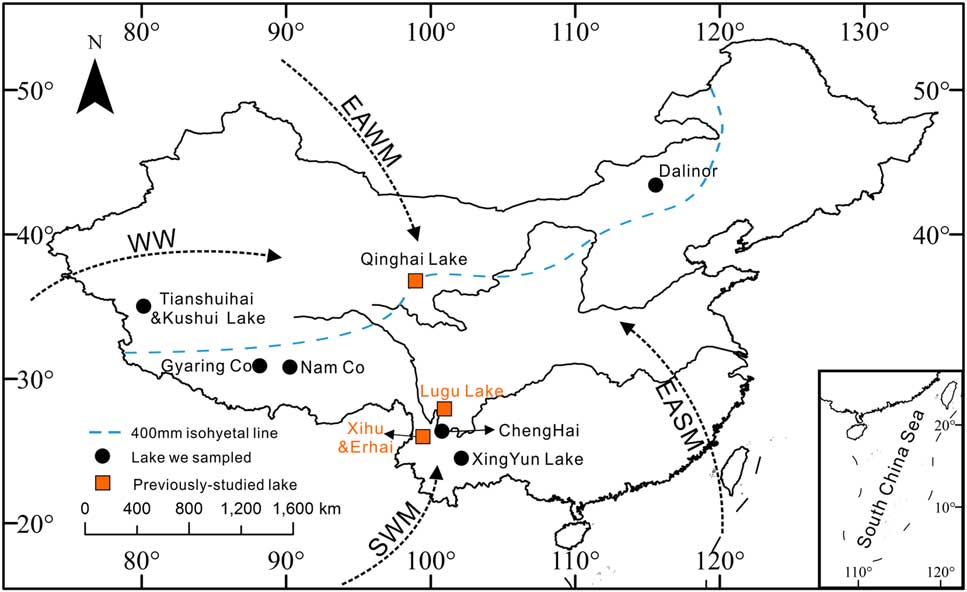
For this study we sampled seven lakes from different parts of China and we review four additional lakes from the published literature. The lakes we sampled include Tianshuihai, Kushui Lake, Gyaring Co, Nam Co, Chenghai, Xingyun Lake, and Dalinor (Figure 1).
Location of the lakes. The circle represents the lakes we sampled; the rectangle represents previously studied lakes. EASM, EAWM, WW, and SWM are abbreviations for East Asian Summer Monsoon, East Asian Winter Monsoon, Westerly Wind, and Southwest Monsoon, respectively.

Tianshuihai (79°35′E, 35°27′N) and Kushui Lake (79°21′E, 35°35′N) are located in northwest China, where the climate is dominated by the westerlies, the bedrock is siltstone (Li et al. Reference Li, Qu, Zhu and Li1998). Gyaring Co (88°13′E, 31°11′N) and Nam Co (90°36′E, 30°43′N) are located in western China, in the central Tibetan plateau, the bedrock is limestone and volcanic rock, the bedrock of Gyaring Co is limestone (Zhang et al. Reference Zhang, Wu, Zhu, Wang, Li and Chen2011). Dalinor (116°37′E, 43°17′N) is located in northern China, near the northwestern limit of the modern East Asian monsoon domain, the bedrock is volcanic stone (Figure 1). Chenghai (100°39′E, 26°33′N) and Xingyun Lake (102°46′E, 24°19′N) are in southern China, where the climate is controlled by the Southwest Monsoon, the bedrock is limestone (Xu et al. Reference Xu, Yeager, Lan, Liu, Sheng and Zhou2015a,Reference Xu, Zhou, Lan, Liu, Sheng, Yu, Cheng, Wu, Hong, Yeager and Xub) (Figure 1). Tianshuihai and Gyaring Co are open lakes (Li et al. Reference Li, Qu, Zhu and Li1998); whereas Kushui Lake, Nam Co, Dalinor, Xingyun Lake and Chenghai are closed lakes (Li et al. Reference Li, Qu, Zhu and Li1998; Zhang et al. Reference Zhang, Wu, Zhu, Wang, Li and Chen2011; Dong et al. Reference Dong2008; Zhang et al. Reference Zhang, Li, Fen and Zhang2008; Hu et al. Reference Hu, Ji and Pan1992).
In November 2014 and May to August 2015, we collected surface lake water from the seven lakes. In some cases we were also able to collect submerged aquatic plants. In Dalinor we collected water from the inflowing rivers, groundwater from a spring, and an air sample. All of the water samples were collected in 600-mL brown glass bottles. The sample bottles were cleaned prior to sampling and rinsed with lake water three times before sampling. The air samples were collected in aluminum foil gas sampling bags using an established methodology (Niu et al. Reference Niu, Zhou, Wu, Cheng, Lu, Xiong, Du, Fu and Wang2016).
SAMPLE PREPARATION AND MEASUREMENT
All of the water samples were filtered with 0.7 μm GF/F glass-fiber filters in the laboratory. The filtered samples were placed in a Pyrex® flask and acidifed with 85% H3PO4 to liberate CO2 from the DIC fraction. The GF/F glass-fiber filters and aquatic plants were treated with 1N HCl and then rinsed in distilled water and dried. The dried, pretreated samples were placed into 9-mm quartz tubes, with an appropriate amount of CuO as oxidant. They were then evacuated to <10–5 Torr and heated to 850°C. The CO2 produced by the combustion was divided into two parts; one is used for δ13C measurement and the other was converted catalytically to graphite using a hydrogen reduction method over iron powder for measurement. Measurements were made at the 3 MV HVE Tandetron AMS (Zhou et al. Reference Zhou, Zhao, Lu, Lin, Wu, Peng, Zhao and Huang2006). δ13C measurements were made with an isotope ratio mass spectrometer (MAT-252). All of the analyses were conducted at the Xi’an Institute of Earth Environment, Chinese Academy of Sciences.
The 14C results are quoted as fraction of modern carbon (F14C) values (Donahue et al. Reference Donahue, Linick and Jull1990), and the 13C results are quoted as δ13C values (V-PDB, ‰).
RESULTS
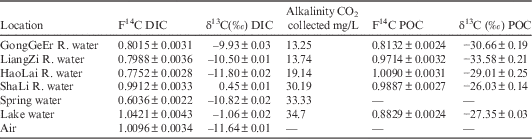
The results from the inflowing rivers, groundwater and air sample from Dalinor are given in Table 1. In Dalinor, the F14C values of the DIC fraction from four inflowing rivers we sampled range from 0.7752 to 0.9912 (Table 1). The lowest value is from the HaoLai river and the highest is from the ShaLi river. The DIC F14C of groundwater collected from the site is 0.6036. The DIC F14C of surface lake water and atmospheric CO2 are 1.0421 and 1.0096 respectively (Table 1). Hence, the DIC F14C values of incoming water (river water and groundwater) are systematically lower than those of the surface lake water.
River water, spring water, DIC and air 14C results for Dalinor.

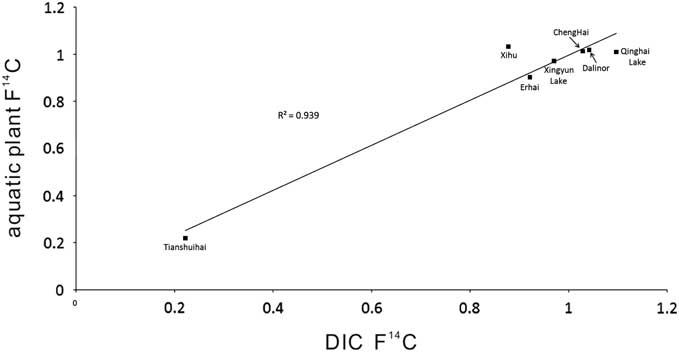
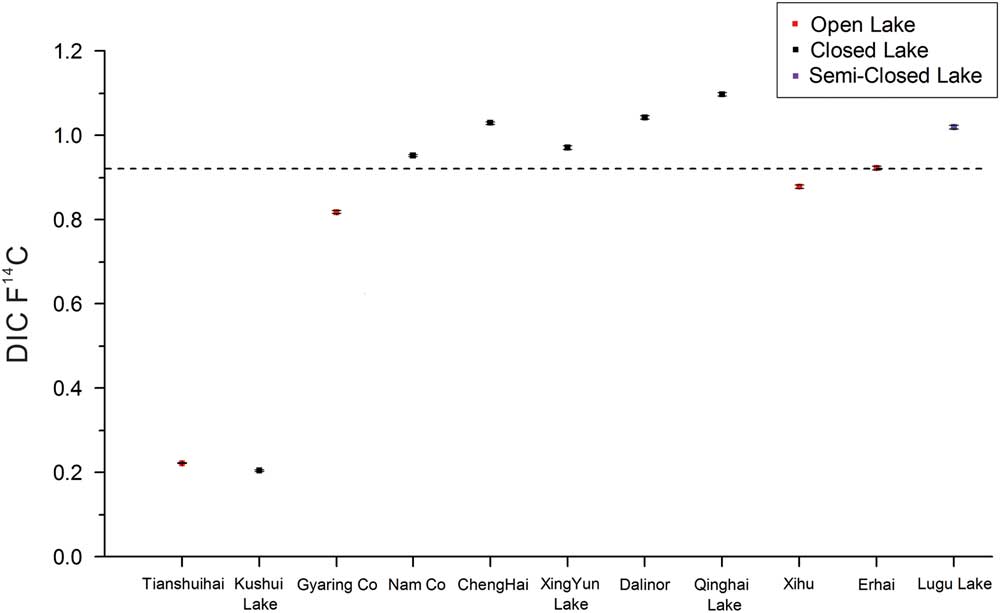
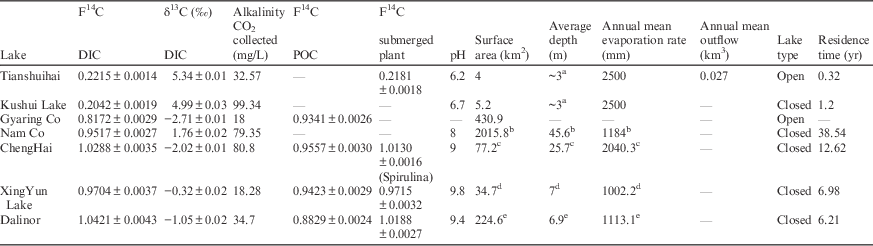
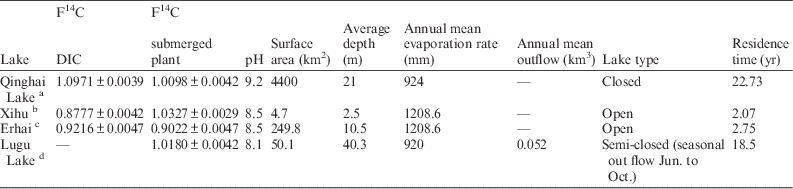
Results for Tianshuihai, Kushui Lake, Gyaring Co, Nam Co, Chenghai, Xingyun Lake, and Dalinor are shown together in Table 2. For comparison, we present published results from several other Chinese lakes in Table 3. We also indicate the open or closed nature of each lake in Tables 2 and 3. The DIC F14C values of the lakes range from 0.2042 to 1.0971; DIC δ13C values range from –2.71‰ to 5.34‰. The F14C values of particulate organic carbon (POC) range from 0.8829 to 0.9557, and the F14C values of aquatic plants in these lakes range from 0.2215 to 1.0971 (Table 2, Table 3). Figure 2 shows that F14C values of aquatic plants were positively correlated with lake water DIC F14C (R2=0.939). This correlation shows that the level of aquatic plants is controlled by the level of lake water DIC, as expected. Another interesting observation is that the DIC samples from open lakes (except Kushui Lake) have lower F14C values than DIC samples from closed lakes (Figure 3). This phenomenon implies that hydrological circulation influences surface lake water DIC levels.
F14C of aquatic plants and DIC. The linear fit result is y=0.955x+0.04, R²=0.939.

DIC F14C of different lakes. The dashed line shows the highest FDIC value of open lakes. Lugu Lake uses the Fwater seed.

The fraction modern carbon (F14C) values and water residence times of the lakes we studied.

The superscripts indicate the data resource of surface area, average depth and annual mean evaporation of the lakes.
a. Li et al. Reference Li, Qu, Zhu and Li1998; b. Zhang et al. Reference Zhang, Wu, Zhu, Wang, Li and Chen2011; c. Hu et al. Reference Hu, Ji and Pan1992; d. Zhang et al. Reference Zhang, Li, Fen and Zhang2008; e. Dong Reference Dong2008; Wang et al. Reference Wang, Wu, Zeng and Ma2015.
The fraction of modern carbon (F14C) values and water residence times of previously studied lakes.

The superscripts indicate the data resource of the lakes.
a. Jull et al. Reference Jull, Burr, Zhou, Cheng, Song, Leonard, Cheng and An2014; Zhou et al. Reference Zhou, Cheng, Jull, Lu, A, Wang, Zhu and Wu2014; b. Xu et al. Reference Xu, Yeager, Lan, Liu, Sheng and Zhou2015a; Du et al. Reference Du1998; c. Xu et al. Reference Xu, Zhou, Lan, Liu, Sheng, Yu, Cheng, Wu, Hong, Yeager and Xu2015b; Fu et al. Reference Fu, Yuan, Cao, Zhong, Zhang, Guo, Zhang, Ni and Wang2013; d. Chen et al. Reference Chen, Wang, Zhu, Zhao, Jiang, Yang and Yang2012; Sheng et al. Reference Sheng, YuKK, Lan, Liu and Che2015.
DISCUSSION
Residence Time of Lakes
The average residence time of the water in a lake can be expressed as the ratio between lake volume and the input or output of water at steady state. This parameter reflects the hydrological processes operating in a particular lake (Yu et al. Reference Yu, Shen and Colman2007; Jull et al. Reference Jull, Burr, Zhou, Cheng, Song, Leonard, Cheng and An2014).
In our study survey, DIC samples from open lakes (except Kushui Lake) have lower F14C values than DIC samples from closed lakes (Figure 3). This suggests that hydrological processes influence DIC F14C values. Some published research comes to the same conclusion. For example, time series DIC 14C data collected from Lake Kinneret, Israel, showed that F14C values from lake water DIC were significantly reduced during years with prevalent flooding (Stiller et al. Reference Stiller, Kaufman, Carmi and Mintz2001). In order to further examine this influence, we calculate the average residence time for each lake. The results are shown in Tables 2 and 3.
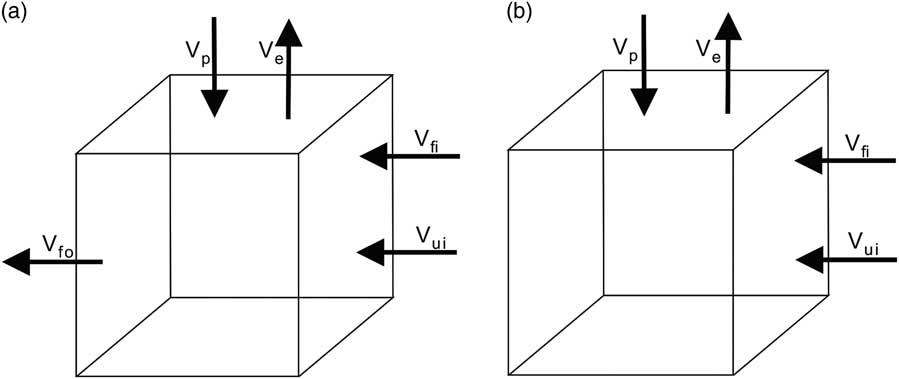
The water balance of open and closed lakes is shown schematically in Figure 4. The steady-state water balance in a lake can be expressed as follows:
 $${\rm for}\,{\rm a}\,{\rm closed}\,{\rm lake}\,\colon\,\quad {\rm V}_{{\rm i}} {\equals}{\rm V}_{{\rm p}} {\plus}{\rm V}_{{{\rm fi}}} {\plus}{\rm V}_{{{\rm ui}}} $$
 $${\rm V}_{{\rm o}} {\equals}{\rm V}_{{\rm e}} $$
 $${\rm for}\,{\rm an}\,{\rm open}\,{\rm lake}\,\colon\,\quad {\rm V}_{{\rm i}} {\equals}{\rm V}_{{\rm p}} {\plus}{\rm V}_{{{\rm fi}}} {\plus}{\rm V}_{{{\rm ui}}} $$
 $${\rm V}_{{\rm o}} {\equals}{\rm V}_{{\rm e}} {\plus}{\rm V}_{{{\rm fo}}} $$
where Vi is annual water volume input to the lake, Vp is the annual precipitation volume to the lake, Vfi is the annual river inflow volume to the lake, Vui is the annual underground water inflow volume to the lake, Vo is annual water output volume from the lake, Ve is the annual evaporation volume from the lake, and Vfo is the annual river outflow volume from the lake.
Model of lake water circulation (modified from Figure 1 of Yu et al. Reference Yu, Shen and Colman2007). (a) open lake; (b) closed lake. Vp is the annual volume of precipitation; Ve is the annual volume of evaporation; Vfi is the annual water flow into the lake; Vfo is the annual water flow out of the lake; Vui is the annual underground water flow into the lake.

We can calculate the average residence time of a lake (τ) for a lake volume V with the following equation (Schaffner and Oglesby Reference Schaffner and Oglesby1978; Jull et al. Reference Jull, Burr, Zhou, Cheng, Song, Leonard, Cheng and An2014):
 $${{{\rm dV}} \over {{\rm dt}}}{\equals}{1 \over {\rm \tau }}{\rm V}$$
where dV/dt is the rate o f input (positive values) or output (negative values) of a lake at steady-state. As the input is more complex than the output, here we use the output to calculate the average residence time. We combine Equations (2) and (4) with Equation (5).
 $${\rm for}\,{\rm a}\,{\rm closed}\,{\rm lake\,\colon\, }\quad \tau {\rm {\equals} V\,/\,V}_{{\rm e}} $$
 $${\rm for}\,{\rm an}\,{\rm open}\,{\rm lake\,\colon\,}\quad \tau {\equals}{\rm V}\,/\,\left( {{\rm V}_{{\rm e}} {\plus}{\rm V}_{{{\rm fo}}} } \right)$$
The volume of a lake can be expressed as
 $${\rm V}{\equals}{\rm SD}$$
 $${\rm V}_{{\rm e}} {\equals}{\rm SE}$$
where S is the surface area of the lake, D is the average depth, and E is the annual evaporation rate. We combine Equations (8) and (9) with Equations (6) and (7).
 $${\rm for}\,{\rm a}\,{\rm closed}\,{\rm lake}\,\colon\,\tau {\equals}{\rm D}\,/\,{\rm E}$$
 $${\rm for}\,{\rm an}\,{\rm open}\,{\rm lake}\,\colon\,\tau {\equals}\left( {{\rm SD}} \right)\,/\,\left( {{\rm SE{\plus}V}_{{{\rm fo}}} } \right)$$
In our study we use Equation (10) to calculate average residence times for all of the closed lakes. For the open lakes we calculated average residence times as follows: Tianshuihai is calculated by Equation (11), Xihu is calculated by Equation (10) due to the lack of outflow data (the actual average residence time is less than the calculated one), and Erhai and Lugu Lake average residence times are from Fu et al. (Reference Fu, Yuan, Cao, Zhong, Zhang, Guo, Zhang, Ni and Wang2013) and Sheng et al. (Reference Sheng, YuKK, Lan, Liu and Che2015), respectively. As there is no published depth and outflow data for Gyaring Co, we do not calculate an average residence time. All of the average residence time results are shown in Tables 2 and 3.
Modern Water in Dalinor
GongGeEr River, LiangZi River, HaoLai River and ShaLi River are the major rivers of Dalinor; and GongGerEr River is the biggest river with 75% of total riverine inflow. The annual inflow of river and underground water accounts for almost 70% of the total annual inflow to Dalinor, and the remaining portion comes from precipitation (Dong Reference Dong2008).
In Dalinor, the modern atmospheric F14C value is 1.0096. DIC F14C values of GongGeEr River (largest river at Dalinor) and spring water are 0.8015 and 0.6036 respectively. The POC F14C value of GongGeEr river is 0.8132 (Table 1).The surface lake water DIC F14C value is 1.0421 (Table 1). The F14C value of surface lake water DIC is similar to the atmospheric CO2 F14C value, but higher than GongGeEr River (and other rivers; Table 1), and the spring DIC F14C value. We presume that water may exchange with atmospheric CO2 after flowing into the lake.
The δ13C value of DIC can reflect the exchange between lake water DIC and atmospheric CO2. Carbon isotope fractionation between dissolved carbonates (HCO3 − and CO3 2−) and atmospheric CO2, which normally has a δ13C value of about −7‰, varies from 9.2‰ at 0 °C, to 6.8‰ at 30ºC (Deuser and Degens Reference Deuser and Degen1967; Mook et al. Reference Mook, Bommerson and Staverman1974; Myrttinen et al. Reference Myrttinen, Becker and Barth2012). Therefore, DIC in the surface lake water should have a δ13C value between 0 and 2.0‰. For example, the δ13C value of Qinghai Lake surface water DIC is in the range of 0.69‰ to 1.03‰ (Li et al. Reference Li, Liu and Xu2012; Wang et al. Reference Wang, Jin and Zhang2013b). This suggests that surface lake water there has reached a steady-state balance with atmospheric CO2.
DIC Content of Lakes
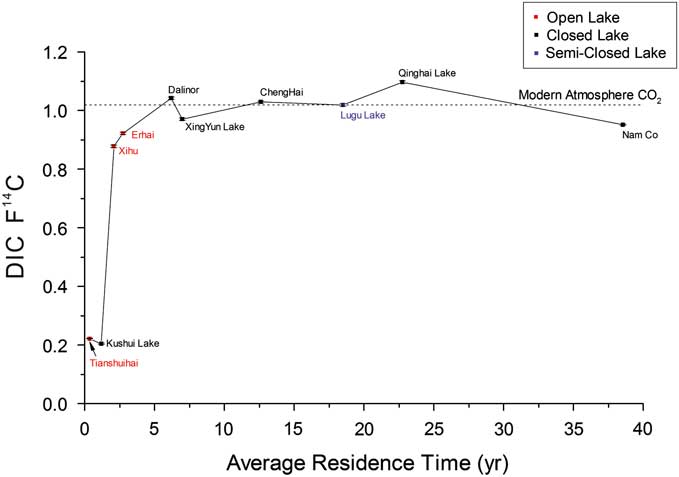
For the lakes we studied and reviewed, surface lake water DIC F14C values of open lakes (except Kushui Lake) were found to be lower than surface lake water DIC F14C values of closed lakes (Figure 3), and the average residence times of open lakes are usually shorter than closed lakes (Figure 5). Furthermore, a comparison between surface water DIC F14C values and average residence time shows that DIC F14C increases with average residence time and reflects a steady-state (Figure 5).
Surface Lake water DIC F14C with lake water residence time. The dashed line shows the F14C value of modern atmospheric CO2 (Levin et al. Reference Levin, Kromer and Hammer2013). Lugu Lake uses the F14C of water seed. Gyaring Co is not shown due to a lack of residence time data.

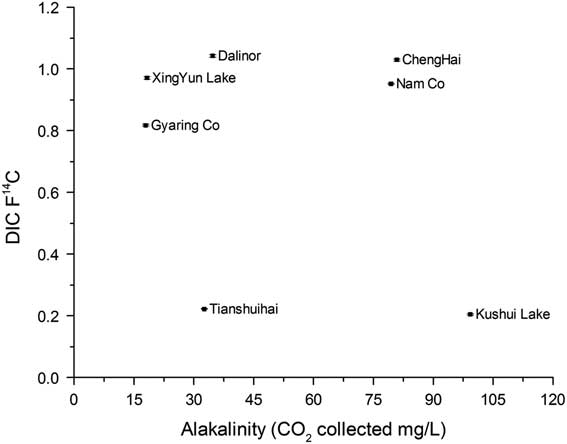
As stated above, there are three factors that control DIC F14C values in our lakes: (1) the rate and degree of exchange with atmospheric CO2; (2) geological weathering; and (3) microbial decay of terrigenous organic matter. Ground waters and river waters generally have low DIC F14C values due to the addition of “dead carbon” from rock weathering (e.g. Dalinor inflow rivers in Table 1). This effect is enhanced where large runoff occurs. The amount of “dead carbon” should be proportional to the concentration of carbon ions in the water (Mook et al. Reference Mook, Bommerson and Staverman1974). According to Keaveney et al. (Reference Keaveney and Reimer2012) the reservoir offset of lakes should follow a linear relationship with alkalinity. When we plot alkalinity against DIC F14C values from seven lakes however, we do not observe an obvious linear relationship (Figure 6). We notice that most lakes described by Keaveney et al. (Reference Keaveney and Reimer2012) are open lakes, whereas many of the lakes studied here are closed lakes. Open lakes generally have lower average residence times than closed lakes, due to their relatively rapid water circulation. Open lakes have little time to exchange carbon with the atmosphere and their DIC F14C values are controlled primarily by the F14C content of source water DIC. This could explain the linear correlation between reservoir offset and alkalinity described in Keaveney et al. (Reference Keaveney and Reimer2012). However, the presence of both open and closed lakes in our study leads to a much broader range of residence times, and a correlation between surface water DIC F14C values and average residence time (Figure 5). We are unable to quantify the impact of microbial decay of terrestrial organic carbon in our Chinese lakes since POC F14C values are available for only four of the lakes, and we lack DOC F14C data.
Alkalinity and DIC F14C values of lakes.

We find some exceptions to the general trend observed between DIC F14C and residence time. For example, at Nam Co, where DIC F14C values are much lower than atmospheric CO2, but have a long average residence time. This difference may be due to the close proximity of the sampling site to an inflowing river. At Qinghai Lake, the DIC F14C value is higher than the atmospheric value, probably because of stored bomb carbon. As mentioned before, Kushui Lake is also exceptional, as a closed lake with a low DIC F14C value. The Kushui lake volume is very small (the average depth is only 3 m), and the evaporation in this area is very strong. These conditions lead to a very short average residence time (about one year) (Table 1). The pH of Kushui Lake is lower at 6.7 (Table 2) which leads to a lower exchange rate with atmospheric CO2. The alkalinity of Kushui Lake is also as high as 99.34 (Table 2), which means it contains abundant carbonates from geological weathering and also may leads to rapid precipitation of carbonates. This produces a low input DIC F14C value, low exchange, rapid removal of surface lake water, and the observed low DIC F14C value in the lake.
CONCLUSIONS
We compare the DIC14C characteristics of 11 lakes from different parts of China. Surface lake water DIC F14C values of open lakes (except Kushui Lake) are lower than the surface lake water DIC F14C values of closed lakes. The DIC F14C value of surface lake water increases with average residence time and reaches a steady-state near the modern atmospheric CO2 F14C value. This phenomenon can be explained by exchange with atmospheric CO2. The driving force (e.g. exchange with atmospheric and geological weathering) behind the freshwater reservoir effect is site-specific.
ACKNOWLEDGMENTS
We thank Hai Xu, Jianghu Lan, Ming Li, Guocheng Dong, and Yonaton Goldsmith for sampling assistance. This study was supported by the National Natural Science Foundation of China and the National Basic Research Program of China.