





Introduction
Buttongrass [Dactyloctenium radulans (R. Br.) P. Beauv.] is a native summer grass species distributed widely across mainland Australia. It is regarded as one of the most common and widespread of the five Dactyloctenium species occurring in the country (Sharp et al. Reference Sharp and Simon2002). Although native, it has become an increasingly problematic weed in northern grain regions, particularly in fallows and summer cropping systems. Its rapid emergence, early vigor, and strong competitive ability enable it to deplete soil moisture and nutrients, thereby reducing the yield potential of subsequent crops (Asaduzzaman and Koetz Reference Asaduzzaman and Koetz2018; GRDC 2017). In addition to being a vigorous competitor, D. radulans serves as an attractive host for Australian plague locusts (Chortoicetes terminifera) and, when overgrazed in stockyards, can cause nitrate–nitrite toxicity in sheep (Ovis spp.) and cattle (Bos spp.) (Everist Reference Everist1981; McKenzie et al. Reference McKenzie, Rayner, Thompson, Pidgeon and Burren2004). Surveys across the northern cotton (Gossypium hirsutum L.) region of Australia during 2017to 2018 detailed infestations of D. radulans on approximately 42% of farms (Asaduzzaman and Koetz Reference Asaduzzaman and Koetz2018). The weed also invades non-cropped areas, exhibiting tolerance to a wide range of soils and climatic conditions (DPIRD 2017).
With increasing climatic variability, including higher summer temperatures, erratic rainfall, and prolonged drought periods, D. radulans has emerged as a major challenge for conservation agriculture in Australia. Its tolerance to abiotic stresses and its ability to produce a large number of seeds contribute to its survival under climate-change conditions (GRDC 2017). The Grains Research and Development Corporation (GRDC) has categorized D. radulans as an emerging weed of national significance and an aggressive weed that is likely to spread and become more competitive under warmer and drier conditions (Gill et al. Reference Gill, Borger and Chauhan2024; GRDC 2017). Consequently, understanding the germination ecology of this species is crucial for predicting emergence timing and designing integrated management strategies adapted to conservation tillage and residue-retained systems. Seed germination behavior is a crucial phase in the weed life cycle, regulating population recruitment and persistence.
Weeds display a range of dormancy mechanisms and environmental responses that allow opportunistic germination under favorable conditions (Baskin and Baskin Reference Baskin and Baskin2000; Chauhan and Johnson Reference Chauhan and Johnson2008; Mahajan et al. Reference Mahajan, Chauhan, Kumar, Chauhan and Mahajan2014). The degree of seed dormancy and its response to maternal environmental conditions (temperature, light, osmotic potential, salinity, burial depth, and crop residue cover) may determine the ecological amplitude of a species. Environmental cues, such as alternating temperatures and light, are important germination signals under changing climatic and agroecological conditions. Light sensitivity (positive photoblastic) in small-seeded grasses is an adaptation to promote surface germination (Chauhan and Johnson Reference Chauhan and Johnson2010; Milberg et al. Reference Milberg, Andersson and Thompson2000). Temperature influences the rate and extent of germination, often interacting with light and moisture availability. High osmotic or salt stress can inhibit germination or delay emergence (Chauhan and Johnson Reference Chauhan and Johnson2008).
Soil burial depth and residue cover may also exert strong effects on weed emergence by modifying temperature, light penetration, and soil moisture around the seed (Jessop and Stewart Reference Jessop and Stewart1983; Mahajan and Chauhan Reference Mahajan and Chauhan2025). Seeds located deeper in the soil profile may experience reduced oxygen diffusion and weaker thermal and light cues, resulting in lower emergence (Mutti et al. Reference Mutti, Mahajan and Chauhan2019). Conversely, retention of crop residues at the soil surface can reduce the light stimulus and modify the soil microclimate, influencing weed seedling recruitment (Rana et al. Reference Rana, Brar and Walia2012; Singh et al. Reference Singh, Mahajan, Singh and Chauhan2021). Such interactions are of particular importance in conservation agriculture, where minimal tillage and residue retention are widely practiced across the northern grain region of Australia.
Conservation agriculture is now the dominant production system across eastern Australia. Greater than 70% to 80% of the cropping area in Queensland and northern New South Wales is being managed under zero- or minimum-tillage practices with significant crop residue retention (Dang et al. Reference Dang, Seymour, Walker, Bell and Freebairn2015; GRDC 2017; Llewellyn and Ouzman Reference Llewellyn, Ouzman, Pratley and Kirkegaard2020). Conservation agriculture practices, which maintain surface residues, create new thermal and light environments at the soil surface, which appear to be favorable ecological niches for many opportunistic summer weeds. Hotter summers with more extreme heat waves and erratic rainfall events interspersed with longer-term dry spells can only benefit surface-germinating C4 grasses, such as D. radulans (GRDC 2017). Periods of rainfall after prolonged dry conditions can trigger flushes of rapid germination followed by rapid growth, while warmer temperatures and minimal soil disturbance give seedlings time to establish and produce seed before control practices can be applied. Climatic variability appears to integrate with conservation agriculture practices to improve the ability of D. radulans to persist and spread across eastern Australia (Peters et al. Reference Peters, Breitsameter and Gerowitt2014).
Knowledge of germination and emergence ecology of D. radulans under a broad range of environmental conditions is limited, despite it becoming more important in Australian farming systems. A previous study in Australia examined some environmental factors, but within a narrow range of temperature, light, salt, and water-stress conditions (Asaduzzaman et al. Reference Asaduzzaman, Koetz and Rahman2019). In the previous study, none of the other important determinants of emergence, such as thresholds to burial depth or residue impact on emergence, were evaluated. Population-level variation in response to germination cues has also not been evaluated. This lack of information limits the ability to predict emergence or optimize control tactics, such as the timing of tillage operations, herbicide application, and stubble management.
This study aimed to: (1) evaluate the effects of alternating temperature and light regimes on germination, (2) quantify the effects of salinity (sodium chloride [NaCl]) and osmotic potential on germination, and (3) evaluate the influence of seed burial depth and residue cover on seedling emergence of D. radulans.
Materials and Methods
Seed Description
Experiments were conducted in 2025 at the Weed Science Laboratory of the Queensland Alliance for Agriculture and Food Innovation (QAAFI), University of Queensland, Gatton, Australia, using fresh seeds of D. radulans. The studies were conducted using two populations of D. radulans (BG3 and BG4) collected in March 2024 from the Dalby region of Queensland, Australia. The BG3 population was collected from the fenceline of a sorghum [Sorghum bicolor (L.) Moench] field, and the BG4 population was collected from fallow fields. The GPS coordinates of BG3 and BG4 populations are 27.2636°S, 151.4258°E and 27.2388°S, 151.3866°E, respectively. Seeds were collected from mature plants by shaking them and separated from the chaff. Care was taken to avoid damaging the seed coat. The collected seed samples were dried in an oven at 40 C for 3 d to avoid microbial contamination and physiological deterioration before being stored in plastic containers at room temperature. These populations were multiplied at the Gatton Research Farm of the University of Queensland in 2025, and fresh seeds were collected for the study.
Breaking Dormancy Using Mechanical Scarification
The seeds of both populations exhibited strong physical dormancy; therefore, dormancy was broken by rubbing them with sandpaper before they were used for experimental purposes. A piece of P800 sandpaper was placed on a table, seeds (population-wise) were placed on it, and it was rubbed with another piece of sandpaper 12 times. One complete back-and-forth movement was considered one scarification. After scarification, 25 seeds were placed from that seed lot in 9-cm-diameter petri dishes with a double layer of filter paper (MN615, 85 mm, Macherey-Nagel, Düren, Germany) moistened with 5 ml of water (in three replicates) and incubated at 30/20 C with a 12-h photoperiod for 28 d. The replicates of each population had greater than 90% germination after scarification (data not shown), and that lot was used for experimental purposes.
General Protocol
Five experiments evaluating the effects of (1) light regimes, (2) osmotic stress, (3) salt stress, (4) burial depth, and (5) crop residue amounts on germination and emergence of D. radulans were conducted in an incubator/growth chamber set at 30/20 C (day/night), with a 12-h photoperiod synchronized with the thermoperiod. Fluorescent lamps with a light intensity of 85 µmol m⁻2 s⁻1 were used as the light source. For the temperature experiment, five incubators with different temperature settings (15/5, 20/10, 25/15, 30/20, and 35/25 C) were used. Germination was assessed by evenly distributing 25 scarified seeds from two populations (BG3 and BG4) in 9-cm-diameter petri dishes lined with a double layer of filter paper moistened with 5 ml of tap water or treatment solution. Petri dishes were sealed in transparent plastic bags to prevent moisture loss and incubated under controlled conditions. Germination in complete darkness was assessed by wrapping petri dishes in three layers of aluminum foil, which were opened only once for germination counts after 28 d.
Seeds were considered germinated when the radicle extended at least 2 mm. Germination percentages were calculated for each petri dish based on the total number of germinated seeds after 28 d. Germination was recorded only at the end of the 28-d incubation period, because the objective of the study was to quantify final germination capacity under each environmental condition rather than germination rate. Preliminary observations showed that germination stabilized within this period, and no further emergence occurred thereafter. Viability of nongerminated seeds was assessed by applying force with forceps; firm seeds were considered viable, whereas soft seeds lacking structural integrity were deemed nonviable. Each experiment was conducted in a completely randomized design with a factorial arrangement, three replicates per treatment (petri dish as the experimental unit in germination assays and pot as the experimental unit in emergence experiments), except for burial depth and residue cover experiments, where four replicates were used.
Effect of Temperature
To determine the optimal temperature conditions for germination of D. radulans, seeds of two populations (BG3 and BG4) were incubated under five alternating day/night temperature regimes (15/5, 20/10, 25/15, 30/20, and 35/25 C). These temperature regimes simulated fluctuations in winter, spring, summer, and autumn in eastern Australia’s cropping region.
Effect of Light
To determine the optimal light conditions for germination of D. radulans, seeds of both populations (BG3 and BG4) were incubated at optimal temperature conditions of 30/20 C under light/dark regimes and complete darkness conditions, following the general protocol described earlier. The optimal temperature conditions for D. radulans were determined through a temperature experiment.
Effect of Salt Stress
Germination responses to salt stress were evaluated using NaCl (Sigma-Aldrich, St Louis, MO, USA) solutions of 0, 20, 40, 80, 160, and 320 mM (using the solution as media in petri dishes). This range corresponds to the salinity levels found in salt-affected cropping regions of Australia (Rengasamy Reference Rengasamy2006).
Effect of Osmotic Stress
Osmotic stress was assessed using polyethylene glycol 8000 (PEG-8000, Sigma-Aldrich) solutions with osmotic potentials of 0, −0.1, −0.2, −0.4, −0.8, and −1.6 MPa, prepared according to the method described by Michel and Radcliffe (Reference Michel and Radcliffe1995).
Effect of Sorghum Residue Amount on Seedling Emergence
Twenty-five seeds of both populations were sown in 14-cm-diameter plastic pots filled with clay loam soil (organic carbon 0.76%, pH 6.3, and electrical conductivity 0.095 ds m−1). Finely chopped sorghum straw (2 to 3 cm) from the cultivar ‘Viper IG’ was evenly distributed at rates equivalent to 0, 1, 2, 4, and 8 Mg ha⁻1. The pots were placed in plastic trays and kept in a growth chamber maintained at 30/20 C (day/night temperature), with a 12-h photoperiod. Pots were watered once a week to maintain soil moisture, and emergence in each pot was recorded after 28 d.
Effect of Seed Burial Depth on Seedling Emergence
Twenty-five seeds of each population were placed or buried at depths of 0, 0.5, 1, 2, 4, and 8 cm in 14-cm-diameter plastic pots filled with clay loam soil (as described earlier). To ensure accurate and uniform seed placement at each burial depth, soil in each pot was filled in measured layers (e.g., to a depth of x cm from the top of the pot), and seeds were placed on a leveled soil surface at the designated depth using a graduated ruler. The pot was then filled with soil to the rim, gently pressed to achieve uniform bulk density. Soil surfaces were lightly leveled after placement to avoid air pockets and surface cracking. The pots were placed in plastic trays and kept in a growth chamber maintained at 30/20 C (day/night temperature), with a 12-h photoperiod. Pots were watered once a week to maintain soil moisture, and emergence in each pot was recorded after 28 d. Seedling emergence was defined by the appearance of a cotyledon, and observations were recorded at 28 d after planting.
Statistical Analyses
A completely randomized design was used for all experiments. Each experiment was repeated after the first run was terminated. Because no significant time-by-treatment interaction was detected in each seed germination ecology experiment via ANOVA, data from both runs were pooled for analysis. ANOVA were conducted (using OPStat–Online Statistical Analysis Tools) to detect significant treatment effects (P < 0.05). Where significant differences occurred, means were separated using Fisher’s protected LSD test (P < 0.05). The corresponding ANOVA results of temperature and light experiments, including degrees of freedom, F-statistics, and P-values for main and interaction effects, are presented in Supplementary Appendix Tables 1 and 2. The assumptions of normality and homogeneity of variances were examined using the Shapiro-Wilk and Levene’s tests, respectively, on model residuals for all experiments. Although minor deviations from these assumptions were observed in a few datasets, ANOVA is generally considered robust under balanced designs with equal replications. Therefore, the results obtained through OPSTAT were considered statistically sound and suitable for interpretation.
The relationship between treatments (salt concentration, burial depth, and residue cover amount) and germination/emergence (%) was established using a logistic model, and described as:
 $$y = {y_{\max }}/1 + \left( {x/{x_0}} \right)^{y_{\rm rate}}$$
where y represents total germination (%) at salt concentration, burial depth, or residue cover x; y max denotes maximum germination (%); x 0 represents the salt, burial depth, or residue cover amount required for 50% inhibition of maximum germination; and y rate defines the slope of inhibition.
Nonlinear regression analysis was used to quantify the relationship between germination and osmotic potential. Data were described using a three-parameter sigmoid model using SigmaPlot v. 15.0:
 $$y = {y_{\max }}/\left[ {1 + \exp \left( {x - {x_{50}}} \right)/{y_{\rm rate}}} \right]$$
where y represents total germination (%) at osmotic potential concentration x, y max denotes maximum germination (%), x 50 represents the osmotic potential required for 50% inhibition of maximum germination, and y rate defines the slope of inhibition.
The logistic model (Equation 1) was fit to the mean response of each population for the salt stress and residue cover experiments. For osmotic potential, a three-parameter sigmoid model (Equation 2) was fit for each population, whereas for burial depth, the logistic model (Equation 1) was fit separately for each population.
Model adequacy was evaluated using the standard error of the estimate rather than R2, as R2 is not an appropriate goodness-of-fit metric for nonlinear models. Parameter estimates (maximum response y max, y rate, and x 50) are presented with their associated standard errors to reflect estimation uncertainty (Supplementary Appendix Table 3). Residual degrees of freedom are reported to indicate model support.
Results and Discussion
Effect of Temperature
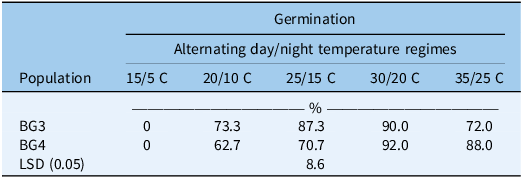
A significant interaction was observed between temperature regimes and populations for the germination of D. radulans (Table 1; Supplementary Appendix Table 1). Germination was nil at 15/5 C in both populations. The BG3 population exhibited a progressive increase in germination from 15/5 C to 30/20 C, with the highest germination (90%) at 30/20 C followed by a decline (72%) at 35/25 C. The BG4 population showed a slightly different trend, recording 63% to 71% germination at moderate temperatures (20/10 C and 25/15 C), reaching a maximum (92%) at 30/20 C, and maintaining a high level (88%) even at 35/25 C. At 20/10 C and 25/15 C, germination of the BG4 population was lower compared with the BG3 population, while a reverse trend was noticed at 35/25 C. The greater germination of BG4 at the highest temperatures (35/25 C) suggests enhanced heat tolerance compared with the BG3 population.
Effect of alternating day/night temperatures (15/5 to 35/25 C) on the germination (%) of two populations of Dactyloctenium radulans from Queensland, Australiaa.

a Seeds were incubated for 28 d under light/dark (12-h photoperiod). Means were separated using Fisher’s protected LSD test.
This study demonstrates that D. radulans can germinate across a wide range of alternating day/night temperatures (20/10 C to 35/25 C), with optimum germination occurring at 30/20 C. The present findings are consistent with earlier reports confirming that D. radulans germinates optimally at warm alternating day/night temperatures (30/20 and 35/25 C), reflecting its adaptation to hot, summer-dominant environments (Asaduzzaman et al. Reference Asaduzzaman, Koetz and Rahman2019). Alternating temperature regimes are known to stimulate germination in many grass weeds, including johnsongrass [Sorghum halepense (L.) Pers.] (Arnold et al. Reference Arnold, Ghersa, Sanchez and Insausti1990), goosegrass [Eleusine indica (L.) Gaertn.] (Nishimoto and McCarty Reference Nishimoto and McCarty1997), junglerice [Echinochloa colona (L.) Link] (Mutti et al. Reference Mutti, Mahajan and Chauhan2019), and southern crabgrass [Digitaria ciliaris (Retz.) Koeler] (Chauhan and Johnson Reference Chauhan and Johnson2008). Collectively, these studies reinforce that D. radulans is a thermophilic C4 grass capable of rapid germination under high-temperature, alternating conditions, which explains its dominance in northern Australia, particularly in cotton-growing regions (GRDC 2017).
The absence of germination at 15/5 C indicates that D. radulans is unlikely to establish in peak winter months in eastern Australia. This supports earlier conclusions that Dactyloctenium species are primarily warm-season grasses adapted to summer rainfall environments (GRDC 2017). The slight decline in germination of BG3 at 35/25 C compared with BG4 may indicate intraspecific variability, likely reflecting adaptive responses to local agroecological conditions (sorghum fencelines).
From a weed management perspective, the ability of D. radulans to germinate across moderate to high temperatures implies a long germination window during the growing seasons (autumn, spring, and summer), particularly after rainfall events in summer-dominant cropping systems. Population-level differences underscore the need for region-specific management approaches to prevent the establishment of this weed in warmer production zones of Queensland and New South Wales. This study suggests that understanding these temperature thresholds for D. radulans is crucial for developing predictive emergence models and optimizing integrated management programs under future climate scenarios.
Effect of Light
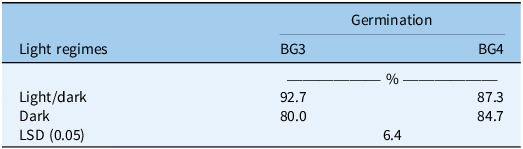
There was a significant effect of light regime and population on the germination of D. radulans (Table 2; Supplementary Appendix Table 2). Both populations germinated well under light/dark conditions (87% to 93%). However, germination of the BG3 population declined in complete darkness (80%) compared with the light/dark regime (93%). This suggests that D. radulans exhibits a weakly positive photoblastic response, with light enhancing but not being essential for germination, and with some population-level variation. A similar light-dependent germination behavior was reported in a previous study from Australia, which found that exposure to alternating light/dark conditions significantly enhanced germination of D. radulans compared with complete darkness (Asaduzzaman et al. Reference Asaduzzaman, Koetz and Rahman2019).
Effect of light regimes on the germination (%) of Dactyloctenium radulans from Queensland, Australiaa.

a Seeds were incubated for 28 d under light/dark (12-h photoperiod) and complete dark (24-h photoperiod) at 30/20 C. Means were separated using Fisher’s protected LSD (least significant difference) test.
Although D. radulans germinated well under continuous darkness, the enhancement of germination under light indicates that light acts as a facilitating cue rather than an absolute requirement. For small-seeded weeds, such cues help synchronize emergence near the soil surface, reducing the likelihood of unsuccessful seedling establishment from deeper soil layers (Fenner and Thompson Reference Fenner and Thompson2005; Pons Reference Pons and Fenner2000). The light-enhanced germination response of D. radulans may therefore represent an evolutionary adaptation that improves synchronization of emergence under favorable surface conditions following rainfall or shallow soil disturbance.
A similar coevolution of light response and seed size has been described in other small-seeded grasses, where light acts as a positional signal for near-surface germination (Milberg et al. Reference Milberg, Andersson and Thompson2000). The partial inhibition of BG3 germination under absolute darkness when compared with light/dark also suggests that cultural practices that reduce light exposure such as minimum tillage, mulching, or crop-residue retention may decrease and/or delay germination of this population. However, complete suppression is unlikely, as considerable germination still took place in the dark. This characteristic is probably why D. radulans predominates in disturbed, open areas but is rarely found under heavy stubble or mulch. Therefore, the use of surface residue in combination with preemergence herbicides may help decrease emergence from light-sensitive seedbanks of D. radulans.
Effect of Salt
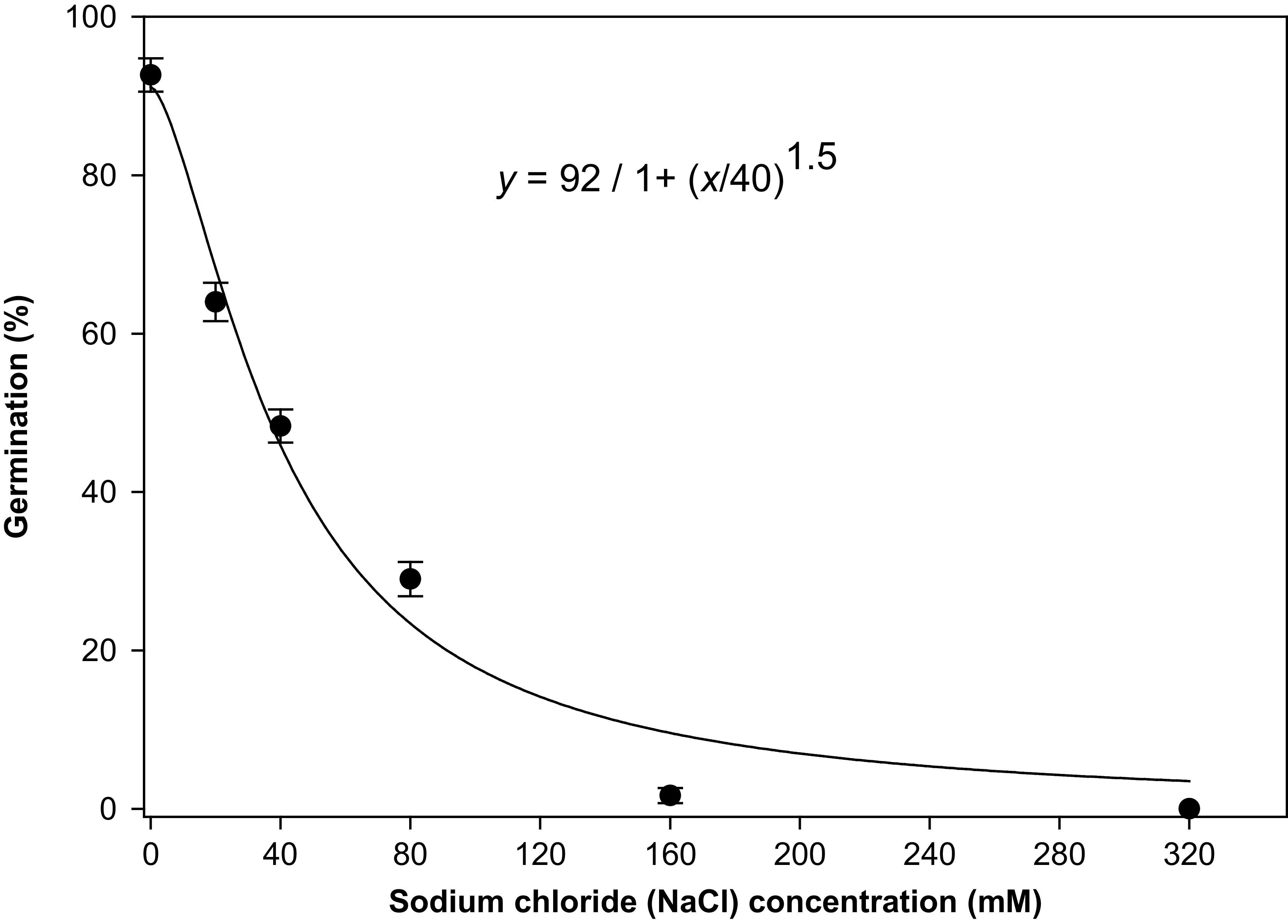
No significant interaction was observed between NaCl concentration and population for the germination of D. radulans (Figure 1). The fitted model confirmed a strong negative relationship between salinity and seed germination (Supplementary Appendix Table 3). Germination remained high under nonsaline conditions but progressively decreased with increasing NaCl concentration. At concentrations above 200 mM NaCl, germination declined sharply, indicating that salt stress severely inhibited seedling emergence.
Effect of sodium chloride (NaCl) on the germination of Dactyloctenium radulans (averaged over two populations from Queensland, Australia). Seeds were incubated for 28 d at alternating day/night temperatures of 30/20 C. The lines represent a logistic model fit to the data. Vertical bars represent the standard errors of the mean (n = 12).

The fitted model predicted a 50% reduction in germination at 40 mM NaCl, suggesting moderate salt tolerance in D. radulans (Supplementary Appendix Table 3). However, <4% germination occurred near 300 mM NaCl, implying that the species’ capacity to germinate under high salinity is limited. These findings closely align with a previous study conducted in Australia, which reported the highest germination (≈80%) of D. radulans under nonsaline conditions and a progressive decline with increasing NaCl levels (Asaduzzaman et al. Reference Asaduzzaman, Koetz and Rahman2019). However, in that study, germination remained above 20% at 50 mM NaCl, and the Dalby population exhibited greater tolerance—maintaining higher germination at 100 mM NaCl—than the New South Wales population. Consistent with these observations, the current study demonstrated a logistic response, wherein germination remained moderately high (>20%) at 90 mM NaCl before sharply declining. Although population-specific data were not separated here, the overall germination trend and x 50 threshold (∼40 mM) closely correspond with the tolerant Dalby population described by Asaduzzaman et al. (Reference Asaduzzaman, Koetz and Rahman2019). This suggests that the population examined in the current experiment likely shares similar adaptive characteristics, reflecting moderate resilience to osmotic stress. Such correspondence reinforces that D. radulans can germinate and establish under moderate salinity, conferring a competitive advantage in saline and semiarid cropping systems of Queensland, Australia.
In contrast to the previous study (gradient range 0 to 200 mM NaCl), the current study focused on overall germination dynamics and functional resilience under a broader NaCl gradient (0 to 320 mM), revealing that germination was maintained up to 100 to 150 mM and can germinate even near 300 mM NaCl. These results demonstrate a wider tolerance window and provide quantitative evidence that D. radulans can persist in moderately saline environments, even in the absence of population-level selection.
The ability of D. radulans to maintain partial germination under salt stress demonstrates physiological and perhaps ecotypic adjustments enabling it to survive transient saline conditions. Differential salt tolerance among populations, as proposed by Pujol et al. (Reference Pujol, Calvo and Díaz2000) and Qu et al. (Reference Qu, Huang, Baskin and Baskin2008) for other halophytic species, may arise from long-term exposure to saline soils and variable osmotic regimes, leading to the selection of salt-tolerant ecotypes. These adaptive mechanisms could be responsible for the persistence of D. radulans in diverse Australian environments ranging from moderately saline agricultural fields to disturbed rangelands.
From an agronomic standpoint, the capacity of D. radulans to germinate (>10%) at concentrations of up to 100 to 150 mM NaCl suggests that this weed can establish even in soils where salinity restricts crop emergence. Consequently, such tolerance poses a challenge for crop–weed competition under saline irrigation or dryland conditions. The persistence of this species under moderate salinity underscores the need for site-specific weed management strategies that integrate both chemical and nonchemical options, while considering the local soil salinity status. If unmanaged, D. radulans may continue to reproduce and expand its seedbank, particularly when rainfall events temporarily reduce surface salinity, thereby enhancing its invasiveness and threat to crop productivity in salt-affected regions of Australia.
Effect of Osmotic Potential
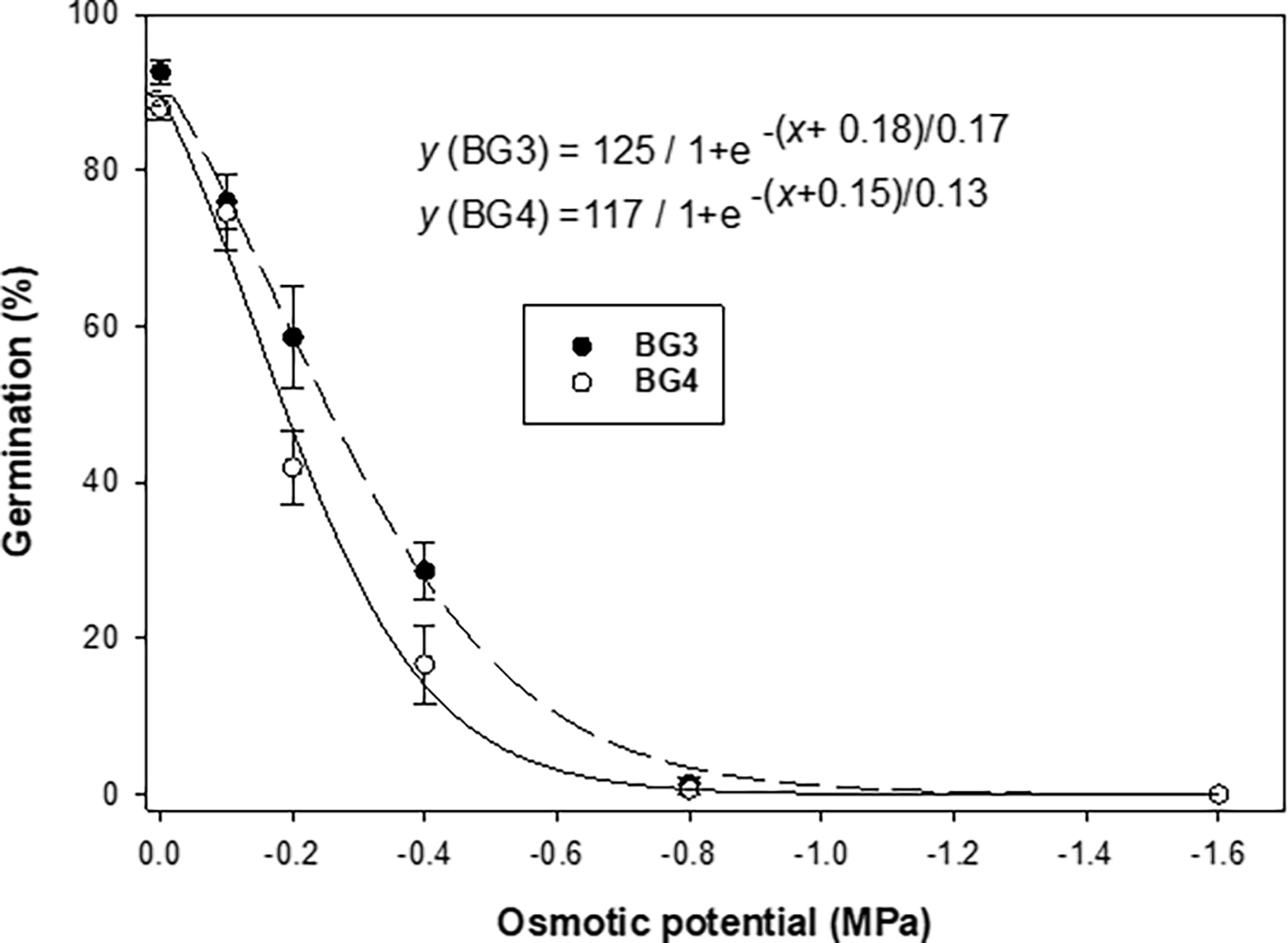
A strong negative relationship was observed between osmotic potential and seed germination of D. radulans for both populations (BG3 and BG4) (Figure 2). Germination was highest under non-stress conditions (0 MPa), where both populations achieved ∼90% to 95% germination. However, germination declined sharply as osmotic potential decreased, following a sigmoidal response pattern well described by sigmoid models (Supplementary Appendix Table 3) for both populations). The rapid decline in germination between −0.2 and −0.6 MPa indicates that D. radulans is highly sensitive to reductions in water availability during early germination.
Effect of osmotic potential on the germination of two populations of Dactyloctenium radulans from Queensland, Australia. Seeds were incubated for 28 d at alternating day/night temperatures of 30/20 C. The lines represent a sigmoid model fit to the data. Vertical bars represent the ± standard errors of the mean (n = 6).

The fitted model indicated that the BG3 population was slightly more tolerant to osmotic stress than the BG4 population (Supplementary Appendix Table 3). This was evident from the leftward shift of the BG3 response curve, indicating that germination persisted longer under declining osmotic potentials. The estimated 50% inhibition occurred at approximately −0.30 MPa for BG3 and −0.25 MPa for BG4, suggesting mild population-level adaptation of BG3 to water-limited conditions. Nevertheless, germination for both populations was almost completely inhibited below −0.8 MPa, highlighting the species’ failure to germinate under severe osmotic stress.
These results demonstrate that D. radulans relies strongly on adequate surface moisture for successful germination, consistent with its ecological strategy as a rapid, flush-emerging grass following intermittent rainfall. Similar sharp declines in germination with decreasing osmotic potential have been reported in other small-seeded C4 grasses, with low water potential restricting imbibition and inhibiting metabolic activation. The slight difference between the two populations suggests environmentally driven micro-adaptation, but overall, D. radulans exhibits limited tolerance to water stress during germination.
The strong dependence on favorable moisture conditions aligns with field observations that this weed may emerge predominantly after rainfall events and fail to establish when the soil surface dries rapidly. This sensitivity has significant management implications, as dry periods following rainfall can naturally suppress recruitment, while moisture-conserving practices, such as heavy residue cover, may interact with light limitation to further reduce seedling emergence.
Similar population-level differences in water-stress sensitivity have been reported for E. colona, whereby germination of the glyphosate-susceptible biotype declined more rapidly under decreasing osmotic potential than germination of the tolerant biotype, indicating that small-seeded tropical grasses often exhibit differential moisture thresholds among populations (Mutti et al. Reference Mutti, Mahajan and Chauhan2019).
Effect of Residue Amount on Seedling Emergence
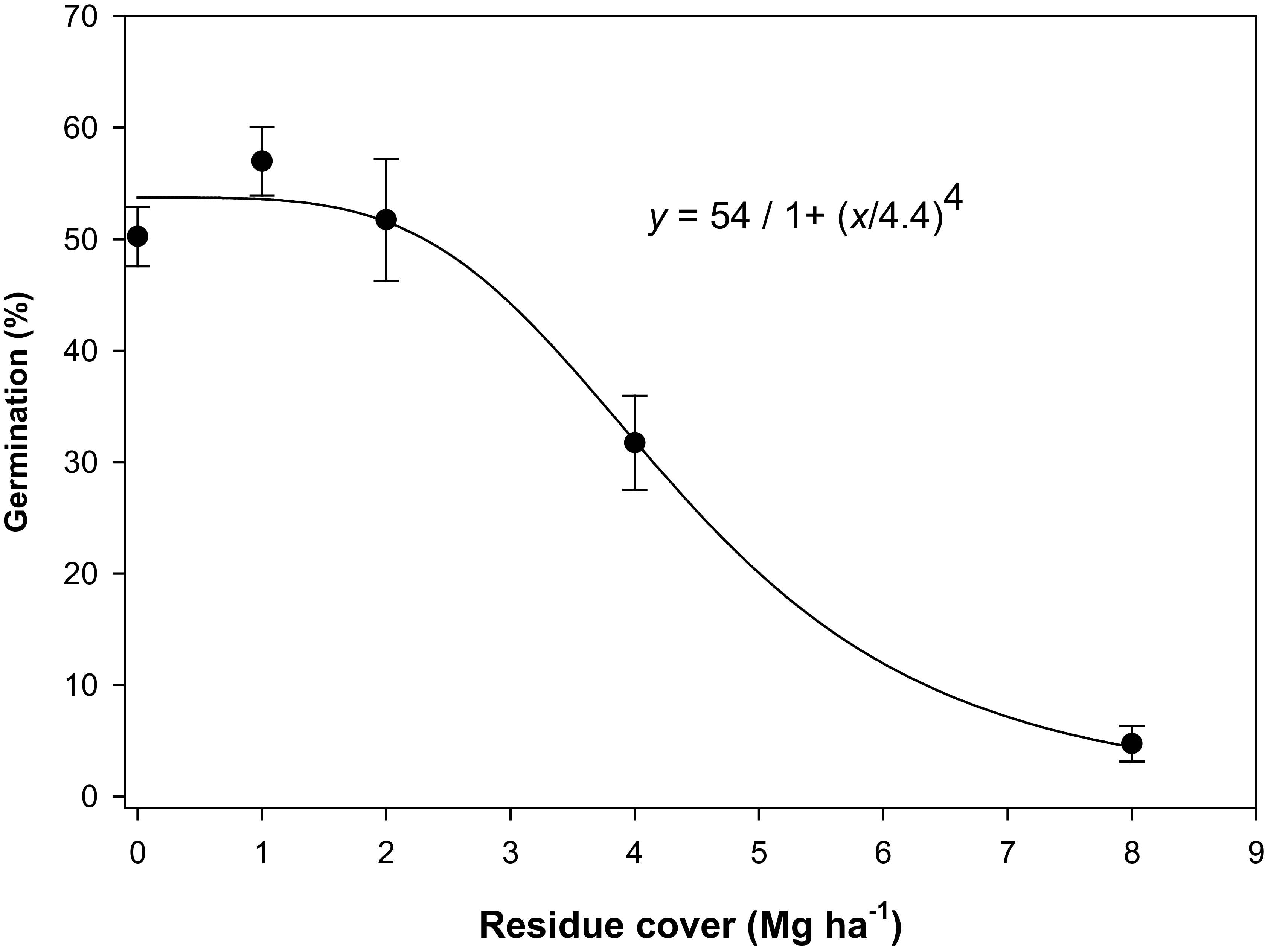
No significant interaction between residue cover and population was observed for the germination of D. radulans. A strong negative relationship was observed between crop residue cover and seedling emergence of D. radulans (Figure 3). The fitted model indicated that emergence declined sharply as residue cover increased (Supplementary Appendix Table 3). Maximum emergence (≈54%) occurred in the absence of residue, whereas emergence was reduced to <20% at residue levels beyond 6 Mg ha⁻1, with near-complete inhibition at 8 Mg ha⁻1. The model predicted a 50% reduction in emergence at approximately 4.4 Mg ha⁻1 of residue, demonstrating that residue loads typical of conservation agriculture systems may substantially suppress D. radulans emergence.
Seedling emergence of Dactyloctenium radulans (average of two populations from Queensland, Australia) in response to residue amount (Mg ha−1). The lines represent a logistic model fit to the data. Vertical bars represent the ± standard errors of the mean (n = 16).

The suppression of emergence under residue cover is primarily attributed to light attenuation, physical obstruction, and altered microclimatic conditions. Being a weak positively photoblastic species, D. radulans requires light exposure for enhanced germination, as evidenced by higher germination under light/dark (12-h photoperiod) conditions compared with continuous darkness in the current study. Residue cover may help in reducing the transmission of light and daily soil temperature fluctuations, both of which serve as essential germination cues for small-seeded tropical grasses. The current study demonstrated that reduced light availability beneath heavy residue layers may be a key inhibitory factor for germination and emergence.
However, the interaction between residue cover and soil moisture conservation may introduce a dynamic balance in the germination ecology of D. radulans. Residue layers may also help in reducing evaporation and conserving surface moisture, which can create favorable conditions for germination under thin to moderate residue levels (1 to 3 Mg ha⁻1). Under such conditions, partial light penetration combined with improved moisture retention may support limited germination following rainfall. Yet, at higher residue loads (>5 Mg ha⁻1), light deprivation might have outweighed the moisture advantage, leading to sharp declines in emergence. This threshold-driven response reflects an ecological trade-off between water availability and photic stimulation at the soil surface.
These findings are consistent with those of Mutti et al. (Reference Mutti, Mahajan and Chauhan2019), who reported that E. colona exhibits a similar dependence on light and surface conditions for germination and emergence. The convergence of responses between D. radulans and E. colona underscores a common adaptive mechanism among small-seeded C4 weeds of the Australian grain region: reliance on surface light cues for germination, coupled with opportunistic exploitation of moisture conservation following rainfall. These types of traits in weeds can enable rapid colonization in reduced-tillage or no-till systems where seeds accumulate near the soil surface. Consequently, maintaining high residue loads (>5 Mg ha⁻1) and minimizing surface disturbance can effectively suppress recruitment by limiting light exposure and imposing a physical barrier. Conversely, shallow tillage, livestock trampling, or machinery traffic that disrupts residue and exposes seeds to intermittent light may trigger germination flushes and reestablish the weed population.
Overall, this study demonstrated that high residue retention can reduce D. radulans recruitment primarily by limiting light penetration and imposing a physical barrier to the seeds present on the soil surface. Any associated moisture conservation beneath residues may further influence emergence but was not directly manipulated in this study. This highlights residue retention as an ecologically sustainable weed management option in conservation agriculture systems.
Effect of Seed Burial Depth on Seedling Emergence
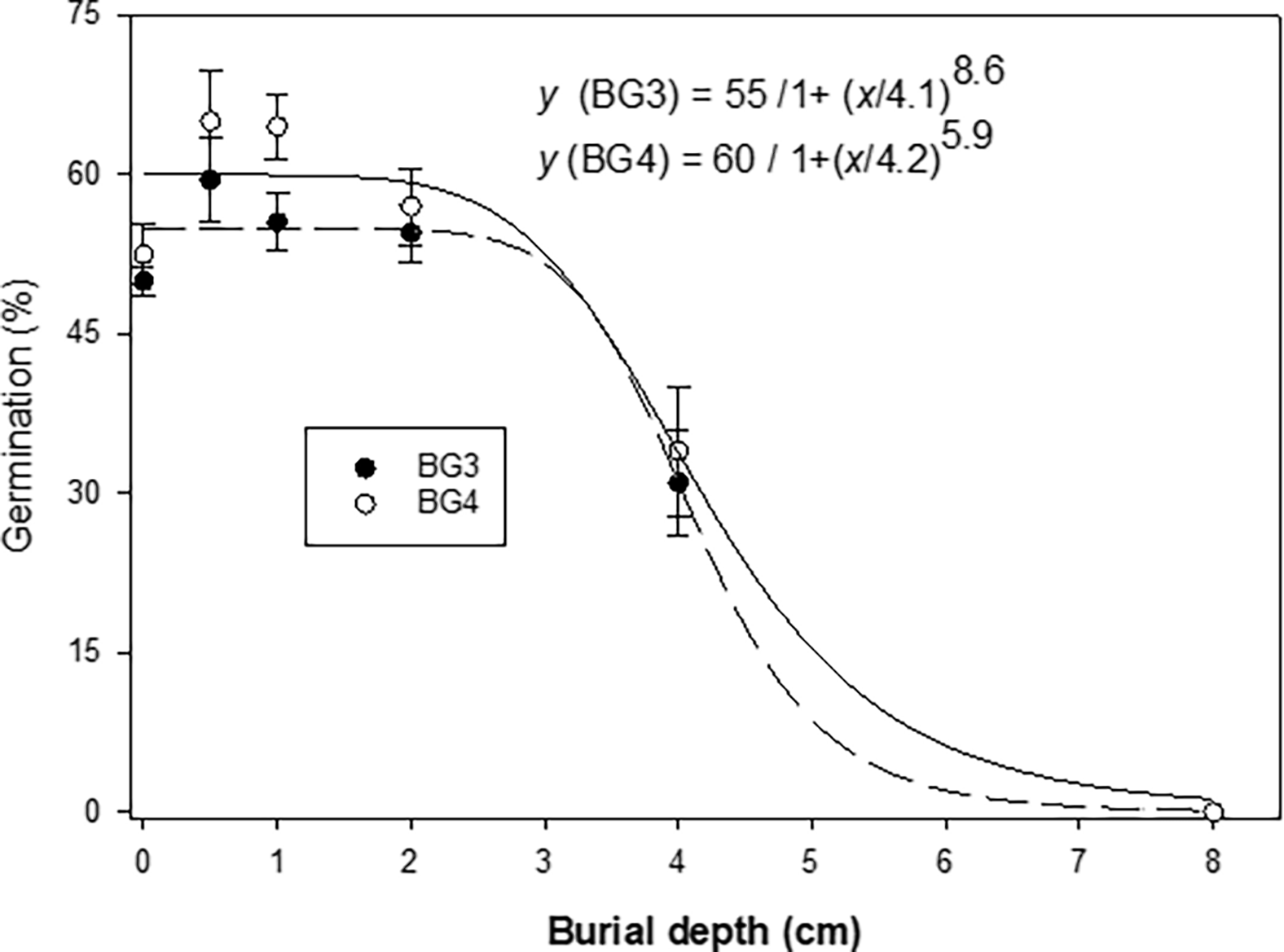
A significant decline in the seedling emergence of D. radulans was observed with increasing burial depth (Figure 4). The fitted logistic regression models revealed that maximum emergence (55% to 60%) occurred when seeds were placed on the soil surface or buried at a depth of 1 cm (Supplementary Appendix Table 3). Emergence declined sharply as burial depth increased and was almost completely inhibited beyond 4 cm. The 50% reduction in emergence (E 50) was predicted at approximately 4 cm for both populations (BG3 and BG4), indicating that D. radulans is a shallow-emerging species with limited ability to emerge from deeper soil layers.
Seedling emergence of two populations of Dactyloctenium radulans from Queensland, Australia, in response to burial depth. The lines represent a logistic model fit to the data. Vertical bars represent the ± standard errors of the mean (n = 8).

The strong reduction in emergence with increasing depth can be attributed to the small seed size and limited carbohydrate reserves of D. radulans, which restrict the coleoptile’s elongation through deeper soil layers. The restricted emergence from deeper soil layers indicates that the species primarily establishes from seeds located near the soil surface; therefore, it may result in enhanced emergence in minimally disturbed or no-till environments.
The burial depth response observed here is consistent with the species’ positive photoblastic germination behavior described under the light experiment. Seeds of D. radulans achieved a higher final germination rate under alternating light/dark conditions (87% to 93%) than under complete darkness (80% to 85%), suggesting that light serves as an important environmental cue for germination. The steep decline in emergence beyond 4- to 5-cm depth likely reflects the combined effects of reduced light penetration and mechanical impedance, both of which are critical for small-seeded grasses. Similar light–depth interactions have been reported for other photoblastic species such as feather fingergrass (Chloris virgata Sw.) and large crabgrass [Digitaria sanguinalis (L.) Scop.], which exhibit optimal emergence when sown on or near the soil surface (Chauhan and Johnson Reference Chauhan and Johnson2008, Reference Chauhan and Johnson2010).
Ecologically, the dependence of D. radulans on shallow burial depth and light exposure ensures that germination occurs primarily after rainfall events that moisten the topsoil and allow light to penetrate cracks or residues. This adaptation may favor its persistence in semiarid and dryland environments, where infrequent rainfall, reduced tillage, and widespread stubble retention create patchy, near-surface microsites that intermittently receive moisture and light, thereby promoting opportunistic emergence. However, it also implies that deep burial through inversion tillage (>8 cm) could be an effective cultural strategy to reduce seedling recruitment by preventing light exposure and placing seeds below their optimal emergence zone.
Overall, the correspondence between the burial depth response and light dependence in D. radulans highlights its ecological strategy as a surface-germinating, opportunistic colonizer that thrives under reduced tillage and open-surface conditions. The strong inhibition of emergence at greater depths confirms that light and shallow placement are both essential cues for the successful establishment of this species in field conditions.
In conclusion, this study demonstrated that D. radulans is a thermophilic, weakly light-responsive, shallow-emerging weed well adapted to the hot and semiarid environments of eastern Australia. Germination occurred across a broad temperature range (20/10 to 35/25 C), with optimum germination at 30/20 C, indicating its strong adaptation to summer-dominant climates. The species showed weak positive photoblastic behavior, moderate tolerance to salinity and water stress, and strong suppression of emergence under increasing residue cover and burial depth. These findings collectively highlight its ecological strategy as an opportunistic surface-germinating species capable of rapid expansion in disturbed or low-residue systems.
From a management perspective, the ability of D. radulans to germinate under warm conditions and shallow placement highlights two alternative but complementary cultural strategies: (1) residue retention under no-till systems to reduce and delay emergence by limiting light and modifying the soil microclimate and (2) occasional strategic deep burial (>8 cm) through inversion tillage to place seeds below their emergence zone. When used judiciously within an integrated weed management (IWM) framework, these approaches can reduce recruitment by narrowing the emergence window rather than relying on a single tactic.
This study suggests that future research should focus on modeling this species’ germination ecology under variable field conditions, assessing population-level differences in stress tolerance, and developing predictive emergence tools to optimize IWM timing. A systems-based IWM approach combining agronomic, mechanical, and chemical tactics will be crucial for long-term suppression of D. radulans in conservation agriculture systems.
Supplementary material
To view supplementary material for this article, please visit https://doi.org/10.1017/wsc.2026.10110.
Acknowledgments
The authors thank the Grains Research and Development Corporation (GRDC) for investing in this research. The authors acknowledge the use of ChatGPT (OpenAI) for language editing support.
Funding statement
This research received funding from GRDC.
Competing interests
The authors declare no conflicts of interest.


 Open access

