Implications
Sorghum panicle residue (SPR) is a palatable feed ingredient that can be used as a partial substitute for grain in growing-finishing diets for feedlot lambs. However, due to its moderate energy density (1.50 Mcal NEm/kg DM), appropriate constraints on level of incorporation is warranted (i.e. no more than 30% of diet dry matter (DM)) to avoid limits of dietary energy dilution on energy intake and weight gain.
Introduction
As its name implies, the unique structure of the long fibrous branches of the seed head (panicle) of broom sorghum (or broom corn, Sorghum vulgare var. technicum Jav) makes it ideal for manufacture of brooms and wisks. Due to drought resistance, it is planted in arid zones of numerous countries throughout the world. The panicle residue (SPR) that remains after separation from the stiff tasseled branches is occasionally used as a substitute for sorghum grain fed to livestock (Estrada et al., Reference Estrada, Dávila, Herrera, Robles, La, Castro, Portillo, Ríos and Contreras2012). Otherwise, the broom manufacture residue represents an agricultural waste. Broom manufacture in Mexico results in an average annual production of 27 500 tons of SPR (Ministry of Agriculture, Livestock, Rural Development, Fishing and Food, Mexico, 2015). Separation of SPR is accomplished by means of rotating rolls with wire bristles. The SPR is comprised largely of seed grain and associated glumes and stem particles. Although not measured empirically, Nikkhah et al. (2004) proposed a NEL value of 1.79 Mcal/kg DM (~1.92 Mcal/kg NEm) for screened broom sorghum grain (SPR minus glumes and stem particles). This value compares closely with tabular values (1.94 Mcal/kg NEm) for whole sorghum grain (NRC, Reference Nikkhah, Alikhani and Amanlou2007). However, the process of separating grain from SPR is expensive and inefficient. At time of writing this report, the relative cost of SPR, including the cost of freight and milling, represented 0.49 the price of whole grain sorghum (National System of Information and Market Integration, 2017). There are no published studies that directly asses the comparative feeding value of SPR for ruminants. We hypothesize that SPR represents an economical alternative energy source for growing-finishing lambs. However, due to the dilution of grain particles with glume and stem, determination of its comparative feeding value is warranted. The objective of this experiment was to study the effect of SPR as a replacement for sorghum grain on growth performance, carcass characteristics and comparative net energy value in finishing diets for feedlot lambs.
Material and methods
This experiment was conducted at the Universidad Autónoma de Sinaloa Feedlot Lamb Research Unit, located in Culiacán, Mexico (24° 46' 13" N and 107° 21'14" W; 55 m above sea level with a tropical climate). All animal management procedures were conducted in accordance with locally approved guidelines for animal use and care (NOM-051-ZOO-1995; NOM-062-ZOO-1995; NOM-024-ZOO-1995) and humane slaughter (NOM-033-ZOO-1995).
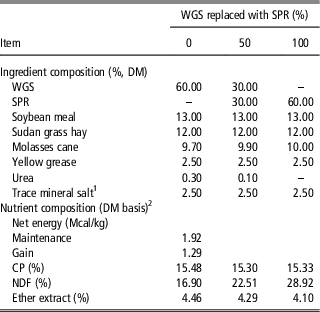
Three weeks before the initiation of the experiment, 48 lambs (1/4 Pelibuey×3/4 Kathadin, 16.2±4.3 kg initial LW) were treated for endoparasites (Albendaphorte 10%; Animal Health and Welfare, Mexico City, Mexico), injected with 1×10⁶ IU vitamin A (Synt-ADE®, Fort Dodge, Animal Health), and vaccinated for Mannheimia haemolityca (One Shot, Zoetis, Mexico City, Mexico). Two weeks before starting the experiment all lambs were fed the same diet (diet containing only whole sorghum grain, Table 1). Upon initiation of the experiment, lambs were individually weighed before the morning meal (electronic scale; TORREY TIL/S: 107 2691; TORREY Electronics Inc., Houston, TX, USA), blocked by weight into four uniform weight groupings, and assigned within weight grouping to 12 pens (four lamb/pen). Individual pens were 6 m2 with overhead shade, automatic waterers and 1 m fence-line feed bunks. The basal diet contained 60% whole grain sorghum (WGS; DM basis, Table 1). Dietary treatments consisted in the replacement of 0, 50 or 100% of WGS with SPR. Because SPR contained slightly more CP than WGS (101 v. 91 g/kg DM), diets were maintained isonitrogenous by partial replacement of cane molasses with urea (Table 1). Sorghum panicle residue was obtained from S. vulgare var. technicum following mechanical separation of fiber. The SPR used in the experiment represents a composite of material collected from two commercial broom factories with similar machinery and techniques for fiber separation. Before incorporation into the complete mixed diets, the SPR was ground in a hammer mill (Bear Cat #1A-S; Westerns Land and Roller Co., Hastings, NE, USA) with a 1.27-cm screen. Whole sorghum grain (S. bicolor L. Moench) used in this study was a commercial blend obtained from Sinaloa, Mexico. Dietary treatments were randomly assigned to pens within weight groupings. The forage source (Sudan grass hay) was ground in a hammer mill (Bear Cat #1A-S, Westerns Land and Roller Co., Hastings, NE) with a 2.7-cm screen, before incorporation into complete mixed diets. The experiment lasted 84 days. Lambs were weighed at the beginning of the trial and every 28 days thereafter. Lambs were allowed ad libitum access to water and to dietary treatments. Daily feed allotment to each pen was adjusted to allow for minimal (<5 g/100 g of offered fed) feed refusals. The amounts of feed offered and refused were weighed daily. Lambs were provided fresh feed daily at 0800 and 1400 h in a 40 : 60 proportion (as fed basis). Refusals were collected and weighed before the morning feeding and feed intake was determined daily. The initial live weight (LW) was converted to shrunk body weight (SBW) by multiplying the weight by 0.96 to adjust for the gastrointestinal fill (Cannas et al., Reference Cannas, Tedeschi, Fox, Pell and Van Soest2004). Final SBW was obtained following an 18 h fast from feed (drinking water was not withdrawn).
Composition of experimental diets fed to lambs (DM basis)

WGS=whole grain sorghum; SPR=sorghum panicle residue.
1 Trace mineral salt contained (%): CoSO4, 0.068; CuSO4, 1.04; FeSO4, 3.57; ZnO, 1.24; MnSO4, 1.07; KI, 0.052; limestone, 56.96%; urea, 18%, and NaCl, 18%.
2 Based on tabular values for individual feed ingredients (NRC, Reference Nikkhah, Alikhani and Amanlou2007) with the exception of CP and NDF, which were determined in our laboratory.
Feed analysis
Samples of WGS and SPR were subjected to the following analyses: AOAC (2000) procedure were used for the determination of DM (oven drying at 105 °C until no further weight loss; method 930.15), CP (N× 6.25, method 984.13), ash (method 942.05), ADF (method 973.18) and ether extract (method 920.39). Neutral detergent fiber was determined following the procedure of Van Soest et al. (Reference Van Soest, Robertson and Lewis1991) using heat stable α-amylase (Ankom Technology, Macedon, NY, USA), and corrected for NDF-ash. Starch was determined following the procedure of Zinn (Reference Zinn1990). Dry matter content of feed and feed refusal was measured daily.
Carcass and whole cuts
Hot carcass weight (HCW) was obtained from all lambs at time of slaughter. After carcasses (with kidneys and internal fat included) were chilled at −1°C for 48 h, the following measurements were obtained: (1) cold carcass weight; (2) longissimus (LM) surface area, measured using a grid reading of the cross-sectional area of the ribeye between the 12th and 13th ribs; (3) fat thickness perpendicular to the LM, measured over the center of the ribeye between the 12th and 13th ribs, and (4) kidney, pelvic and heart fat (KPH). The KPH was removed manually from the carcass, and then weighed and reported as a percentage of the cold carcass weight according to the United States Department of Agriculture standards (USDA, 1982). Each carcass was split along the vertebrae into two halves. The left side of each carcass was fabricated into wholesale cuts, without trimming, according to the North American Meat Processors Association guidelines (NAMP, 1997). Rack, neck, and shoulder were obtained from the foresaddle, and the loins; flank and leg were from the hindsaddle. The weights of each cut were subsequently recorded.
Calculations
Average daily gain was determined by subtracting the initial SBW from the final SBW and dividing that result by 84 (days on test). Efficiency of SBW gain (gain efficiency) represents the ADG : DMI ratio. Estimation of dietary net energy (NE) was performed by means of the quadratic formula: x=(−b±(b 2−4ac)0.5)/2c, where x=NEm, a=−0.41EM, b=0.877 EM+0.41 DMI+EG and c=−0.877 DMI (Zinn et al., Reference Zinn, Barreras, Owens and Plascencia2008), and where EM (energy required for maintenance, Mcal/day=0.056×SBW0.75 (NRC, 1985), EG (energy gain, Mcal/day)=0.276×ADG×SBW0.75 (NRC, 1985). The coefficient (0.276) was estimated assuming a mature weight of 113 kg for Pelibuey×Kathdin (Estrada-Angulo et al., Reference Estrada-Angulo, Valdés, Carrillo-Muro, Castro-Pérez, Barreras, López-Soto, Plascencia, Dávila-Ramos, Ríos and Zinn2013).
The comparative NEm values for SPR were estimated using the replacement technique. Given that the NEm value of WGS grain is 1.94 Mcal/kg (NRC, Reference Nikkhah, Alikhani and Amanlou2007), the comparative NEm values for the SPR was estimated as follows:
SPR NEm, Mcal/kg=[(test diet NEm–WGS diet NEm)/SPR y ]+1.94, where SPR y represents the inclusion (g/g) of SPR that replaced WGS grain in diet (0, 0.30 or 0.60).
Statistical analysis
Performance (DMI, ADG, G : F, dietary NE), carcass, and wholesale cut-out data were analyzed as a randomized complete block design considering pen as the experimental unit. The MIXED procedure of Statistical Analysis System (SAS, Reference Sousa, Cartaxo, Costa, Cazar, Cunha, das, Pereira Fhilo and dos Santos2004) was used to analyze the variables. Treatment effects were tested for linear and quadratic components of SPR inclusion. Treatment effects were considered significant when the P-value was ⩽0.05, and tendencies were identified when the P-value was >0.05 and ⩽0.10.
Results and discussion
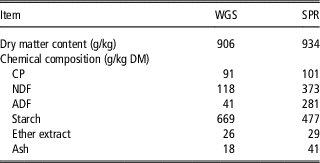
The chemical composition of WGS and SPR used in the experiment are shown in Table 2. In contrast with WGS, SPR contained slightly greater proportions (g/kg DM) of CP (101 v. 91) and lipid (29 v. 26), but markedly greater proportions of NDF (37 v. 12) and ADF (281 v. 40), and a correspondingly lesser proportion (48 v. 67) of starch (Table 2). The nutrient composition of WGS (S. bicolor) is consistent with previous reports (Villarreal-Silva et al., Reference Villarreal-Silva, Castrejón-Pineda, Plascencia, Pujol, Estrada-Angulo, Ríos-Rincón, Cortés-Sánchez, Cuca-García and Corona2015; González-García et al., Reference González-García, Corona, Castrejón-Pineda, Balcells, Castelán-Ortega and González-Ronquillo2016; Srichuwong et al., 2017). The chemical composition of SPR has not been previously reported. Based on comparative starch content, it can be assumed that SPR was comprised of 71% sorghum grain with the remainder consisting of glumes, panicle stem particles and associated ash.
Chemical composition of whole sorghum grain (WGS) and sorghum panicle residue (SPR) offered to finishing lambs

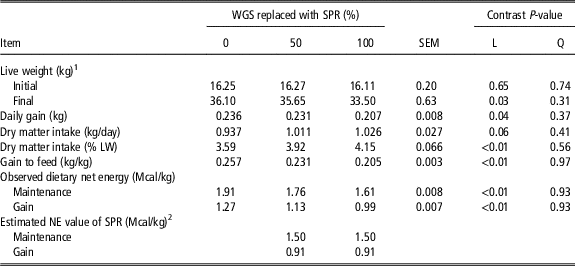
The effect of replacing WGS with SPR on lamb growth performance and dietary energy are shown in Table 3. Replacement of WGS with SPR decreased (linear effect, P=0.04) ADG, and tended to increase (linear effect, P=0.06) DMI. Replacement of WGS with SPR decreased (linear effect, P<0.01) gain efficiency and observed dietary NE. Limited information is available that evaluates the comparative effects of replacing grain with SPR on performance and carcass characteristics in feedlot lambs. Estrada-Angulo et al. (Reference Estrada-Angulo, Chávez-Campos, Obregón, Ríos-Rincón and Coronel-Burgos2005) observed an ADG of 0.205 kg/day with a gain efficiency of 0.178 in Pelibuey lambs (initial weight=17.2 kg) fed a finishing diet (88 : 12 concentrate : forage proportion) containing 61% finely ground SPR.
Influence of replacing whole sorghum grain (WSG) with sorghum panicle residue (SPR) on growth performance and dietary energy of feedlot lambs

1 The initial live weight was reduced by 4% to adjust for the gastrointestinal fill, and all lambs were fasted (food but not drinking water was withdrawing) for 18 h before recording the final live weight.
2 Net energy values for SPR derived using the replacement technique, assuming that net energy for maintenance and net energy of gain values of whole sorghum grain are 1.94 and 1.29 Mcal/kg, respectively (NRC, Reference Nikkhah, Alikhani and Amanlou2007).
The DMI for lambs fed the basal WGS diet was estimated based on the observed ADG, average SBW and the tabular (NRC, 1985) NE value of the diet according to the formula: expected DMI, kg/day=(EM/NEm)+(EG/NEg), and amounted 0.932 kg/day. This estimated value closely corresponds with the observed DMI (0.937 kg/day), lending support to the reliability of tabular values for feed ingredients used in diet formulation (NRC, 1985), as well as generalized relationships between lamb growth performance and energy utilization, as shown above.
In feedlot cattle, DMI is maximized as dietary energy density approaches 1.90 Mcal NEm/kg DM (Zinn and Plascencia, Reference Zinn and Plascencia1996). Likewise, Sousa et al. (Reference Srichuwong, Curti, Austin, King, Lamothe and Gloria-Hernández2012) observed maximal DMI (80 g/kg SBW0.75) in Santa Ines and Dorper cross lambs when diet energy density approximated 1.93 Mcal NEm/kg. In the present study, DMI of lambs fed the control WGS diet (1.91 Mcal NEm/kg DM) was 81 g/kg BW0.75; hence, close to the specified lower limit where diet energy density, per se, places restraint on DMI. Although DMI tended to slightly increase as SPR replaced 50% and 100% of WGS (88 and 92 g/kg BW0.75, respectively), the increase was not sufficient to sustain maximal ADG.
Based on the observed performance, the estimated replacement NEm and NEg values for SPR were 1.50 and 0.91 Mcal/kg, respectively (Table 3). This corresponds to 75% of the tabular NE value of WGS. However, the NE value of SPR may also be estimated using the difference technique (Zinn and Plascencia, Reference Zinn and Plascencia1993) by subtracting the tabular (NRC, 1985) NE contribution of the other dietary ingredients from the NE values of the complete diet estimated on the basis of growth performance (as previously described) and dividing that difference by the proportion of SPR in the complete diet. Estrada-Angulo et al. (Reference Estrada-Angulo, Chávez-Campos, Obregón, Ríos-Rincón and Coronel-Burgos2005) fed Pelibuey lambs a finishing diet containing 61% SPR. Estimating dietary NE from their study based on lamb growth performance (SBW, ADG and DMI) and diet composition using the difference technique, the corresponding NEm and NEg values for SPR are 1.47 and 0.88 Mcal/kg, respectively, in good agreement with the present study.
Given (based on its starch content) that SPR contained 71% sorghum grain, and that the NEm of sorghum grain is 1.94 Mcal/kg (NRC, Reference Nikkhah, Alikhani and Amanlou2007), it can be calculated that the NE values for the non-sorghum grain component of SPR (glumes, panicle stems, etc.) was low (0.42 Mcal/kg NEm), <68% the value of wheat straw (0.62 Mcal/kg NEm; NRC, Reference Nikkhah, Alikhani and Amanlou2007).
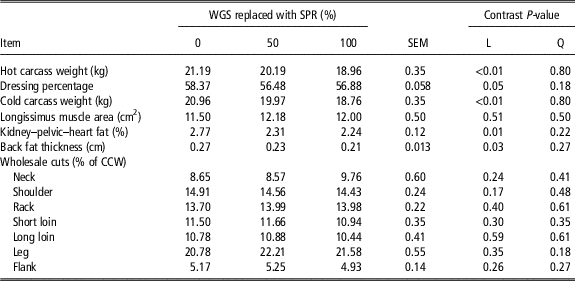
Treatment effects on carcass characteristics and wholesale cuts as a percentage of cold carcass weight are shown in Table 4. Replacement of WGS with SPR decreased (linear effect, P⩽0.05) HCW, dressing percentage, KPH and back fat thickness. Other carcass characteristics and wholesale cuts as a proportion of cold carcass weight were not affected by dietary treatments. The decrease in HCW, fat thickness and KPH with increasing proportion of SPR is consistent with changes in ADG (Félix-Bernal et al., Reference Félix-Bernal, Angulo-Escalante, Estrada-Angulo, Heredia, Muy-Rangel, López-Soto, Barreras and Plascencia2014; Ríos-Rincón et al., Reference Ríos-Rincón, Dávila-Ramos, Estrada-Angulo, Plascencia, López-Soto, Castro-Pérez, Calderón-Cortes, Portillo-Loera and Robles-Estrada2014; Hernández et al., Reference Hernández, Mendoza, Castro, Lara, Plata, Martínez and Ferraro2017). The lower dressing percentage of lambs receiving SPR diets was a likely reflection of the greater NDF concentration in SPR and its very low apparent fiber digestibility, resulting in greater ruminal fill (Vinhas-Voltolini et al., Reference Vinhas-Voltolini, Alves de Moraes, Garcia Leal de Araújo, Ribeiro Pereira, Dantas dos Santos and Alves Neves2011). Lack of treatment effects on wholesale carcass cuts as a proportion of cold carcass weight is consistent with previous reports for feedlot lambs (Pittroff et al., Reference Pittroff, Keisler and Blackburn2006; Vinhas-Voltolini et al., Reference Vinhas-Voltolini, Alves de Moraes, Garcia Leal de Araújo, Ribeiro Pereira, Dantas dos Santos and Alves Neves2011).
Influence of replacing whole sorghum grain (WSG) with sorghum panicle residue (SPR) on carcass characteristics of feedlot lambs

Considering actual feed prices in Mexico (National System of Information and Market Integration, 2017), the cost of the diets amounts to 204, 176 and 148 US dollars/metric T for WGS, WGS : SPR and SPR. To obtain a total weight gain of 20 kg, this would represent a feed cost of 16.2, 15.4 and 14.7, respectively.
Conclusion
It is concluded that SPR is a palatable feed ingredient for inclusion in finishing diets for feedlot lambs. The comparative NE value of SPR is 1.50 and 0.91 Mcal/kg for maintenance and gain, respectively (75% the tabular NE value of whole sorghum grain), reflecting the high fiber content of SPR. Whereas SPR is a palatable low-cost alternative to WGS for feedlot lambs, high levels of substitution may depress ADG.
Acknowledgments
There are no acknowledgments.
Declaration of interest
Author declare no conflict of interest.
Ethics statement
All phases of experiment (protocol, personnel involved, facilities, and management, procedures on experimental phase and slaughter) was audited and approved by Bioethics Committee of the Faculty of Veterinary Medicine and Zootechnics of the Autonomous University of Sinaloa.
Software and data repository resources
None of the data were deposited in an official repository.