

Both South Korea (henceforth Korea) and Taiwan are considered consolidated democracies with similar levels of economic development.Footnote 1 The two countries have similar political systems with a directly elected president and a prime minister appointed by the president.Footnote 2 Both countries have mixed electoral systems, with single-member districts and proportional representation.Footnote 3 However, the two countries have developed very different sets of electoral campaign regulations. Taiwan has few restrictions on campaigning, while Korea's election law imposes numerous restrictions on campaign activities, including a strict ban on door-to-door canvassing and prohibition of electioneering prior to a brief legal campaign period.
The stark contrast between Korea and Taiwan is puzzling. Why do these two countries have such different approaches to regulating political speech prior to elections? In particular, why does Korea, ostensibly a liberal democracy, impose such severe restrictions on political expression before elections, contrary to the idea of free and fair elections that is central to liberal democracy? Even more perplexing is that, compared to Taiwan, Korea has had a much longer experience with electoral democracy and a more rapid democratic transition. While Korea had semi-competitive national elections from 1948 to 1961 and from 1963 to 1972, Taiwan was continuously under hard-authoritarian rule until the repeal of Martial Law in 1987. Both countries started a democratic transition in 1987; this took less than a year in Korea but almost a decade in Taiwan.Footnote 4
A cursory comparison with Japan, a country with a longer history of democracy in East Asia, adds to the puzzle. In fact, Japan also has very stringent electoral campaign regulations, such as a ban on door-to-door canvassing and prohibition of pre-campaign- period campaigning. Although Japan was once known to have “the most stringent electoral rules in the democratic world” (Hrebenar Reference Hrebenar2000, 50–51), Korea outstrips Japan regarding both the extent of campaign regulations and the severity of punishment for violations. Taiwan's approach to campaign regulation is closer to that of Western liberal democracies, with few restrictions on campaign activities, apart from the various regulations on campaign finance. As both countries experienced colonial rule by Japan and have been much influenced by the United States since independence, our question is why Korea has developed even more stringent electoral regime than that of Japan while Taiwan's electoral regime is more similar to that of Western liberal democracies.
Answering this question requires a comparative historical investigation into the evolution of electoral campaign regulations in these two countries. Korea's first election law was promulgated by the American Military Government in March 1948, prior to the Constitutional National Assembly elections in May 1948. The law contained no restrictions on campaigning. Taiwan's first electoral rules administering local elections did not have any practical restrictions on campaign activities. Both the soft-authoritarian (1948–1960, 1963–1972) and hard-authoritarian (1961–1963, 1972–1987) regimes in Korea and the hard-authoritarian regime in Taiwan (1949–1987) soon developed various restrictions on campaigning. Curiously, Korea has maintained most of the restrictions that were developed during the authoritarian period and even added more regulations since the democratic transition of 1987, while Taiwan's democratic transition was accompanied by a series of liberalization of campaign regulation.
What forces made the liberalization of campaign regulation at the critical junctures of democratic transition in Taiwan, and why did a path-dependent logic preclude any significant reform in Korea? Our research finds that, during the critical junctures of democratic transition, the legislators in Korea and Taiwan made different choices. In Korea, during the authoritarian period, National Assembly members from both the opposition party and the ruling party were beneficiaries of incumbency advantage that came from campaign restrictions. In Taiwan, the opposition forces were disadvantaged by restrictive campaign regulations because they had few seats in the Legislative Yuan during the authoritarian period. Consequently, the opposition parties’ attitudes toward campaign regulation in the two countries diverged. Restrictive campaign regulation has been only a minor issue in Korea, and there has been a strong force of path dependency. However, campaign regulation was an important agenda of the opposition in Taiwan. Consequently, the ruling Nationalist Party (KMT) of Taiwan strategically accommodated the opposition's demand for liberalization of campaign rules.
It is hard to find comparative studies of election campaign regulations. Indeed, campaign regulation has been almost neglected in comparative politics literature. There exists an extensive body of comparative politics literature on macro-level electoral systems that translate votes into legislative seats. However, the absence of comparative studies on micro-level campaign rules amounts to an important gap in the literature on election systems. Legal restrictions on campaign period, campaign methods, and the content of campaign speech can have important consequences for “freeness” and “fairness” of elections. Comparing the different trajectories in Korea and Taiwan will provide important insights into campaign regulation and electoral rules in general.
The purpose of this article is twofold. First we examine the significance of election campaign regulation through a comparison of two East Asian democracies. We demonstrate how campaign rules can be used by incumbent legislators to create incumbency advantage, thus hurting fairness as well as freeness of elections. Second, we attempt to provide explanations for the different trajectories of campaign regulations in the two countries through a comparative historical process tracing. We will focus on the continuity and changes in campaign regulation at the critical junctures of democratic transition, using both archival and secondary sources in Korean, Chinese, and Japanese.
The two countries have been selected as the most similar cases because they have diverged in terms of campaign regulation in spite of many similarities in their political history and current political institutions. While this article focuses on Korea and Taiwan, since Japan has a much longer history of democracy, we will also briefly compare these cases with the experiences of Japan to better understand the origins and developments of campaign regulation in the two countries of our primary interest.
The article is organized as follows. Section 1 is a brief review of the relevant literature. Section 2 describes the different electoral campaign regulations and their consequences in the two countries. Section 3 provides historical narratives of electoral campaign regulations in the two countries. Section 4 discusses the causes of the different trajectories in Korea and Taiwan. And, finally, section 5 concludes the article.
I. LITERATURE REVIEW
The existing comparative politics literature on electoral system focuses on macro-level features of electoral formula and district magnitude. While there are some studies of micro-level features of electoral system such as campaign finance and voter registration rules, institutional differences in campaign regulation have been neglected by scholars (McElwain Reference McElwain2008). This is largely because in established democracies in the Western world there are few regulations on election campaigning, apart from regulations on campaign finance to ensure transparency and to limit the influence of money in politics. However, institutional differences in campaign regulation can significantly affect the quality of elections by encouraging or limiting free and fair competition.
Recently there has been an increasing interest in the study of electoral malpractice, electoral integrity, and quality of elections, as many young democracies have failed to reach the ideal of “free and fair” elections and many competitive authoritarian regimes still control or manipulate elections. These studies have identified the various tools used by authoritarian regimes or illiberal electoral democracies to manipulate and control elections, including outright electoral fraud, repression, intimidation, vote-buying, gerrymandering, and subtle forms of discrimination and manipulation such as unequal access to state institutions, resources, and the media (Birch Reference Birch2012; Gandhi and Lust-Okar Reference Gandhi and Lust-Okar2009; Kelley Reference Kelley2012; Levitsky and Way Reference Levitsky and Way2010; Norris Reference Norris2014). Even in consolidated liberal democracies like the United States, voter registration rules and gerrymandering are important subjects of political debate and scholarly research (Hanmer Reference Hanmer2009; Kennedy Reference Kennedy2017). However, there has been no comparative study of election campaign regulations published in English, and only a few English-language studies have discussed the issue of campaign regulation in Japan (Curtis Reference Curtis1971; McElwain Reference McElwain2008) and in Korea (Mobrand Reference Mobrand2015).
There are many legal and political studies on electoral campaign regulation in Korea published in Korean, but most of them discuss constitutional and legal issues and few are comparative or historical. Of the few comparative studies, none discusses the Taiwan case. They only provide a descriptive comparison of the Korean electoral campaign regulations with those of established Western democracies and Japan (Kim Reference Kim2007; Kim and Hong Reference Kim and Hong2014). A few historical studies of Korea's campaign regulations are more illuminating. One study by Chan-Pyo Park (Reference Park1996) found that American influence was decisive in the creation of liberal electoral rules in 1948. Seog-Yun Song's (Reference Song2005) study of the origin of Korea's stringent campaign regulations, on the other hand, revealed that the conservative ruling party of authoritarian president Syngman Rhee and the conservative main opposition party made a compromise in 1958 to introduce Japanese-style regulations such as a ban on premature campaigning. In another study, Ji-Yeon Shim and Min-Jeon Kim (Reference Shim and Kim2006) suggested that the authoritarian governments’ intention to suppress the opposition, voters’ lack of political awareness, bureaucrats’ patriarchal interventions, and incumbency advantage were all responsible for the development of restrictive regulations. Hyun Jong Yoo's (Reference Yoo2011) historical study indicated the importance of path dependency for the continuity of restrictive rules after democratization. In his research, Erik Mobrand (Reference Mobrand2015) highlighted the illiberal consequences of the strict regulatory regime and argued that an established party elite had appropriated pre-democratic institutions of electoral governance.
In Taiwan, most of the existing studies were published in Chinese and focused on describing the law's development or evaluation of the campaign regulations. Some researchers pointed out that many regulations on campaign activities were difficult to implement (Lang Reference Lang1990; Huang Reference Huang2004). A study by Chen and Wang (Reference Chen and Wang2002) found that the trend in campaign regulations in Taiwan has been liberalization and decriminalization. Through interviews with candidates and their campaign workers, they also found that campaign regulations were difficult to enforce and that electoral supervisors often tried to downplay the significance of the violation or favor particular groups. Huang and Cheng (Reference Huang and Cheng2002) suggested that the KMT government's suppression of the opposition and incumbency advantage were responsible for the development of restrictive regulations in the 1950s. They argued that international attention after the Kaohsiung Incident in 1979 was the main reason for the KMT to begin liberalization of the campaign regulations.Footnote 5 Studies of Japanese campaign regulations help shed some light on campaign regulations in Korea and Taiwan. A study by Gerald Curtis (Reference Curtis1971) demonstrated how Japanese strict election law influenced the styles of electoral campaign and gave a substantial advantage to the incumbents. Masao Soma (Reference Soma1986) argued that the main reason Japan introduced extensive campaign regulations in 1925 and further strengthened these regulations in 1934 was that the major conservative parties sought to limit the challenge of the then-rising socialist parties following the enactment of the universal male suffrage law. He also found that attempts to liberalize the election law under the US occupation were unsuccessful due to resistance from legislators who had vested interest in defending the restrictive campaign regulations. In another study, Kenneth McElwain (Reference McElwain2008) argued that most of the changes to campaign regulations, such as the repeated shortening of campaign period which the Liberal Democratic Party implemented between 1960 and 1990, were aimed at enhancing incumbency advantage and that the LDP's long dominance of postwar politics was partly aided by the restrictive campaign regulations.
II. COMPARISON OF ELECTION CAMPAIGN REGULATIONS IN KOREA AND TAIWAN
II. 1. Election Campaign Regulations in Korea
Korea's election law provides “a pervasive system of restrictions on the time and manner of election campaigning” (Haggard and You Reference You2015). The Public Officials Election Act (POEA) temporally circumscribes election campaigns in Korea (National Law Information Centre 2017).Footnote 6 The POEA prohibits anyone from distributing or posting advertisements, letters of greetings, posters, and other printed matter “or the like” showing the name of a political party or candidate to influence the election for a period of 180 days before the election day. The statute also proscribes any campaign activities before a short 13-day legal campaign period leading to the National Assembly and local elections and a 22-day period for presidential elections. The POEA makes an exception for very limited activities for “preliminary candidates,” who are permitted to set up one campaign office and distribute their name cards “in person.” The name cards can also be distributed by the preliminary candidate's spouse or family members and a few persons designated by the candidate (they cannot leave name cards in mailboxes or on car windows). The preliminary candidate is also permitted to mail only one item of campaign material to not more than ten percent of the total households in the district (hence, they cannot reach 90 percent of the households). Preliminary candidacy is allowed starting from 120 days before National Assembly elections (90 days before gubernatorial, mayoral, and high-level council elections, and 60 days before low-level council elections). Campaign speech meetings or open discussions about the election between the preliminary candidate and voters are not allowed. Moreover, individuals and civil society organizations violating these provisions are subject to imprisonment of up to two years or fines of up to four million won (about four thousand US dollars).
In addition, the POEA provides strict and detailed regulations on who can engage in what kinds of campaign activities during the legal campaign period. Door-to-door canvassing is strictly prohibited, as is the creation of any private organization for electoral purpose. It is even illegal for political parties to hold party members’ meetings or recruit party members for 30 days prior to the election day. There are a number of restrictions on public campaign speeches and any meetings that can influence the election. Candidates and campaign workers can only distribute the candidate's name cards; they are not allowed to distribute any other campaign materials, and the district-level Election Commission will mail each household a set of campaign leaflets for all the candidates in the district. Not only are the press and organizations prohibited from endorsing candidates or political parties, but they are also barred from awarding points or ranks to candidates or political parties when comparing and appraising their policies and campaign promises. Violators of these regulations are subject to harsh punishment. For example, the penalty for door-to-door canvassing or creating a private organization for electoral purposes is up to three years in prison or up to six million won (about six thousand US dollars) in fines.
Campaign fundraising is strictly limited and regulated. Candidates for lower-level local councils are completely barred from any fundraising activities. Candidates for upper-level (provincial or metropolitan) councils, governorship, or mayorship cannot raise campaign funds until the official registration of their candidacy, that is, 20 days prior to election day. Preliminary candidates for the National Assembly are allowed to raise campaign funds starting from 120 days before the election day. South Korea is quite generous in reimbursing a substantial part of campaign expenses to those candidates who have obtained fifteen percent or more of the total votes, which advantages major party candidates. However, these restrictions on campaign fundraising, in addition to a substantial amount of deposit for candidate registration, place a high hurdle for aspiring candidates, especially for minor party candidates.
Even if candidates and campaign workers observe all these regulations, they are still not safe. Election campaigning often involves criticizing and attacking one's opponents, but Korea's election law provides broad definitions of false campaign speech and slander and severe criminal penalties for these offences. The POEA stipulates that anyone who publishes false facts about a candidate and his or her family for the purpose of defeating the candidate in the election is punishable by imprisonment of up to seven years or a fine between five million won and thirty million won. However, even publication of correct information about a candidate that is deemed slanderous could be punishable by imprisonment of up to three years or a fine of up to five million won. South Korea is the only OECD country that criminalizes true but defamatory or insulting campaign speech.
All these restrictions have been justified in the name of fairness or to ensure a level playing field between richer and poorer candidates. Another justification is to prevent the danger of “overheated” elections that could encourage costly campaigns and vote-buying (Mobrand Reference Mobrand2015). It is claimed that allowing direct contacts between voters and politicians, through door-to-door canvassing or private organizations, would increase opportunities for vote-buying (Kim Reference Kim2007). Critics have noted that ensuring a level playing field between rich and poor candidates could be achieved by strict enforcement of spending limits. Restricting campaign opportunities in addition to a spending cap is redundant (Seo Reference Seo and Choi2013). The United Nations Special Rapporteur on Freedom of Opinion and Expression, Frank La Rue (Reference La Rue2011), has criticized South Korea's highly restrictive electoral campaign rules, saying that they hurt freedom of political expression.
The stringent restrictions on campaigning produce enormous incumbency advantage because challengers are unable to effectively promote themselves. Incumbents, on the other hand, are already well known to the voters. In addition, they can contact their constituents freely, hold meetings to report their legislative activities and distribute or mail out their reports, while aspiring challengers cannot do anything that can be construed as campaigning before registering as preliminary candidates. Thus, restrictive campaign rules put opponents at a great disadvantage compared to incumbents, not only stymying freedom of electioneering but also creating unfairness in electoral contest.
However, the Constitutional Court has consistently upheld these legal regulations, arguing they are necessary to ensure fairness between rich and poor candidates and prevent overheated and corrupt elections considering the backwardness of Korean electoral culture (Chon Reference Chon2010).
Korean prosecutors have vigorously enforced campaign regulations, including the ban on premature campaigning and various restrictions on campaign methods. For example, of the 46 members elected in the 2004 National Assembly elections who were investigated for violation of the election law, 21 were charged for premature campaigning (Song Reference Song2005). An increasing number of elected members of the National Assembly have been investigated and indicted, convicted, and even lost their seats. The number of elected legislators who lost their seats due to conviction for election law violation was nine for the 16th National Assembly (2000–04), eleven for the 17th NA (2004–08), fifteen for the 18th NA (2008–12), and ten for the 19th NA (2012–16), which amounts to between three and five percent of 300 lawmakers (중앙선거관리위원회 2016).
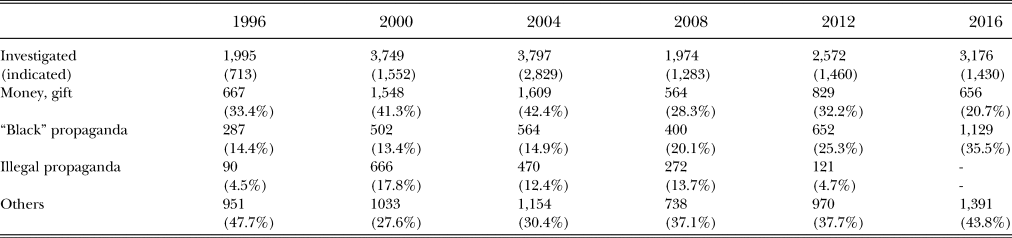
Table 1 shows the trends in investigations, indictments, and detentions for all election-related crimes from the 15th (1996) through the 20th (2016) National Assembly elections. It also breaks down all investigations by the type of crime. It shows that the number of prosecutions for “black propaganda,” which includes both false campaign statements (candidate defamation) and true but slanderous statements (candidate insult), has been increasing throughout this period, while that for vote-buying practices (money and gift) has been decreasing since 2004. In the 20th National Assembly elections in 2016, the number of prosecutions for black propaganda (1,129 persons or 35.5 percent of total election crime prosecutions) surpassed that for vote-buying (656 persons or 20.7 percent of total prosecutions). This trend stands in stark contrast with Taiwan as well as other established democracies, where election campaign speech is rarely prosecuted (Day Reference Day2009; Rowbottom Reference Rowbottom2012).
Prosecutions for Violations of Election Laws in National Assembly Elections in South Korea (1996–2016)

Source: Supreme Prosecution Office, Republic of Korea, Press releases (various issues).
A welcome development is the reduction of “illegal propaganda” cases in the 2012 NA elections, a steep fall from 13.7 percent in the 2008 NA elections to 4.7 percent. The statistics for this category have not been published for the 2016 NA elections, suggesting its insignificance. This decline appears to be due to the Constitutional Court's ruling in December 2011 that online campaigning should not be banned before the campaign period. In spite of reduced prosecutions for illegal propaganda and vote-buying, however, the total number of electoral crime prosecutions has not been decreasing.
The increasing prosecution of “black propaganda” (candidate defamation and insult) is accompanied by a troubling trend of politically biased prosecutions against opposition candidates and critics of the ruling party candidates. Chung Bong-ju, a former National Assembly member, was imprisoned in late 2011 after being convicted of spreading rumors about Lee Myung-bak's connection to an alleged stock fraud during the 2007 presidential election (Freedom House 2012). By contrast, Park Keun-hye was not investigated by the prosecution even though she had raised the same issue during the presidential nomination contest of the Grand National Party in 2007. After the inauguration of Park Keun-hye as president in February 2013, a number of people who had criticized her as a presidential candidate, or her late father and former president Park Chung-hee, were investigated, detained, fined, and indicted for false statements even when there was reasonable evidence that the claims were in fact true (Do Reference Do2013). Park and You's (Reference Park and You2017) investigation of trial cases for candidate defamation and insult during the 2012 presidential election shows that the number of indictments initiated upon statements attacking the ruling party candidates (154 cases, or 87 percent) outnumbered the ones attacking the opposition candidates (23 cases, or 13 percent) by a wide margin.
II. 2. Election Campaign Regulations in Taiwan
Taiwan's election law (Civil Servants Election and Recall Act, Presidential and Vice-Presidential Election and Recall Act) takes a much more liberal approach in campaign regulation than South Korea (Laws & Regulation Database 2017). The law defines election campaign periods for various offices but does not prohibit electioneering prior to the campaign period. The main purpose of the legal campaign period is to administer and regulate campaign activities during the official campaign period, including those managed or sponsored by the Election Commission. There are several provisions on publicly managed campaign activities such as holding candidates’ political presentation meetings, printing and distributing election bulletin that provides information about candidates, and allocating television and broadcast time to political parties.
Unlike Korea's election law, Taiwan's law does not restrict the kind or quantity of campaign literature. It requires the candidate's signature or the name of the political party to appear in the campaign literature, and there are certain restrictions on hanging or erecting advertising articles. According to Taiwan's election law, government agencies, schools, and polling places cannot be used as a campaign office, but there are no restrictions on the number of campaign offices, unlike Korea. Also, there are some restrictions on television time and television advertisements, newspaper and magazine advertisements, and publication of election survey results. Interestingly, Taiwan's election law prohibits the candidates and their electioneering personnel from instigating others to commit insurrection or foreign aggression. Also, spreading rumors or lies for electoral purposes is illegal but, unlike Korea, there is no provision about “true but slanderous” statements.
Overall, Taiwan's campaign regulation is minimal and soft, compared to Korea. The focus of election law enforcement is not restricting political speech but preventing vote-buying practices. Table 2 indicates that the law enforcement is concentrated on prosecuting vote-buying cases, which represent about 93 percent of prosecutions for election-related crimes. In contrast, vote-buying cases accounted for only 20.7 percent of total investigations, while false propaganda as much as 35.5 percent in the 2016 legislative elections in Korea. There are relatively few cases of false propaganda in Taiwan, only between four and five percent of the total electoral crimes. In Taiwan, the judiciary has established “actual malice” standards for criminal defamation, which require the prosecutors to prove both the falsity of the statement and that the defendant made a false statement knowingly or with reckless disregard (Hsu Reference Hsu2009). Hence, there is less potential for political abuse of false campaign speech prosecution in Taiwan than in Korea.
The number of defendants charged for election law violation in the lower court in Taiwan, by type and year

Note: The percentage (the last column) denotes the proportion of each type of election-related crime out of the total election-related crimes of which the type is known, for the periods of 2005–08, 2009–12, and 2013–16.
Source: ROC Court statistics, provided by Dr. Bi-ling Kuan (管碧玲), member of the Legislative Yuan.
The above description of campaign regulations and their enforcement in Korea and Taiwan shows a stark contrast between an illiberal electoral regime in the former and a liberal electoral regime in the latter.
III. HISTORICAL CHANGES AND CONTINUITIES OF ELECTION CAMPAIGN REGULATIONS IN KOREA AND TAIWAN
The history of campaign regulations in Korea and Taiwan show both similarities and differences. Both countries started with a liberal election law but soon moved toward highly restrictive regulations under authoritarian regimes. However, the two countries took a completely different approach during and after democratic transition.
III. 1. Korea
The history of campaign regulation in Korea can be divided into five periods, with a slight modification from Hyun Jong Yoo (Reference Yoo2011). These are the liberal period (1948–1958), strict regulatory regime (1958–1963), strengthening of regulatory regime with comprehensive restriction (1963–1987), partial deregulation (1987–1994), and re-strengthening of strict regulatory regime (1994–present).
The first election law, or the National Assembly Members Election Act, was enacted on March 17, 1948 by the interim legislative assembly under the American Military Government. The only restriction on campaigning stipulated in the law was the prohibition of electioneering by Election Commissioners and public officials. The US State Department and the American Military Government in Korea helped draft the bill (Park Reference Park1996).
The amendments to the law in 1951 introduced a prohibition on house-to-house visit, but the revised law remained largely liberal (Song Reference Song2005). In 1952, the Syngman Rhee government attempted to introduce extensive campaign regulations, including a ban on premature electioneering, without success (Seo Reference Seo and Choi2013). However, the new House of Representatives Election Act, enacted on January 25, 1958 after the introduction of the bicameral system, contained many provisions to restrict campaign activities. The law stipulated prohibition of premature campaigning, prohibition of campaigning by any person other than the candidate and a limited number of campaign workers, and prohibition of various campaign methods. It also introduced spending limit as well as provisions on publicly managed campaign activities. Various restrictions on campaigning were largely modelled on the Japanese election law.
The 1958 law was enacted through bipartisan negotiations and compromise. The main conservative opposition, the Democratic Party, changed its previous position on electoral campaign regulations as a third party, the Progressive Party, was growing in popularity. Although the main rationale for the restrictions on campaigning was to curb corruption and ensure fairness, the law ended up creating substantial incumbency advantage.Footnote 7
The military junta led by Park Chung-hee further strengthened campaign regulations by introducing the “principle of comprehensive restriction.” The 1963 law stated that “any election campaign activities are forbidden except for those that are stipulated by this law.” The election law enacted in 1972, right after Park Ching-hee's Yushin declaration that abolished direct presidential elections and gave the president the authority to appoint a third of the National Assembly members, further tightened campaign regulations. The law allowed only campaign posters, campaign bulletins, and joint campaign speech meetings that were posted, distributed, and organized by the Election Commission. The revised election law in 1981 under the Chun Doo-hwan government only marginally expanded campaign opportunities by adding hanging banners to the menu of legal campaign methods.
A partial liberalization of campaign regulations took place after the democratic transition of 1987. The new law enacted in 1988 added campaign leaflets to the list of permitted campaign tools and increased the numbers of permitted hanging banners and campaign workers. During the legislative process, campaign regulation was not a key issue. Other issues such as adjustments of electoral districts were more salient. Under the catchphrase of “tying money, untying mouths,” more revisions were made in 1991, to allow the broadcasting of candidate careers and the holding of political party campaign speech meetings. The 1991 revisions also emphasized the need to reduce the costs of election campaigns, strengthening the provisions to prevent and punish vote-buying activities. In this context, the campaign period for National Assembly elections was shortened from 18 days to 17, contrary to the professed goal of “untying mouths.”
A major overhaul of the election law took place in 1994. Called the Act Concerning Public Officials Election and Prevention of Electoral Corruption, the new law replaced the existing laws for National Assembly elections, presidential election, and local elections. As the title of the new law indicates, the primary focus of the new law was preventing electoral corruption rather than expanding freedom of electioneering and voters’ right to know. The new law further strengthened the provisions on bribing voters and increased transparency of campaign finance. On the surface, the law also made an important improvement to liberalize campaign regulations by removing the principle of comprehensive restriction. However, the law prescribed detailed regulations on every possible campaign method. During the legislative process, the main opposition party also showed little interest in deregulation (Seo Reference Seo and Choi2013).
Another major revision of the law was made in 2004, in the aftermath of revelations that the 2002 presidential candidates had received vast amounts of illegal campaign contributions from major chaebol or family conglomerates. The 2004 revisions not only strengthened the provisions against illegal funding and vote-buying but also further tightened various campaign regulations, including restrictions on political party activities during campaign period and prohibition of local branch organization at the district level. In 2005, another revision of the law introduced an internet real name registration system to effectively police online activities.
On the other hand, there was a slight loosening of regulations on pre-period campaigning in the 2004 and subsequent revisions. The 2004 law introduced a new institution called “preliminary candidacy” and allowed preliminary candidates a set of campaign tools, albeit very limited ones, such as direct distribution of name cards in person. The maximum period for preliminary candidacy differs by the kind of electoral office: 120 days for National Assembly elections, 90 days for gubernatorial, mayoral, and high- level council elections, 60 days for low-level council elections, and 240 days for presidential election. However, the introduction of preliminary candidacy has become a ground for stricter prosecution of any campaigning activities before registering as a preliminary candidate.
South Korea's Constitutional Court is generally credited for enhancing human rights and freedom, especially during the early years of post-democratic transition. The Court has made some important rulings regarding the election law, including on the issue of proportional representation seat allocation and the amount of candidacy deposit, which represents a form of discrimination against independent candidates. However, the Court has not made any substantial contribution to liberalizing campaign regulations, except for campaigning on the internet in its ruling in December 2011. The Court has consistently upheld the prohibition of pre-period campaigning, based on concerns about overheated and expensive elections. Interestingly, the primary rationale for legalization of internet-based campaigning was that the internet was not expensive.
In summary, South Korea's election law was liberal at first but has continuously increased the scope and strength of campaign regulations and severity of punishment for violations, except for a short period of marginal deregulation immediately after the democratic transition.
III. 2. Taiwan
Taiwan's first electoral rules were liberal without any practical restriction on campaign period or campaign activities. However, the authoritarian Koumintang (Chinese Nationalist Party; KMT) regime soon developed a range of severe restrictions on campaign period and campaign tools. During the early 1980s, the regime slightly relaxed campaign regulations, but that was far from sufficient to satisfy the growing demand for liberalization of electoral campaigning from the political movement outside of the KMT. As Taiwan entered a gradual process of democratic transition starting in 1987 with the repeal of martial law, substantial deregulation of electoral campaign took place with the revision of election law in 1989, followed by further liberalization during the 1990s.
After Taiwan returned to Chinese control upon the Japanese surrender in 1945, Governor Chen Yi, who was dispatched by Chinese president Chiang Kai-shek, held its first local elections in 1946 (Rigger Reference Rigger1999, 38–39). The elected positions were for consultative assemblies at the district, city, township, and provincial levels, but direct popular election was limited to representatives of district assemblies. Above the district level, representatives were chosen indirectly. Then, the electoral rules were about the administration of direct and indirect elections and did not include any clause on campaigning.Footnote 8
The KMT government of the Republic of China (ROC) relocated to Taiwan after being defeated by the communists in 1949. Claiming to represent all of China, the KMT suspended elections for the national legislature. The KMT effectively maintained a one-party rule, prohibiting the forming of other political parties. In order to retain the “Free China” label, as opposed to “Red China,” the authoritarian regime of the ROC had to make some gestures in the direction of democracy (Rigger Reference Rigger1999, 81). In this regard, the nationalist regime implemented local elections at the provincial, county, township, and village levels. The elected offices included both executives and council members, all through direct popular elections. These local elections helped the KMT regime to not only gain support from the United States but also co-opt native local elites (Chen and Lin Reference Lin, Ming-tong and Zheng1998; Lin Reference Lin, Ming-tong and Zheng1998).
In 1950, after the relocation of the KMT government in Taiwan, the provincial government proclaimed an administrative order, The Measures for the Banning of Obstructing Elections in Taiwan Province, ahead of the first island-wide local elections. Interestingly, Taiwan chose the electoral system of single non-transferrable vote (SNTV) in multi-member districts, modelled on the Japanese system. The Measures also contained the principle of “comprehensive restriction,” or restricting campaign methods to legally specified ones, following the Japanese election law. While the Measures allowed only four types of campaigning, including 1) speech, 2) broadcasting, 3) publishing advertisements, and 4) spreading campaign flyers, there were no specific restrictions on the time and manner of these activities, unlike Japan where the law imposed stringent restrictions. Although the Measures established spending limits in addition to the prohibition of vote-buying and malicious speech to libel others, there was no restriction on the campaign period or canvassing. The Governor of Taiwan Province, Guo-jhen Wu, announced publicly that the government should not only avoid intervening in the election but also encourage people to express their opinions freely during the election (Gao Reference Gao2009).
Soon, however, the authoritarian KMT regime began to introduce stringent regulations on electoral campaigning. In 1952 and 1953, the government revised the Measures, adding strict restrictions on campaign activities. The government claimed that the revised Measures was based on the spirit of publicly funded elections, but critics argued that the government only fulfilled state-run elections (Lin Reference Lin1952). The 1952 law stipulated specific restrictions on the following four activities: (1) public speech or politics presentation meetings at the time and place designated by the electoral agency, (2) election bulletin of candidate information within 100 words collected, printed, and distributed by the electoral agency, (3) one-time publication by the election agency of candidate information within 100 words in a local newspaper, and (4) the use of one car for campaign activities. Candidates were prohibited from hiring more than three or five campaign workers. In 1953 another revision was made to limit the campaigning period to ten days (Copper and Chen Reference Copper and Chen1984, 44). The law criminalized canvassing and visiting the electorate house-to-house, publishing advertisements on newspapers, handing out campaign flyers, and operating loudspeakers in campaign vehicles. If the electoral supervisory agency found a candidate violating provisions of the law, the agency had the authority to disqualify the candidate.
While the government claimed that the purpose of these stringent regulations was to reduce campaign spending and promote fair competition (United Daily News 1952), the dismal performance of the KMT in the 1950 local elections might have incentivized the authoritarian regime to seek tools to tightly control the elections. Since the mainlander-dominated KMT did not have well-established local institutions to support its nominated candidates in 1950, the KMT could only win around ten percent of the total seats of county and town councils, according to Lin (Reference Lin, Ming-tong and Zheng1998). To overcome its weak local foundations, the KMT had to co-opt local factions by nominating many candidates with local factional backgrounds in the subsequent elections. The KMT also wanted to control local factions and the whole electoral competition, which would have been difficult without strict electoral rules. The KMT soon dominated the local elections (Lin Reference Lin, Ming-tong and Zheng1998).Footnote 9
The strict campaign regulations immediately attracted criticism from dissident intellectuals and independent candidates. For example, the Free China Magazine pointed out that the Measures caused low voter turnout as well as low number of candidates participating in elections (Free China Magazine 1954). The magazine criticized the banning of pre-election-period activities and of canvassing (Free China Magazine 1953). It also argued that the power to disqualify candidates should be assigned to the court instead of the electoral supervisory commission (Free China Magazine 1954).
According to reports from the United Daily News (1954; 1956a; 1956b), the electoral supervisory commission had disqualified several candidates for electioneering before the campaign period and for bribing voters. However, the ban on door-to-door canvassing became increasingly difficult to enforce as many KMT-nominated candidates ignored the law. There was a partial loosening of the campaign regulations in the late 1950s and early 1960s, allowing slightly more space for campaign speech.Footnote 10 In 1964, the government announced that door-to-door canvassing would no longer incur any penalties were it not for electioneering (Central News Agency 1964).
The partial loosening was perhaps motivated by the KMT's “policy of replacement,” in which more candidates were nominated from the educated elite trained by the party than from local factional leaders with low levels of education (Lin Reference Lin, Ming-tong and Zheng1998). The KMT had to give the elite candidates without local factional background an opportunity to promote themselves among local residents. The government first introduced candidates’ educational requirements in 1955 and further raised the required educational levels in 1967, which excluded many local factional leaders from being KMT candidates (Huang and Cheng Reference Huang and Cheng2002). In 1972, the government also prohibited candidates who were older than 61 years to compete in elections (Lin Reference Lin, Ming-tong and Zheng1998). Combination of these new requirements and the partial loosening of campaign regulations helped the elite candidates, reducing the KMT's reliance on local factions to a certain extent.
After the death in 1975 of Chiang Kai-shek, who had kept a tight grip on both the KMT and the government, the opposition movements began to grow. Although opposition parties were still banned, the first significant effort of the opposition movements to field non-KMT candidates throughout the island took place in 1977 (Rigger Reference Rigger1999, 114). They were called Dangwai, meaning “outside-the-party.” In January 1978, Chiang Ching-kuo, Chiang Kai-shek's son, became the new ROC president and the KMT announced several reforms for partial liberalization. While there were supplementary elections to fill a small number of vacant seats of the national legislatures starting from 1969, the first substantial national-level elections to fill a fairly large number of legislative seats were scheduled for December 1980. The government promulgated a new election law in consultation with many scholars.
The Public Officials Election and Recall Law (POERL) was announced in May 1980. The new election law made campaign regulations slightly less stringent than before. For example, canvassing and visiting the electorate were legally permitted, and the punishment for pre-period campaigning became administrative fines rather than disqualification of candidacy. Many Dangwai candidates circumvented the prohibition of pre-period campaigning by holding tea parties and celebrating birthdays before the legal campaign period (Copper and Chen Reference Copper and Chen1984). Despite the relaxation of campaign regulations, Dangwai legislators and liberal scholars criticized that the new law still generated disadvantages for non-party candidates (Warm Wave 1983).
In September 1986, Dangwai leaders declared the formation of the Democratic Progressive Party. Chiang Ching-kuo indicated that he would lift the martial law and allow the establishment of new parties. During the 1985 local elections and the national elections in December 1986, many DPP candidates ignored and violated campaign regulations they deemed unjust. Prior to the legal campaign period, many candidates held tea parties. Many students actively participated in campaign activities.11 A number of candidates campaigned in restricted places, conducted marches, published newspaper advertisements, and distributed more handbills and posted larger posters than prescribed by law. As the law was not rigorously enforced, many of the campaign regulations became rather meaningless (Copper Reference Copper1990). In 1988 Chiang Ching-kuo died and Lee Teng-hui became the new president. President Lee continued with the democratization process, fully opening the national legislative elections starting from 1991 and eventually agreeing to direct popular election of the president in 1996. Liberalization of campaign regulations continued in 1989, 1991, and 1994. President Lee's commitment to liberalization of campaign regulation was perhaps motivated by several reasons. First, since Lee Teng-hui faced strong challenge from the conservative faction in the KMT, he chose to build a strategic coalition with the DPP (Lin, Chu, and Hinich Reference Lin, Chu and Hinich1996). Second, the government conducted a survey and found that 79 percent of the sample disagreed that campaign activities should be regulated (United Daily News 1988). President Lee might have chosen to move further toward liberalization of the electoral laws in order to gain more public support. Third, the new faction in the KMT, the New KMT Coalition, also became an active group promoting liberalization of the electoral laws in order to challenge the old KMT factions’ advantage in elections.
In January 1989, the POERL was revised, substantially liberalizing the rules of campaigning. The new law repealed the comprehensive restriction and the provisions to prohibit cross-constituency politics presentations and campaign activities. However, the revised law introduced new provisions to regulate the campaign activities of political parties. Despite the partial liberalization of electoral rules, many restrictions on campaigning remained in place and were difficult to enforce. Many DPP candidates deliberately ignored some regulations. During the elections in November 1989, the standards of enforcement were inconsistent across counties (United Daily News 1989a). After the elections, the DPP and the New KMT Coalition both criticized the fact that the campaign regulations still had many problems and needed to be revised again (United Daily News 1989b).
The DPP legislators called for more thorough liberalization of electoral campaign rules, and the trend of liberalization continued in the 1990s. In 1991 the POERL was revised again, allowing candidates to make public speeches outside the officially sanctioned “political views presentation meetings” and to assemble a crowd for a parade, although they still could not utilize the mass media for campaign advertising. More substantial revisions were made after the elections of Taiwan provincial governor and city mayors in 1994 (United Daily News 1994). The 1994 revision repealed the prohibition of campaigning by non-campaign workers. It abolished the provision that banned candidate advertisement on mass media and removed the stringent restrictions on campaigning by political parties. It also repealed the provision that forbid candidate-sponsored meetings during the second half of the campaign period when only the election commission-sponsored meetings could be held. The requirement for legislative candidates’ educational qualifications was also abolished. In 1997, the restrictions on the number of campaign vehicles and campaign offices were rescinded. Thus, Taiwan's election law came to have few regulations on campaigning, unlike South Korea's law.
IV. THE CAUSES OF DIVERGENT TRAJECTORIES IN KOREA AND TAIWAN
The preceding section shows that both Korea and Taiwan started with few restrictions on campaigning but soon developed highly stringent sets of campaign regulation under authoritarian regimes. However, the two countries later diverged. Korea has continued to expand regulations, whereas Taiwan has reduced restrictions on campaigning over time. Why did both countries start with liberal campaign rules but soon develop a stringent regulatory electoral regime? What explains their divergent trajectories in recent years? Answers to the former questions are fairly straightforward. Answering the latter question requires a more careful analysis.
Both countries started with a liberal electoral regime largely because of American influence. The US influence was more direct and explicit in Korea because the first election law was enacted under the American Military Government. American advisors helped the Interim Legislative Assembly to draft the law and intervened in the deliberation process. It is less clear how exactly Americans exerted influence in the promulgation of the electoral rules of 1950 in Taiwan. It is common knowledge, however, that the KMT government in Taiwan wanted to show to the United States its commitment to democracy because US support was vital to its national interests and survival.
Both countries soon introduced strict restrictions on campaigning, such as the ban on pre-period campaigning and door-to-door canvassing to limit the opportunities for effective campaigning by the political forces deemed dangerous to the authoritarian regimes. This represents a shift from American-style to Japanese-style campaign regulations. Since Japanese political influence disappeared in both countries, this shift cannot be explained by external influence. The changes must have occurred because of the authoritarian regimes’ political interests in both countries. While the motivations for both authoritarian regimes were similar, there were important differences in the legislative process as well as the target groups for restriction. Since Korea's soft-authoritarian regime held semi-competitive national elections and the ruling party did not have a majority in the National Assembly during the 1950s, a compromise between the ruling party and the major opposition party was necessary to amend the election law. The major opposition party members of the National Assembly initially did not agree to introduce strict campaign regulations. However, their calculus changed when they came to enjoy substantial representation in the legislature and a third leftist party was gaining popularity. They shared with the ruling party members common interest of defending incumbency advantage from the challenge of the third party candidates. The party-state in Taiwan with no opposition parties did not have to compromise but was able to make decrees at will. While the target groups for restraint were socialist-leaning progressive parties in Korea, any potential opposition was to be restrained in Taiwan.
The role of Japanese legal legacy should also be acknowledged in the adoption of stringent Japanese-style campaign regulations in both countries. When the authoritarian regimes in both countries felt the need to restrict electioneering by opposition and leftist candidates, the menu of regulations was readily available because they were well aware of Japanese election campaign rules. However, they introduced Japanese-style regulations selectively as their need for optimal level of stringency changed over time. Note that Taiwan introduced Japanese-style electoral system (SNTV in multi-member districts) from the beginning but Japanese-style electoral campaign regulations a little later. In Korea, Japanese-style electoral system has never been introduced although it continued to heavily adopt the Japanese campaign regulations until today.
With regard to the continuation of the stringent regulatory electoral rules in Korea even after democratization, previous literature has offered several explanations, such as voters’ lack of political awareness, bureaucrats’ patriarchal interventions, incumbency advantage, and path dependency (Shim and Kim Reference Shim and Kim2006; Yoo Reference Yoo2011). All these factors may have exerted some influence in Korea, but it is not evident if these factors can explain the differences from Taiwan. Voters’ lack of political awareness and endemic electoral corruption have often been cited as the rationale for restricting free electoral speech during the legislative process and by the Constitutional Court (Chon Reference Chon2010). However, there is no evidence that Korean voters are more prone to vote-buying and lack of political awareness than Taiwanese voters. Surveys of voter behavior in Korea show that vote-buying practices such as provision of cash, gifts, entertainment, dining, and tour ahead of elections have all but disappeared. While more than 10 percent of Korean voters admitted receiving some kinds of gifts, special treatment, or even cash during the 1990s, that percentage has dropped to around one or two percent since the mid-2000s (You Reference You2015, 112). In addition, many Korean voters want to freely express and exchange their political opinions, including their preferences of political parties and candidates. The conflict between the restrictive election law and people's desire to actively participate in campaigns and discussions about elections has created increasing tensions.
Bureaucrats’ patriarchal interventions may partly explain the continuity of restrictive campaign rules in Korea. In particular, the regulatory power of the Central Election Management Commission and its provincial and local branches has increased over time in tandem with the organization's budget (Yoo Reference Yoo2011). The prosecutors’ power has increased as well. It is understandable that the bureaucrats at the Election Management Commission and the prosecutors have enjoyed their increasing power due to the restrictive regulatory system and that they have vested interests in protecting such a system. However, the preferences of the bureaucrats and prosecutors cannot outweigh those of lawmakers because it is ultimately the legislature that enacts the election law.
Path dependence due to incumbency advantage probably explains why Korea has maintained and even expanded campaign restrictions after democratization. Although the primary rationale for strict campaign regulations was ensuring fairness between rich and poor candidates and eliminating vote-buying and corruption, the highly restrictive regulations have produced enormous electoral advantages for the incumbents. Hence, it is understandable that incumbent legislators including both ruling party members and opposition members have no interest in liberalizing campaign regulations that will reduce their electoral advantages. This explains why the opposition legislators were content with only partial deregulation and did not fight to remove a number of restrictive regulations after democratic transition in Korea.
In addition, the concept of “cartel parties” proposed by Katz and Mair (Reference Katz and Mair1995) helps explain the collusion between the major parties to keep stringent regulations. While in Europe public financing has been a major driver of party cartelization, the Korean variant has involved rigid legal regulation of parties and campaigning (Mobrand Reference Mobrand2019, 151). Institutional combat between major parties in Korea has centered around the electoral system, while they have cooperated to increase the share of major parties in public financing and maintain stringent campaign rules to their common advantage.
Also, the incumbency advantage explanation is consistent with the standard explanation for Japan's restrictive campaign rules (Soma Reference Soma1986; McElwain Reference McElwain2008). After Japan's defeat in World War II, the US Occupation in Japan recommended a liberalizing reform of election law. But lawmakers from both the right and the left resisted, and the ban on pre-period campaigning as well as door-to-door canvassing remained intact (Soma Reference Soma1986, chapter 5). Then, the LDP-dominated parliament has revised the election law many times to expand, rather than reduce, campaign regulations. In particular, the parliament has repeatedly reduced the legal campaign period for Lower House elections from 30 days (1950) to 25 days (1952) to 20 days (1958) to 15 days (1983) to 14 days (1992) to 12 days (1994) (McElwain Reference McElwain2008).
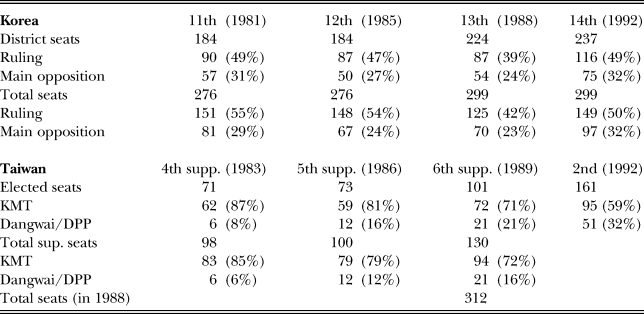
Why, then, did the legislators in Taiwan not maintain restrictive regulations but choose instead to liberalize campaigning contrary to their own interests? How can we explain the divergent paths between Korea and Taiwan? The critical difference between the two countries is that, during the authoritarian period, opposition lawmakers in Korea were also beneficiaries of campaign regulations, but the opposition, or Dangwai, in Taiwan was rarely represented in the national legislature. Table 3 shows that the ruling parties in Korea had maintained only a slight majority of seats in the National Assembly before the democratic transition of 1987; moreover, in the 13th National Assembly, right after the transition, the opposition parties occupied a majority of seats. In Taiwan, the opposition (Dangwai, or DPP) occupied only 6 to 12 percent of supplemented seats in the Legislative Yuan before the democratic transition. Since many of those members who had been elected in mainland China in 1947–1948 stayed in the Legislative Yuan and only supplementary elections were held until 1989 to fill part of the vacancies (Tien Reference Tien1989, 145–146), the opposition's representation in the Legislative Yuan was negligible. In 1988, the 12 seats held by DPP members accounted for less than four percent of the 312 seats of the Legislative Yuan, in which a large portion was held by permanent legislators. Also, during the early years of democratic transition the KMT maintained a handsome majority in the legislature.
Numbers and percentages of legislative seats by ruling and main opposition in Korea and Taiwan

Notes: In Korea, total seats are the sum of district and proportional representation (PR) seats. In Taiwan, total supplementary seats include popularly elected seats and those appointed by the president. The appointed seats were supposed to represent the mainland Chinese population but were abolished with democratization.
Sources: Central Election Management Commission (2009), Tien (Reference Tien1989: 145–146), Wikipedia (2018).
Hence, Korea's opposition legislators and ruling party legislators shared vested interests in keeping the stringent electoral regime, while that was not the case in Taiwan. As a result, Korea's opposition was content with the election law once the extremely limited campaign opportunities were partially remedied in the early years of post-democratic transition. In Taiwan, liberalization of election law was an important agenda for Dangwai during the 1980s. DPP legislators, as a minority in the legislature, pushed for further liberalization in the late 1980s and early 1990s during the gradual democratic transition of the country. While some hardliners within the KMT resisted rapid liberalization, the party leadership liberalized campaign regulation step by step.
However, it is notable that the DPP increased its seat share gradually during the 1990s and eventually became a governing party, alternating power with the KMT since 2000. One may question why the DPP legislators in Taiwan did not switch their position and collude with the KMT lawmakers to reintroduce stringent campaign regulations. In other words, how can we explain the continuing divergence between the two countries after the mid-1990s in spite of their convergence in seat shares by the opposition? What is the path-dependent mechanism behind this continuing divergence?
We reason that the dominant political discourse about electoral campaign regulation had been firmly established by the mid-1990s in both countries. In Korea the dominant discourse emphasized fairness and strict implementation of election rules, including those on campaign finance and campaign activities. In Taiwan the dominant discourse emphasized freedom and liberalization. Once the dominant discourse was established, it would be difficult and costly for lawmakers to change their position on campaign regulation.
Institutional complementary is also an important factor. In Korea the emphasis on fairness and strict enforcement of the election law has been shared by the Electoral Management Commission, prosecutors, and courts. The shared discourse is further strengthened by the organizational and professional interests of the Electoral Commission and prosecutors. Additionally, many civil society organizations have shared the discourse on fairness, as the large coalition of CSOs for fair election campaign in the 1990s demonstrates. Although some civil society organizations advocated the liberalization of campaign regulations, their voice has been weak. In Taiwan the emphasis on free electioneering has been shared by the Electoral Commission, prosecutors, courts, and the civil society. Given these circumstances, it is difficult for incumbent lawmakers to challenge the shared discourse. Changing their position to reintroduce stringent regulations would make them vulnerable to charges of being inconsistent, hypocritical, and anti-democratic.
Another potential problem with the incumbency advantage explanation is that many elected legislators have been investigated, indicted, and even convicted and removed from their seats under the stringent electoral law in Korea. Why, then, do they maintain such a risky law? That the law is more dangerous and disadvantageous to their challengers than to them partly answers this question. Institutional complementarity and path dependence also help answer this question. Beliefs in regulatory stringency and strict enforcement have been ingrained among Koreans through the colonial and Cold War period, and liberalism has been weak among both the rightists and leftists in Korea (Choi Reference Choi2009). Politicians as well as the general public have become accustomed to the existing campaign rules, even though they are very cumbersome and dangerous. A survey of perceptions and opinions on campaign regulations shows an interesting pattern: while 88 percent of political scientists advocate rapid deregulation, only 38 percent of politicians and campaign experts held the same opinion (한국선거학회 [Korea Election Studies Association] 2012). Also, it seems that the prosecutors and judges enforce the law at the optimal degree rather than maximum degree. The proportion of lawmakers who lost their seats because of election law violations has been substantial but never exceeded 5 percent, perhaps because the judiciary has been cautious not to provoke backlash from the legislature.
V. CONCLUSION
Electoral campaign regulation has been a neglected issue in comparative politics literature. In spite of increasing interests in electoral integrity or quality of elections, regulations on campaign activities, apart from campaign finance regulations, have not attracted the attention of scholars. However, our study shows the importance of this issue with regard to both “freeness” and “fairness” of elections. Although strict restrictions on campaign period and campaign tools have been justified in the name of fairness between rich and poor candidates, these restrictions not only threaten the freeness but also fairness between the incumbents and challengers.
A comparative historical investigation of electoral campaign regulations in Korea and Taiwan shows that both countries started with liberal rules but soon developed highly restrictive regulations. However, the two countries later diverged. While Korea has continued to maintain restrictive campaign regulations after democratization, Taiwan has liberalized the rules over time. Our findings suggest that incumbency advantage and containment of the leftist or opposition parties were the primary reasons for introducing the stringent regulations under the soft- and hard-authoritarian regimes in Korea and Taiwan. The key difference between the two countries was that the main opposition party as well as the ruling party in Korea enjoyed the incumbency advantage but that opposition forces in Taiwan did not. As a result, the opposition in Taiwan demanded a liberalization of campaign regulations, but the Korean opposition did not. Democratization in Taiwan was accompanied by successive liberalizations in campaign regulations, while in Korea the legislators affiliated with the ruling and opposition parties shared a common interest in limiting the campaigning opportunities of electoral challengers.
The findings of this study shed light on the weakness of Korean democracy. Korea is generally regarded as a fully consolidated democracy, but numerous concerns regarding civil liberties including freedom of expression and association have been raised by international organizations. While freedom of political expression should be guaranteed ahead of elections in a liberal democracy, Korea's illiberal electoral regime has invoked questions about the status of Korean democracy (Haggard and You Reference You2015). Although Koreans have kept its democracy from backsliding through the candlelight civil revolution of 2016–2017, liberal political culture is still weak (Choi Reference Choi2009). Concerns about fairness outweigh considerations of freedom; strict legal enforcement and harsh punishment are more emphasized than flexible enforcement and voluntary compliance.
The last question to consider is whether and under what conditions there will be a weakening of these campaign restrictions in Korea. It is unlikely that we will see substantial deregulation of electioneering any time soon, considering the lack of interest in this issue among the legislators and civil society. The legislature has been debating the reform of the electoral system to increase proportionality, but reforming electoral campaign regulation has not been on the agenda. The lawmakers maybe incentivized to liberalize campaign rules if the prosecutors enforce them too strictly, so that too many lawmakers lose their seats. This is one possible condition for reform of campaign regulation, but the likelihood of such a situation looks small. What also contributes to the status quo is Korea's regionalist politics, which makes it more important for aspiring candidates to get party nomination in districts where the party is popular than to compete with candidates nominated by other parties in general elections. Since a majority of the parliamentary seats are practically determined at the party nomination stage, in which party leadership usually exerts more influence than competition on the ground, the issue of campaign restriction does not get popular attention. Hence, even in civil society, campaign regulation is only a minor issue. In sum, there seems to be a strong force for path dependence.
This study also has significant implications in the context of global democratic backsliding. Although electoral democracy has rapidly spread to the world over the last decades, free and fair electoral competition has been undermined in many new democracies. The results of this study speak to the need for closer scrutiny of the freedom and fairness of electoral competition. The study of electoral integrity or electoral malpractices should pay attention to electoral campaign regulation as a tool for manipulating and controlling elections. And we need to pay more attention to micro-level campaign rules than has been found in the previous literature's exclusive focus on macro-level electoral systems.
FUNDING
This work was supported by the Academy of Korean Studies Grant(AKS-2013-R-67).
CONFLICTS OF INTEREST
The authors declare none.