1. INTRODUCTION
The classical theory of rational choice prevalent in economics is one according to which rational action aims at maximizing expected utility. According to this theory, the primary unit of agency is the individual: a rational individual chooses in a way that maximizes her own expected utility – or, chooses in a way that satisfies her preferences in light of her beliefs. An alternative theory is team reasoning, which preserves the utility-maximizing framework of the classical theory, but shifts the unit of agency from individuals to groups. Team reasoning allows groups (or teams) to count as agents, and individuals to reason as members of a team. A team reasoner will determine which combination of actions done by the team's members will best promote the aim of the team, and then perform her component part (Gold Reference Gold, Okasha and Binmore2012: 185).
Team reasoning promises to explain and prescribe rational behaviour of team members – that is, of individuals who conceive of themselves as members of a team. Proponents of team reasoning claim that it is descriptively and normatively superior to the classical theory of rational choice (Hurley Reference Hurley1989, Reference Hurley and Gold2005; Bacharach Reference Bacharach1999, Reference Bacharach, Gold and Sugden2006; Sugden Reference Sugden2003; Hakli et al. Reference Hakli, Miller and Tuomela2010; Tuomela Reference Tuomela2013). As a descriptive theory, it is thought to better explain actual behaviours, such as our ability to successfully coordinate our actions (e.g. on the Hi/Hi outcome in Hi-Lo games) and cooperate in Prisoner's Dilemma-type situations.Footnote 1 And as a normative theory, it is thought to better capture our intuitions about what the rational action is in such situations.
My concern in this paper is with the theory's normative adequacy. Team reasoning shows that it is rational for team members to choose Hi in the Hi-Lo game and sometimes rational for team members to cooperate in Prisoner's Dilemma-type situations. However, left unaddressed is whether becoming a team member is itself rational for individuals, leaving what some have identified as a gap in the theory (Bacharach Reference Bacharach1999: 144; Hurley Reference Hurley and Gold2005: 203; Hollis and Sugden Reference Hollis and Sugden1993: 13). I will argue that the prospect of closing this gap by appealing to individual instrumental rationality looks grim.
The structure of this paper is as follows. In Section 2, I introduce the problems associated with coordination in the Hi-Lo game and cooperation in Prisoner's Dilemma-type situations, along with the basic structure and promise of team reasoning. In Section 3, I take up a limit to team reasoning's normative force, specifically that prescriptions for action apply only to team members, leaving a gap between reasons for team members to act and reasons for individuals to become team members. Footnote 2 I take up, in Section 4, the question whether it is instrumentally rational for an individual to become a team member, and examine Susan Hurley's view that doing so is rational. I argue that Hurley's account fails to show that becoming a team member is necessary to gain the advantages of coordination in Hi-Lo games or cooperation in Prisoner's Dilemma-type situations and, furthermore, that individuals will often fare better reasoning as individual agents than as members of a team. I conclude in Section 5 that the failure of Hurley's argument points to a more general problem for the normative force of team reasoning – specifically, that the conditions needed to make it rational for a team member to employ team reasoning make becoming a team member unnecessary.
2. THE LIMITATIONS OF CLASSICAL GAME THEORY AND THE PROMISE OF TEAM REASONING
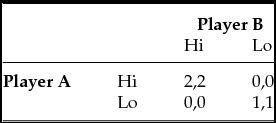
Team reasoning has been developed, in part, as a revision to classical (individualistic) game theory in response to coordination and cooperation problems, such as the Hi-Lo game and Prisoner's Dilemma-type situations, respectively (Gold Reference Gold2005: 2–5). Both problems are familiar, so I shall only sketch them here. Consider first the Hi-Lo game (Table 1).
The Hi-Lo Game.

We assume that both players are rational and that each knows the other is rational. We also assume that each player is concerned solely with maximizing her own expected utility. In the Hi-Lo game, there are two equilibria: Hi/Hi and Lo/Lo. If Player 1 chooses Hi, Player 2’s best reply is to choose Hi; she can do no better by choosing Lo. And if Player 1 chooses Lo, Player 2’s best reply is to choose Lo.
Given that both players do better at the outcome Hi/Hi than they do at Lo/Lo, we would expect most players to choose Hi, and intuitively deem that as the rational solution to the game. But the classical theory does not have the resources to explain or prescribe this. The reason is that the classical theory is confined to ‘best reply’ reasoning: it can tell Player A, for example, that she should select Hi if she expects Player B to select Hi, and Lo if she expects Player B to select Lo. And Player B can expect A to pick Hi if she expects A to expect that B will pick Hi. But A has no reason to expect this of B since B's choice is contingent on what she expects A to pick.
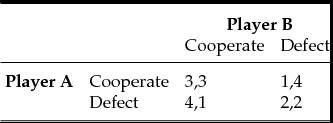
Next is the Prisoner's Dilemma (Table 2).
The Prisoners’ Dilemma.

The first number of each pair represents Player A's utility; the second, Player B's utility. We can see that, no matter what each player expects the other to do, defecting is always the best reply. Mutual defection constitutes the equilibrium of this game. The trouble is that the resulting outcome – mutual defection – is suboptimal to the mutual cooperation outcome. Thus, rational action, as prescribed by the classical theory, guarantees a suboptimal outcome in Prisoner's Dilemma-type situations. Some people find this normatively problematic. Additionally, people often cooperate at much higher levels than are predicted, which casts doubt on the descriptive adequacy of the classical theory (Gintis Reference Gintis2000).
There is thus a disconnect between what is predicted and prescribed by the classical theory, on the one hand, and what is observed and intuitively thought to be rational, on the other. The basic issue is that best reply reasoning characteristic of classical game theory cannot explain or prescribe why individuals do or should coordinate on Hi in the Hi-Lo Game or cooperate in Prisoner's Dilemma-type situations.
Team reasoning preserves the utility-maximizing framework of the classical theory, but shifts the level at which maximization happens from individuals to groups. The theory assumes that individuals have the capacity to reason as members of a team rather than merely as individual agents. A team is a group of individuals who conceive of themselves as members of that group (or team). Conceiving of oneself as a member of a team entails that one sees the decision problem as one that we rather than I face. Rather than asking ‘What should I do?’ a team member asks ‘What should we do?’ Team reasoning thus involves reasoning on the basis of what will bring about the outcome that is best for the team of which one is a member. A team member engaged in team reasoning will determine the profile of strategies employed by the team's members that leads to the best outcome for the team, and then perform her component part to achieve that outcome.
To put this another way, we might understand team reasoning as involving two steps. In the first step, an individual will identify as a member of the team – or, in our current terminology, become a team member. This involves an agency transformation from an individual agent to a team (or group) agent. In the second step, the individual team member will adopt the team's preferences as her own. This involves a preference transformation (which, in the context of a Prisoner's Dilemma, ultimately transforms the game into a coordination game). According to team reasoning, outcomes are deemed rational for the team by virtue of their granting to the team a higher utility than alternative outcomes. And individual members of the team act rationally insofar as they perform their component parts to achieving the outcome that is best for the group to which they identify themselves as belonging.
This shift from the individual to team – or from I to we – opens the door to coordination in Hi-Lo games and cooperation in Prisoner's Dilemma-type situations. In the Hi-Lo game, while I can't determine merely on the basis of my knowledge of your rationality whether to pick Hi or Lo, we should both pick Hi. In the Hi-Lo game, the outcome Hi/Hi is one that uniquely maximizes the utility of the team. Each team member should thus do her part in bringing about that outcome and choose Hi.
Team reasoning is also able to deliver a prescription to cooperate in Prisoner's Dilemma-type situations. Insofar as C/C is the outcome that brings about what is best for the team, C/C is the rational outcome for the team.Footnote 3 Thus, while I should always defect in Prisoner's Dilemma-type situations, we should cooperate. From the conclusion that we should cooperate, each individual team member derives a reason to bring about the component action needed to bring about that outcome – i.e. to cooperate (Gold and Sugden Reference Gold, Sugden, Peter and Schmid2007: 289–294).
3. A GAP IN REASONS
It is partly because of team reasoning's promise to prescribe choosing Hi in Hi-Lo games and to cooperate in Prisoner's Dilemma-type situations that it has been thought to serve both as a better descriptive and normative theory of rational choice. I will consider here only the normative adequacy of the theory. The problem is that, while the theory promises to provide us with a reason why team members should choose Hi or cooperate – namely, their actions constitute a component part in bringing about what is best for the team – no account has been given of why a rational individual would become a team member. Thus, we are left with a gap between reasons for team members and reasons for individuals.
Sugden (Reference Sugden2003: 168–169) draws a distinction between what he calls the ‘internal’ and ‘external’ problem that will help to clarify the above-mentioned gap in reasons. According to him, ‘The internal problem is that, from the viewpoint of any individual, the validity or acceptability of team reasoning, narrowly defined, may be conditional on his confidence that other members of the team are reasoning in a similar way’ (Sugden Reference Sugden2003: 168). Sugden (Reference Sugden2003: 166–169) illustrates the logic of team reasoning with the Footballer's Problem, which is the athletic version of the Hi-Lo game. In it, I, a team member, can pass left or right. Passing right has a greater chance of scoring than does passing left but only if my teammate is to my right to intercept my pass. As a team member, I can determine, by team reasoning, which action I ought to perform in order to achieve the aim of scoring. Since pass right/intercept right is the outcome that is best for the team, I should do my component part, which is to pass right. However, I only have reason to carry through with the directives I arrive at by team reasoning – or, employ team reasoning – if Sudgen's internal problem is solved.
Sugden (Reference Sugden2003: 169–172) appeals to the concept of ‘reason to believe’ to answer the internal problem. According to him, when individuals have sufficient reason to believe that others will employ team reasoning, it is rational for them to do so as well. There are different accounts of how my reason to believe that others are employing team reasoning can be secured. Hurley (Reference Hurley and Gold2005: 207–212), appeals to our capacities for mind-reading (more on this later), where we have the capacity to detect the intentions of others to employ team reasoning, and Bacharach (Reference Bacharach, Gold and Sugden2006: 130–137) recommends probabilistic or ‘circumspect’ reasoning to accommodate uncertainty with respect to whether others will employ team reasoning. There may be other ways of getting the necessary assurance, and different accounts may yield different degrees of assurance (Gauthier Reference Gauthier1986; Frank Reference Frank1988; Sally Reference Sally2000; Spiekermann Reference Spiekermann2007; Barrett et al. Reference Barrett, Cosmides and Tooby2010). But as long as they provide team members with a sufficient reason to think that others will employ team reasoning and carry out their part, the internal problem is solved, and a team member will have reason to employ team reasoning.
Sugden says that even if we can solve the internal problem, there is a further question of whether an individual should endorse team reasoning at all. This is what he refers to as the ‘external’ problem, and what I take as corresponding to the question – and our main focus here – whether one should become a team member.
4. THE RATIONALITY OF BECOMING A TEAM MEMBER
On the question of whether it is rational to become a team member, there is a divide in the literature. Both Sugden and Bacharach think (for different reasons) that becoming a team member is not something that can be rationally evaluated. For Sugden, since choices are assessed as rational or irrational in relation to an agent's preferences, the determination of whether choices are rational cannot be made until after the unit of agency has been specified. On this view, one can assess the rationality of choices of an individual agent in relation to that individual's preferences, or of a team member in relation to the team's preferences, but one cannot assess the rationality of becoming a team member.
Bacharach (Reference Bacharach, Gold and Sugden2006: 69) also denies the possibility of rationally assessing becoming a team member. According to him, the unit of agency – individual or group – is not something that can be chosen, but is instead the product of framing. On Bacharach's view, sometimes a player will see the situation she faces as one that she alone faces; other times, as one that we face. Whether an individual participates as a team member is dependent on the player having adopted the ‘we’ frame.Footnote 4 According to Bacharach, the adoption of this frame is the result of being primed by features of one's circumstances, and is not chosen (Reference Bacharach, Gold and Sugden2006: 82). And since the frame is not chosen, it is presumably something that cannot be rationally assessed.
These two views lie in contrast to those that maintain that rationality can sometimes recommend adopting a particular unit of agency. This line is expressed by Hurley (Reference Hurley and Gold2005), Hakli et al. (Reference Hakli, Miller and Tuomela2010) and Tuomela (Reference Tuomela2013). Such a recommendation, as I understand the arguments, rests ultimately on the better consequences – and consequences for an individual agent in particular – that come from reasoning as a team member than from reasoning as an individual. My focus hereafter will be on Hurley's view.
Hurley appeals to the consequences generated by team membership compared to those generated by individual reasoning, and argues that participation in a collective unit of agency – or, in our terminology, a decision to become a team member – may sometimes be rational, insofar as the consequences generated by team membership are preferable to those brought about by individual reasoning (Hurley Reference Hurley1989: 148; Reference Hurley and Gold2005: 212). Hurley is most commonly interpreted as providing a recommendation to become a team member on the basis of the advancement of impartial goals (Hollis and Sugden Reference Hollis and Sugden1993: 14; Gold and Sugden Reference Gold, Sugden, Peter and Schmid2007: 294–295). According to this interpretation, individuals might have reason to become team members to the extent that doing so advances goals that those individuals who are a part of the team share on the basis of a common ethical framework (Hurley Reference Hurley1989: 147).Footnote 5
Recommendations of this kind on the basis of impartial concerns may get us some distance in prescribing cooperation to agents who care about such things, but still leave us without any reason why anyone who lacks impartial concerns should cooperate. We are thus left with the question of why should I – who lacks impartial concerns – become a team member. Hurley's answer to this is as follows:
A group of individuals acting as a collective unit can have different possible outcomes within its causal power [than can an individual unit], given what agents outside the group are expected to do. A collective unit may thus be able to bring about an outcome that is better than any outcome the individual unit can bring about – better for that individual, inter alia . . . As an individual I can recognize that a collective unit of which I am merely a part can bring about results that I prefer to any I could bring about by acting as an individual unit, and that my acting as an individual would interfere with this process. I can instead act in a way that partly constitutes the valuable collective action, and in so doing, act rationally. (Hurley Reference Hurley and Gold2005: 203)
If we identify ‘acting as part of a collective’ with ‘team reasoning’, we can take Hurley's conditions to amount to a claim that becoming a team member will be individually rational if the following two conditions are met: (1) team reasoning generates an outcome for the individual that is better than the outcome an individual could achieve by his or her self, (2) team reasoning is the only way of achieving those benefits.
In contrast to Sugden, Hurley thinks that it is possible to evaluate the rationality of becoming a team member in relation to an individual agent's preferences. Against Bacharach, she thinks that the unit of agency is something that can be chosen, and thus rationally assessed. Hurley's view is that an agent can evaluate outcomes both brought about by acting as an individual agent and brought about by acting as a team member in relation to her preferences as an individual, and rationally choose, on the basis of those outcomes, which unit of agency should operate (Hurley Reference Hurley1989: 148; Reference Hurley and Gold2005: 212).
Hurley's approach aligns with a common-sense reconstruction of how an individual might reason about whether to join a team. Consider, for example, an individual's choice to study for a test by herself or by joining a study group. Or, a competitive athlete who must choose between competing as an individual (in, say, gymnastics) or as part of a team. In both cases, the individual may see that her own aims can better be advanced – of doing well on the test or of winning the gold medal – by joining the study group or athletic team. In other words, an individual agent may reason that becoming a team member will have better consequences for her, in relation to her own perspective and preferences now, than those achievable by the alternative, and that she thus has reason to become a team member. These above examples also illustrate, contra Bacharach, that agents can sometimes consciously choose whether to join a team. Moreover, even if an individual did not choose to become a team member, that would not preclude an assessment of the state of affairs (chosen or not) of her becoming one. Such an assessment can be made on the basis of how well team membership contributes to an agent's given ends. Such an evaluation would consider whether, when Sugden's internal problem is answered, a state of affairs where one is a team member who employs team reasoning is superior to one where an individual employs individual reasoning characteristic of the classical theory.
Let us grant to Hurley, for the sake of the argument, that it is possible for an individual agent to evaluate whether becoming a part of a team will advance her own interests as an individual.Footnote 6 The central problem with Hurley's argument is that it is rational for the individual to become a team member only if she has assurance that others will do so too. But if she has this assurance, then she does not need team reasoning to coordinate on Hi in Hi-Lo games. Best reply reasoning is sufficient for that. Furthermore, if she has that assurance, it would be positively irrational for her to cooperate in Prisoner's Dilemma-type situations, for her best interest would be served by defecting/free riding at the expense of a cooperative partner.
Hurley suggests a way to circumvent this conclusion. She maintains that individuals have the capacity for mind-reading. (This is one way to answer Sugden's internal problem.) She says:
Mind readers do not merely keep track of the behaviour of other agents, but also understand other agents in terms of their mental states. Mind readers can attribute intentions to others even when their acts do not carry out their intentions, or attempt to do so but fail; mind readers can attribute beliefs to others even when those beliefs differ from their own or are false. (Hurley Reference Hurley and Gold2005: 208)
Hurley compares mind-reading to what she calls ‘behaviour-reading’, which, she says, ‘merely tracks and predicts behaviour-circumstance correlations’ (Hurley Reference Hurley and Gold2005: 210). She says that behaviour-reading is a less-reliable mechanism for excluding free riding. Without the capacity to detect intentions of others, as is possible with mind-reading, Hurley suggests that individuals could pretend to be cooperators and gain by defecting at the expense of those they deceive. As she says, ‘Free riding through deceptive mimicry limits the advantages to be obtained through collective activity based on behaviour-reading’ (Hurley Reference Hurley and Gold2005: 209). Mind-reading, by contrast, permits individuals to detect another's intention to defect in Prisoner's Dilemma-type situations.Footnote 7
On Hurley's account, the capacity to detect intentions permits cooperators to identify other cooperators, and avoid being exploited by defectors. A rational individual who detects in another the intention to defect will respond by likewise defecting. Defectors will thus be unable to gain at the expense of cooperators. This makes defection counterproductive. Mind-reading also permits cooperators to detect one another and to reap the rewards of mutual cooperation. Thus, the reliability of intention detection will discourage free riding and make cooperation profitable. Individuals will do best to form intentions to cooperate. Doing so makes available to them gains from mutual cooperation without exposing themselves to the cost of unilateral cooperation against a defector. But this invites the question what role team reasoning is playing in generating cooperation. Why not just rely on individual reasoning?
Hurley does not address this concern, but there is a way that she could do so. This would be to point out that individuals may indeed do best if they are able to form intentions to cooperate, but that individual reasoning cannot prescribe following through with those intentions, because cooperating is non-maximizing and therefore irrational. And insofar as intentions are rational only if they are intentions to perform rational actions, and actions are rational only if they are maximizing to perform, forming an intention to cooperate is not rational either. But if individual reasoners can only form rational intentions, if their intentions are detectable, others will see that one has not formed (or cannot rationally form) the intention to cooperate and so will not either. If so, individual reasoning cannot prescribe cooperation even when mind-reading is possible.
The same story unfolds in the Hi-Lo game. Intending to choose Hi is only rational if it will be maximizing to choose Hi when the time comes, and it will only be maximizing for me to choose Hi if you also choose Hi. Since I do not know that you will choose Hi, I do not know that it will be maximizing to choose Hi and so I cannot rationally form an intention to choose Hi. Individual reasoning thus cannot deliver to me a reason to intend to nor to choose Hi. But if I could get myself to intend to choose Hi or cooperate, then you would detect my intention and be induced to choose Hi or cooperate.
It is here that team reasoning can play a role. Specifically, it may be that a team reasoner can form and fulfil intentions in a way that an individual reasoner cannot. As a team reasoner, it is rational for me to choose Hi in Hi-Lo games and cooperate in Prisoner's Dilemma-type situations, so long as doing so constitutes my component part in bringing about what is best for the team of which I am a member and I have suitable assurance that others likewise intend to do their component parts. I receive this assurance through mind-reading. And since it is rational for me to choose Hi or cooperate it will be rational for me to form the intention to choose Hi or cooperate. Thus, it may be rational for me to become a team reasoner because, as such, I am able to take my reasons from what benefits the team and thus form the intention to choose Hi or cooperate. And I do better as a team reasoner – by being able to form the intention to choose Hi or cooperate – than I do as an individual reasoner when I am unable to.
We thus arrive at an argument for why I as an individual should become a team member. As a team member, I am able to take my reasons from what benefits the team. This permits me to form and fulfil intentions to choose Hi or cooperate that I otherwise, as an individual reasoner, could not, and this makes available to me gains from cooperative activity that are unavailable to the individual reasoner.
There are, however, two problems with this position. First, it is not clear that it really is rational (or possible) to form the intention to choose Hi in the Hi-Lo game or to cooperate in Prisoner's Dilemma-type situations. It is rational for me to form those intentions only if it is rational for me to carry through with the act. And here we return to Sugden's internal problem. It will be rational for me to perform the action only if doing so constitutes my component part in bringing about what is best for the team of which I am a member and I have suitable assurance that my teammates also intend to perform their component parts. But I cannot have suitable assurance that my teammates will intend to perform their component parts unless I am able to read their intentions to do so. Their intentions can be rationally formed, however, only if they have similar assurance about my intentions. Thus, unless we assume that mind-reading entails a capacity to simultaneously and mutually read another's intention and form a corresponding intention of our own, neither of us will have the needed assurance from the other to form the intention to choose Hi or cooperate.
Second, once we are able to get a peek into the intentions of others through mind-reading, it is not clear that team reasoning is necessary to deliver coordination on Hi or the cooperative outcome in the Prisoner's Dilemma-type situation. On the assumption that whatever intention I form will prompt you to choose the same, and from the fact that coordination on Hi or mutual cooperation is maximizing for us as a team, I arrive at a reason to form the intention to choose Hi or to cooperate. It is thus on the basis of the good consequences of my forming the intention to choose Hi or cooperate that I choose Hi or cooperate.
But this kind of reasoning is not uniquely available to team reasoners. It is, for example, also the kind of reasoning that is available to Gauthier's constrained maximizers. According to Gauthier, if intentions are detectable – a condition that Gauthier (Reference Gauthier1986: 174) refers to as translucency – then it is rational for an individual to form a disposition to conditionally cooperate in Prisoner's Dilemma-type situations. This is because those with dispositions to cooperate fare better than those without. And on Gauthier's account, actions that are recommended by a rational disposition are rational. This allows Gauthier to conclude that cooperation in Prisoner's Dilemma-type situations is rational: because doing so is recommended by a disposition it is rational to have. A similar argument can be advanced for choosing Hi in Hi-Lo games: choosing Hi is rational because forming a disposition to aim at Pareto-optimality (viz., Hi/Hi in the Hi-Lo game) is advantageous.Footnote 8 If so, then team reasoning might serve as one way to justify choosing Hi in Hi-Lo or cooperating in Prisoner's Dilemma-type situations. But it is not the only way of doing so.Footnote 9 Importantly, if team reasoning ends up relying on the same assumptions that would be needed to make it individually rational to coordinate in Hi-Lo games or cooperate in Prisoner's Dilemma-type situations, it seems that team reasoning will fare no better than an individualistic account in prescribing action.
5. CONCLUSION
I have argued that, in the absence of mind-reading (or some other reliable way of determining how others will act), it cannot be shown to be instrumentally rational for an individual to become a team member in Prisoner's Dilemma-type situations, since an individual can do better by reasoning as an individual than as a team member. But once mind-reading (or its equivalent) is introduced, team reasoning becomes unnecessary. As we see with Gauthier's constrained maximizers, the same results can be reached without invoking reasoning that is uniquely ‘teamish’. I end by pointing to a more general difficulty for team reasoning. If we assume that Hurley's mind-reading is essentially no different than other ways of solving Sugden's internal problem, then the above problems facing team reasoning on Hurley's account of it apply equally to any account of team reasoning. What answers to the internal problem do (perhaps to varying degrees) is provide assurance to other team members that others will likewise employ team reasoning. If so, it seems that wherever a solution to the internal problem can be had, doubts arise about how much work team reasoning is doing in generating the cooperative outcome in Prisoner's Dilemma-type situations or coordination on Hi in Hi-Lo games, rather than the mechanisms needed to solve the internal problem, specifically some form of mind-reading. In short, the conditions needed to give to a team member reason to employ team reasoning make team reasoning unnecessary. Team reasoning is thus irrational to employ or unnecessary to adopt.
ACKNOWLDGEMENTS
Earlier versions of this paper were presented at ‘The Social Mind: Origins of Collective Reasoning Workshop’ at the Centre for the Study of Mind in Nature, University of Oslo (August 2014) and ‘Collectivity – A Conference on Different Aspects of Collectivity’ at the University of Bristol (September 2014). I am grateful to comments from audience members on both of those occasions. Thanks also to Alister Browne, Raul Hakli, Torfinn Huvenes, Duncan MacIntosh, Leo Townsend, Sebastian Watzl, the Editor of this journal, and two anonymous referees for helpful comments and discussion on earlier drafts of the paper.
This work was supported in part by the Research Council of Norway through its Centres of Excellence funding scheme, project number 179566/V20, and by Françoise Baylis’ Canada Research Chair in Bioethics and Philosophy at Dalhousie University.