Abortion, cloning, and stem cell research provoke public debate over biology but also much more, including morality. This research note employs moral foundations theory (MFT) to explain the emergence of such emotionally charged “morality policies” in the United States and abroad. With its intellectual roots in anthropology and evolution, MFT argues that “moral intuitions derive from innate psychological mechanisms that co-evolved with cultural institutions and practices” (Graham et al., Reference Graham, Haidt and Nosek2009, p. 1030; see also Richerson & Boyd, Reference Richerson and Boyd2005). In other words, our instincts tell us that something is bad or disgusting even though we may not be able to explain why that practice is bad or disgusting. Such powerful emotions about right and wrong that engage those public debates largely explain why morality policies are not easily resolved. Although any emotion can provoke a feeling of disgust about the behavior of other groups’ practices, extant research most commonly shows that the purity foundation of MFT is the most powerful predictor of disgust.
Looking ahead, we begin with a discussion of morality policies, which begs the question of why they emerge in any society. Morality policy is a subfield of public policy analysis that pays primary attention to public policies that involve contested moral values instead of direct competition over economic self-interests. This article posits the view that morality policies emerge as a result of distinctions between status and urges scholars to consider the ways that MFT, particularly the sanctity foundation, can help us better understand morality policies. The sanctity foundation is driven by the emotion of disgust, whose meaning is then discussed toward our listing of the various targets of disgust in the MFT scholarship. In sum, we argue that status politics, mediated by moral intuitions such as disgust, is the origin of morality policies.
Why moral conflict
Since Kenneth Meier (Reference Meier1994) coined the term “morality policy” in his study of illicit drugs and intoxicating beverages, there has been a virtual explosion of research on various morality policies, including anthologies of case studies in the United States (Mooney, Reference Mooney2001; Tatalovich & Daynes, Reference Tatalovich and Daynes2011) and Europe (Engeli et al., Reference Engeli, Green-Pedersen and Larsen2012; Knill et al., Reference Knill, Adam and Hurka2015). For Meier, a morality policy is one that primarily features a conflict over moral values, rather than a conflict over economic distribution of resources. Meier’s definition has been a useful and influential construct for policy research for decades. While many scholars would readily acknowledge that conflicts over economic interests likely contain at least some conflict over moral values, the policy trichotomy of moral content (nonmorality policies, morality policies, and mixed policies) has been supported by recent empirical work (Wendell & Tatalovich, Reference Wendell and Tatalovich2021). There have also been comprehensive inventories of the different morality policies (Studlar, Reference Studlar and Mooney2001; Tatalovich & Wendell, Reference Tatalovich and Wendell2018) and empirical studies of specific morality policies, notably abortion (Roh & Berry, Reference Roh and Berry2008; Roh & Haider-Markel, Reference Roh and Haider-Markel2003) and gay rights or same-sex marriage (Fleischmann & Moyer, Reference Fleischmann and Moyer2009; Haider-Markel, Reference Haider-Markel2001; Haider-Markel & Meier, Reference Haider-Markel and Meier1996), but also others like Prohibition (Frendreis & Tatalovich, Reference Frendreis and Tatalovich2010) and the death penalty (Mooney & Lee, Reference Mooney and Lee2000).
Meier (Reference Meier1994) drew a distinction between one-sided or consensual morality policy, which he labeled the “politics of sin,” and two-sided or contentious morality policy that redistributes values (p. 247). Sinful policies are universally condemned—for example, illicit drugs like heroin—because one dominant frame has mobilized a powerful supportive “policy monopoly” (see Baumgartner & Jones, Reference Baumgartner and Jones1993), whereas two-sided morality policy, such as abortion or gay rights, provokes a legitimate debate between competing advocacy coalitions that promote their own arguments about the causes and remedies of a social problem. To break the stranglehold of morality as sin, Meier (Reference Meier and Mooney2001) argued that
[t]he only possible option is to change the social construction of the debate from sin to some other dimension, that is, to frame the issue in such a manner that opposition becomes legitimate and the redistributive nature of the policy becomes open and acknowledged. In this second form of morality politics, the underlying value conflict is exposed and the politics is openly redistributive with a focus on key values. (p. 25)
Meier would expect that a redistribution of values would replace traditional or conservative values with new values that are progressive or reformist. In sum, conflicts over morality policy involve contested values, not competing economic interests.
Although this corpus of scholarship tried to define morality policy and indicate the scope of its coverage, there is one overarching question left unanswered by that research stream, namely, Why do morality policies erupt in any society? As a capstone to this body of scholarship, therefore, Schwartz and Tatalovich (Reference Schwartz and Tatalovich2018) sought to explain the rise and fall of moral conflicts in the United States and Canada based on six parallel cross-national case studies. Of the six stages they posited—emergence, establishment, continuity, decline or resurgence, and resolution—our concern is with their accounting for the emergence of moral conflicts. Here, Schwartz and Tatalovich (Reference Schwartz and Tatalovich2018) rely on sociologist Neil Smelser’s (Reference Smelser1962) seminal work on collective behavior, and specifically on three features that facilitate collective behavior: structural conduciveness, structural strain, and precipitating factors.
Conduciveness, in general, defines the boundaries of the possible, that is, it encompasses those features of social structure that allow conflicts to be expressed. In particular, he directs us to ask whether existing structural arrangements encourage overt hostility while restraining other kinds of protest. Strain is the result of changes that produce “ambiguities, deprivations, conflicts, and discrepancies” among social groups based on race, class, religion, partisanship, or other animosities that fuel collective outbursts. Precipitants, better known in the policy literature as triggering events, refer to specific events that provide the fuse for conflict to appear. (Schwartz & Tatalovich, Reference Schwartz and Tatalovich2018, p. 12)
What is most relevant for our purposes are the “structural strains” from which conflicts emerge, but it is noteworthy that Schwartz and Tatalovich (also Smelser) did not include status in their inventory of the leading causes of strains that affect societies. In sum, although Schwartz and Tatalovich reference Smelser as the authoritative source, they never specify what kind of structural strain would yield moral conflict between two ideological combatants. This research note offers an answer to that question: morality policies are the direct result of conflict over status politics.
Status politics or class conflict
Meier was not alone in understanding that value conflicts are different from economic conflicts, though he may not have appreciated that value conflicts are a manifestation of status politics. Clearly, the first academician who argued that social status was fundamentally unlike economic class was the nineteenth-century sociologist Max Weber. Class relates to the ability to command goods and services in an economic market, as Weber explained:
The typical chance for a supply of goods, external living conditions and personal life experiences, in so far as this chance is determined by the amount and kind of power, or lack of such, to dispose of goods or skills for the sake of income in a given economic order. (Gerth & Mills, Reference Gerth and Mills1958, p. 181; emphasis added)
Social status has nothing to do with markets but rather with honor (or the modern idiom, recognition). Again, to quote Weber,
In contrast to classes, status groups are normally communities. They are, however often of an amorphous kind. In contract to the purely economically determined ‘class situation’ we wish to designate as ‘status situation’ every typical component of the life fate of men … is determined by a specific, positive or negative, social estimation of honor. This honor may be connected with any quality shred by a plurality, and, of course, it can be knit to a class situation: class distinctions are linked in the most varied with status distinctions. (Gerth & Mills, Reference Gerth and Mills1958, pp. 186–187)
Thus, for Weber, honor refers to any distinction, respect, or esteem that is accorded to an individual by others. Honor is expressed in social relationships, and it may be positive or negative, to mean that an individual may be given a high level or a low level of social esteem or honor.
That insight fueled a small but short-lived body of sociological research that has an uncanny resemblance to what we now call morality policy. This early sociological literature on symbolic politics employed status theory to explain why conflict erupts over belief systems. The term “status politics” was coined by historian Richard Hofstadter (Reference Hofstadter and Bell1955) to explain the rise of the radical right in American politics. But the classic work in this genre was written by Joseph Gusfield (Reference Gusfield1963), who argued that status anxiety explains the temperance movement of the early twentieth century. One noteworthy finding by Gusfield (Reference Gusfield1963) is that the language of status confrontation usually takes the form of moral condemnation:
In the confrontation of one culture with another, each seeks to degrade the other and to build its own claim to deference. The sources of conflict are not quantitative ones of the distribution of resources. Instead they are the differences between right and wrong, the ugly and the beautiful, the sinful and the virtuous. Such issues are less readily compromised than are quantitative issues. When politicians argue about the definition of sin instead of being uniformly opposed to it, then the underlying consensus is itself threatened. (p. 184)
At least four other early studies embraced status politics or lifestyle conflicts. Zurcher et al. (Reference Zurcher, Kirkpatrick, Cushing and Bowman1971) authored lengthy “natural histories” of anti-pornography campaigns in two midsize American cities based largely on interviews with participants on both sides of the controversy. In the final analysis, they concluded that “a primary function of the symbolic crusade is to provide those individuals whose lifestyle is being threatened by social change with a way to reinforce that style and yet not actually importantly to interfere with social change” (Zurcher et al., Reference Zurcher, Kirkpatrick, Cushing and Bowman1971, p. 236). A related work that studied censorship campaigns in 18 cities (Rodgers, Reference Rodgers1975) did not explicitly reference status politics but nonetheless drew similar conclusions—namely, that the “general stimulus for censorship campaigns has been changes in moral definitions which have threatened the values and lifestyle of some members of society” (Rodgers Reference Rodgers1975, p. 203). Therefore, censorship campaigns “involve attempts to restore to prominence a certain value system or efforts to make certain that new values do not make serious inroads into a community” (Rodgers, Reference Rodgers1975, p. 196).
The textbook controversy that engulfed Kanawha County, West Virginia, forged a cleavage between the “cultural cosmopolitans” and the “cultural fundamentalists” who were “adherents of a lifestyle and world view which are under threat from a variety of sources—the educational system, the mass media, the churches—fundamentally from every socialization agency beyond their immediate control which impinges on their lives” (Page & Clelland, Reference Page and Clelland1978, p. 279). On school prayer, a multivariate analysis of public opinion found that “[p]eople support [school] prayer because they are religious, but even more so because they see in modern society a threat to their cherished values and their established way of life” (Moen, Reference Moen1984, p. 1070). Finally, with respect to the Equal Rights Amendment (ERA),
[The] value conflict pits a traditional view of gender and parental roles—mother/wife role for women and sole breadwinner for men—against more ‘contemporary’ arrangements, especially career occupational roles for women along with all the alterations in traditional family life this entail. (Scott, Reference Scott1985, p. 505)
However, this body of scholarship posited not one but three versions of status politics theory (Moen, Reference Moen1984, pp. 1066–1067). The first, by historian Hofstadter (Reference Hofstadter and Bell1955), argued that individuals concerned with a loss of their personal prestige would turn to reactionary political movements; this approach lost favor in the sociological research that followed. The second, illustrated by Gusfield (Reference Gusfield1963) and Zurcher et al. (Reference Zurcher, Kirkpatrick, Cushing and Bowman1971), argued that it is the perceived loss of cultural dominance rather than the fear of losing personal prestige that causes individuals to embrace status politics. But the third, exemplified by Page and Clelland (Reference Page and Clelland1978), Moen (Reference Moen1984), and Scott (Reference Scott1985) and said to be most consistent with Weber’s original formulation, argued that status politics is manifested when individuals try to maintain their way of life in a rapidly changing pluralistic society. It is “when individuals feel ‘value threatened’ that they are motivated into status politics issues” (Moen, Reference Moen1984, p. 1067). Thus, “it is the perceived demise of cherished personal values, rather than a fight to maintain personal prestige or to assert cultural dominance, that lies at the heart of status politics issues” (Moen, Reference Moen1984, p. 1067). Other sociological studies have criticized Gusfield’s (Reference Gusfield1963) original thesis on similar grounds, namely, that a defense of cultural values and not status preservation lies at the heart of conflicts over status politics (Clarke, Reference Clarke1987; Ruonavaara, Reference Ruonavaara2022; Wood & Hughes, Reference Wood and Hughes1984).
In sum, although the early research offered different interpretations of how status politics manifests, one important commonality is that none of these studies even hinted that a clash of economic interests is at issue. As Page and Clelland (Reference Page and Clelland1978) succinctly put it, status politics is “the master concept which should be applied to all struggles involving noneconomic belief systems” (p. 267). In these conflicts over social status, a “symbol”—whether alcohol or pornography or the ERA—represents a deeper conflict over divergent values that characterize the opponents who defend the status quo and the proponents who favor social change.
Or the symbol can be a firearm. Recent sociological research on legal gun sales borrowed the concept of status anxiety to define a new type of demand for buying a gun in addition to recreational or security purposes (Steidley & Kosla, Reference Steidley and Kosla2018; also see Steidley & Trujillo, Reference Steidley and Trujillo2021). A status anxiety demand for guns is partly triggered by the rhetoric of gun control advocates, which stigmatizes gun owners as social outcasts.
Sociology has largely abandoned its study of status politics, while political science never became enthralled with that approach. But more recently, political science has embraced a psychological theory—moral foundations theory—that holds promise for both resurrecting status politics and addressing the neglected question of why moral conflicts emerge in any society.
Moral foundations theory
Moral foundations theory is arguably the best-known use of moral psychology in political science (Graham et al., Reference Graham, Haidt, Koleva, Motyl, Iyer and Wojcik2013). It is based on five foundations of morality, each with a positive (virtue) or negative (vice) connotation (care/harm, fairness/cheating, loyalty/betrayal, authority/subversion, and sanctity/degradation), that have application both historically and cross-culturally. The care foundation, which pertains to helping others and avoiding danger, is indicated by such virtues as compassion, peace, and security and such vices as cruel, violence, and war. The fairness foundation, which pertains to treating others the same way, is indicated by such virtues as impartial, equal, and honest and such vices as dishonest, exclude, and prejudice. The loyalty foundation, which pertains to supporting one’s group or community, is indicated by such virtues as family, nation, and member and such vices as foreign, betray, and deceive. The authority foundation, which pertains to giving deference to social hierarchies, is indicated by such virtues as duty, law, and obedience and such vices as dissent, illegal, and sedition. The sanctity foundation was shaped by the psychology of disgust and contamination and underlies religious notions of striving to live in a more elevated, noble way. It also underlies the widespread view that the body is a temple, and that the bodily and spiritual integrity of the individual should not be desecrated by immoral activities and contaminants. The sanctity foundation is characterized by such virtues as purity, innocence, wholesomeness and such vices as lewd, wicked, and obscene.
Original MFT research found that liberals tend to emphasize the care and fairness foundations, which make up the individualizing foundations, whereas conservatives are sensitive to all five foundations in roughly equal amounts, but especially the other three foundations—loyalty, authority, and, in particular, sanctity—that make up the binding foundations of MFT (Haidt & Graham, Reference Haidt and Graham2007). However, some studies have cast doubt on that finding, showing that liberals and conservatives are ideologically heterogeneous with respect to the binding or individualizing foundations (Frimer et al., Reference Frimer, Caitlin and Motyl2017; Iyer et al., Reference Iyer, Graham, Koleva, Ditto and Haidt2010; Weber & Frederico, Reference Weber and Federico2013). To promote textual analysis, Graham et al. (Reference Graham, Haidt and Nosek2009, pp. 1045–1046) developed a Moral Foundations Dictionary (available at MoralFoundations.org) of keywords that designate the positive (virtue) or negative (vice) expressions within each of the five psychological intuitions of MFT (see also Haidt & Graham, Reference Haidt and Graham2007; Haidt & Joseph, Reference Haidt and Joseph2004).
Sanctity morality and disgust
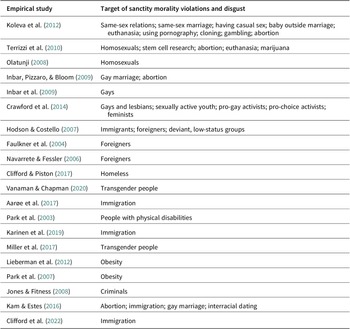
While any of the five foundations may give rise to moral conflict over status, our argument is that the sanctity/degradation foundation best accounts for the controversies in status politics because labeling an individual, group, or activity as morally disgusting in effect places them in a lower position on society’s status hierarchy. For example, consider animal welfare, where harm (from the care/harm foundation) was found to be the strongest predictor of disapproval of medical testing on animals (Koleva et al., Reference Koleva, Graham, Iyer, Ditto and Haidt2012, p. 187). Or harm explains why liberals support environmental protection measures (Fineberg & Willer, Reference Feinberg and Willer2013; Milfont et al., Reference Milfont, Davies and Wilson2019). Notwithstanding these exceptions, and probably others, there is more published MFT research showing that the sanctity/degradation foundation is the more typical moral grounding for status politics. The sanctity foundation is measured with items such as “People should not do things that are disgusting, even if no one is harmed,” “I would call some acts wrong on the grounds that they are unnatural,” or “Chastity is an important and valuable virtue.” An early study across three generations found that feelings of disgust best explained why those respondents viewed smoking as immoral (Rozin & Singh, Reference Rozin and Singh1999). Since then, at least 20 studies have linked disgust to specific target groups or behaviors (see Table 1).
Summary of targets of disgust in MFT empirical studies

To summarize the line of causation, status politics begins with a violation of a moral code (often sanctity/degradation). This prompts feelings of disgust by traditionalists toward the violators of that moral code, who are mobilized as competing advocacy coalitions that either defend the normative status quo or justify the new morality of the norm violators, which is manifested by a public debate over fundamentally different morality policies.
Unlike the other foundations, moral violations of the sanctity/degradation foundation provoke feelings of disgust. And disgust is the emotion that drives the behavioral immune system (BIS), which is composed of psychological mechanisms that “(a) detect cues connoting the presence of infectious pathogens in the immediate environment, (b) trigger disease-relevant emotional and cognitive responses, and thus (c) facilitate avoidance of pathogen infection” (Schaller & Park, Reference Schaller and Park2011, p. 99). In its most basic manifestation, disgust is the emotion that prevents us from ingesting contaminated foods, but the concept has evolved from this “core disgust” and broadened to include social relationships. As Haidt et al. (Reference Haidt, Rozin, McCauley and Imada1997), explain, “core disgust is an emotion that makes people cautious about foods and animal contaminants of foods,” but, in addition, “disgust has extended among Americans to become not just a guardian of the mouth, but also a guardian of the ‘temple’ of the body, and beyond that, a guardian of human dignity in the social order” (p. 121).
Perhaps the most widely used model of disgust has four categories (Tybur et al., Reference Tybur, Lieberman and Griskevicius2009): core disgust; animal reminder disgust, “which functions to protect the soul by preventing people from recognizing their animal nature”; interpersonal disgust, “which functions to protect the soul and social order and is elicited by contact with undesirable others”; and moral disgust, “which also functions to protect the social order and is elicited by moral offenses” (p. 104). Their reassessment led Tybur et al. (Reference Tybur, Lieberman and Griskevicius2009) to simplify these categories of disgust into three: pathogen (core) disgust, sexual disgust, and moral disgust. Yet Horberg et al. (Reference Horberg, Oveis, Keltner and Cohen2009) further clarified what they called “sociomoral” disgust as the “revulsion evoked by people who commit vulgar violations against others, such as child abuse or incest.” But “[h]owever elicited, disgust motivates people to reject anything perceived as likely to contaminate the self physically or spiritually or to threaten their status as civilized human beings” (p. 964).
A key insight from MFT is that pathogenic threat of disease gave rise to casting some forms of social behavior as morally disgusting. The sanctity foundation is about how individuals and groups can remain biologically clean, but also morally and spiritually pure. Pathogenic disgust alone would not trigger status conflicts around out-groups, something that is often present in public policy. Hodson and Costello (Reference Hodson and Costello2007) reported that “disgust reactions connote the sense that one is better, purer, and less offensive than the offending target” and, moreover, that “[c]hronic experiences of heightened disgust, particularly interpersonal disgust, likely facilitate hierarchical thinking about human social organization and perceptions of out-groups as less human” (p. 692) On the other hand, Crawford et al. (Reference Crawford, Inbar and Maloney2014) found that “disgust sensitivity [is] one piece of a more general dislike of groups seen as threatening traditional sexual morality” and thus “undermine[s] the argument that the social attitudes of the disgust-sensitive are motivated primarily by an attachment to social hierarchies and an animus toward low-status outgroups” (p. 222). But a cursory review of various targets of disgust (see Table 1) would suggest that while gay and lesbian individuals (also probably transgender individuals) would be perceived as threats to traditional sexual norms, it seems unlikely that the homeless, the disabled, the obese, or even immigrants, foreigners, and criminals would inherently pose a threat to traditional sexual values, although they all could be considered out-groups who are deemed lower on the status hierarchy.
Yet there is another more fundamental linkage between sanctity/degradation morality and status politics. The conventional wisdom that disgust affects conservatives more than liberals (Murray, Reference Murray2012) is supported by MFT studies (Haidt & Hersh, Reference Haidt and Hersh2001; Inbar, Pizarro, & Bloom, Reference Inbar, Pizarro and Bloom2009), although some recent research has found that conservatives do not have a higher disgust sensitivity (Elad-Strenger et al., Reference Elad-Strenger, Proch and Kessler2020) and are not more sensitive to threats (Bakker et al., Reference Bakker, Schumacher, Gothreau and Arceneaux2020). Yet other research confirms that the BIS exhibits moderate relationships with various measures of social conservatism (Terrizzi et al., Reference Terrizzi, Shook and McDaniel2013). Also, this relationship extends to socially conservative political parties, as Aarøe et al. (Reference Aarøe, Petersen and Arceneaux2020) explain that “socially conservative right-wing parties promote policies oriented toward exclusion, the avoidance of contact with social outgroups and norm violators, and strict adherence to national customs and traditions” (p. 1074). For the most part, these findings comport with status politics insofar as conservatives are often the defenders of status quo values against liberals who champion social change and reforms. For us, therefore, regardless of the psychological mechanism involved, what is important is that the targets of disgust are deemed less worthy of recognition and respect than more conventional social groups or practices.
To summarize this large body of research, Table 1 lists the various targets of disgust reported in empirical studies using MFT. Many of the targets have a sexual component, which may explain why sanctity/degradation yields stronger moral disapproval. But its grounding in religious values cannot explain those effects, as Koleva et al. (Reference Koleva, Graham, Iyer, Ditto and Haidt2012) explain with respect to nine “culture war” issues they studied (see Table 1): “Conceptually and empirically, this sanctity moral foundation is closely related to divinity and religion,” but “the low church attendance reported by our participants implies relatively low levels of religiosity in our samples. Thus, it is not religious beliefs per se, but perhaps some more general moral sensitivity to issues of sanctity, self-transcendence, and self-control that may drive these results” (p. 192).
Conclusion
Morality politics arises from conflict over status. Moral intuitions, like moral disgust arising from sanctity violations, mediate the relationship between status conflicts and morality politics. These moral intuitions can be fiendishly powerful, causing us to be capable of denigrating others as impure, contagious, and dirty to maintain our perception of our own status. Nussbaum (Reference Nussbaum2001) powerfully illustrates the prejudicial impact of disgust:
Throughout history, certain disgust properties—sliminess, bad smell, stickiness, decay, foulness—have repeatedly and monotonously been associated with, indeed projected onto, groups by reference to whom privileged groups seek to define their superior human status: Jews, women, homosexuals, untouchables, lower-class people—all of these are imagined as tainted by the dirt of the body. (p. 347)
Sometimes pathogen avoidance and fear of disease result in people wanting to maintain social distance from individuals of out-groups, or it could simply be disgust at the normative or sexual behavior of those out-groups that triggers an emotional reaction or, indeed, a perception that they are lower in the social hierarchy. In their summation of this body of research, Clifford and Piston (Reference Clifford and Piston2017) conclude that “disgust seems to play a role in attitudes towards many social groups and evolutionary psychology may help spur new insights into the influence of group attitudes on public policy” (p. 521). One of those new insights, we suggest in this research note, is that sanctity morality and moral disgust facilitate the connection between status conflict and morality politics.
Looking ahead, a promising area for MFT research is gun control. It has already been noted that status anxiety fuels the legal purchase of firearms (Steidley & Kosla, Reference Steidley and Kosla2018), and there is anecdotal evidence that gun owners are stigmatized by gun control advocates as “gun nuts” who are “red-necks, violent, anti-intellectual, racist, reactionary and dangerous” (Kaplan, Reference Kaplan1979, p. 6). Kleck et al. (Reference Kleck, Gertz and Bratton2009) found that survey respondents “who despise the ‘gun culture’ as violent, racist, and backward support handgun bans, while those who reject such stereotypes oppose them” (p. 503). The use of pejoratives by gun control advocates clearly disparages gun owners as being lower on the status hierarchy, but so far this debate has not been analyzed in terms of MFT or more precisely the sanctity foundation and moral disgust.
To conclude, whatever the rationale, in the final analysis, many individuals—and especially those of a socially conservative temperament—find it advantageous not to associate with out-groups that they think do not deserve recognition or respect. This is how status politics yields conflict over morality policy.