Introduction
Patients who are acutely unwell often display aggressive or agitated behaviour when admitted to a psychiatric intensive care unit (PICU). The consequences to themselves, other patients and staff can be significant and were highlighted by The Royal College of Psychiatrists’ National Audit of Violence (2007), which found that a third of inpatients had experienced violent or threatening behaviour whilst in care. Nursing staff and members of the clinical team were most likely to have been threatened or made to feel unsafe within PICUs compared to other wards and the risk of physical assault upon clinicians was greatest in PICUs. Therefore, it is not surprising that being in such an environment can often be a stressful and traumatic experience for patients and staff alike (Frueh et al. Reference Frueh, Knapp, Cusack, Grubaugh, Sauvageot, Cousins, Yim, Robins, Monnier and Hiers2005).
Previous research investigating features relating to aggression and conflict on psychiatric wards has identified links with gender (Fottrell, Reference Fottrell1980), age (Hodgkinson et al. Reference Hodgkinson, McIvor and Phillips1985), diagnosis (Blomhoff et al. Reference Blomhoff, Seim and Friis1990), staff training (Hodgkinson et al. Reference Hodgkinson, McIvor and Phillips1985), psychopathology and substance abuse. Often each incident has a complex mix of factors relating to staff-patient interaction as well as patient, staff and environmental characteristics (Bowers et al. Reference Bowers, Stewart, Papadopoulos, Dack, Ross and Khanom2011a).
Evidence supporting a role for increased patient space is mixed. Some studies reported that violence and aggression rates increased with overcrowding and excess bed occupancy (Ng et al. Reference Ng, Kumar, Ranclaud and Robinson2001; Virtanen et al. Reference Virtanen, Vahtera, Batty, Tuisku, Pentti, Oksanen, Salo, Ahola and Kivima2011). Another showed only a modest correlation between the number of patients on a ward and aggressive incidents, and no relationship with the amount of physical space (Nijman & Rector, Reference Nijman and Rector1999). One study demonstrated that following a 50% reduction in bed numbers, although severe aggressive incidents to staff decreased, inter-patient violence actually increased (Palmstierna & Wistedt, Reference Palmstierna and Wistedt1995). Recently, a large multi-centred study, using seclusion as an outcome measure, showed that having more private space per patient, greater comfort and better visibility on the ward all contributed to a reduction in the need for restrictive measures on acute psychiatric units (Van der Schaaf et al. Reference Van Der Schaaf, Dusseldorp, Keuning, Janssen and Noothoorn2013).
A few studies have used the opportunity of a ward moving from an old to a new site to investigate the impact of environmental change upon inpatient behaviour. The results have shown a reduction in various measures of aggression and arousal but measures of the environment were sometimes subjectively descriptive (Feeney et al. Reference Feeney, Kavanagh, Kelly and Mooney2007) or objectively limited, such as a measure of light readings (Olver et al. Reference Olver, Love, Daniel, Norman and Nicholls2009). This current service evaluation study builds upon that small body of work by making use of advantages gained through being a naturalistic study but having a broader range of environmental measures and patient behaviour. It was hypothesised that a new and improved ward environment would be associated with a reduction in arousal and aggression levels overall as measured by formal reports and continuous monitoring records.
Background
In August 2011, a purpose-built PICU opened within a new NHS mental health hospital alongside the local district general hospital. This enabled the transfer of patients from an 18 year-old, ‘temporary’ mixed gender 10-bed unit on an old psychiatric hospital site. The new unit, also mixed gender and accommodating 10 patients, serves the same patient population with no significant changes in protocols or admission criteria. The staff population was largely unchanged, including continuity of Ward Manager and Consultant. Three years prior to the move, an independent assessment by the Psychiatric Intensive Care Advisory Service (a collaboration between the National Association for Psychiatric Intensive Care Units (NAPICU) and the Royal College of Psychiatrists’ Centre for Quality Improvement) highlighted environmental difficulties within the old PICU, and recommended development of a new ward.
Method
To assess the association between a changed environment and levels of arousal and aggression, time periods of three months duration either side of the ward move (August 2011) were chosen and both environmental and anonymised patient data were retrospectively analysed. To avoid any impact of the moving process on staff and patients, the time periods were between six and three months before the move (February–April 2011) and between three and six months after the move (November 2011 – February 2012).
Measures
To assess comparability of the two patient groups we analysed age, sex, psychiatric diagnosis, Mental Health Act status and mean duration of stay. Data was collected from electronic records of admissions to both PICUs.
Physical environment of the wards was assessed using the Environment Assessment Inventory (EAI). The EAI is a 55-item inventory based on national guidelines and PICU research that provides quantitative data assessing the ward environment against National Minimum Standards (Pereira & Clinton, Reference Pereira and Clinton2002). A national survey using the EAI demonstrated its ‘validity and sensitivity to discriminate good and bad physical environments’ (Dix et al. Reference Dix, Pereira, Chaudhry, Dale and Halliwell2005). Standards are grouped into four main areas:
-
1. Critical issues. Key important areas/aspects which critically affect the functioning of the unit.
-
2. Difficult issues. Difficult to resolve as they require major work to the building.
-
3. Serious issues. Serious and problematic but require less funding.
-
4. Achievable issues. Achievable with modest funding or change in practice.
(Full details of the EAI can be found in Appendix S1 in the online Supplementary Materials.)
EAI scores for the old ward were retrieved from a previous assessment performed by the Ward Manager in 2006 in preparation for the independent review that year. Scores for the new ward were gathered in 2012 for this project by the same Ward Manager who continued to hold that role. The Ward Manager also verified that any minor issues that had been addressed prior to the move of ward did not affect measurements on the EAI (as emphasis was on creating an entirely new building to house the PICU).
For the two three-month periods, different markers of arousal and aggression were compared. Seclusion data was gathered electronically and analysed in terms of total duration of all seclusions, number of seclusion incidents and number of secluded patients. For the purpose of this study, seclusion on both wards was defined as confinement in a designated seclusion area with regular and specific reviews.
Using the NHS web-based incident reporting system DATIX, the numbers of aggressive incidents on both wards were recorded. Aggressive incidents on DATIX are defined as ‘verbal and physical aggression to others and physical aggression to the environment’. To analyse whether any difference in numbers of incidences reflected the actions of one or two individuals (outliers) the number of patients involved in the incidences was also recorded.
Also gathered were total hours of within eyesight observation of patients over the two time periods by taking data from the observation records. ‘Within eyesight’ monitoring, a form of close observation, is defined by the Trust as the service user being ‘within eyesight and accessible at all times of the day and night’. Again, the number of patients this pertained to was recorded to monitor any impact from exceptional patients.
Direct comparisons between the two time periods for aggressive incidents, ‘within eyesight’ monitoring and seclusion were made using chi squared analysis.
Alongside this discrete episode data, results from the Nursing Observed Illness Intensity Scale (NOIIS) recorded on both wards were compared. The NOIIS was devised to provide a more objective measure of behavioural improvement and symptom reduction. The scale is completed by qualified nurses at the end of every shift, based on everyday nursing observation and interaction with patients, and scores are entered on a NOIIS ‘temperature’ chart’. The NOIIS has been shown to have good validity against the Brief Psychiatric Rating Scale (Bowers et al. Reference Bowers, Brennan, Ransom, Winship and Theodoridou2011b).
From the overall five-item scale we chose to use the two most relevant to this study: Agitation and activity and Conflict (for details of scoring questions see Appendix S2 in the online Supporting Materials). Data was gathered from hand-written charts in the notes and entered onto an Excel spreadsheet. The data was then tabulated and analysed with the Mann-Whitney U-test to ascertain any significant difference in total scores between wards for the two items overall, or for morning, afternoon or night nursing shifts. The two NOIIS data items were further analysed using univariate analysis of variance to measure significance level reduction of mean overall scores from the point of admission to two weeks later.
Results
Environment
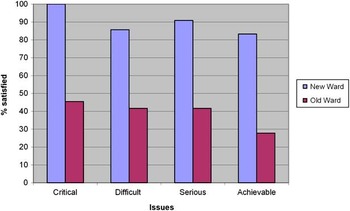
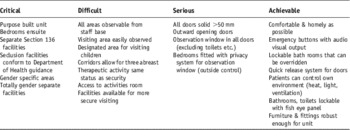
Comparative scores from EAI ratings shown in Figure 1 make it clear that for each of the four main areas, the new ward scored significantly higher. Table 1 highlights those standards that have been met on the new ward but which were not previously achieved on the old ward. The critical area, which assesses key factors that ‘critically affect the functioning of the unit’ (Dix et al. Reference Dix, Pereira, Chaudhry, Dale and Halliwell2005) can be identified as the most important region of improvement and highlights development of ensuite facilities for bedrooms, separate Section 136 facilities (areas to assess patients detained by the police), gender specific areas and a seclusion area conforming to Department of Health (1999) guidelines. The seclusion area is also located more proximally to the nursing station on the new ward.
Environmental Assessment Inventory scores

Standards identified by the Environmental Assessment Inventory as not met on the old ward (score 0) and met on the new ward (score 1)

One significant change from the old ward is increased privacy for patients. Previously furniture was used to partition bedrooms in an attempt to achieve privacy. All bedrooms in the new ward are single. Formerly visitation was difficult and also unsuitable for children. Development of specific visiting areas improved this.
A further notable positive change was greater access to therapeutic activity space with a designated activities room. Another significant difference identified by the EAI was increased levels of visibility on the new ward as measured by all areas of the ward being visible from the staff base, clear lines of sight and observation systems available in all doors and windows.
Patients
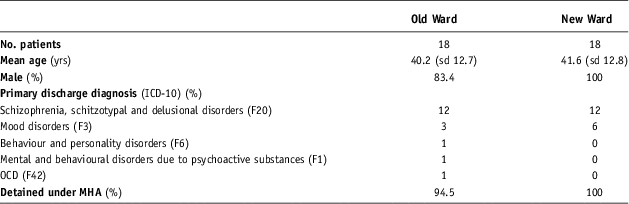
Over the three-month periods on both wards there were 18 patients present, with the old ward receiving 10 new patients and the new ward 11 new patients (Table 2). The population data showed no significant differences in mean age, sex or MHA status despite the fact that there was one patient who was of an informal status and three females on the old ward, compared to all males and all detained under the Mental Health Act (1983) on the new ward.
Patient characteristics

Measures of disturbance
Direct measures
Seclusion data is presented in Table 3 and shows a significant fall both in total duration and number of seclusion episodes from the old ward to the new in the time periods assessed (χ2 = 11.70 (N = 17, df 1) p < 0.001).
Seclusion data

*No significant difference: t = 0.571, df = 15, p = 0.288
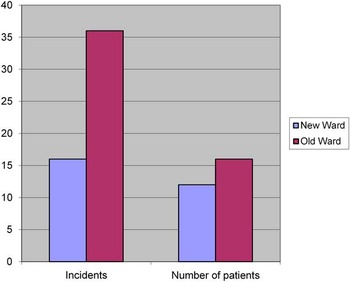
Figure 2 shows a significant reduction in the number of formally reported ‘aggressive incidents’ (χ2 = 16.47 (N = 52, df 1) p < 0.001). Both the seclusion and ‘aggressive incidents’ data sets include sufficient numbers of patients to demonstrate that the significant differences identified are not due to the effects of statistical outliers.
Formally recorded ‘aggressive incidents’ on the new ward and old ward in study time periods

A comparison of hours under ‘within eyesight’ observation shows no significant difference between the two wards either for total hours or number of patients. Both wards had 12 patients on ‘within eyesight’ observation over the three-month period. On the old ward the total observation time was 2 356 hours and on the new ward it was 2 259 hours.
Indirect measures
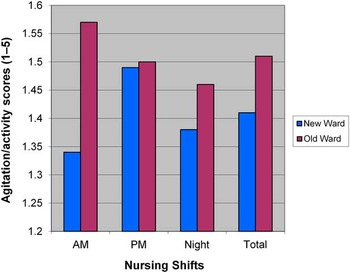
The NOIIS data results showed no significant difference for the Conflict item between wards, overall or for morning, afternoon or night time periods. However, as can be seen in Figure 3, the Agitation and activity item results showed lower scores for each of the three time periods and overall on the new ward (with a statistically significant reduction in the mornings (1.22 v. 1.14, p = 0.001)).
NOIIS Agitation and activity scores for the new ward and old ward during study periods

When the data were analysed to look at the change in NOIIS scores over the first two weeks of admission the results for neither Conflict nor Agitation and activity showed a significant difference in reduction between wards.
Discussion
This study was able to make use of both direct and indirect measures to assess the link between an objectively improved ward environment and levels of conflict and arousal. Overall findings suggest that the physical environment of the ward (having moved to a new purpose-built site) had some significant effects on patient behaviours.
There were statistically significant reductions in numbers of episodes of seclusion and also aggressive incidents following the move. Given that violence and aggression are the most commonly associated triggers for seclusion (Currier, Reference Currier2003) it is likely that a fall in aggressive incidents contributed to a fall in seclusion rates. The continuity of both staff and patient factors between wards in this experimental design, provides a great strength in holding constant factors that have been demonstrably linked with aggression and seclusion. It can therefore be postulated that aspects of the physical environment identified by the EAI may be linked with the decrease in aggression and seclusion. The significance of reducing levels of seclusion cannot be underestimated given the controversy surrounding its likely negative impacts on patients and the risks to both physical and mental health that can ensue (Sailas & Fenton, Reference Sailas and Fenton2000).
The EAI suggested that greater space on the new ward would enable more privacy and autonomy for patients. Recent multicentre research identified total private space as a significant factor in reducing the rate of seclusion on inpatient wards (Van der Schaaf, 2013). Private space and the opportunity to have intimate time with family and friends can help alleviate the sense of institutionalisation and also provide an ability to regulate the level of social contact. These are both considered to be important elements of a therapeutic environment (Karlin & Zeiss, Reference Karlin and Zeiss2006).
Visibility is a factor that has also been significantly associated with reduction in aggression and reduction in levels of seclusion on inpatient wards (Van der Schaaf, 2013). Changes in the EAI demonstrate that this increased with the new ward. Visibility may enable patients to feel more secure and to have more personal space. It may also, by giving staff better sight of the unit and thus its inhabitants, enhance the ability to anticipate any potentially escalating behaviour at an earlier stage.
One marker of conflict/arousal may be the measurement of the use of ‘within eyesight’ observation. There was no significant difference in the use of this indicator between the two wards. Special observation is a containing strategy on inpatient wards. It is assigned for a number of reasons but the most common aims are to reduce self-harming, violence and aggression, and absconding (Bowers et al. Reference Bowers, Whittington, Nolan, Parkin, Curtis, Bhui, Hackney, Allan, Simpson and Flood2006). There are reasons to expect a reduction in total duration of close observation on the new ward given better lines of sight, a more secure ward and more secure garden environment resulting in less concern about absconding behaviour. However, given that the principle indicator for these observations is self-harm and suicide risk (Bowers et al. Reference Bowers, Gournay and Duffy2000) and that such behaviour may be less likely to respond to a change in environment, the consistent total duration of observation across wards is perhaps less surprising. Also, the decision to use close observation tends to be a proactive strategy to manage risk in contrast to the use of seclusion, which is a reactive approach following an incident. The fact that observation levels did not decrease in the new ward could indicate that the same approach by clinical staff is being used to manage risk and disturbed behaviour on a PICU. It is difficult to be certain of this without formally assessing staff attitudes pre- and post ward move, but it is supported by the continuity of staff and policies during the two time periods.
Results of the NOIIS subscales are more complicated to interpret. Overall, scores for conflict showed no difference between the two wards but the scores for agitation were reduced on the new ward and statistically significantly reduced in the mornings. A reduction in the morning is important as research has shown that incidents of violence tend to peak between 08:00 and 12:00 on inpatient wards (Bowers et al. Reference Bowers, Stewart, Papadopoulos, Dack, Ross and Khanom2011a).
Decrease in levels of incidents as measured by DATIX and amount of seclusion can be seen as consistent with a decrease in agitation levels as recorded by the NOIIS. This subscale reflects behavioural difficulties, overactivity, agitation and tension displayed by a patient and has been shown to be higher in all three nursing shifts before a conflict event (Bowers et al. Reference Bowers, Brennan, Ransom, Winship and Theodoridou2011b). Although the conflict subscale does highlight aggression in its highest rating (see Appendix S2 in the online Supplementary Materials), the rest of this measure reflects such aspects as compliance with rules and acceptance of treatment which may be more influenced by the skills of ward staff at engaging with patients and de-escalating difficult situations.
Continuity of staff within this study could explain the similar levels of conflict according to NOIIS data. It may be that the staff viewed this measure as specifically one to rate non-compliance. Thus, within this study, agitation as opposed to conflict may be a better measure of the impact of the ward environment upon disturbed behaviour. Reducing agitation is important as not only is it seen to be a notable antecedent to violence, it is also a deeply unpleasant experience for the individual. Agitation levels, as measured by restlessness, pacing and overactivity may be reduced on the new ward due to increased availability of individual and private space as above, but also due to greater opportunity for therapeutic engagement.
One thing NOIIS data did not show was a significant difference between the two wards in reduction of levels of agitation or conflict over the first two or four weeks of admission. In fact, the results showed no statistically significant changes over those timescales at all within each individual ward. This finding does not fit with the hypothesis of a ward environment impacting on aggression and arousal but may be explained by poor NOIIS data recording and small numbers of patients in the study. Another possibility is that whilst mental state improvements are typically seen over a two-week period, on a PICU behavioural changes may reduce even sooner after admission and were therefore not identified by our chosen timescale.
Recent research in Denmark along similar lines to this project has tried to further understand theoretical links between ward design and patient aggression (Ulrich et al. Reference Ulrich, Bogren and Lundin2012). Findings enhanced the theory that specific aspects of building design act to lower stress levels which in turn reduces episodes of aggression. Included amongst environmental factors considered were features picked up by the EAI in our study (such as single patient rooms and good visibility from the staff base). Ulrich et al. (Reference Ulrich, Bogren and Lundin2012) also concluded that these elements, by fostering a sense of control and privacy, reduced stress levels and thereby aggression.
The current study's strengths lie in the combination of formally recorded data on aggressive incidents and seclusion rates with the broader and more sensitive observation scale that was used on a daily basis. The NOIIS data helped overcome the impact of under-reporting of incidents that can skew data on aggression. This study also made use of a reliable measure of the environment that could demonstrate a quantifiable difference between the two wards.
Limitations in terms of data interpretation include variable levels of NOIIS data recorded and how to interpret what impact this would have had on the findings. Significant changes in NOIIS data between the two wards may not have been identified due to the study being underpowered. A change in DATIX reporting behaviour affecting the number of formally reported aggressive incidents cannot be excluded as we have not balanced this by analysing reporting for all other incidents within our two periods of assessment. The study design also does not make it possible to identify which of the identified improved design features may be most important in reducing aggression and arousal.
Despite these limitations this study lends support to the theory that the physical environment of a psychiatric ward is important and that good hospital design, based on empirical evidence, can help to reduce levels of aggression and arousal.
Future studies of this nature could benefit from including other measures of patient arousal and aggression (such as physical interventions for managing disturbed behaviour), incorporating further measures of the ward environment such as the Ward Atmosphere Scale (Moos, Reference Moos1974) and comparing different timescales with larger periods of data gathering and more analysis of the first few days following admission. Qualitative feedback from staff and patients would also help further understand the importance of environmental change, especially its possible impact on staff attitudes and approach to aggression and distress.
Appendix S1: Environmental Assessment Inventory
Appendix S2: Nursing Observed Illness Intensity Scale (NOIIS)
Supplementary Materials
To view Supplementary Materials for this article, please visit http://dx.doi.org/10.1017/S1742646414000065