Communities cannot avoid natural disasters, but these events can be leveraged by the public health system to achieve better preparedness for and response to future events. In 2012, Hurricane Sandy (Sandy) devastated several East Coast states. The most severe impact in New York State (NYS) was on October 29, with environmental damage, flooding, destruction of infrastructure, and deaths.Reference Blake, Kimberlain and Berg 1 , 2 While press reports focused on the response of the health care system with multiple facility evacuations, the broader public health system was also impacted, including interruption of local health department (LHD) and community-based public health services and the need for public health staff to divert their efforts to assist with evacuation and sheltering of the public.Reference Powell, Hanfling and Gostin 3 , Reference Abramson and Redlener 4
The NYS public health system encompasses private, voluntary, and governmental organizations including the NYS Department of Health (NYSDOH), health care providers and insurers, community organizations, and 58 LHDs, all working to promote and protect the health of the public. 5 During Sandy, some LHDs were impacted by flooding and loss of power at their regular office sites, which complicated coordination and communication with the broader public health system. LHDs relied on assistance from NYSDOH and emergency entities to support evacuations, provision of medical supplies, water supply protection, and continuation of public health services.
During the hurricane response and recovery period (October 26 to November 21, 2012) the state and local health departments prepared and submitted situation reports daily to record what happened, needs and gaps in services, which needs and gaps were addressed, and possible solutions. These reports function as one of the real-time communication tools used within and between agencies to better understand the situation to improve response. During Sandy, the LHDs submitted situation reports electronically that were attached to the NYSDOH statewide situation reports.
After-action reports (AARs) are an important type of emergency report that provides information on response to natural disasters.Reference Savoia, Agboola and Biddinger 6 The AAR is completed at the conclusion of the emergency after organized internal debriefings and discussions, or “hot washes,” have taken place. The hot washes are also conducted with small groups of providers representing LHDs, health care facilities, and associations. Then the AAR is written as a compilation of lessons learned, primarily focusing on improvement areas. NYSDOH had both AARs and situation reports available to evaluate the public health system response during Sandy.
We undertook an analysis of AARs and situation reports as an initial step to providing a better understanding of the public health system’s performance during Sandy. These results were intended to inform collection of more detailed individual-level feedback on ways to improve public health emergency response measures for future disasters.
METHODS
Emergency reports were obtained for analysis from the NYSDOH and the Nassau and Suffolk County LHDs. Nassau and Suffolk counties on Long Island, New York, were selected because of their locations in the direct path of Sandy. New York City was not included owing to separate assessments. A total of 51 emergency reports were examined, including 3 AARs (from NYSDOH and Nassau and Suffolk County LHDs) and 48 situation reports (from NYSDOH). The situation reports spanned October 26, 2012, to November 21, 2012, and were organized into 4 phases: preparedness (October 26–28), response (October 29–30), relief (October 31–November 7), and recovery (November 8–21).
To reduce subjectivity in coding, all 51 emergency reports were reviewed by 2 researchers independently. Using qualitative analysis, each researcher grouped text by key words and tallied the total number of times each key word was mentionedReference Corbin and Strauss 7 with the use of NVivo version 10 (QSR International, Melbourne, Australia). For each report, the intercoder reliability was determined by using percent agreement and Cohen’s Kappa. Any code with a percent agreement lower than 80 percent or a kappa value lower than 0.7 was reexamined and negotiated.
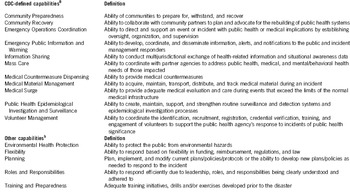
A total of 142 key words were identified, and each was then sorted into one of 11 Centers for Disease Control and Prevention (CDC) Public Health Preparedness Capability categories. 8 Key words not fitting clearly into one of these CDC capabilities were sorted into 1 of 5 newly defined capability categories. Within each capability, key words were labeled as strengths, challenges, or recommendations. Table 1 provides a complete list of the capability categories used and their definitions.
Public Health Preparedness Capabilities Used for Categorizing Emergency Report Key WordsFootnote a

a Abbreviations: CDC, Centers for Disease Control and Prevention. bRemaining items that did not fit into a capability were categorized as “miscellaneous”.
Descriptive statistics were performed to determine the frequency of each key word in the emergency reports. The most frequently cited strengths, challenges, and recommendations for each capability in terms of percentages were determined from the NYSDOH and the LHD reports. Statistical analysis was performed by using the Statistical Analysis Software (SAS) package, version 9.2 (SAS Institute Inc, Cary, NC).
Before the study was undertaken, the proposed analyses were deemed exempt by the NYSDOH Institutional Review Board on October 31, 2013.
RESULTS
What Went Well: Strengths
For NYSDOH, 1681 citations of strengths were identified in the 49 NYSDOH emergency reports. Figure 1 summarizes the most cited strengths by capability, with examples of each one. These include emergency operations coordination (27.4% of the citations), information sharing (19.2%), surveillance and investigation (12%), and planning (7.8%). Conference calls with partner agencies such as the Environmental Protection Agency and LHDs supported successful emergency operations coordination across these agencies. Another example is NYSDOH assistance in coordinating routine tasks such as public health surveillance on behalf of LHDs who were not able to conduct these activities. Despite state staff being stationed in multiple locations across New York, the information sharing capability was demonstrated by disaster-related information being available owing to NYSDOH’s ability to share information. Within the capability of surveillance and investigation, the NYSDOH laboratory system remained intact and responsive during a reported outbreak of enteric disease at disaster shelters.
What Went Well: Most Cited Strengths by Capability, Hurricane Sandy Emergency Reports, New York, 2012. Abbreviations: LHD, local health department; NYSDOH, New York State Department of Health.

In the 2 LHD AARs, there were 30 citations of strengths by capability (Figure 1). The most frequently cited strengths were the same capabilities as for NYSDOH: emergency operations coordination (46.7%) and information sharing (16.7%). The strength of emergency operations coordination was evidenced by the positive working relationships with external agencies during the response, including coordination with local governments to use government-owned cars for transporting staff. To monitor at-risk health care facilities, LHDs relied on the county’s information sharing ability to provide a county map of health care facilities in flood-impacted areas.
A different demand for LHDs compared with the NYSDOH was the requirement for shifting of staff roles to the establishment and provision of care at shelters; thus, the LHD most-cited strengths included mass care (10%) and medical surge (6.7%). LHDs assisted with care to those using the shelters and in arranging transport for their residents. They played a key role for medical surge by requesting and receiving federal ambulances to assist with transportation needs to shelters.
What Needs Improvement: Challenges and Recommendations
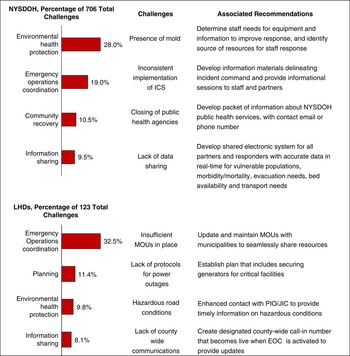
There were 706 challenges and 318 recommendations in the 49 NYSDOH emergency reports (Figure 2). The most cited challenges were within the environmental health protection (28%), emergency operations coordination (19%), community recovery (10.5%), and information sharing (9.5%) capabilities. Examples of challenges included exposure to oil and mold as a result of flooding, inconsistent implementation of the Incident Command Structure, lack of access to services due to closing of public health agencies such as Women, Infants, and Children (WIC) nutrition services, and the inability to access needed data. Some key recommendations in the emergency reports associated with these challenges are summarized in Figure 2.
What Needs Improvement: Most Cited Challenges and Associated Recommendations by Capability, Hurricane Sandy Emergency Reports, New York, 2012. Abbreviations: EOC, Emergency Operations Center; ICS, incident command system; JIC, Joint Information Center; LHD, local health department; MOU, memorandum of understanding; NYSDOH, New York State Department of Health; PIO, Public Information Officer.

In the 2 LHD AARs, there were 123 challenges and 207 recommendations (Figure 2). Three of the most cited challenges were in the same capabilities as for NYSDOH: emergency operations coordination (32.5%), environmental health protection (9.8%), and information sharing (8.1%). However, for LHDs the second most cited capability for challenges was planning (11.4%). At the local level, the challenges cited involved insufficient memorandums of understanding established in advance of the disaster to ensure continuity of services during response, a lack of protocols for staff to follow during power outages, hazardous road conditions that prevented staff from traveling to provide public services and the public from reaching services, and difficulty with communicating given the use of remote sites. Some recommendations offered within the reports to address these challenges are summarized in Figure 2.
Capability Changes Over Time
The ability to compare strengths, challenges, and recommendations by capability across the 4 time periods—preparedness (October 26–28), response (October 29–30), relief (October 31–November 7), and recovery (November 8–21)—was available only for the 49 NYSDOH situation reports. During the preparedness period, 95% of capabilities were cited as strengths, compared to approximately 70% of strengths in the response and relief phases and 81% in the recovery phase. No recommendations were shared within these reports.
The most cited capabilities in both the initial preparedness and final recovery periods were strengths in information sharing (26% and 20%, respectively) and emergency operations coordination (21% and 18%, respectively). The capabilities most cited during response were emergency operations coordination (strength, 23%) and environmental health protection (challenge, 14%), with similar results during the relief phase (20.6% and 11%, respectively).
DISCUSSION
Emergency operations coordination and information sharing within and across agencies were top capabilities in Sandy emergency reports written at the state and local levels in New York. These issues are critical in any response to a disaster or other public health emergency and are similar to those identified in an analysis of other disasters including Hurricane Irene in NYS and Hurricane Katrina.Reference VanDevanter, Leviss and Abramson 9 During Hurricane Irene the need to evacuate many residents from facilities to shelters underscored the importance of coordination of health departments, health care agencies, and emergency management.Reference Adalja, Watson and Bouri 10 Hurricane Katrina also highlighted the need for staff to work beyond their normal scope of work, which was also reported under the emergency operations coordination capability as a strength, challenge, and recommendation in NYS during the Sandy response.
The after-action review process is a key part of developing improvements for future response. The NYS after-action review process revealed that emergency operations coordination and information sharing priorities were present as areas of strength as well as presenting some challenges, and both can serve as lessons learned. The recommendations on these priorities in the emergency reports provide a foundation to begin improvements for future response. Emergency operations coordination is particularly critical at the local level where the response is focused and was reported by the LHDs as their top strength and challenge.
Health departments can use the CDC’s Public Health Preparedness Capability framework 8 and the recommendations shared in this analysis to improve their emergency operations coordination and information sharing capabilities. Use of CDC’s widely recognized framework facilitates translation of the findings of this analysis to other health departments beyond those in this evaluation. Other health departments can benefit from understanding that the sharing of information and coordination of agencies, personnel, and resources during Sandy proved to be prominent during all preparedness and response phases for both state and local health departments in New York.
Emergency reports are frequently generated during and after a disaster, and they may be consulted in planning changes for future responses. A strength of this study was the use of a rigorous content analysis approach to provide a more quantitative interpretation of the reports. Coding of summary data has been valuable in assessments of other disasters such as Hurricanes Andrew and Katrina.Reference Knox 11
An issue with relying only on existing reports is that the number of public health staff members who contribute to them may be limited. In addition, the reports are usually generated during the disaster or soon after, which provides the action steps taken during the response but not a complete evaluation of those action steps. Thus, NYSDOH as funded by CDC under the Hurricane Sandy Recovery Priority Research Area C will also report separately on an extension of this qualitative content analysis approach to new Hurricane Sandy feedback collected through staff focus groups and interviews, including specific service providers.
CONCLUSIONS
The systematic review of AARs and situation reports should be a part of the after-action quality improvement process. Based on NYS analyses, the emergency operations coordination and information sharing capabilities should be prioritized in planning response activities for future disasters. The recommendations from this analysis can be utilized for health departments in or outside of NYS. However, the limited scope of the NYS emergency reports indicates the need for collection of additional feedback from public health staff to evaluate disaster preparedness, response, and recovery.
Acknowledgments
This publication was supported by Cooperative Agreement number U01TP000567 from the Centers for Disease Control and Prevention (CDC). Its contents are solely the responsibility of the authors and do not necessarily represent the official views of the CDC. The authors thank Dr Tavora Buchman, Nassau County Department of Health, co-Principal Investigator; Mr Robert Delagi, Suffolk County Department of Health; Mr Michael Primeau and the Office of Health Emergency Preparedness, New York State Department of Health; and members of the Research Guidance Team for their input into the study design.