INTRODUCTION
Non-native marine and terrestrial species impose high economic costs worldwide (Pimentel et al., Reference Pimentel, McNair, Janecka, Wightman, Simmonds, O'Connell, Wong, Russel, Zern, Aquino and Tsomondo2001). For the UK alone, the costs are estimated to be £1.7 billion per year (Williams et al., Reference Williams, Eschen, Harris, Djeddou, Pratt, Shaw, Varia, Lamontagne-Godwin, Thomas and Murphy2010). Non-native and non-indigenous species are those that have been introduced by humans into an area historically outside their range and they then successfully reproduce and maintain a population within the new area (Eno et al., Reference Eno, Clark and Sanderson1997; Reise et al., Reference Reise, Olenin and Thieltges2006). The temperate northern Pacific, the eastern Indo-Pacific and the temperate North Atlantic are often hotspots for marine invasive species (Molnar et al., Reference Molnar, Gamboa, Revenga and Spalding2008). Non-native seaweeds pose a threat as they are able to change ecosystem structure and functioning (Schaffelke et al., Reference Schaffelke, Smith and Hewitt2006). However, worldwide only 6% of non-native seaweeds (17 species) have had their ecological effects on ecosystems evaluated (Williams & Smith, Reference Williams and Smith2007). In terrestrial and freshwater ecosystems, non-native species may have devastating consequences for native species. In Britain, examples include the loss of flora from areas due to domination by Rhododendron ponticum L. and Fallopia japonica Houtt. (Ronse Decr.) (Japanese knotweed) or the introduction of diseases. Non-native species are also known to outcompete native species for habitat, such as by Pacifastacus leniusculus (Dana, 1852) (signal crayfish) or to cause commercial impacts such as clogging cooling water intakes (Dreissena polymorpha (Pallas, 1771) the zebra mussel). Although many non-native species do not have major disruptive effects on native communities, and may even increase food availability or habitats for native species, some threaten to overwhelm native species and can also be a threat to commercial activities (Williams et al., Reference Williams, Eschen, Harris, Djeddou, Pratt, Shaw, Varia, Lamontagne-Godwin, Thomas and Murphy2010). For instance, slipper limpets (Crepidula fornicata (L., 1758)) are a serious pest of oyster and mussel beds whilst it is estimated that the carpet sea squirt Didemnum vexillum Kott, 2002 could cost mussel farming between £1.3 and £6.8 million in the next ten years. A species of seaweed present in Britain since 1973, the Asian Sargassum muticum (Yendo) Fensholt, is visually dominant in many areas and has the potential to foul propellers and reduce access to areas (information on non-native species is provided on the Great Britain Non-Native Species Secretariat web pages where Risk Assessments include bibliographies: www.nonnativespecies.org).
The kelp Undaria pinnatifida (Harvey) Suringar is one of the most invasive seaweeds worldwide (Trowbridge, Reference Trowbridge, Critchley, Ohno and Largo2006; ICES, 2007; Williams & Smith, Reference Williams and Smith2007); it is an annual kelp with a macroscopic sporophyte and a microscopic gametophyte (Floc'h et al., Reference Floc'h, Pajot and Wallentinus1991; Morita et al., Reference Morita, Kurashima and Maegawa2003). In its native range, which is in the north-west Pacific, sporophytes are present between autumn and mid-spring (Morita et al., Reference Morita, Kurashima and Maegawa2003). However, in areas it has successfully invaded, sporophytes are present throughout the year (e.g. Hay, Reference Hay1990; Fletcher & Manfredi, Reference Fletcher and Manfredi1995). In Plymouth Sound Special Area of Conservation (SAC) we have observed young sporophytes nearly all year. The outer boundary of the SAC is 3 km south of the Breakwater and it extends along the Tamar but does not include the Plym estuary. Undaria pinnatifida is known as ‘Japanese kelp’ and also as ‘wakame’ and has long been eaten by humans (Morita et al., Reference Morita, Kurashima and Maegawa2003; Peteiro & Freire, Reference Peteiro and Freire2011). Currently it is also part of the European diet due to its high quality in taste and nutrition (Peteiro & Freire, Reference Peteiro and Freire2011).
Besides a hardy aquarium strain of the tropical seaweed Caulerpa taxifolia (M. Vahl) C. Agardh, Undaria pinnatfida is the only other marine macroalga identified as one of the 100 most invasive species of the world in the list maintained by the Invasive Species Specialist Group (Lowe et al., Reference Lowe, Browne, Boudjelas and De Poorter2000). In Europe U. pinnatifida has been ranked as the third most invasive seaweed, from a range of 113 species, and has been transported by boats and through aquaculture (Nyberg & Wallentinus, Reference Nyberg and Wallentinus2005; ICES, 2007). It was first introduced to southern France, possibly accidently together with oysters, and in 1983 deliberate cultivation of this species began on the North Atlantic coast of Brittany (Fletcher & Farrell, Reference Fletcher and Farrell1999). It is now widely distributed in the world's oceans including the northern Mediterranean, north-east Atlantic, south-west Pacific, Tasman Sea, south-west Atlantic, east Pacific and parts of the north-west Pacific where it has not occurred formerly (Trowbridge, Reference Trowbridge, Critchley, Ohno and Largo2006; ICES, 2007). In European waters it has reached France, Italy, Spain, England, Holland and Belgium (ICES, 2007). Its spread however is expected to have increased since then and recent observations in September 2012 (Julia Nunn and Chris Frid, personal communications) have recorded the species from north-east Ireland and Liverpool.
First records for the British Isles were from the Hamble estuary, southern England, in June 1994 (Fletcher & Manfredi, Reference Fletcher and Manfredi1995). Undaria pinnatifida has since spread to several locations along the south coast (Arenas et al., Reference Arenas, Bishop, Carlton, Dyrynda, Farnham, Gonzalez, Jacobs, Lambert, Lambert, Nielson, Pederson, Porter, Ward and Wood2006; ICES, 2007), including Plymouth Sound and associated estuaries. It was first recorded by Keith Hiscock in May 2003 in the Plymouth Yacht Haven marina (National Biodiversity Network, 2012), which is in the Cattewater at the mouth of the Plym estuary. Since then, U. pinnatifida has been observed in several locations around Plymouth Sound but estimates of its abundance at different locations vary considerably from two individuals to abundant (MarLIN, 2012). It occurs between +1 m to –7 m relative to Chart Datum (K.H. and J.H.-S., personal observations).
In this study, quantitative data are provided on the occurrence of Undaria pinnatfida in Plymouth Sound. These data form a baseline for future studies enabling the monitoring of changes in abundance and distribution of U. pinnatifida and other observed species over time. Furthermore, its settlement on vertical and upward-facing surfaces is assessed in comparison to native kelps and other large phaeophytes.
MATERIALS AND METHODS
Data collection
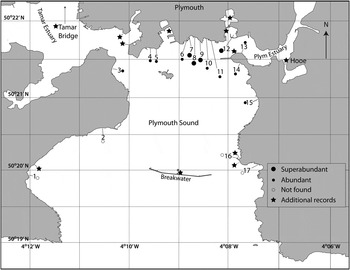
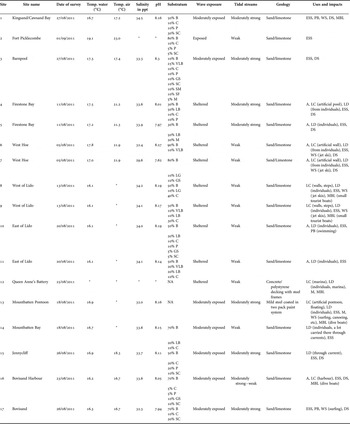
Between August and September 2011 snorkellers surveyed 17 sites within Plymouth Sound (Figure 1; Table 1) which were chosen due to their distribution around the sound and accessibility. The survey took place between 0 to +1 m relative to Chart Datum (or at sea level in the case of floating pontoons). At most sites, 30 quadrats (50 × 50 cm) were placed haphazardly on vertical surfaces and 30 quadrats on upward-facing surfaces. The surveyor either placed the quadrat blindly on vertical or steeply sloping surfaces or dropped it from a height, respectively. Sites 4 and 5 lacked vertical surfaces, at site 7 only 15 quadrats for each orientation were surveyed, and at sites 12 and 13 only vertical surfaces of marina pontoons were surveyed (the other sites were rocky). In each quadrat Laminariales and Tilopteridales were counted, the species observed were: Laminaria digitata (Hudson) J.V. Lamouroux; Laminaria hyperborea (Gunnerus) Foslie; Laminaria ochroleuca Bachelot de la Pylaie; Saccharina latissima (Linnaeus) C.E. Lane, C. Mayes, Druehl & G.W. Saunders; Saccorhiza polyschides (Lightfoot) Batters; and Undaria pinnatifida. The area surveyed at each site depended on the local topography along the coast (how large an area was of suitable substratum) and steepness of the slope seawards (how wide was the zone which was within the required depth of 0 to +1 m relative to Chart Datum). It was generally over about a 20 m length of coastline. At each site, salinity, pH and temperature were measured using a pH-multimeter and general characteristics of the site were noted such as substratum type and percentage cover, wave exposure, tidal streams and the uses and impacts on the site.
Distribution of Undaria pinnatifida (Harvey) Suringar off Plymouth (0.25 m2 quadrats were used, N = 60, except for sites 4, 5, 7 and 13 where N = 30). Superabundant = 10–99 individuals per m2; abundant = 1–9 individuals per m2.

Site description for each site. No data are available for *. Substratum: B, bedrock; VLB; very large boulders (>1024 mm); LB, large boulders (512–1024 mm); SB; small boulders (256–512 mm); C, cobbles (64–256 mm); P, pebbles (16–64 mm); GS, gravel stone (4–16 mm); SC, sand coarse (1–4 mm); SM, sand medium (0.25–1 mm); SF, sand fine (0.063–0.25 mm); M, mud (<0.063 mm). The substratum sizes are those developed by the Marine Nature Conservation Review of Great Britain (Connor & Hiscock, Reference Connor, Hiscock and Hiscock1996). Uses and impacts: A, angling; LC, land claim; LD; litter and debris; ESS, educational/scientific study; PB, popular beach; M, marina; WS; water sports; DS, dive site; MBL, mooring/beaching/launching. Temp., temperature.

Data analysis
The data were converted from individuals per 0.25 m2 to individuals per 1 m2. The mean (± standard error (SE)) abundance of individuals per m2 was calculated and displayed in bar graphs including error bars. All data were tested for equal distribution with the Kolmogorov–Smirnov test from Minitab 16. As the data were not equally distributed, the non-parametric Mann–Whitney test (U) was used for differences between groups. In order to account for multiple testing, the Bonferroni method was used to adjust P values.
The map used to display the distribution of Undaria pinnatifida in Plymouth Sound SAC was retrieved from Digimap Collections (2011). Our abundance data were converted into the SACFOR abundance scale (Connor & Hiscock, Reference Connor, Hiscock and Hiscock1996) and mean abundance of each species was calculated for sites with and without U. pinnatifida and for upward-facing and vertical surfaces (excluding sites 4, 5, 12 and 13, which only had vertical surfaces).
RESULTS
Distribution of Undaria pinnatifida
The distribution of Undaria pinnatifida sporophytes around Plymouth Sound in summer 2011 is shown in Figure 1; with site descriptions given in Table 1. Thalli were found on shallow hard substrata consisting mainly of sand and sandstone (Table 1) throughout Plymouth Sound north of the Breakwater, to Saltash in the Tamar estuary and to Hooe in the Plym estuary. The highest abundance was found in a marina (site 12, 24 ind. m−2 ± SE 2.0; Table 1) on pontoon floats made out of concrete. Wherever U. pinnatifida was found it was superabundant (10–99 m−2) or abundant (1–9 m−2) on the SACFOR scale.
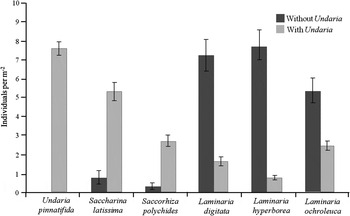
At sites where U. pinnatifida was present all other Laminariales and Tilopteridales were significantly lower in abundance (Figure 2). Saccharina latissima and Saccorhiza polyschides were significantly more abundant at sites with U. pinnatifida whereas Laminaria digitata, L. hyperborea and L. ochroleuca were significantly more abundant at sites without U. pinnatifida.
Mean (± standard error) abundance of Laminariales and Tilopteridales at sites with Undaria pinnatifida (Harvey) Suringar (N = 510) and without U. pinnatifida (N = 240), excluding sites 4, 5, 12 and 13. Undaria pinnatifida present: all other Laminariales and Tilopteridales significantly lower in abundance, Saccharina latissima and Saccorhiza polyschides significantly more abundant than on sites without U. pinnatifida. Without U. pinnatifida: Laminaria digitata, Laminaria hyperborea and Laminaria ochroleuca significantly more abundant than at sites with U. pinnatifida.

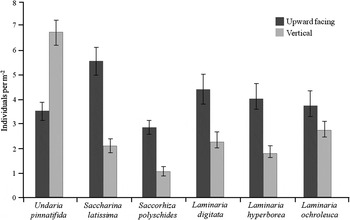
On upward-facing surfaces there was no significant difference in abundance between Undaria pinnatifida and the other Laminariales and Tilopteridales present (Figure 3). Undaria pinnatifida was twice as abundant on vertical surfaces as on upward-facing surfaces. Saccharina latissima, Saccorhiza polyschides, Laminaria digitata and L. hyperborea were significantly less abundant on vertical than on upward-facing surfaces. On vertical surfaces, U. pinnatifida was significantly more abundant than the other large phaeophytes present.
Mean (± standard error) abundance of Laminariales and Tilopteridales on upward-facing and on vertical surfaces (N = 375) for all sites excluding 4, 5, 12 and 13. Upward-facing: no significant difference between Undaria pinnatifida and other Laminariales and Tilopteridales; U. pinnatifida was twice as abundant on vertical surfaces as on upward-facing surfaces; Saccharina latissima, Saccorhiza polyschides, Laminaria digitata and Laminaria hyperborea significantly less abundant on vertical than on upward-facing surfaces; vertical: U. pinnatifida significantly more abundant than the other Laminariales and Tilopteridales.

DISCUSSION
Distribution of Undaria pinnatifida
By summer 2011, Undaria pinnatifida had become well established within Plymouth Sound SAC. The first occurrence and the highest abundance were observed in marinas (Plymouth Yacht Haven and Queen Anne's Battery, respectively), which are both visited by boats from all over the world. This indicates that the vector for introduction to Plymouth has been boat traffic, the same suspected vector as at other sites on the south coast of England, like the Hamble estuary where it was first recorded in Britain (Fletcher & Manfredi, Reference Fletcher and Manfredi1995). In our surveys, sites with U. pinnatifida present were more sheltered from wave exposure and most had weak surface tidal streams (Table 1).
Undaria pinnatifida grew in the same habitat as Saccharina latissima and Saccorhiza polyschides and was the dominant macroalga in that association. Floc'h et al. (Reference Floc'h, Pajot and Wallentinus1991) suggested that Undaria is not very competitive, especially compared to the annual S. polyschides. However, Casas et al. (Reference Casas, Scrosati and Piriz2004) found that U. pinnatifida can outcompete native species at certain times of year. Hay (Reference Hay1990) identified three characteristics of U. pinnatifida that could increase its competitive interactions with native algae. First, new or recently disturbed areas are quickly colonized. Second, compared to local annuals its propagules settle throughout the year and mature to reproducing sporophytes. Third, it is able to colonize artificial substrata successfully. We found that the invasive kelp was especially dominant on vertical surfaces and concur with the findings of Farrell & Fletcher (Reference Farrell and Fletcher2006) that U. pinnatifida tolerates turbidity and siltation better than native kelps.
Ecological impact
Undaria pinnatifida has become established throughout Plymouth Sound and extends into the associated estuaries. It has become visually dominant during the summer at some locations, especially on shallow vertical surfaces where other kelp species do not flourish. We do not yet know whether native species will be outcompeted by U. pinnatifida although observations made in summer 2013 suggest that it is continuing to spread into habitats occupied by native kelps off Plymouth (J.H.S. and K.H. personal observations). The highly invasive fucalean alga Sargassum muticum competes with native macroalgae (Stæhr et al., Reference Stæhr, Pederson, Thomsen, Wernberg and Krause-Jensen2000; Britton-Simmons, Reference Britton-Simmons2004) but has not adversely affected biodiversity levels (Hopkins, Reference Hopkins, Leppäkoski, Follasch and Olenin2002; Ribera Sagun, Reference Ribera Sagun, Leppäkoski, Gollasch and Olenin2002; Streftaris et al., Reference Streftaris, Zenetos and Papathanassiou2005). As S. muticum is able to settle in sites with low prevailing heterogeneity it can increase epifaunal biodiversity and abundance by adding structural features to the habitat (Buschbaum et al., Reference Buschbaum, Chapman and Saier2006). However, White & Shurin (Reference White and Shurin2011) identified that, at high cover, S. muticum excludes native species and reduces richness through light competition by shading smaller, understory macroalgae. Undaria pinnatifida is likely to have a much higher shading effect than S. muticum as, when submerged, S. muticum floats vertically and has a very small ‘footprint’ whereas U. pinnatifida remains draped over the substratum when submerged or in subtidal habitats and is likely to have a much greater shading or smothering effect than S. muticum. Given the spread of U. pinnatifida in nature conservation areas ecological interactions with other flora and fauna need to be assessed. Wherever we found U. pinnatifida around Plymouth during spring to late summer, it was abundant and often the visually dominant species; we are concerned that U. pinnatifida may outcompete native macroalgae and cause community shifts. Furthermore, since U. pinnatifida currently thrives in warmer waters in its native Japan rather than those of southern Britain (Pinet, Reference Pinet2009), it is likely to spread north as sea surface temperatures warm.
Abiotic and biotic factors are likely to influence the further spread of Undaria pinnatifida and its ecological impact. In New Zealand, Thompson & Schiel (Reference Thompson and Schiel2012) found that U. pinnatifida settlement and growth was facilitated by coralline turf algae but inhibited by a native fucoid (Carpophyllum maschalocarpum) and Thornber et al. (Reference Thornber, Kinlan, Graham and Stachowicz2004) found that native crabs consumed U. pinnatifida.
The collection of baseline data and rigorous monitoring for non-native species is especially important for SACs such as Plymouth Sound where Undaria pinnatifida is spreading rapidly. An aim of SACs is to conserve natural habitats although it is difficult to prevent the replacement of native species by non-natives. Once U. pinnatifida has settled and grown to mature sporophytes it resists most attempts at long-term removal (Fletcher & Farrell, Reference Fletcher and Farrell1999). One of the few successful eradication attempts was undertaken in the Chatham Islands (New Zealand) where a sunken ship was completely cleared of the non-native kelp through heat treatment at 70°C that prevented further spread onto adjacent natural habitats (Wotton et al., Reference Wotton, O'Brien, Stuart and Fergus2004). Manual removal was successful in controlling (but not eradicating) U. pinnatifida in a Tasmanian marine reserve (Hewitt et al., Reference Hewitt, Campbell, McEnnulty, Moore, Murfet, Robertson and Schaffelke2005) with the authors concluding that, to be effective, ‘a long-term commitment to a removal activity needs to be coupled with vector management and education initiatives to reduce the chances of re-inoculation and spread, with monitoring (and response) on a larger spatial scale for early detection of other incursion sites, and with treatment to remove persistent microscopic stages’. A record of eradication or control attempts worldwide and their success is maintained on the Global Invasive Species Database (www.issg.org). We conclude that it is essential that the spread of U. pinnatifida is monitored, taking substratum orientation into account, especially when reporting on ‘favourable conservation status’ of SACs. The impact of this rapidly spreading invasive kelp on local ecosystems also needs to be assessed to establish whether eradication or control should be attempted.
ACKNOWLEDGEMENTS
We thank Tim Absalom and Jack Sewell for helping to produce the map, as well as delegates at the British Phycological Society Winter Meeting 2012 who contributed ideas towards the poster on the same topic. Special thanks go to the Diving and Marine Centre (Plymouth University) who provided equipment and to all the snorkellers (C. Bertolini, S. Brand, A. Brechon, L. Castle, L. Cocks, R. Cole, A. Dowds, P. Edwards, H. Evans, G. Lewis, K. MacPherson, C. Mills, J. Mudge, S. Pountney, E. Stroud, A. Sykes, M. Vanderzwalmen and E. Whittle). We thank the staff from Queen Anne's Battery and the Mountbatten Centre for making it possible to survey their pontoons. Thanks also to Simon Morley (British Antarctic Survey) for advice.