Introduction
Among other well-known genera, Spath (Reference Spath, Wyllie and Smelly1925, p. 144) erected the genus Lytohoplites, which he based on Lytohoplites burckhardti (Mayer-Eymar in Burckhardt, Reference Burckhardt1900), a species described from Upper Jurassic–Lower Cretaceous beds of the Vaca Muerta Formation in the Neuquén Basin, west-central Argentina. Nevertheless, the original description of L. burckhardti (Mayer-Eymar in Burckhardt, Reference Burckhardt1900) was based on a single fragmentary specimen, which occurred with L. vetustoides (Burckhardt, Reference Burckhardt1903), later assigned by Burckhardt to another incomplete specimen coming from the very same collection spot as L. burckhardti. The holotypes of both species are currently missing, and neither well-preserved nor more-complete specimens of L. burckhardti have been published, thus obscuring details on the ontogeny and morphological variability of the type species of the genus (Vennari, Reference Vennari2018). In addition to that, the stratigraphic range of Lytohoplites in Argentina is quite uncertain. It was originally considered to be Neocomian (Burckhardt, Reference Burckhardt1900, Reference Burckhardt1903; Gerth, Reference Gerth1925), but was later restricted to the Upper Jurassic (Leanza, Reference Leanza1945).
Despite the alleged drawbacks, a number of specimens from different perigondwanean localities were later referred to the genus (Besairie, Reference Besairie1936; Spath, Reference Spath1939; Collignon, Reference Collignon1960, Reference Collignon1961, Reference Collignon1962; Biró-Bagóczky, Reference Biró-Bagóczky1964; Howlett, Reference Howlett1989; Salazar Soto, Reference Salazar Soto2012), making necessary a revision of the genus Lytohoplites in the Andean region, from which it was first described. So, one of the main purposes of this contribution is to present new specimens of L. burckhardti retrieved bed-by-bed from several upper Tithonian–lower Berriasian localities of the Neuquén Basin, and to select a neotype specimen. In addition to the traditional taxonomic revision, including the qualitative description of L. burckhardti and its possible sexual dimorphism, a paleontological analysis involving quantitative analyses, through uni-, bi- and multivariate techniques, is performed in order to test if the split into two taxa (L. burckhardti and L. vetustoides) should be maintained. This approach, from a paleobiological rather than from a strictly typological point of view, has the advantange of considering the occurrence of natural morphological variability within a paleobiological population, thus avoiding the taxonomic oversplitting that could significantly bias any biostratigraphic, paleobiogeographic, or evolutionary conclusions (De Baets et al., Reference De Baets, Bert, Hoffmann, Monnet, Yacobucci, Klug, Klug, De Baets, Kruta and Mapes2015). A number of research studies have successfully applied this non-typological approach on unrelated Paleozoic and Mesozoic ammonoid groups (e.g., Aguirre-Urreta, Reference Aguirre-Urreta1998; Monnet et al., Reference Monnet, Bucher, Wasmer and Guex2010; Bersac and Bert, Reference Bersac and Bert2012; De Baets et al., Reference De Baets, Klug and Monnet2013; Bert, Reference Bert2014).
Additionally, this contribution clarifies the stratigraphic occurrence of L. burckhardti in the Upper Jurassic–Lower Cretaceous successions of west-central Argentina and, in consequence, reevaluates its biostratigraphic significance for the Andean region in the context of the paleogeographic distribution of the genus around Gondwana.
Geological setting and fossil localities
All the studied material was sampled from upper Tithonian–lower Berriasian outcrops of the Vaca Muerta Formation (lower Tithonian–lower Valanginian) of the Mendoza Group (Groeber, Reference Groeber1946). The Vaca Muerta Formation (Weaver, Reference Weaver1931) is widely extended (>500 km from north to south) within the Neuquén Basin in central-west Argentina. This marine unit was deposited over a carbonate ramp-platform system after a lower Tithonian sudden transgressive event (Mitchum and Uliana, Reference Mitchum, Uliana, Berg and Woolverton1985) and it is characterized by the alternation of organic-rich marl and clay beds with commonly fossiliferous massive and nodular limestones.
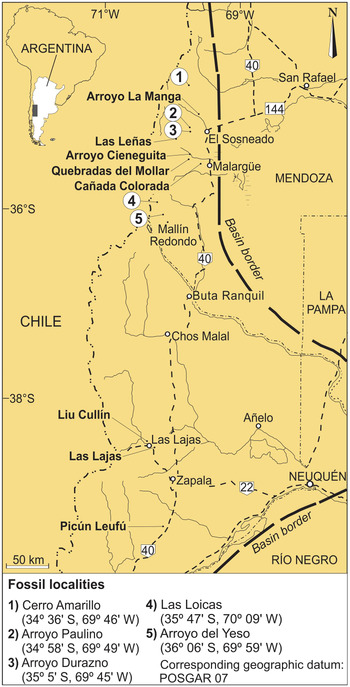
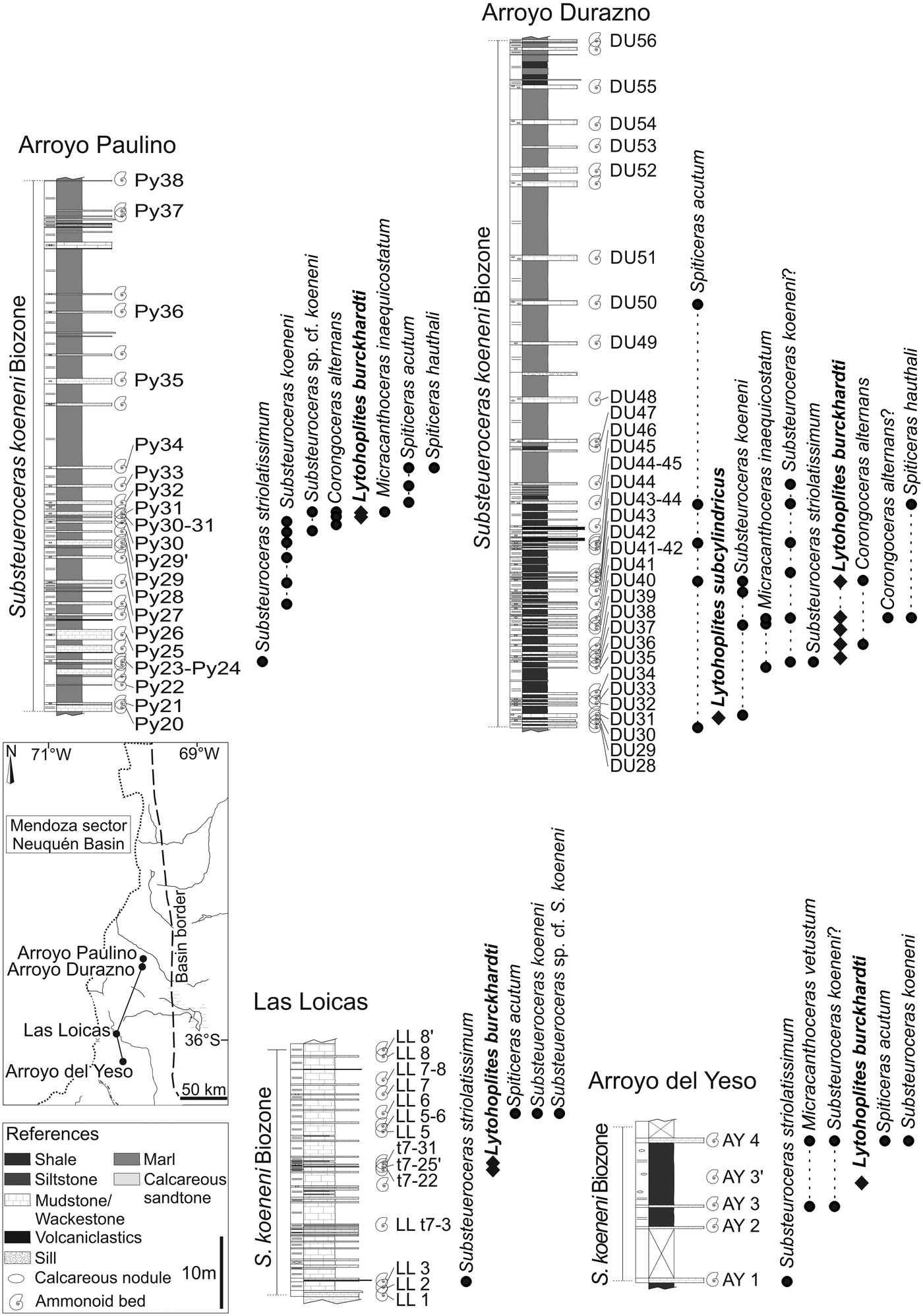
New specimens of Lytohoplites were collected bed-by-bed from five localities in the southern Mendoza sector of the Neuquén Basin (Figs. 1, 2): Cerro Amarillo, Arroyo Paulino, Arroyo Durazno, Las Loicas, and Arroyo del Yeso. A Cerro Amarillo stratigraphic section was included in Kim (Reference Kim2002), but a more elaborated version is currently under development as part of a Bachelors degree thesis. Additional descriptions and detailed sedimentary logs of the Arroyo Paulino, Arroyo Durazno, and Las Loicas sections can be found in Vennari et al. (Reference Vennari, Lescano, Naipauer, Aguirre-Urreta, Concheyro, Shaltegger, Armstrong, Pimentel and Ramos2014) , López-Martínez et al. (Reference López-Martínez, Aguirre-Urreta, Lescano, Concheyro, Vennari and Ramos2017), Vennari and Aguirre-Urreta (Reference Vennari and Aguirre-Urreta2017), and Fernández et al. (Reference Fernández, Vennari, Herrera, Campos, Talevi and de la Fuente2018). According to Kim (Reference Kim2002), the Cerro Amarillo area is difficult to access, but exposes a complete, 485 m thick section of the Vaca Muerta Formation between continental rocks of the Tordillo Formation (Kimmeridgian) and the shelf bioclastic limestones of the Chachao Formation (Valanginian). At the Arroyo Paulino section, located 14 km north of the Arroyo Durazno section, ~220 m of the upper portion of the Vaca Muerta Formation were prospected. To the south, at Arroyo del Yeso, the Vaca Muerta Formation (~400 m thick) lies at an angular unconformity over the Oxfordian evaporites of the Auquilco Formation. Arroyo del Yeso is a classic locality studied by Groeber (in Groeber et al., Reference Groeber, Stipanicic, Mingramm, Groeber, Stipanicic and Mingramm1953) where he collected the ammonoid fauna described by Leanza, (Reference Leanza1945). Lytohoplites specimens from other southern Mendoza localities, such as Arroyo Cieneguita (Steuer, Reference Steuer1921), Cerro Las Leñas, Quebradas del Mollar and Arroyo La Manga (Gerth, Reference Gerth1925), were revised.
Lytohoplites fossil localities. Numbers indicate log sections with studied material.

Partial log sections with vertical distribution of Lytohoplites burckhardti, L. subcylindricus, and other selected ammonoid species.

Materials and methods
For the present study, 142 new Lytohoplites specimens were available. In addition, twelve specimens from Gerth's and Steuer's Collections (Gerth, Reference Gerth1925 and Steuer, Reference Steuer1921, respectively) coming from four different localities were analyzed from pictures. Terminology used for the description of general shell morphology and its parameters is that applied for Spiticeras in Vennari and Aguirre-Urreta (Reference Vennari and Aguirre-Urreta2017, and references therein). Measurements were performed either with an electronic digital caliper accurate to ± 0.1 mm or with the aid of software (CorelDraw Graphics Suite) on well-preserved specimens (Appendix). Sutural lines were sketched under a binocular microscope with camera lucida.
Shell and type material terminology is abbreviated as follows: D, maximum shell diameter; H, whorl height at a given diameter; H/D, whorl height ratio; HT, holotype; H/W, whorl compression; [M], macroconch; [m], microconch; [?], uncertain type of dimorph; NT, neotype; Ru/2, number of umbilical ribs per half a whorl; Rt/2, number of bituberculated ribs per half a whorl; U, umbilical width at a given diameter; U/D, umbilical width ratio; U/H, umbilical width to whorl height ratio; W, whorl width at a given diameter; W/D, whorl width ratio. Suture terminology includes: E, external lobe; L, lateral lobe; Ul, umbilical lobe.
Incomplete, diagenetically distorted, or poorly preserved specimens were a priori excluded from contributing to the digital matrix of quantifiable shell characters. Whenever possible, more than one set of measurements was performed on each of the specimens at different diameters to assess variations along the ontogeny.
Univariate, bivariate and multivariate analyses were conducted over a sample of N = 51 individuals assigned to Lytohoplites burckhardti and collected from Arroyo Durazno. Ammonoids from this locality were selected as representatives of the original paleobiological population because they are more abundant there than in the other sections, all of them come from a restricted stratigraphic interval, and all the recognized morphotypes of the species are represented. In addition, the threshold of 32 individuals that would be representative of the original paleobiological population is exceeded (Tintant, Reference Tintant1980). The null hypothesis to be tested is that the sample is homogeneous, that is to say that the sample does not encompass more than one ammonoid species. This is relevant because two separate species of Lytohoplites (L. burckhardti and L. vetustoides) have been described from the same stratigraphic interval.
Statistical analyses were performed within the PAST environment version 3.18 (Hammer et al., Reference Hammer, Harper and Ryan2001). Scatter plots were produced in EXCEL and PAST and afterwards edited with CorelDRAW for publication.
To test the occurrence of continuous intraspecific variation within the sample, the distribution of shell characters, such as H, W, and U (expressed as ratios relative to D in order to remove the influence of growth), was analyzed through the construction of frequency histograms (Monnet et al., Reference Monnet, Bucher, Wasmer and Guex2010; Bert, Reference Bert2014; De Baets et al., Reference De Baets, Bert, Hoffmann, Monnet, Yacobucci, Klug, Klug, De Baets, Kruta and Mapes2015). The number and width of bins of each histogram were set by default by PAST. Normality was tested through the Shapiro-Wilk test with p = 0.05, the usual value used in biological sciences (Hammer and Harper, Reference Hammer and Harper2006), and graphically through the degree of adjustment of a kernel density estimation to a theoretical Gaussian normal curve (Bert, Reference Bert2014; De Baets et al., Reference De Baets, Bert, Hoffmann, Monnet, Yacobucci, Klug, Klug, De Baets, Kruta and Mapes2015).
Bivariate plots were produced to visualize ontogenetic variations of shell parameters (H, W, and U) and ornamentation changes (Ru/2 and Rt/2). Scatter plots of H/W, H/D, and U/D were composed to explore general variations of those parameters with age. Successive values of H, W, and U against shell diameter were adjusted to an allometric curve, conforming to a power function like the one depicted by Equation 1, by means of a linear regression of log-transformed data and through the reduced major axis fitting method (Hammer and Harper, Reference Hammer and Harper2006).
 $${\rm Y} = {\rm bX}^a \eqno(1)$$
If the probability that the allometric exponent a = 1 is significant (p < 0.05), the growth is considered to be isometric. In contrast, if a is significantly different from 1 (p > 0.05), then the growth is considered as allometric (Hammer and Harper, Reference Hammer and Harper2006; Monnet et al., Reference Monnet, Bucher, Wasmer and Guex2010; Bert, Reference Bert2014; De Baets et al., Reference De Baets, Bert, Hoffmann, Monnet, Yacobucci, Klug, Klug, De Baets, Kruta and Mapes2015; Jattiot et al., Reference Jattiot, Bucher, Brayard, Monnet, Jenks and Hautmann2016). Dispersion of the data was tested through the Pearson's r correlation coefficient squared (R2).
A multivariate analysis was performed with shell structural parameters (H/D, H/W, U/D, and U/H), diameter (as a proxy for size/age), and ornamental characters (Ru/2 and Rt/2). Normality of the sample was explored through a Doornik and Hansen test (Ep) and homoscedasticity through an F test (p > 0.05) (Hammer and Harper, Reference Hammer and Harper2006). After log-transforming and performing an iterative imputation of missing data, the parametric multivariate test of Principal Component Analysis (PCA) was completed with the two-fold aim of exploring how the variables explain the variability of the sample and visualizing the morphological space occupied by the studied specimens. The magnitude and orientation of the variable vectors were analyzed both by their graphic representation and quantitatively through the non-parametric Spearman's rank correlation (rs coefficient; p < 0.05) (Hammer and Harper, Reference Hammer and Harper2006).
Repositories and institutional abbreviations
Studied material is housed at the Invertebrate Paleontology collections of the Natural and Anthropological Sciences Museum Juan Cornelio Moyano (MCNAM-PI), Mendoza, Argentina and at the Paleontological Collection of the Buenos Aires University (CPBA), Buenos Aires, Argentina. Specimens from Gerth's and Steuer's Collections are stored at the Steinmann Institute of Palaeontology Bonn (STIPB), Germany and at the Geoscience Museum of the Georg-August University (GZG.INV), Göttingen, Germany, respectively. Those from Feruglio's Collection are housed at the Geological Museum Giovanni Capellini (IGPUB), Bologna, Italy and material coming from Madagascar from Collignon's and Besairie's Collections are placed at the Bourgogne University (UBGD), Dijon, France. Type material search was conducted at the following institutions: Natural Sciences Museum of La Plata (MLP), La Plata, Argentina; National Geological Survey of Argentina (SEGEMAR), Buenos Aires, Argentina; Burke Museum of Natural History and Culture (BMW), Washington, United States of America; Natural History Museum of Basel (NMBS), Basel, Switzerland; and at the Paleontology Museum of Munich (BSPGM), Munich, Germany.
Systematic paleontology
Class Cephalopoda Cuvier, 1797
Order Ammonoidea Zittel, 1884
Suborder Ammonitina Hyatt, 1900
Superfamily Perisphinctoidea Steinmann, 1890
Family Neocomitidae Salfeld, 1921
Subfamily Berriasellinae Spath, 1922
Genus Lytohoplites Spath, 1925
Type species
Hoplites burckhardti Mayer-Eymar in Burckhardt (Reference Burckhardt1900, p. 17, pl. 26, figs. 1, 2), Vaca Muerta Formation, Las Lajas, Neuquén Province, Argentina, by original designation.
Diagnosis
Subinvolute to evolute shells, whorl section subtrapezoidal to subquadrate. Outer whorls with distant, variably strong primary ribs, simple, twinned, or bifurcated, some looped. Intercalatory ribs may be present. Lateral to externo-lateral tubercles. Rounded to spiny or elongate swellings may develop on main ribs. Ribs weakened or interrupted by a ventral furrow bordered by transverse swellings or oblique, rounded to clavate tubercles.
Occurrence
Upper Tithonian–?Berriasian of Argentina, Chile, Antarctica, Madagascar, and Pakistan.
Remarks
Genus diagnosis is emended from Wright et al. (Reference Wright, Callomon and Howarth1996) to embrace the morphological variability observed in the revised type species. In addition to Argentina, the genus has been reported from Chile (Biró-Bagóczky, Reference Biró-Bagóczky1964; Salazar Soto, Reference Salazar Soto2012), Western Antarctica (Howlett, Reference Howlett1989), Madagascar (Besairie, Reference Besairie1936; Collignon, Reference Collignon1960, Reference Collignon1961, Reference Collignon1962), and Pakistan (Spath, Reference Spath1939). Although the occurrence of Lytohoplites in northwestern Peru was reported by Spath (Reference Spath, Wyllie and Smelly1925), representatives of the genus were neither illustrated nor mentioned in the late Tithonian ammonoid assemblages of the Chicama Basin revised by Enay et al. (Reference Enay, Barale, Jacay, Jaillard and Riccardi1996), so this region is excluded from the occurrence list of the genus. This is also the case for the Caribbean area, where Lytohoplites occurrence has been disregarded by Myczynski (Reference Myczynski1996, Reference Myczynski1999), who transferred the species L. carribeanus Imlay, Reference Imlay1942 to the late early Tithonian genus Paralytohoplites Myczynski, Reference Myczynski1996.
Lytohoplites burckhardti (Mayer-Eymar in Burckhardt, Reference Burckhardt1900)
Figures 3–6, 7.1–7.17, 8–10
- 1897
?Odontoceras cf. perornatum Steuer non Retowski, p. 182.
- 1900
Hoplites burckhardti Mayer-Eymar in Burckhardt, p. 17, pl. 26, figs. 1, 2.
- 1903
Hoplites burckhardti; Burckhardt, p. 61, pl. 10, figs. 17–20 (figs. 17, 18 = Burckhardt, Reference Burckhardt1900, pl. 26, figs. 1, 2).
- 1903
Hoplites vetustoides Burckhardt, p. 62, pl. 10 figs. 23–25.
- 1925
Lytohoplites burckhardti; Spath, p. 144.
- 1925
Kilianella burckhardti; Gerth, p. 98, text-fig. 10.
- 1926
Lytohoplites burckhardti; Gerth, p. 476.
- 1931
Kilianella burckhardti; Windhausen, pl. 30, fig. 9 (= Burckhardt, Reference Burckhardt1903, pl. 10, figs. 17, 18).
- ?1936
Berriasella alternans Gerth (n. var.?); Feruglio, p. 70, pl. 8, fig. 6.
- 1957
Lytohoplites burckhardti; Arkell et al., p. L352, figs. 463a–d (= Burckhardt, Reference Burckhardt1903, pl. 10, figs. 17–20).
- non 1964
Lytohoplites burckhardti; Biró-Bagóczky, p. 102, pl. 23, figs. 3a–b (= Lytohoplites zambranoi Salazar Soto, Reference Salazar Soto2012, p. 209, figs. 4.72d–f).
- ?1967
Lytohoplites burckhardti; Leanza, p. 146.
- 1989
Lytohoplites cf. burckhardti; Howlett, p. 23, pl. 4, fig. 3.
- 1996
Lytohoplites burckhardti; Wright et al., p. L55, figs. 38a–d (= Burckhardt, Reference Burckhardt1903, pl. 10, figs. 17–20).
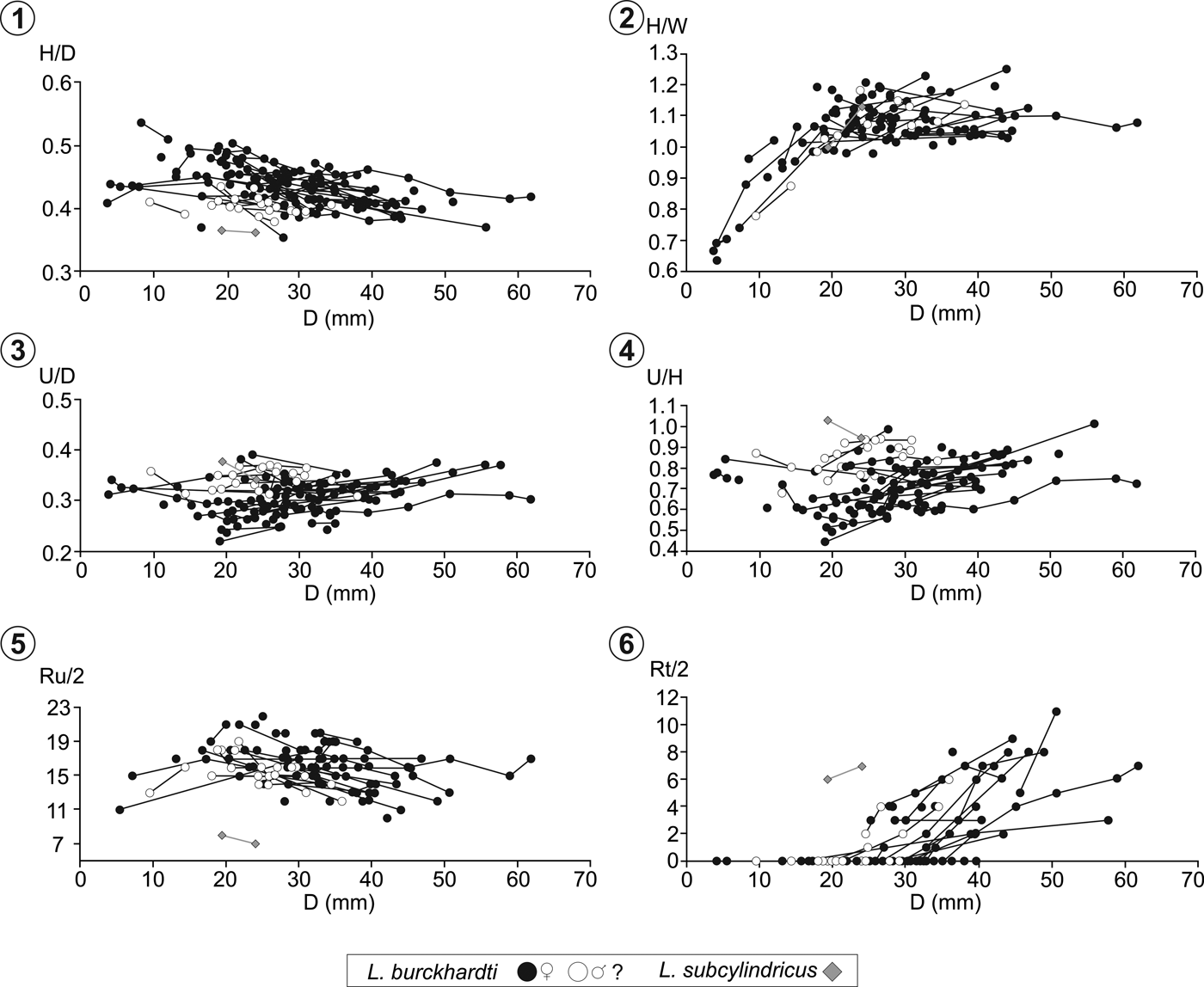
Scatter plots of Lytohoplites burckhardti and L. subcylindricus: (1) H/D, whorl height ratio; (2) H/W, whorl compression; (3) U/D, umbilical width ratio; (4) U/H, umbilical width to whorl height ratio; (5) Ru/2, number of umbilical ribs per half a whorl; and (6) Rt/2, number of bituberculated ribs per half a whorl; all against D, diameter. Lines connecting dots or diamonds indicate ontogenetic trajectories.

Holotype
By monotypy. Specimen ASXXXV3, figured in Burckhardt, Reference Burckhardt1900, pl. 26, figs. 1, 2, from upper Tithonian–?lower Berriasian rocks of the Vaca Muerta Formation, Neuquén, Argentina. This specimen, which was stored at the Bayerische Staatsamlung für Paläontologie und Geologie, Munich, Germany (BSPGM), is currently missing.
Neotype
Macroconchiate specimen GZG 499-114 from upper Tithonian beds of the Vaca Muerta Formation, Arroyo Cieneguita, Mendoza (Cieneguita-III in Steuer, Reference Steuer1897). Hereby designated with the intention of defining objectively the taxonomic status of Lytohoplites burckhardti. Burckhardt himself described and considered this specimen (figured here for the first time, Fig. 6.1, 6.2) as a representative of Hoplites burckhardti (Burckhardt, Reference Burckhardt1903, p. 61).
One of the authors (VV) unfruitfully searched the type material of both nominal species, L. burckhardti and L. vetustoides (ASXXXV5), in collaboration with collection managers of the BSPGM and GZG in Germany, NMBS, Switzerland and MLP and SEGEMAR in Argentina, all places where Dr. Burckhardt spent some time studying Argentinean material. No topotype specimens were found at the type locality, nor nearby it. Despite Weaver (Reference Weaver1931, p. 51) having mentioned some specimens coming from the Vaca Muerta Ridge, southeast of Las Lajas, they are not listed in the inventory of the BMW.
Diagnosis
Macroconchiate shells of moderate size, subinvolute to subevolute on inner whorls and subevolute on outer whorls. Whorl cross section subtrapezoidal to subquadrate with broad, flat to slightly concave, furrowed venter. Simple ribs more frequent than bifurcated ribs. Ribs are bituberculated with upper lateral and ventro-lateral to ventral spiny tubercles. Ribs falcoid over the outer third of the flank on middle to outer whorls. Intercalatory ribs and lirae can occur as well as rib looping between the two rows of tubercles. Compressed, robust, and slender variants are recognized. Potential microconchiate shells are smaller and develop falcoid ribbing from the last portion of the phragmocone onwards.
Occurrence
Vaca Muerta Formation, Neuquén Basin, Argentina (Cerro Amarillo, Arroyo Paulino, Arroyo Durazno, Arroyo Cieneguita, Cerro Las Leñas, Quebradas del Mollar, Las Loicas and Arroyo del Yeso in Mendoza Province, Las Lajas and Picún Leufú, cf. Armella et al. [Reference Armella, Cabaleri and Leanza2007] in Neuquén Province); Siliciclastic rocks intercalated on the top of the El Quemado Complex, Magallanes or Austral Basin, Argentina (Lago Argentino, Santa Cruz Province); Himalia Ridge Formation, Western Antarctica (Planet Heights, Alexander Island). Upper Tithonian–?lower Berriasian.
Description
Studied specimens are mostly preserved as internal molds with fragmentary and/or crushed body chambers, which prevented obtaining an adequate amount of measurements on that portion of the shell. Subtle features like fine growth lines and lirae can be seen wherever patches of neomorphic shell are adhered. Those specimens coming from Las Loicas are preserved as variable distorted imprints.
Macroconchs
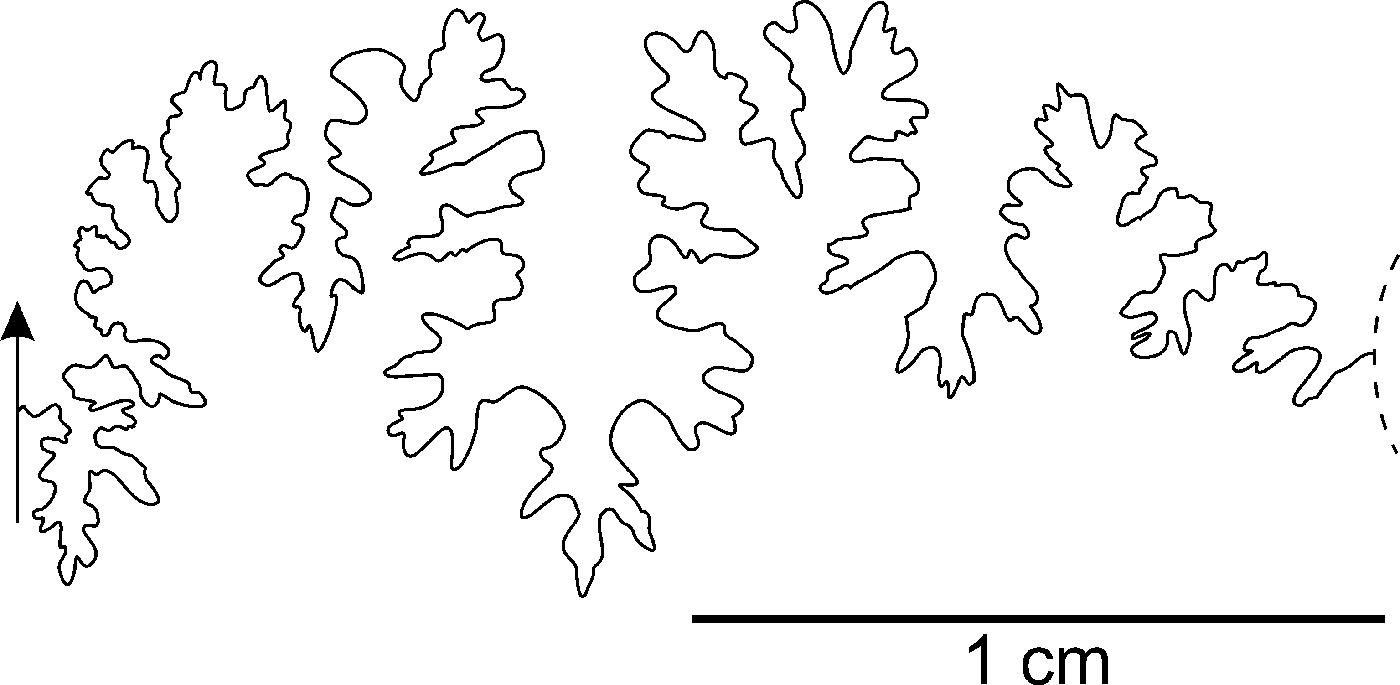
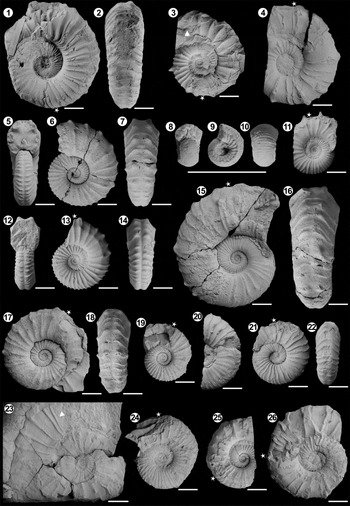
Macroconchiate specimens are discoidal and attain a moderate final size (~70–85 mm in diameter). A maximum phragmocone diameter of 61.8 mm was recorded in specimen MCNAM-PI 24601.2 (Fig. 6.15, 6.16). Early whorls (D = 4–10 mm), observed in specimens MCNAM-PI 24601.3 (Fig. 6.8–6.10) and MCNAM-PI 24601.1 (Fig. 6.5–6.7), are weakly depressed and coronate (mean H/W = 0.71, mean U/D = 0.33), with rounded flanks and a broad convex venter. Whorl overlapping extends up to the middle of the flank at this point. Over the next whorls and up near the end of the phragmocone (30–40 mm in diameter), whorl height-to-width ratio increases (mean H/D = 0.43; mean H/W = 1.12,; Fig. 3.1, 3.2). Consequently, the shell whorls become more compressed and the variably arched flanks converge over a broad flat to slightly concave furrowed venter. The ventral furrow is most conspicuous on the internal mold, but a weakening of the ribbing is still evident when some neomorphic shell is preserved (Fig. 7.16, 7.17). Whorl section becomes subtrapezoidal (Fig. 6.15, 6.16) to subquadrate (Fig. 6.5, 6.7), with its maximum width attained between the rounded umbilical border and the middle of the flank. Inner whorls are subevolute (Fig. 6.8–6.10) to subinvolute (Fig. 7.6,7.7, 7.16, 7.17), then becoming subevolute on inner and outer whorls (U/D ~0.32; Fig. 3.3). After 40 mm in diameter, height-to-width ratio decreases, thus producing a lower whorl cross section, with H/D = 0.42 and H/W = 1.06, at the end of the phragmocone of specimen MCNAM-PI 24601.2 (Fig. 3.1, 3.2). Specimens MCNAM-PI 24646.1 (Fig. 6.23) and MCNAM-PI 24864.1 (Fig. 7.4) preserve simple peristomes (at ~85 mm and 70 mm in diameter, respectively). Suture line is fairly indented with incised saddles and a trifid lateral lobe as deep as the external lobe (Fig. 4).
Suture line of Lytohoplites burckhardti. Specimen MCNAM-PI 24861.3 at 38 mm in diameter.

A smooth neanic conch up to 4 mm in diameter is observed in specimen MCNAM-PI 24601.3 (Fig. 6.8–6.10). Following it, juvenile whorls up to 10 mm in diameter bear primary ribs that bifurcate, forming a bulge at the umbilical border into two secondaries of equal thickness that cross the venter without interruption or weakening. Over middle and outer whorls, simple primaries ribs dominate over bifurcated ones, the division point moves upwards to the middle or outer portion of the flank, and ribbing is interrupted or weakened over the venter by a furrow.
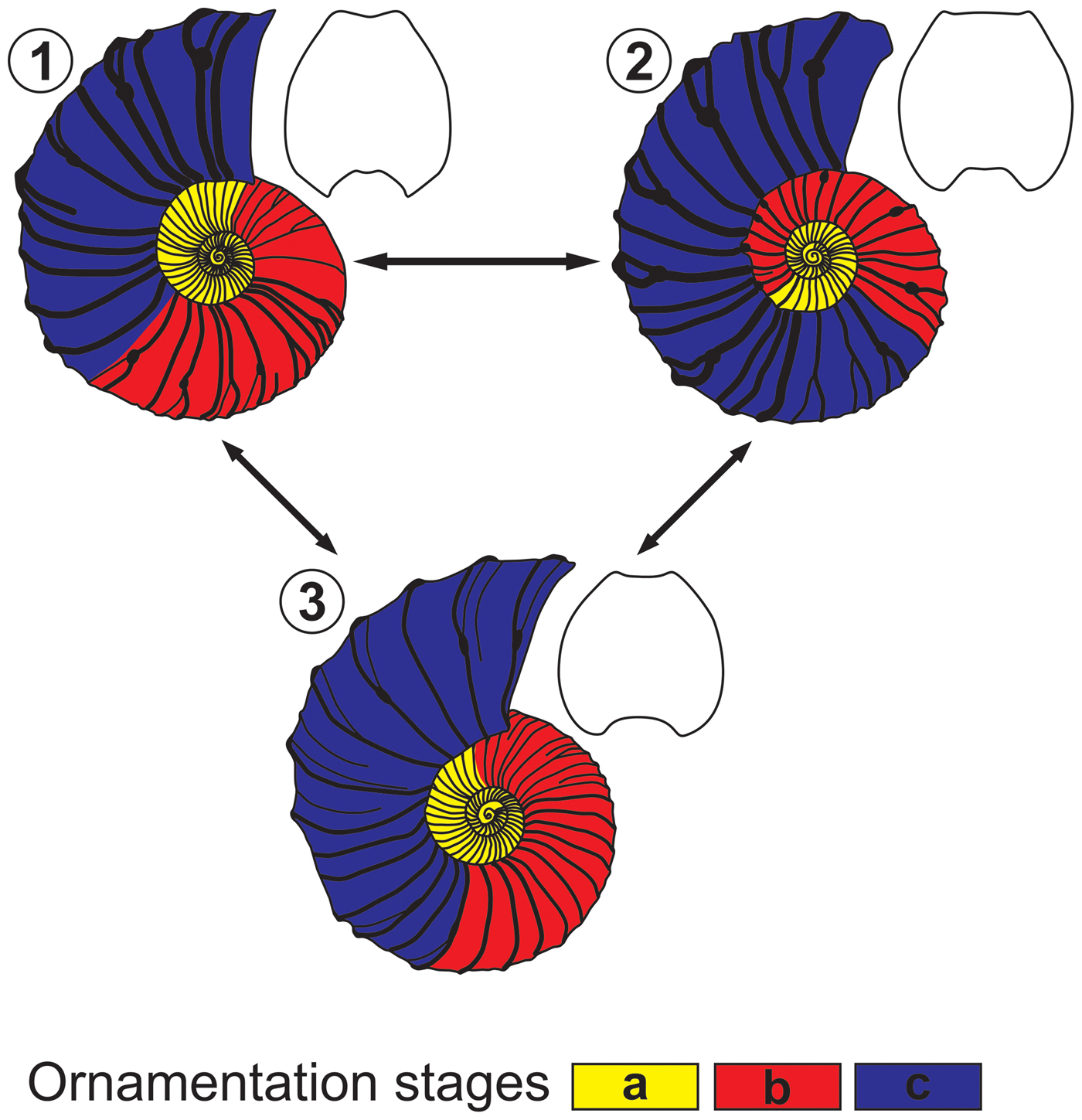
Three generalized ornamentation stages can be described from the studied macroconchiate phragmocones, maximum diameters are averaged because the duration of the ontogenetic stages is quite variable (Figs. 3.5, 5): (a) fine, prorsiradiate, regularly spaced simple and bifurcated ribs without lateral or ventral tubercles (up to 24 mm in diameter); (b) irregular ribbing, with simple and bifurcated ribs more distant and gradually thicker, turning falcoid on the upper third of the flank and swelling perpendicular or obliquely in relation to the ventral furrow (some ribs can bear lateral spiny to rounded tubercles, up to 40 mm in diameter); and (c) primaries very distant, coarse simple or bifurcated ribs that are sickle-shaped over the upper third of the flank. Simple or bifurcated bituberculated ribs. Lateral tubercles are spiny to rounded, ventral tubercles rounded to stout. On bifurcated ribs, the aboral secondary is coarser and more rursiradiate than the adoral one and both can loop over the ventral tubercle (Fig. 3.5). Simple intercalatory ribs may extend up to the inner third of the flank and occasionally tend to fuse with primaries. Stage c seems to extend at least over the first portion of the body chamber (up to 60 mm in diameter). The last portion of the body chamber (e.g., in specimens MCNAM-PI 24646.1 and MCNAM-PI 24864.1, Figs. 6.23 and 7.4, respectively) has very distant thick simple ribs, some of which bear elongated lateral tubercles on the upper portion of the flank. Ribs are prorsiradiate but not falcoid, and the shell appears somewhat sunken between them. Weak growth lines accompany the last two ribs that rim the aperture.
Tripolar morphological spectrum and whorl cross-sections depicted by Lytohoplites burckhardti specimens: (1) compressed pole; (2) robust pole; (3) slender pole. Ornamentation stages a, b and c and their relative durations are described in the text.

Lytohoplites burckhardti (Mayer-Eymar in Burckhardt, Reference Burckhardt1900) from the Vaca Muerta Formation: (1, 2) neotype GZG 499-114, macroconch, lateral and ventral views; (3) MCNAM-PI 24870, microconch, lateral view with right lappet preserved; (4) MCNAM-PI 24601.4, macroconch, lateral view; (5–7) MCNAM-PI 24601.1, macroconch, apertural, lateral, and ventral views; (8–10) MCNAM-PI 24601.3, inner whorls, apertural, lateral, and ventral views; (11) MCNAM-PI 24859.6, microconch?, lateral view; (12–14) MCNAM-PI 24860, microconch?, apertural, lateral, and ventral views; (15, 16) MCNAM-PI 24601.2, macroconch, lateral and ventral views; (17, 18) MCNAM-PI 24598, macroconch, lateral and ventral views; (19) MCNAM-PI 24861.9, macroconch, lateral view; (20) MCNAM-PI 24864.7, macroconch, lateral view; (21, 22) CPBA 22636.3, macroconch, lateral and ventral views; (23) MCNAM-PI 24646.1, macroconch, lateral view with simple aperture preserved; (24) MCNAM-PI 24864.4, macroconch, lateral view; (25) MCNAM-PI 24861.2, macroconch, lateral view; (26) MCNAM-PI 24861.5, macroconch, lateral view. 1–2, Arroyo Cieneguita, Mendoza; 3–20, 24–26, Arroyo Durazno, Mendoza; 21, 22, Arroyo del Yeso, Mendoza; 23, Las Loicas, Mendoza. All specimens are coated with ammonium chloride. Stars indicate the end of the phragmocone. Arrowheads indicate the aperture and aperture modifications wherever preserved. All scale bars represent 1 cm.

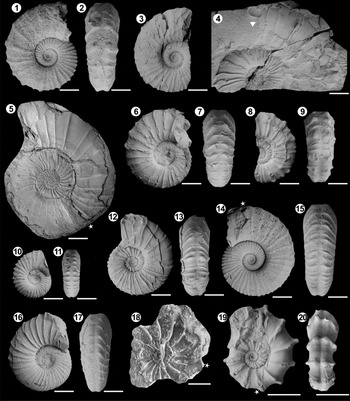
(1–17) Lytohoplites burckhardti (Mayer-Eymar in Burckhardt, Reference Burckhardt1900) from the Vaca Muerta Formation: (1, 2) MCNAM-PI 24861.6, macroconch, lateral and ventral views; (3) MCNAM-PI 24861.7, macroconch, lateral view; (4) MCNAM-PI 24864.1, macroconch, lateral view with simple aperture preserved; (5) MCNAM-PI 24590, macroconch, lateral view; (6, 7) MCNAM-PI 24863.2, macroconch, lateral and ventral views; (8, 9) MCNAM-PI 24861.8, macroconch, lateral and ventral views; (10, 11) MCNAM-PI 24859.4, microconch?, lateral and ventral views; (12, 13) MCNAM-PI 24864.3, macroconch, lateral and ventral views; (14, 15) MCNAM-PI 24597, macroconch, lateral and ventral views; (16, 17) CPBA 22636.4, macroconch, lateral and ventral views. (18–20) Lytohoplites subcylindricus Collignon, Reference Collignon1962: (18) holotype, UBGD 10794, lateral view of an inverted cast; (19, 20) MCNAM-PI 24596, macroconch?, lateral and ventral views. 1–4, 6–15, 19, 20, Arroyo Durazno, Mendoza; 5, Las Loicas, Mendoza; 16, 17, Arroyo del Yeso, Mendoza; 18, Bevoay, Madagascar. All specimens are coated with ammonium chloride. Stars indicate the end of the phragmocone. Arrowheads indicate the aperture and aperture modifications wherever preserved. All scale bars represent 1 cm.

The neotype specimen GZG 499-114 (Fig. 6.1, 6.2), which was described in detail by Burckhardt (Reference Burckhardt1903, p. 61), shows its last portion, corresponding to the body chamber, crushed and somewhat distorted, and the main ribs of the last whorl tend to be arranged in pairs.
Microconchs
Eleven specimens from Arroyo Durazno: MCNAM-PI 24859.1–24859.3, MCNAM-PI 24859.4 (Figs. 7.10, 7.11), MCNAM-PI 24859.6 (Fig. 6.11), MCNAM-PI 24860 (Figs. 6.12–6.14), MCNAM-PI 24862, 24865, 24871, and MCNAM-PI 24870 (Fig. 6.3) are considered as potential microconchs of L. burckhardti, and only one of them (MCNAM-PI 24870) preserves the basal narrow portion of a broken right lappet (Fig. 6.3). They are tentatively assigned to this species due to the comparable features of early whorls, their smaller size, the prevailing of simple ribs over bifurcated ones, and by the development of falcoid ribbing over the upper third of the flank of the last portion of the phragmocone and over the body chamber. In addition, the dispersion of the plots of H/D, H/W, U/D, and U/H against D (Fig. 3.1–3.4) do not show any appreciable ontogenetic deviations between putative macroconchs and microconchs. The later also occur at the same stratigraphical interval as macroconchiates specimens. Microconchs are smaller (estimated maximum diameter of 45–50 mm, ~53–71% of macroconchs) with a body chamber that is at least half a whorl long. Shells are discoidal, weakly compressed, and subevolute, with shallow umbilicus from the inner whorls (Fig. 3.1–3.3). Flanks are slightly convex and converge over a rather narrow furrowed venter. Whorl cross-section is subtrapezoidal but slender, higher that wide (H/W ~1.1 mm on middle to outer whorls). Described ribbing stages for macroconchs are recognized in microconchs (Fig. 3.6), but sickle-shaped ribs are only evident over the upper flank of the last portion of the phragmocone and over the body chamber (MCNAM-PI 24859.1). Prorsiradiate ribs are of fine to medium thickness over the phragmocone and low-angle bifurcations take place between the middle and the upper third of the flank. The onset of ventral and lateral spiny to rounded tubercles of stage c takes place between 20–30 mm in diameter, near the end of the phragmocone (Fig. 3.5). Bifurcations of this stage can be high angled (MCNAM-PI 24870, Fig. 6.3) or low angled (MCNAM-PI 24859.6, Fig. 6.11), but the aboral secondary rib is thicker than the adoral one and both can merge into a single ventral tubercle. Primary ribs are very distant, prorsiradiate, mostly straight (MCNAM-PI 24870, Fig. 6.3) or somewhat sigmoidal (MCNAM-PI 24859.6, Fig. 6.11) up to the upper third of the flank over the body chamber. They can be bituberculated, with a rounded to sharp lateral tubercle over the upper portion of the flank and another one over the venter. Intercalatory ribs were not recorded.
Materials
142 specimens from Mendoza, Argentina. One from Arroyo Cieneguita (GZG.INV.97114; neotype); one from Arroyo La Manga (GZG.INV.97115); three from Quebradas del Mollar (STIPB 315.1–315.3, Gerth Collection); two from Las Leñas (STIPB 1120.1–1120.2, Gerth Collection); two from Cerro Amarillo (CPBA 22069.1–22069.2); 26 from Arroyo Paulino (Beds Py30-31 and Py31; MCNAM-PI 24875.1–24875.20, 24876, 24877.1–24877.5); 85 from Arroyo Durazno (Beds DU37, DU39–DU41 and DU43: MCNAM-PI 24597, 24601.1–24601.8, 24859.1–24859.6, 24860, 24861.1–24861.9, 24862, 24863.1–24863.5, 24864.1–24864.11, 24865, 24866, 24867.1–24867.2, 24868–24871, 24872.1–24872.5, 24873.1–24873.4, 24874.1–24874.2; CPBA 23100.1–23100.12, 23118.1–23118.2); 10 from Las Loicas (Beds LLt7-25′ and LLt7-31; MCNAM-PI 24590, 24646.1–24646.7; CPBA 23248.1–23248.2), and 12 from Arroyo del Yeso (Bed Ay3′; CPBA 22636.1–22636.12).
Variability
The intraspecific variability observed in the macroconchiate specimens of L. burckhardti can be accommodated in a tripolar spectrum according to modifications in height-to-width ratio (and hence in cross-section morphology), shell evolution, ribbing intensity, and/or tubercle onset. Compressed, robust, and slender variants are recognized (Fig. 5). Compressed shells (e.g., MCNAM-PI 24601.2, Fig. 6.15, 6.16; MCNAM-PI 24601.3, Fig. 6.8–6.10, MCNAM-PI 24597, Fig. 7.14, 7.15) are less evolute and show a slender whorl cross section (mean H/W = 0.93, mean U/D = 0.31). Their primary ribbing also is denser per half whorl and have a comparatively shorter c stage than robust forms. The latter (e.g., MCNAM-PI 24601.1, Fig. 6.5–6.7; MCNAM-PI 24598, Fig. 6.17, 6.18; MCNAM-PI 24861.6, Fig. 7.1, 7.2; MCNAM-PI 24861.8, Fig. 7.8, 7.9) are more evolute (mean U/D = 0.33), have a subquadrangular whorl section (mean H/W = 1.02), show fewer ribs per half whorl (ribs are coarser), and lateral tubercles of stage c may be evident from the inner whorls onwards, thus shortening stage b. Hence, the robust morphological pole includes the most peramorphic variants. Finally, the slender pole (e.g., CPBA 22636.4, Fig. 7.16, 7.17; MCNAM-PI 24864.1, Fig. 7.4) accommodates those shells with subinvolute inner whorls, but subevolute outer whorls (mean U/D = 0.32), and having a subquadrangular whorl section, but with rounder flanks than those of the shells of the robust pole (mean H/W = 1.07). The slender pole is mainly characterized by shells with a delicate ornamentation, thinner and denser ribs, and low division angles on bifurcated ribs. Delicate intercalatory ribs paralleling the trajectories of primary ribs or fusing with them, up to the inner third of the flank, are usual as well as fine lirae. Stages a and b are longer than on the other poles and stage c is indicated by the occurrence of elongated to spiny lateral tubercles and rounded bulged tubercles over the outer whorl's ventral area. In contrast to the robust pole, the slender-pole groups the more pedomorphic variants.
End members of this tripolar spectrum are connected by all possible intermediaries. Variability regarding the suture line could not be properly assessed because it was not possible to obtain its full length from all variants.
Some variability can also be observed in the potential microconchiate specimens. Those individuals with a more depressed cross section (e.g., MCNAM-PI 24860, Fig. 6.12–6.14) also show a coarser ornamentation and are slightly more evolute than those with a more compressed whorl section (e.g., MCNAM-PI 24859.1). Nevertheless, a larger sample of microconchs would allow evaluating their range in morphological variability.
Remarks
Hoplites burckhardti was introduced at the beginning of the 20th century by Mayer-Eymar (in Burckhardt, Reference Burckhardt1900) based on a specimen from Upper Jurassic–Lower Cretaceous loose rocks near Las Lajas, Neuquén, Argentina. That specimen, which only consisted of nearly a half outer whorl of a shell, was later refigured by Burckhardt (Reference Burckhardt1903, pl. 10, figs. 17, 18, 20) and Windhausen (Reference Windhausen1931, pl. 30, fig. 9), and subsequently included in both Ammonoidea Treatise editions (Arkell et al., Reference Arkell, Bernhard, Wright and Moore1957, figs. 463a–c; Wright et al., Reference Wright, Callomon and Howarth1996, figs. 38a–c). Burckhardt (Reference Burckhardt1903) also assigned three specimens from Steuer's collection at Göettingen to L. burckhardti, all coming from southern Mendoza localities (Steuer, Reference Steuer1921).
Although Burckhardt certainly considered some degree of morphological variability of L. burckhardti (Burckhardt, Reference Burckhardt1903, p. 62), he still assigned two specimens to a new species, Lytohoplites vetustoides (Burckhardt, Reference Burckhardt1903, p. 62, pl. 10, figs. 23–25). The figured shell preserves only half of the outer whorl and a small fragment of an inner whorl. It is possible that Burckhardt considered it a different species due to its more compressed whorl section and lack of rounded tubercles. Nevertheless, the morphotype represented by the holotype and the neotype specimens can be related to the here-described slender pole, while the one displayed by the nominal species, L. vetustoides, can be accommodated somewhere between the slender and the compressed poles. Therefore, L. vetustoides is considered a junior synonym of L. burckhardti.
Morphological variability of L. burckhardti was also recognized by Gerth (Reference Gerth1925, p. 98), who studied a sample of more than 20 specimens coming from different localities of southern Mendoza. Part of this material, currently stored at the Steinman Institute at Bonn, was available to the authors by pictures that proved representatives of the three morphological poles herein described. Lytohoplites burckhardti was originally mentioned by Gerth as Hoplites burckhardti, following Burckhardt's original designation (Gerth, Reference Gerth1921, p. 148), then as Kilianella Uhlig (Gerth, Reference Gerth1925, p. 98), and finally as Lytohoplites (Gerth Reference Gerth1925, p. 130; Reference Gerth1926, p. 476) following Spath (Reference Spath, Wyllie and Smelly1925).
From a siliciclastic interval on the top of the El Quemado Complex in the Lago Argentino region (Austral or Magallanes Basin, Santa Cruz, Argentina), Feruglio (Reference Feruglio1936, p. 70, pl. 8, fig. 6) reported a laterally crushed specimen (IGPUB 361) as a probable new variant of Berriasella alternans Gerth, Reference Gerth1925. The specimen was later revised by Leanza (Reference Leanza1967, p. 146) and reassigned to L. burckhardti. On the first portion of the preserved outer whorl, the ribbing resembles the c stage here described, but from there onwards, ribs are grouped in pairs following the disposition observed in L. subcylindricus Collignon (described below). The poor preservation of Feruglio's specimen prevents a more assertive assignation to either of the two species.
Howlett (Reference Howlett1989, p. 23, pl. 4, fig. 3) described a fragmentary and somewhat distorted specimen from Planet Heights, Alexander Island, Western Antarctica and assigned it to L. cf. burckhardti. Despite its resemblance to L. burckhardti type material, the development of more prominent tubercles and a less-inflated whorl section prevented Howlett from providing a full assignation at that time. Nevertheless, the Antarctic specimen (BAS KG 3404.138, of which colorful pictures are available at the British Antarctic Survey webpage) is comparable to the specimen MCNAM-PI 24863.2 from Arroyo Durazno, Mendoza (Fig. 7.6, 7.7), which represents a transitional morphotype between the slender and coarser poles of L. burckhardti.
The Chilean specimen described as L. burckhardti by Biró-Bagóczky (Reference Biró-Bagóczky1964, p. 102, pl. 23, figs. 3a, b) was refigured by Salazar Soto (Reference Salazar Soto2012, p. 209, figs. 4.72d–f) and reassigned to L. zambranoi Salazar Soto, Reference Salazar Soto2012. Although inner whorl ornamentation of the holotype of L. zambranoi is comparable to that of the more robust variants of L. burckhardti, outer whorls differ in presenting finer and denser ribbing with a consequent attenuation of tubercle development. Salazar Soto (Reference Salazar Soto2012) introduced three more species of the genus Lytohoplites, all of them coming from the basal portion of the Sandstone Member of the Lo Valdez Formation, Chile. Nominal species L. paredesi Salazar Soto, Reference Salazar Soto2012 and L. rauloi Salazar Soto, Reference Salazar Soto2012 might represent a single species characterized by an evolute shell with convex venter and groups of two or three ribs converging on upper lateral and/or latero-ventral tubercles (Salazar Soto, Reference Salazar Soto2012, p. 207, figs. 4.70a, b, 4.71a–h, p. 212, figs. 4.70f, 4.74a–i). Such ribbing has not been observed in L. burckhardti representatives. Regarding L. varelae Salazar Soto, Reference Salazar Soto2012 (p. 211, figs. 4.73a–j, 4.74e), its compressed shell, oval whorl section, and lack of a ventral furrow even on inner whorls, cast some doubts on its assignation to Lytohoplites.
Concerning other records of the genus, the specimens coming from the Chichali Formation (ex Belemnite Beds), Salt Range, Pakistan, which were originally labeled as Neocosmoceras sp. nov. (Spath, Reference Spath1939, p. 68, pl. 6, figs. 4a–d, pl. 7, figs. 4a-d, pl. 18, figs. 4a, b) and later on transferred to Lytohoplites by Enay (Reference Enay1972, p. 377), as well as the specimen figured as Neocosmoceras sp. indet. cf. sayni (Simionescu) by Spath (Reference Spath1939, p. 70, pl. 7, figs. 3a–d), differ from L. burckhardti in presenting more spaced and not falcoid ribs. Lack of a third row of umbilical tubercles sustains their exclusion from Neocosmoceras Blanchet, Reference Blanchet1922.
Lytohoplites from Madagascar, L. houcqi (Besairie, Reference Besairie1936) and L. hourcqi bevoayensis Collignon, Reference Collignon1960, differ from L. burckhardti in being planulate and by lacking lateral tubercles. Lytohoplites besairiei Collignon, Reference Collignon1960, L. besairiei ambilobensis Collignon, Reference Collignon1960, and L. besairiei saonjensis Collignon, Reference Collignon1960 bear strong paired looped primaries and lateral tubercles that are less developed than on the coarser variants of L. burckhardti. Lytohoplites transitorius Collignon, Reference Collignon1960 and L. andranomainyensis Collignon, Reference Collignon1962 are more involute and bear frequent bifurcated and closely spaced ribs. Lytohoplites ambatomasinensis Collignon, Reference Collignon1962 lacks a row of lateral tubercles, and primary ribs are rather flexuous over the inner two thirds of the flank. The differentiation of L. subcylindricus Collignon, Reference Collignon1962 from L. burckhardti is discussed below.
Lytohoplites subcylindricus Collignon, Reference Collignon1962
Figures 3, 7.18–7.20
- 1962
Lytohoplites subcylindricus Collignon, p. 11, pl. 179, figs. 794, 795.
Holotype
By original designation. Specimen UBGD 10794 (Collignon, Reference Collignon1962, pl. 179, figs. 794, 795), here refigured (Fig. 7.18), from lower? Berriasian beds, Bevoay, Morondava Basin, Madagascar.
Diagnosis
Small subevolute shells with subtrapezoidal whorl section and narrow furrowed venter. Ribbing dominated by simple ribs, bituberculated on middle to outer whorls. Ventrolateral tubercles are rounded to sharp. Ventral tubercles are well developed, rounded to clavate. Body chamber with widely spaced ribs.
Occurrence
Vaca Muerta Formation, Neuquén Basin, Argentina (Arroyo Durazno, Mendoza); Morondava Basin, Madagascar (Bevoay). Upper Tithonian–?lower Berriasian.
Description
The specimen MCNAM-PI 24596 (Fig. 7.19, 7.20) is well preserved and bears some patches of neomorphic shell still adhered. Only the last portion of the body chamber is laterally crushed. It is a small discoidal shell (24 mm in diameter) with the phragmocone extended up to 17.5 mm in diameter, and with almost 210° of the body chamber preserved, although its aperture is not visible. Flanks are convex and converge over a narrow flattish venter. Whorl section is weakly compressed, subtrapezoidal, higher than wide (mean H/W= 1.06, Fig. 3.1, 3.2), with its maximum width at around the middle of the flank. Whorl overlapping is weakly embracing. The conch is subevolute (mean U/D = 0.36, Fig. 3.3) with a fairly shallow umbilical area, delimited by a scarcely defined rounded margin and a low umbilical wall.
Inner whorls bear regularly disposed, simple fine to medium ribs at least up to the coiling line (Fig. 3.5, 3.6). Starting from the last whorl of the phragmocone onwards, ribs are gradually thicker and tend to be arranged in pairs. The front rib of each pair is thinner than the posterior one, which bears two rows of tubercles, one ventrolateral, rounded to sharp and arising just below the coiling line, and another one ventral, rounded to clavate and well projected. Ribs are prorsiradiate and no backwards deflection is observed on the upper portion of the flank. Ribbing is interrupted or weakened on the ventral region by a narrow furrow, which is more noticeable on the internal mold. Only simple, widely spaced, bituberculated ribs remain over the body chamber, with the conch somewhat sunken between them. A slight forward inclination of the ribbing on the upper third of the flank occurs on the last whorl quarter preserved. The suture line could not be obtained.
The holotype (specimen UBGD 10794, Fig. 7.18) is preserved as an external mold. It is a small specimen, ~29 mm in diameter, of which half of the last whorl corresponds to the body chamber. Although the inner whorls are partially obscured by an encrusting serpulid tube, ribbing is fine and regularly disposed. The last portion of the phragmocone shows paired ribs, as described above in specimen MCNAM-PI 24596. Ventrolateral and ventral tubercles are well developed. Upwards from the row of ventrolateral tubercles, ribs are more markedly prorsiradiate. In addition to that, the paratype (Collignon, Reference Collignon1962, pl. 179, fig. 795) shows a fragmentary body chamber with a narrow ventral region, bearing exclusively bituberculated ribs.
Materials
Three specimens. One from Arroyo Durazno (Bed DU29), Mendoza, Argentina (MCNAM-PI 24596); and two from Bevoay, Madagascar (UBGD 10794–10795).
Remarks
Lytohoplites subcylindricus is here described for the first time outside Madagascar. The size, umbilical width, and specially the ribbing features described in the specimen MCNAM-PI 24596 (Fig. 7.19, 7.20) are comparable to those of the type material, albeit a slightly thicker ribbing on the inner whorls of the Argentinean shell. The morphological resemblance of L. subcylindricus and L. besairiei Collignon, Reference Collignon1960 (pl. 165, figs. 674, 675) was already indicated by Collignon (Reference Collignon1962, p. 11), but specimens of L. besairiei are larger (both lack body chambers) and some of the pairs of primaries (which, in addition, do not significantly differ in thickness) converge on a ventral tubercle. Nevertheless, a better stratigraphical resolution and a larger sample might allow elucidating the morphological variability of the species.
Lytohoplites subcylindricus is easily differentiable from L. burckhardti mostly by its narrower venter, twinned ribbing, and clavate ventral tubercles. Although the final size is comparable to that of L. burckhardti potential microconchs, ribs are never falcoid, which cuts out the possibility of considering L. subsylindricus as an extreme morphological variant of the former.
Paleontological analysis results and discussion
Intraspecific variability of Lytohoplites burckhardti
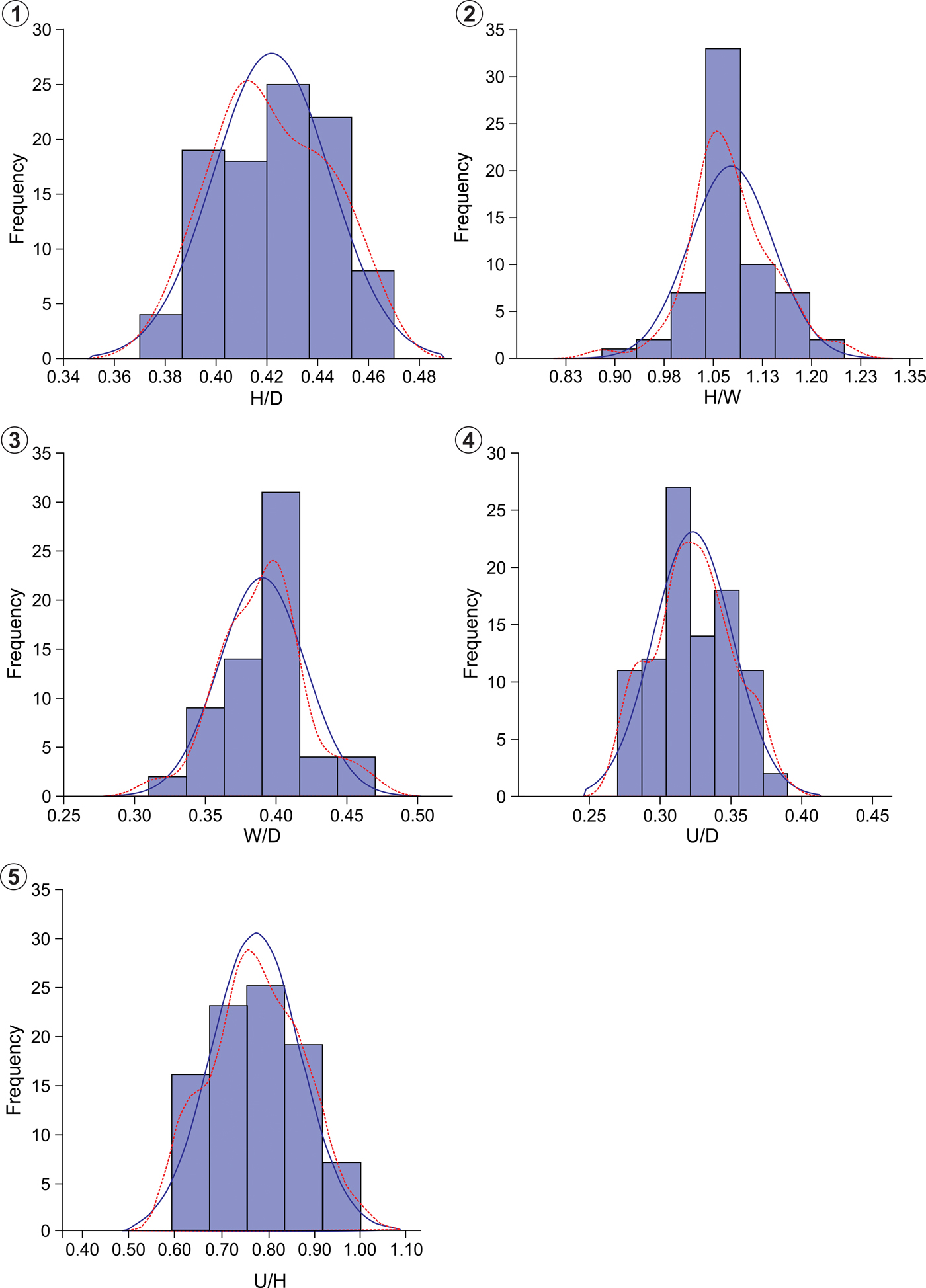
The univariate analysis of N = 51 shells from Arroyo Durazno (Table 1) resulted in two unimodal histograms for variables H/W and W/D, and two slightly bimodal histograms for variables H/D, U/D, and U/H (Fig. 8), although bimodality is not decisive. Frequency distributions of variables H/W, W/D, U/D, and U/H are consistent with a Gaussian distribution (0.9656 < Shapiro-Wilk < 0.9836; with 0.058 < p < 0.3164). Unimodal, normal distributions are considered good indicators of continuous intraspecific variation within a population restricted in time and space (Kennedy and Cobban, Reference Kennedy and Cobban1976; Monnet et al., Reference Monnet, Bucher, Wasmer and Guex2010; De Baets et al., Reference De Baets, Bert, Hoffmann, Monnet, Yacobucci, Klug, Klug, De Baets, Kruta and Mapes2015), which might represent a single species (Tintant, Reference Tintant1980). These results reinforce the null hypothesis of homogeneity of the sample and the choice to interpret it as a single taxonomic entity.
Frequency histograms of shell parameters of Lytohoplites burckhardti: (1) H/D, whorl height ratio; (2) H/W, whorl compression; (3) W/D, whorl width ratio; (4) U/D, umbilical width ratio; (5) U/H, umbilical width to whorl height ratio. The red broken line corresponds to the kernel density estimation of the distribution of the data and the full blue line to the theoretical normality curve. The number and width of bins of each histogram were set by default by the PAST environment 3.18.

Basic statistics on the Arroyo Durazno Lytohoplites burckhardti sample: N = number of measurements, H/D = whorl height ratio, W/D = whorl width ratio, H/W = whorl compression, U/D = umbilical width ratio, U/H = umbilical width to whorl height ratio, Ru/2 = number of umbilical ribs per half a whorl, Rt/2 = number of bituberculated ribs per half a whorl.

Regarding the variable H/D, in spite of failing the normality test (Shapiro-Wilk = 0.971, p = 0.031), its kernel density estimation is a close match to a normality curve (Fig. 8.1), hence it does not allow rejecting the null hypothesis of homogeneity of the sample. H/D results might be influenced by differences in post-burial compression. Even considering that the specimens come from the same section, they were collected from beds with different diagenetic features (i.e., early cemented [carbonate concretions or mudstones] or uncemented [shales or marls]) beds (Westphal et al., Reference Westphal, Head and Munecke2000; Wani and Gupta, Reference Wani, Gupta, Klug, De Baets, Kruta and Mapes2015).
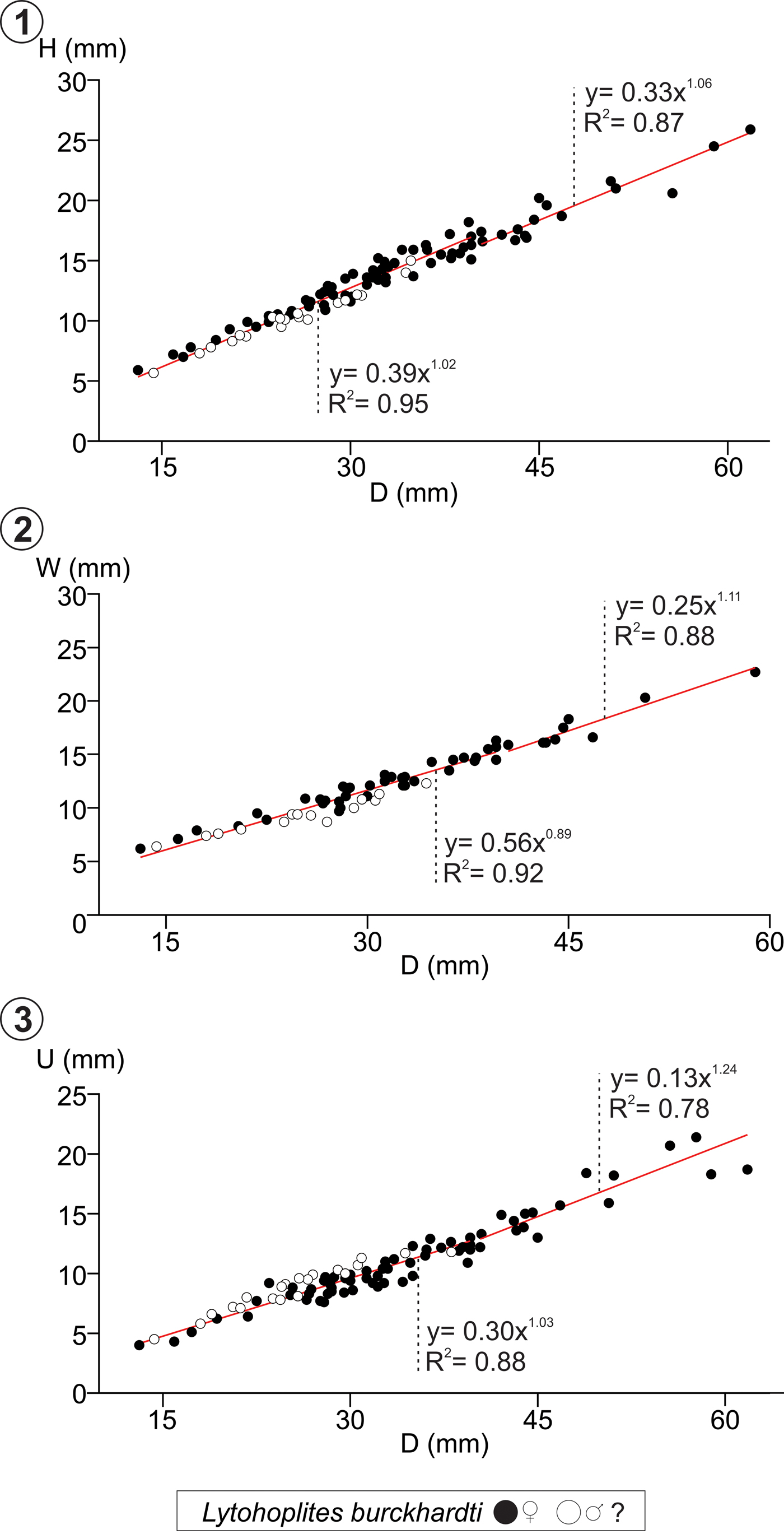
The bivariate analyses of H, W, and U against shell diameter resulted in regression curves that showed a more variable growth of shells after ~40 mm in diameter (Fig. 9). This result is in accord with the paleontological analysis because the adult body chamber of L. burckhardti begins at 40–50 mm in diameter in macroconchs and dispersion of data might be related to differences in coiling and cross-section after reaching maturity. Parameters measured over potential microconchs do not show evident deviation from the general tendencies observed.
Bivariate plots and regression curves of shell parameters of Lytohoplites burckhardti: (1) H, whorl height; (2) W, whorl width; (3) U, umbilical width; all against D, diameter.

For D < 40 mm, whorl height and umbilical width curves (Fig. 9.1, 9.3) show isometric growth, consequently the relationship of those parameters with diameter is consistent with a linear regression model with low dispersion of data (0.88 < R2 < 0.95). By contrast, for D > 40 mm in diameter, growth is sub-isometric for H (a is slightly different from 1), although R2 is still high (R2 = 0.87), and allometric for U (R2 = 0.78). Whorl height variability with respect to diameters < 40 mm is related to the growth slowdown of the shell after reaching maturity and to the acquisition of a more depressed whorl section over the body chamber (Fig. 3.1, 3.2). Allometric growth of the umbilical width on larger shell diameters might also be related to adulthood changes, but it also might be reflecting a smaller number of measurements of that parameter on body chambers than on phragmocones. Allometric growth during the entire ontogeny was obtained for W (Fig. 9.2) and with low dispersion of the data around the mean (0.88 < R2 < 0.92). Again, accurate measurements of whorl width were obtained in fewer individuals and different post-burial compression rates might be affecting the results.
Regarding ornamentation (Fig. 3.5, 3.6), ribbing density per half whorl shows a general tendency to decrease between 15–45 mm in diameter because primary ribs are more spaced during growth. The timing of the onset of bituberculated ribs varies through the studied population, thus defining the duration of stage c. For instance, compressed and slender variants (more pedomorphic) bear bituberculated ribs from ~40 mm in diameter, which is later than robust forms (more peramorphic) that show them from ~33 mm in diameter.
In spite of the different relationships in growth found for the studied shell parameters, the data do not allow recognition of distinct ontogenetic trajectories, thus being in accord with the existence of a single ammonoid species in the sample. Also, variation coefficients of geometric shell parameters (Table 1) are all relatively low (<9). Those related with ornamentation characters are higher as a reflection of the greater variability observed in ribbing density and tubercles onset during the ontogeny of the different morphotypes.
Prior to the multivariate analysis, the normality of the whole sample for the variables D, H/D, H/W, U/D, U/H, Ru/2, and Rt/2 was checked. The Doornik and Hansen test indicated a non-normal distribution (Ep = 1595, p = 0), so the data had to be log-transformed (Log base 10). Equality of variances (homoscedasticity) between each pair of variables was tested through an F test, which resulted in significantly low p values (p < 0.05) in all cases, thus indicating the procedure of standardization of the data and choice of a correlation matrix for the PCA.
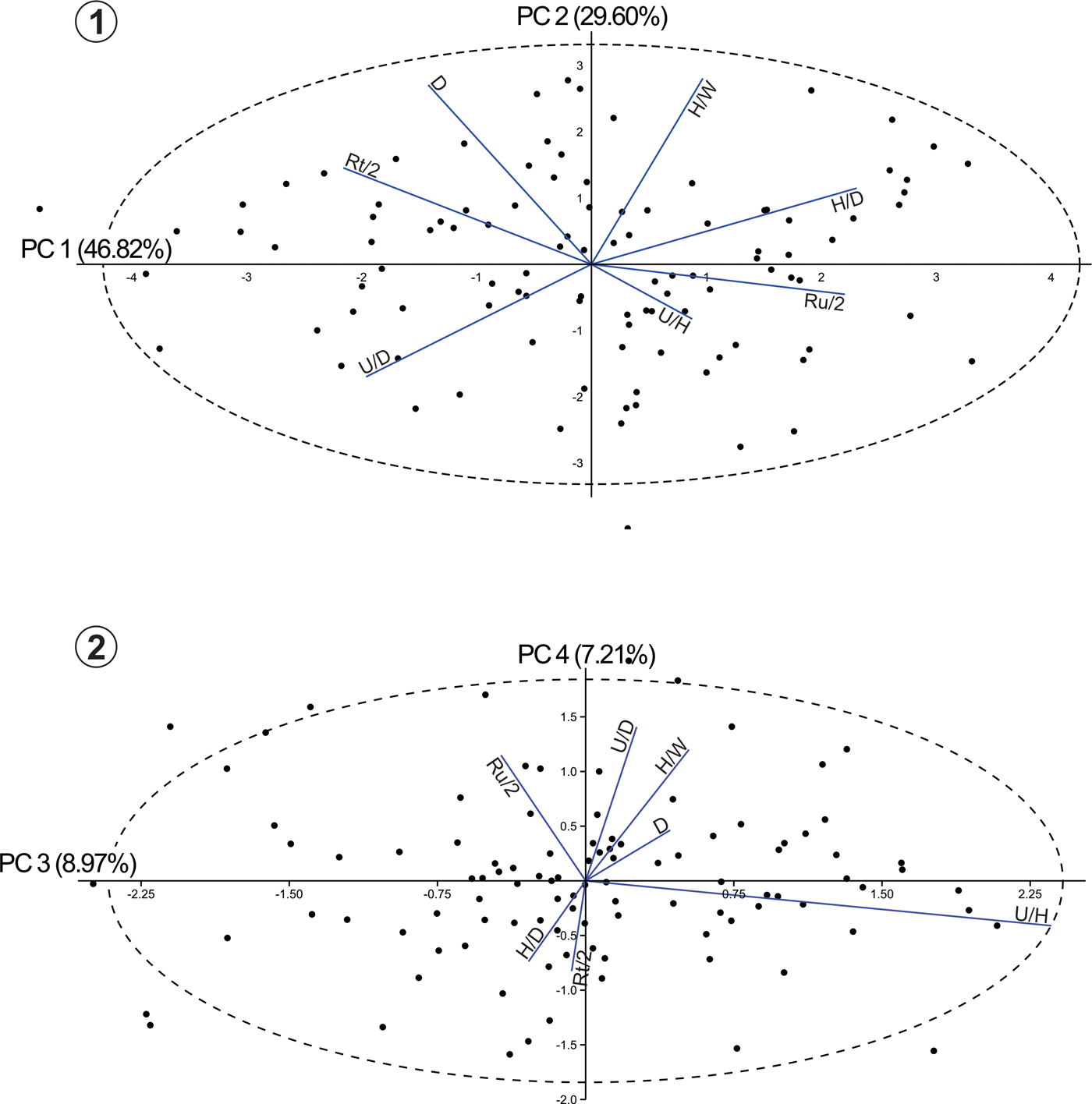
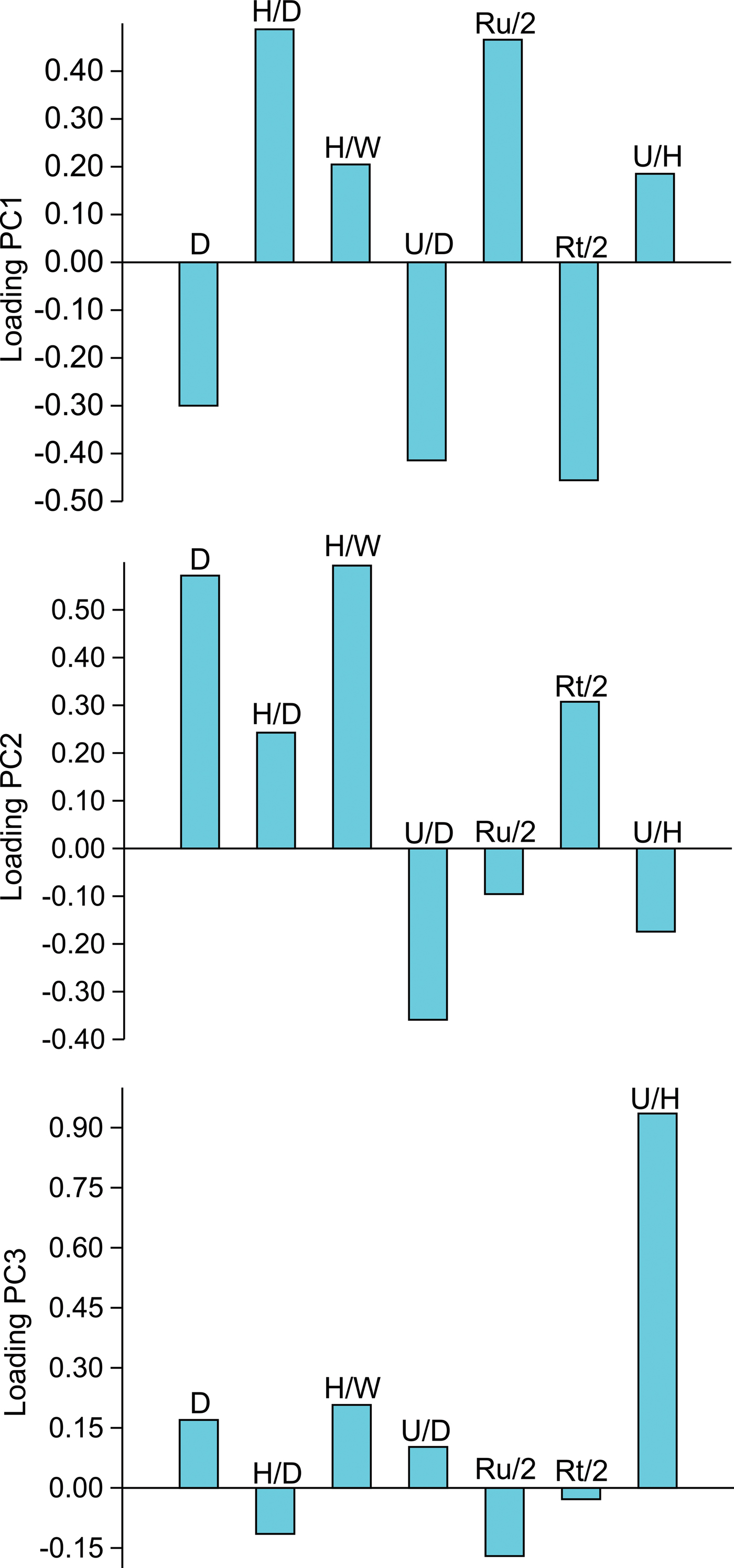
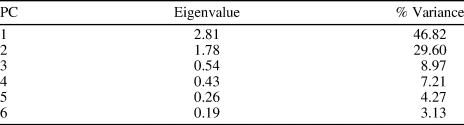
The first three components obtained from the PCA have eigenvalues of 2.90, 1.77, and 0.94 (PC1, PC2, and PC3, respectively), and together explain 79.80% of the total variance of the sample (Table 2). The variables H/D, U/D, Ru/2, and Rt/2 are mostly expressed by PC1 (Figs. 10.1, 11), the variables D and H/W are principally supported by PC2 (Figs. 10.1, 11), while U/H is strongly expressed by PC3 (Figs. 10.2, 11). Analysis of the biplot of the first two principal components (PC1 vs PC2, Fig. 10.1) shows a significant negative correlation (vectors situated in almost a straight angle) between H/D and U/D (rs = −0.684, p = 1.066 × 10⁻¹³), thus the relative whorl height is inversely correlated with the relative umbilical width. Both vectors are also almost orthogonal to D, indicating their independence from shell size (rs = −0.136, p = 0.186 for D and H/D; rs = −0.016, p = 0.875 for D and U/D). A weak correlation is observed between the relative whorl section (H/W) and the relative umbilical width (U/D), although their corresponding vectors are almost opposite (rs = −0.684, p = 0.737). In accordance with Figure 3.5, the PCA indicates a strong positive correlation between the number of bituberculated ribs (Rt/2) and the diameter of the shells (rs = 0.640, p = 3.618 × 10⁻¹²). Conversely, Rt/2 is inversely correlated with the number of umbilical ribs (Ru/2) as a measure of ribbing density since their projected vectors are quite opposite (rs = −0.490, p = 1.644 × 10⁻⁶). The projected vectors of both ornamental variables are almost orthogonal with the shell relative section (H/W), indicating their lack of correlation (rs = −0.347, p = 0.184 for Rt/2 and H/W; and rs = 0.435, p = 0.204 for Ru/2 and H/W). A similar relationship is observed with relative umbilical width (rs = −0.174, p = 0.048 for Rt/2 and U/D; and rs = 0.171, p = 0.024). While ribbing density is more related to whorl relative height than to shell size (rs = 0.435, p = 2.825 × 10⁻⁵ for Ru/2 and H/D; and rs = −0.306, p = 0.003 for Ru/2 and D). In addition, the biplot of PC3 vs PC4 (Fig. 10.2) shows an almost orthogonal relationship between U/H and the rest of the variables and a slight positive correlation with D (rs = −0.253, p = 0.016).
Biplot of the Principal Component Analyses (PCA) of shell and ornament variables of Lytohoplites burckhardti: (1) PC1 vs PC2; (2) PC3 vs PC4.

Loading of the variables for the first three principal components (PC). D, diameter; H/D, whorl height ratio; H/W, whorl width ratio; U/D, umbilical width ratio; U/H, umbilical width to whorl height ratio; Ru/2, number of ribs per half a whorl; Rt/2, number of bituberculated ribs per half a whorl.

Amount of variance (as percentage) and eigenvalues of each of the principal components (PC) of the Principal Component Analysis (PCA).

No evident clustering is observed in the spatial distribution of the dots in any of the biplots (Fig. 10). Actually, the projected point values over the three principal components analyzed (PC1 to PC3) indicate a normal unimodal distribution (Shapiro-Wilk = 0.986, p = 0.356 for PC1; 0.990, p = 0.603 for PC2; and 0.984, p = 0.235 for PC3). Therefore, the multivariate analysis cannot reject the null hypothesis of homogeneity of the sample.
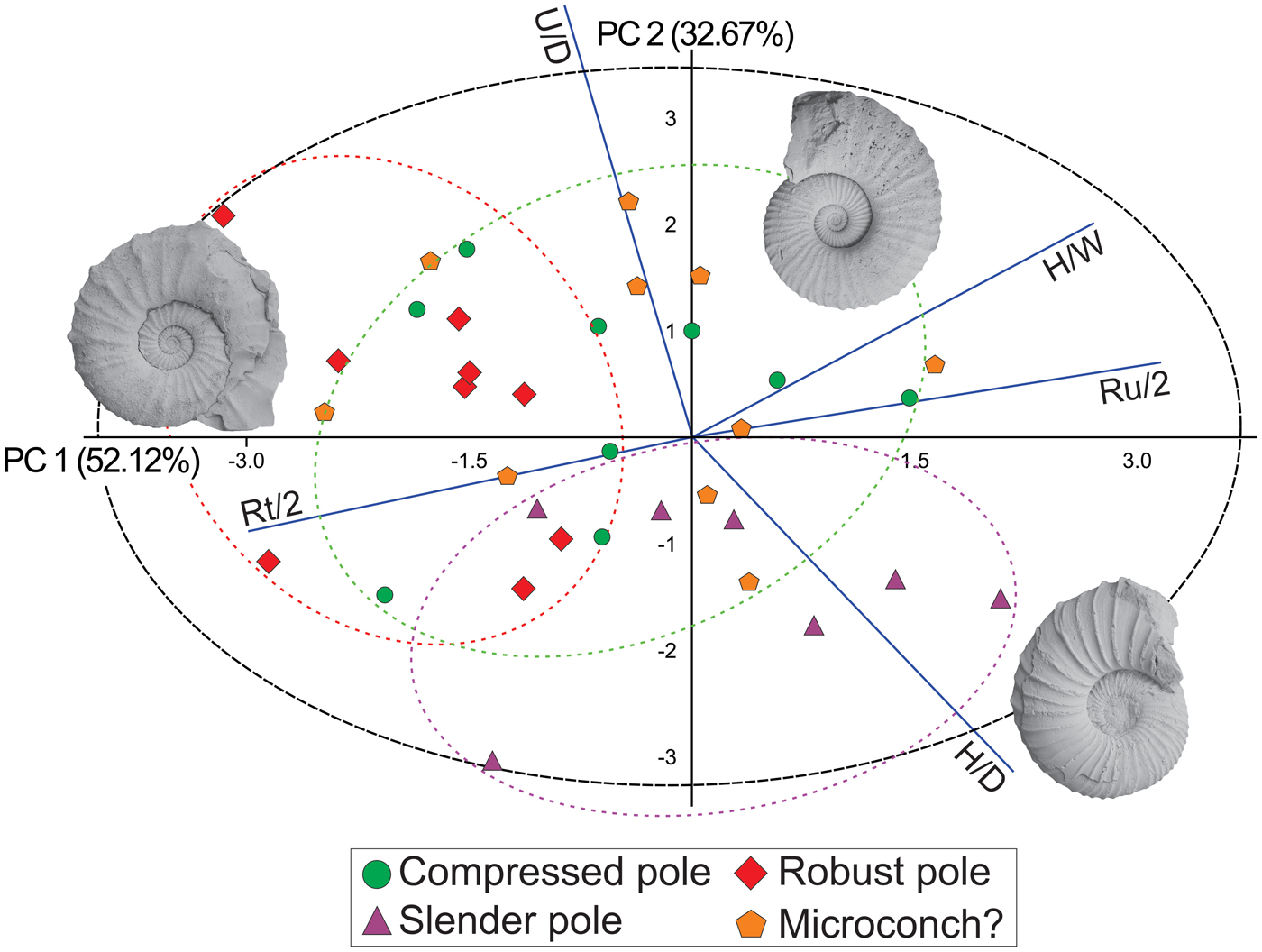
To visualize occupation of the morphological space of the variants, a new PCA was run without D in order to remove the influence of size in the analysis (Fig. 12). Moreover, when U/H was included, no preferential grouping of the observations was detected, so the variable U/D is considered instead. By doing that, the morphological poles described in the paleontological analysis (compressed, robust, and slender extreme morphologies, Fig. 5) tend to occupy different positions in the space defined by the analyzed variables, albeit with some degree of overlapping (Fig. 12). For instance, robust specimens (evolute with depressed whorl section and high number of bituberculated ribs) are mostly situated over the mid portion of the left quadrants of the PCA (i.e., between the projected vectors of Rt/2 and U/D). Slender specimens (less evolute, with depressed whorl section and delicate ribbing) are chiefly located over the opposite portion of the biplot, around the projected vector of H/D, whereas compressed variants (with higher H/W ratios and bituberculated ribs only on outer whorls) are in an intermediate position between robust and slender morphotypes. Potential microconchiate specimens appear to be scattered over the morphological space, and they were not grouped either when considering U/H instead of U/D.
Biplot of the Principal Component Analyses (PCA) of shell and ornament variables of Lytohoplites burckhardti without the influence of size (D). Broken lines contour the maximum density distribution of each variant. The ellipse depicts 95% of the data concentration.

To sum up, in accordance with the qualitative analyses, the quantitative uni-, bi-, and multivariate methods failed to detect more than one population within the analyzed subsample coming from Arroyo Durazno, Mendoza, thus strengthening the homogeneity of the studied sample and of L. burckhardti as a valid species.
Contrary to what was expected according to Buckman's first rule of covariation (Westermann, Reference Westermann1966)—the more depressed, the more evolute and more ornamented an ammonoid shell is (Monnet et al., Reference Monnet, De Baets, Yacobucci, Klug, De Baets, Kruta and Mapes2015)—the results obtained from the PCA show almost no correlation between shell relative cross section (H/W) and ornamental characters (Rt/2 and Ru/2). Similar results have been obtained by previous authors on other ammonoid groups, for which alternative explanations were proposed (e.g., Yacobucci, Reference Yacobucci2004; Bert, Reference Bert2014; Monnet et al., Reference Monnet, De Baets, Yacobucci, Klug, De Baets, Kruta and Mapes2015). It is possible that the existence of a third (slender) morphological pole is interfering with the straightforward application of Buckman's first rule, which would otherwise explain well the variability observed between robust and compressed variants. Tripolar morphological variability has also been observed in other unrelated ammonoid groups (Bert, Reference Bert2014 and references therein).
The influence of heterochronies of development (Dommergues et al., Reference Dommergues, David and Marchand1986; Landman and Geyssant, Reference Landman and Geyssant1993) needs to be taken into account as an important factor modulating the duration of the ontogenetic stages, and thus the manifestation of various morphological variants within a homogeneous and isochronus ammonite sample (Courville and Crônier, Reference Courville and Crônier2003; Bersac and Bert, Reference Bersac and Bert2012). In Lytohoplites, the slender pole groups the most pedomorphic variants with delicate ornamentation features and a shorter stage c. In contrast, the robust pole accommodates the most peramorphic shells, with stout ribbing since early whorls and with a longer stage c.
Biostratigraphy and age
The genus Lytohoplites in the Neuquén Basin
An ongoing revision of the Late Jurassic–Early Cretaceous ammonite species of the Neuquén Basin is being conducted by the authors, and in consequence some taxonomic assignations and number of vertical occurrences may differ from those reported in previous publications.
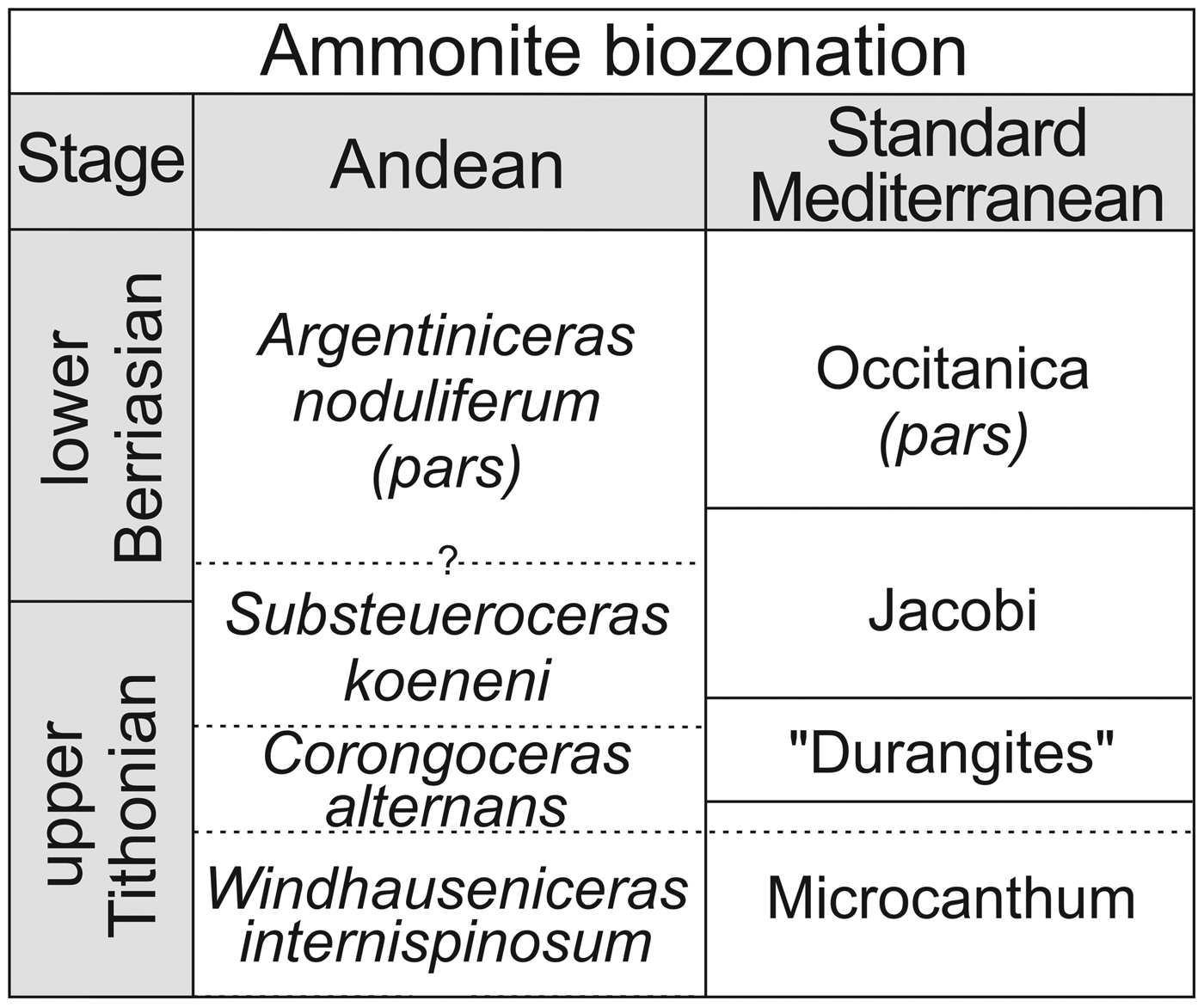
In each of the studied sections, Lytohoplites was found in beds assigned to the lower to middle part of the Andean Substeueroceras koeneni Assemblage Zone (Figs. 2, 13; López-Martínez et al., Reference López-Martínez, Aguirre-Urreta, Lescano, Concheyro, Vennari and Ramos2017; Vennari and Aguirre-Urreta, Reference Vennari and Aguirre-Urreta2017). Lytohoplites burckhardti occurrences are bracketed between the first occurrence (FO) of Substeueroceras striolatissimum (Steuer, Reference Steuer1897) and the last occurrence (LO) of Spiticeras acutum Gerth, Reference Gerth1925 in every analyzed section, with the exception of Cerro Amarillo where those two species were not documented (most probably due to insufficient sampling). As pointed out by Groeber (in Groeber et al., Reference Groeber, Stipanicic, Mingramm, Groeber, Stipanicic and Mingramm1953, p. 359), S. striolatissimum characterizes a restricted stratigraphic interval in the Neuquén Basin within the S. koeneni Zone (Gerth, Reference Gerth1925; Leanza, A., Reference Leanza1945; Leanza, H., Reference Leanza, Volkheimer and Musacchio1981; Riccardi, Reference Riccardi2008, Reference Riccardi2015). Even more, the L. burckhardti range overlaps with that of S. koeneni (Steuer, Reference Steuer1897) and/or S. sp. cf. S. koeneni in Arroyo Durazno, Arroyo Paulino, and Arroyo del Yeso.
Correlation between Andean and Standard Mediterranean ammonite biozonation schemes after Reboulet et al. (Reference Reboulet, Szives, Aguirre-Urreta, Barragán, Company, Idakieva, Ivanov, Kakabadze, Moreno-Bedmar, Sandoval, Baraboshkin, Çaglar, Fözy, González-Arreola, Kenjo, Lukeneder, Raisossadat, Rawson and Tavera2014) and Riccardi (Reference Riccardi2015).

Lytohoplites subcylindricus was found in Arroyo Durazno in a bed (DU29) underlying the FO of S. koeneni at bed DU30, but overlying the FO of Spiticeras acutum at bed DU27 and the LO of Corongoceras duraznense (Krantz, Reference Krantz1926), which equals Micracanthoceras vetustum (Steuer, Reference Steuer1897) (see Salazar Soto, Reference Salazar Soto2012); = C. mendozanus (Behrendsen, Reference Behrendsen1891–1892) (see Parent et al., Reference Parent, Garrido, Scherzinger, Schweigert and Fözy2015), at bed DU25, which is to say at the very base of the S. koeneni Zone at that locality.
In order to understand why Lytohoplites was hitherto considered an element of the late Tithonian Andean Corongoceras alternans Assemblage Zone rather than of the late Tithonian–early Berriasian S. koeneni Zone (Fig. 13), a review of the different interpretations made by the authors who studied the genus and/or associated species is presented below.
The L. burckhardti holotype was originally assigned to the Neocomian (Burckhardt, Reference Burckhardt1900, p. 29) and then specifically to Jurassic–Cretaceous beds (Burchhardt, Reference Burckhardt1903) on account of the presence of Reineckeia koellikeri (Oppel, Reference Oppel1865) (Burckhardt, Reference Burckhardt1900, pl. 20, figs. 14, 15, pl. 21, fig. 1) and Odontoceras ellipsostomum Steuer, Reference Steuer1897 (Burckhardt, Reference Burckhardt1900, pl. 21, figs. 2, 3), both based on some incomplete specimens found in an underlying upper Tithonian interval. Reineckeia koellikeri was recently considered a macroconch of Steueria alternans (Gerth, Reference Gerth1925) by Parent et al. (Reference Parent, Scherzinger and Schweigert2011), while the whorl fragment ascribed to O. ellipsostomum could belong to a large specimen of S. koeneni. Actually, S. koeneni and C. alternans (Gerth, Reference Gerth1925) new specimens (MOZ-PI 11497 and 11496, respectively), have been collected for this study in the same interval studied by Burckhardt. Thus, although L. burckhardti could not been identified, the accompanying fauna not only coincides with that originally reported, but also resembles that recognized in other localities. The hereby selected neotype specimen comes from an upper Tithonian interval nominated Cieneguita-III, sandwiched between Cieneguita-II with Corongoceras mendozanum and Cieneguita-IV with S. koeneni among other species (Steuer, Reference Steuer1897; Parent et al., Reference Parent, Scherzinger and Schweigert2011).
Although Gerth (Reference Gerth1925, Reference Gerth1926) considered the beds with L. burckhardti to indicate the base of the Neocomian in the Andes, and included the species in the S. koeneni Zone (Gerth, Reference Gerth1921), in subsequent contributions it was promoted to index-species of an independent zone located between the C. mendozanum and S. koeneni zones (Gerth, Reference Gerth1925, Reference Gerth1926). According to that author, the accompanying fauna of the L. burckhardti Zone was originally composed of Berriasella alternans Gerth, B. inaequicostata Gerth, Reference Gerth1925, B. spinulosa Gerth, Reference Gerth1925, and S. koeneni in his bed 31 g in Arroyo Durazno (Gerth, Reference Gerth1925, p. 126), and Spiticeras acutum in Arroyo La Manga (Gerth, Reference Gerth1925, p. 119). The Micracanthoceras inaequicostatum-Corongoceras alternans association has been identified in this study between beds DU35 and DU43 in Arroyo Durazno and beds Py30–Py31 to Py31 in Arroyo Paulino.
The biostratigraphic scheme proposed by Gerth for the Neocomian was subsequently followed by Windhausen (Reference Windhausen1931) and Weaver (Reference Weaver1931), yet the latter claimed that S. koeneni and L. burckhardti zones were not as easily differentiated in Neuquén as they were in Mendoza. Weaver (Reference Weaver1931) also reported L. burckhardti from two new localities: Cañada Colorada, in Mendoza, and from Las Lajas, at a western range of the Sierra de la Vaca Muerta. Referring to L. burckhardti occurrences, Weaver (Reference Weaver1931, p. 55) claimed that “it occurred in the same beds that S. koeneni but it is far more abundant in the base than higher up, while the reverse is true of S. koeneni.” Persistence of Lytohoplites in the S. koeneni Zone was also envisaged by Leanza (Reference Leanza, Volkheimer and Musacchio1981, p. 577), although its range was restricted to the C. alternans Zone in Riccardi et al. (Reference Riccardi, Leanza and Volkheimer1990), probably following Leanza's (Reference Leanza1945) suggestions.
Actually, Leanza (Reference Leanza1945) transferred Berriasella alternans Gerth (one of the original components of the Lytohoplites association) to the genus Corongoceras Spath after reporting that species in bed 1762a in Mallín Redondo, Sierra Azul, Mendoza. The specimens identified as C. alternans by Leanza (Reference Leanza1945, pl. 1, figs. 2, 3) and Corongoceras rigali Leanza (Reference Leanza1945, pl. 6, figs. 3, 4) from the same bed were assigned to C. alternans by Salazar Soto (Reference Salazar Soto2012) and Salazar Soto and Stinnesbeck (Reference Salazar Soto and Stinnesbeck2015). In contrast, the specimen named Berriasella (?) delhaesi Leanza (Reference Leanza1945, pl. 6, figs. 1, 2) was reinterpreted as C. mendozanum by the same authors, although its ribbing style is similar to that of C. alternans and Micracanthoceras inaequicostatum (Gerth, Reference Gerth1925, pl. 6, fig. 4). From five meters upwards in the same section, at bed 1762, Leanza (Reference Leanza1945) and Groeber et al. (Reference Groeber, Stipanicic, Mingramm, Groeber, Stipanicic and Mingramm1953) reported another assemblage composed of Berriasella pastorei Leanza, Reference Leanza1945, B. inaequicostata Gerth (= C. alternans and Micracanthoceras spinulosum, respectively, cf. Salazar Soto, Reference Salazar Soto2012; Salazar Soto and Stinnesbeck, Reference Salazar Soto and Stinnesbeck2015), B. groeberi Leanza, Reference Leanza1945, A., and B. krantzi Leanza, Reference Leanza1945, A. (= C. mendozanum cf. Salazar Soto, Reference Salazar Soto2012; Salazar Soto and Stinnesbeck, 2015), and B. bardensis Krantz, Reference Krantz1926 (transferred to Blanfordiceras by Parent et al., Reference Parent, Scherzinger and Schweigert2011 and to Chigaroceras by Salazar Soto, Reference Salazar Soto2012). Actually, the specimens figured as B. inaequicostata (Leanza, Reference Leanza1945, pl. 4, fig. 2) and B. groeberi (Leanza, Reference Leanza1945, pl. 4, fig. 1) could be interpreted as macroconchs of M. inaequicostatum, while those ascribed to B. pastorei (Leanza, Reference Leanza1945, pl. 3, figs. 12, 13) and B. krantzi (Leanza, Reference Leanza1945, pl. 6, figs. 7, 8) could be representatives of microconchs of the same species. With the exception of B. krantzi, the remaining species were included in the synonymy of Steueria alternans by Parent et al. (Reference Parent, Scherzinger and Schweigert2011). Nevertheless, new specimens assigned to S. alternans from Mendoza and Neuquén (Parent et al., Reference Parent, Scherzinger and Schweigert2011, Reference Parent, Garrido, Scherzinger, Schweigert and Fözy2015) seem not only to differ from Gerth's original concept of the species, but also in stratigraphic position, given its close association with C. mendozanum.
It is interesting to point out that the faunal association of beds 1762 and 1762a from Mallín Redondo (up to now ascribed to the C. alternans Zone) is comparable to that from Arroyo Durazno, which is hereby ascribed to the younger S. koeneni Zone. The only non-exclusive element would be B. bardensis (Leanza, Reference Leanza1945, pl. 2, figs. 3, 4; SEGEMAR 7111), a species recorded in the C. alternans Zone, but that may range into the S. koeneni Zone as well (Vennari and Aguirre-Urreta, Reference Vennari and Aguirre-Urreta2017 and references therein).
A revision from a paleobiologic point of view of the whole association of C. alternans–M. inaequicostatum–M. spinulosum is needed in order to determine if they should be considered a single species of a new genus (Parent et al., Reference Parent, Scherzinger and Schweigert2011) or if they should be split (Salazar Soto, Reference Salazar Soto2012; Salazar Soto and Stinnesbeck, Reference Salazar Soto and Stinnesbeck2015). That reassessment might result in the renaming of the C. alternans Zone as C. mendozanus, as was Gerth's (Reference Gerth1921) original proposal.
More recently Zeiss and Leanza (Reference Zeiss and Leanza2010, table 3) proposed correlating a Corongoceras alternans/Lytohoplites association from the Neuquén Basin with the Lytohoplites weaveri Zone from the Antarctic Peninsula. Nevertheless, L. weaveri was originally ascribed to the genus Blanfordiceras by Howlett (Reference Howlett1989), then ratified by Enay (Reference Enay2009, p. 208). The misconception may have originated in Kiessling et al. (Reference Kiessling, Scasso, Zeiss, Riccardi and Medina1999, p. 700), where it is claim that “the Blanfordiceras fauna (from Antarctica) include L. weaveri, a true Lytohoplites.” The Blanfordiceras fauna (Thomson, Reference Thomson1979) or Blanfordiceras Local-range Biozone (Howlett, Reference Howlett1989), which actually includes a specimen here assigned to L. burckhardti, was later correlated with the C. alternans and S. koeneni Andean zones by Westermann in Hillebrandt et al. (Reference Hillebrandt, von Smith, Westermann, Callomon and Westermann1992).
Other occurrences of the genus Lytohoplites and assigned age
At the Austral or Magallanes Basin, Santa Cruz, Argentina, L. burckhardti was reported by Feruglio (Reference Feruglio1936), then assigned a Tithonian sensu lato to possibly Berriasian age (Leanza, Reference Leanza, Volkheimer and Musacchio1981; Riccardi, Reference Riccardi1988).
Lytohoplites recorded from central Chile have been described by Biró-Bagóczky (Reference Biró-Bagóczky1964) and Salazar Soto (Reference Salazar Soto2012) from the basal part of the Sandstone Member of the Lo Valdez Formation, and from the Baños del Flaco Formation in the Río Maitenes-Cajón del Fierro section by Biró-Bagóczky (Reference Biró-Bagóczky1984), although the later were not illustrated. Records from the Lo Valdez Formation have been included in the upper Tithonian Micracanthoceras microcanthum/Corongoceras alternans Zone and below the first occurrence of S. koeneni by Salazar Soto (Reference Salazar Soto2012, figs. 5.6, 5.7), while those from Baños del Flaco Formation have been ascribed to the C. alternans Zone by Biró-Bagóczky (Reference Biró-Bagóczky1984). Consequently, representatives of the genus Lytohoplites in Chile seem to be older than those from Argentina. Undoubtedly, as biostratigraphic schemes are refined, the relationship of both faunas will become clearer.
Lytohoplites from the Salt Range, Pakistan were interpreted as coming from the base of Lower Cretaceous transgressive beds by Enay (Reference Enay1972). Later on, Fatmi (Reference Fatmi1977) assigned them an Upper Jurassic–Lower Cretaceous age within the Chichali Formation.
Unfortunately, insufficient biostratigraphic control in the Madagascar localities hinders any attempt of correlation with the Andean Lytohoplites, yet an upper Tithonian (Collignon, Reference Collignon1961) to upper Tithonian–lower? Berriasian (Besairie, Reference Besairie1936; Collignon, Reference Collignon1960, Reference Collignon1962) age has been envisaged for them. Most of the ammonoids reported to indicate the Subthurmannia boissieri Zone by Collignon (Reference Collignon1962), among which is L. subcylindricus, have been interpreted by Hoedemaeker (Reference Hoedemaeker1990) to actually represent the lower Berriasian Pseudosubplanites euxinus Zone (Jacobi Zone of Reboulet et al., Reference Reboulet, Szives, Aguirre-Urreta, Barragán, Company, Idakieva, Ivanov, Kakabadze, Moreno-Bedmar, Sandoval, Baraboshkin, Çaglar, Fözy, González-Arreola, Kenjo, Lukeneder, Raisossadat, Rawson and Tavera2014). Still, conspecificity of Madagascar and Mediterranean-Caucasian faunas is quite unresolved (Lehmann et al., Reference Lehmann, Ifrim, Bulot, Frau, Klug, De Baets, Kruta and Mapes2015).
Age of Lytohoplites in the Neuquén Basin
Lytohoplites records in the Neuquén Basin are included in the S. koeneni Zone. The lower part of this zone has been correlated to the Mediterranean “Durangites” Zone (Wimbledon et al., Reference Wimbledon, Reháková, Pszczólkowski, Casellato, Halásová, Frau, Bulot, Grabowski, Sobién, Pruner, Schnabl and Cížková2013; Riccardi, Reference Riccardi2015), but its extension into the Berriasian is still unresolved (Vennari et al., Reference Vennari, Lescano, Naipauer, Aguirre-Urreta, Concheyro, Shaltegger, Armstrong, Pimentel and Ramos2014; Riccardi, Reference Riccardi2015; López-Martínez et al., Reference López-Martínez, Aguirre-Urreta, Lescano, Concheyro, Vennari and Ramos2017, Reference López-Martínez, Aguirre-Urreta, Lescano, Concheyro, Vennari and Ramos2018; Kietzmann and Iglesia-Llanos, Reference Kietzmann and Iglesia Llanos2017), which is why the Lytohoplites age is left open as late Tithonian–? Early Berriasian. Notwithstanding, Lytohoplites records appear to be restricted to the middle to lower portion of the S. koeneni Zone and, in at least two of the studied localities, they can be correlated with upper Tithonian nannofossil and/or calpionellid primary markers.
At Arroyo Durazno, L. burckhardti records extend up to bed DU43. Rhagodiscus asper (Stradner, Reference Stradner1963) Reinhardt (Reference Reinhardt1967) was identified from the immediately overlying bed DU44 (Vennari et al., Reference Vennari, Lescano and Kietzmann2010), which is considered a secondary calcareous nannofossil bioevent (Casellato, Reference Casellato2010) correlated to the upper Tithonian NJK-B Subzone (Bralower et al., Reference Bralower, Monechi and Thierstein1989).
At the Las Loicas section, L. burckhardti was recorded from two consecutive beds (LLt7-31 and LLt7-25′) that are located above the FAD of Umbria granulosa Bralower and Thierstein in Bralower et al., Reference Bralower, Monechi and Thierstein1989 and below the FADs of R. asper (Stradner) and of Nannoconus wintereri Bralower and Thierstein in Bralower et al., Reference Bralower, Monechi and Thierstein1989 (Vennari et al., Reference Vennari, Lescano, Naipauer, Aguirre-Urreta, Concheyro, Shaltegger, Armstrong, Pimentel and Ramos2014; López-Martínez et al., Reference López-Martínez, Aguirre-Urreta, Lescano, Concheyro, Vennari and Ramos2017). The FAD of U. granulosa is interpreted as the base of the NJK-B subzone and is correlated with the uppermost Tithonian, while the FAD of N. wintereri is considered an upper Tithonian marker of the NJK-C Subzone (Bralower et al., Reference Bralower, Monechi and Thierstein1989), which defines the base of the NJT 17b Subzone (Casellato, Reference Casellato2010). All of these calcareous nannofossil bioevents have been correlated with an upper Tithonian calpionellid assemblage ascribed to the Colomi Subzone of the Crassicollaria Zone (López-Martínez et al., Reference López-Martínez, Aguirre-Urreta, Lescano, Concheyro, Vennari and Ramos2017).
Paleobiogeographic remarks
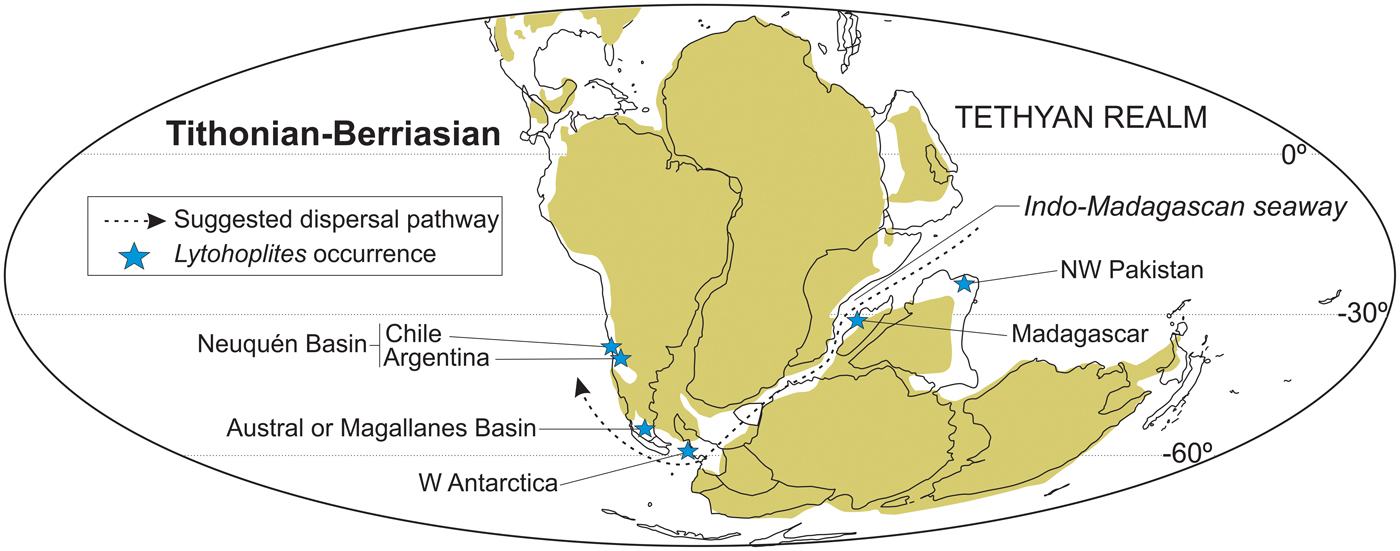
The paleobiogeographic pattern of Lytohoplites, in spite of being initially considered to conform to a disjunct distribution (Cecca, Reference Cecca1999), is now accepted to be restricted to southern Gondwana (Fig. 14). Its distribution, along with that of other ammonoid genera (e.g., Corongoceras, Blanfordiceras, and Aspidoceras), has lent support to the hypothesis of a direct marine connection between the Himalayas, east Africa, and the Andean region, passing by western Antarctica, which might have been fully operational at least from the Late Jurassic according to a number of authors (e.g., Enay, Reference Enay1972; Riccardi, Reference Riccardi1991; Krishna, Reference Krishna1996; Leanza, Reference Leanza and Riccardi1996; Cecca, Reference Cecca1999; Bardhan et al., Reference Bardhan, Shome, Roy, Landman, Davis and Mapes2007). The early Indo-Madagascan seaway (Cecca, Reference Cecca1999) has been interpreted to be a shallow intermitent epicontinental connection (Riccardi, Reference Riccardi1991), although the timing of its formation is still under discussion (Martin, Reference Martin2007). Nevertheless, hints provided by independent invertebrate and vertebrate groups supporting the effective use of this trans-Gondwana seaway since late Tithonian–early Berriasian times is accumulating.
Lytohoplites Spath occurrences around southern Gondwana and suggested dispersal pathways. Base map modified from Smith et al. (Reference Smith, Smith and Funnell1994).

Related invertebrate evidence includes the records of the bivalve Megacucullaea, whose distribution seems to be restricted to Eastern Africa, Kutch, and southern Patagonia (Reyment and Tait, Reference Reyment and Tait1972; Riccardi, Reference Riccardi1977; Fürsich et al., Reference Fürsich, Heinze and Jaitly2000). In addition, a significant change in the bivalve faunal composition of Eastern Africa, which involves a relative increase in the percentage of high-latitude taxa since the Oxfordian–Kimmeridgian, occurred possibly in connection to the opening of the trans-Gondwana seaway (Kauffman, Reference Kauffman and Hallam1973; Cecioni and Charrier, Reference Cecioni and Charrier1974; Damborenea et al., Reference Damborenea, Echevarría and Ros2013). Paleobiogeographic distribution of belemnites of the Family Duvaliidae and Belemnopseidae also seems to favor the existence of this dispersion route during the late Tithonian–Berriasian (Mutterlose, Reference Mutterlose1986; Challinor and Hikuroa, Reference Challinor and Hikuroa2007). That pathway might also have enabled the migration of marine benthonic ostracods through shallow platforms into the Neuquén Basin (Ballent, Reference Ballent2009). On the other hand, Late Jurassic–Early Cretaceous gastropod faunas of Madagascar and the Neuquén Basin are currently known to only share affinities at the family level at least since the Tithonian. That includes representatives of families Pleurotomariidae (Harasewych and Kiel, Reference Harasewych and Kiel2007; Cataldo and Lazo, Reference Cataldo and Lazo2012), Aporrhaidae (Kiel, Reference Kiel2006), and Acteonidae (Kiel, Reference Kiel2006; Cataldo, Reference Cataldo2017).
A southern marine seaway through Gondwana that could have been employed by marine reptiles since the Late Jurassic was proposed by Gasparini (Reference Gasparini and Westermann1992) to explain the record of an ichthyosaurid tooth from the Ameghino Formation in the Antarctic Peninsula (Whitham and Doyle, Reference Whitham and Doyle1989). More recently, another tooth from the Latady Group has been reported (Hikuroa, Reference Hikuroa2009). It also seems to be a reasonable alternative to explain other ichhtyosaurid records from the Upper Jurassic of Madagascar (Fernández, Reference Fernández1997) and Kachchh (Prasad et al., Reference Prasad, Pandey, Alberti, Fürsich, Thakkar and Chauhan2017), and from the Middle Jurassic to Lower Cretaceous of southernmost Chile (Shultz et al., Reference Shultz, Fildani and Suarez2003). Some Late Jurassic plesiosaur remains from the Antarctic Peninsula (O'Gorman et al., Reference O'Gorman, Gouiric-Cavalli, Scasso, Reguero, Moly and Burlaille2018) and the presence of Leedsichthys, a suspension-feeding pachycormid genus from Laurasia and the lower Tithonian of the Neuquén Basin (Gouiric-Cavalli, Reference Gouiric-Cavalli2017), point into the same direction.
Although the proposal of Madagascar as a possible center of origin of Lytohoplites cannot be sustained due to insufficient biostratigraphic control (Cecca, Reference Cecca1999, Reference Cecca2002), the herein-reported occurrence of L. subcylindricus in the Neuquén Basin, lends additional support to the existence of a marine connection between Madagascar and Argentina during the late Tithonian.
Conclusions
A systematic revision of the genus Lytohoplites in west-central Argentina was performed based on new bed-by-bed collections in five localities of the Neuquén Basin. Among them, an isochronus subsample of L. burckhardti coming from Arroyo Durazno, Mendoza was selected to conduct a paleontological analysis aiming to understand the range of phenotipic variability of the paleopopulation. The qualitative and quantitative analyses, through uni-, bi-, and multivariate methods, failed to reject the null hypothesis of taxonomic homogeneity of the sample, which is thus interpreted as the existence of a single paleopopulation of L. burckhardti (and to consider L. vetustoides as its junior synonym). All the morphological variants of L. burckhardti can be accommodated in a tripolar spectrum according to modifications in the timing of the onset of different ontogenetic stages and, hence, in shell form and ornamentation features. Resultant extreme morphologies include compressed and slender (more pedomorphic) and robust (more peramorphic) end-members, that are connected by an arrange of transitional morphotypes.
A non-significative correlation was observed between the whorl cross-section of L. burckhardti and its ornamentation. The existence of a third pole of morphological variability might affect the straightforward application of Buckman's first rule of covariation, as well as the effect of heterochronies of development that regulate the duration of the ontogenetic stages.
All the studied specimens were recorded from beds assigned to the Andean Substeueroceras koeneni Assemblage Zone (upper Tithonian–lower Berriasian), thus challenging its hitherto assumed biostratigraphic assignment to the older Corongoceras alternans Assemblage Zone (upper Tithonian). Moreover, co-occurring calcareous nannofossil and calpionellid bioevents point to an upper Tithonian age for Lytohoplites in the Neuquén Basin. Still, its range is left open as upper Tithonian–?lower Berriasian until more biostratigraphic data are available.
Finally, records of Lytohoplites from a number of southern Gondwana basins and the herein-reported occurrence of Lytohoplites subcylindricus in Argentina, lend support to the existence of a trans-Gondwana seaway, operative at least since the upper Tithonian.
Acknowledgments
This study was possible through the financial support of the Agencia Nacional de Promoción Científica y Tecnológica through PICT 2597/2014 and PICT 2016/1016 granted to VVV and PICT 1413/2013 granted to BAU. The authors want to thank Dr. M. Yacobucci, Dr. D. Bert, and another anonymous reviewer for their valuable suggestions. We also appreciate the help provided by the collection managers: A. Gehler and T. Stegemann (GZG), G. Heumann (STIPB), J. Thomas (UBGD), and J. Moreno. R. Palma and C. Cristiani (FCEN-UBA) provided material from Cerro Amarillo. D. Benedito, D. Kietzmann, I. Maniel, S. Vázquez, M. Jannello, F. López, Y. Herrera, M. Hoqui, R. Ezquerro, D. Lazo, C. Cataldo, and L. Luci are acknowledged for their help in field season, which was endorsed by the Dirección de patrimonio cultural y museos, Secretaría de Cultura de Mendoza and the Dirección Provincial de Patrimonio Cultural de Neuquén. C. Salazar Soto, S. Gouiric-Cavalli, C. Cataldo, and L. Luci are also thanked for providing literature and helpful discussions. This is BAU's contribution R-280 from the Instituto de Estudios Andinos “Don Pablo Groeber.”
Appendix. Dimensions of Lytohoplites burckhardti (Mayer-Eymar in Burckhardt, 1900) macroconchiate (M) and probable microconchiate (m?) specimens. Shell measurements in mm. Uncertainty is indicated by *.

Appendix. Dimensions of Lytohoplites subcylindricus Collignon, 1962. Shell measurements in mm.