1. Introduction
On 6 April 2014, China's Ministry of Commerce (MOFCOM) imposed anti-dumping duties on imports of dissolving cellulose pulpFootnote 1 from three countries (Brazil, Canada, and the United States) following a 14-month investigation. The anti-dumping order covered nearly $900 million of imports, including $270.5 million from Canadian producers, which were assessed anti-dumping duties ranging from 13% to 24%. Canada filed a request for consultations under the World Trade Organization (WTO)’s Dispute Settlement Understanding (DSU) on 15 October 2014, claiming that MOFCOM's anti-dumping determination was inconsistent with the Agreement on Implementation of Article VI of the General Agreement on Tariffs and Trade 1994 (Anti-dumping Agreement or ADA), and followed with a request for the establishment of a panel in February of 2015; after a brief delay, the panel circulated its final report on 25 April 2017. Although the panel dismissed some of Canada's claims, those it upheld were significant enough to force MOFCOM to reinvestigate the case.Footnote 2
Article VI of the General Agreement on Tariffs and Trade 1994 (GATT, 1994) allows countries to impose anti-dumping duties if it determines (i) that a product has been ‘dumped’ by exporting firms or sold at less than its normal value in the importing country and (ii) that the dumped imports have caused material injury to the domestic industry. The ADA, one of the WTO covered agreements negotiated in the Uruguay Round, includes detailed rules and guidance as to how this determination should be made. Of interest in this dispute is Article 3 of the ADA, which spells out the rules governing the determination of material injury caused by dumped imports. Article 3 requires WTO Members to, among others, engage in an examination of the volume of dumped imports and the impact of these dumped imports on prices in the domestic market.
Although the examination of the volume of dumped imports is usually straightforward during an anti-dumping investigation, determining the impact of these dumped imports on prices and the domestic industry tends to prove more challenging. Among Canada's specific allegations in China – Anti-Dumping Measures on Imports of Cellulose Pulp from Canada was the assertion that MOFCOM's consideration of the price depression effects of the dumped imports was inconsistent with Article 3.2 of the ADA. Article 3.2 of the ADA requires countries to establish, inter alia, whether dumped imports have depressed prices or prevented price increases which otherwise would have occurred (price suppression). These determinations have proven so controversial that over 40 disputes have been brought under Article 3.2 alone; 7.7% of the total number of complaints brought under the DSU since 1995 and one-third of those complaints involved anti-dumping determinations.
Although WTO Members have discretion to choose what methodologies to use to assess price effects, determinations must be based on an objective examination of positive evidence and investigating authorities must provide reasoned and adequate explanations for their conclusions. In the cellulose pulp investigation, MOFCOM used a methodology known as ‘parallel price trends’ to conclude that dumped imports resulted in the depression of domestic prices. Essentially, China suggested that the fact that domestic prices and prices of the subject imports were moving in tandem, first increasing then decreasing over the period of investigation (POI) with the ‘same trend of changes’, was evidence of the price depression effect of the dumped imports. However, the panel found that MOFCOM failed to explain how their analysis of the parallel price trends between the dumped imports and domestic prices demonstrated that the dumped imports caused the decline of domestic prices.
WTO panels and the Appellate Body have taken up similar issues in China–GOES Footnote 3 and China–Autos,Footnote 4 two other disputes involving Chinese anti-dumping investigations that used parallel price trends. In the 2012 China–GOES ruling, the Appellate Body stated that parallel price trends might support a finding of price depression, but MOFCOM failed to explain what role these trends had played in its analysis. The Appellate Body neglected to specifically define how price effects should be established, and the panel in China–Cellulose Pulp continues to be silent in this regard.
In this paper, we explore the China–Cellulose Pulp ruling, and examine why WTO panels and the Appellate Body have found China's consideration of price effects so problematic. We explore to what degree ‘parallel price trends’ can be used as a valid methodology to determine price depression, and whether it is the methodology itself that is problematic or China's implementation of that methodology that has caused it to lose three disputes over the past five years.
This article is structured as follows. In Section 2, we describe the state of the dissolving cellulose industry at the time of the anti-dumping petition. In Section 3, we describe the legal standard of Article 3 of the ADA and, in Section 4, we summarize the salient legal findings of the panel report in China–Cellulose Pulp. In Section 5, we discuss the use of parallel price trends in previous disputes on similar issues against China followed by a brief description in Section 6 of the different methodologies used for determining price depression by other WTO Members. In Section 7, we discuss why China's anti-dumping procedures might be driving the large number of WTO disputes targeting their actions. In Section 8, we conclude.
2. The dissolving cellulose industry
To understand the weaknesses in MOFCOM's anti-dumping investigation, it is useful to review the state of the dissolving cellulose market between 2010 and 2014. Dissolving cellulose is a special form of pulp that has a high degree of cellulose; the pulp can be dissolved into a solvent to remove all fibre. Although it can be made from cotton linters or even bamboo, most cellulose pulp is made from fast-grown hardwoods. There are two grades of dissolving pulp. Specialty dissolving pulp has a higher cellulose content and is used in cigarette filters, explosives, paints and other similar products. Low-grade or commodity dissolving pulp is overwhelmingly used in the production of viscose fibre, more commonly known as rayon (Stone, Reference Stone2013).
Widespread cotton crop failures in 2010 and 2011 caused the price of cotton to increase dramatically and apparel makers shifted into a relatively cheaper substitute, rayon. Between 2004 and 2012, worldwide demand for rayon increased 84%, with China accounting for 61% of world production (Stone, Reference Stone2013). To meet this growing demand, global capacity in dissolving pulp also grew, nearly doubling between 2008 and 2013 with China accounting for 30% of this global expansion (Young, Reference Young2013: 17). Even with this domestic expansion, China accounted for 40% of world imports of dissolving pulp. In 2012, Brazil, Canada, and the United States, the three countries targeted in China's anti-dumping investigation, accounted for 35% of China's imports of dissolving pulp.
Because of the strong substitution pattern between cotton and rayon, the price of commodity dissolving pulp is highly correlated with cotton prices. Intuitively, the price of rayon falls with the price of cotton as consumers substitute into less expensive cotton fibres. This in turn reduces demand for inputs into the production of rayon, including cellulose pulp. Between 2010 and 2011, the price of cotton fell over 60%, and prices continued to fall through 2016. The dramatic decline in cotton prices, combined with the build-up in global capacity in cellulose pulp, had an almost immediate impact on the cellulose pulp industry as prices declined sharply to levels more consistent with their long-run averages (Young, Reference Young2013: 17). Although Chinese cellulose pulp production increased between 2010 and 2012, its operating rate fell from 66% to 52% and inventories grew 115% over this same period.Footnote 5 It was in the face of these dramatic industry changes that Chinese producers requested the anti-dumping investigation.
3. Legal standard of Article 3 of the ADA
The panel's findings in China–Cellulose Pulp concern MOFCOM's determination of material injury. Therefore, before discussing the panel's findings in the specific context of the dispute, we will briefly introduce the concept of ‘material injury’ within the framework of the ADA.
The determination of injury is an essential pre-requisite for the imposition of anti-dumping duties. Before imposing anti-dumping duties, Article 3 of the ADA, entitled ‘[d]etermination of [i]njury’, requires an investigating authority to assess a broad range of factors in determining that dumped imports are injuring the domestic industry (injury analysis), and, in addition, that there is a causal link between the dumped imports and injury (causation analysis).
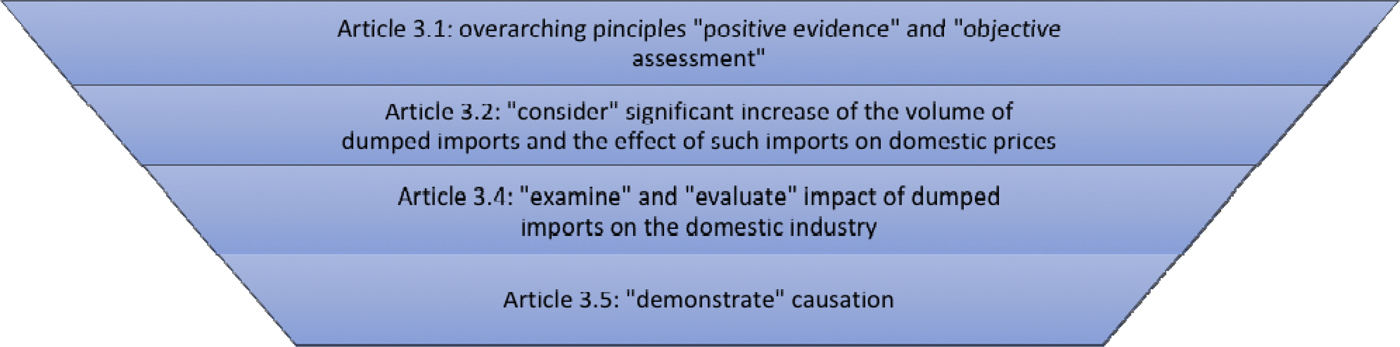
Article 3 of the ADA has a pyramidal structure, as illustrated in Figure 1.Footnote 6 It provides ‘a logical progression of inquiry leading to an investigating authority's ultimate injury and causation determination’.Footnote 7 Article 3.1 of the ADA provides general principles that inform the more detailed provisions set out in the remainder of Article 3. Article 3.2 provides that investigating authorities shall ‘consider’ the increase in volume of subject imports in the domestic market as well as the effects of subject imports on domestic prices.Footnote 8 With respect to the effects of subject imports on domestic prices, the second sentence of Article 3.2 provides that investigating authorities shall consider whether subject imports undercut domestic prices significantly (significant price undercutting), or whether the effect of the subject imports has been to significantly depress prices (significant price depression) or significantly prevent price increases that otherwise would have occurred (significant price suppression).Footnote 9
Legal standard under Article 3 of the ADA

The ADA does not define these price effects or the term ‘significant’. WTO commentators and jurisprudence, however, have interpreted these terms as follows:
• Price undercutting occurs when the prices of subject imports are below domestic prices (Durling, Reference Durling, Wolfrum, Still and Koebel2008: 54).
• Price depression occurs when domestic prices are ‘pushed down, or reduced by something’.Footnote 10
• Price suppression occurs when domestic prices have not increased or not as they otherwise might have in the absence of subject imports.Footnote 11
• The ‘significance’ of price effects has been interpreted loosely by WTO adjudicators.Footnote 12 The ordinary meaning of ‘significant’ is ‘important, notable, consequential’.Footnote 13 In assessing the term ‘significantly’ in the context of Article 2.4.2 of the ADA, the Appellate Body noted that this term has both quantitative and qualitative dimensions.Footnote 14
Article 3.4 provides that investigating authorities shall ‘examine’ and ‘evaluate’ the impact of subject imports on the domestic industry on the basis of all relevant economic factors. Finally, Article 3.5 directs investigating authorities to ‘demonstrate’ a causal relationship between subject imports and injury by, in part, examining all other factors that may also be causing injury to the domestic industry (non-attribution analysis).
Certainly, the obligation to ‘consider’ something imposes a different, less onerous, obligation than the obligation to ‘demonstrate’ something.Footnote 15 Whether the authority ‘considered’, ‘examined’, ‘evaluated’, and ‘demonstrated’ the relevant issues can only be assessed on the basis of the explanations provided by the investigating authority in its injury determination. In particular, WTO panels assess whether the explanations provided by the investigating authorities are ‘reasoned and adequate’, that is, whether the reasoning is coherent and internally consistent, the explanations given disclose how facts and evidence in the record were treated and why alternative explanations and interpretations of the record evidence were discounted or rejected.Footnote 16
4. Salient legal findings of the Panel Report in China–Cellulose Pulp
Canada challenged MOFCOM's determination of material injury under Articles 3.1, 3.2, 3.4, and 3.5 of the ADA. In what follows, we address in more detail what are the main obligations under these provisions of the ADA, we refer to Canada's claims, and discuss the panel's findings.
4.1 A claim under Article 3.1 of the ADA cannot be made independently of other provisions of Article 3
As mentioned above, Article 3.1 of the ADA provides general principles that inform the more detailed provisions set out in the remainder of Article 3. It provides that the determination of injury ‘[s]hall be based on positive evidence and involve an objective examination’. ‘Positive evidence’ refers to evidence that is ‘affirmative, objective, verifiable, and credible’.Footnote 17 ‘Objective examination’ refers to an investigation that is conducted ‘in an unbiased manner, without favouring the interests of any interested party, or group of interested parties, in the investigation’.Footnote 18 If a Member fails to consider, examine, evaluate, and demonstrate different issues under Article 3.2, 3.4, and 3.5 that Member may also fail to conduct an ‘objective examination’ based on ‘positive evidence’ as required by Article 3.1 of the ADA.Footnote 19
Although Canada did not bring an abstract claim under Article 3.1 of the ADA, the panel noted that, normally, a claim of inconsistency with Article 3.1 cannot be made in the abstract, i.e. independently of other provisions of Article 3.Footnote 20 For the panel, ‘the “positive evidence” to be examined by the investigating authority must pertain to the particular substantive elements relevant to the determination made, and the “objective examination” must relate to the consideration and evaluation of that evidence in the investigation at issue’.Footnote 21 In fact, even with respect to general challenges against bias of the investigating authority, the panel considered that it would be difficult to assess whether the authority was objective without going into the substance of the actual determination.Footnote 22
4.2 Canada's claim that MOFCOM's consideration of the volume of dumped imports was inconsistent with Articles 3.1 and 3.2 of the ADA
Article 3.2 of the ADA provides more specific guidance concerning the objective examination required by Article 3.1. According to the first sentence of this provision, investigating authorities shall consider whether there has been any significant increase in the volume of subject imports either in absolute terms, or relative to production or consumption in the importing Member.
In this dispute, Canada challenged MOFCOM's consideration of the increase in volume of dumped imports as it did not consider the ‘factual circumstances’ surrounding that increase. According to Canada, an investigating authority should undertake a contextual consideration of the increase in volume, including sales of like domestic products, to determine whether the increase in the absolute volume of the dumped imports is ‘significant’.Footnote 23
The panel noted that the term ‘significant’ did not encompass an obligation on the investigating authorities to undertake a contextual consideration. Instead, whether the absolute increase in volume is ‘significant’ depends on whether the increase is ‘important, notable or consequential’, and may be assessed ‘on the basis of the magnitude of that increase’.Footnote 24 The panel further emphasized that the obligation to consider a significant increase in dumped imports is different from the obligation to determine a significant increase in dumped imports, and, thus, whether the increase in volume of dumped imports, be it significant or not, is sufficient to support a determination of material injury will have to be addressed in the causation analysis of the investigation authority under Article 3.5 of the ADA. Thus, there is no need to duplicate the same analysis under the first sentence of Article 3.2 of the ADA.Footnote 25
In the merits of the case, the panel found that MOFCOM's consideration of the volume of imports both in absolute terms (43.82%), and relative terms (consumption in the Chinese market) was consistent with Articles 3.1 and 3.2 of the ADA. In particular, the panel found that MOFCOM was not required to take into account ‘factual circumstances’ such as the expansion of the market and increase in sales in its consideration of increase in the volume of dumped imports as these issues appertain to the analysis under Article 3.4 and 3.5 of the ADA, as applicable.Footnote 26 Moreover, the panel stated that ‘while it might have been preferable had MOFCOM explicitly characterized the 43.82% increase as “significant” and given a reasoned explanation of that characterization, we consider that it would have been apparent to the interested parties from the Final Determination’, and that a reasoned explanation of this issue would still be assessed under Articles 3.5 and 3.1 of the ADA.Footnote 27
4.3 Canada's claim that MOFCOM's consideration of price effects was inconsistent with Articles 3.1 and 3.2 of the ADA
Article 3.2 provides that investigating authorities shall ‘consider’ the effects of subject imports on domestic prices, that is, whether there is significant price undercutting, significant price depression, or significant price suppression.
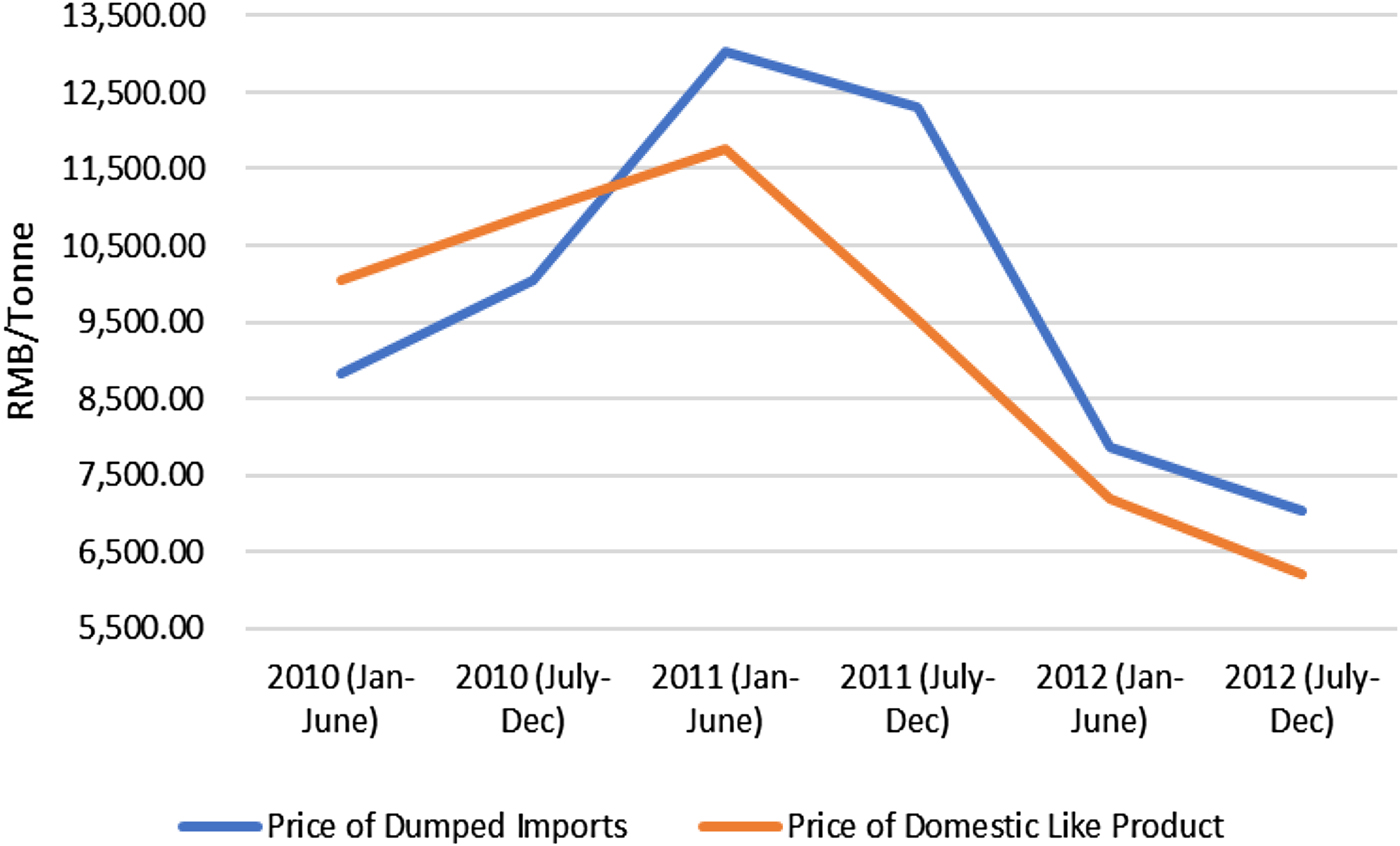
In the case at hand, MOFCOM concluded that the effect of subject imports on domestic prices was price depression. MOFCOM used the price data depicted in Figure 2 to conclude that there was ‘undisputed evidence’ of parallel price trends between the dumped imports and the domestic like products. MOFCOM noted that prices of both products first increased and then decreased, and that they had the same trend of change. In their analysis, MOFCOM found that the combination of these parallel ‘fast and continuous’ decline in the prices of both dumped and domestic like products, combined with the increase in the quantity of the dumped imports, indicated that the dumped products had a depressing effect on the price of the domestic like product.Footnote 28
Chinese cellulose pulp prices, 2010–2012
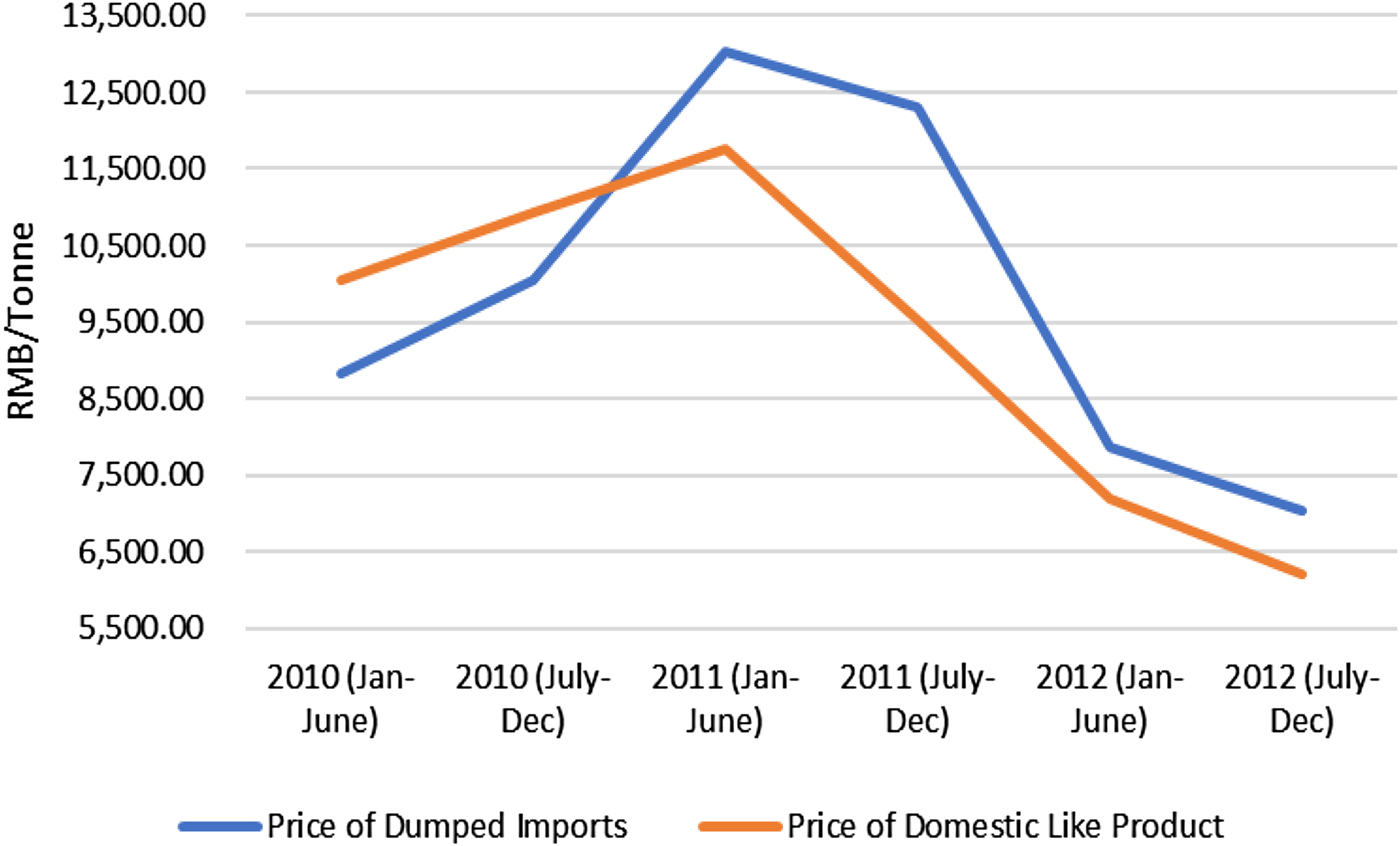
Although both Canada and China agreed that the dumped imports and domestic like product were basically identical and substitutable for one another given the commodity-like nature of cellulose pulp, Canada argued that MOFCOM erred in its finding of parallel price trends, noting that while prior to 2011 the prices of dumped imports were lower than the domestic like product, the prices of the dumped imports were higher than domestic prices in the later part of the POI. In addition, Canada argued that MOFCOM failed to consider the different rates of change in prices of the dumped imports and domestic prices, particularly in 2011,Footnote 29 and that the relevant price trends were not parallel as they crossed at the end of 2010.Footnote 30
The panel was not persuaded that the different rates of change in prices of the dumped imports and domestic prices undermined the finding of the parallel trends in prices per se as ‘prices still moved in the same direction and quickly adjusted to the price decline in the market, showing the close competition between the domestic and imported dumped products’.Footnote 31 Moreover, the panel considered the fact that price trends crossed at one point during the POI did not undermine MOFCOM's conclusion that the prices of dumped imports and the domestic like products followed the same or parallel trends, especially because, ‘even at the time they crossed, they were moving in the same direction – both domestic and import prices were increasing’.Footnote 32
Instead, the panel concluded that while MOFCOM reasonably found evidence of parallel price trends between the dumped imports and the domestic like prices, it did not explain how these parallel price trends affected the prices of domestic like products.Footnote 33 The panel noted that given the fact that the prices of the dumped products, although declining, were above those of the domestic like products during the period in question, absent any explanation from MOFCOM the parallel price trend ‘provides little if any support’ for the proposition that the dumped imports depressed prices of domestic like products. Indeed, the finding of parallel price trends may simply indicate that two price variables move together, as might be expected in a commodity market. The panel reaffirmed the panel finding in China–Autos that although ‘price depression is not contingent on the existence of price undercutting’, absent price undercutting, the investigating authority must explain how it concluded that the dumped imports caused the decrease in the price of the domestic like products.Footnote 34
4.4 Canada's claim that MOFCOM's examination of the impact of dumped imports was inconsistent with Articles 3.1 and 3.4 of the ADA
Article 3.4 of the ADA provides that the investigating authorities shall ‘examine’ and ‘evaluate’ the impact of subject imports on the state of the domestic industry on the basis of all ‘relevant economic factors and indices’ referred to in the non-exhaustive list of that provision.Footnote 35 This analysis does not derive from a mere characterization of the degree of ‘relevance or irrelevance’ of each and every individual factor, but rather must be based on a thorough evaluation of the state of the industry and, must contain a persuasive explanation as to how the evaluation of relevant factors led to the determination of injury.Footnote 36
In this dispute, Canada claimed that MOFCOM's failure to consider whether there was actual and potential decline in market share and MOFCOM's characterization of market share as having ‘remained low’ was inconsistent with Articles 3.1 and 3.4 of the ADA. Canada further claimed that MOFCOM failed to explain the trends of the positive factors and how they related to each other and to the negative factors.Footnote 37
The panel dismissed Canada's claims.Footnote 38 It found that MOFCOM did examine trends and developments in market share; that MOFCOM's characterization of market share as ‘remained low’ was not unreasonable considering the demand for cellulose pulp had increased, and domestic production capacity had increased to meet that demand but ‘the domestic industry's market share had not increased commensurate with the available production capacity’.Footnote 39 Moreover, the panel found that MOFCOM evaluated the mandatory economic factors and indices set forth in Article 3.4; it considered some of the factors were negative and some were positive, and discussed their relevance in its analysis of the impact of dumped imports on the domestic industry under Article 3.4 as well as in its analysis of causation under Article 3.5, which is unproblematic as there is no mandatory order to be followed to the extent that the requirements of Article 3 are fulfilled.Footnote 40
4.5 Canada's claim that MOFCOM's demonstration of causation and non-attribution analysis was inconsistent with Articles 3.1 and 3.5 of the ADA
Article 3.5 of the ADA stipulates that the investigating authority is required to demonstrate a ‘causal relationship’ between dumped imports and injury to the domestic industry. It must examine all other factors that may be simultaneously injuring the domestic industry to ensure that any injury caused by other factors is not improperly attributed to the dumped imports (non-attribution analysis), although there is no specific guidance for how to undertake this analysis.
Canada alleged that China failed to consider four factors that were having deleterious effects on the domestic cellulose pulp industry. These factors were: (i) the change in cotton and VSF (rayon) prices; (ii) domestic industry overexpansion; (iii) non-dumped imports; and (iv) a shortage of cotton linter, one of the potential inputs to the production of cellulose pulp.
Because the panel had already found that MOFCOM had failed to demonstrate that the dumped imports were causing the depression of domestic prices, the panel also found that MOFCOM failed to demonstrate that the dumped imports were causing injury to the domestic industry.Footnote 41 In its analysis of MOFCOM's examination of other potential factors, the panel noted that MOFCOM addressed cotton and VSF prices in its discussion of the effect of dumped imports on prices but did not address these factors in the final determination concerning the non-attribution of injury to other factors. Noting that the domestic industry increased capacity at a faster rate than domestic demand over the POI, the panel concluded that MOFCOM failed to adequately examine this expansion as a factor outside of the dumped imports causing injury to the domestic industry.Footnote 42 In a similar fashion, the panel found that there was evidence that the effect of non-dumped imports on prices was similar to that of dumped imports, and that it was likely that the shortage of cotton linter in China could have led to increased imports of cellulose pulp made from wood and bamboo.Footnote 43
5. Use of ‘parallel price trends’ in MOFCOM's anti-dumping investigations
The ADA does not set out methodologies for the consideration of price effects.Footnote 44 To consider these effects, each investigating authority has the discretion to choose a methodology.Footnote 45 As mentioned above, MOFCOM uses the methodology of ‘parallel price trends’ for the consideration of price depression and price suppression in its anti-dumping investigations. MOFCOM's determination of price depression and price suppression has been challenged in three WTO disputes, two of them brought by the United States and one of them brought by Canada. These disputes are: China–GOES, China–Autos (US), and China–Cellulose Pulp.Footnote 46 WTO adjudicators involved in these disputes concluded that parallel price trends may support a finding of price depression or price suppression but that this methodology does not exempt the investigating authority from its obligation to consider whether subject imports have ‘explanatory force’ for the occurrence of significant depression or suppression of domestic prices.Footnote 47
Before addressing these WTO challenges against MOFCOM's parallel price trends in more detail, we will first discuss more generally what investigating authorities should assess when considering price effects according to WTO jurisprudence.
At the outset, WTO adjudicators have clarified that the consideration of price undercutting, price depression, and price suppression may be independent of one another, i.e. price depression and price suppression can exist in the absence of price undercutting, or vice versa. In general, an investigating authority initiates its analysis of price effects by considering, first, whether there has been price undercutting, and, second, whether the subject imports also had the effect of price depression or price suppression, in that order.Footnote 48 However, if there is no evidence on record pointing to the existence of price undercutting, the investigating authority may base its consideration of price effects on price suppression or price depression alone, without considering the occurrence of price undercutting. The investigating authority must, however, explain why there is price depression or price suppression based on other arguments and evidence.Footnote 49
Moreover, the elements relevant to the consideration of price undercutting may differ from those relevant to the consideration of price depression and price suppression.Footnote 50 The consideration of price undercutting requires ‘a dynamic assessment of price developments and trends in the relationship between the prices of the dumped imports and those of domestic like products over the duration of the POI’.Footnote 51 With respect to price depression and price suppression, an investigating authority shall consider whether subject imports have ‘explanatory force’ for the occurrence of significant depression or suppression of domestic prices.Footnote 52 This explanatory force can only be derived from an analysis of ‘what brings about such price phenomena’.Footnote 53 In the case of price depression, an investigating authority must not only consider whether prices are declining but also ‘what is pushing down the prices’.Footnote 54 In the case of price suppression, an investigating authority must analyse a counterfactual situation: ‘whether, in the absence of subject imports, prices “otherwise would have” increased’.Footnote 55
In the case of price depression, the Appellate Body has provided some guidance with respect to the conceptual foundations on which methodologies can be based. It has stated that an investigating authority may decide to take a ‘two-step analysis’ or a ‘unitary analysis’. According to the two-step analysis, the authority must consider, first, whether the price phenomena is taking place, i.e. whether, in the case of price depression, prices have declined, and, second, whether this phenomenon is an effect of subject imports; whereas according to the unitary approach, both elements are assessed jointly.Footnote 56
In sum, according to WTO jurisprudence, an investigating authority assessing price depression should consider: (i) the relevant price decline and (ii) ‘what is pushing down the prices’. These analyses can take place according to a ‘two-step analysis’ or a ‘unitary analysis’.
Considering this guidance from WTO jurisprudence, we will now assess MOFCOM's use of parallel price trends in China–GOES, China–Autos (US), and China–Cellulose Pulp. In China–GOES, the United States challenged China's imposition of anti-dumping and countervailing duties on grain oriented flat-rolled electrical steel from the United States, pursuant to a MOFCOM's final determination rendered in April 2010. The panel found in favour of most of the United States’ claims including those concerning price effects.Footnote 57 In appeal, the Appellate Body upheld the Panel's findings.Footnote 58 Subsequently, the United States brought compliance proceedings pursuant to Article 21.5 of the DSU against China. The compliance panel found that MOFCOM's redetermination of anti-dumping duties was inconsistent with China's obligations under the ADA.Footnote 59 In China–Autos (US), the United States challenged China's imposition of anti-dumping duties on certain automobiles from the United States. The panel found in favour of most of the United States’ claims including those concerning price effects.Footnote 60
As mentioned above, WTO adjudicators involved in these previous disputes (and in China–Cellulose Pulp) concluded that parallel price trends may support a finding of price depression.Footnote 61 This is because parallel price trends ‘might indicate the nature of competition’ between the prices of subject imports and the prices of domestic products, and ‘may explain the extent to which factors relating to the pricing behaviour of importers have an effect on domestic prices’.Footnote 62 However, the use of parallel price trends does not replace the investigating authority's obligation to assess whether subject imports have ‘explanatory force’ for the occurrence of significant price depression, that is, the investigating authority's obligation to consider ‘what is pushing down the prices’.Footnote 63 Without an explanation thereof, ‘the identification of parallel price trends does no more than recognize that two variables, domestic and dumped import prices, move together’.Footnote 64
MOFCOM's considerations of price depression were faulted by WTO adjudicators in these three disputes for one main reason: MOFCOM failed to explain what role parallel price trends had in its price effects analysis.Footnote 65 In particular, in China–GOES, the panel found that MOFCOM's final determination made only two discrete references to parallel price trends without providing any explanation or reasoning regarding the role that this methodology played in MOFCOM's analysis.Footnote 66 Similarly, in China–Autos (US), the panel found that MOFCOM's final determination ‘contain no explanation of the connection between the purported existence of parallel pricing and the price depression found to affect domestic industry prices’. Therefore, the panel considered that MOFCOM ‘failed to adequately explain the role of subject imports in the price depression found to exist on the domestic market’.Footnote 67 Finally, as mentioned above, in China–Cellulose Pulp, MOFCOM provided a chart showing parallel price trend, and a narrative describing the chart, without explaining how parallel price trends affected the domestic like product prices.Footnote 68
Besides this common ground of inconsistency, MOFCOM's considerations of price depression were faulted by WTO adjudicators for other reasons:
• MOFCOM did not address why there were significantly different rates of change in prices of dumped imports and domestic products (see China–GOES, China–Autos (US));Footnote 69
• MOFCOM did not assess the fact that domestic and import price trends moved in opposing directions during part of the POI (see China–Autos (US));
• MOFCOM failed to assess whether its consideration of price depression was altered by the fact that the prices of subject imports were higher than the prices of domestic products during the POI (see China–Autos (US) and China–Cellulose Pulp).
In China–GOES, MOFCOM's final determination in the original proceedings failed to explain the significant different rates of change in prices of dumped imports and domestic prices. In particular, it failed to explain a decline of 1.25% in the prices of subject imports versus a decline of 30.25% in the prices of domestic products during the same period, suggesting that these products were not in competition with each other, or that there were other factors affecting prices.Footnote 70 In addition, MOFCOM's final determination did not provide any facts relating to the price comparisons of subject imports and domestic products.Footnote 71 In the compliance proceedings in China–GOES (Article 21.5–US), the panel faulted MOFCOM's analysis of price depression once again because, inter alia, it still failed to explain the significant different rates of change in prices of dumped imports and domestic prices.Footnote 72
In China–Autos (US), MOFCOM's final determination failed to address the fact that: (i) domestic and import price trends moved in opposing directions during part of the POI; (ii) there were different rates of change in prices of subject imports and domestic products, and (iii) the prices of subject imports oversold domestic products prices during the POI. MOFCOM failed to address opposing price trends from 2006 to 2007 according to which prices of subject imports decreased by 8.47%, while the prices of the domestic like products rose by 11.08%. Moreover, MOFCOM failed to address the fact that the rates of change in prices of subject imports and domestic products were considerably different. From 2007 to 2008, for example, the prices of the domestic like products increased less than half as much as the prices of subject imports (16.82% compared to 39.6%).Footnote 73 The panel noted that it would have expected an objective and unbiased investigating authority to take these two issues into account and explained why they did not affect the conclusion reached.Footnote 74 With respect to the third issue, MOFCOM did address the fact that prices of imports were, for the most part, significantly higher than those of the domestic like products. This issue was brought to MOFCOM's attention by one of the interested parties (Chrysler USA). While MOFCOM did refer to Chrysler USA's comments in its final determination, MOFCOM's reference to this issue fell short of the necessary analysis and explanation required under Article 3.1 of the ADA.Footnote 75
Moreover, in China–Autos, as well as in China−GOES, MOFCOM relied on average unit values without effecting adjustments to ensure price comparability between subject imports and the domestic like product when considering price effects (Prusa and Vermulst, Reference Prusa and Vermulst2014: 246, 249; Mitchell and Prusa, Reference Mitchell and Prusa2016: 315).Footnote 76 MOFCOM further mixed annual price data with some quarterly data, which makes inference essentially impossible (Mitchell and Prusa, Reference Mitchell and Prusa2016: 319−322).
As stated in Section 4.3, in China–Cellulose Pulp, the panel failed to assess whether its consideration of price depression was altered by the fact that, although declining, the prices of subject imports were higher than the prices of domestic products during the POI.
These findings show that MOFCOM's use of parallel price trends falls short of the requirements of Article 3.2 of the ADA. MOFCOM does not consider ‘what is pushing down the prices’.Footnote 77 As long as MOFCOM continues to omit the consideration of this aspect, its analysis of price depression will continue to be insufficient to satisfy a WTO panel or the Appellate Body.
6. Methodologies used for determining price depression
The above cited findings against MOFCOM's consideration of price depression raise the question of whether other WTO Members face similar difficulties in their analysis of this issue. WTO jurisprudence does not answer this question. To date, there have been only four cases in which an investigating authority's consideration of price depression has been challenged in WTO dispute settlement. Three of these challenges concerned MOFCOM's parallel price trends methodology discussed in Section 5.Footnote 78 The fourth challenge was brought by Indonesia in Korea–Certain Paper. This challenge, however, focused on whether the ‘significance’ of the price depression must be explicit in the investigating authority's final determination, not in the methodology used to consider price depression.Footnote 79 In light of the foregoing, we address WTO Member's practice in the consideration of price depression to determine whether there are similarities or differences to MOFCOM's methodology of parallel price trends.
In their analysis of the China–GOES dispute, Qin and Vandenbussche (Reference Qin and Vandenbussche2017) argue that to conclude that dumped imports caused price suppression or depression, investigators should be required to undertake a counterfactual analysis in which they statistically analyse the change in the prices that occurred from the price that otherwise would have occurred absent the dumped imports. For example, the authors explain the benefits of using regression analysis, which statistically estimates how much the change in the explanatory variable (subject import prices) impacted the change in the dependent variable (Chinese prices) over the POI, while controlling for other potential explanatory variables like Chinese production capacity or cotton prices. The resulting estimates can be tested for statistical significance and used to compare the relative impact of the potential explanatory variables.
Similarly, statistical models such as difference-in-difference estimators could theoretically be used to compare prices in the Chinese cellulose pulp market to those in the ‘control’ market to determine the impact of the subject imports. For example, if an analyst can identify a geographic or product market that experienced similar price trends as the Chinese cellulose pulp market prior to the alleged dumping but was isolated from any impact of the subject imports, he or she could identify the impact of the dumping from the change in trends between the Chinese and control market.Footnote 80 Alternatively, structural modelling techniques statistically estimate the parameters of a system of supply and demand equations to determine what factors, including subject imports, could explain the changes in Chinese prices.
All these econometric techniques typically require much more data than are available to anti-dumping investigators. For example, Milton's (Reference Milton1986) formula suggests using a minimum of ten observations, but typically many more depending on such factors as the number of explanatory variables in the model. As a result, implementing any of these tools would go above and beyond the current economic analysis undertaken by countries in anti-dumping investigations. The European Union and the United States, for example, more commonly use trend analysis, which compares domestic prices, subject and non-subject import prices, the value of subject and non-subject imports, and lost sales or revenue by the domestic industry over time. Typically, the sample period in this analysis includes up to three years of data prior to the launch of the anti-dumping investigation (Qin and Vandenbussche, Reference Qin and Vandenbussche2017: 215). The investigators can then compare trends prior to the alleged dumping to those during the alleged dumping.
In many ways, MOFCOM's use of parallel price trends in cellulose pulp is not that different from the trend analysis successfully undertaken by other countries. However, both the European Union and the United States have a lengthy history of anti-dumping investigations and ensure that their public reports, which typically follow very structured templates, discuss the full range of other potential explanatory factors to indicate that these have been taken into consideration when analysing the impact of dumped imports on domestic prices. MOFCOM could potentially address the WTO findings simply by improving its written explanation of its conclusions.
7. Criticism against China's anti-dumping procedures
As discussed above, China–Cellulose Pulp is just one of a long line of WTO disputes that have criticized China's anti-dumping investigations (Mitchell and Prusa, Reference Mitchell and Prusa2016: 318). Between 2012 and 2014, WTO panels found substantive issues with China's analysis in China–GOES, China–Broiler Products, China–X-Ray Equipment, China–Autos, and China–HP-SSST. Some of these disputes were brought contemporaneously to the WTO, thus MOFCOM's authorities may have continued to use practices and methodologies in good faith, understanding that they were consistent with China's WTO obligations until proven otherwise (Mitchell and Prusa, Reference Mitchell and Prusa2016: 318–319). By the time MOFCOM issued its final determination in China–Cellulose Pulp, however, the Appellate Body had already issued its report in China–GOES and the panel had circulated its interim report in China–Autos. The analysis in the China–Cellulose Pulp anti-dumping investigation suggests that MOFCOM authorities had altered their analysis to implement earlier panel recommendations. For example, in both China–GOES and China–Autos, MOFCOM's analysis compared annual import and domestic price data, making a thorough statistical analysis of causation virtually impossible (Mitchell and Prusa, Reference Mitchell and Prusa2016: 320–321). Perhaps in response, MOFCOM collected semi-annual price data for the cellulose pulp investigation, a marked improvement from earlier analysis.
Despite these changes, MOFCOM's causation analysis still fell short according to the China–Cellulose Pulp panel. The fact that there have been three nearly identical WTO disputes targeting China's anti-dumping policies may indicate that China is still in the process of learning what specific anti-dumping procedures will satisfy its WTO partners. Although it is possible that China lacks the resources to monitor complex WTO jurisprudence to ensure that MOFCOM fully understands and implements the findings of WTO panels and the Appellate Body, we do not believe that this is the case. Since its accession to the WTO, China has made important investments in WTO-related capacity-building initiatives for central, provincial, and local government departments; it has actively trained domestic law firms in WTO dispute settlement; it has hired experienced international law firms to represent its interests; and it typically sends the largest delegations of any WTO Member to panel or Appellate Body hearings (including government officials that will be involved in the implementation of the relevant findings and recommendations) (Shaffer and Gao, Reference Shaffer and Gao2017: 137–172). Thus, lack of resources does not appear to be preventing MOFCOM from changing the procedures that are subject to criticism. More likely, each of the investigations targeting China's price analyses was nuanced enough that China could believe it was correcting past failings in its current investigations, but still not quite be meeting the standards of WTO dispute panels. The challenge of meeting these standards is made more difficult by panel findings that are purposely vague as to how countries could sufficiently explain the use of parallel price trends to prove price depression or suppression.
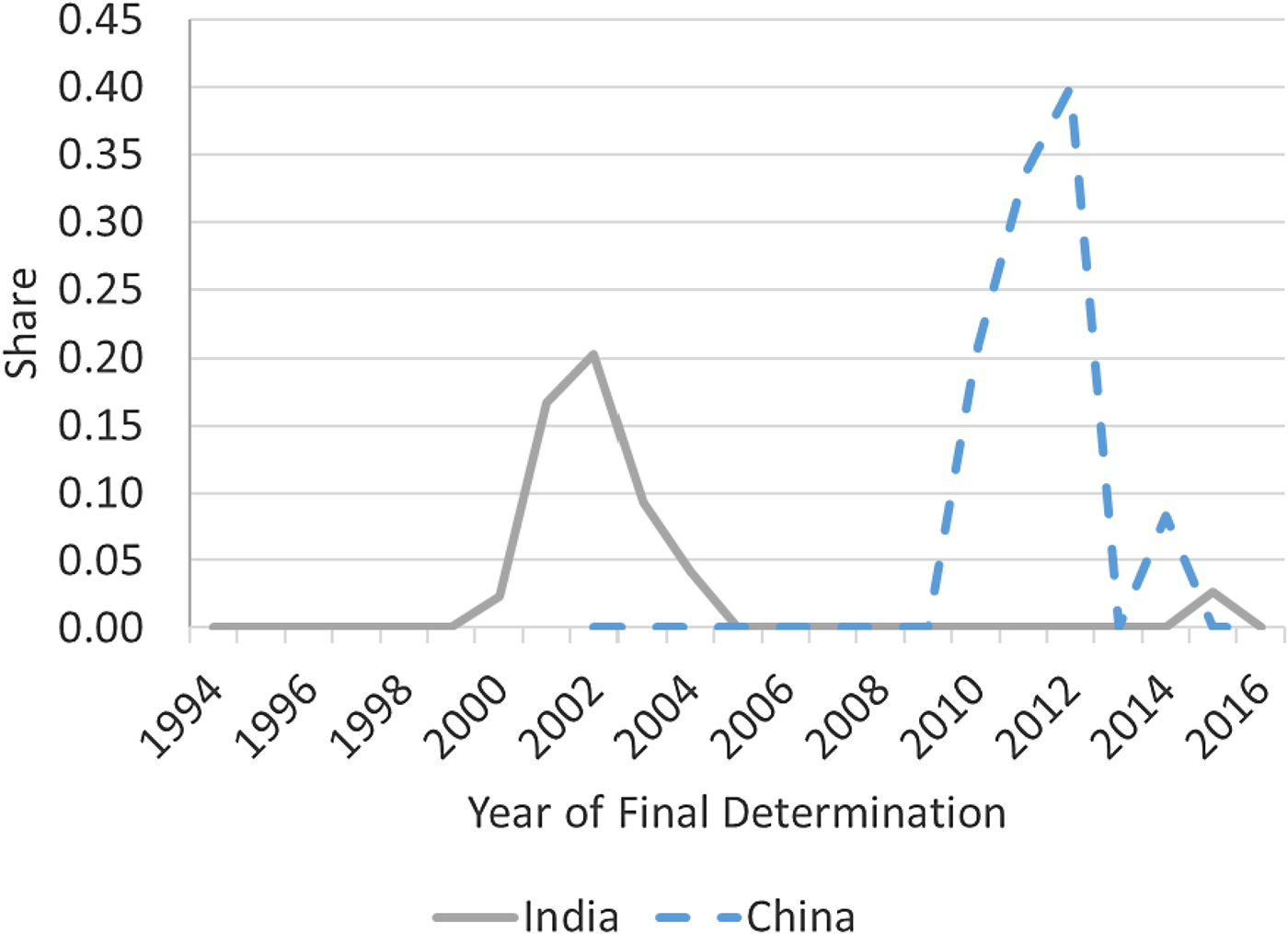
It is also interesting to consider what other factors may be driving the large number of disputes involving China's anti-dumping procedures. We note that this pattern of WTO disputes targeting relatively new and active users of anti-dumping protection does not appear to be unique to China. As illustrated in Figure 3, India faced a strikingly similar surge in WTO disputes targeting its anti-dumping investigations in the early 2000s. Although few of India's anti-dumping investigations are now challenged at the WTO, it remains to be seen whether China will similarly learn to satisfy its WTO partners with its explanations in anti-dumping investigations.
Anti-dumping investigations challenged at the WTO: China versus India
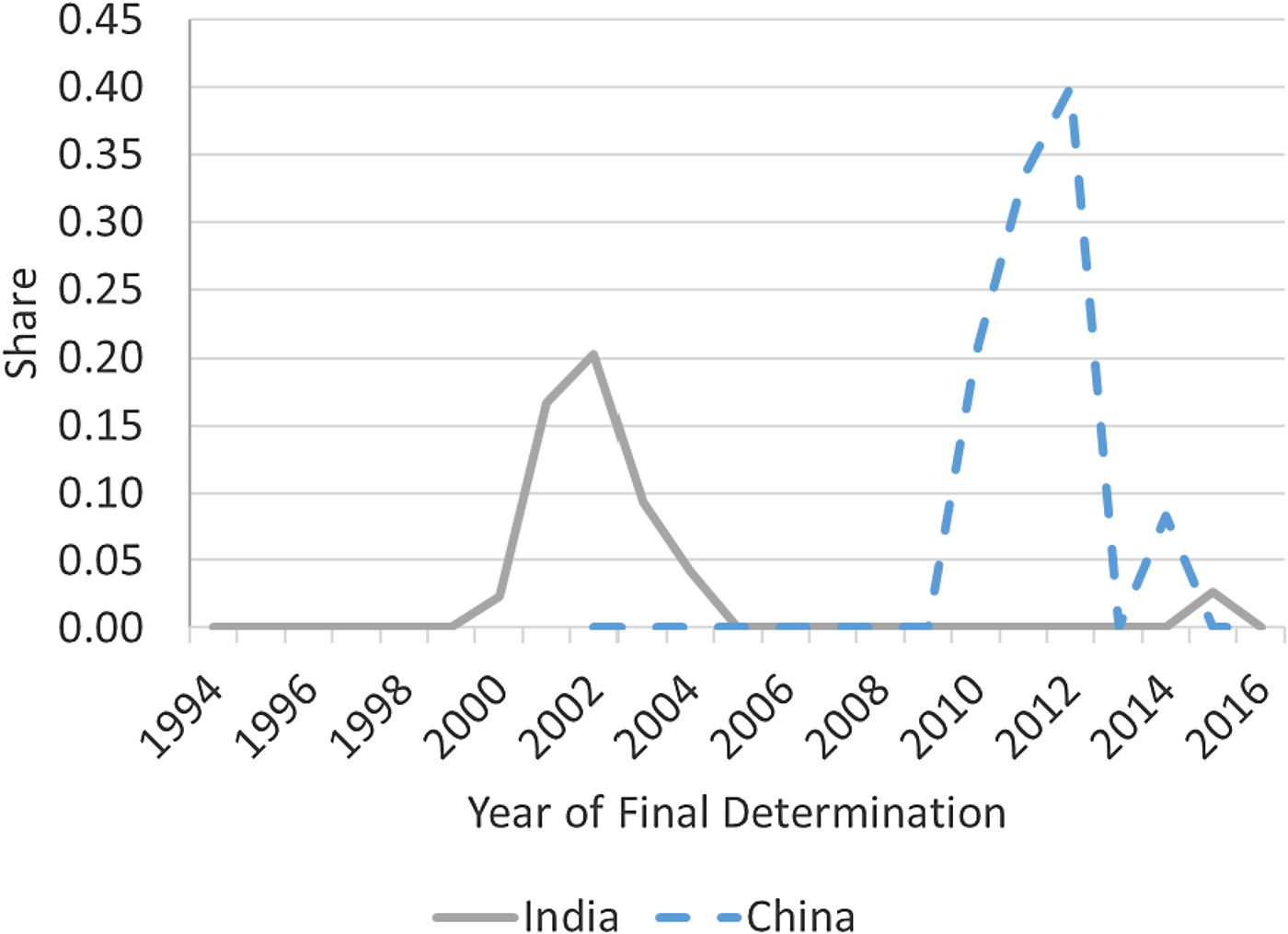
Both India and China may face a greater number of WTO challenges associated with their anti-dumping actions for political economy reasons. For example, Bown (Reference Bown2005) found in his study of US anti-dumping investigations that countries are more likely to challenge the anti-dumping duties in the WTO dispute settlement system the larger the value of the affected exports; given the large size of the Chinese economy, any anti-dumping duties imposed by this country could warrant more legal action by the impacted countries.
The propensity to challenge China's investigations at the WTO may also be driven by the unique nature of its anti-dumping investigation regime, which has resulted in an extremely high success rate for anti-dumping petitions. Of the 180 anti-dumping investigation initiated by China between 2001 and 2014, 82% resulted in the imposition of anti-dumping duties, compared to the average success rate of 67% across all WTO members.Footnote 81 Some trading partners have criticized the Chinese practice of launching anti-dumping investigation in retaliation for the ‘discriminatory’ use of anti-dumping measures against China by other countries, as provided for by Article 56 of China's anti-dumping regulations (Zheng and Abrami, 2011: 385).Footnote 82 In response, China has stated that Article 56 has never been used; that this provision does not contradict the obligation under Article 17 of the ADA to have recourse to WTO dispute settlement instead of taking unilateral actions; and that, as a WTO Member it would resort to WTO dispute settlement before taking countermeasures.Footnote 83 While such countermeasures may be consistent with behaviour of other countries as documented by Feinberg and Reynolds (Reference Feinberg and Reynolds2018), such an explicit rule makes China more vulnerable to WTO challenges to their anti-dumping actions. Furthermore, the United States contends that China files tit-for-tat anti-dumping investigations against United States’ companies whenever the United States brings a WTO dispute against China (Shaffer and Gao, Reference Shaffer and Gao2017: 179). However, as virtually all these Chinese retaliation cases are against the European Union and the United States, it is unlikely that the cellulose pulp investigation would fall into this category.
A final potential reason that may explain why Chinese anti-dumping investigations are challenged more at the WTO is that there is an insufficient domestic appeal process. One of the obligations of the ADA is the establishment of judicial review mechanisms for trade remedy measures. Prior to its accession agreement, anti-dumping decisions were specifically excluded from judicial review in China under the Administrative Litigation Law (Qin, Reference Qin2007: 736). Although China designated the Beijing Interim People's Court to hear judicial reviews of anti-dumping investigations, as of 2017 no cases had been brought to the court for review.Footnote 84 As means of comparison, the United States International Trade Commission was involved in the litigation of 24 anti-dumping investigations in United States courts in 2016 alone. As noted in Wu (Reference Wu2016), there are close links between the Chinese Party-state and Chinese firms, both state-owned and private, thus domestic Chinese firms hurt by Chinese anti-dumping duties may find alternative forms of compensation for duties. Foreign firms targeted by Chinese anti-dumping duties, on the other hand, may turn more frequently to the WTO dispute settlement body absent a reliable domestic review process.
8. Conclusions
The 2017 China–Cellulose Pulp ruling marked the third time in five years that a WTO panel repudiated China's use of the ‘parallel price trends’ methodology to assess the effects of subject imports on domestic prices. In each of these cases, the panel ruled that MOFCOM's use of this methodology fulfils its consideration of whether prices have declined, but it continues to fail to explain what is driving the prices down, and particularly whether dumped imports have caused the decline in domestic prices.
In this paper, we explored whether it is the parallel price trend methodology itself that is problematic or China's implementation of that methodology that has caused it to lose these three disputes. We find that there are certainly more sophisticated statistical methods to prove price depression. Nevertheless, the large number of disputes over China’s recent anti-dumping actions appears to be more related to China’s inability to provide detailed explanations of their findings. We further explored a number of confounding factors that may be driving the large number of disputes over these anti-dumping actions, including political economy factors and insufficient domestic judicial review of China's anti-dumping investigations. It remains to be seen whether China will be able to implement WTO panel and Appellate Body recommendations into their future anti-dumping investigations, thus reducing the need for future challenges.