


%20--%3e%3c!DOCTYPE%20svg%20PUBLIC%20'-//W3C//DTD%20SVG%201.0//EN'%20'http://www.w3.org/TR/2001/REC-SVG-20010904/DTD/svg10.dtd'%3e%3csvg%20version='1.0'%20id='Layer_1'%20xmlns='http://www.w3.org/2000/svg'%20xmlns:xlink='http://www.w3.org/1999/xlink'%20x='0px'%20y='0px'%20width='64px'%20height='64px'%20viewBox='5.5%20-3.5%2064%2064'%20enable-background='new%205.5%20-3.5%2064%2064'%20xml:space='preserve'%3e%3cg%3e%3ccircle%20fill='%23FFFFFF'%20fill-opacity='0'%20cx='37.785'%20cy='28.501'%20r='28.836'/%3e%3cpath%20fill='%23595959'%20d='M37.441-3.5c8.951,0,16.572,3.125,22.857,9.372c3.008,3.009,5.295,6.448,6.857,10.314%20c1.561,3.867,2.344,7.971,2.344,12.314c0,4.381-0.773,8.486-2.314,12.313c-1.543,3.828-3.82,7.21-6.828,10.143%20c-3.123,3.085-6.666,5.448-10.629,7.086c-3.961,1.638-8.057,2.457-12.285,2.457s-8.276-0.808-12.143-2.429%20c-3.866-1.618-7.333-3.961-10.4-7.027c-3.067-3.066-5.4-6.524-7-10.372S5.5,32.767,5.5,28.5c0-4.229,0.809-8.295,2.428-12.2%20c1.619-3.905,3.972-7.4,7.057-10.486C21.08-0.394,28.565-3.5,37.441-3.5z%20M37.557,2.272c-7.314,0-13.467,2.553-18.458,7.657%20c-2.515,2.553-4.448,5.419-5.8,8.6c-1.354,3.181-2.029,6.505-2.029,9.972c0,3.429,0.675,6.734,2.029,9.913%20c1.353,3.183,3.285,6.021,5.8,8.516c2.514,2.496,5.351,4.399,8.515,5.715c3.161,1.314,6.476,1.971,9.943,1.971%20c3.428,0,6.75-0.665,9.973-1.999c3.219-1.335,6.121-3.257,8.713-5.771c4.99-4.876,7.484-10.99,7.484-18.344%20c0-3.543-0.648-6.895-1.943-10.057c-1.293-3.162-3.18-5.98-5.654-8.458C50.984,4.844,44.795,2.272,37.557,2.272z%20M37.156,23.187%20l-4.287,2.229c-0.458-0.951-1.019-1.619-1.685-2c-0.667-0.38-1.286-0.571-1.858-0.571c-2.856,0-4.286,1.885-4.286,5.657%20c0,1.714,0.362,3.084,1.085,4.113c0.724,1.029,1.791,1.544,3.201,1.544c1.867,0,3.181-0.915,3.944-2.743l3.942,2%20c-0.838,1.563-2,2.791-3.486,3.686c-1.484,0.896-3.123,1.343-4.914,1.343c-2.857,0-5.163-0.875-6.915-2.629%20c-1.752-1.752-2.628-4.19-2.628-7.313c0-3.048,0.886-5.466,2.657-7.257c1.771-1.79,4.009-2.686,6.715-2.686%20C32.604,18.558,35.441,20.101,37.156,23.187z%20M55.613,23.187l-4.229,2.229c-0.457-0.951-1.02-1.619-1.686-2%20c-0.668-0.38-1.307-0.571-1.914-0.571c-2.857,0-4.287,1.885-4.287,5.657c0,1.714,0.363,3.084,1.086,4.113%20c0.723,1.029,1.789,1.544,3.201,1.544c1.865,0,3.18-0.915,3.941-2.743l4,2c-0.875,1.563-2.057,2.791-3.541,3.686%20c-1.486,0.896-3.105,1.343-4.857,1.343c-2.896,0-5.209-0.875-6.941-2.629c-1.736-1.752-2.602-4.19-2.602-7.313%20c0-3.048,0.885-5.466,2.658-7.257c1.77-1.79,4.008-2.686,6.713-2.686C51.117,18.558,53.938,20.101,55.613,23.187z'/%3e%3c/g%3e%3c/svg%3e)
%20--%3e%3c!DOCTYPE%20svg%20PUBLIC%20'-//W3C//DTD%20SVG%201.0//EN'%20'http://www.w3.org/TR/2001/REC-SVG-20010904/DTD/svg10.dtd'%3e%3csvg%20version='1.0'%20id='Layer_1'%20xmlns='http://www.w3.org/2000/svg'%20xmlns:xlink='http://www.w3.org/1999/xlink'%20x='0px'%20y='0px'%20width='64px'%20height='64px'%20viewBox='5.5%20-3.5%2064%2064'%20enable-background='new%205.5%20-3.5%2064%2064'%20xml:space='preserve'%3e%3cg%3e%3ccircle%20fill='%23FFFFFF'%20fill-opacity='0'%20cx='37.637'%20cy='28.806'%20r='28.276'/%3e%3cg%3e%3cpath%20fill='%23595959'%20d='M37.443-3.5c8.988,0,16.57,3.085,22.742,9.257C66.393,11.967,69.5,19.548,69.5,28.5c0,8.991-3.049,16.476-9.145,22.456%20C53.879,57.319,46.242,60.5,37.443,60.5c-8.649,0-16.153-3.144-22.514-9.43C8.644,44.784,5.5,37.262,5.5,28.5%20c0-8.761,3.144-16.342,9.429-22.742C21.101-0.415,28.604-3.5,37.443-3.5z%20M37.557,2.272c-7.276,0-13.428,2.553-18.457,7.657%20c-5.22,5.334-7.829,11.525-7.829,18.572c0,7.086,2.59,13.22,7.77,18.398c5.181,5.182,11.352,7.771,18.514,7.771%20c7.123,0,13.334-2.607,18.629-7.828c5.029-4.838,7.543-10.952,7.543-18.343c0-7.276-2.553-13.465-7.656-18.571%20C50.967,4.824,44.795,2.272,37.557,2.272z%20M46.129,20.557v13.085h-3.656v15.542h-9.944V33.643h-3.656V20.557%20c0-0.572,0.2-1.057,0.599-1.457c0.401-0.399,0.887-0.6,1.457-0.6h13.144c0.533,0,1.01,0.2,1.428,0.6%20C45.918,19.5,46.129,19.986,46.129,20.557z%20M33.042,12.329c0-3.008,1.485-4.514,4.458-4.514s4.457,1.504,4.457,4.514%20c0,2.971-1.486,4.457-4.457,4.457S33.042,15.3,33.042,12.329z'/%3e%3c/g%3e%3c/g%3e%3c/svg%3e)
Introduction
Antimicrobial resistance (AMR) is a growing global health concern that contributed to approximately 4.95 million deaths worldwide in 2019 Reference Murray, Ikuta and Sharara1 and was associated with over 3 million deaths among children worldwide in 2022. Reference Harwell and Hu2 If nothing is done, these figures could rise to 10 million annually by 2050, with devastating health and economic consequences. Reference de Kraker, Stewardson and Harbarth3 Two research studies conducted in the United States revealed that about 30%–50% of antibiotic prescriptions are inappropriate, highlighting the widespread reach of this challenge. Reference Fleming-Dutra, Hersh and Shapiro4,Reference Chua, Fischer and Linder5 Africa has also borne its share of this global menace, with an estimated 1.05 million deaths linked to AMR. Reference Sartorius, Gray and Weaver6
The World Health Organisation (WHO) lists AMR as one of the top ten global public health threats facing humanity. 7 In response, the WHO Global Action Plan on AMR adopted strategies to help curb these threats. The objectives of this Global Action Plan are to improve awareness and understanding of AMR through communication and training; strengthen knowledge via surveillance and research; reduce infection incidence through hygiene, sanitation, and infection prevention; optimize antimicrobial use through stewardship programs across human and animal health; and promote sustainable investment in new medicines, diagnostics, and vaccines. 8 Collectively, these objectives support a coordinated, “One Health” approach to tackling AMR. Reference Velazquez-Meza, Galarde-López, Carrillo-Quiróz and Alpuche-Aranda9
Antimicrobial stewardship (AMS) refers to a coherent set of actions aimed at ensuring the appropriate use of antimicrobials to achieve safe and effective clinical outcomes. Reference Dyar, Huttner, Schouten and Pulcini10 This is achieved through appropriate selection of antimicrobials, usually following a sensitivity test, as well as the correct dosing, route of administration, and duration of therapy, to achieve safe and effective clinical outcomes at a reasonable cost. Reference Dellit, Owens and McGowan11 Household-and community-level self-medication with antimicrobials remains a significant global driver of inappropriate use. Reference Nazari, Ghafoury, Chezani-Sharahi, Moradzadeh and Naghshbandi12 A recent systematic review and meta-analysis revealed a pooled prevalence of self-medication at 43.0%, with the highest rate, 55.2%, observed in sub-Saharan Africa. Reference Gashaw, Weldegebreal, Demissie, Jambo and Assefa13 Another systematic review spanning 24 countries reported a 62% pooled prevalence of non-prescription antibiotic dispensing for self-limiting conditions. Reference Auta, Hadi and Oga14 The widespread dispensing of antibiotics without prescription at community pharmacies may enhance the spread of AMR, underscoring the need for targeted AMS initiatives at the community level. Reference Auta, Hadi and Oga14
Pharmacists, especially in community settings, are easily accessible, frequently consulted, and trusted healthcare professionals known for resolving minor health conditions. Reference Oladipo, Muili, Rashidat and Rokibat15 Consequently, community pharmacists could play a crucial role in the success of initiatives aimed at combating AMR particularly in developing countries such as Nigeria, where the use of antibiotics without a prescription is predominant. Reference Raju, Srinivas and Siddalingegowda16 Nonetheless, there are limited data regarding the practices, facilitators, and barriers related to AMS in community pharmacies in Nigeria. This study aimed to evaluate the practices, barriers, and facilitators related to AMS in community pharmacies in Uyo, Akwa Ibom State, Nigeria.
Methods
Design, setting, and participants
This was a descriptive cross-sectional study among 112 pharmacists across 95 community pharmacies in Uyo Local Government Area (LGA), Akwa Ibom State, Nigeria. Uyo, the state capital, covers approximately 214.31 km2 and has a population of about 1.5 mmillion. 17 The minimum sample size of 86 was computed with an online sample size calculator, 18 considering a 95% confidence level, a 5% margin of error, 110 registered community pharmacies in Uyo as of August 2023, and a 50% response distribution. To increase the statistical power of the analysis, however, 112 pharmacists drawn from 95 community pharmacies were surveyed. Pharmacists who had been practicing for at least six months and provided informed consent to participate were included in the study.
Instrument for data collection
Data were collected using a 31-item self-administered questionnaire adapted from previous studies. Reference Alowairdhi, Alhussain and Alomran19–Reference Scheepers, Niesing and Bester23 To assess content validity, the 31-item instrument was sent to three academic pharmacists in the Department of Clinical Pharmacy and Biopharmacy, University of Uyo, Nigeria, who have experience in psychometrics and community practice. They were required to give their opinions with regard to the relevance and clarity of each item. Their feedback was used to modify and improve the instrument. The revised questionnaire was piloted among ten community pharmacists who were not included in the main study. These participants were asked to read through and complete the instrument and to state which item(s), if any, were ambiguous. Based on their feedback, final refinements were made before field administration. The questionnaire comprised two sections: Section A enquired about personal information of the participant, while Section B sought information regarding knowledge/awareness, perceptions, practices, barriers, and facilitators related to AMS in community pharmacies.
Data collection
Potential participants were approached during working hours where the study’s objectives and procedures where explained. Eligible participants were required to fill the informed consent form for participation by ticking a box on the data collection instrument. The questionnaire was administered on-site and retrieved upon completion. The data collection period lasted from October to November 2023.
Data analysis
Data were entered into Microsoft Excel and exported to SPSS version 25.0 (IBM Corp., Armonk, NY, USA) for analysis. Descriptive statistics were used to summarize the data. To simplify analysis and make results easier to interpret, the 5-point Likert response scales were reduced to 3-point scales. ‘Strongly agree’ and ‘agree’ were combined into ‘agree‘, while ‘strongly disagree‘ and ‘disagree‘ were merged into ‘disagree‘. The neutral option remained unchanged. In a similar manner, the original options ‘never‘ and ‘rarely‘ were combined into a single category (labeled never/rarely), while ‘often‘ and ‘always‘ were grouped as often/always; the ‘occasionally’ option was retained as a distinct option.
Ethical considerations
Ethical approval was obtained from the Health Research Ethics Committee of the Ministry of Health, Akwa Ibom State. Informed consent was obtained from each participant.
Results
Out of 125 community pharmacists approached, 112 agreed to participate, yielding a response rate of 89.6%. Thirteen pharmacists declined participation, citing time constraints or lack of interest.
Characteristics of participants
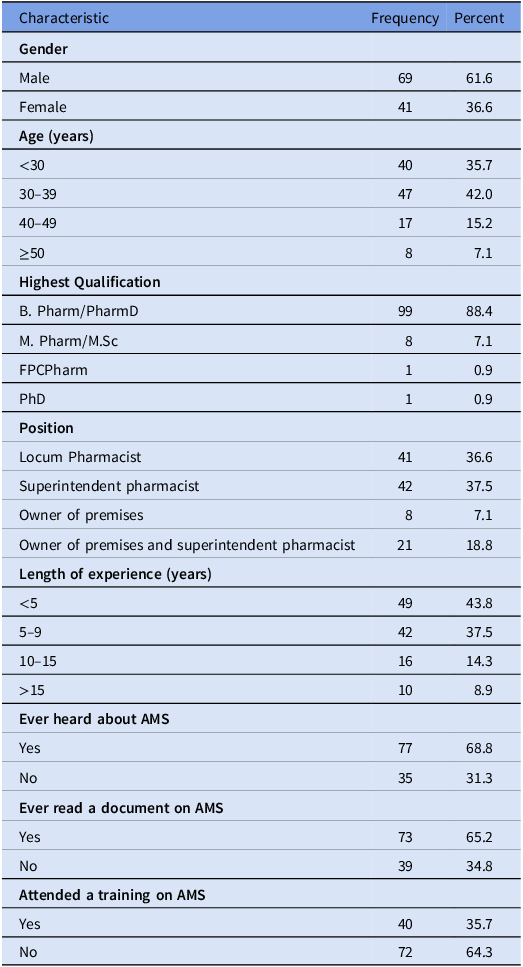
Most of the participants were male (61.6%); only 8 (7.1%) of the participants were over 49 years old. Most of the participants (88.4%) had a Bachelor of Pharmacy (B.Pharm) or Doctor of Pharmacy (PharmD) as their highest qualification; 49 (43.8%) had less than 5 years’ experience in community practice. The majority of participants had heard of AMS (68.8%) and had read a document about it (65.2%) (Table 1).
Characteristics of participants (N = 112)

AMS Antimicrobial stewardship, B.Pharm Bachelor of Pharmacy, PharmD Doctor of Pharmacy, M.Pharm Master of Pharmacy, M.Sc Master of Science, FPCPharm Fellow of the West African Postgraduate College of Pharmacists.
Perceptions about antimicrobial resistance and antimicrobial stewardship
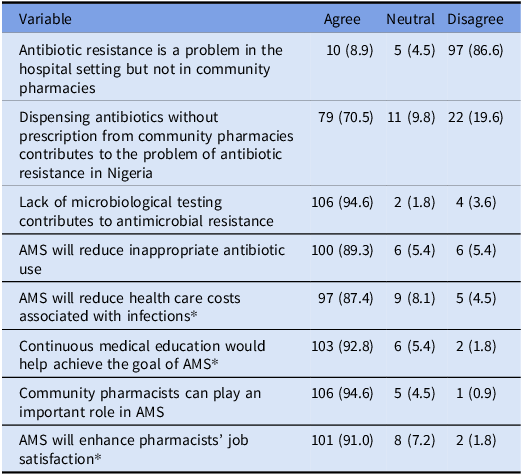
Most of the participants (86.6%) disagreed that antibiotic resistance is a problem in the hospital setting but not in community pharmacies. Only 4 (3.6%) disagreed that lack of microbiological testing contributes to AMR. The majority of participants (94.6%) agreed that community pharmacists can play an important role in AMS (Table 2).
Perceptions of antimicrobial resistance and antimicrobial stewardship

AMS Antimicrobial stewardship; *n = 111 due to non-response; values are n (%).
Practices of participants
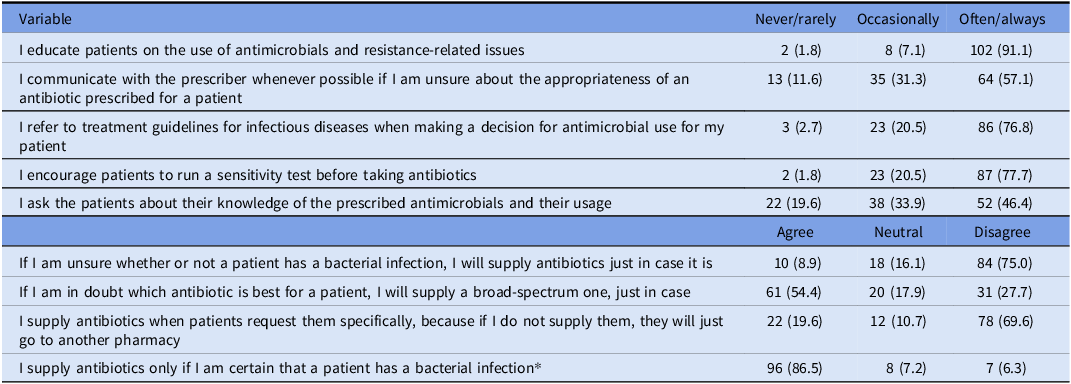
One hundred and two (91.1%) of the participants indicated that they often/always educate patients on the use of antimicrobials and resistance-related issues; about a third (33.9%) of them reported that they occasionally ask the patients about their knowledge of prescribed antimicrobials and their usage. Ninety-six (86.5%) agreed that they supply antibiotics only if they are certain that a patient has a bacterial infection. About half of the participants (54.4%) agreed that they would supply a broad-spectrum antibiotic when uncertain about the most appropriate antibiotic for a patient (Table 3).
Practices of participants (N = 112)

* n = 111 due to non-response; values are n (%).
A clear majority of the participants (95.5%) indicated that their choice of antibiotics for patients is based on microscopy, culture, and sensitivity tests, while only a few (4.5%) reported that advice from pharmaceutical/sales representatives influences their antibiotic choices (Figure 1).
Factors influencing community pharmacists’ choice of antibiotics for patients.

Barriers to antimicrobial stewardship in community pharmacies
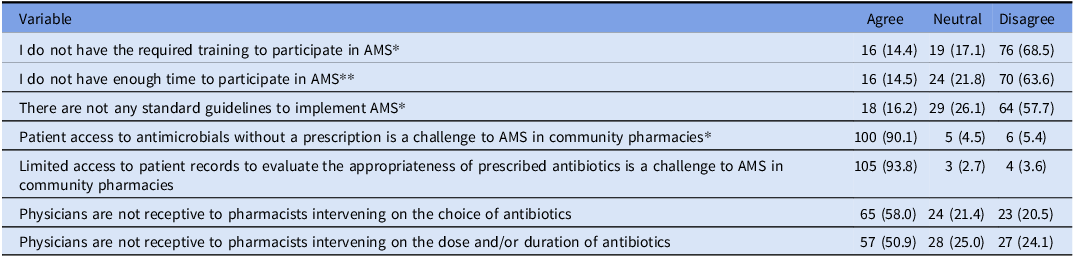
The most frequently reported barriers to AMS in community pharmacies were limited access to patient records to evaluate the appropriateness of antibiotic prescriptions (93.8%), unrestricted patient access to antimicrobials without a prescription (90.1%), and a lack of receptiveness from physicians toward pharmacists intervening in the selection of antibiotics for patients (58.0%) (Table 4).
Barriers to antimicrobial stewardship in community pharmacies

AMS Antimicrobial stewardship; *n = 111 due to non-response; **n = 110 due to non-response; values are n (%).
Facilitators of antimicrobial stewardship in community pharmacies
The two most frequently cited facilitators of AMS in community pharmacies were increased availability of pharmacy education programs on AMS (93.7%) and better access to patient’s clinical and laboratory data (89.2%) (Figure 2).
Facilitators of antimicrobial stewardship in community pharmacies AMS antimicrobial stewardship; CP community pharmacist.

Discussion
This study explored the practices, barriers, and facilitators associated with AMS in community pharmacies in Uyo, Akwa Ibom State, Nigeria. Additionally, it assessed the participants’ knowledge and perceptions regarding AMS.
The participants reported generally favorable practices related to AMS. Most pharmacists reported that they would not dispense antibiotics “just in case” nor accede to patient-specific demands for antimicrobials. However, about half of them admitted to dispensing broad-spectrum antibiotics in cases of diagnostic uncertainty. This practice of dispensing broad-spectrum antibiotics when diagnosis is uncertain supports earlier report of widespread use of fluoroquinolones and penicillins among residents of the city where the current study was conducted. Reference Orebiyi, Usifoh, Udoh, Ebong, Ekuma and Awofisayo24 According to the authors, most antibiotics consumed were from the Watch category of the WHO AWaRe (Access, Watch, Reserve) classification, which has a higher resistance potential than the Access group. Reference Orebiyi, Usifoh, Udoh, Ebong, Ekuma and Awofisayo24,25 Similarly, a nationwide study of antibiotic dispensing among community pharmacists revealed that cephalosporins, penicillins, and quinolones were the major classes of antibiotics dispensed. Reference Gladys, Gabriella, Lawal, Bukola, Amaechi and Augustine26 Although most penicillins belong to the Access group, most cephalosporins and all quinolones generally fall under the Watch group. 25 There is a need for antibiotic stewardship interventions aimed at educating community pharmacists about the WHO AWaRe classification of antibiotics and the importance of minimizing the dispensing of Watch-group antibiotics without a prescription or clear clinical indication. Reference Belachew, Hall and Selvey27,Reference Santos Caxico-Vieira and da Silva Moura28 Targeted training has been reported to significantly improve dispensing appropriateness and reduce inappropriate antibiotic recommendations among community pharmacists. Reference Santos Caxico-Vieira and da Silva Moura28
Most of the participants in our study reported that they regularly educate patients on proper antimicrobial use and resistance-related issues. This contrasts with reports from Pakistan Reference Nabeel, Ali, Sarwar and Waheed29 where community pharmacists seldom provided such counseling. Strengthening patient education with formal support and resources would amplify its impact, as reported in previous research. Reference Mason, Trochez, Thomas, Babar, Hesso and Kayyali30
The results of this study also indicate that most of the community pharmacists surveyed would encourage patients to run a sensitivity test before taking an antibiotic. This report supports findings from a previous study conducted in Western Nigeria, suggesting that community pharmacists in Nigeria understand the importance of a personalized treatment approach. Reference Akande-Sholabi, Oyesiji and Adebisi31
In our study, limited access to patient records for evaluating the appropriateness of prescribed antibiotics was the most commonly cited barrier to implementing AMS in community pharmacies, consistent with a previous study that also identified this as a barrier. Reference Barakat and Abougalambou32 Most of our participants also reported that patient access to antimicrobials without a prescription poses a barrier to implementing AMS in community pharmacies. Unrestricted access to antimicrobials continues to pose a global barrier to attaining AMS goals, especially in low-and middle-income countries (LMICs). Reference Belachew, Hall and Selvey27 This highlights the need for stricter enforcement on the rational and clinical use of antimicrobials in attaining these goals. Another major barrier identified was physicians’ resistance to pharmacists intervening in antibiotic selection or the dose/duration of prescribed antibiotics. This echoes findings from an Australian study which revealed that pharmacists and physicians rarely collaborated on concerns related to AMS. Reference Saha, Kong, Thursky and Mazza33 It is crucial to develop and implement ongoing AMS education programs for healthcare professionals, including physicians, because AMS requires a multidisciplinary team effort across healthcare settings.
In spite of the importance of AMS education progrmmes, our study revealed that most of our participants had never attended a training on AMS. This gap likely reflects the limited integration of comprehensive AMS lectures in undergraduate pharmacy curricula in Nigeria. Reference Abdu-Aguye, Barde, Yusuf, Lawal, Shehu and Mohammed34 This observation also mirrors findings from Australia, where pharmacists reported insufficient training to confidently engage in AMS programs. Reference Rizvi, Thompson, Williams and Zaidi35
Most pharmacists acknowledged AMR as a pressing issue in community pharmacies and recognized how a lack of microbiological diagnostics and non-prescription dispensing exacerbate AMR. Similar findings were reported by participants in a previous study. Reference Al-Shami, Abubakar, Hussein, Hussin and Al-Shami36 The overall high awareness of participants on AMS aligns with findings from Pakistan, where pharmacists exhibited good general knowledge of AMS despite misconceptions regarding resistance drivers.Reference Hashmi, Muhammad, Hussain, Gajdács and Jamshed 21
Key facilitators of AMS in community pharmacies identified in our study were enhanced availability of pharmacy education programs on AMS, improved access to patients’ clinical data, public awareness initiatives that emphasize the role of community pharmacists in AMS, and stronger collaboration with physicians in hospitals. Globally, pharmacists in LMICs show willingness to adopt AMS practices when supported with training, diagnostic tools, and interprofessional collaboration. Reference Raju, Srinivas and Siddalingegowda16,Reference Barakat and Abougalambou32 Interestingly, only a small minority felt that monetary compensation was a motivating factor, a mindset equally shared by community pharmacists in a survey done in Thailand.Reference Netthong, Kane and Ahmadi 37 Most participants also reported that AMS in community pharmacies will enhance pharmacists’ job satisfaction. These findings suggest that while financial recognition may be beneficial, pharmacists’ commitment appears to be largely driven by professional responsibility and a sense of service. These findings also reflect a widespread professional eagerness to engage in AMS, consistent with a previous study that reported strong interest among Australian pharmacists in adopting stewardship roles in primary care. Reference Saha, Kong, Thursky and Mazza33
To our knowledge, this is the first study that evaluates the practices, facilitators, and barriers regarding AMS in community pharmacies in south-south Nigeria. Consequently, the findings offer locally relevant and actionable insights into AMS at the community level. However, several limitations should be noted. The cross-sectional design may limit causal inferences, and reliance on self-reported behaviors may be subject to social desirability bias. Furthermore, as the study was conducted in only one state, this may limit the generalizability of the findings.
Acknowledgements
The authors would like to thank all the community pharmacists that participated in the survey and Franklin Ozurumba, who assisted greatly with data collection.
Financial support
No financial support was received for the conduct of this study or the preparation of the article.
Transparency and Artificial intelligence (AI) tools use disclosure
ChatGPT 5.3 and Grammarly were used between October 2025 and January 2026 to paraphrase and refine the ideas generated by the authors, improve clarity, and organize the manuscript. All AI-assisted outputs were carefully verified by the authors, with appropriate citations included where necessary. The authors take full responsibility for the content of the publication.



 Open access

