Introduction
When illness generates a threat to personal integrity, human beings are naturally led to reflect on life and death, along with their own values, culture and identity (Lakasing Reference Lakasing2014). As medicine became more focused on technology, end-of-life care gradually moved toward institutional care and away from communities, making discussions of death and dying uncomfortable and aversive. As paradoxical as it may seem, engaging in conversations about finitude reduces anxiety, feeling of loneliness, depression and fear in patients and their families (Death Education 2019; Kalish Reference Kalish2002). In addition, patients with depression, anxiety, and hopelessness are more likely to express a desire to die and a loss of sense of dignity (Chochinov Reference Chochinov2012).
Dignity comprises both inherent and extrinsic components; the latter of which can be bolstered through personal relationships and notions of respect for oneself and others (Jacobson Reference Jacobson2009; Tadd et al. Reference Tadd, Bayer and Dieppe2002). With the advent of Model of Dignity in the Terminally Ill, it became possible to delineate features of dignity toward end of life (Chochinov Reference Chochinov2002a, Reference Chochinov2004, Reference Chochinov2012, Reference Chochinov2022b; Chochinov et al. Reference Chochinov, Hack and McClement2002c; Julião Reference Julião2014a). Based on this model, dignity therapy (DT) was developed in order to help dying patients reframe and give meaning to their illness process through narrative addressing of significant life stories and reflections. These are recorded, transcribed, and edited to produce a generativity document that patient can bequeath to their loved ones (Chochinov Reference Chochinov2004, Reference Chochinov2012; Chochinov et al. Reference Chochinov, Hack and Hassard2005).
After patients consent to doing DT, they are presented with a list of questions, stimulating the recollection of memories, thoughts, and feelings and words that need to be shared. The original English DT Question Protocol has been adapted for use in several countries such as China, Japan, Denmark, Portugal, Germany, and Sweden (Chochinov Reference Chochinov2012). In order for DT to enable the creation of a reliable legacy document, it is essential that patients fully understand what they are being asked. To the best of our knowledge, the DT Question Protocol has never been adapted to Brazilian Portuguese. Hence, the aim of this study was to translate and culturally adapt the Dignity Therapy Question Protocol (DTQP) to Brazilian Portuguese.
Methods
Study design and setting
This study used descriptive methods for the process of cross-cultural adaptation. It took place within an inpatient palliative care unit at Barretos Cancer Hospital (Barretos, São Paulo, Brazil).
Ethical considerations
This study was approved by the Committee of Ethics in Research of Barretos Cancer Hospital, under the opinion no. 5.567.892/2022. All the participants invited to participate in the study signed an informed consent form.
Procedures
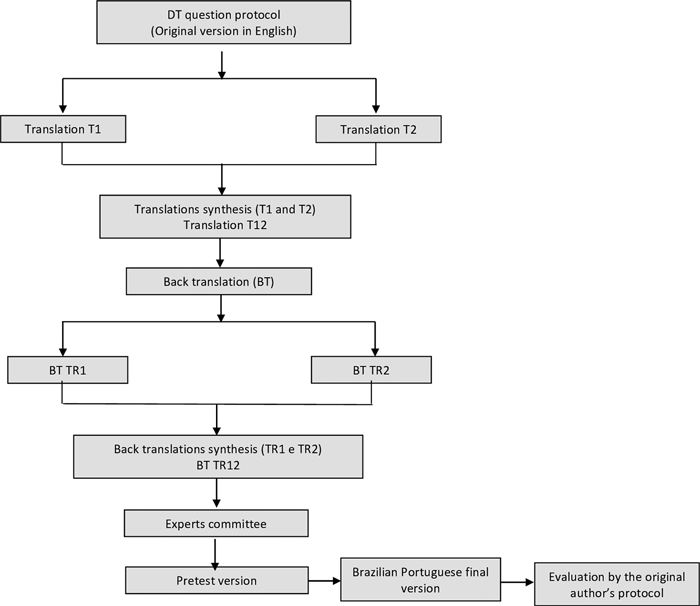
The translation from English into Brazilian Portuguese followed the internationally established standardized process proposed by Beaton et al. (Reference Beaton, Bombardier and Guillemin2000) and Sousa and Rojjanasrirat (Reference Sousa and Rojjanasrirat2011). It took place in 4 stages: (1) translation and synthesis of English original version protocol into Brazilian Portuguese, (2) back translation, (3) review by expert committee, and (4) pretest.
Stages of the study
Stage I: translation and synthesis of English original version protocol into Brazilian Portuguese
In this stage, 2 independent bilingual translators, one with native English and fluency in Brazilian Portuguese and the other with native Brazilian Portuguese and fluency in English, evaluated and translated the English version of the DT question protocol, generating 2 versions (T1 and T2), which were synthesized into a unique version (T12).
Stage II: back translation
The back translation process consisted of translating the synthesized Portuguese version back into English by 2 independent bilingual translators different from the translation phase ones, who evaluated and translated the synthesized Portuguese version (T12) and produced 2 versions of the back translation (BT TR1 and BT TR2), which were synthesized into a single English version almost identical to the original.
Stage III: experts committee
An expert committee, comprising 2 palliative doctors, 2 nurses and a psychologist, then examined and rated each question, using a Likert scale (1 = inaccurate, 2 = not very precise, 3 = precise, and 4 = very precise). They also proposed suggestions for better adaptation. Items were judged based on equivalence of meaning (semantic equivalence), cultural context (cultural equivalence), and concept (conceptual equivalence) (Beaton et al. Reference Beaton, Bombardier and Guillemin2000). This was followed by the calculation of the Content Validity Index (CVI), which measures the proportion of participants in the expert committee who are in agreement with the instrument’s items. This procedure is performed by calculating the number of responses with a score of 3 or 4 on the Likert scale (“precise” or “very precise,” respectively) divided by the total number of responses. In order to consider the item adequate, the minimum recommended agreement is 80% (Alexandre and Colucci Reference Alexandre and Colucci2011). The protocol was then considered suitable for pretest.
Stage IV: pretest
In order to maintain a good generalizability, the pretest aims to test the questionnaire in a sample from the same population in which this instrument will be applied in studies that envisage larger samples.
For the pretest, we used convenience sampling. The pretest took place in a sample of 30 participants, with eligibility criteria including the following: (1) at least 18 years old, (2) with an incurable disease, (3) receiving palliative treatment, with or without oncology follow-up, (4) with awareness of illness and incurable, (5) fluent in Brazilian Portuguese, orally and in writing.
The final translation of the DTPQ was evaluated by the authors of the original protocol, who approved the Brazilian Portuguese version, indicating that it maintained the essence of the original English version, which was based on the Model of Dignity in the Terminally Ill (Chochinov Reference Chochinov2004, Reference Chochinov2012; Chochinov et al. Reference Chochinov, Hack and Hassard2005) (see Figure 1).
DT question protocol process of translation and cultural adaptation flowchart.

Pretest data collection
Sociodemographic characteristics
The following data were collected: age (years), gender, religion, educational level, marital status, number of children, primary caregiver, diagnosis, time since diagnosis, and Palliative Performance Scale (PPS).
Dignity therapy question protocol
The DTQP is a question guide that is presented to patients before the DT application itself and aims to encourage the participant to reflect on subjects that can be discussed during DT. This is done to reduce patient’s anxiety about the process one will go through during this intervention. This protocol is meant to be flexible, adapting to patient’s preferences, and not necessarily being addressed in its entirety. It is meant to guide and facilitate a dialogue between the therapist and participant (Chochinov Reference Chochinov2012).
Pretest protocol
A pretest protocol was designed to elicit participant ratings on each item in terms of textual clarity. Each participant rated the protocol title and questions for the criteria “doubts” and “discomfort, annoyance, and/or embarrassment” using a dichotomous scale (YES or NO). Items that were classified as not understandable or unpleasant were reformulated by way of consensus among the researchers who evaluated the participants’ suggestions (Sousa and Rojjanasrirat Reference Sousa and Rojjanasrirat2011)
Statistical analysis
Descriptive statistics were used to describe sociodemographic variables and responses to the feedback questionnaire. Semantic, cultural, and conceptual equivalences were determined by calculating the content validity index.
Study data were managed using REDCap electronic data capture tools (Harris et al. Reference Harris, Taylor and Thielke2009), hosted at Barretos Cancer Hospital, and analyzed using IBM Statistical Package for the Social Sciences (SPSS), version 27.
Results
Translation and cross-cultural adaptation
The translation and back translation were carried as per the previously described. This resulted in the emergence of the Portuguese version Protocolo de Perguntas sobre Terapia da Dignidade (“Protocol of Questions about Dignity Therapy”); all 11 questions from the original question protocol were retained.
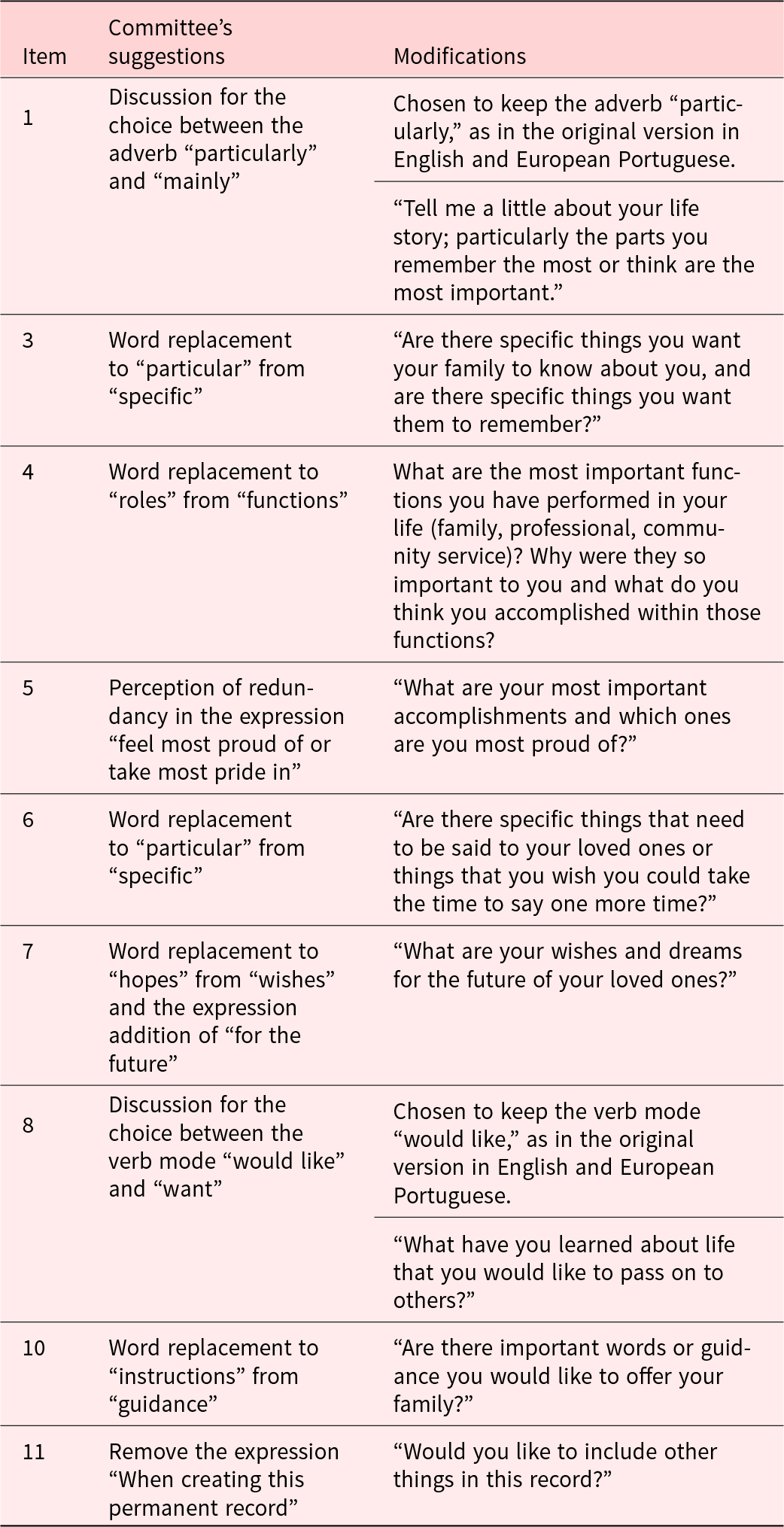
Questionnaire items 1, 3, 4, 5, 6, 7, 8, 10, and 11 received score of 3, and the experts committee proposed suggestions for modifying the respective items. No item received a score lower than 3, and therefore the content validity index was 1 for all equivalences (semantic, cultural, and conceptual). The remaining items received a score of 4. Table 1 shows the item-specific expert committee recommendations.
Description of the items with modifications requested by the expert committee

Pretest
From all the possible participants screened, 262 patients did not meet the eligibility criteria, mainly due to delirium and the process of actively dying (25%), dysfunctional coping (12%), impaired cognition (12%), uncontrolled symptoms (11%), contact isolation (4%), psychiatric disorder (2%), family dysfunctional coping (2%), unaware of prognosis (2%), social issues (1%), foreigners (1%), and illiteracy.
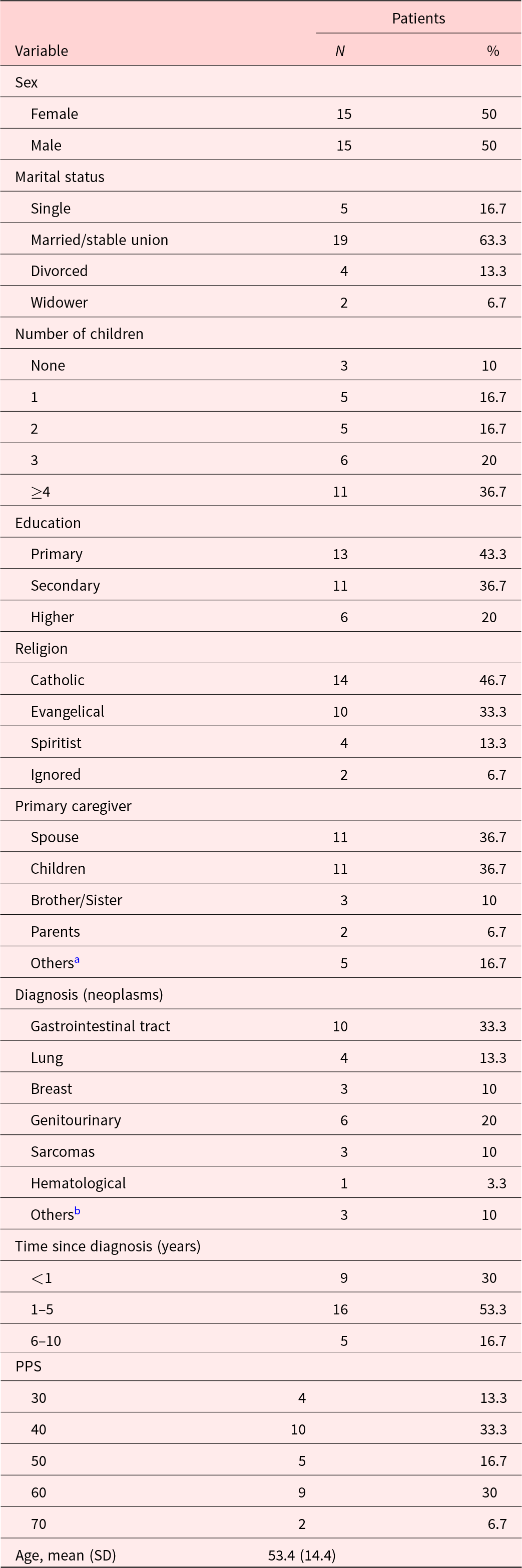
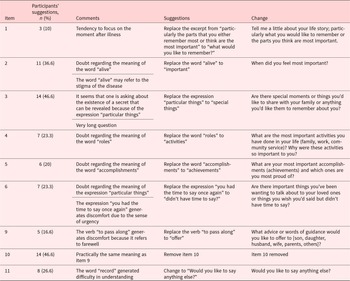
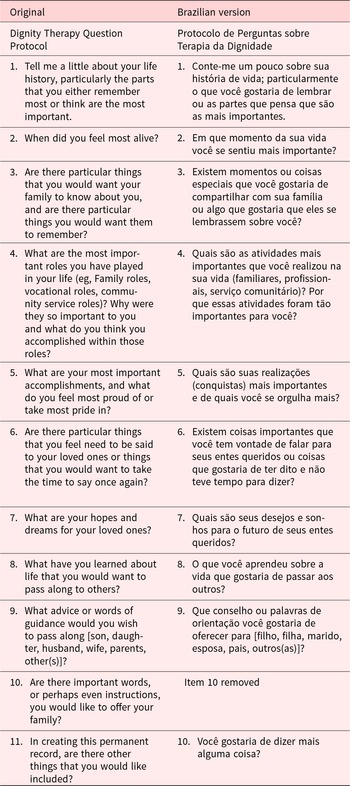
The initial sample consisted of 41 participants; 10 (24%) refused to participate because they were not feeling well and one (2%) dropped out during the interview. The pretest was administered to 30 (73%) participants, 15 of them were female with the mean age of 53.4 years, ranging from 28 to 80. The patients’ sociodemographic characteristics are shown in Table 2. All participants answered a questionnaire with questions related to the understanding of each item. In the final version, the protocol title and items 7 and 8 were not changed. In addition, almost 50% of participants suggested that item 10 should be removed as they considered it had the same meaning as item 9. In contrast, recommendations for changes in wording were suggested for items 1, 2, 3, 4, 5, 6, and 9. These recommendations are shown in Table 3. The original and Brazilian DT question protocol versions are shown in Table 4.
Sociodemographic characteristics of the participants who completed the pretest

a Others: brother-in-law, mother-in-law, friend.
b Others: Nasopharynx, urachus, adrenal; PPS: Palliative Performance Scale.
Pretest

Original dignity therapy question protocol and Brazilian version

The interviews lasted an average of 50 minutes, mainly because several participants, in addition to collaborating with the pretest process, wanted to make personal reflections on the DT protocol questions, which generated several reports of a feeling of well-being at the end of the interview.
In view of this, it is recommended that, in the face of the pretest process, the researcher reinforces to the participant the difference between judging the understanding of the question and answering itself. From this understanding, there is no need to interrupt the participants in their narratives, since the authors understand that these reflections can help the participant in their process of coping with the disease.
Discussion
The translation and cross-cultural adaptation of the DTQP was carried out in order to maintain the original characteristics of DT application procedures. This process took place according to the international standard by Beaton et al. (Reference Beaton, Bombardier and Guillemin2000) to preserve the implementation of DT in Brazil.
The process of adaptation demands consideration of the mindset, belief system, and established habits and cultural practices, so that the translation and adaptation are applicable to the reality and context of Brazilian people (Epstein et al. Reference Epstein, Santo and Guillemin2015; Sousa and Rojjanasrirat Reference Sousa and Rojjanasrirat2011). This is critical, given that elements of clarity, meaning, and relevance can affect the ability of individuals to partake in DT (Houmann et al. Reference Houmann, Rydahl-Hansen and Chochinov2010). To help arrive at an adaptation that was culturally sensitive and easily comprehended, our expert committee evaluated semantic, cultural, and conceptual issues, proposing minimal modifications leading to a CVI of 1 for all the overall framework.
Most of the changes in the DTQP Brazilian Portuguese version related to comprehension difficulties regarding meaning of words and expressions such as “alive” (11/36.6%), “roles” (7/23.3%), “accomplishments” (6/20%), “particular things” (7/23.3%), and “records” (8/26.6%). Some participants expressed discomfort that some items alluded to goodbyes (5/16.6%), feeling of urgency by the lack of time (7/23.3%), and memories of events after the disease onset (3/10%), hence informing possible modifications. This may reflect limited vocabulary or fluency, since most participants did not conclude elementary school (10/33.3%). Furthermore, reports of discomfort related to matters of death and dying underscore how these topics are still very much taboo (Death Education 2019; Kalish Reference Kalish2002; Lakasing Reference Lakasing2014). Interestingly, a Danish translation and cultural adaptation of DTQP demonstrated the importance of customs and education. They reported that some items were existentially challenging, and topics related to one’s own achievements and matters of pride were interpreted as being boastful and having a sense of grandiosity (Houmann et al. Reference Houmann, Rydahl-Hansen and Chochinov2010). A German adaptation of the DTQP found that the words “alive” and “accomplishment” were considered adequate and had positive connotations; they also proposed an additional question: “What has been your mission in your life?” (Mai et al. Reference Mai, Goebel and Jentschke2018).
These diversified results raise questions regarding the main objective of translation and the process of cross-cultural adaptation. Wherever this takes place, the goal is to generate a framework of questions for conducting DT that is readily understandable and culturally sensitive, thus providing maximal benefits within that particular setting. Both Danish and German versions of the DTQP have undergone minor modifications and appear to be manageable, acceptable, and feasible to administer (Houmann et al. Reference Houmann, Rydahl-Hansen and Chochinov2010; Mai et al. Reference Mai, Goebel and Jentschke2018). Despite the importance of the rigor of this procedure, the DTQP is meant as a framework for conducting DT. The questions were designed to address facets concerning personhood, helping individuals connect with their essence. Specific language must always be sensitive to the patients’ level of acceptance and topics shaped according to their interests and needs (Chochinov Reference Chochinov2012; Houmann et al. Reference Houmann, Rydahl-Hansen and Chochinov2010; Julião Reference Julião2014a).
Previous randomized clinical trials have taken place in several countries such as Canada, Portugal, Spain, and England. Results indicate that DT is able to reduced anxiety and depression, make life more meaningful, increase sense of purpose and peace of mind, desire to live, quality of life, sense of dignity, and decreased suffering (Chochinov et al. Reference Chochinov, Kristjanson and Breitbart2011; Hall et al. Reference Hall, Goddard and Opio2011; Julião et al. Reference Julião, Barbosa and Oliveira2013, Reference Julião, Oliveira and Nunes2014b, Reference Julião, Oliveira and Nunes2017; Rudilla et al. Reference Rudilla, Galiana and Oliver2015).
The main limitations of our study are that the participants were recruited from a single health center with an exclusive diagnosis of cancer. However, our institution offers health care to the 5 regions of the country, which means our sample was likely representative of the different sociocultural characteristics of Brazil.
Based on our results, we conclude that the Brazilian Portuguese DTQP is a robust adaptation, with all items being well understood by patients. It will be very useful in the clinical practice of palliative care, helping patients near end of life reflect on their life stories while giving meaning to their illness experience The adapted version to Brazilian Portuguese will facilitate future studies using the DTQP.
Data availability statement
All data relevant to the study are included in the article or uploaded as supplementary information.
Acknowledgments
We want to thank the Research Group on Palliative Care and Health-Related Quality of Life (GPQual) - Barretos Cancer Hospital.
Author contributions
M.U.M., B.S.R.P., and C.E.P. contributed to the design of the study. M.U.M., B.S.R.P., and A.J.S.F. contributed to data collection. M.U.M. and B.S.R.P. were responsible for data analysis. M.U.M., C.E.P., A.J.S.F., M.J., H.M.C., B.S.R.P. drafted the manuscript. All authors edited and approved the final version of the paper.
Conflicts of interest
None declared.
Ethical approval
This study was approved by the Committee of Ethics in Research of Hospital de Câncer de Barretos, under opinion n. 5.567.892/2022.