The Agreement made in Belfast on Good Friday 1998 is seen inside and outside Northern Ireland as a dramatic success story.Footnote 1 Killing and inter-ethnic violence have long been on a downward trajectory. The British army has reduced its presence to normal garrison levels and plays no role in domestic security. The principal militias are no more, or are not what they were. The Irish Republican Army (IRA) has disbanded and disarmed, while the major loyalist paramilitary organizations have largely disarmed or dissolved into criminal networks. ‘Dissident’ republicans in the Real IRA or the Continuity IRA exist but so far pose no comparable threat-capacity to that once possessed by the IRA. Likewise, fragments of the old Ulster Defence Association (UDA) and Ulster Volunteer Force (UVF) cause friction in the greater Belfast region. The Police Service of Northern Ireland (PSNI) is far more broadly accepted than its predecessor, the Royal Ulster Constabulary. The novel power-sharing institutions, which stumbled between 1998 and 2007, now appear stable. All of Northern Ireland’s major political parties, including the Democratic Unionist Party (DUP) and Sinn Féin, are currently in their second consecutive term of sharing executive power, a benchmark often associated with democratic consolidation. All the political parties with elected representatives support constitutional politics. The dominant view among the region’s politicians is that important changes to the Agreement require broad consent.
This is a novel state of affairs for a region that was once a byword for violence and intransigence. Yet in spite of the Agreement’s success, and in some cases because of it, its novel political institutions have been criticized, particularly by the bi-confessional Alliance Party, but also by the Ulster Unionist Party (UUP), the Democratic Unionist Party, and even by the Social Democratic and Labour Party (SDLP) and the British government. Once seen as unstable, the institutions are now said to be ineffective (see, for example, Wilford Reference Wilford2009; Wilson Reference Wilson2009). They are condemned as obstacles to the emergence of a post-conflict society in which ‘normal’ politics would occur around bread-and-butter issues – and Europe, the euro and the environment. The institutions allegedly reinforce ethnic and sectarian divisions and limit the potential, not just of small bridge-building parties such as the Alliance Party and the Greens, but of the more moderate unionist and nationalist parties, the Ulster Unionist Party and the Social Democratic and Labour Party, respectively. Some claim that the institutions have contributed to increased social segregation. The institutions are even accused of being undemocratic because they allow all major parties into government, which is seen as inconsistent with the strong opposition of the Westminster model of democracy.
These criticisms were the ostensible reasons behind Owen Patterson’s decision in August 2012, when secretary of state for Northern Ireland, to undertake a ‘consultation’ to solicit views on increasing the effectiveness of the institutions (see Northern Ireland Office 2012). In response, the Assembly and Executive Review Committee (AERC) undertook to review and report back to the secretary of state on the use of the d’Hondt rule (for executive formation), community designation and the provisions for opposition parties. The consultation also addressed the issue of constituency boundaries under (now abandoned) plans to reduce the number of members of parliament at Westminster; the length of the Assembly’s term and the practice of politicians holding more than one elected office (known locally as ‘double-jobbing’). The questions around d’Hondt, designation and opposition, however, were the central and most contested issues at stake (see Northern Ireland Office 2013: para. 27).
As long-time advocates and diagnosticians of the Agreement’s institutions we welcomed the explicit commitment of the new secretary of state for Northern Ireland, Teresa Villiers, to inclusive power-sharing, and her acknowledgement that change requires consensus. We submitted evidence to the Assembly and Executive Review Committee suggesting that the proposed changes were unnecessary and are pleased that the committee’s final report recommends no substantive changes (Northern Ireland Assembly 2013). This article elaborates the case we made, and we believe it merits notice by scholars of comparative politics and students of power-sharing in deeply divided places. First, however, it is necessary to canvass the arguments made by the institutions’ critics.
CRITICISMS OF D’HONDT, DESIGNATION AND CURRENT PROVISIONS FOR OPPOSITION
The d’Hondt ‘sequential and proportional allocation mechanism’, as it is strictly described (see O’Leary et al. Reference O’Leary, Grofman and Elklit2005), is used to allocate 10 ministries in the Northern Ireland Executive (as well as committee chairs and deputy chairs in the Assembly). The d’Hondt divisor (1, 2, 3 . . . n) is applied to party seat shares in order to allocate ministerial portfolios, in exactly the same way as it is applied to party vote shares in order to determine parliamentary seats in standard European proportional representation systems (see, for example, Taagepera and Shugart Reference Taagepera and Shugart1989: 32–4). All sizeable parties receive executive posts proportionate to their share of seats in the Assembly. The comparative novelty is that the application of the divisor is additionally used to determine the sequence in which parties ‘pick’ ministries. The largest party gets first pick of the ministries available, while the next eligible party gets second pick (and so on until the available ministries are filled). From 1998 to 2007, the first minister and deputy first minister were elected together by a procedure that required cross-community consent; that is, an Assembly majority and a concurrent majority of unionists and nationalists. Since March 2007 the two are now appointed in a procedure that is very close to the functional equivalent of d’Hondt;Footnote 2 that is, the first minister is now the appointee of the largest party in the Assembly, while the deputy first minister is the appointee of the largest party in the largest designation (nationalist, unionist or other) apart from that of the first minister.Footnote 3
The d’Hondt system is said to be undemocratic because it allegedly precludes an opposition, or alternating governments. Secretary of State Patterson, for example, stated that there are ‘obvious flaws’ in a system where ‘it is hard to remove the government by voting’; he thought that voters should be able to decide who is in government and who is not – the inference being that currently they do not (AERC 2012: 224; Northern Ireland Office 2012: para. 4.2). The d’Hondt rule is also criticized because it guarantees ministries to parties regardless of their preparedness to cooperate and before any agreement on a programme of government. Others are unhappy that ‘extremists’ benefit: the executive not only includes unionists and nationalist parties, but since 2007 has been dominated by the Democratic Unionist Party and Sinn Féin, seen as the most radical party in each community, and this too is thought to curb effectiveness. The former secretary of state claimed that the institutions hinder ‘innovation’ and that an opposition would fix this difficulty (Northern Ireland Office 2012: para. 4.2). The Northern Ireland Conservatives complain of the Assembly’s apparent difficulties in passing legislation, while the Ulster Unionist Party’s former leader, Tom Elliott, claims that opposition is needed ‘to improve delivery of public services’ (Northern Ireland Office 2013).Footnote 4 The Alliance Party and others see the executive as unable to deliver policies to promote a more integrated society. The institutions are said to impede a focus on social and economic matters because of what is sometimes alleged to be a ‘sectarian carve-up’ of government spoils between the two leading parties. D’Hondt is criticized as an abnormal arrangement. Indeed, the briefing paper produced for the Assembly’s research and information service describes its application as ‘unique’ to Northern Ireland (McCaffrey and Moore Reference McCaffrey and Moore2012: 20).
The suggested remedies to these alleged defects vary. The furthest reaching, proposed by the Democratic Unionist Party, is the replacement of the d’Hondt mechanism with a ‘voluntary coalition’ that would include nationalist and unionist parties, but not necessarily all of them.Footnote 5 It is hoped that this would facilitate opposition, alternating governments, and pre-coalition bargaining on government programmes. The last, it is said, would bolster cooperation and democratic transparency. A less radical proposal, supported by the Ulster Unionist Party, the Greens, the Conservatives, and the Social Democratic and Labour Party, involves a reversion to the cross-community method used for electing the first minister and deputy first minister until 2007 – a mechanism thought to favour moderate parties.Footnote 6 Others, repeating arguments made elsewhere (McGarry and O’Leary Reference McGarry and O’Leary2006a, Reference McGarry and O’Leary2006b), suggest that the executive, and the Assembly’s committee chairs and deputy chairs, should be allocated by the Sainte-Lagüe divisor (1, 3, 5 . . . n) rather than d’Hondt. The former proportionality formula is usually considered to be fairer to smaller parties. Rick Wilford (Reference Wilford2013: 14–15) advocates moving to Sainte-Lagüe, particularly in the context of a reduction in the total number of members of the Legislative Assembly (MLAs) or executive departments, ‘in order to sustain the inclusivity principle that underpins the process of Executive formation’.
As a complement (or more realistically as an alternative) to abandoning d’Hondt, critics think the Assembly should make provisions for opposition that go beyond what exists currently to make the Assembly more like some other legislatures: for example, by the provision of special financial assistance to parties that are in opposition, such as salaries for key opposition positions, an allocation of key committee chairs to opposition parties, and special speaking rights for opposition spokespersons in debates and during question time. It has also been suggested that there could be a provision for a vote of no-confidence in the executive, as there is at Westminster, the Scottish Parliament, the Welsh Assembly and Dáil Éireann, or, more realistically, a vote of no-confidence in particular ministers (McCaffrey and Moore Reference McCaffrey and Moore2012: 21; Wilford Reference Wilford2013: 20).
A further object of criticism is the use of community designation. Under the Northern Ireland Act 1998, members of the Assembly are required to self-designate as ‘nationalist’, ‘unionist’ or ‘other’. Designation enables the measurement of cross-community votes on certain decisions. Specified ‘key’ measures – including until 2007 the election of the first minister and deputy first minister – require ‘parallel consent’ (a majority in the Assembly and a concurrent majority of nationalist and unionist Assembly members) or a ‘weighted majority’ (60 per cent of the Assembly, including at least 40 per cent of nationalist and unionist members). Any measure before the Assembly requires cross-community consent if it is successfully made the subject of a ‘Petition of Concern’ signed by at least 30 members of the Assembly.Footnote 7 The St Andrews Agreement of 2006 extended the use of designation to executive decision-making: three nationalist or unionist members of the executive can require an executive decision to be subject to cross-community support within the executive: the executive equivalent of the Petition of Concern procedure.
Designation is subject to two main criticisms. One claim is that it entrenches and institutionalizes ‘tribal politics’.Footnote 8 The paucity of novel policies is attributed in part to the use and abuse of the Petition of Concern. Another is that designation is unfair to the ‘others’. Even the Democratic Unionist Party, arguably the main beneficiary of the current institutions, claims that designation is ‘fundamentally undemocratic as it does not provide equality for all assembly members’ (see AERC 2012: 209; see also Wilford Reference Wilford2010). The alleged unfairness results from the fact that, when the cross-community decision rules apply, the votes of the ‘others’ count towards the composition of the majority or qualified majority (60 per cent) thresholds, while the votes of nationalists and unionists count towards both the majority or qualified majority thresholds and, respectively, the intra-nationalist and intra-unionist thresholds (see McGarry and O’Leary Reference McGarry and O’Leary2004).Footnote 9 Some claim that designation encourages voters to support nationalist and unionist parties at the expense of ‘others’ because voting for the former carries more weight. Opponents of designation raise further concerns that it may even be illegal – a breach of the European Convention of Human Rights, which upholds the equality of citizens as a fundamental legal right, adherence to which is a requirement of the Agreement.Footnote 10 The critics sometimes propose that cross-community consent might be registered in an alternative ‘difference-blind’ way that does not privilege nationalists and unionists or involve designation. The most commonly suggested prescription is a qualified majority vote (QMV) of 60 or 65 per cent (in AERC 2012: 209; Wilford Reference Wilford2013: 16). It has been suggested that such a vote could be used not just to pass legislation, but to elect the executive and to make executive decisions. The alleged problems caused by d’Hondt, designation and petitions of concern might be addressed in one blow (Wilford Reference Wilford2013: 16–18).
DON’T BE UNFAIR TO D’HONDT
We believe, in contrast, that the use of the d’Hondt system for executive formation should be preserved. It has functioned well. It ensures a proportionally composed executive, one that is fairly composed of those parties with a sufficient mandate, and the decision to take up portfolios is voluntary, though that is sometimes forgotten. The d’Hondt mechanism provides an automatic, elegant, transparent and democratic way of avoiding the lengthy negotiations that sometimes delay government formation in countries that use proportional representation election systems. It avoids the delays in executive formation in other parliamentary regimes, such as Belgium and Iraq – after recent parliamentary elections, these two countries took 19 and 10 months, respectively, to form a government.Footnote 11
The d’Hondt system is not, in fact, unique to Northern Ireland. Named after the Belgian Viktor d’Hondt, the method is an independent European invention of the system first devised by Thomas Jefferson to structure the apportioning of congressional districts among the several states of the US (Balinski and Peyton Young Reference Balinski and Peyton Young1982). The d’Hondt divisor has been widely used in proportional representation elections to allocate parliamentary seats in proportion to votes won by parties (Cox Reference Cox1997; Lijphart Reference Lijphart1994; Taagepera and Shugart Reference Taagepera and Shugart1989). It has been used to allocate committee chairs and places in the European Parliament (Hix and Høyland Reference Hix and Høyland2011). Indeed, its usage in Brussels helped inspire its adaptation by Northern Ireland’s politicians. Even the use of d’Hondt to allocate executive portfolios is not unique to Northern Ireland. The method has been used in the four largest Danish municipalities of Copenhagen, Aarhus, Odense and Aalborg, with a combined population of over 1 million people, for decades (O’Leary et al. Reference O’Leary, Grofman and Elklit2005). The government of the Brussels-Capital Region, which regulates a population larger than that of Northern Ireland, allocates portfolios according to the d’Hondt system, while allowing for subsequent exchanges of portfolios.Footnote 12 Variations on d’Hondt have also been contemplated as constructive ways of resolving conflict in Cyprus.Footnote 13
In short, the system has worked, is used and proposed elsewhere, and is predictable. There have been no technical difficulties in its use. The relevant provisions of the Northern Ireland Act 1998 (as amended) are well drafted. The Act considered the possibility that there could be ties among parties at various stages in the allocation process and chose to break these ties by the parties’ respective first-preference vote totals, thereby linking the electorate’s preferences to the determination of ministerial portfolios in a transparent manner that is fully in keeping with a shared democratic ethos. Northern Ireland’s peace agreement and political institutions may be instructively compared with some recent and less successful settlements where the parties in conflict agreed to share power, but not on the details of how many ministries, or which ministries, were to go to particular parties, and which later gave rise to conflict and disagreement; see, for example, Kenya’s ‘Serena Accord’ signed in February 2008, or Zimbabwe’s agreement of 2009.Footnote 14
In a very constructive manner, the leading parties in Northern Ireland agreed to meet in 2007 and 2011 to indicate how they would express their preferences among portfolios before the actual legal determination by the d’Hondt mechanism in the Assembly. This decision, a welcome sign of mutual confidence-building, was intended to avoid ‘surprises’ in the formal allocation process in the Assembly, and it enabled the parties to express and resolve whatever anxieties they deemed fit to discuss. This development was entirely constructive, and we see no reason why it should not act as a precedent. Nevertheless it is essential that the formal d’Hondt mechanism be preserved to help the parties coordinate close to what would be the default outcome if they could not agree to avoid springing surprises on one another.
The d’Hondt mechanism is also strongly inclusive. All parties with a significant electoral mandate benefit; they can then get automatic access to the executive if that is what they seek, provided that they bind themselves to democratic and peaceful politics through the pledge of office. No other party can veto their presence; differently put, no one can veto the inclusion of those with a mandate from the voters. This feature of the d’Hondt system is exceptionally important in a place as deeply divided as Northern Ireland. Government formation would have been extraordinarily difficult if the parties had been obliged to negotiate not only over the number of portfolios and their allocation but also over which parties would comprise the executive and which ministers would be allocated to which ministerial portfolios.
The d’Hondt system is also democratically fair. Other things being equal, the party which wins more votes wins a stronger presence in the executive. The executive has not been deadlocked by micro-parties, which famously have had excessive ‘pivotality’ in countries such as Israel. It is true that the d’Hondt divisor benefits larger parties (slightly) more than other divisors that could be used for executive portfolio allocation (such as Sainte-Lagüe). Indeed, among the family of possible divisors, d’Hondt is the most frequently used precisely because it benefits larger parties. Yet it can also be justified from an institutional-design perspective because, in a modest way, it discourages excessive party fragmentation.
While some among us have supported both d’Hondt and Sainte-Lagüe, none of us sees any strong case at present for changing the formula in Northern Ireland from d’Hondt to Sainte-Lagüe. That the Democratic Unionist Party and Sinn Féin have been the recent beneficiaries of a rule that was initially agreed in negotiations between the Ulster Unionist Party and the Social Democratic and Labour Party is not a principled reason to change the system. The case that used to be made for Sainte-Lagüe was partly based on the idea that it would help to include the Democratic Unionist Party and Sinn Féin, then the second largest parties of their respective community designations – a need that is now otiose.
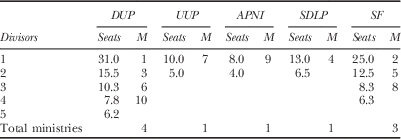
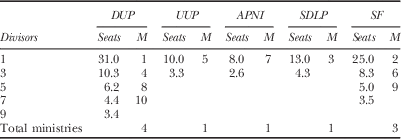
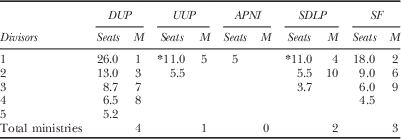
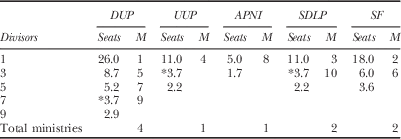
Sainte-Lagüe, contrary to some local wisdom, would not in any case significantly help the ‘others’, the parties which choose not to self-designate as ‘nationalist’ or ‘unionist’. Had Sainte-Lagüe been used instead of d’Hondt to allocate ministries after the last Assembly election in 2011, the ministerial allocation would have been the same (although Alliance would have been able to pick the eighth ministry instead of the tenth). Given recent speculation about reducing the size of the Assembly,Footnote 15 and the size of the executive,Footnote 16 it is worth testing how a switch to Sainte-Lagüe would affect the fortunes of the ‘others’. We have a reasonably accurate way of predicting seat allocation in a future Assembly with a smaller district magnitude, assuming that voters vote as they did in 2011. This is because the best simple predictor of the number of seats a party will win in a multimember constituency under PR-STV is the number of ‘Droop’ quotas (1/(n+1)+1) it has at the first stage of the count (where n is the number of people to be elected in the constituency). In Tables 1 to 4 we have extrapolated from the 2011 elections by calculating the approximate number of Droop quotas that would be won by each party if there were five or four candidates to be elected per constituency instead of six, as at present, using the size of these quotas to predict outcomes.Footnote 17
Simulating a 10-Member D’Hondt Executive in an Assembly of 90 Members
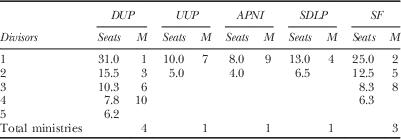
Note: In a six-member executive the Alliance Party and Ulster Unionist Party win no places, and unionists and nationalists have parity.
Key to all tables: DUP=Democratic Unionist Party; UUP=Ulster Unionist Party; APNI=Alliance Party of Northern Ireland; SDLP=Social Democratic and Labour Party; SF=Sinn Féin; M=Order of pick for ministerial portfolio.
All simulations assume the first-preference vote share won by parties in 2011.
Simulating a 10-Member Sainte-Lagüe Executive in an Assembly of 90 Members
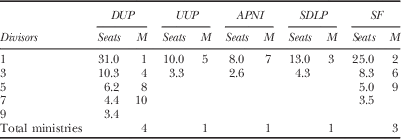
Note: In a six-member executive the Alliance Party wins no places, and unionists and nationalists have parity.
Simulating a 10-Member D’Hondt Executive in an Assembly of 72 Members
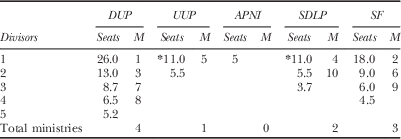
Notes: *When two or more parties are tied in number of members, the tie-breaker is the number of first-preference votes.
In a six-member executive the Alliance Party wins no places, and unionists and nationalists have parity.
Simulating a 10-Member Sainte-Lagüe Executive in an Assembly of 72 Members
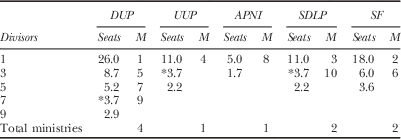
Notes: When two or more parties are tied in number of members, the tie-breaker is the number of first-preference votes. In Table 4 the DUP precedes both the SDLP and the UUP because the 3.7 seats won by the DUP results from rounding down, whereas the 3.7 won by the SDLP and the UUP results from rounding up.
In a six-member executive the Alliance Party wins no places, and unionists and nationalists have parity.
If the size of the Assembly was reduced from 108 members to 90 – that is, from a district magnitude of 6 members to 5 – the contrasting results from d’Hondt and Sainte-Lagüe can be seen in Tables 1 and 2. The ‘others’ would win only 1 of 10 ministries, as at present, regardless of whether d’Hondt or Sainte-Lagüe were used. But if the size of the executive in a 90-member Assembly was reduced from 10 ministers to 6, the ‘others’ would be shut out of the executive under both d’Hondt and Sainte-Lagüe.
If the Assembly was reduced to 72 members (a district magnitude of 4) – as called for by the Democratic Unionist Party – and the executive was kept at 10 ministers, then ‘others’ would again receive only one ministry, whether d’Hondt or Sainte-Lagüe was used (see Tables 3 and 4). If the executive was reduced to six ministries, the ‘others’ would lose out completely under either d’Hondt or Sainte-Lagüe. A reduction in the size of the Assembly would also affect the ‘others’ share of seats. If voters voted as they did in 2011 for a 90-member Assembly, the percentage share of ‘others’ would rise to 11.1 per cent from 9.3 per cent at present, but their number of members in the Assembly would stay the same. However, if the Assembly was reduced to 72, the percentage share of ‘others’ would fall from 9.3 per cent at present to just 6.9 per cent, and the single seat the Greens currently hold would be eliminated.
The moral is straightforward: Sainte-Lagüe cannot materially help the ‘others’, and the shift to a smaller executive would damage them while simultaneously increasing the chances of parity on the executive between unionists and nationalists. Significantly reducing the size of the Assembly to 72 members would make it more difficult to maintain proportionality, and it would damage the ‘others’. Anyone who is genuinely interested in helping the ‘others’, including the ‘others’ themselves, should argue against significant cuts to the size of the executive and Assembly, rather than for a switch from d’Hondt to Sainte-Lagüe.Footnote 18
Without the inclusionary mechanisms of the d’Hondt system, the largest political parties currently in Northern Ireland would have found it far more difficult to have reached a stable accommodation. We have seen remarkable changes in the Democratic Unionist Party and Sinn Féin in recent years. Great care should be taken to avoid the premature dismantling of the institutional machinery that helped make this accommodation possible.
The debate about d’Hondt is a sub-set of a larger debate over which model of democracy is most effective for divided places – the winner-takes-all type, illustrated by the traditional Westminster model; or the consensual (or proportional) model, perhaps best illustrated by contemporary Belgium (Lijphart Reference Lijphart2012). Under winner-takes-all, governments or cabinets endorsed by bare majorities in the legislature, ‘minimum winning coalitions’, are seen as virtuous. The government is held to account by a recognized opposition, and the electorate is provided with an alternative government-in-waiting. But this model, some forget, applied to the Northern Ireland parliament between 1929 and 1972 (McCrudden Reference McCrudden1994; O’Leary and McGarry Reference O’Leary and McGarry1993) and proved deeply divisive because there was a permanent governing majority. None of the benefits that might have flowed from alternation in government was available. In any case, the Westminster Parliament has presided over changes in the UK’s political system that significantly depart from the full winner-takes all model – in Scotland and Wales, in elections to the European Parliament, in some local and regional institutions and election systems, and in the UK’s legal institutions (see, for example, King Reference King2001; Morrison Reference Morrison2001). There have also been minor modifications to the parliamentary committee system. Against this context, it is perplexing to hear calls to make Northern Ireland look more like the Westminster model. These demands seem archaic, out of tune with the UK trajectory, and literally reactionary.
The consensual type of democracy places a much higher value on inclusivity and power-sharing, and makes consociation feasible. Great care, in our view, should be taken in modifying or dissolving consociational institutions, especially when they have proved their worth in helping to ameliorate conflict and deliver stable government. That is why we share the current secretary of state’s view that any changes to the institutions must be consistent with the power-sharing and inclusive values of the Agreement, and its rules for change.
OPPOSITION AND ACCOUNTABILITY
The d’Hondt system does not oblige an all-party, comprehensive or ‘grand coalition’. Any party is free to choose to go into opposition. The fact that there are five parties in the current executive is a choice, not one forced by the rules. The constraint is that no party can demand the exclusion (or inclusion) of other parties, and other rules, not based on d’Hondt, render non-viable an executive without both nationalists and unionists. Through the d’Hondt system, the parties entitled to ministerial portfolios have their entitlements determined by the electorate, though this too is misrepresented by the claim that voters cannot change the government. In the future one can imagine any of the five largest parties going into opposition by refusing to take up its entitlements to portfolios on the executive. It is also possible to imagine the governing coalition narrowing or broadening, as happened in 2011, or the parties that are entitled to assume the positions of first minister and deputy first minister changing, as happened in 2007. A party’s share of ministries may be reduced or increased, as has happened at every election. All that d’Hondt excludes is a government that is not broadly inclusive of voters’ preferences.
The current institutions provide for ministerial accountability through statutory or departmental committees. The Northern Ireland Act 1998 does not permit ministers, or junior ministers, to become chairs or deputy chairs of these committees and, in making a nomination for chair or deputy chair, the nominating officer ‘shall prefer a committee in which he does not have a party interest to one in which he does’. This means that parties are obliged not to nominate chairs or deputy chairs of committees monitoring ministers who come from their party, which in turn means that during committee hearings and Assembly debates ministers are faced by committee chairs and deputy chairs from other parties (see Northern Ireland Assembly 2013: 11). These chairs and deputy chairs have good reasons to hold the relevant minister to account and are likely to be in receipt of both formal and informal information to enable them to perform their tasks well. Furthermore, the existing arrangements permit a party that does not take up its entitlement to executive portfolios to continue to nominate its members to chair and deputy-chair committees in the relevant d’Hondt sequential order. This system certainly does not punish a decision to go into opposition, and has no counterpart in the Westminster model. In the latter, or related winner-takes-all systems, it has been rare for opposition parties to chair anything other than public accounts committees. Governments in such systems have usually been very careful to maintain control over virtually all committees. In this respect, Northern Ireland’s arrangements are both more inclusive and, at least potentially, more amenable to a scrutinized executive.
Opposition is also facilitated by the relatively low ratio of executive members to non-executive members of the Legislative Assembly. When there are two first ministers, ten ministers and two junior ministers, then approximately 13 per cent of the Assembly members are in the government. That leaves 87 per cent of the Assembly outside the executive. Typically, each ministerial member of the executive faces a committee composed of a majority from other parties, hardly a position that automatically favours the executive. Precisely because Northern Ireland’s ‘programme of government’ and the other obligations ministers owe one another, legal and prudential, are not as binding as those imposed by rigorous collective cabinet responsibility under winner-takes-all, we suggest that ministers are possibly more exposed to criticism (by MLAs whose parties are also in the executive, as well as without) than their Westminster counterparts. We are therefore not persuaded that the current arrangements deprive Northern Ireland of constructive opposition.
Northern Ireland is governed differently from the rest of the UK partly because it is different. One clear difference is the effective joint leadership embedded in the first minister and deputy first minister. There can be no meaningful singular leader of the opposition to these two post-holders without generating the spectacle of a first leader of the opposition and a deputy first leader of the opposition. The first minister and deputy first minister jointly run the executive, but only control their own party’s ministers on the executive. This, and the fact that the first and deputy first ministers represent different parties, constitutes a double constraint on what some have called the prime-ministerialization of parliamentary government: the centralization of control over the executive and legislature in the hands of an all-powerful prime-minister (see Dunleavy and Rhodes Reference Dunleavy and Rhodes1995; Dunleavy et al. Reference Dunleavy, Jones and O’Leary1990; Poguntke and Webb Reference Poguntke and Webb2005).
The first minister and deputy first minister are open to interpellation. They answer questions for half an hour on Mondays. Answers are rotated sequentially between the two post-holders. Members of the Assembly do not decide which of them answers their questions. The Speaker determines which questions are to be asked through random computer selection. At least regarding Question Time, we think that creating occasions for more dramatic debating pyrotechnics would increase heat more than light and would not necessarily be good for the people of Northern Ireland, who might benefit from some dullness in executive–legislative relations.
An impressive study by Richard Conley (Reference Conley2013) regarding the questioning of ministers in the Assembly demonstrates a decline in the number of questions posed over the period 2007–11, but convincingly shows that the cause was not increasing executive reluctance to be questioned. Rather, recent Northern Ireland experience reflects the successful determination of the Assembly to obtain more substantive answers from ministers through procedural reforms that decreased the number of questions, and expanded the time available for ministers to answer. Conley’s other findings included the following items:
∙ The first minister and deputy first minister, who have no control over the questions they face, give substantive answers and do not refer matters to other ministers. They are, however, given ample time to prepare under Standing Orders that oblige them to answer clearly and fully (a clear shift from Westminster-style adversary politics).
∙ The Social Democratic and Labour Party’s and the Ulster Unionist Party’s members of the Assembly were the most active in holding the executive to account on general government questions (more than 20 per cent of the Social Democratic and Labour Party’s and more than 30 per cent of the Ulster Unionist Party’s questions concerned the functioning of the executive). These data suggest, in Conley’s words, that the ‘minor designated parties often assumed the role of the “loyal opposition”’.
∙ The members of the Assembly systematically vary by party regarding what subjects they raise (for example, Sinn Féin’s specialty is in social policy, whereas the Alliance Party focuses on social cohesion).
∙ Constituency concerns constituted a full one-third of the questions posed to the first minister and deputy first minister.
This research suggests a maturing consociational system, attuned to Northern Ireland’s political requirements, in which the need to incentivize ‘cooperation’ has been successfully balanced against the benefits of incentivizing ‘accountability’.
It would be perverse in a deeply divided polity if the Assembly sought to reward parties for opposing rather than cooperating, when they can currently do both. The consociational principle of proportionality suggests that parties should have resources commensurate with their popular support. It would be odd to reward largely uncalled-for adversary politics by giving those who deliberately go into opposition, or who fail to win significant electoral support, disproportionate resources. There is therefore no clear need to enhance the resources (whether in money, time or positions) of exclusively opposition parties as opposed to enhancing the research and information-processing capabilities of all Assembly members (for example, through giving them the capability to hire more highly skilled assistants to aid them in scrutinizing policy issues and the public administration, as opposed to constituency matters). Non-executive parties in opposition should have no more call on public resources than a consistent proportionality rule would suggest (and members of the Assembly from parties in the executive should enjoy the same, proportional, support). Similarly, time allocated for non-executive business should be proportionally linked to the size of non-executive parties. If opposition proves popular, then a decision to go into it will be automatically rewarded, which is entirely consistent with democratic and consociational principles.
We are also not persuaded that there should be more opportunities for ‘votes of no confidence’. Under Sections 32(1) and 32(2) of the Northern Ireland Act 1998 the Assembly may dissolve itself through a qualified majority of two-thirds of Assembly members. Additional election triggers are not needed. Elections will remain polarized in Northern Ireland for the foreseeable future. There is no need to increase their number or frequency (although occasionally elections may be needed to resolve a deep crisis within the executive). It remains true that under Section 32(3) of the Northern Ireland Act 1998 (as amended) that the first minister or the deputy first minister can trigger an election if they resign and their party refuses to fill the vacated post. We would prefer that the resignation of either a first minister or a deputy first minister could not take place without the relevant party having first nominated the successor. Executive stability is a good thing. Northern Ireland certainly does not need to become like France’s Fourth Republic or Italy’s First Republic, with ‘revolving door governments’, often with the same personnel simply moved around ministerial offices.
Regarding the proposal for votes of no-confidence in particular ministers, there is already provision to admonish and suspend ministers in breach of the pledge of office. With cross-community consent a party can be excluded from access to the office if it has breached the pledge of office. Is more needed? Our perspective is that the d’Hondt executive formation system in Northern Ireland is closely analogous to Switzerland’s election of its federal executive council. Though the Swiss voting is majoritarian in form, it is consensual in substance, and once the federal executive council has been elected it is like a presidency (Steiner Reference Steiner1982); that is, it cannot normally be replaced until the next general election. Likewise in Northern Ireland, the appropriate way to conceive of the emerging political system is that the public, through its votes, determines Northern Ireland’s executive for the next legislative term. Parties may replace individual ministers and are wise to do so if their ministers are inadequate or have been engaged in maladministration. They should surely suffer electoral retribution if they do not replace ministers who have disgraced themselves. This should be sufficient incentive for them to act accordingly.
DESIGNATION
A foundational component of the April 1998 Agreement, endorsed by the referendum of May 1998 in both parts of Ireland, is the use of community designation rules to protect the distinctive interests of nationalists and unionists. Though the designation rules are criticized for reifying division and for being unfair to those who do not identify with either of the two main communities, these criticisms, and the associated proposals for change, are either misguided or premature.
Discussion of the designation rules must be informed by an understanding of the tension between sometimes competing consociational principles, namely, parity between the consociational partners as communities, and proportionality as an electoral, representational and allocation rule (McCrudden and O’Leary Reference McCrudden and O’Leary2013a: 14ff). Proportionality as such (for example, through the single transferable vote in multimember constituencies to elect MLAs, or d’Hondt to allocate executive portfolios and committee positions) does not prevent one community from being consistently outvoted according to simple majority voting procedures. Designation was intended to complement proportionality with parity, preventing one community from being dominated by the other, both now, and in the future should there be a demographic and electoral reversal of community fortunes. The Northern Ireland Act 1998, as amended, produces parity by obliging concurrent majority support or weighted cross-community consent on specific matters that affect the vital interests of the partners – this is achieved through designation.
As things stand, the designation rules play two different and important roles. First, they have been adapted to solve the problem of executive leadership. Experience between 1998 and 2002 taught members of the Legislative Assembly that the use of the concurrent majority requirement for the election of the first and deputy first ministers demanded too much of the partners (and of the ‘others’, in extremis).Footnote 19 Thus the rules for electing the first minister and the deputy first minister were modified with wide consent, and these rules have so far worked well. Significantly, they do not prevent those who choose not to identify with either the nationalist or unionist designation from holding either of the offices in question. If the ‘others’ made up the largest party they would nominate the first minister. If they were to provide the largest party in the largest designation other than that of the first minister, then they would nominate the deputy first minister. In short, the rules prevent the leadership of the executive from being captured by a single community without excluding those who prefer not to designate as nationalist or unionist. Insofar as ‘designation’ is used for the appointment of the first minister and deputy first minister, we see no need for reform.
The other role of designation is to manage ‘key’ decisions or decisions subjected to the Petition of Concern. The underlying rationale for these rules is to protect the interests of the two historically largest and most antagonistic communities by allowing each group’s representatives to veto important proposed decisions when they do not attract a significant degree of cross-community agreement. In keeping with this rationale, the rules make it impossible for the votes of any single party, regardless of how many seats it holds, to be both necessary and sufficient for a winning coalition on any vote to which the decision rule applies.
These rules are criticized for being unfair to the ‘others’. There is some truth to this claim: when the cross-community decision-rules apply, the votes of ‘others’ are demonstrably less pivotal (Schwartz Reference Schwartz2010). But what are the alternatives? One that can be dismissed briskly is to give ‘others’ a parallel role as a designated community in cross-community consent procedures. This proposal would give excessive weight to the ‘others’ voting power in the Assembly in relation to their support among the electorate. As importantly, the ‘others’ have not sought any such change. On current electoral trends, without any cross-community consent procedures and with an Assembly run on simple majority rules, the ‘others’ would probably be disproportionally ‘pivotal’ in the Assembly in the decade ahead, in the same way that small parties in Germany or Israel have frequently punched above their electoral weight in executive and legislative decision-making. There is no compelling evidence that the current rules have so far functioned as disincentives for voters contemplating support for the ‘others’: support for the latter increased slightly in net terms in the 15 years since the 1998 Agreement, whereas it had fallen in the 15 years before the Agreement. Any argument that possible growth in support for the ‘others’ has been held back by the rules rests on highly speculative counterfactuals.
Another proposed alternative is to introduce an ostensibly ‘difference-blind’ qualified majority decision rule: that is, one which makes no use of community designation. Any such revision would have to set a qualified majority threshold consistent with the rationale of blocking decisions that lack a significant amount of nationalist and unionist support. This is a more plausible suggestion, but, however the threshold is set, there are inevitable and problematic trade-offs involved. On the one hand, a relatively low threshold – say 60 per cent – is a relatively less reliable means for blocking decisions that lack de facto cross-community consent. Given the current composition of the Assembly, for example, a 60 per cent threshold would not be a very secure guarantee for nationalists. The total number of nationalist Assembly members is 43 – about 39.8 per cent of the Assembly. Thus, a decision which attracted no nationalist support whatsoever could still pass. On the other hand, a higher qualified majority threshold – say 65 per cent – risks giving a single party the power to block any motion or bill it chooses, regardless of the subject matter. Under a 65 per cent threshold, again assuming the current composition of the Assembly, the Democratic Unionist Party alone (which currently has 38 seats, or 35.1 per cent of the Assembly) would be necessary to any possible winning coalition of votes. In other words, the Democratic Unionist Party would have its very own veto (a party veto, that is, not a designated community veto), even though its support falls well short of a majority of the voters. Moreover, because the Democratic Unionist Party would also have more than 30 seats, the party could unilaterally activate this veto by organizing a Petition of Concern. Meanwhile, the voting power of the second largest party, currently Sinn Féin with 29 seats, could be effectively nullified if all the remaining parties were to vote against its preferences en bloc. Because the second largest party is (and is often likely to be) also the largest of the two nationalist parties, a winning coalition that excluded that party would have less than 50 per cent support among the nationalist bloc. This possibility runs counter to the Agreement’s principle of inclusivity. Such a change would also significantly alter the bargaining power of the parties in the Assembly. As things stand, both the votes of the Democratic Unionist Party and Sinn Féin (who each currently have more than 50 per cent of the seats from their respective community designations) are necessary for any possible winning coalition under either of the two cross-community consent procedures (Schwartz Reference Schwartz2010: 356–7). The current provisions therefore give these leading designation parties relatively equal veto bargaining power (‘parity’). Requiring a difference-blind qualified majority rule beyond two-thirds of the Assembly’s members might also generate additional pathologies, beyond those predicted here, as and when legislative consent requirements approached unanimity. We therefore caution strongly against any precipitate change to the rules relating to key decisions.
The language of ‘difference-blind’ rules is in any case misleading. In a place as highly politicized as Northern Ireland, intelligent politicians, parties and communities are more than capable of knowing whether they are likely to stand to lose or gain under various ‘difference-blind’ rules. The current situation is not one in which the parties are blind to their likely future strengths and weaknesses under any new rules. For that reason we are inclined to doubt that there is likely to be cross-community consent to change the cross-community consent rules, as would be required by the mandate of the 1998 Agreement. We cannot identify a qualified majority decision-making rule likely to be agreed as an equilibrium outcome by a majority among nationalists, unionists and ‘others’, respectively.
More specific criticisms of the Petition of Concern mechanism are also overstated or misplaced. There is a perception that the procedure is being used at an increasingly frequent rate, contributing to the alleged ineffectiveness of Northern Ireland’s institutions. This perception is not entirely accurate. It is true that during the first several years of post-Agreement devolution – from 2 December 1999 until the Assembly’s temporary suspension from 14 October 2002 – the Petition of Concern was used more sparingly (see McCaffrey Reference McCaffrey2013: Table 3). Yet, since the Assembly’s powers were restored in May 2007, the frequency with which the procedure is used has remained steady, averaging out at 5.5 uses per year over the course of both the 2007–11 mandate and the 2011–15 mandate.Footnote 20 Furthermore, the procedure has been used to block divisive motions, typically of only symbolic or expressive importance, more frequently than it has been used to block actual lawmaking (McCaffrey Reference McCaffrey2013: Figure 1). Meanwhile, the Assembly has successfully enacted 82 pieces of legislation since its powers were restored in 2007.Footnote 21 This is hardly the picture of gridlock that the critics like to depict. In fact, the Assembly’s legislative output compares favourably with its Scottish counterpart at Holyrood. Over the same period, the Scottish Parliament (which enjoys a wider range of competencies than the Northern Ireland Assembly and has no equivalent to the Petition of Concern) enacted only eight more pieces of legislation (even though it had a one-party majority government during some of this period).Footnote 22 In sum, and contrary to the doomsayers, the Petition of Concern does not appear to have made the Assembly relatively less productive.
Although the Petition of Concern can apply to any decision of the Assembly, it has generally been used as it ought to be: to manage divisive issues relating to nationalist or unionist culture and political identity,Footnote 23 the institutions set up under the AgreementFootnote 24 or the legacy of the conflict.Footnote 25 The procedure is open to abuse; it has occasionally been used to block decisions which have nothing to do with community-specific nationalist or unionist interests.Footnote 26 But there are remedies for this mischief which do not involve reverting to simple majoritarian decision-making. For example, the Assembly might consider ways in which its presiding officer, in conjunction with a suitably composed committee of the Assembly, could be empowered to inhibit pseudo-Petitions of Concern. Such measures might curb the potential for abuse without going so far as to scrap the procedure, with all its attendant benefits.
LEGAL ISSUES
Regardless of the political, ethical or prudential grounds for designation, the possibility has been raised that the measures could be legally challenged. Some courts are indeed developing a habit of undoing, on legal, rights-based grounds, careful political compromises that are aimed at securing fairness, peace and political stability (McCrudden and O’Leary Reference McCrudden and O’Leary2013a). Such undoing, however, is unlikely in Northern Ireland’s case. Below we focus on the legal implications, particularly of the European Convention on Human Rights, for the current arrangements.
Two issues should be distinguished. The first is whether the mere requirement of parties to register as unionist, nationalist or other is itself a breach of human rights requirements under Article 8 of the Convention, which protects the right to private life, or Article 9, which protects freedom of religion. The relevant case law poses no threat to the requirement on parties to choose a designation in the Assembly. The cases in which the European Court of Human Rights has objected to requirements to disclose affiliations and identities have all involved the forced disclosure of religious or ethnic identities, and it is not at all clear that the Court would regard unionist, nationalist or other as ethnic let alone religious classifications. Even if the Court were to view the designations as ethnic classifications, the other elements of these past cases would come into play. All the relevant cases in which claims have been successful have involved individual designation, but the designation requirements for the Assembly relate primarily to political parties, not to individuals. Party designations in the Assembly are chosen, based on self-identification, rather than imposed. There can be no objection to the procedural fairness of the process of designation. Given the strong prudential justifications for the system of designation, it would constitute a dramatic departure from precedent if the Court regarded the Assembly designation requirements as by themselves contrary to the Convention.
The second major legal issue is whether the provisions for executive formation and for passing key legislation amount to a breach of the Convention, specifically Article 3 of Protocol 1 (the right to fair elections) taken alone or in combination with Article 14 (the prohibition of discrimination). Regarding the arrangements for the appointment of the executive, the legal position is straightforward. Article 3 of Protocol 1 does not apply to executive formation, only to the right to vote for, and to be elected to, the Assembly. Article 14 also does not apply because it is not a stand-alone prohibition of discrimination; it has to engage some other right. Article 3 of Protocol 1 seems to be the only possible candidate, but, as we have seen, it does not apply. So there appears to be no legal basis for challenging executive formation under human rights law. In any event, as noted, the d’Hondt system that is used for the allocation of ministries makes no use of community designation; it does not, on its face, allocate according to religion, ethnicity or even political identity; neither does it exclude the ‘others’ from gaining ministerial portfolios. Indeed it is more conducive to small parties like the ‘others’ receiving ministerial portfolios than the Westminster system or the devolution arrangement in Scotland and Wales, all of which require a party to win a majority of seats in the legislature, or join a coalition with such a majority, before being entitled to ministries (McGarry and O’Leary Reference McGarry and O’Leary2009). Regarding the election of the first minister and deputy first minister, the rule agreed at St Andrews in 2006 abandoned a practice – the requirement for each position to be elected by cross-community consent – which effectively ruled out a candidate from the ‘others’. Now the election rule for each position is neutral. All that stops the ‘others’ from winning the position of first minister or deputy first minister is insufficient support from the electorate. It is true that the ‘others’ cannot win the position of first minister and deputy first minister, but neither can the ‘unionists’ or ‘nationalists’. It is passing strange that some of the critics of designation are troubled with the changes made at St Andrews and appear to favour a return to previous provisions for electing the first and deputy first ministers that rely on designation and exclude the ‘others’.
What about measures for passing key legislation in the Assembly that require designation, and therefore privilege the position of ‘nationalists’ and ‘unionists’? Do these amount to a breach of Article 3 of Protocol 1 of the Convention, on the ground that a vote cast by a voter for a candidate of a party that will register as ‘others’ is of less value than that of a voter voting for a unionist or nationalist candidate? The answer to this question is more complicated because clearly Article 1 of Protocol 1 does apply and, therefore, Article 14, prohibiting discrimination, applies as well, unlike in the context of the selection of the executive or the first and deputy first ministers. It is also more complicated because of the decision of the European Court of Human Rights (2009) in the Sejdić and Finci v Bosnia case, in which aspects of the constitutional arrangements agreed at Dayton to settle the civil war in Bosnia were successfully challenged. The decision of the Court was that constitutional prohibitions on non-constituent peoples – Bosnia’s ‘others’ – from being able to stand for the upper house of the federal parliament were contrary to the convention insofar as they prevented a self-identified Jew and Roma who did not wish to self-identify as one of the constituent peoples (Serbs, Bosniaks, Croats) from standing. Northern Ireland’s ‘others’ by contrast do not have to decide to be nationalists or unionists to be eligible for office.
In sum, Northern Ireland’s legislative arrangements would probably survive a challenge on these grounds under the Convention. The rules on designation are not based on ethnicity or religion, but on political opinion or national identification. Given that no ‘suspect classification’ (such as ethnicity or religion) is used, the Court is not required to give these provisions any heightened scrutiny. Instead, the default rule is likely to apply – that is, that electoral systems, the right to vote and the right to be elected are matters within national competence and expertise, to which the Court generally gives a very wide margin of appreciation. It would also be relevant that Northern Ireland’s Agreement, unlike the Dayton Accords, was subject to democratic approval by referendum. Whatever the merits or demerits of the existing arrangements on political, prudential or ethical grounds, there is no good reason under equality or human rights law to depart from them.
CONCLUSION
There is much accumulated wisdom in Northern Ireland’s current institutional arrangements; they are the product of several years of political experimentation, much learning and many agreed compromises achieved after long negotiations. We have counselled in these circumstances for a conservative approach to institutional design – even ostensibly minor reforms may have unintended and undesirable consequences.
Some of the Agreement’s harsher critics are unable or unwilling to acknowledge any of the gains it has made possible. They think the institutions should be reformed because there has been no progress, or believe that Northern Ireland is as divided as it was in 1976 or more divided than ever. Others are prepared to credit the Agreement with some progress, but think that Northern Ireland is now less divided than it once was and that it is safe to remodel its new institutions. It is not possible that both of these outlooks are correct. Our view is that Northern Ireland has achieved a great deal under the Agreement, but that its progress remains fragile. One does not have to accept the absurd position that it is more polarized now than before the Agreement to appreciate that it remains a divided place. The prudent path is cautious system maintenance. Though we are outspoken proponents of consociational democracy for Northern Ireland, we do not insist that consociational institutions must be permanent fixtures of life. There may be a time for substantial changes, but that time is not now.