Sometime in the middle of March 1742, John Byron witnessed a murder. He could only guess at the date because he had been shipwrecked and stranded on the western coast of South America, in the region commonly known as Patagonia, for nearly a year. The act of murder was awful, but it was only the latest in a series of harrowing events. Over the past few months, the surviving crew of the warship Wager, on which Byron served as midshipman, had endured a seemingly endless series of catastrophes. There were mutinies, arguments, gunfights and frequent desertions. Most of the survivors suffered a slow, agonizing death by starvation, while others struggled in vain to gather shellfish and seaweed along the ‘tempestuous and inhospitable shore’.Footnote 1 The mortality rate among the remaining crew was staggering. Byron's small band dwindled rapidly from twenty to sixteen, then five, and finally four. Stripped of all their material possessions, facing complete social breakdown, they remained alive through a combination of luck and perseverance.
Indigenous nomads took pity on the eighteen-year-old Byron, fed him, and agreed to guide his group to the Spanish colony on Chiloé Island, about three hundred miles north of the wreck. But life among his indigenous rescuers provided little relief. Byron's guide and benefactor, a Catholic convert named Martin, held total power over the half-naked and starving band of survivors. He forced them to carry heavy bundles and paddle a large canoe, and carefully rationed their food supply. Scion of a noble family, accustomed to a highly structured world of privilege and deference, Byron felt that he had become nothing more than a slave to an arbitrary and cruel master. There were many indignities. But the homicidal scene to which he would be a witness was especially galling.
The story, as Byron tells it, is as follows: Martin and his wife returned from one of their frequent expeditions for sea urchins in the frigid waters of the Pacific coast. Their catch was disappointing, and both were unhappy.
A little boy of theirs, about three years old, whom they appeared to be dotingly fond of, watching for his father and mother's return, ran into the surf to meet them; the father handed a basket of sea-eggs to the child, which being too heavy for him to carry, he let it fall.
Furious, ‘the father jumped out of the canoe, and catching the boy in his arms, dashed him with the utmost violence against the stones’. The child died almost instantly and his mother ‘appeared inconsolable for some time’. But the ostensibly Christian father ‘shewed little concern about it’.Footnote 2 Byron says nothing more about this tragic incident. There is no need. For eighteenth-century readers, the scene was self-explanatory. It would become the perfect specimen of the irreducibly violent ‘savage’, the futility of religious conversion, and the moral supremacy of British civilization.Footnote 3
This is the story of an encounter, and like many such stories, it is one-sided. There is no account of this alleged homicide from Martin's point of view. Nor is there any evidence to corroborate Byron, who had a well-documented fondness for exaggeration. This version survives only in his narrative, published in England over a quarter of a century after the event it purports to describe. Since then, Byron's story has achieved a life of its own. It has been told and retold in different ways to different audiences, in different times, and in different places. As a ‘far-fetched fact’, it has crept from the margins of empire to the heart of professional discourse.Footnote 4 Yet it would have been long forgotten if another ship had not followed in the wake of Byron's journey, nearly one hundred years later.
Both Charles Darwin and Robert FitzRoy were impressed by this graphic tale of savagery and murder, and both discussed it openly in their respective accounts of the voyage of the Beagle. And other, more modern, writers have followed suit. In his popular history of Darwin's experiences abroad, Australian author Alan Moorehead moves Byron's story to the 1830s and over eight hundred miles south to Tierra del Fuego. According to Moorehead, it was the Beagle's surgeon, Benjamin Bynoe, who witnessed a ‘Fuegian child’ dashed against the rocks and ‘abandoned to die’. A recent narrative of the Beagle expedition provides the correct date, but also insists that Martin was ‘a Fuegian’ of the same type that Darwin would encounter on the southern tip of Cape Horn.Footnote 5 Political theorist Lee Harris cites Darwin's version of the murder as evidence for ‘the law of the jungle’, and travel writer John Woram offers it as proof that the Fuegians who greeted the Beagle cared little for their children.Footnote 6 Surveying Darwin's many misinterpretations of Fuegian culture, Anne Chapman writes that the murder ‘may be true’, but offers no evidence to support her claim.Footnote 7 Although they do not comment on its veracity, even Darwin scholars Adrian Desmond and James Moore feature Byron's story in a crucial passage at the end of their study of the intersection between racial slavery and evolutionary theory.Footnote 8 What accounts for this lingering influence?
Historians have long pointed to the second voyage of the Beagle (1831–1836) as the defining moment in Darwin's career. With stops on both coasts of South America, in Australia and Africa, and on numerous islands in the Pacific, Indian, and Atlantic oceans, this epic five-year journey exposed the fledgling naturalist to an intoxicating array of foreign cultures and ecosystems. The lengthy excursions combined with ample time for reflection, Darwin later wrote, supplied ‘the first real training or education of my mind’, and the expedition yielded, in the words of one contemporary, ‘a harvest of fresh knowledge’.Footnote 9 Most historians agree that Darwin's extensive studies of geology, palaeontology and zoology during this period provided the catalyst for the development of the theory of evolution by natural selection, and recent scholarship on the ‘geographies of scientific knowledge’ has further underscored the central role of foreign travel in the production and diffusion of evolutionary science.Footnote 10 Yet Darwin's equally extensive encounters with African slaves and indigenous populations have only slowly garnered serious scholarly attention.Footnote 11
The true story behind Byron's tale of savagery and murder, and Darwin's reaction to it, illuminate important aspects of the acclaimed naturalist's relationship with the history of European expansion and cross-cultural interaction. It highlights the subtle role of historical memory in the development and interpretation of scientific knowledge. More importantly, it reveals how that memory is embedded in specific spatial contexts. The distant, semi-mysterious land of Tierra del Fuego looms large in the global gaze of scientists and historians, a regional backdrop for the ‘play of memory and forgetting’ at the heart of evolutionary theory.Footnote 12 Falsely associated with the people of Tierra del Fuego, uncritically transmitted from generation to generation, Byron's story occupies a nebulous place at the crossroads of geography and memory. But it all begins with a teenage castaway, a mutiny and a desert island.
The castaway
Like so many stories of the golden age of European imperialism, this one begins with a war. The twenty-eight-gun, six-hundred-ton Wager sailed from England in late September 1740, during the brief but colourfully named War of Jenkins' Ear. Part of a small squadron led by Commodore George Anson, her goal was to raid Spanish settlements along the Pacific coast of South America. Disaster arrived before any significant military targets, however, and she collided with a series of boulders off the Patagonian coastline eight months later. The surviving crew managed to rescue some provisions from the wreck, but found themselves stranded on a bleak and desolate island in the present-day Golfo de Piñas, about five hundred miles north of Tierra del Fuego. Authority quickly disintegrated among the marooned men as supplies were looted and crewmembers deserted. Captain David Cheap, who had survived the initial disaster, became increasingly erratic, hoarded food and other material and shot one of his officers in the face during a heated exchange. After five months of confusion and arguments, the majority of the crew decided to abandon Cheap, seize the ship's longboat, and sail back around Cape Horn to Brazil.Footnote 13
Midshipman John Byron (grandfather of the famous poet) was seventeen at the time of the wreck. At first enticed to sail south with the mutineers, he returned to Captain Cheap on the newly christened ‘Wager Island’ and remained there for two months while the officers plotted their escape. According to Byron's narrative, published in England more than twenty-five years later, the remaining castaways hoped to commandeer a ship and rejoin Anson's squadron in the north. But supplies ran short, and after an ambitious attempt to traverse the gulf ended in disaster, their condition deteriorated rapidly. Deaths and desertions increased, followed by whispers of cannibalism.Footnote 14 Nomadic inhabitants of the nearby Chonos Archipelago agreed to provide the remaining group with food and shelter and guided them to the Spanish colony on Chiloé Island. Only four survivors made their way to Valparaiso, and then on to Santiago, where they were held as prisoners of war until they were able to find transport back to Europe. Their journey home spanned almost five years altogether.Footnote 15
Byron capitalized on his loyalty. He was given command of his own vessel within a year of his return and enjoyed a robust and tumultuous career until his death, at the rank of vice-admiral, in 1786. He achieved moderate fame as a naval explorer, earning the nickname ‘Foul Weather Jack’ for his uncanny ability to attract natural disasters, and though hardly a swaggering buccaneer, he did not hesitate to boost his heroic self-image. A 1759 portrait by Joshua Reynolds shows a steely-eyed, almost comically hyperbolic officer, arrayed in full imperial bravado, courageously defying a ferocious storm.Footnote 16 Byron had a special fondness for the dark-skinned women he encountered abroad, and like others in his position blurred the lines between sexual and colonial conquest. ‘We find that the queens and princesses of the islands he discovered, were ever partial to Englishmen’, mused a contemporary biographer.Footnote 17 A successful circumnavigation of the globe between 1764 and 1766 cemented his reputation as a dashing adventurer, and when his epic tale of shipwreck and survival finally appeared in 1768, he was at the pinnacle of his celebrity.
Of the six different accounts of the wreck of the Wager published during the eighteenth century, Byron's Narrative was by far the most popular.Footnote 18 ‘It is scarcely possible to trace their miseries without feeling the most exquisite sensibility at every step they make’, wrote one reviewer, ‘and the heart involuntarily sympathizes with their distress, and throbs at every new danger that they encounter’. The Gentleman's Magazine pronounced it ‘one of the most extraordinary literary productions that the world has ever seen’. Press coverage across the Anglo-American world was equally positive. Readers praised Byron as an authoritative source on Patagonian culture and pointed to the murder scene as particularly instructive.Footnote 19 The book had gone through at least twelve editions by the end of the century. It was well known among maritime explorers for the next hundred years and provided satiric fodder for the grandson's poem Don Juan.Footnote 20
Byron's narrative continues to appeal to modern audiences. Twentieth-century novelist Patrick O'Brian used it almost exclusively in his fictionalized account of the Wager disaster, including the murder of the child, which he recommended as ‘an almost perfect exhibition of savagery and the cult of toughness’. Byron served as the prototype for one of O'Brian's most popular characters, the fearless Captain Jack Aubrey (played by Russell Crowe in the 2003 film Master and Commander: The Far Side of the World).Footnote 21 But the authenticity of Byron's published account is dubious at best, and his encounter with a homicidal benefactor during his journey to Chiloé is difficult to substantiate. A close reading of the surviving evidence makes it hard to accept his narrative at face value. In fact, there is significant evidence to suggest that portions of his story are exaggerated, if not outright fabrications.
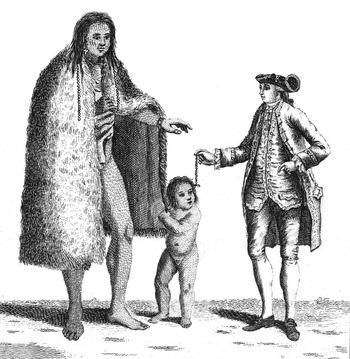
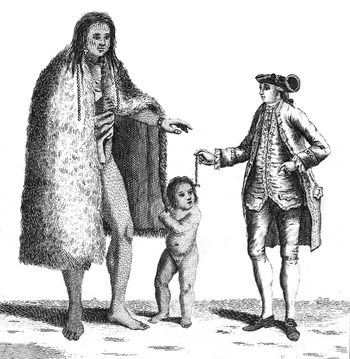
Byron had a reputation for stretching the truth, a bad habit that became increasingly evident later in his career. During a subsequent voyage to Patagonia, he claimed to have discovered a mythical race of eight-foot-tall indigenous ‘giants’. The reports created a sensation throughout Europe and captivated the scientists of the Royal Society, who encouraged the next generation of ship captains to carry measuring implements on their journeys to the southern hemisphere. Although no concrete evidence emerged to authenticate their existence, tales of Patagonian giants remained deeply embedded in the public imagination for decades, and when contemporary authors inflated the details of Byron's encounter to an absurd degree, offering a chance for self-correction or repudiation, he did nothing to stop them. If a letter published by the Welsh naturalist Thomas Pennant is accurate, Byron was still defending his account of the tribe's ‘amazing size’ at the end of his life.Footnote 22
Literary historian Percy Adams considers Byron a minor offender in the giant craze, but the latter's tacit endorsement of the myth casts serious doubt on his credibility as a witness. Byron fits the definition of the ‘travel liar’, part of a thriving group of early modern adventure writers who competed with the likes of Daniel Defoe and Jonathan Swift. The only scholar to publish a comprehensive, comparative analysis of the various Wager narratives agrees that Byron ‘was given to extraordinary exaggeration and distortion’.Footnote 23 To make matters worse, while there are authentic manuscript journals of Byron's later travels to South America, no notes or other documentary evidence are known to exist for his Wager narrative.Footnote 24 It seems likely, in fact, that he wrote entirely from memory, augmenting or embellishing earlier published accounts wherever he saw fit.
A careful reading of Byron's narrative reveals that he plagiarized heavily from fellow survivor Alexander Campbell, also a midshipman serving on board the Wager.Footnote 25 Campbell was among the few to remain with Captain Cheap after the final departure of the mutineers, and he published his own account of the northward journey of the loyalist faction. Printed in London in 1747, more than twenty years before Byron's version, Campbell's narrative contained few of the latter's dramatic flourishes or colourful details, and it failed to gain a wide readership. Rumours that its author had converted to Catholicism and defected to the Spanish did not aid the book's popularity in Protestant England.Footnote 26 No subsequent editions were published, and there is very little mention of it anywhere by the end of the century. Despite, or perhaps because of, all this, Campbell's narrative is probably much closer to being an accurate description of events.
Campbell remained close to Byron for most of their journey and his account confirms that they met a local chieftain and guide. Circumstantial evidence implies that the guide was a resident of Chiloé, a large island colonized by the Spanish just north of the Chonos Archipelago. Jesuit priest José García, who interviewed indigenous eyewitnesses twenty years after the wreck, suggests that he was a member of the Caucahue nation, adjacent to the Chonos. He appeared to hold an official appointment under the colonial regime, and according to Byron he was accompanied by a ‘servant’ named Emanuel. García states that the English made the guide ‘governor’ of the territory. Whatever the case, it is clear that he was a special figure and noticeably distinct from the Fuegian tribes farther south. All reports agree that he spoke the Spanish language and that he participated in regional trade networks with European settlers – which may explain how the Spanish military acquired over a dozen cannons from the wreck of the Wager. Campbell identifies the guide as a resident of Chiloé, but does not call him ‘Martin’ and makes no mention of the death of his young son.Footnote 27
Compared with Byron's vivid recollection of the event decades later, his fellow midshipman's complete silence on the matter is striking. Letters from Captain Cheap and Spanish official Manuel de Guirior, composed after the survivors' arrival in Santiago, also fail to mention the murder. A rambling, ten-page missive sent by Cheap to a British factor in Argentina gives little attention to his indigenous rescuers. For the captain, his mutinous crew were the real barbarians. Even his loyal officers were reduced to a state of savagery, ‘exposed to the Inclemency of the Weather, without heat, without cloaths, living in a dirtier manner than the Hottentots’. Obsessed with his imperial mandate, Cheap imagined ‘that if half the number of Lice, that we had about us, had been armed men’ he could have taken the colony.Footnote 28 Campbell completes the inversion. Though he complains of being ‘obliged to submit’ to indigenous authority, he praises his rescuers for their selfless generosity and suggests that they are morally superior to ‘many well-educated CHRISTIANS!’ Father García's oral history also contrasts the ruthless English with ‘heathen’ altruism.Footnote 29
The youthful, aristocratic Byron, on the other hand, seems to resent deeply his complete dependence on his native benefactors. It must have been a sobering blow for the son of a peer and a junior officer in the imperial Navy to be forced to appeal to an obscure nomadic tribe for food, shelter and geographic knowledge. Several authors have suggested that his later accounts of Patagonian giants were an unconscious manifestation of his humiliating subordination to native prowess.Footnote 30 Even worse, according to Byron, his indigenous saviour was a Catholic ally of the Spanish Empire, one of Britain's chief enemies in the American theatre. The image of the brutally homicidal Catholic thus plays a dual role in Byron's narrative – it demonstrates the irreducible savagery of indigenous populations as well as the pious hypocrisy of Spanish colonialism, to be contrasted with the nobler example of Protestant England. This geopolitical context, combined with personal feelings of humiliation and resentment, the lack of corroborating evidence, a reputation for exaggeration and the extremely late publication date, renders Byron's story rather unbelievable.
‘Commodore Byron conversing with a Patagonian woman’. The exaggerated size of the Patagonians may have been an attempt to deflect embarrassment at their superior knowledge and skill. Illustration from David Henry (ed.), An Historical Account of all the Voyages Round the World, Performed by English Navigators; Including Those Lately Undertaken by Order of His Present Majesty, 4 vols., London: F. Newbery, 1773, vol. 3, facing p. 11.
Of course, the possibility remains that something similar to what Byron describes did occur. Western Patagonia was hardly an Arcadian utopia, where child abuse and murder were completely unknown, and no other survivors came forward to challenge the veracity of his account.Footnote 31 It is doubtful that we can ever know exactly what happened on the road to Chiloé Island in mid-March 1742. But, in a way, the exact details of this macabre tale do not matter. What does matter is that Byron's narrative was accepted by a broad reading public and valorized as historical knowledge. As both thrilling adventure story and ‘factual’ account of the imperial frontier, it became part of the official memory of British encounters with the wider world. And a hundred years later it appealed to a fledgling naturalist as he attempted to make sense of his own international journey.
The naturalist
When Charles Darwin arrived at the southern tip of Tierra del Fuego in late December 1832, he was not the first European traveller to stand in awe of its primal wildness or marvel at its rugged, copper-toned inhabitants.Footnote 32 But there was still a certain romance in the experience, an initial rush of excitement that came with the encounter. The Yahgan people of the Cape Horn Archipelago captured his attention almost immediately. Also known as the Yagán or Yámana, they wore little clothing, spoke an unusual language, and had no system of government, no chiefs and no concept of private property. Although Darwin used the term ‘Fuegian’ as shorthand for a number of indigenous ethnic groups, his most extensive contacts were with the Yahgan.Footnote 33 They show up again and again in his writing, over a period of more than forty years, and he became convinced that they offered a living window on the prehistory of human civilization. ‘The astonishment which I felt on first seeing a party of Fuegians on a wild and broken shore will never be forgotten by me’, he wrote at the end of The Descent of Man, ‘for the reflection at once rushed into my mind – such were our ancestors’.Footnote 34
In the second edition of his Journal of Researches, published thirteen years after his initial encounter, Darwin dwelled at length on the stark primitiveness of the Yahgans and theorized that their semi-nomadic lifestyle was responsible, in part, for their lack of societal development.Footnote 35 Because of the jagged, irregular terrain along the coast, ‘they are compelled unceasingly to wander from spot to spot’ in search of nourishment, and a crude form of patriarchal oppression only compounded their misery. ‘They cannot know the feeling of having a home, and still less that of domestic affection’, he wrote, ‘for the husband is to the wife a brutal master to a laborious slave’. Darwin cited not his own research, but a much earlier anecdote, to substantiate this claim of filial iniquity. ‘Was a more horrid deed ever perpetrated’, he asked, ‘than that witnessed on the west coast by Byron, who saw a wretched mother pick up her bleeding dying infant-boy, whom her husband had mercilessly dashed on the stones for dropping a basket of sea-eggs!’Footnote 36 Even if it did happen hundreds of miles away, outside the boundaries of Tierra del Fuego, and involve a completely different ethno-social group, it is a startling interjection. To understand its true meaning, it is necessary to delve much deeper into the young naturalist's ideas about savagery and civilization, his opinions on slavery and race, and his intellectual relationships with other authors.
‘The Other is rarely met in a present divorced from all the meetings that have gone before’, argues maritime historian Greg Dening.Footnote 37 This was especially true for Darwin, whose voyages at home and abroad were deeply structured by a long list of predecessors and heroes. Darwin had a penchant for travel books. Like many nineteenth-century Britons, he devoured Mungo Park's thrilling tales of adventure and discovery on the African frontier, and he cherished his early edition of Alexander von Humboldt's Personal Narrative.Footnote 38 An epic chronicle of scientific observation and exploration in the American wilderness, Humboldt's Narrative celebrated the romance of total immersion in the natural world, and Darwin claimed to have read it ‘over and over again’.Footnote 39 The Beagle itself was a floating library, with adventure tales and travelogues figuring prominently among the ‘immense stock’ of books crammed into Darwin's cabin. And his travelling companion, the brooding and enigmatic Captain Robert FitzRoy, encouraged his pursuits.Footnote 40
Largely forgotten and rarely studied in depth today, FitzRoy's account of the Beagle expedition appeared simultaneously with the first edition of Darwin's Journal and provided some of the raw material for the latter's scientific investigations. FitzRoy eagerly discussed Byron's story, which shows up in the middle of his chapter on the ‘Horse Indians of Patagonia’, and even reprinted the famous passage from Byron's narrative in a separate appendix.Footnote 41 Darwin marked the passage in his copy of the appendix, and since he does not mention the murder in his manuscript diary of the voyage or in the first published edition of his Journal, he almost certainly lifted it directly from FitzRoy when preparing the second edition of his Journal in 1845.Footnote 42 Another account, by Phillip Parker King, renowned surveyor and commander of the first Beagle expedition (1826–1830), no doubt fuelled the curiosity of both men. King alluded to a Fuegian who had ‘killed his child for a most trifling offence’. He also retraced the Wager crew's journey to Chiloé and interviewed a man there who still recalled ‘Don Juan’ (Byron) and ‘Don David’ (Captain Cheap). FitzRoy, clearly impressed by King's detective work, added several footnotes to the text.Footnote 43
Unlike Darwin, FitzRoy did not view Byron's tale in the moralistic terms of domestic oppression. He offered it, instead, as evidence of the inherent bloodthirstiness of indigenous populations and the danger they posed to hapless Europeans. ‘Neither man, woman, wife, nor even a smiling innocent child’, he opined, ‘is safe from that tiger in human shape – a savage in a rage’. Indigenous groups were not entirely evil, according to FitzRoy, and he provided numerous examples of their strong fidelity to their children. But, in his opinion, this was exactly the point. They lacked the allegedly superior European capacity for emotional restraint. Thus ‘the man who, in a moment of passion, dashed his own child against the rocks, would, at any other time, have been the most daring, the most enduring, and the most self-devoted in its support and defence!’Footnote 44 Interestingly, Darwin borrowed this theme from FitzRoy, not in his Journal, but over three decades later in The Descent of Man, when he repeated the captain's injunction to ‘never, never, trust the Indians’.Footnote 45
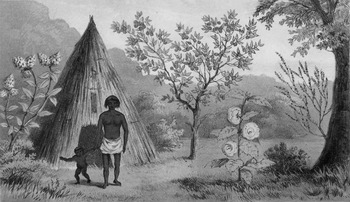
Other travellers echoed FitzRoy's view of the mercurial relationship between aboriginal parents and their offspring. According to Thomas Edward Coffin, who lived among a Fuegian group (probably the Alacaluf) after a devastating shipwreck in 1855, ‘maternal instincts were not very strong’ and both parents would administer beatings to their children.Footnote 46 But most visitors could not help noticing a powerful and deep bond between family members. Husbands ‘show a good deal of affection for their wives, and are careful of their offspring’, wrote English sailor James Weddell in 1827. When surprised by foreigners, he observed, parents clutched their young in their arms to prevent them from being stolen. John MacDouall, a participant in the first Beagle expedition that same year, found the Fuegians ‘very affectionate to their children’. Fathers ‘evince considerable fondness for their wives and children’, agreed American explorer Benjamin Morrell in 1832, and veteran sailor William Parker Snow found that little had changed a quarter of a century later. ‘They were very fond of their children’, Snow wrote after a visit among the Yahgans, ‘and any notice we took of the little ones always gave them pleasure’. Snow was confident enough in their filial affection to conclude that ‘a child in [his] arms’ would be a good shield against a sudden attack or ambush. Indeed, the frontispiece of his memoir depicts a Fuegian woman holding her infant child by the hand, both cheerfully domestic and safely ensconced in a prelapsarian paradise.Footnote 47
These reports, situated in a variety of times and contexts, provide a radically different perspective on the moral anarchy described by Darwin and FitzRoy. They all involve some degree of wishful exaggeration, vestiges of noble savagery soon to be eclipsed by the teleology of the degraded ‘primitive’. Still, the authors are remarkably consistent in their observations, and when considered together they point to an important reality: domestic affection was a cornerstone of Fuegian society.Footnote 48 Even if there were occasional incidents of child abuse, there is no contemporary evidence to support the claim of depraved indifference to murder. So why did Darwin feel the need to draw on an example from another century, featuring a Catholic colonial official from Chiloé, to construct generalizations about the Yahgans he encountered over eight hundred miles away in Tierra del Fuego? Why choose this particular story?
‘Woman of Fuegia and child’. The conical hut in the background, like much early ethnographic information about the Yahgans, represents an artist's fanciful interpolation. Illustration from W. Parker Snow, A Two Years' Cruise off Tierra del Fuego, The Falkland Islands, Patagonia, and in the River Plate, 2 vols., London: Longman, Brown, Green, Longmans, and Roberts, 1857, vol. 1, frontispiece.

Both Darwin and FitzRoy were probably responding to contemporary social and political pressures that placed added cultural significance on the death of infant children. An estimated thirty-four percent of all murders in England and Wales between 1838 and 1840 involved children under the age of one, and that number would climb as high as sixty-one percent by 1864. The precise origin of this troublesome epidemic remains obscure, although most commentators point to the growing urban population and economic hardship precipitated by the Industrial Revolution.Footnote 49 Whatever the causes, British subjects were becoming increasingly aware of the problem of infanticide by the middle decades of the nineteenth century and published a growing number of newspaper articles and pamphlets on the topic that were rife with class-based anxieties about the urban poor. One incensed author observed that the London Police ‘think no more of finding the dead body of a child in the street than of picking up a dead cat or dog’.Footnote 50 It is ironic to think that travellers would fixate on a single act of murder among a foreign population when so many more children were being killed on a daily basis at the very heart of the ‘civilized’ world. But, as was so often the case with imperial encounters, ‘the colonized abroad and the poor at home occupied similar moral space’.Footnote 51
The new level of attention directed to the death of small children was only one component of a larger revolution in the perception of violence in Victorian England. As cultural historian J. Carter Wood has shown, ‘violence as a social idea was “invented”’ during this period, ‘becoming a key cultural concern and increasingly urgent topic for discussion and analysis’. The discovery of new forms of ‘savagery’, both at home and abroad, played a vital role in this process, offering a nemesis image through which ‘civilized’ society could be defined and affirmed.Footnote 52 Darwin was clearly working within this paradigm when discussing Byron's story. The murder also resonated on a personal level. By the time the second edition of his Journal appeared in 1845, Darwin's family included four children: William (aged five), Anne (four), Henrietta (two), and George (newborn). A daughter, Mary, had died in infancy a few years earlier. The naturalist's children were a cornerstone of his world, as well as raw data for his observational experiments; and the experience of fatherhood informed his work in subtle ways.Footnote 53
Darwin returned to the subject of infanticide in The Descent of Man. It was, he argued, a relatively recent and ‘perverted’ instinct, not found among ‘the lower animals’, and was practised by ‘barbarians’ in order to alleviate the pressures of overpopulation in the struggle for existence.Footnote 54 The displacement of this phenomenon to indigenous populations abroad might have been Darwin's way of dealing with more pressing social anxieties at home – part of a carefully delineated moral geography of violence. It is possible that he noticed more areas of similarity between allegedly ‘civilized’ nineteenth-century Europeans and these seemingly prehistoric ‘barbarians’ than he was later willing to admit. Still, it is difficult to ignore the stark contrast between primitiveness and civilization that remains so explicit in all of his work. There is a latent polygenism in his depiction of the unnaturally perverse savage, ‘a quality of feeling’ that appears to run counter to his empirical defence of the common descent of all life.Footnote 55
There is more to this story than just the naturalist echoing the captain echoing the castaway. It is tempting to conclude that these passages reveal Darwin the imperialist, or Darwin the ‘social Darwinist’ hard at work, carefully reinforcing the distance between the colonizer and the exotic other, laying the intellectual foundation for the genocides and holocausts yet to come. The controversy sparked by historian Richard Weikart's book From Darwin to Hitler points to the danger of exaggerating such claims. At the same time, the idea that Darwin's legacy ‘turned predation into a sacrament’, setting the stage for ‘enormous crimes against non-Europeans’, is common enough to warrant concern.Footnote 56 Could this be an example of Darwin applying evolutionary logic to make value judgements about social behaviour, a tacit endorsement of predatory morality?
Like Byron's account of the wreck of the Wager, there can be no doubt that Darwin's observations were deeply implicated in the imperial project. As recent scholarship has shown, the complex systems of trade and dominion established by European empires both shaped and were shaped by centuries of scientific voyages stretching back to the age of Columbus. Science and empire are mutually constitutive, and scientists' encounters with foreign populations played a key role in the development and solidification of racial hierarchies.Footnote 57 Even the seemingly innocuous act of natural history, writes Gillian Beer, could be ‘an expression of the will to control, categorize, occupy and bring home the prize of samples and of strategic information’.Footnote 58 Yet this line of analysis tends to distort the nuance of Darwin's position. Convincing in macro-historical terms, accusations of imperialist subjugation fail to account for potentially subversive narratives embedded in scientific encounters.
The social Darwinist label, although attractive, can be anachronistic and misleading. Popularized during the Second World War by historian Richard Hofstadter to explain various intellectual currents in the late nineteenth- and early twentieth-century United States, it has since become a kind of vernacular shorthand for the ethical pitfalls of extreme biological reductionism. Applied to earlier time periods, however, the phrase holds little explanatory power.Footnote 59 Most scholars acknowledge that biologically reductive and culturally chauvinist social theories were around long before Darwin's rise to fame. In fact, Darwin's own assumptions about the evolutionary trajectory of civilization mirrored contemporary texts by Herbert Spencer, Francis Galton and Alfred Russel Wallace, among others.Footnote 60 Evolutionary naturalism carried powerful social implications. But Darwin's views on the philosophical and political significance of his theories could be frustratingly obscure, if not contradictory, allowing readers to choose whatever fragments reinforced their own predetermined beliefs.Footnote 61
It is not difficult to find condescending, even overtly racist, vocabulary scattered throughout Darwin's published material. He sometimes spoke of ‘higher races’ and ‘lower races’. And, like almost all of his contemporaries, he believed that indigenous populations were doomed to extinction as a direct result of their contact with Europeans. ‘The varieties of man seem to act on each other in the same way as different species of animals’, he wrote in his Journal, ‘the stronger always extirpating the weaker’.Footnote 62 Encounters on the Argentine pampas, where colonists engaged in a war of extermination against their indigenous rivals, left a bitter taste and a lasting impression, and the language of colonialism, of civilized and savage, competition and displacement, progress and paternalism, crept almost imperceptively onto the pages of his books. Ironically, as historian Dane Kennedy points out, some of Darwin's more rigidly racist colleagues were more critical of colonial efforts to subvert indigenous cultures.Footnote 63
Darwin's personal chauvinism becomes strikingly clear when narrating his encounters with the Fuegians: ‘I never saw more miserable creatures', he wrote in his Beagle diary, ‘stunted in their growth, their hideous faces bedaubed with white paint & quite naked … their red skins filthy & greasy, their hair entangled, their voices discordant, their gesticulation violent & without any dignity’. Boyish curiosity mixed with revulsion to create an almost lurid vision of the exotic, ‘Man in his primitive wildness’, virtually incomprehensible. ‘Viewing such men’, he famously reflected, ‘one can hardly make oneself believe that they are fellow creatures placed in the same world’.Footnote 64 These statements echoed similar, if harsher, remarks by contemporary travellers, who branded Yahgans ‘the most hideously ugly race in the world’, ‘imbecile in intellect & weak in body’, ‘destitute of the human quality of reason’, the adults ‘a large ourangoutang’ and their children ‘like a little baboon with its head shaved’. Even the Fuegians who accompanied the Beagle expedition showed signs of ethnocentrism, referring to other tribes as ‘monkeys … not men’.Footnote 65 But Darwin's thoughts on racial difference were unusually complex, and as the qualifier ‘hardly’ suggests, many of his conclusions tend to undermine the more prosaic social theorists upon whom he sometimes relied.
Darwin's use of the term ‘laborious slave’ to explain the status of the mother in his discussion of Byron's story is extremely significant and indicative of a powerful moral undercurrent that runs throughout his work. As Desmond and Moore point out, Darwin was an intense, almost visceral, opponent of chattel slavery. Like his intellectual hero, Alexander von Humboldt, he was convinced of the natural ‘unity of the human species’, and close encounters with Brazilian slavery during the voyage of the Beagle inflamed his sense of racial justice.Footnote 66 ‘To this day’, he wrote in the second edition of his Journal, ‘if I hear a distant scream, it recalls with painful vividness my feelings, when passing a house near Pernambuco, I heard the most pitiable moans, and could not but suspect that some poor slave was being tortured’. His failure to prevent the beating of an enslaved child, ‘six or seven years old’, left a memory that was particularly embarrassing, if not emasculating.Footnote 67
First-hand contact with slavery played a key role in the international anti-slavery movement. In Africa, the Americas and elsewhere these encounters contributed to a geography of abolition that also included lecture tours, missionary campaigns and political debates, and for Darwin the experience was life-changing.Footnote 68 To those who excused slavery as ‘a tolerable evil’ and insisted that subordinates were ‘well treated’, he replied that they had not ‘lived among the lower classes’. They had not seen the physical abuse and interacted with the victims. In short, others lacked his intimate, personal experience among the oppressed. This grounded form of empathy distinguished Darwin from the aristocratic aloofness of Byron, not to mention many of his contemporaries, and he called for immediate action to end the nefarious institution once and for all.Footnote 69 Even FitzRoy, who insisted that the Brazilians treated their slaves ‘humanely’, concluded that the institution should be abolished after what he had witnessed in South America.Footnote 70
Long before he set sail on the Beagle, while still a medical student in Edinburgh, Darwin had met and befriended former Guianese slave John Edmonstone, whose taxidermic skill, thoughtful conversation, and tales of South American ecology left a strong impression. Interracial encounters and friendships of this sort were foundational for Darwin, as for the anti-slavery movement more generally.Footnote 71 Darwin also had strong family ties to organized anti-slavery in England – both his grandfathers and several sisters were avid supporters of the cause. But it was Brazil that prompted his most ardent racial egalitarianism. ‘I was told before leaving England’, he wrote to his sister Catherine from the Rio Plata,
that after living in slave countries: all my opinions would be altered; the only alteration I am aware of is forming a much higher estimate of the Negro's character. – it is impossible to see a negro & not feel kindly towards him; such cheerful, open honest expressions & such fine muscular bodies; I never saw any of the diminutive Portuguese with their murderous countenances, without almost wishing for Brazil to follow the example of Hayti; & considering the enormous healthy looking black population, it will be wonderful if at some future day it does not take place.Footnote 72
Given the intense political battles over the legacy of the Haitian Revolution and the future of Caribbean slavery during this period, it is astonishing that Darwin would contemplate this sort of revolutionary action.Footnote 73
Following the legal abolition of slavery in the majority of the British colonies (1834–1838), the anti-slavery salvos in Darwin's Journal carry a whiff of smug triumphalism. Yet his commitment ran deep, and the lingering guilt of enslavement was enough to make his ‘blood boil’.Footnote 74 Unlike FitzRoy, who stressed the deleterious effects of slavery on the ruling race, Darwin always identified most closely with the enslaved. He hoped that the United States would transform the Civil War into ‘a crusade against slavery’, even ‘at the loss of millions of lives’, and deeply admired Thomas Wentworth Higginson, an ally of the revolutionary John Brown, whose writing on slavery ‘vividly recalled walks taken forty years ago in Brazil’.Footnote 75 Although ‘on principle a free-trader’, Darwin supported tariffs to block slave produce, and even his personal predilection for laissez-faire was consistent with the political economy of anti-slavery.Footnote 76 His lack of active participation in any major reform organization notwithstanding, these ideas rank him among the more radical of international abolitionists.
Much of Darwin's early writing on African slavery and indigenous populations exhibits traces of what George Frederickson would call ‘romantic racialism’.Footnote 77 Darwin openly embraced and perpetuated racist stereotypes, such as the ‘fine muscular’ African and the ‘murderous’ Portuguese. His reflections on indigenous communities in Tierra del Fuego and elsewhere point to a conception of racial difference that blended the cultural with the biological, rendering superficial variations as manifestations of an inner essence. At the same time, he understood that human racial categories were intrinsically variable and artificial. Darwin was especially impressed by the three Fuegian captives who had been educated in England and who had accompanied him on his journey to South America. Well-dressed, affable and multilingual, they appeared to undermine completely the idea of static and discrete racial types, and he could not help but notice ‘how similar their minds were to ours’.Footnote 78
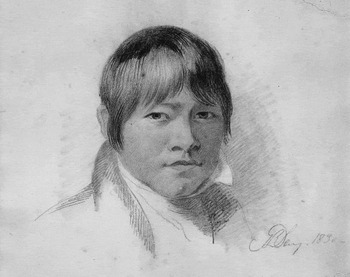
According to FitzRoy, exposure to civilized culture could even impact biology, updating and altering what seemed like stable racial features. A sketch published in his Beagle narrative showed the Yahgan captive Orundellico's amazing phenotypical transformation, after returning to his ancestral home, from inquisitive, well-groomed Englishman to low-browed, thick-lipped savage.Footnote 79 Europeans were also capable of this kind of physical metamorphosis. When Darwin returned home from the Beagle expedition, his father was convinced that the shape of his head was ‘quite altered’. Although it may have been a joke aimed at the popular obsession with phrenology, the elder Darwin's remark highlights a fundamental assumption about the mutability of mental and physical characteristics. Darwin put little stock in FitzRoy's facial theories and even less in phrenology, with its zealously racist applications. But images of protean naturalism could have subversive results.Footnote 80 For Darwin, race was a moving target, both tangible and ephemeral, and at times he appeared to question its underlying scientific validity across the entire biological spectrum. ‘It may be doubted’, he wrote in The Descent of Man, ‘whether any character can be named which is distinctive of a race and is constant’.Footnote 81
An early sketch of Yahgan captive Orundellico, also known as Jemmy Button. Like the illustrations in FitzRoy's narrative, it implies a successful transition from feral tribesman to European gentleman. Courtesy of the State Library of New South Wales.

Other naturalists reached vastly different conclusions based on their international and cross-cultural encounters. Francis Galton, Darwin's half-cousin and the founding father of the eugenics movement, travelled extensively in Africa and the Middle East and published a best-selling guidebook for European sojourners in foreign lands.Footnote 82 Like his cousin, Galton's experiences abroad helped build the empirical foundation for his immensely popular scientific theories. ‘I saw enough of savage races’, he claimed many years later, ‘to give me material to think about all the rest of my life’.Footnote 83 Yet he could barely contain his disgust at the racial otherness of sub-Saharan Africans. ‘A row of seven dirty squalid natives came to meet us’, he wrote after arriving off the coast of present-day Namibia. ‘They had Hottentot features, but were of a darker colour, and a most ill-looking appearance: some had trousers, some coats of skins, and they clicked, and howled, and chattered, and behaved like baboons’. For Galton, Africans were ‘lazy, palavering savages’, incapable of ‘any respectable form of civilization’, who needed to be ‘out-[bred]’ by a more ‘suitable race’.Footnote 84
Famed Swiss zoologist Louis Agassiz experienced a similar revulsion during an encounter with African American servants in Philadelphia in 1846:
[S]eeing their black face with their thick lips and their grimacing teeth, the wool on their head, their bent knees, their elongated hands, their large curved nails and especially the livid color of the palm of their hands, I could not divert my eyes from their face in order to tell them to stay away
,he wrote in a letter to his mother. ‘What unhappiness for the white race’, he concluded, ‘to have tied their existence so closely with that of negroes in certain countries! God preserve us from such a contact!’Footnote 85 Like Darwin, Agassiz expressed his opposition to chattel slavery during a research expedition to Brazil, but unlike Darwin he had little interest in racial justice. As his wife, Elizabeth, explained in their co-authored travel narrative, slavery should be abolished for its ‘evil effects’ on slaveholders rather than on the enslaved multitude, the latter of which Agassiz continued to view as separate and inferior.Footnote 86
Compared to his colleagues, Darwin's strong empathy for African slaves and his abiding sense of humility when discussing the Yahgans (‘such were our ancestors’) are remarkable. Despite a clear Eurocentric bias, Darwin never once followed his contemporaries in referring to indigenous populations as ‘ourangoutangs’ or ‘baboons’, and he went considerably beyond most of them in calling for the revolutionary overthrow of slavery. If it is true, as Douglas Lorimer suggests, ‘that science followed rather than led opinion on the racial question’, Darwin's casual embrace of racial hierarchy is hardly surprising.Footnote 87 But to maintain even a modicum of social parity at a time when scientific racism was growing rapidly on both sides of the Atlantic was no mean feat – and all of it was deeply embedded in the politics of encounter. Darwin's biological theories were directly connected to his humanist critique of slavery, and this critique, in turn, was closely tied to assumptions about the boundaries between savagery and civilization.Footnote 88
Darwin called the English racists who continued to deny the brotherhood of man ‘polished savages’.Footnote 89 Scrawled almost as an afterthought on a page in his Beagle diary, it is a wonderfully evocative phrase that speaks volumes about his sociological world view. For the young Darwin, at least, the ladder of civilization was deceptively precarious, with room for dramatic moral ascension or declension on either end. Savagery was neither static nor essential – it was a social disease that could infect and degrade even the most modern of civilizations – and the process cut both ways. Just as the Yahgan Orundellico could demonstrate his brilliance by adapting to English culture, so could English subjects and their American cousins demonstrate their depravity by condoning racist oppression. Not coincidentally, Darwin's colleagues referred to opponents of evolutionary theory as ‘savages’.Footnote 90
Despite all his talk about ‘high’ and ‘low’ races, even at the end stages of his career, Darwin could not help viewing all seemingly stable categories as fluid and malleable. In The Descent of Man, the capstone of his investigations into evolutionary theory, he returned almost immediately to Byron's story. Contrasting the father ‘who dashed his child on the rocks for dropping a basket of sea-urchins’ with the British abolitionist Thomas Clarkson, the ageing naturalist suggested a fluid moral spectrum. ‘Differences of this kind between the highest men of the highest races and the lowest savages, are connected by the finest gradations’, he argued. ‘Therefore it is possible that they might pass and be developed into each other’.Footnote 91 However vile and unforgivable the suggestion of innate inferiority, the emphasis was on the process of development, the potential for change.
Although he broke from tradition in important respects, Darwin was not immune from the Whiggish idealism of his age. The anti-slavery triumph spearheaded by Clarkson and others, more than anything, seemed to place Britain on the leading edge of an ongoing process of social improvement. And assigning unspeakably violent acts, such as the murder of a small child, to some distant, ‘primitive’, state of human development allowed for greater confidence in the advance of European civilization. This evolutionary optimism coexists in strange tension with viciously pessimistic asides on the extermination of inferior races and eugenic assumptions that would make most modern readers recoil in disgust. As he grappled with the issue, though, Darwin always returned to a core belief in humanitarian benevolence. The ultimate criterion of civilization, he concluded, was universal respect for human life.Footnote 92
Darwin's passionate opposition to chattel slavery and lifelong commitment to basic human unity help clarify why he would find Byron's story so alluring. He probably could not help sympathizing with the grieving mother left at the mercy of her murderous husband. Like so many aboriginal women of the Americas, she performed manual labour and gathered large quantities of food for her family. She resembled the Fuegian women of the Cape Horn Archipelago, skilled swimmers and divers, whose subaquatic harvests of sea urchins and other shellfish provided year-round nutrition. To a Victorian reformer, steeped in the cult of female domesticity, she would have seemed ‘a laborious slave’ indeed.Footnote 93 And the death of her ‘infant-boy’ was just as senseless and arbitrary as the violent beatings he had seen administered to enslaved Africans in Brazil. Whether Darwin interpreted this story as part of the larger struggle for existence, as just one more example of that basic principle that would come to be known as ‘natural selection’, remains unclear. But there can be no question that he found it morally repugnant – a sharp repudiation of crassly mechanical, biologically reductive ethics.Footnote 94
The implications
Darwin never lost interest in Tierra del Fuego. He continued to receive reports on the culture and customs of ‘semi civilised’ Fuegians until the year before his death (in 1882) and agreed to sponsor a Yahgan child, James FitzRoy Button, named in honour of his Beagle shipmates.Footnote 95 At the same time, his reflections on South America became a key reference for nineteenth-century readers. Far more accessible than his technical studies of natural history and similar to the heroic travel narratives authored by Park and Humboldt, they inspired a lust for knowledge and adventure in the exotic wilderness of faraway territories. Galvanized by ‘the famous voyage of the Beagle’, naval officer George Musters spent a year wandering the plains of Patagonia.Footnote 96 Likewise, botanist–adventurer Joseph Hooker, soon to leave for the Himalayas, ‘sat up I cannot say how long’ poring over Darwin's account of the Fuegians in the second edition of the Journal.Footnote 97 As Darwin's image has evolved from Victorian celebrity into a sprawling, multinational enterprise, his experiences and observations abroad have acquired even greater significance.Footnote 98 And Byron's story of savagery and murder has sailed alongside the Beagle into the canon of science history.
Darwin's neighbour and fellow naturalist John Lubbock paid special attention to the Beagle expedition when drafting his influential 1865 textbook Pre-historic Times. Although it is not clear if he was inspired directly by Darwin, Lubbock was well versed in the latter's work and cited Byron's story as a key piece of evidence proving the childlike intellect and ‘moral inferiority of savages’.Footnote 99 Darwin revelled in ‘the very interesting chapters on savage life’ and marked the section comparing savage mentality to that of children in his copy of Lubbock's tome. It undoubtedly played a role in his decision to feature the murder as a moral counterpoint in Descent.Footnote 100 Thus the anecdote passed back and forth between authors, repeated so often that it became a truism. Some nineteenth-century writers plagiarized Darwin's version of events; others cited Darwin or Lubbock directly. As early as 1872, in the Italian translation of the Journal, ‘Binoe’, the Beagle's surgeon, replaced Byron as eyewitness to the murder.Footnote 101 Yet it is worth asking why, amid the legions of historians and libraries of text devoted to the impact of Charles Darwin, Byron's story remains intact and unquestioned.
To some, no doubt, it is a classic Darwinian moment. Here is aboriginal man stripped bare, consumed by the primeval evolutionary impulse to kill. Here is nature, in Tennyson's famous words, ‘red in tooth and claw’.Footnote 102 The longevity of the murder story might be connected to the post-Darwinian obsession with pinpointing a biological explanation for human violence, the quest for a basic ‘savagery’ at the core of our genetic heritage.Footnote 103 But it also appeals to a larger, transhistorical concern. For audiences then and now, Byron's story serves as a vivid reminder of the boundaries between savagery and civilization, a marker of obscene otherness in a rapidly globalizing world. And, as such, it is both attractive and appalling. What crime could be more repulsive than infanticide? And what better setting for such a brutal act than an ancient, wild shoreline at the very end of the earth? For Darwin and others, the story seems to fit better in that ‘primitive’ space at the southern tip of Cape Horn, and the young boy, reconfigured as a Yahgan, is theirs for the killing.
Not all authors, to be fair, dwell on the darker side of Fuegian culture. In his classic statement of mutual-aid evolutionary theory, first published in 1902, Russian polymath Peter Kropotkin revisited Darwin's experience among the Yahgans. Rather than harping on their alleged proclivity towards violence, Kropotkin complimented the Fuegians' highly developed sense of morality and the peace that prevailed as a result of their strong communal ethic.Footnote 104 Wendell Phillips Garrison, son of the fiery New England abolitionist, praised Darwin's moral integrity and published a popular edition of his Journal together with a full-page portrait of Admiral Byron, but quietly expunged the murder from his text.Footnote 105 While they accepted the story's veracity, critics of Descent questioned Darwin's use of the murder as evidence for evolutionary change. ‘[I]t is not necessary to go to the antipodes to find such a savage as Byron describes’, mocked creationist Charles Grant.Footnote 106 Anthropologist Otto Raum came closest to a full reckoning. In the opening paragraph of his 1940 field study of childhood in East Africa, Raum challenged Darwin's use of the story as ‘hearsay’, although he preserved its false Fuegian setting. Unfortunately, his brief critique passed virtually unnoticed by the burgeoning Darwin industry.Footnote 107
Darwin was well aware of the kindness and generosity of the indigenous nomads who rescued the Wager survivors from certain death. ‘Miss Martineau says … charity is found everywhere’, he scribbled in his notebook in 1838; ‘I doubted it in Fuegians, till I remembered Byron's story of the women’ – the Chonos Islanders who fed and cared for him when he was on the brink of starvation.Footnote 108 That he chose to ignore this fact in his later work is significant. Like the members of the Royal Society who swallowed Byron's tall tales about Patagonian giants, Darwin could not resist the juxtaposition of savagery and civilization conjured by the ‘bleeding dying infant-boy’. Such contrasts, argues Ann Stoler, are the lynchpin of empire, and it behoves historians to pay closer attention to ‘the politics of comparison’ across space and time.Footnote 109
Stoler's insight holds true for scholars as well as for their subjects. More than anything, the persistence of Byron's homicidal encounter, and its imaginary Fuegian locale, highlight the intersection of geography and memory in the practice and popularization of evolutionary theory. From an eighteenth-century castaway to a nineteenth-century captain to a famous naturalist to twenty-first-century historians, memory can be both a powerful tool and a dangerous weapon. And ‘to kill an error is as good a service as, and sometimes even better than, the establishing [of] a new truth or fact’.Footnote 110