In a brilliant piece of scholarship that recuperates several early opera dubia to the corpus of lyric poems by Leonardo Giustinian (1383?–1446), David Fallows concludes that the young Venetian humanist and future politician penned Con lagreme bagnandome el viso during his student days at Padua, following the death of the last lord of Padua, Francesco Il Novello da Carrara (1359–1406).Footnote 1 This conclusion would be of a lesser consequence for the history of early fifteenth-century music except that the composer Johannes Ciconia set Giustinian's lament to music.Footnote 2 Pointedly, one of the numerous transmissions of the musical setting of Con lagreme occurs in the Lucca Codex in a gathering of songs that Ciconia seems to have composed during the last decade of his life in Padua.Footnote 3 As several musicologists before him, Fallows notes the exceptional conjunction of melodic and textual repetition in Ciconia's late songs, a device he calls Ciconia's ‘sighing technique’.Footnote 4 Although Con lagreme avoids the kind of textual repetition found in Ciconia's other settings of Giustinian's lyrics in the Lucca Codex, it features substantial melodic repetition. I propose that the repetition of melodic patterns in Con lagreme is analogous to rhetorical figures of speech, and its presence signals Ciconia's participation in – to borrow terminology from the historian of emotions Barbara Rosenwein – an ‘emotional community’ of humanists and musicians in early fifteenth-century Padua.Footnote 5
Although this article makes the case for such an emotional community on philological grounds, it is useful to sketch a picture of some of the archival evidence that also points to its existence. Anne Hallmark has noted that the humanist Pier Paolo Vergerio (1380–1444) was one of the witnesses for the collations of a benefice and cathedral chaplaincy to Ciconia on 11 and 14 July 1401.Footnote 6 That the collations were made by Padua's archpriest and celebrated jurist Francesco Zabarella (1360–1417) in his own house may or may not indicate Ciconia was present. There can be no doubt that Ciconia was present at the end of the same month when professor of canon law Marino Zabarella conferred the benefice into the composer's physical possession (in tenutam et corporalem possessionem).Footnote 7 No further archival evidence linking Vergerio and Ciconia has emerged, although documentation shows Vergerio was still in war-torn Padua in March 1405 when he took examinations for the doctorates of Arts and Medicine as well as Civil Law.Footnote 8 The multiple instances of Ciconia witnessing chapter acts or being present for important events at Padua cathedral, as well as his role of cathedral cantor,Footnote 9 provide circumstantial evidence that the composer was regularly in the company of Zabarella.Footnote 10 Zabarella's long friendship with Vergerio was without doubt instrumental in bringing the humanist and composer into contact, if they had not already met earlier.Footnote 11 Other archival evidence already published elsewhere associates Ciconia with other singers at Padua (some of whom were also composers), including Benedictus Isembertis a Sancta Catarina, Giovanni Gasparo, Luca de Lendenaria, Melchior de Brissia (whom Margaret Bent has proposed is also Marchion de Civilibus, prepositus brixiensis),Footnote 12 and a certain Orpheus.Footnote 13 Guillelmus de Linder, a canon priest and singer at Padua cathedral like Luca and Orpheus, named Ciconia in his will of July 1405, although Ciconia predeceased Guillelmus by several decades.Footnote 14 These and other associations foreshadowed in the archives, and the symbiosis of cultural practices and ideas, particularly between Ciconia and Vergerio, shaped Ciconia's musical creativity during his years in Padua.
The emotional community of humanists at Padua
In Emotional Communities in the Early Middle Ages, Barbara Rosenwein puts forward an approach for a history of emotions centred on the concept of emotional communities. These are not necessarily communities in a locative sense, but rather social and cultural groups unified through their use of common modes of emotional expression or – to use William Reddy's term – ‘emotives’.Footnote 15 Emotives are emotional utterances that, in Reddy's words, ‘have a direct impact upon what they are supposed to refer to’.Footnote 16 Emotives are neither emotions themselves nor simply descriptions of emotional states, but expressions that can elicit emotional responses. Rosenwein, for example, discusses how, in certain early medieval communities, epitaphs to deceased children used emotive superlatives such as ‘filius carissimus’ (dearest son) or ‘filia dulcissima’ (sweetest daughter).Footnote 17 The realm of emotives extends beyond verbal semantics to signs and gestures used in particular cultures. Thus readings of emotives need to be sensitive to context and conscientious in the unravelling of the webs of signification for the cultures in which they operate. Although Rosenwein is concerned in her book with the early Middle Ages, her successful extension of Reddy's theoretical framework, which is concerned with early modern European society, as a general approach to a socio-cultural history of emotions, recommends it for the history of emotions in the late Middle Ages.
Reddy's theoretical framework is useful when juxtaposed with an older theory of expression set out in classical manuals on rhetoric, the art of public speaking or oratory. In particular, codified figures of speech, also known as figures of pathos, offer direct parallels to the concept of the emotive. Just as an emotive can induce emotional responses in listeners, figures of pathos were intended to invoke strong feelings as part of a rhetorical strategy to win over listeners to a speaker's point of view, not merely through logic but through persuasion and consensus.
Revived epideictic oratory in funeral orations of the late Middle Ages also reinforced a sense of community among the likeminded through the praise of individuals who embodied shared values. Although humanist funeral oratory had as much to do with the speaker's social position as it did with the dead that it honoured, this article cannot explore the fuller political ramifications of Reddy's ‘fugitive instrumentalism’ of emotives or what I see as the optative capacity of emotives for personal or social gain.Footnote 18 Similarly, since a detailed taxonomy of emotions for the late Middle Ages lies beyond the scope of this article, the terms ‘emotion’, ‘passions’, ‘pathos’ and the like will be used interchangeably.
Early humanist culture in Padua provides ample evidence for a community of shared modes of emotional expression, stimulated by ideas borrowed from ancient rhetoric and literature, and articulated within a distinct sphere of homosocial discourse. Ronald Witt has emphasised the importance of Padua for the development of early humanism, especially the efforts of earlier Paduan notaries like Lovato dei Lovati (c.1240–1309) and Alberto Mussato (1261–1329) in cultivating Ciceronian Latin in poetry and prose.Footnote 19 Francesco Petrarca's long association with Padua served as one focus for this movement both before and after his death in 1374.Footnote 20 At the end of the fourteenth century, a new standard of public oratory, inspired by Ancient Roman rhetoric, emerged at Padua in the public funeral orations of Pier Paolo Vergerio.Footnote 21 The influence of the precepts of classical rhetoric and a renewed self-awareness centred on Latinity can be readily observed in the public orations of these early humanists.
Until Poggio Bracciolini discovered a complete copy of Quintilian's Institutio oratoria in 1416 at the monastery of St Gall and Gerardo Landriani found all of Cicero's De oratore in 1421 at Lodi, the late medieval understanding of classical rhetoric rested almost wholly on Cicero's De inventione and the Pseudo-Ciceronian Rhetorica ad Herennium.Footnote 22 Before it was revealed in the fifteenth century to be an anonymous treatise, medieval readers considered the Rhetorica ad Herennium to be a work of the young Cicero. Early humanists also read William of Moerbeke's late thirteenth-century translation of Aristotle's Rhetoric. Despite several commentaries on the Rhetoric, such as those by Giles of Rome (c.1280) and John Buridan (c.1360), there is little evidence from before the fifteenth century that Aristotle's text was taught.Footnote 23 At the same time, the works of widely transmitted encyclopaedists like Isidore of Seville and Uggucione of Pisa preserved lists of figures of speech from classical rhetoric, although they did not offer practical advice on their usage.Footnote 24 Yet, the gradual recovery, from the thirteenth century, of classical literature, including the speeches of Cicero and writings of Seneca, fuelled the rebirth of oratory: at Padua the notary Lovato dei Lovati, for example, seems to have been instrumental in the recovery of Seneca's tragedies and the classic elegiac poetry of Ancient Rome.Footnote 25
Early humanists in Padua demonstrate their knowledge of ancient literature and classical formulations of the conventions of rhetoric in their writings and teaching. In his De ingenuis moribus written in Padua c.1402, Vergerio refers to the first two books of Aristotle's Rhetoric, possibly from Moerbeke's translation, and the parts of Quintilian that were known before the recovery of his complete text.Footnote 26 Vergerio had made an integral contribution to Padua's cultural fabric during his two residencies in the city 1390–7 and 1400–5.Footnote 27 Giovanni Conversini da Ravenna taught the Ad Herennium at the Florentine studium in the late 1360s.Footnote 28 After his return to Padua in 1392, where he remained as chancellor to the Carrara court until 1404, Conversini owned a copy of the fragmentary portions of Quintilian's Institutio.Footnote 29 Gasparino Barzizza, chair of grammar and rhetoric at Padua University (1407–21), lectured, and wrote a commentary, on the Ad Herennium. Barzizza also attempted to complete the then still fragmentary De oratore.Footnote 30 His De compositione deals with one of the parts of elocutio according to the scheme set out in the Ad Herennium, and presupposes an understanding of the rudiments of ancient Roman rhetoric.Footnote 31
In the context of the revival of classical oratory, the Ad Herennium provided a detailed account of the art of rhetoric and served as the basis for its practice and teaching. Of importance was the division of oratory into five phases or parts that mapped out the process of creating a speech. Of the five parts – invention (inventio), arrangement (dispositio), expression (elocutio), memory (memoria) and delivery (pronuntiatio) – expression was central to its efficacy, notwithstanding the importance of correct arrangement, memory and artful delivery. Expression was the seat of an orator's persuasiveness, wherein he could have the greatest effect on his listeners. In particular, the three styles of expression – the plain, the middle and the grand – are concerned respectively with producing an effect upon the listener ranging from impassive instruction (docere), to delight or comfort (delectare), to being persuaded towards an opposing point of view (movere).Footnote 32 These parallel Aristotle's well-known three modes of persuasion: the appeal to reason (logos), character (ethos) and emotion (pathos).Footnote 33 The last of these is considered here.
Rhetorical theory considered figures of speech and thought (exornationes) important for setting the tone or dignitas of a speech. Repetition in oratory was usually considered a vice (pleonasm) (e.g. Ad Herennium, 4.17.18). Yet the author of the Ad Herennium noted, just as Aristotle had done in his influential Rhetoric, that repetition, when used judiciously, was an effective figure of pathos. The Roman author writes:
Conduplicatio est cum ratione amplificationis aut commiserationis eiusdem unius aut plurium verborum iteratio, ‘Tumultus, Gai Gracce, tulmutus domesticos et intestinos conparas!’ Item: ‘Commotus non es, cum tibi pedes mater amplexaretur, non es commotus?’ Item: ‘Nunc audes etiam venire in horum conspectum, proditor patriae? Proditor, inquam, patriae, venire audes in horum conspectum?’ Vehementer auditorem commovet eiusdem redintegratio verbi et vulnus maius efficit in contrario causae, quasi aliquod telum saepius perveniat in eandem corporis partem.
Reduplication is the repetition of one or more words for the purpose of amplification or the appeal to pity, as follows: ‘You were promoting riots, Gaius Gracchus, yes, civil and internal riots.’ Or again: ‘Were you not moved when his mother embraced your feet? Were you not moved?’ And again: ‘You dare now to come into their sight, Traitor to his country? Traitor, I say, to his country, dare you to come into their sight?’ The repetition of the same word deeply moves the listener and inflicts a major wound upon the opposition, as if some weapon should often pierce the same part of the body. Footnote 34
The idea that certain types of repetition move (commovet) the listener, as if repeatedly wounded, is striking. In terms of the emotional mode of persuasion, figures of pathos played a crucial role in classical oratory. Vergerio seems to have recognised the importance of these classical techniques and incorporated them into his own oratory.
Evidence for the practice of classically inspired public oratory at Padua can be found in Vergerio's funeral oration for Francesco Il Vecchio da Carrara, the former lord of Padua, who died on 6 October 1393 at the castle of Monza in Lombardy while a hostage of the Giangaleazzo Visconti, lord of Milan. The return of Francesco Il Vecchio's remains to Padua on the 18 November was followed by several days of unprecedented outpourings of grief and civic mourning. After further preparations, the former lord's funeral was held on 20 November. Paduan chronicler Galeazzo Gatari described the grand procession of the funeral cortège through the streets of Padua, the Requiem Mass at the cathedral, and commemorations at the Carrara palazzo. He noted that the doctor of law Zaune Luixe de Lanbertazi delivered a eulogy to the court.Footnote 35 From other sources it is known that Francesco Zabarella delivered a consolation on behalf of the university to Il Vecchio's son and the current lord of Padua, Francesco Il Novello da Carrara; Vergerio gave the funeral oration the following day.Footnote 36 Lanbertazi's sermon is firmly rooted in the medieval tradition in its structure and Latin. Zabarella's consolation spans the gulf between scholasticism and humanism, quoting Cicero and making abundant references to ancient illustrious men. In contrast, Vergerio's oration strives to cultivate Ciceronian Latin and the precepts of classical rhetoric.Footnote 37 Nowhere is his affective use of figures of speech more apparent than at the emotional highpoint of his eulogy:Footnote 38
Heu quanta expectatione erat illa dies uniuersis nobis atque omni huic populo: qua tu ad reuidendam hanc urbem, deuotissimos cives carissimosque nepotes dulcissimosque liberos, cum summo triumpho ac gloria uenturus sperabaris, cum inexplicabili iocunditate et numquam antea excogitatis honoribus excipiendus uenires. Quae omnia iniquae sortis inuidia commutata sunt. Pro uiuente enim ac sospitate, qua licet sperabamus, iacentem atque extinctum accepimus; pro tubarum instrumentorumque iocundissimis sonis raucas uoces audimus intimosque singultus; pro niueis ac roseis signis, sub quibus uenire quondam inuicti tui milites solebant, integros hostium exercitus uictos trahentes, nunc atra deiectaque uexilla uidemus; pro candido cultu, quem omnes in aduentum tuum paraturi erant, magna sed quae eos minime grauaret impensa, lugubrem sordidamque uestem attulimus; prorisu lacrymas, prolaetitia dolorem, pro cantu gemitus damus: omnes gradus, omnes ordines, quemadmodum affuissent decretis honoribus, ita nunc beneficiorum maiestatisque memores in supremum munus conuenerunt singuli, quod possunt, imo quod negare non possunt, in funeris datari.Footnote 39
Alas, that day was of such great anticipation for us and all the people here: how you, about to return with triumph and glory, must have been hoping to look again upon this city, most devoted citizens, dearest grandchildren and sweetest children; you were to come, fit to be received with inexpressible pleasure and never before thought of honours! The envy of iniquitous fate changed all that. Instead of the living and the healthy, as much as we hoped, we received the fallen and the lifeless; instead of the most joyful sounds of trumpets and musical instruments, we hear hollow voices and profound sobbing; instead of the snow-white and rose-red arms, under which your undefeated soldiers once marched, dragging whole vanquished armies of enemies, we now see a midnight-black and downcast banner; instead of glowing white garb, that all for your ceremonial entrance would have bought (with great expense but little burden to them), we donned mournful and dark clothes; instead of laughing we shed tears; instead of happiness, sadness; instead of song, lamentation: every rank, every order, just as they would have stood by with honours decreed, thus each now have gathered to give remembrance for daily kindnesses and majesty in a final tribute, which they can – indeed cannot deny – in funeral rites.
Vergerio's text is laden with emotives (indicated by italics in the Latin), words and phrases chosen to elicit emotional responses in his audience. He imagines most devoted citizens, dearest grandchildren and sweetest children (deuotissimos cives carissimosques nepotes dulcissimosque liberos) turning out to greet Francesco had he returned in life to Padua. Vergerio describes the pleasure (iocunditas) that the old lord would have felt and honours he would have received. This daydream of what might have been is shattered in an instant when envious and iniquitous fate intervenes, marking a turning point in Vergerio's little epic.
A series of antithetical statements follow, describing the stark reality of a city and family in mourning for a former lord and father: instead of life, there is death; instead of song, lamentation; instead of triumphant banners, funeral standards; instead of laughter, tears. The subtle shift from the past to present tense renders this description even more vivid as the listener is transported from what might have been, what has happened and what is presently before their own eyes. Vergerio repeatedly punctuates each comparison with the preposition pro, resorting to a rhetorical figure of speech known as anaphora in which each period or phrase begins with the same word. The juxtaposition of words or phrases describing contrasting emotional states and the gradual reduction in each period or colon is another rhetorical effect. Moreover, Vergerio appeals to shared sentiment towards the end of the extracted text by repeating omnes, which must have also reminded attentive listeners of the pivotal quae omnia iniquae sortis inuidia commutata sunt, and causing them to dwell on their mortality (memento mori) and the significance of the old lord's death for the citizens of Padua. Vergerio refers to all memories (memoriae omnia) at the beginning of his oration where he, in a typically Ciceronian fashion, reminds the listener that the ghost of Francesco is nearby:Footnote 40
Si enim subiciantur memoriae omnia (nam is quidem, cuius inexplebili desiderio tenemur, presens qualem uidemus oculis subest) omnia, inquam, quae aut exasperare dolorem aut solvere lacrimas possunt, cum subsint quidem innumera, quae ab crudis etiam hostibus penitissimas extorquerent, nullus erit umquam dolori aut lacrymis modus. Footnote 41
For if all memories were treated (for he, by whose insatiable loss we are bound together, is close by, as if we see him with our own eyes), all, I say, they would provoke sorrow or unleash tears, when a countless number might be mentioned, that might even wrench out the greatest of regrets from unfeeling enemies, there will be no limit to (our) suffering or tears.
The listener cannot fail to link the memory of things past with the imagined return of Francesco: memory and imagination are entwined, and contrasted with the stark present.
Vergerio's use of vivid description or ekphrasis anticipates the colourful distinctions made by fifteenth-century humanists when describing contemporary artworks in classically modelled Latin.Footnote 42 The Carrara arms, consisting of a red ox-cart on a white background, are not simply red (ruber) and white (albus), but rose-red and snow-white; funeral banners are not just black (niger) but are midnight-black (atra); triumphal costumes not just white, but pure white (candidus). Yet Vergerio was selective in what he chose to portray. He does not mention the gold canopy (baldachino) embroidered with the Carrara arms carried above the casket draped in gold cloth, as the Paduan chronicler Galeazzo Gatari does. Nor does Vergerio focus on the lamentation of Padua's women, whose cries and tears Gatari finds impossible to describe (i pianti e stridi che fu per le donne fatti saria imposibelle a me a scrivere) except by inviting the reader ‘to think of the noise (romore) that just one woman makes, and multiply that six-thousand times or more, and that will most certainly not be the same’.Footnote 43 Such matters were clearly not the concern of humanist men.
Leonardo Giustinian was also known for his fine oratory, his earliest surviving example was also a funeral oration from 1418 for the Venetian general and one-time Carrara sympathiser Carlo Zeno.Footnote 44 In it, Giustinian makes use of frequent emotive repetition, but goes beyond Vergerio's rhetorical style by comparing Zeno, the saviour of Venice in the war against Genoa at the battle of Chioggia, to the heroes of antiquity. Giustinian's Latin attains the polish of classical elegance that at times evades Vergerio's lofty tone. Giustinian's celebration of Zeno's long life lacks the despair that permeates Vergerio's funerary oration for the old Francesco. This is not altogether unexpected given that Giustinian addressed his oration to the confident doge and oligarchs of Venice who had imprisoned the old Zeno after his name was found on the paylists of the defeated Carrara.Footnote 45
Although Vergerio's funeral oration for Francesco Il Vecchio predates Con lagreme bagnandome el viso by thirteen years, it nonetheless shows that Vergerio was active in reviving classical models of rhetoric and that he had no hesitation in trying them out on the Paduan community of elites. Around 1402, he had completed his most important contribution to fifteenth-century humanism, his manual on the education of youths, De ingenuis moribus et liberalibus adulescentiae studiis.Footnote 46 Dedicated to the youngest son of Francesco Il Novello, Ubertino da Carrara, oratory was one of the pillars of Vergerio's proposed program of education.Footnote 47 Even if they were not personally acquainted (which I suspect was not the case), Ciconia would have surely noticed Vergerio's teaching and have heard his public orations.
Con lagreme bagnandome el viso
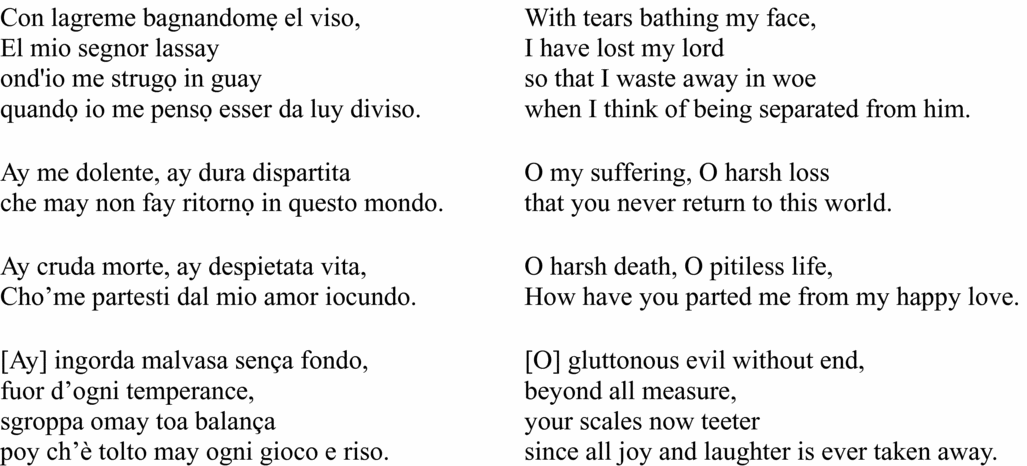
Giustinian's Con lagreme bagnandome expresses the poet's profound grief over the irreparable loss of a paternal figure (Ex. 1).Footnote 48 The ripresa begins with the imagery of tears bathing the grieving poet's face. Although in the Middle Ages (as is still the case today) one could bath one's face in tears of joy or of piety, the rest of Con lagreme makes it clear that these are tears of grief.Footnote 49 In the first piede Giustinian cries out, tormented by his suffering (Ay, me dolente) and the hard reality of his loss (Ay, dura dispartita).Footnote 50 The second piede blames cruel death (cruda morte) for the poet's grief and loss.
Text and translation of Con lagreme bagnandome. Source: Lucca Codex, fol. 54r.

Phrases similar to ‘Con lagreme bagnandome el viso’ recur regularly in fourteenth-century Italian verse.Footnote 51 In sonnet XIV of the anonymous Il Fiore, the partial Italianisation of the Roman de la rose, Pity is described ‘Con lagrime bagnando il su’ vissaggio’ when she speaks to Danger (Schifo).Footnote 52 Florentine notary Andrea Lancia employs the same phrase in his Italian prose translation of Vergil's Aeneid made shortly before 1316 to describe a father's joy at the reunion with his son in the afterlife.Footnote 53 Andrea loosely translates Vergil's description of the poignant moment in Aeneid 6.684–9 when Aeneas encounters the shade of his father Anchises in the Underworld:
Ma, poi che elli [Anchise] vide venire Enea per lo campo, levò le mani a cielo e di lagrime si bagna il viso, e la voce uscì della sua bocca cotale: O figliuolo dolcissimo, tu se’ venuto a me.Footnote 54
But then Anchises saw Aeneas coming through the field, he lifted his hands towards heaven and bathed his face with tears, and these words left his mouth: ‘O sweetest son, you have come to me .’
Andrea idiomatically transforms Vergil's phrase effusaeque genis lacrimae (‘and tears poured out upon [Achises’s] cheeks’) to tears bathing the eyes. Also telling is Andrea's intensification of Vergil's vocative nate in line 689 (‘O son’) into the more emotive ‘O dearest son’.Footnote 55 Andrea's text is valuable for what it reveals about the late medieval emotional reception of the Aeneid and the translation of ancient emotive figures into contemporary vernacular ones. Unlike Il Fiore, Giustinian may have known Andrea's Volgarizzamento dell’Eneide, which survives in many copies.Footnote 56
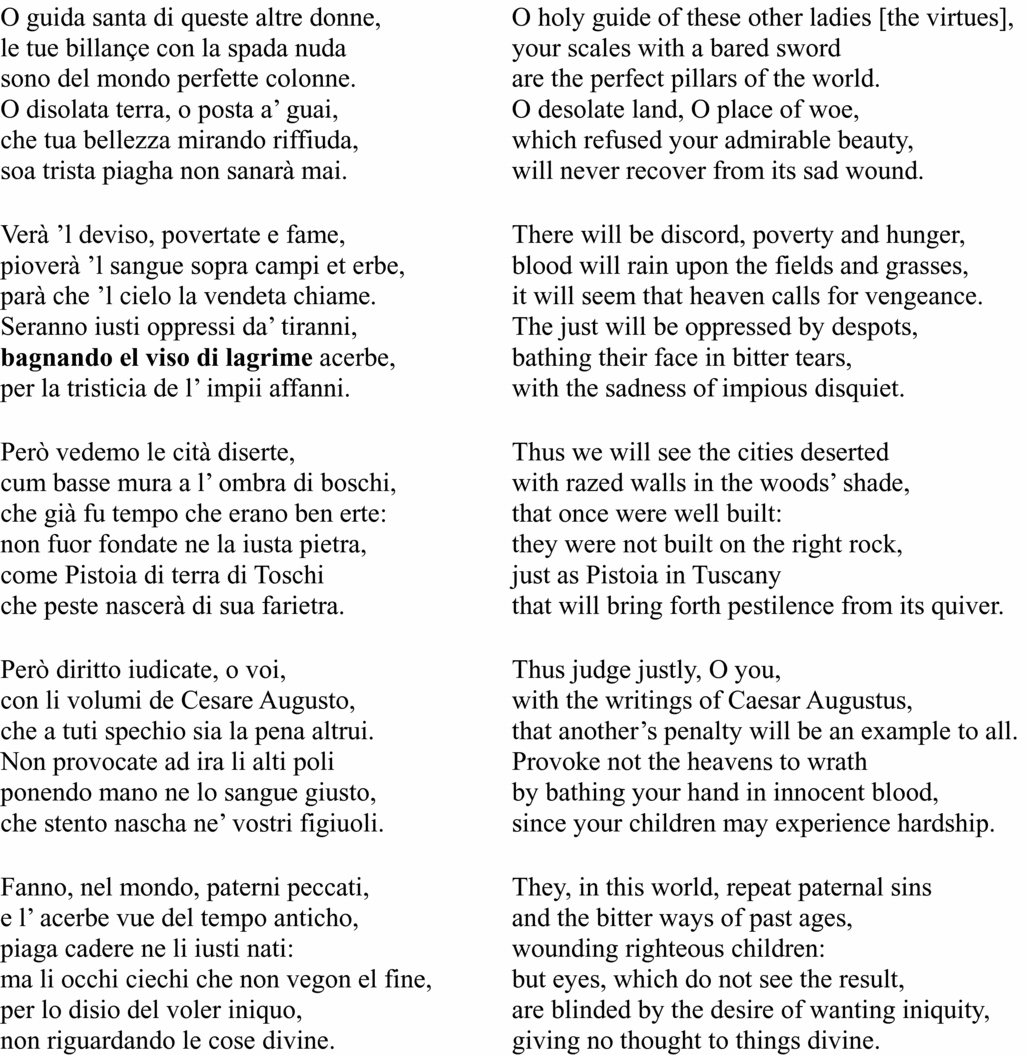
Cecco d'Ascoli's L’Acerba, a long didactic poem that would have been even better known in the Veneto than Andrea's Volgarizzamento, contains a poignant variation on Con lagreme’s first line and, moreover, sheds additional light on parts of Giustinian's poem.Footnote 57 Cecco – also known as Francesco Stabili (1257–1327) – taught astrology and moral philosophy at Padua in the early fourteenth century. He wrote the L’Acerba in 1305 while awaiting a second trial by the inquisition. Despite it being condemned in 1327, his versified treatise survives in numerous manuscripts mostly copied in Italy, at least seventeen of which have been dated to the fourteenth century.Footnote 58 Three of the latter include Latin commentary, indicating a close interest in the text. The copy now kept in Oxford, Taylorian Library, Arch. 1 e 8 appears to have been written in Padua on paper dating from 1360 to 1368.Footnote 59L’Acerba 2.5 contains a poignant warning about what fate befalls a land bereft of Justice and plagued by injustice and iniquity (see Ex. 2).
Cecco d'Ascoli, L’Acerba, 2.5: De iusticia et a quo celo procedit (Concerning Justice and how it proceeds from heaven).
The reference in the third tercet in Example 2 to the Just, when oppressed by despots, ‘bathing their face in bitter tears’ closely resembles the first line of Con lagreme. A shared reference to the scales of Justice in both poems reveals that the object of Giustinian's complaint shifts from Death in the piede to Justice in the volta of his ballata. In this light, Con lagreme might be gently admonishing the Most Serene Republic to rule its new Paduan subjects justly. Giustinian's reference to a passage in L’Acerba that speaks of transparent justice (che a tuti spechio sia la pena altrui) might refer to the then-rumoured cruel execution of Francesco Il Novello da Carrara and his two sons in a Venetian dungeon in January 1406.Footnote 60 Whether this message in the rather intimate form of a ballata would have been heard by more than a small audience is possibly of little consequence given the wide transmission of this composition or its text in early fifteenth-century Italy.Footnote 61
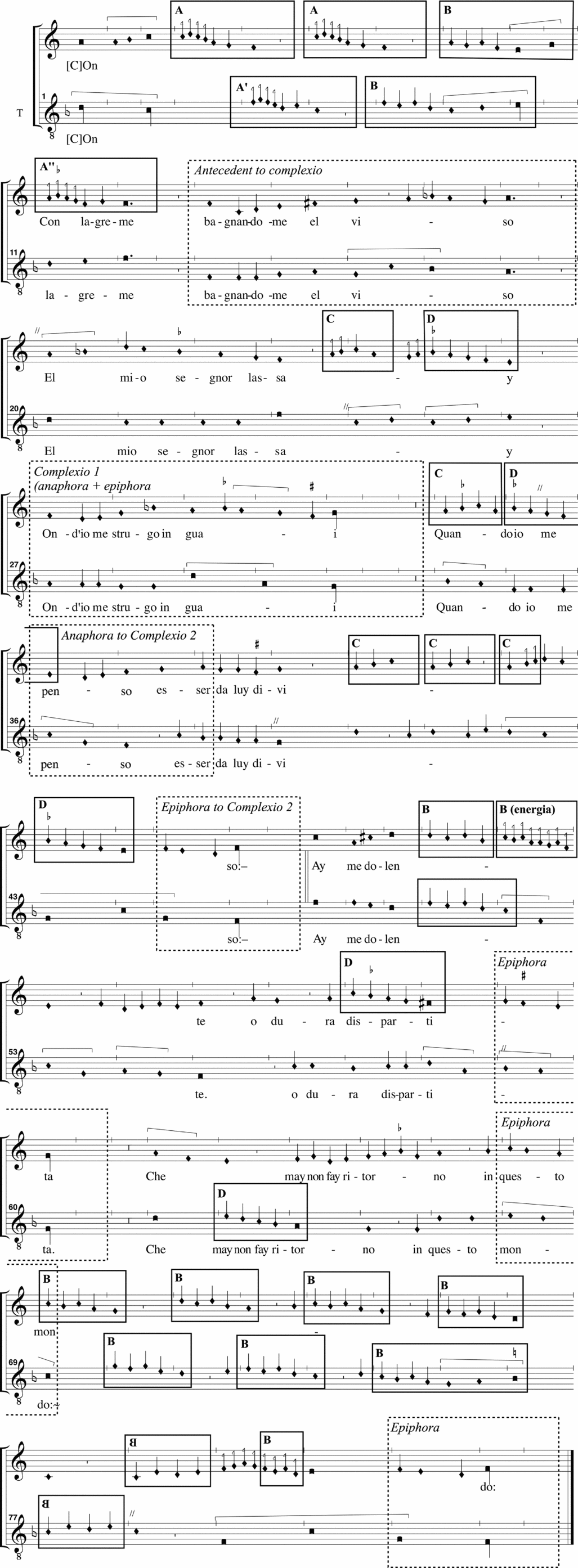
From the perspective of the late Middle Ages, a remarkable feature of Ciconia's setting of Con lagreme bagnandome is the degree of repetition of melodic and rhythmic patterns (see Ex. 3).Footnote 62 Ciconia's use of what might be called musical figures (labelled A–D in Ex. 3) serves as a type of rhetorico-musical expansion of the text of this ballata.Footnote 63 In Con lagreme these musical figures operate as emotive musical gestures. They also delineate several longer-term musical phrases that resemble rhetorical structures that I have labelled in Example 3 with the names of figures of speech. These musical figures function as rhetorical analogues, and in the absence of anything comparable, mark out Ciconia's originality as a late medieval composer operating within the relatively new humanist culture that had begun to assert in a nascent form the individuality of poets, artists and composers.
The ballata begins with a melisma analogous to a rhetorical exordium and narration. Figure A serves to introduce this song but plays no further role. The more important Figure B reappears towards the beginning of the piede (bb. 51–2) and then is treated sequentially, again in both voices in bars 69–76 followed by its partial retrograde in bars 77–8. Ciconia's use of Figure B parallels Vergerio's use of anaphora. The treatment of Figure B in bars 69–76 resembles the rhetorical figure of reflexio where a word or idea is passed between interlocutors (here the Cantus and Tenor) with a changed sense.Footnote 64 Besides transposition, changes to Figure B consist mainly of the absence or presence of an upbeat. For example, in bar 70 the Tenor does not repeat the upbeat to the cantus's Figure B in the previous bar; the cantus then mimics the ‘upbeatless’ tenor's Figure B in bar 71. Even though Figure B is melodically and rhythmically non-descript, its repetition in Con lagreme singles it out as an important musical idea. Its first appearance might suggest that it is associated with tears, but its reappearances for dolente and then at the end of the piede suggests a less specific meaning, one that reflects the overall tone of suffering and grief that permeates Giustinian's poem.
Ciconia also makes use of what I shall call rhetorical phrase construction using repeated musical figures. Akin to Vergerio's use of emotive repetition is a type of musical complexio in Con lagreme, a rhetorical figure that combines anaphora and epiphora.Footnote 65 The first complexio is foreshadowed by an antecedent in bars 14–19 that corresponds to the last seven syllables of the first line. The first complexio in bars 27–31 corresponds to the third line (Ond’io mi strugho in guai). A longer complexio follows in bars 36–43, the anaphora and epiphora separated by a passage based on Figure C. The epiphora takes on a special role throughout the rest of the song as a cadence figure in bars 59, 68, and 81.
Figure C – an ascending melodic minor third – occurs regularly in Con lagreme, and its treatment in the Cantus at bars 40–2 (mid-phrase of complexio 2) brings to mind variatio, a rhetorical principle that Johannes Tinctoris, for example, later emphasised in relation to the music of the fifteenth century.Footnote 66 Finally, Figure D, consisting of a pathetic stepwise descent through a diminished fifth, is repeated several times. When it first appears at bar 25, it is associated with the verb lassay; the second and third time (bb. 35–43) with expressions of separation (or abandonment in the case of the textual variant in the cantus of Pit); and finally with parting in bar 57. It would be wrong to attribute a leitmotiv-like function for Figures B–D, especially given the strophic nature of the ballata, but a general sense of their quasi-poetic nature is apparent through their intimate association with words expressing loss and separation.
Are Vergerio's oration, Giustinian's poem and Ciconia's musical setting, then, indicative of a single emotional community? One might object that each works in a different genre and ‘language’, one in Latin, another in Venetian, and another in music. But one need not succumb to thinking that the vernacular immediately disqualifies Giustinian from Vergerio's emotional community. No less than three early humanists – Giovanni Boccaccio, Franco Sacchetti and Coluccio Salutati – penned vernacular poems for the consolation of their friends following Petrarch's death in 1374.Footnote 67 Second, Vergerio, Giustinian and Ciconia certainly knew each other personally, given the close friendship of Ciconia's patron Francesco Zabarella with Vergerio, and Ciconia's enthusiasm for setting other poems by Giustinian. Even if Giustinian studied at Venice and not Padua, Ciconia's musical settings show that his poetry was well known in Padua and may even point to a personal acquaintance between similarly aged men.
Stepping back from these concerns, Ciconia's music links all three individuals to the same emotional community of early humanists at Padua. His music responds to emotives wrought upon the reader by the young poet Giustinian and increases their effect through musical repetition and rhetorical phrase construction. Ciconia's musical repetitions are analogous to figures of pathos, and hence emotives, which Vergerio exploited in his orations delivered at Padua. Taken as a whole, one can gain some sense of how Ciconia exploited rhetorical precepts for emotional expression that were endorsed by the community of early humanists. The significance of this conclusion needs to be emphasised: Ciconia's song, Vergerio's oration, and Giustinian's poem respond to the emotional space of nascent humanism.
Rhetorical analysis of Johannes Ciconia's Con lagreme bagnandome.