Introduction
Suicide risk is high and increases with age with the highest rates being in middle-aged and older persons (Office for National Statistics, 2012). In Western societies, suicide rates in older people vary around 14 and 27 per 100,000 persons for men and around 4 and 7 per 100,000 persons for women (Centraal Bureau voor de Statistiek, 2007; Office for National Statistics, 2012). In addition to age, depression is the most consistently reported determinant of suicidality (Awata et al., Reference Awata2005; Rowe et al., Reference Rowe, Conwell, Schulberg and Bruce2006; Corna et al., Reference Corna, Cairney and Streiner2010). In depressed persons, suicidality is considered as a unidimensional construct varying from no thoughts of death to thoughts of death to suicidal thoughts, plans, and complete suicide. Therefore, frequently used instruments to assess depression, such as the Inventory of Depressive Symptoms (IDS; Rush et al., Reference Rush, Gullion, Basco, Jarrett and Trivedi1996) and the Montgomery–Åsberg Depression Rating Scale (MADRS; Montgomery and Åsberg, Reference Montgomery and Åsberg1979), do not discriminate between the two conditions. Furthermore, the Diagnostic and Statistical Manual of Mental Disorders, 4th Edition Revised (DSM-IV-TR; American Psychiatric Association (APA), 2000) criteria for depression do not discriminate between thoughts of death and thoughts of suicide, as patients meeting criteria for this symptom must have thoughts of death or suicidal ideation or suicide plans, or a suicide attempt (APA, 2000). However, thoughts of death may differ from suicidal ideation in terms of risks and consequences. This may be particularly so in older people, as old age may trigger thoughts of death in the context of somatic and social losses in the absence of psychopathology.
Many studies evaluated determinants of suicidal ideation. Depression severity (Alexopoulos et al., Reference Alexopoulos, Bruce, Hull, Sirey and Kakuma1999; Lenze et al., Reference Lenze2000; Jeste et al., Reference Jeste, Hays and Steffens2006; Tan and Wong, Reference Tan and Wong2008), comorbid psychopathology, and psychosocial and somatic comorbidity have been reported to increase the risk of suicidal ideation or behavior. For instance, high levels of anxiety (Jeste et al., Reference Jeste, Hays and Steffens2006) and comorbid anxiety disorder (Lenze et al., Reference Lenze2000) increase the risk of suicidal ideation. A lack of social support or social interaction is associated with suicidal ideation in depressed and non-depressed older adults (Alexopoulos et al., Reference Alexopoulos, Bruce, Hull, Sirey and Kakuma1999; Awata et al., Reference Awata2005; Rowe et al., Reference Rowe, Conwell, Schulberg and Bruce2006). Life events may be particularly relevant to provoke suicide or suicidal ideation in presence of depressed mood (Hintikka et al., Reference Hintikka2009). Finally, somatic diseases have been identified as risk factors for suicidal thoughts in community-dwelling older people (Rowe et al., Reference Rowe, Conwell, Schulberg and Bruce2006), although this may not be the case among depressed older persons (Tan and Wong, Reference Tan and Wong2008).
In contrast to suicidal ideation, thoughts of death have hardly been examined in depressed older persons. The present study will examine a wide range of possible determinants separately for thoughts of death and thoughts of suicide within a large cohort of depressed older persons. We hypothesize that thoughts of death and suicidal ideation differ in relevant demographic, social, and clinical characteristics in depressed older persons.
Methods
Study design
The data for this study were obtained from baseline assessment of the Netherlands Study of Depression in Older persons (NESDO), a prospective multi-site naturalistic study of patients aged 60 years and older with a current DSM-IV-TR diagnosis of a depressive disorder (Comijs et al., Reference Comijs2011). Extensively trained and supervised research assistants carried out interviews and assessments between April 2007 and September 2010.
Participants
The patients were recruited from mental healthcare institutes and general practitioners of five regions of the Netherlands. After oral and written information, the participants gave their informed consent. Persons with a primary diagnosis of dementia, a Mini-Mental State Examination (MMSE; Folstein et al., Reference Folstein, Folstein and McHugh1975) score below 18, and those who were not sufficiently in command of the Dutch language were excluded. A DSM-IV-TR diagnosis (APA, 2000) of current major or minor depressive episode or dysthymia was established with the Composite International Diagnostic Interview (CIDI; WHO version 2.1 and lifetime version) with questions added to determine the research DSM-IV-TR diagnosis of current minor depression. The CIDI is a well-validated structured clinical interview designed for use in research (Wittchen, Reference Wittchen1994).
Assessment of thoughts of death and suicide
Thoughts of death or suicide during the past month were derived from the CIDI. Based on the following CIDI questions, participants were divided into three groups. The reference group consisted of depressed persons with no thoughts of death or suicide. These patients had a negative answer for the following CIDI question: “Did you think a lot about death?.” Patients were assigned to the thoughts of death group in case of a positive answer for the above-mentioned CIDI question and a negative answer for any other CIDI question about suicide. Finally, patients were assigned to the thoughts of suicide group in case of a positive answer on at least one of the following CIDI questions: “Did you feel so low that you thought a lot about committing suicide?,” “Did you make a suicide plan?,” or “Did you attempt suicide?.”
Assessment of determinants of thoughts of death and suicidal ideation
Determinants were classified in socio-demographic variables, lifestyle characteristics, psychopathology, psychosocial variables, and somatic morbidity. Socio-demographic variables of interest included age, gender, years of education, having a partner relationship, and finally, level of income in 24 categories (ranging from below €600 to above €5,000 per month). Lifestyle conditions included alcohol use, current smoking (self-report, yes/no), and body mass index. Alcohol usage was measured with the Alcohol Use Disorders Identification Test (AUDIT; Babor et al., Reference Babor, Kranzler and Lauerman1989) and classified as no use, moderate use, or severe (at risk) use based on questions asking for frequency of alcohol use and number of units on a typical drinking day. Body mass index was calculated as the measured weight in kg (light clothing and no shoes) by height squared in centimeters. Psychopathology was assessed with both self-report instruments and a structured diagnostic interview (CIDI). We included well-validated self-report instruments to assess the severity of depressive symptoms (Inventory of Depressive Symptomatology – Self-Rating (IDS-SR); Rush et al., Reference Rush, Gullion, Basco, Jarrett and Trivedi1996), severity of anxiety symptoms (Beck Anxiety Inventory (BAI); Beck et al., Reference Beck, Epstein, Brown and Steer1988), and sleeping problems (Women's Health Initiative Insomnia Rating Scale (IRS); Levine et al., Reference Levine, Kaplan, Kripke, Bowen, Naughton and Shumaker2003).
The presence of generalized anxiety disorder, panic disorder, agoraphobia, and social phobia was assessed with the CIDI 12-month version. The CIDI lifetime (CIDI-L) version was used to assess age of onset of depressive disorder. In addition, the CIDI-L was used to assess thoughts of death and suicide earlier in life. Somatic determinants included global cognitive functioning, chronic somatic morbidity, and functional limitations. Global cognitive functioning was assessed with the MMSE (Folstein et al., Reference Folstein, Folstein and McHugh1975). The presence of somatic comorbidities was evaluated with a self-report questionnaire, including current or previous presence of cardiac disease, peripheral atherosclerosis, stroke, diabetes mellitus, chronic obstructive pulmonary disease (COPD), arthritis, cancer, or any other disease (Longitudinal Aging Study Amsterdam (LASA) questionnaire; Kriegsman et al., Reference Kriegsman, Penninx, van Eijk, Boeke and Deeg1996). Functional limitations were assessed with the World Health Organization Disability Assessment Schedule (WHODAS; Chwastiak and Von Korff, Reference Chwastiak and Von Korff2003). The items concerning work, which are embedded in the domain of household activities, were deleted from the Schedule to suit the current population. Finally, psychosocial determinants were assessed. Social determinants included early and recent life events assessed with the Brugha questionnaire (short form; Brugha et al., Reference Brugha, Bebbington, Tennant and Hurry1985), loneliness assessed with the loneliness and affiliation scale (De Jong Gierveld and Kamphuis, Reference De Jong Gierveld and Kamphuis1985), worrying assessed with the Worry Scale (Wisocki et al., Reference Wisocki, Handen and Morse1986), and mastery assessed with the Pearlin Mastery Scale (Pearlin and Schooler, Reference Pearlin and Schooler1978). Childhood trauma, including emotional neglect and psychological, physical, and sexual abuse, were assessed with a structured interview from the Netherlands Mental Health Survey and Incidence Study (De Graaf et al., Reference De Graaf, Bijl, Ten Have, Beekman and Vollebergh2004) and calculated as a childhood trauma index ranging from 0 to 8.
Statistical analysis
First, determinants were compared between depressed persons with no thoughts of death and thoughts of death and suicidal ideation with χ 2 test, one-way ANOVA, and the Kruskall–Wallis test. In case of a significant main effect, post hoc tests (χ 2 test, independent sample t-test, and the Mann–Whitney U test) were conducted to evaluate groups that differed significantly from each other. Multiple multinomial logistic regression analyses were conducted to explore the association of the above-mentioned determinants with either thoughts of death or thoughts of suicide, using the group with no thoughts of death or suicide as the reference group. Acknowledging the potential of confounding by age or depression severity with many of the determinants under study, these analyses were adjusted for age and depression severity.
Results
The Netherlands Study of Depression in Older persons has included 378 older persons with a DSM-IV-TR (APA, 2000) depressive disorder. Of these depressed older persons, 107 (28.3%) reported thoughts of death in the past month and 37 (9.8%) reported thoughts of suicide. Of the 37 patients reporting thoughts of suicide, 33 also had thoughts of death, and four reported no thoughts of death. Four persons with missing data (one with missing data on both thoughts of death and thoughts of suicide, one with no thoughts of death but missing data on thoughts of suicide, two with missing data on thoughts of death and no thoughts of suicide) were assigned to the group with no thoughts of death and no thoughts of suicide. Two persons actually attempted suicide. According to the lifetime questions, more than half of the patients (n = 239 (63.2%)) have had thoughts of death earlier in their lives and one-third (n = 135 (37.5%)) have had thoughts about suicide. Among those patients, 52 (13.8%) had a history of attempted suicide.
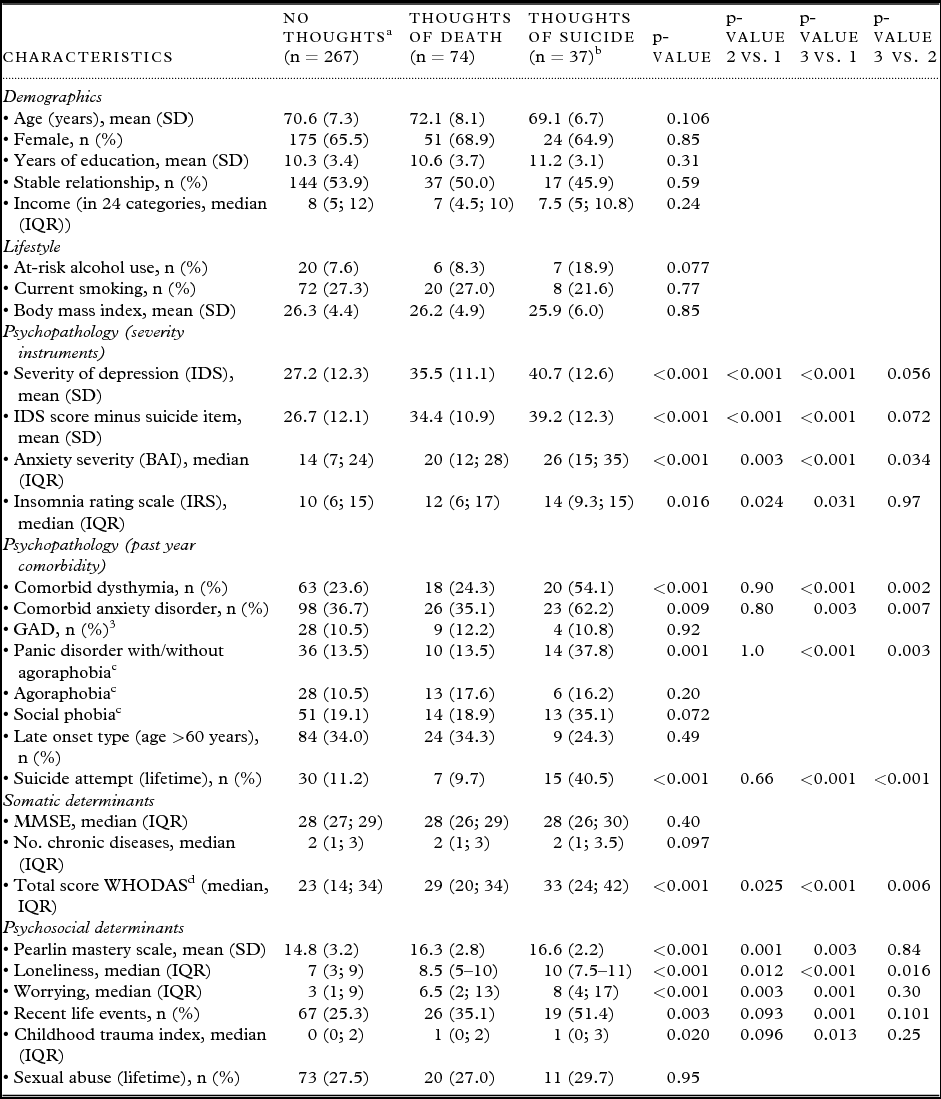
Table 1 presents the demographic, lifestyle, psychopathologic, somatic, and psychosocial characteristics for the three groups of depressed older patients. In general, socio-demographic, lifestyle and somatic determinants did not differ across the three groups, whereas most psychopathological as well as psychosocial determinants differed across the three groups. The mean age did not differ across the three groups (p = 0.106), whereas the severity of depressive symptoms was increased among patients with thoughts of death as well as patients with thoughts of suicide (p < 0.001).
Characteristics of depressed older patients by past month's thoughts of death and thoughts of suicide

Notes: Non-parametric tests were used for the MMSE score, number of chronic diseases, WHODAS scores, level of income, Beck Anxiety Inventory, Worry Scale, Insomnia Rating Scale, loneliness, and childhood trauma index.
aOne person had missing data on thoughts of death as well as on thoughts of suicide, one person had no thoughts of death but did not answer the question about suicide, and two persons had missing thoughts of death and no thoughts of suicide. These four patients were classified in the group of patients with neither thoughts of death nor thoughts of suicide.
bOf these 37 patients with suicidal ideation, 33 also had thoughts of death and four had no thoughts of death.
cWithout hierarchical rules of DSM-IV-TR.
dFor the WHODAS scale the items concerning work, which are embedded in the domain of household activities, were not administered to suit the current population.
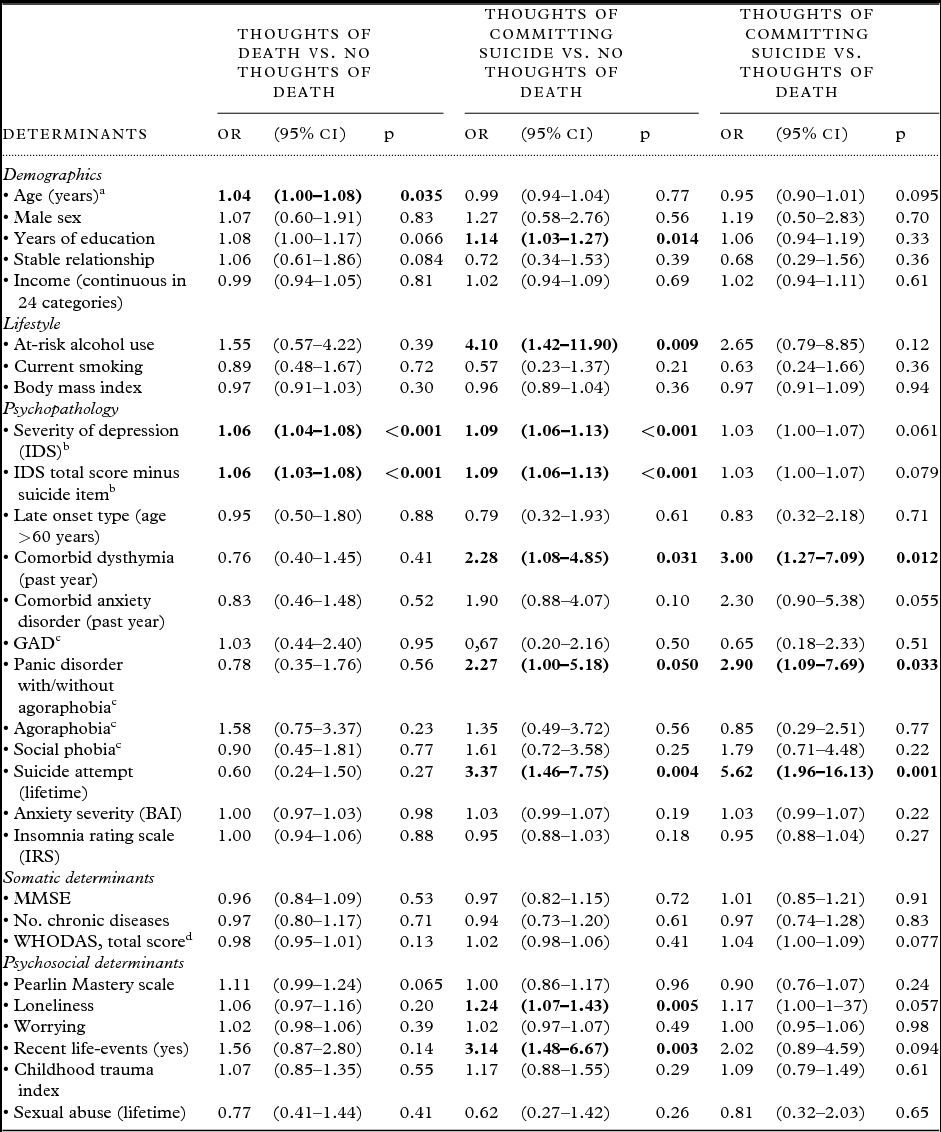
Table 2 shows the results from the multinomial logistic regression, comparing the characteristics between the three groups adjusted for depression severity and age. After adjusting for depression severity, older age was associated with thoughts of death, but not with suicidal ideation. In contrast, a higher level of education, at-risk alcohol use, dysthymia, panic disorder, history of suicide attempts, loneliness, and recent life events were associated with suicidal ideation, but not with thoughts of death in the absence of suicidal ideation. Finally, after adjusting for age, the level of depressive symptoms was significantly associated with thoughts of death and suicidal ideation.
Associations of past month's thoughts of death and suicide adjusted for depression severity (IDS) and age by multinomial logistic regression
Notes: aOnly adjusted for IDS-score.
bOnly adjusted for age.
cWithout hierarchical rules of DSM-IV-TR.
dFor the WHODAS scale the items concerning work, which are embedded in the domain of household activities, were not administered to suit the current population.
Discussion
Main findings
Our data confirm the importance of thoughts of death and suicidal ideation in depressed older persons. We found that more than half of the patients had struggled with thoughts of death and one-third with thoughts of suicide at some time in their lives. During a current depressive episode, 28% of the patients think a lot about death, of whom almost 10% think about ending their lives.
Moreover, we found suicidal ideation to differ from thoughts of death in important demographic, social, and clinical characteristics, suggesting that risks and consequences may differ between the two conditions. Interestingly, older age itself was associated with thoughts of death only and not with suicidal ideation, whereas suicidal ideation was specifically associated with more severe comorbid psychopathology (dysthymia, at-risk alcohol use, panic disorder with/without agoraphobia, lifetime suicide attempts) and psychosocial characteristics (higher level of education, loneliness, recent life events). Somatic comorbidity and functional limitations were neither associated with thoughts of death nor thoughts of suicide.
Comparison with the literature
Our results are in line with the studies in community-dwelling older people that found that wish or thought of death was strongly associated with depressive symptoms (Dennis et al., Reference Dennis, Baillon, Brugha, Lindesay, Stewart and Meltzer2007; Rurup et al., Reference Rurup, Deeg, Poppelaars, Kerkhof and Onwuteaka-Philipsen2011).
We found no association between gender and thoughts of death or suicide. This is in line with previous research (Alexopoulos et al., Reference Alexopoulos, Bruce, Hull, Sirey and Kakuma1999). In contrast to studies in younger and older community-dwelling adults (Ten Have et al., Reference Ten Have2009; Corna et al., Reference Corna, Cairney and Streiner2010) as well as younger depressed adults (Claassen et al., Reference Claassen2007), being involved in a partner relationship did not influence the occurrence of thoughts of suicide or suicidal behavior, but loneliness does. In older age, subjective feelings of loneliness and perceived lack of social support may play a more prominent role than partner status in developing thoughts of suicide (Alexopoulos et al., Reference Alexopoulos, Bruce, Hull, Sirey and Kakuma1999; Vanderhorst and McLaren, Reference Vanderhorst and McLaren2005; Rowe et al., Reference Rowe, Conwell, Schulberg and Bruce2006; Corna et al., Reference Corna, Cairney and Streiner2010).
In our cohort the severity of depressive symptoms did not differ significantly between the patients with suicidal ideation and those with thoughts of death. On the other hand, comorbid dysthymia and lifetime suicide attempts, suggestive of a longer duration of psychopathology, did distinguish patients with suicidal ideation from those with only thoughts of death. This suggests that severity of depression may be of less importance compared to duration of symptoms for the development of suicidal thoughts.
The role of comorbid anxiety is complex. On the one hand, comorbid anxiety has been associated with suicidal ideation in depressed adults (Seo et al., Reference Seo2011), on the other hand, it has been suggested that anxiety and panic disorder may prevent patients from acting on their suicidal thoughts (Nakagawa et al., Reference Nakagawa, Grunebaum, Oquendo, Burke, Kashima and Mann2009). We found a high prevalence of a comorbid anxiety disorder among depressed patients with suicidal ideation (62.2%). Within our sample, only comorbid panic disorder was associated with suicidal ideation after adjusting for the severity of depression. The absence of association of other anxiety disorders is consistent with studies showing that not anxiety but the depression severity accounts for the development of suicidal behavior (Lenze et al., Reference Lenze2000). Taking previous findings into account, two explanations for the association between panic disorder and suicidal ideation seem reasonable. First, panic disorder leads to social withdrawal and social dysfunctioning (Lenze et al., Reference Lenze2000, Zimmerman and Chelminski, Reference Zimmerman and Chelminski2003), which may result in loneliness and suicidal ideation. Second, catastrophic thoughts within panic attacks might specifically increase the risk of suicidal ideation and suicide attempts (Katz et al., Reference Katz, Yaseen, Mojtabai, Cohen and Galynker2011).
With regard to childhood trauma or sexual abuse, however, we did not find any impact on thoughts of death or suicide in contrast with studies on suicidality in younger adults (Ullman and Najdowski, Reference Ullman and Najdowski2009). Our cross-sectional design, however, precludes any conclusions with respect to survival bias, cohort effects, or a decreasing impact of childhood abuse on thoughts of death or suicide by age. Actual stressors, however, were still associated with suicidal ideation in our sample.
In contrast to our expectations, we neither found association with the number of somatic diseases nor with functional limitations and thoughts of death or suicide. In community-dwelling older adults, thought of death or wish to die is, independent of depressive symptoms associated with the number of somatic diseases, activities of daily living (ADL) impairment, pain, poor self-rated health, and involuntary urine loss (Dennis et al., Reference Dennis, Baillon, Brugha, Lindesay, Stewart and Meltzer2007; Rurup et al., Reference Rurup, Deeg, Poppelaars, Kerkhof and Onwuteaka-Philipsen2011). Our results, however, suggest that in depressed older people, depression severity is more relevant for thoughts of death or suicide than physical health. Interestingly, however, it has been also reported that physical health is only associated with suicide attempt but not suicidal ideation in depressed older patients (Alexopoulos et al., Reference Alexopoulos, Bruce, Hull, Sirey and Kakuma1999).
Strengths and limitations
Strength of our study is the distinction between suicidal ideation and thoughts of death based only on a structured interview (CIDI) within a large sample of depressed older persons in various developmental and severity stages of their depressive illness. Our study, however, is still limited by not having included the most severely depressed patients because they were too depressed to be able to participate. In addition, NESDO was powered on determinants of depression and its course (Comijs et al., Reference Comijs2011), but not on determinants of thoughts of death/suicidal ideation. Another limitation is the chance of type-1 errors (i.e. spurious findings) due to multiple comparisons. However, we chose not to adjust for multiple testing because it increases the chance of type-2 errors, and because the nature of our analyses was explorative. The reader must, however, keep in mind the potential presence of type-1 errors and replication of present findings is necessary to be able to make firm conclusions. Final limitations of our study are the limited number of patients with suicidal ideation (37) and its cross-sectional design precluding causal inferences.
Conclusions
The present study suggests that thoughts of death and suicidal ideation may differ in terms of risks and consequences, stressing the importance of distinguishing between these two conditions. However, frequently used instruments assessing depression severity like MADRS (Montgomery and Åsberg, Reference Montgomery and Åsberg1979) or IDS (Rush et al., Reference Rush, Gullion, Basco, Jarrett and Trivedi1996) do not discriminate between thoughts of death and suicidal ideation. Longitudinal studies should be conducted on the development and course of thoughts of death and suicidal ideation over time. This would help to understand these serious problems in more depth and to enable adequate monitoring and treatment beyond the classical treatments for late life depression alone.
Conflict of interest
None.
Description of authors’ roles
Ista C.H.M. Bogers and Richard C. Oude Voshaar conceived the idea of this paper and formulated research questions. Ista C.H.M. Bogers drafted the manuscript. Hannie C. Comijs, being the principle investigator of the NESDO study, critically reviewed and revised the manuscript. Marjolein L. Boshuisen critically reviewed and revised the manuscript. Marij Zuidersma and Richard C. Oude Voshaar assisted in analyses and critically reviewed and revised the paper. All authors read and approved the final manuscript.
Acknowledgment
The infrastructure for NESDO was funded through the Fonds Nuts Ohra, Stichting tot Steun VCVGZ, NARSAD the Brain and Behaviour Research Fund, and the participating universities and mental healthcare organizations (VU University Medical Center, Leiden University Medical Center, University Medical Center, Groningen, Radboud University Nijmegen Medical Center, and GGZ inGeest, GGNet, GGZ Nijmegen, GGZ Rivierduinen, Lentis, and Parnassia).