Burgeoning literature within the social sciences studies the effects of culture on collective action. In economics, this topic can be found in the rising fields of behavioral economics (Camerer, Loewenstein, and Rabin Reference Camerer, Loewenstein and Rabin2004; Diamond, Vartiainen, and Jahnssonin Reference Diamond, Vartiainen and Jahnssonin2007; Thaler Reference Thaler2007; Wilkinson Reference Wilkinson2007) and experimental economics (Friedman and Sunder Reference Friedman and Sunder1994; Friedman Reference Friedman and Friedman2004; Kagel and Roth Reference Kagel, Roth, Kagel and Roth1995), where increasing notice is taken of individuals who do not behave uniformly as self-interested, rational utility maximizers. Instead, altruism (Andreoni and Miller Reference Andreoni, Miller, Plott and Smith2008), reciprocity (Fehr and Gachter Reference Fehr and Gachter2000; Fischbacher and Gachter Reference Fischbacher and Gachter2010; Rabin Reference Rabin1993), social welfare maximization (Charness and Rabin Reference Charness and Rabin2002), and inequality aversion (Bolton and Ockenfels Reference Bolton and Ockenfels2000; Fehr and Schmidt Reference Fehr and Schmidt1999) have been proposed as explanations for behavior in collective action situations.
In social anthropology, there is an increasing awareness of cultural variations across countries and societies in the way that individuals behave under the same sets of circumstances (Henrich et al. Reference Henrich, Boyd, Bowles, Camerer, Fehr and Gintis2004). In political science, widespread interest in understanding origins of and solutions to ethnic conflicts focuses on the role of culture and identity (Fearon and Laitin Reference Fearon and Laitin1996; Habyarimana et al. Reference Habyarimana, Humphreys, Posner and Weinstein2007). Ostrom (Reference Ostrom1990) identifies successful cases of managing a commons in Swiss village communal land tenure, common lands in Japanese villages, Huerta irrigation institutions, and Zanjera irrigation communities in the Philippines, and points to the importance of rules, behavioral factors, institutions, and motivations for successful results (Ostrom and Ostrom Reference Ostrom, Ostrom, Ellis and Thompson1997; Ostrom Reference Ostrom2011). One common feature that unifies all of these studies is the recognition of heterogeneity in humans and the attempt to explain social patterns beyond “thin” rational choice theory (for related discussion, see Chai Reference Chai, Ellis and Thompson1997; Lockhart and Coughlin Reference Lockhart and Coughlin1992, Reference Lockhart, Coughlin, Chai and Swedlow1998; Swedlow Reference Swedlow2002, Reference Swedlow and Swedlow2006, Reference Swedlow2011, this issue; Wildavsky Reference Wildavsky1991, Reference Wildavsky1994).
Another common feature that unifies these studies is the lack of a framework (and even more, the lack of a theory) of culture to explain the observed variations in human behavior. It is evident that cultural factors are only marginally examined in the analysis of performance, and the interaction of cultures is virtually ignored (Stock Reference Stock2004). This article addresses this shortcoming by turning to what may be the most prominent general framework for cultural classification in the social sciences, the cultural theory (CT) developed by Mary Douglas, Aaron Wildavsky, and others (Douglas Reference Douglas1982; Thompson, Ellis, and Wildavsky Reference Thompson, Ellis and Wildavsky1990). CT derives four cultural types (hierarchs, egalitarians, individualists, and fatalists) from two dimensions of social relations, group and grid. The dimension of group measures the extent to which individuals are incorporated into a group or collective; grid measures the extent to which political and social prescriptions constrain individuals. This study empirically demonstrates how group and grid affect performance in systematic, predictable ways, in a range of settings, making use of attitudinal survey methodology and computer-mediated experiments,Footnote 1 the most rigorous way of validating general behavioral predictions. More specifically, CT shows how the group and grid characteristics of individuals can predict the level of contribution that such individuals make to a collective undertaking, hence affecting the overall benefits from that action. CT shows how under certain institutional structures and conditions “groupness” influences contributions, while under others “gridness” does.
CT is quite different from most cultural theories or typologies such as those of Hofstede (Reference Hofstede2003), House et al. (Reference House, Hanges, Javidan and Dorfman2004), Chhokar, Brodbeck and House (Reference Chhokar, Brodbeck and House2007), or Hampden-Turner and Trompenaars (Reference Hampden-Turner and Trompenaars1993). One distinction is that CT has only two major factors, group and grid, as opposed to several found in comparable typologies. Moreover, CT's factors tend to be more abstract. This abstractness can be seen as one of CT's great advantages, as its concepts of group and grid can be viewed as being relevant to literally all choice situations that an individual will confront in a social or political setting (Chai and Wildavsky Reference Chai, Wildavsky, Coyle and Ellis1994, Reference Chai, Wildavsky, Chai and Swedlow1998; Douglas Reference Douglas1989; Douglas and Wildavsky Reference Douglas and Wildavsky1982; Swedlow Reference Swedlow2011, this issue; Wildavsky Reference Wildavsky, Chai and Swedlow1998).
Experimental methodologies are being used more frequently throughout the social sciences as the primary way to test rational choice models under controlled conditions with human subjects (Wilson and Eckel Reference Wilson and Eckel2006; Yamagishi, Cook, and Watabe Reference Yamagishi, Cook and Watabe1998), including a growing body of work in political science and sociology. Outside of the CT-based experiments reported in this article, previous attempts to correlate attitudes with behavior in interactive experiments have been limited to single questions and have sometimes produced seemingly contradictory results. For example, while Gachter, Herrmann, and Thoni (Reference Gachter, Herrmann and Thoni2004) find no predictive power of trust question responses in explaining behavior in the voluntary contribution mechanism (VCM), a type of public goods game most widely used in experimental economics, Glaeser et al. (Reference Glaeser, Laibson, Scheinkman and Soutter2000) and Fehr et al. (Reference Fehr, Fischbacher and Gachter2002) find that attitudes about trust predict trusting behaviors. Meanwhile, Chuah et al. (Reference Chuah, Hoffmann, Jones and Williams2009) explain higher offers in the ultimatum game among residents of Malaysia by their attitude toward freedom and civic-mindedness. Moreover, while this work has brought cultural variables into experimental economics, it, like the rest of the social science literature on the influence of culture on collective action, has done so in an ad hoc fashion, without developing or adopting a comprehensive framework (and even less a theory) for conceptualizing culture or using it to explain behavior.
Our research seeks to improve on the above-mentioned approaches by using CT to better characterize cultural variables and to explain collective action. CT cannot only help explain the differences between specific nationalities/ethnic groups, but can show how they can be generalized to other countries and other types of interactions. Moreover, CT shows how it is possible to go beyond stereotypes of national character and examine cultural differences at an individual and sub-national level. Next, we describe the survey instrument and the hypotheses we tested in our public goods experiments.
MEASUREMENT AND BEHAVIOR PREDICTION FROM GROUP AND GRID
The group attribute is operationalized here as generating other-regarding behavior, while the grid attribute is operationalized as generating rule-regarding behavior. We measure group and grid using a survey developed in Chai et al. (Reference Chai, Dorj, Hampton and Liu2009a) that uses 22 items drawn from the World Values Survey (WVS). We quantify culture using 11 questions for each of the group and grid attributes, generating a variable varying continuously from zero to one for each attribute, as explained in Chai, Kim and Liu (Reference Chai, Kim and Liu2009). To provide an example, the following opinions indicate a high “group” score: (a) family are very important; (b) friends are very important; (c) people should respect their own parents; (d) people should trust each other; and (e) government should take more responsibility. People with low group scores do not share these opinions. Similarly, items indicating a high “grid” score include the following opinions: (a) religion is very important; (b) men should have more rights than women; (c) young people should get more job opportunities; (d) people have to follow/obey instructions; and (e) having children is quite necessary. People with low grid scores do not share these opinions. In three experiments (Chai et al. Reference Chai, Dorj, Hampton and Liu2009a,Reference Chai, Dorj, Hampton and Liub, Reference Chai, Dorj and Sherstyuk2010), Cronbach's alpha coefficients of .68, .70, and .72, respectively, demonstrate the high reliability of the survey instrument.
A high group score was hypothesized to induce altruism toward other individuals, and a high grid score to induce enforcement of social norms of reciprocity. The justification and formalization of this interpretation is provided in Chai et al. (Reference Chai, Dorj, Hampton and Liu2009a). Briefly, to operationalize group and grid in choice-theoretic terms, it is necessary to translate the general cultural biases inherent in each cultural trait into specific behavioral patterns that will manifest themselves in controlled game-like experimental conditions. The general tendency of high group individuals to subsume their identity within that of the collective leads to altruism, a tendency to factor in the payoffs of others into one's own calculation of utility (Chai et al. Reference Chai, Dorj, Hampton and Liu2009a; Chai, Kim, and Liu Reference Chai, Kim and Liu2009). The general tendency of high grid individuals to be controlled by collective social norms, absent a priori knowledge of culture-specific norms and constrained by conditions found in controlled games, leads high grid individuals to enact the social norm generally thought to be most widely shared across cultures, that is, reciprocity (Henrich et al. Reference Henrich, Boyd, Bowles, Camerer, Fehr, Gintis and McElreath2001). On one hand, the group attribute explains what causes cooperation to begin in the first place, as it indicates a predisposition to regard the group's interests as being congruent with one's own. On the other hand, results with respect to the grid attribute shed light on social behavior reflecting reciprocity that helps to explain the maintenance of social norms of cooperation even in the absence of external enforcement.
In what follows, we provide a detailed description of a public goods game and review our findings. First, we report results of the group attribute, which signifies other-regarding choices in a voluntary contributions public goods experiment. Then, we discuss the results of the grid attribute, which induces rule-regarding behavior in this experiment where punishment is possible. Next, we briefly summarize the similar results we found in our bargaining and trust experiments. As predicted, we find that the willingness to contribute and offer a larger share of the pie to other people is significantly stronger among individuals with a higher group score. As expected, we also find that individuals with a higher grid score reciprocate significantly more often by punishing others for misbehavior.
OTHER-REGARDING GROUP BEHAVIOR IN PUBLIC GOODS EXPERIMENTS
For the public goods experiment, 132 subjects were provided with pretest surveys, which were used to generate measures for each subject along group and grid. Within teams of four, at random or unchanged, these subjects were then placed in 10 rounds of a voluntary contributions mechanism (VCM) experiment. Individuals were given an endowment of 50 tokens, and they decided how many tokens to contribute toward the provision of the public good. Each individual kept the tokens not contributed to the public good. Every token contributed to the public good by each of the four group members generated half of a token for all members of the group regardless of their contributing amount. Thus, individual return on investing in the public good was equal to a half of a token but the total group return was two tokens. Thus, for self-interested subjects it was always a superior strategy not to invest in a public good, yet the group as a whole was better off if any subject contributed any of their tokens to the public good, a classic public goods problem. Of course, the group would benefit the most if all members contributed all of their tokens to the public good.
Experimental treatments varied according to whether or not team membership was shuffled between rounds [shuffled (S) versus partner (P) treatments], and by whether or not information was provided to team members regarding how they responded on average to a question about the appropriate individual contribution to the public good [frame (F) versus no frame (NF) treatments]. In the shuffled treatment participants were matched with different members each round, although in partner groups the same four people interacted throughout a session, across all 10 rounds. The shuffled treatment was meant to induce one-shot interaction, which reduces effects of the norm of reciprocity and efforts to extract future benefits that are found in long term interactions. Hence, a comparison across shuffled (S) and partner (P) treatments allows us to distinguish the behavior of self-interested subjects from that of reciprocating subjects.
As mentioned above, in the shuffled frame (SF) and partner frame (PF) treatments, we study framing effects as well. These treatments include a preliminary stage to elicit from subjects their expectation of what constitutes a fair individual contribution to the public good of their group. To enhance the presence of social norms within the group, we report group opinion to the group about what constitutes a fair contribution in the frame treatment. The average answer is reported back to the subjects before the treatments commence. This is meant to create a “frame” for subjects; that is, a collectively shared norm against which actual contributions can be compared. Shuffled (S) and partner (P) treatments do not include this framing stage.
According to the conventional theory assuming self-interested, utility maximizing individuals, there should be no contributions in all four treatments of this public goods experiment. According to our model the formalization of groupness allows individuals to consider some of the team payoff as part of their own utility, thus increasing the incentives for contribution. The research question raised is thus: In this experiment, to what extent does the cultural characteristic of altruism (groupness) affect decisions to contribute to the public good? The research hypothesis follows: Individuals with higher group scores will contribute more than individuals with lower group scores.
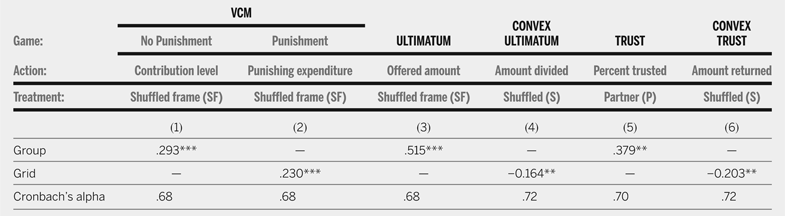
The results of our experiment were consistent with previous findings. Contributions to the public good of the group did not occur at the highest level possible but were above zero (Chai et al. Reference Chai, Dorj, Hampton and Liu2009a). Moreover, as hypothesized, the group attribute was positively and significantly correlated with the level of individual contribution across all treatments of the public goods experiment (Pearson correlation p < .001). For example, column 1 in table 1 reports that this result was significant for the shuffled frame (SF) treatment at all significance levels, p = 0. Individuals' group scores and contributions also remained strong, positive, and significantly correlated for both groups of subjects in the partner treatments in that the Pearson coefficient was .227 for those asked about what the contribution should be (PF) and .156 for those who were not asked (P). These findings were stronger in the shuffled groups (.293 in SF and .207 in S-treatment) because one-shot interactions eliminated any direct reciprocity effect. In the PF, P, SF, and S treatments, individuals with group scores above .5 contributed on average, respectively, 68%, 65%, 50%, and 47% of their endowment. Contributions for individuals with group scores at or below .5 were lower at 55%, 56%, 39%, and 41%, respectively.
Pearson Correlation Results

***, ** significant at 1%, 5% levels
RULE-REGARDING GRID BEHAVIOR IN PUBLIC GOODS EXPERIMENTS
In this section, we report on whether or not the grid attributes of participants in our public goods experiment affected their rule-regarding choices. Individuals were placed in a modified voluntary contributions mechanism (VCM) experiment, similar to a well-known Fehr and Gachter (Reference Fehr and Gachter2000) study, in which team members could punish, at cost to themselves, those who failed to contribute to the public good. After seeing the contribution level of team members, everyone could reduce the earnings of others by assigning penalty points. However, choosing to punish was costly in that the punisher paid five cents for each penalty point assigned to others and received no direct compensation for punishing.
According to the conventional theory assuming self-interested, utility maximizing individuals, no punishment should occur because no one will want to incur the costs of imposing punishment. Because no one punishes, no one contributes anything. However, punishment for failure to contribute is a form of strong reciprocity, a social norm that is accepted by most experimental social scientists to be one (and perhaps the only norm) that is universally shared across societies. For the one-shot public goods games (S treatment) that include an opportunity to punish, we posit the existence of a norm of strong reciprocity, i.e., the willingness of strongly reciprocating individuals to punish non-contributors even if this action is costly to them. While this norm of strong reciprocity occurs across all cultures, it is stronger in some cultures than in others.
In the partner (P) treatment, if an individual can commit to punish others either due to future benefits of cooperation (direct reciprocity) or reputation-building (indirect reciprocity), and the other individuals in the team are aware of this, these individuals may choose to contribute because the cost of receiving punishment exceeds any individual benefits from failing to contribute. Therefore, the shuffled (S) treatment allows clear identification of the grid attribute through strong reciprocity, whereas in the partner (P) treatment there is more than one motivation to punish others. Given the existence of strong reciprocity as a social norm, our formalization of grid implies that cultures that are higher in reciprocity (gridness) are more willing to give up their own benefits and engage in costly monitoring activity to restore social norms. Hence in the punishment game the research question is as follows: Do individuals with the high reciprocity (grid) characteristic have higher punishment abilities in the public goods game when they have the opportunity to punish? The research hypothesis is: Individuals with a higher grid score will punish more than individuals with a lower grid score.
In line with previous studies, we observed increased contributions to the public good across all treatments when punishment was possible. For example, in the shuffled frame (SF) and shuffled (S) treatments, when punishment was possible contributions were at 71.4% and 82% of endowment versus 41% in both treatments where punishment was not possible. Further, the grid attribute was positively correlated with the willingness to punish across all treatments, and significantly so for treatments when team membership was shuffled from round to round [Pearson coefficient = .230, p = 0 and Pearson coefficient = .111, p = .036, respectively, for those asked (SF) and not asked (S) what the individual contribution should be]. See table 1, column 2. This result aligns with our expectations, as non-shuffled partner (P) groups provide an incentive for low-grid individuals to punish those individuals who fail to contribute. Furthermore, this may create incentives for those punished to make higher future contributions from which the punishers themselves can benefit. For the shuffled (S) groups, there is no such benefit, and the only reason to do so would be strong reciprocity, i.e., an individual-level norm that calls for rewarding those who act cooperatively and punishing those who do not, even when following such a pattern of reward and punishment is costly to oneself (Fehr, Fischbacher, and Gachter Reference Fehr, Fischbacher and Gachter2002).
SUMMARY AND CONCLUSION: GROUP AND GRID BEHAVIOR IN PUBLIC GOODS, BARGAINING, AND TRUST EXPERIMENTS
Space constraints prevent us from describing our bargaining and trust experiments here. However, we can summarize the results of these experiments with respect to the influence of group and grid on participant behavior. Bargaining experiments took a variety of common forms, including a standard ultimatum game (Chai et al. Reference Chai, Dorj, Hampton and Liu2009a) and a convex ultimatum game (Chai, Dorj, and Sherstyuk Reference Chai, Dorj and Sherstyuk2010). Trust experiments also took a variety of forms, including the investment game described in Berg et al. (Reference Berg, Dickhaut and McCabe1995) (implemented in Chai et al. Reference Chai, Dorj, Hampton and Liu2009b) and a convex trust game (Chai, Dorj, and Sherstyuk Reference Chai, Dorj and Sherstyuk2010). Group and grid played the same role in bargaining and trust experiments as they played in our public goods experiment. To summarize, and as predicted, individuals with higher group scores contributed more in the voluntary contribution game, offered more in the ultimatum game, and trusted more in the trust game as compared to individuals with lower group scores. Meanwhile, and as predicted, individuals with higher grid scores reciprocated others by punishing them for non-contributing action in the public goods game, dividing fewer dollars in the convex ultimatum game, and returning less money in the trust game. A higher grid attribute led to higher punishment for violating this norm.
Overall, our studies show that CT and its dimensions of group and grid can be used to predict differences in behavior under widely varying controlled experimental conditions that are standard or variations of standard treatments in experimental studies of computer-mediated exchange. Our contribution is twofold: first, we incorporate CT's group and grid dimensions into the analysis by providing a measure of individual preferences (altruism and reciprocity) through the survey. Second, for experimental economists and those, including political scientists, who use similar methodologies, we explain variations in behavior within these standard games by showing how culture influences cooperation behavior in collective action.