Introduction
Late-life suicide is an international public health crisis (Szanto et al., Reference Szanto1996). Older adults have the highest risk of making a lethal suicide attempt among all age groups in nearly all regions around the globe, and account for almost 20% of suicides in the U.S.A. (Drapeau and McIntosh, Reference Drapeau and McIntosh2018). Despite the fact that suicide is widespread in this population, the mechanisms underlying late-life suicide risk are far less understood compared with suicide risk in younger age groups. Known risk factors in younger age groups, such as a past history of an attempt, are less useful in estimating suicide risk in older adults (Van Orden and Conwell, Reference Van Orden and Conwell2011). And, while depression and disability significantly increase the risk of suicide attempts in older adults, the high prevalence of both of these conditions in older populations limits their utility in estimating and predicting suicide risk (Conwell et al., Reference Conwell, Van Orden and Caine2011; Lutz and Fiske, Reference Lutz and Fiske2018).
Passive suicidal ideation (PSI) may be an especially important early stage of suicide risk in older adults (Van Orden et al., Reference Van Orden, O’Riley, Simning, Podgorski, Richardson and Conwell2015). Whereas, “active” suicidal ideation refers to thoughts of suicide with or without intention to attempt and/or with a plan, PSI generally refers to a wish to die without thoughts of actual intent and without a plan to harm or kill oneself. While PSI is often overlooked due to assumptions that it is a non-pathological, age-normative experience (Forsell, Reference Forsell2000), older adults with PSI have been shown to be just as likely to have a past history of suicidal behavior and to report a similar severity of hopelessness as older adults assumed to have a higher suicide risk severity due to active thoughts of harming or killing themselves (Barry et al., Reference Barry, Wakefield, Trestman and Conwell2016; Szanto et al., Reference Szanto1996). Further, older adults can quickly transition from PSI to more active suicidal thoughts (Szanto et al., Reference Szanto1996). Thus, delineating the mechanisms of risk for PSI in older adults is a crucial direction for late-life suicide research.
To identify more precise mechanisms of late-life suicide risk, an increasing number of studies have focused on executive dysfunction. Executive functioning has been broadly defined as cognitive processes underlying higher level thinking and problem-solving (Miyake et al., Reference Miyake, Friedman, Emerson, Witzki, Howerter and Wager2000). These executive function processes may be especially vulnerable in older adults compared with younger age groups due to normative declines in executive functioning due to prefrontal cortex (PFC) gray matter loss with older age (Elderkin-Thompson et al., Reference Elderkin-Thompson, Ballmaier, Hellemann, Pham and Kumar2008). Executive dysfunction is also widely documented in late-life depression (LLD) and other psychiatric disorders (Lockwood et al., Reference Lockwood, Alexopoulos and van Gorp2002; O’Hara, Reference O’Hara2012). Impairments in executive function abilities, such as cognitive flexibility and inhibition, have been particularly hypothesized as vulnerabilities for suicide risk due to the presumed impact of cognitive flexibility on the ability to cope adaptively with distressing negative feelings, and to generate and enact adaptive solutions to problems, and for inhibitory ability to control or suppress intrusive thoughts and urges of self-harm (Bredemeier and Miller, Reference Bredemeier and Miller2016). Cognitive flexibility refers to the ability to shift attention (or “set”) in the context of changing demands of a task; inhibition encompasses the ability to inhibit a “dominant, automatic, or prepotent response” (Miyake et al., Reference Miyake, Friedman, Emerson, Witzki, Howerter and Wager2000). In addition to the role of executive functioning in adaptive coping and problem-solving, we posit, as have others, that the ability to regulate distressing emotions that could lead to suicidal behaviors requires intact executive function abilities, especially inhibitory control (Etkin et al., Reference Etkin, Gyruak and O’Hara2013).
To date, studies of late-life suicide risk and executive dysfunction have focused on LLD with a recent suicide attempt or suicidal ideation with a plan, but not PSI. For global executive function (based on the Executive Interview) in older adults with depression, those with a suicide attempt or suicide ideation with a plan showed greater executive dysfunction than those deemed “non-suicidal” (no-PSI or active suicidal ideation) or nonpsychiatric controls (Dombrovski et al., Reference Dombrovski2008; Gujral et al., Reference Gujral, Dombrovski, Butters, Clark, Reynolds and Szanto2013). Among older inpatients with depression, one study found that cognitive flexibility requiring rapid set-shifting (as measured by Trail Making Test – Part B; TMT-B) worsened with age among older suicide attempters compared with non-attempters (i.e. those with no history of a suicide attempt; King et al., Reference King, Conwell, Cox, Henderson, Denning and Caine2000). A different study found that suicide attempts in LLD were associated with inhibitory deficits, as measured by the Stroop test (Richard-Devantoy et al., Reference Richard-Devantoy, Szanto, Butters, Kalkus and Dombrovski2015), although this effect was not observed in the King et al. (Reference King, Conwell, Cox, Henderson, Denning and Caine2000) study. Research examining neurocognitive correlates of suicide attempt lethality among older adults has found that “high-lethality” attempters exhibited greater deficits on cognitive flexibility on the Wisconsin Card Sorting Task (WCST) than low lethality attempters, non-suicidal older adults with depression, or nondepressed healthy controls (McGirr et al., Reference McGirr, Dombrovski, Butters, Clark and Szanto2012).
Still, it is unknown whether worse cognitive flexibility and inhibitory ability exist in LLD with PSI relative to LLD without PSI. Executive function, specifically cognitive control, is linked to the PFC (Williams, Reference Williams2016). Given that PSI is considered an early stage of suicide risk and extant research suggests an association between late-life suicide risk and cognitive control difficulties, it is possible that any differences in cognitive control in older adults with depression and PSI would be mediated by PFC dysfunction. Extant research supports this hypothesis, as a remarkably high 2-year prevalence of suicidal ideation, plans or attempts have been reported in older adults with substantial neurodegeneration of the PFC and/or other frontal and temporal regions due to frontotemporal dementia (Lai et al., Reference Lai, Kaup, Yaffe and Byers2018a). Yet, to date, no studies have compared volumetric differences in PFC regions in non-demented older adults, with or without PSI in LLD.
Structural imaging studies addressing this topic have primarily compared depression with or without a suicide attempt. An earlier review of this literature in adults concluded that suicide attempters have volumetric and functional connectivity abnormalities including but not limited to multiple regions of the PFC compared with non-attempters – dorsolateral and dorsomedial PFC, ventrolateral orbital cortex, and the anterior cingulate gyrus (Jollant et al., Reference Jollant, Lawrence, Olié, Guillaume and Courtet2011). Recently, a meta-analytic study of depressed adults reported significantly reduced volume of the left medial PFC in suicide attempters versus non-attempters (Jollant et al., Reference Jollant2018). Relevant to older adults, there is evidence to indicate that there are reduced regional brain volumes across cortical and subcortical regions in late-life suicide attempters (relative to non-attempters), particularly in the dorsomedial PFC (Hwang et al., Reference Hwang2010). The potential relationship between executive functioning and regional brain volumes in LLD with PSI is underexplored and could provide a neurobiological explanation for executive function deficits in older adults with depression with PSI relative to those without PSI.
The current study examined potential neurocognitive risk factors for PSI in depression based on differences in cognitive flexibility and inhibitory ability. Structural brain regions underlying these two executive functions were examined as mediators of the association between PSI status (present or absent) and neurocognitive performance. The primary goal of this study was to determine whether the presence of PSI was associated with greater neurocognitive dysfunction compared with having no-PSI in middle-aged and older adults with depression. Given that previous research has associated increased suicide risk in LLD with deficits in inhibitory ability and cognitive flexibility, these two areas of executive function were examined. Based on previous findings, we hypothesized that participants with depression and PSI would have poorer performance in these two neurocognitive domains compared to those with depression but no-PSI. Given the lack of previous findings relating suicidality to performance in other neurocognitive domains, such as delayed verbal memory, verbal fluency, and information processing and processing speed, we did not make predictions about these domains. Nonetheless, in exploratory models, we also examined these other cognitive domains in relation to PSI with the goal of assessing whether suicidality was specifically related to differences in inhibition and cognitive flexibility or was instead related to more global cognitive differences.
The secondary goal was to examine whether regional brain volumes in the PFC were associated with PSI. Based on reviews and meta-analytic findings of structural differences in the PFC in suicide attempters (Jollant et al., Reference Jollant, Lawrence, Olié, Guillaume and Courtet2011; Reference Jollant2018), we hypothesized that there would be smaller structural volumes in subregions of the PFC (dorsomedial/dorsolateral PFC, ventromedial PFC, and ventrolateral PFC), in the PSI group as compared to the non-PSI group.
Methods and materials
Participants
Participants were community-dwelling older adults enrolled in a larger study of cognitive functioning and neurocircuitry differences among LLD, late-life anxiety (LLA), mixed LLD/LLA, and healthy controls (no. DSM-IV-TR psychiatric diagnosis) (R01 MH091342-05, PI: O’Hara). The sample was recruited from the Stanford University School of Medicine, regional hospitals and psychiatric clinics, and local media and websites. Eligible participants (a) were ≥50 years of age; (b) did not exhibit cognitive impairment, defined as a score of <24 on the Mini-Mental State Examination (MMSE); (c) had no significant ongoing medical or neurological conditions (e.g. diabetes, cardiovascular disease, and Parkinson’s disease), and (d) were right handed. There were 147 participants in the larger study; for the current study, secondary analyses of this dataset were restricted to participants who met criteria for a current major depressive disorder (MDD); participants were also included if they met criteria for comorbid MDD/Generalized Anxiety Disorder (GAD) according to the DSM-IV-TR (see Measures, below) and completed both structural imaging and neuropsychological assessment (n = 40). MDD or MDD/GAD participants were the focus of our study given the extant literature on neurocognition, neuroimaging, and suicidality in depression. All participants provided written consent for participation as approved by the Stanford Institutional Review Board.
Procedure
After an initial phone screening, participants completed in-person assessments including clinical measures in their first visit, neuroimaging in their second visit, and neuropsychological testing in their third visit at the Stanford University. Trained research assistants administered standardized diagnostic interviews and the neuropsychological battery.
Clinical measures
The Structured Clinical Interview for DSM-IV-TR (SCID; Spitzer et al., Reference Spitzer, Gibbon and Williams1998) was used to establish psychiatric diagnoses. Depressive symptom severity was measured with the interviewer-administered 24-item Hamilton Rating Scale for Depression (HRSD; Hamilton, Reference Hamilton1980) and the self-report 30-item form of the Geriatric Depression Scale (GDS; Yesavage et al., Reference Yesavage1983). The interviewer-administered Hamilton Rating Scale for Anxiety (HRSA; Hamilton, Reference Hamilton1959) measured anxiety symptom severity.
Suicidal ideation was assessed via item three of the HRSD (Hamilton, Reference Hamilton1980). Participants were considered to have PSI if they obtained a score of 1 (“Feels life is not worth living”), or 2 (“Wishes he/she were dead”). These scores have previously been used to define PSI (Szanto et al., Reference Szanto1996). Per the original study protocol, scores of 3 (“Ideas or gestures of suicide”) or 4 (“Attempts at suicide”) were excluded from the study. Two participants had a score of 3 and were provided with an immediate intervention, treatment plan, and referral.
Neurocognitive measures
The Delis–Kaplan Executive Function System (D-KEFS; Delis et al., Reference Delis, Kaplan and Kramer2001) Color/Word Interference Test (CWIT, inhibition condition) was selected as a measure of inhibition and D-KEFS Trail Making Test (TMT, number–letter sequencing condition) was selected as a measure of cognitive flexibility. Time to completion on both of these measures served as the primary neurocognitive performance measures of interest. The secondary measure of interest was the presence and number of errors on both of the CWIT and TMT. To determine whether other domains of neurocognitive function were associated with PSI, we also examined information processing speed and attention (Symbol Digit Modalities Test; Smith, Reference Smith1982), verbal fluency (D-KEFS Letter Fluency subtest), and episodic verbal memory (delayed free recall of the California Verbal Learning Test – II (Delis et al., Reference Delis, Kramer, Kaplan and Ober2000).
Neuroimaging
All participants completed a structural neuroimaging scan in a GE Discovery MR750 3T scanner at the Center for Cognitive and Neurobiological Imaging (CNI) at the Stanford University. The scanner used a Standard GE bird-cage head coil with an InVivo 8-channel head array and Nova Medical 32-channel head coil. For the anatomical MRI, a 1 mm isotropic T1-weighted spoiled grass gradient recalled (SPGR) inversion recovery 3D sequence was used (TI = 300 ms, TR = 8 ms; TE = 3.6 ms; flip = 15°; FOV 24 cm; 130 sagittal slices; 256 × 256 matrix).
Observer-independent volumes were extracted using the subcortical segmentation and volume estimation techniques aligning with the Destrieux Atlas (Destrieux et al., Reference Destrieux, Fischl, Dale and Halgren2010) incorporated into FreeSurfer software (http://surfer.nmr.mgh.harvard.edu/). Regions of interest (ROI) for each hemisphere were selected a priori based on extant literature (Jollant et al., Reference Jollant, Lawrence, Olié, Guillaume and Courtet2011; van Heeringen et al., Reference van Heeringen, Bijttebier, Desmyter, Vervaet and Baeken2014; Reference van Heeringen, Wu, Vervaet, Vanderhasselt and Baeken2017; Pu et al., Reference Pu2015; Myung et al., Reference Myung2016), and included the mid-frontal gyrus (MFG; a region associated with the dlPFC and dmPFC), triangular and opercular part of the inferior frontal gyrus (regions associated with the ventrolateral PFC; vlPFC), ventromedial prefrontal cortex (vmPFC; which consisted of the transverse frontopolar gyri and sulci, orbital gyri, and rectus gyrus), and the anterior cingulate cortex (ACC), which consisted of the dorsal and rostral ACC. The estimated volume for each ROI was extracted in Freesurfer.
Statistical Analyses
All analyses were conducted in Stata v16.1 (StataCorp, 2019). Groups were compared on demographic and psychiatric variables with Mann–Whitney U tests for continuous or ordinal variables and Pearson’s χ2 or Fisher’s Exact Test for categorical variables. For the primary analysis, participants with PSI were compared to those without PSI on the CWIT and TMT time to completion (seconds) using negative binomial regression, adjusting for the following covariates: depression severity (per the HAMD without the SI item), age, and years of education. Because there were two primary outcomes, group differences were considered statistically significant at p < .05/2 = .025. Negative binomial regression was used because CWIT and TMT scores were overdispersed (Hardin and Hilbe, Reference Hardin and Hilbe2012). As an exploratory step, we also examined the total number of errors made on these tests using hurdle regression, using the aforementioned covariates. These two-step models test whether those with PSI and those without (a) differed in presence or absence of an error on the TMT and the CWIT (logit model) and (b) for those that made an error, whether LLD participants with PSI and LLD participants without PSI differed in the number of errors made (negative binomial model). Analyses of Covariance (ANCOVA; using the same covariates) were used to examine group differences in information processing speed and attention, verbal fluency, and episodic verbal memory. Because these exploratory analyses were not part of the primary hypothesis, p-values were left uncorrected for these models.
Next, we conducted models examining whether regional brain volumes differ between participants with PSI and those without PSI via ANCOVA on extracted regional volumes. Models adjusted for total intracranial volume (TIV), age, years of education, and depression severity (GDS score). A False Discovery Rate (FDR, using the Benjamini–Hochberg procedure) of p < .05 was applied to protect against Type I error. For significant PFC brain regions, we then conducted Spearman’s correlations to test whether there was an association between these brain regions and the neurocognitive abilities that we found to be significantly different between the PSI and no-PSI groups.
Results
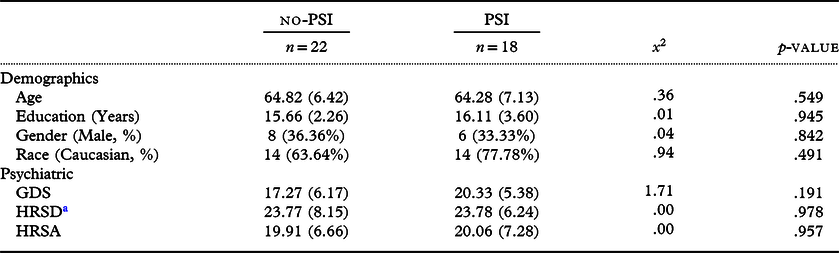
Demographic and psychiatric information are presented in Table 1. A total of 18 (45%) participants reported current PSI by endorsing either “life is not worth living” (n = 14) or “wishes he/she was dead” (n = 4). Among LLD participants without current PSI, one had past ideation (without a plan or intent). None had a previous suicide attempt. Participants were primarily female (65%), were 64.56 + 6.66 years old (range 52–81), had 15.86 + 2.91 years of education (range 11–26), and performed at approximately one-half of standard deviation above age-based D-KEFS population norms for the CWIT and TMT. No significant differences existed between groups on demographic variables (p ≥ .491), or psychiatric symptom severity. Sixteen participants (40%) met criteria for comorbid GAD; though comorbid GAD was more common in the PSI group (n = 11; 50%) compared with the no-PSI group (n = 5; 27.28%), this association was not significant (x 2[1] = 2.04, p = .154).
Demographic and psychiatric characteristics of the sample

Numbers presented are means and standard deviations, with the exception of gender and race, which are frequency and percentage. Degrees of freedom for all comparisons is 1. P-values provided are based on Mann–Whitney U tests for continuous/ordinal variables and Pearson’s χ2 for categorical variables.
Abbreviations: PSI, Passive Suicide Ideation; GDS, Geriatric Depression Scale; HRSD, Hamilton Rating Scale for Depression; HRSA, Hamilton Rating Scale for Anxiety.
a HRSD minus suicide ideation item.
Neurocognitive performance
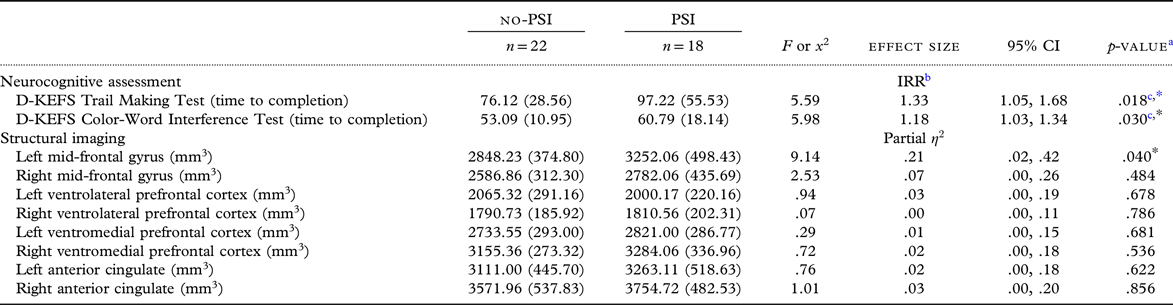
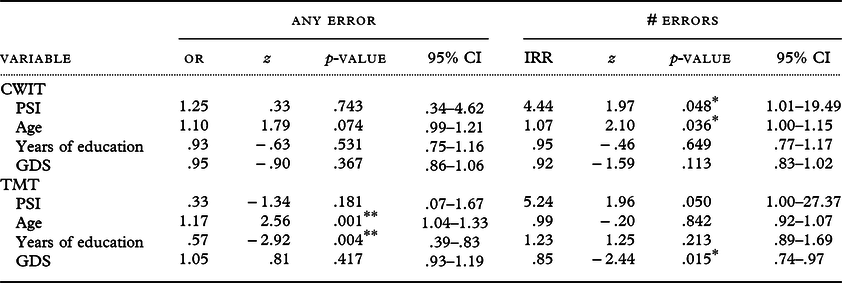
Results are presented in Table 2. As hypothesized, the presence of PSI was associated with worse cognitive flexibility, as measured by longer completion times for the TMT (95% Confidence Intervals [CIs] 5–68% longer) and worse (slower) inhibitory ability on the CWIT (3–34% longer), after adjusting for covariates (age, years of education, and depression). A sensitivity analysis indicated that these effects remained significant even when controlling for the Motor Speed subtest of the TMT (Incident Rate Ratio [IRR] = 1.26, x 2[1] = 4.11, p = .043, 95% CI = 1.01, 1.58) in analyses of TMT number–letter sequencing (cognitive flexibility) and when controlling for Word Reading condition of the CWIT (IRR = 1.18, x 2[1] = 7.46, p = .006, 95% CI = 1.05, 1.33) in analyses of Color-Word condition CWIT (inhibitory ability), meaning that PSI was associated with a 26% and 18% longer completion times even when adjusting for general speed. LLD participants with PSI also made more errors on the TMT than did those without PSI (IRR = 2.20, |z| = 3.31, p = .001, 95% CI = 1.38, 3.49), but there were no significant differences for the number of inhibition errors on the CWIT (IRR = 1.69, |z| = 1.84, p = .065, 95% CI = .97, 2.94; see Table 3). No group differences were observed on other neurocognitive measures, specifically processing speed and attention, verbal fluency, and episodic verbal memory (all p ≥ .145).
Between-group differences on neurocognitive performance and structural neuroimaging

Partial eta-squared and adjusted p-value are based on multivariate models that adjusts for depression severity, age, and years of education. Structural imaging data also adjusted for total intracranial volume. Degrees of freedom for all main effects of PSI is 1.
Abbreviations: PSI, Passive Suicide Ideation; D-KEFS, Delis–Kaplan Executive Function System, IRR, Incident Rate Ratio.
* Significant at p < .05 after False Discovery Rate correction.
a p-value adjusted for False Discovery Rate.
b IRR is the ratio of time to completion between groups. For example, an IRR of 2.00 would indicate that the total time for one group was twice as long as the other group.
c p-value from negative binomial regression.
Error analysis of primary neurocognitive tests

Abbreviations: OR, Odds Ratio; IRR, Incident Rate Ratio; CWIT, Color-Word Interference Test; GDS, Geriatric Depression Scale; TMT, Trail Making Test; PSI, Passive Suicide Ideation.
*p < .05; **p < .01.
Structural neuroimaging
Results are also presented in Table 2. Following covariate adjustment and correction for multiple comparisons via FDR, LLD participants with PSI had larger left MFG than did LLD participants without PSI (partial
 ${{\rm{\eta }}^2}$
= .21, F[1, 39] = 9.27, p = .005, 95% CI = .02, .42). No other group differences were observed for TIV, subcortical gray matter, corpus callosum, cerebral white matter, white matter hyperintensities, and left or right hippocampus (ps ≥ .05), or for other regions that have been implicated in suicidal behaviors, specifically, the left or right caudate, left or right superior temporal gyrus, and left or right amygdala (ps ≥ .05). The one significant brain region, left MFG, was not associated with TMT (cognitive flexibility) or CWIT (inhibitory ability) (all r s ≤ −.12, p ≥ .460).
Discussion
This investigation found evidence for neurocognitive markers of PSI in middle-aged and older adults with depression. Consistent with our hypotheses, the PSI group compared with the no-PSI group had significantly poorer neurocognition in two domains of executive dysfunction: cognitive flexibility and inhibitory ability. These results align with theories about increased suicide risk in depression among individuals who have poor cognitive flexibility (e.g. the cognitive rigidity hypothesis; Neuringer, Reference Neuringer1964; Rickelman and Houfek, Reference Rickelman and Houfek1995; Schotte and Clum, Reference Schotte and Clum1987). Considering our findings in the context of other research that has found differences in cognitive flexibility and inhibitory ability in depression with high suicide risk (e.g. active suicidal ideation, past suicide attempts, and high vs. low lethality attempters; King et al., Reference King, Conwell, Cox, Henderson, Denning and Caine2000; Lai et al., Reference Lai, Tan, Wang, Wu, Wang and Shen2018b; McGirr et al., Reference McGirr, Dombrovski, Butters, Clark and Szanto2012; Richard-Devantoy et al., Reference Richard-Devantoy, Szanto, Butters, Kalkus and Dombrovski2015), these neurocognitive differences likely occur on a continuum, with increasingly poor cognitive flexibility and inhibitory ability associated with the progression from PSI to more active suicidal ideation or behaviors. Notably, differences between the PSI and no-PSI groups for cognitive flexibility included both slower time to completion and more errors, whereas for inhibitory ability only time to completion was significant. Thus, for participants with PSI compared to no-PSI, cognitive flexibility was both more effortful and less accurate, whereas inhibition was more effortful but otherwise intact.
It is noteworthy that group differences between PSI and no-PSI in our study were specific to these two domains of executive dysfunction, rather than reflecting global executive dysfunction or other cognitive differences, based on our findings of no significant group differences on other cognitive measures, including phonemic fluency (i.e. unstructured generativity). It is entirely possible that more expansive or global cognitive problems could be present with increased suicide risk beyond PSI; however, the two focal executive function abilities of cognitive flexibility and inhibitory ability might be most important, particularly given that there are few other differences between ideators and attempters across neurocognitive domains in a recent systematic review (Saffer and Klonsky, Reference Saffer and Klonsky2018). Regardless, our findings with PSI suggests that these two executive function differences in cognitive flexibility and inhibitory ability might represent the earliest signs of an at-risk neurocognitive profile in depression with PSI.
Our study does not support a mechanistic link for structural neuroimaging markers as a biological substrate for neurocognitive dysfunction in PSI, as there was no association between the two. The lack of support for an association between executive dysfunction and regional brain volumes suggests that executive dysfunction and left MFG volume may represent parallel but mechanistically unrelated features of this population. In some psychiatric disorders, smaller structural brain volume in regions implicated in associated-cognitive impairments have been found to precede the development of the disorder (e.g. Gilbertson et al., Reference Gilbertson2002). These preliminary results suggest that the neurocognitive differences associated with having thoughts of death or suicide (PSI) may not have a structural basis. However, given the specificity of the neurocognitive finding, future studies examining functional connectivity might be a fruitful direction for biological moderators of this neurocognitive difference. The medial PFC is associated with the generation and regulation of emotional responses (Etkin et al., Reference Etkin, Egner and Kalisch2011). In contrast to our measures of executive function, which were nonemotional, PFC volumes might have covaried with performance on emotion regulation tasks.
The specificity of the current neurocognitive findings is remarkable given that the PSI and no-PSI groups were nearly identical on demographic and psychiatric measures, e.g. age, gender, years of education, race, depression severity, anxiety severity, and neurocognitive performance in other domains. Our study was not powered to compare neurocognitive performance between MDD/GAD and MDD only, but future studies with a larger sample size would be poised to do so. Our previous work in a nonclinical population of community-dwelling older adults found that worry symptoms attenuate negative associations between anxiety symptom severity or depression symptom severity with a poorer inhibitory ability (Beaudreau et al., Reference Beaudreau, Hantke, Mashal, Gould, Henderson and O’Hara2017). Though speculative, if worry, a core symptom of GAD, potentially attenuates negative neurocognitive associations, it is plausible that older adults with PSI and comorbid MDD/GAD are less impaired on these two neurocognitive domains than PSI and MDD without comorbid GAD. Future studies with a larger sample of older adults with MDD would be poised to determine if this association is moderated by the presence of comorbid GAD. This would also suggest that the neurocognitive profiles of PSI could potentially vary depending on psychiatric comorbidity that is present in addition to depression in middle-aged and older adults.
Clinically, worse inhibition may translate to difficulty suppressing cognitions (e.g. negative thoughts), and poorer cognitive flexibility may translate to difficulties in set-shifting (e.g. inflexibility in thinking). Based on this interpretation, the current results implicate inhibition and cognitive flexibility as potential neurocognitive targets for late-life suicide prevention. Consistent with this interpretation, previous studies have found that cognitive deficits predicted a greater likelihood of treatment response (Beaudreau et al., Reference Beaudreau, Rideaux, O’Hara and Arean2015; Goodkind et al., Reference Goodkind2016). However, the role of executive dysfunction in treatment response is variable, as one study found that depressed older adults with poor inhibitory control exhibited less reduction in suicidal ideation following antidepressant treatment compared to those without cognitive deficits (Kasckow et al., Reference Kasckow2016). It is also important to note that executive dysfunction may serve as a protective factor for some older adults, in that individuals with severely impaired executive function may be unable to develop and execute a suicide plan. These seemingly inconsistent previous findings may be resolved by assuming a quadratic relationship between executive dysfunction and suicide risk, such that risk increases up to a certain level of cognitive impairment, then decreases (Lutz and Fiske, Reference Lutz and Fiske2018).
The current study has several limitations and suggested future directions for research. First, not all participants with PSI may have disclosed it during the assessment. Binary classifications of PSI such as that employed here are less nuanced than more formal, continuous measurements of suicide risk, such as the Geriatric Suicide Ideation Scale (Heisel and Flett, Reference Heisel and Flett2006). Second, overlapping domains of executive function implicated in suicide risk, such as planning and decision-making (e.g. the Tower Test, Iowa Gambling Task), were not assessed; their inclusion in future studies could expand our understanding of neurocognitive risk in PSI. Third, our relatively small sample size may have precluded us from detecting smaller associations between cognitive flexibility or inhibitory ability and left MFG. We also did not have sufficient power to detect an indirect effect of regional brain volumes between executive function and PSI. Fourth, we did not measure functional brain activation, which could have provided greater clarity regarding the impact of our regional brain volumetric measures at a functional level. Regarding future directions, our finding of volumetric abnormality of a larger left MFG in middle-aged and older adults with depression and PSI is inconsistent with previous neuroimaging investigations, which have found smaller MFG in young- to middle-aged adult attempters and active ideators (Hwang et al., Reference Hwang2010; Jollant et al., Reference Jollant, Lawrence, Olié, Guillaume and Courtet2011). Future studies are needed to determine if the current structural findings are replicable to support a distinct volumetric profile in early-stage suicide risk.
Overall, these findings expand upon previous research of higher risk suicidal thoughts and behaviors, by demonstrating that PSI is also associated with neurocognitive dysfunction. In line with previous findings linking PSI to the development of active SI and suicide attempts (Barry et al., Reference Barry, Wakefield, Trestman and Conwell2016; Szanto et al., Reference Szanto1996), these findings add to previous research suggesting that PSI should be taken seriously, with the current study providing some of the first evidence that it is associated with neurocognitive features that may be prodromal to suicide attempts.
Conflict of interest
None.
Source of funding
This study was funded by NIMH R01 MH091342-05 (PI: Dr. Ruth O’Hara).
Description of authors’ roles
All the authors critically reviewed and approved the manuscript. JTJ formulated the research question, analyzed the data, and prepared the manuscript. IC, RK, and SP recruited, assessed, and collected data from participants. CFC, CER, NH, CEG, JL, MK, and MB assisted with writing the manuscript. KS analyzed the structural neuroimaging data. ROH funded the study, was involved in formulation of the research question, and assisted with writing the manuscript. SAB assisted with writing and revising the manuscript.
Acknowledgments
This work was supported in part by the Department of Veterans Affairs Sierra-Pacific Mental Illness Research, Education, Clinical Center (MIRECC). Dr. Gould is supported by the U.S. Department of Veterans Affairs (IK2 RX001478). Dr. Kawai is supported by the National Institute on Aging of the National Institutes of Health K23AG053465. His contribution to this manuscript was made possible by an award from the American Sleep Medicine Foundation (#157-BS-16), a foundation of the American Academy of Sleep Medicine, and his project is supported in part by the 2018 NARSAD Young Investigator Grant (#27430) from the Brain & Behavior Research Foundation. Dr. Keith Sudheimer received support from the National Institutes of Health (K01 MH108705) and is a named inventor on a provisional patent for improved transcranial magnetic stimulation systems and methods. Views expressed in this paper are those of the authors and are not necessarily those of the Department of Veterans Affairs or the Federal Government.