

Introduction
Administering sodium bicarbonate or other alkalinizing agents via a nasogastric tube prior to a competition is a well-known (and illegal) abuse of the buffering capabilities of these compounds. This practice, referred to as ‘milkshaking’, is a threat to the health and welfare of the horse as well as to the integrity of the entire racing industryReference Rose and Lloyd1, Reference Roelofson and Short2. To counter this threat, many racing jurisdictions measure total plasma carbon dioxide (tCO2) concentrations.
Plasma tCO2 concentration is an important physiological factor that is controlled so as to ensure the tight regulation of blood pHReference Lloyd, Reilly, Rose and Short3–Reference Szucsik, Balaskonis and McKeever5. Animals transport >90–95% of all CO2 produced in metabolically active tissue to the lungs in the form of carbonic acid, which rapidly dissociates to bicarbonate and hydrogen ions in the presence of an aqueous environment. This renders tCO2 an effective and reliable measure of bicarbonate concentration within blood plasmaReference Lloyd, Reilly, Rose and Short3–Reference Szucsik, Balaskonis and McKeever5. Multiple investigations have reported ~30 mMol l− 1 to be the average plasma tCO2 concentration for racing horsesReference Rose and Lloyd1–Reference Irvine and Short9. Thus, most racing jurisdictions have set the threshold for a positive test at 37 mMol l− 1 to avoid false positivesReference Rose and Lloyd1–Reference Irvine and Short9, which is approximately four standard deviations from the mean.
One area of controversy arises when one compares the data obtained from populations of very fit racehorses with those obtained from the unfit horses used at many research institutions. Training can affect the buffering capacity of humansReference McKenna, Heigenhauser, McKelvie, MacDougall and Jones10. Regrettably, no information has been published on the effect of training on plasma tCO2 concentrations in normal horses. Another area of concern in New Jersey and elsewhere has been the effect of the limited amount of exercise performed by horses during quarantine. Some horse owners have suggested that the limited exercise and stall rest associated with a few days of quarantine may have an effect on plasma tCO2 concentrations. Strong speculation regarding this issue has been made in court cases11. Unfortunately, as with the effect of training, there have been no horizontally collected data published in the scientific literature to support or rebuke this speculation. Therefore, the purpose of this study was to test the hypothesis that training and short-term cessation of training would alter tCO2 concentrations in Standardbred horses.
Materials and methods
All the methods and procedures used in this experiment were reviewed and approved by the Rutgers University Institutional Review Board for the Care and Use of Animals. Twenty-seven mature Standardbred mares (9–27 years, ~522 kg) were used in this experiment. Resting plasma tCO2 concentrations were measured on two occasions in the same ten unfit mares used in two separate studiesReference Szucsik, Balaskonis and McKeever5, Reference Balaskonis, Szucsik, Lehnhard and McKeever12 that were conducted 1 month apart. These two studies were conducted at the same time during which another experiment, with the objective to examine the effect of training and ageing on a variety of parameters, was in progressReference Malinowski, Shock, Roegner, Rochelle, Kearns and Guirnalda13. The analysis of plasma tCO2 concentrations in the samples that were collected from the later study revealed that there was no effect of age, so all data are included in the present paper; therefore, data obtained from all three experiments and from both groups of horses were utilized in the present analysis. All mares were housed in groups on 2–3-acre dry lots, and were fed approximately 12 kg of mixed alfalfa-grass hay divided into two feedings per 24 h period. During the detraining period, the 17 horses that were part of the training study were housed in 5 × 5 m stalls, and were fed the same hay ration. Water and trace-mineral blocks were available ad libitum.
Blood samples and analysis
Blood samples (20 ml) were obtained from the unfit horses via jugular venipuncture while they stood quietly prior to dosing and feedingReference Szucsik, Balaskonis and McKeever5, Reference Balaskonis, Szucsik, Lehnhard and McKeever12. Samples (20 ml) were collected from the trained maresReference Malinowski, Shock, Roegner, Rochelle, Kearns and Guirnalda13 prior to their last session of 12 weeks of training at 60% HRmax. Following the completion of their last exercise session, the trained mares were placed in stalls, and a second set of samples was collected on the third day following 2 days of ‘detraining’ that was used as simulated quarantine. Samples were collected using an 18-gauge needle and two tubes (Vacutainer; Becton Dickinson, Parsippany, NJ, USA) containing lithium heparin. These samples were placed in crushed ice for analysis later in the day. Each tube was spun in a refrigerated centrifuge (TJA-6; Beckman-Coulter, Fullerton, CA, USA) at a rate of 1500 × g and at a temperature of 4°C for a period of 10 min. The plasma fraction was then decanted and analysed in duplicate using an ion-sensitive electrolyte analyser (Synchron EL-ISE; Beckman-Coulter) to determine the tCO2 concentrations.
Statistical analysis
The data were analysed using t-tests with the a priori level of statistical significance set at P < 0.05 (Sigma Stat 2.0; SPSS, Inc., Chicago, IL, USA).
Results and discussion
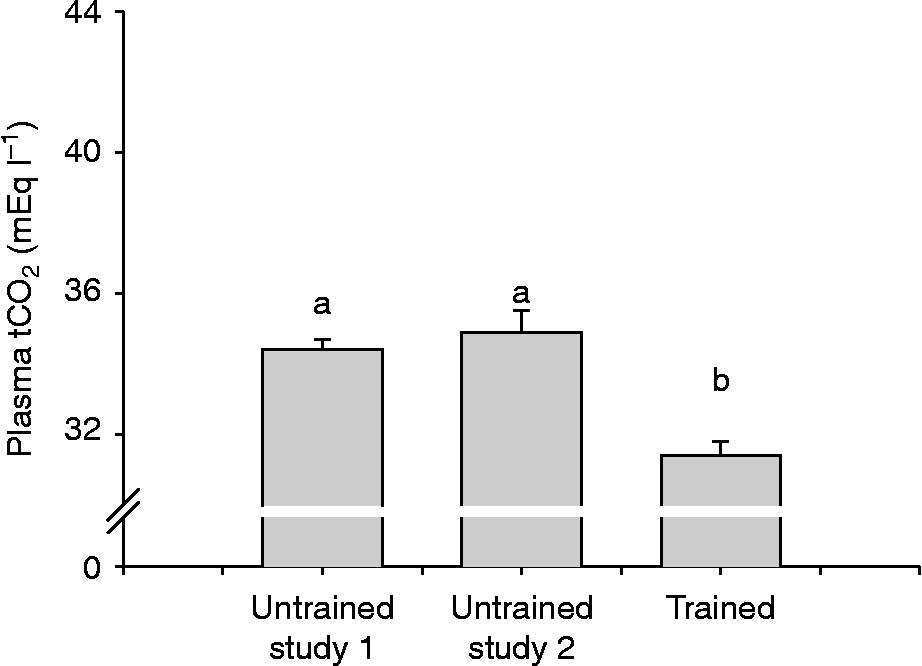
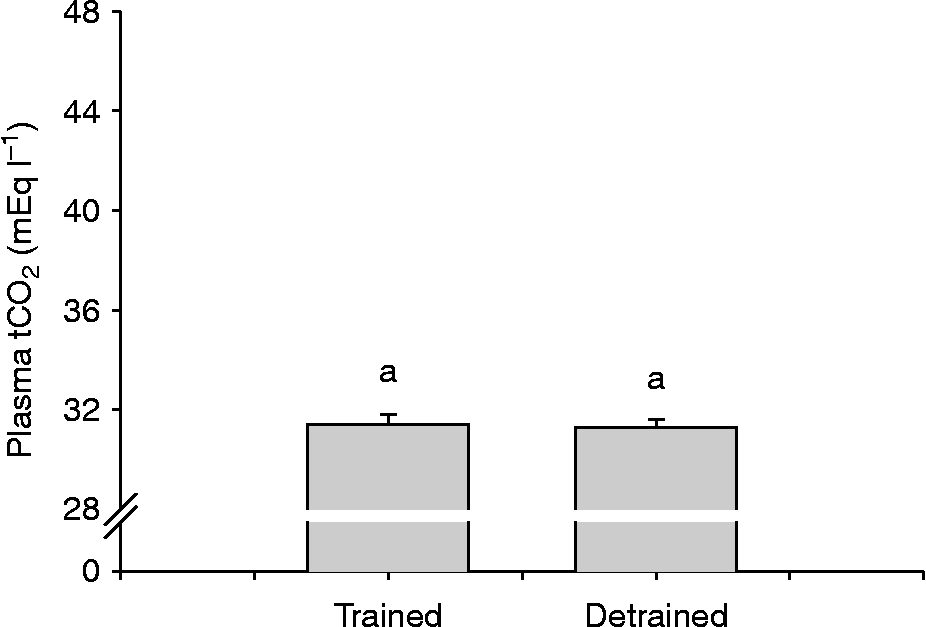
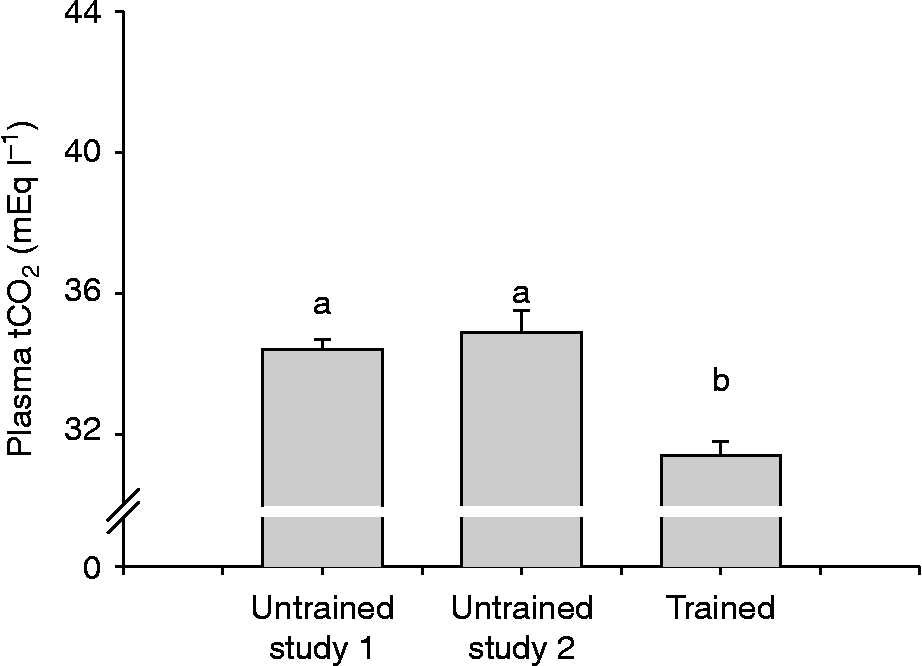
The results presented in the figures are expressed as means ± standard error. Training had an effect (P < 0.05) on resting plasma tCO2 concentrations, with lower values being present in the trained horses (31.4 ± 1.9 mMol l− 1) than in the untrained horses (34.4 ± 0.9 mMol l− 1). There were no effects (P>0.05) due to cessation of training (Figs 1 and 2). Thus, a major finding of the present study was that there was a substantial decrease in plasma tCO2 concentrations with training that was not reversed by short-term cessation of training. This finding is important for two reasons. Many published studies of management and other factors affecting plasma tCO2 concentrations have been done by universities where unfit horses that were part of a research teaching and research herd were utilizedReference Ciolino, Lehnhard and McKeever14–Reference Kauffman, Kline, Forman and Lyman16. While these populations are appropriate for testing the effects of various factors on plasma tCO2 concentrations, the present study has demonstrated that even moderate training affects resting plasma tCO2 concentrations. As with humansReference McKenna, Heigenhauser, McKelvie, MacDougall and Jones10, higher-intensity conditioning appears to lower resting plasma tCO2 concentrations further towards the concentrations observed in fit racehorses (Dr Ric Birks, 2002, personal communication, University of Pennsylvania). Thus, it would be inappropriate to make a simple comparison of unfit horses with the population of fit racehorses to attempt to challenge the resting values obtained from tightly controlled studiesReference Lloyd, Reilly, Rose and Short3, Reference Auer, Skelton, Tay and Badlock6, Reference Lorimer8, Reference Irvine and Short9 of populations of racehorses.
Mean ± SE plasma tCO2 concentration measured in untrained horses (n = 10) on two occasions and in trained horses (n = 17) following 12 weeks of moderate-endurance exercise training. Means with different letters are different (P < 0.05)
Mean ± SE plasma tCO2 concentration measured in horses (n = 17) at rest before their last training session following 12 weeks of moderate-endurance exercise training and on the third day following 2 days of detraining (simulated quarantine). Means with different letters are different (P < 0.05)
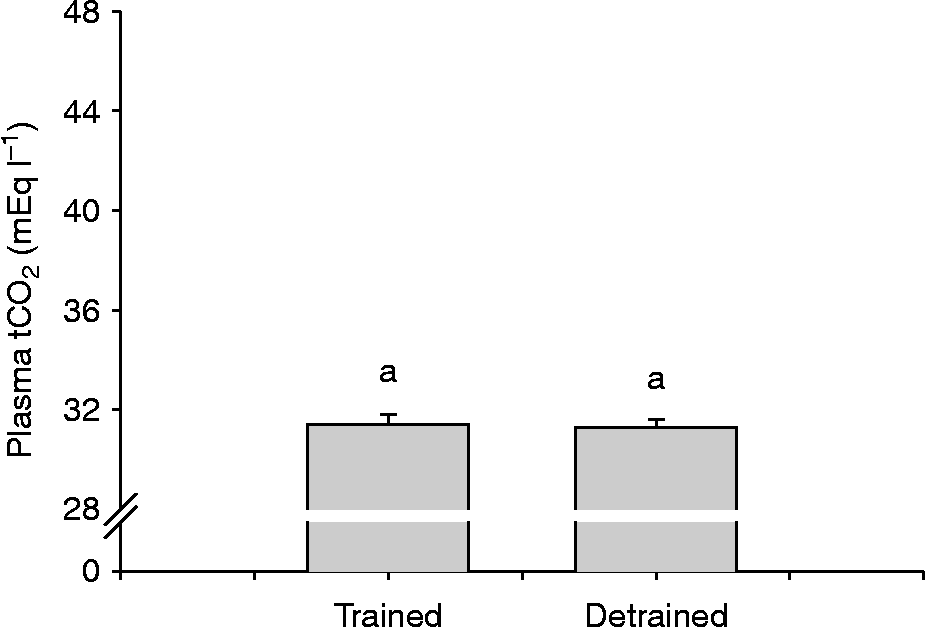
Another major finding of the present study was that detraining for a short period analogous to the quarantine period used in many racing jurisdictions does not affect plasma tCO2 concentrations. In theory and practice, these jurisdictions offer a short quarantine period to allow a trainer to demonstrate that a horse that exceeds the posted threshold has done so because it had a naturally high plasma tCO2 concentration. One issue that has been raised regarding the quarantine period has been that the lack of exercise or ‘detraining’ could potentially affect plasma tCO2 concentrations. The present study has demonstrated that there is no effect of limited cessation of training on plasma tCO2 concentrations.
Acknowledgements
The authors thank the undergraduates enrolled in Research Problems in Animal Science as well as the graduate students and equine care staff for their assistance with data collection and the exercise testing; Jennifer McKeever for conducting the lactate measurements and for her help in the preparation of the manuscript; and Philip Lorimer and the NJ State Police Meadowlands Equine Drug Detection Laboratory for technical support. The research support was provided by a grant from the New Jersey State Strategic Initiative on Equine and the New Jersey Agricultural Experiment Station. Conflict of interest. None of the authors of this paper has a financial or personal relationship with other people or organizations that could inappropriately influence or bias the content of the paper.