





1. Polar science and outreach opportunities
The polar (Arctic and Antarctic) regions play an integral part in regulating the world’s climate, yet are highly vulnerable to the impacts of global warming (IASC 2024). The impacts of climate change span physical, biological and social repercussions, including increases in the prevalence of extreme events, depleting sea and land ice, melting permafrost, Arctic greening, greenhouse gas emissions, sinking roads and infrastructure, and changes within fishing and shipping polices (IPCC, 2023). There is a growing interest to understand, monitor, protect and capitalise (such as through tourism and fisheries, e.g. Jørgensen and others, Reference Jørgensen, Bakke and Hoel2020; Shijin and others, Reference Shijin, Yaqiong, Xueyan and Jia2020; Hanaček and others, Reference Hanaček, Kröger, Scheidel, Rojas and Martinez-Alier2022; Stoeckl and others, Reference Stoeckl2024) the polar regions (Haward and Jackson, Reference Haward and Jackson2023; IASC 2024; European Parliament News, 2025; UK Defence Research Briefing, 2026). In order to protect, restore and sustainably develop these areas, an educated public and work force is required, with scientists, policymakers, journalists, agriculturists, businesses, industries, which understand the link between the polar regions and global climate, ecosystems, biodiversity, food security, and geopolitical and economic stability (Shabudin and others, Reference Shabudin, Rahim and Ng2016; IPCC, 2023). Scientific focus on polar regions has been bolstered by initiatives such as polar research groups, research station networks, the Antarctic Treaty (1959) and the International Polar Year (IPY, previously called International Geophysical Year, held in 1882–83, 1932–33, 1957–58 and 2007–08, with the next planned event in 2032–33). The IPY 2007–08 facilitated an increase in education, outreach and communication initiatives across the polar research community, with the purpose to attract, engage and develop a new generation of polar researchers, engineers and logistics experts, and engage the awareness, interest and understanding of the purpose and value of polar research and monitoring to school students, the general public and decision-makers (Rapley and others, Reference Rapley2004; National Research Council, 2012; Salmon and Priestley, Reference Salmon and Priestley2019). With preparations for the upcoming IPY 2032–33 already commencing and growing UK governmental interest in the Polar Regions, e.g. the UK’s Arctic policy framework ‘Looking North: The UK and the Arctic’ (Foreign, Commonwealth & Development Office (FCDC), 2023) and UK Government Research Briefing on Greenland (2025) and Environmental Audit Committee (2025) report on Antarctica, there is opportunity to increase education, outreach and communication efforts to improve public understanding of our polar regions and expand on the inclusion of sustainability and climate change in the UK national curriculum (Department of Education, 2023). This also presents a critical time to attract a new diverse generation of talented physical, biological and social polar scientists.
1.1. Current diversity in scientific research communities
Diversity covers characteristics such as age, disability, ethnicity, gender, religion, sexual orientation and socioeconomic status (Office for National Statistics, 2023; GOV.UK, 2024). Research has shown that increased diversity can benefit scientific advancements through expanding perspectives and approaches to problem solving (Medin and Lee, Reference Medin and Lee2012; Bernard and Cooperdock, Reference Bernard and Cooperdock2018). However, there is a known global lack of diversity in environmental science disciplines. For example, The Reuters Hot List (2021) identified the world’s top 1000 climate scientists, of which 122 were female, and Carbon Brief (2021) found that for 100 highly cited climate science papers published in the past 5 years, <1% of authors were based in Africa and 12 papers had female lead authors. Gender inequality in environmental science disciplines has been recognised for decades, e.g. Bell and others (Reference Bell, Kastens, Cane, Miller, Mutter and Pfirman2003), Rosner (Reference Rosner2009) and Hulbe and others (Reference Hulbe, Wang and Ommanney2010). There is some indication that the gender gap has decreased among early career researchers in the field of glaciology (Hulbe and others, Reference Hulbe, Wang and Ommanney2010; Koenig and others, Reference Koenig, Hulbe, Bell and Lampkin2016); however, other characteristics of diversity continue to have poor representation (e.g. Griffiths and others, Reference Griffiths2021; Lawrence and Escobedo, Reference Lawrence and Escobedo2023; Robel and others, Reference Robel, Ultee, Ranganathan and Nash2024). In the UK, recent analysis of the British Antarctic Survey (BAS) workforce in 2019 found that approximately 31% of staff identified as female, 3% as BAME (Black, Asian and Minority Ethnic), 2% as LGBTQ+ (Lesbian, Gay, Bisexual, Transgender, Queer or Questioning, and others) and 1.8% as having a disability; all lower than the overall UK society percentages (British Antarctic Survey (BAS), 2019). Such statistics are difficult to find and quantify for Arctic-focused or non-glaciology polar sciences. However, BAS, as a case study of UK polar scientists, suggests further work is required to improve UK polar science diversity.
Improving diversity in UK polar science requires investment in people (Bentley and others, Reference Bentley2021). Many research funders have started to invest in diversity projects, such as The Royal Society Inspiring Scientists: Diversity in British Science project and the Natural Environment Research Council’s diversity and inclusion living action plan (NERC, 2022). Papers are being published on the current status of equality, diversity and inclusion (EDI) initiatives in research (Bencivenga and others, Reference Bencivenga, Leone and Siri2021) and how to improve EDI in research and funding (Fisher and others, Reference Fisher2024; Nicola and others, Reference Nicola2025). Such actions can help improve the present research environment; however, to ensure that future research is fully inclusive, it is imperative to encourage grassroots participation and engagement with science subjects (Brzozowy and others, Reference Brzozowy2017; Chtena and others, Reference Chtena2025). Collectively these papers indicate that to increase the number of underrepresented groups in environmental and polar sciences at undergraduate level, there needs to be increased involvement and exposure to these topics earlier in the education system, such as secondary school, demonstrating potential career paths and encouraging students to pursue further education in these areas. Further barriers exist for students from low-income or disadvantaged backgrounds who are more likely to experience barriers in accessing and completing tertiary education, often linked to earlier educational experiences (Burney and Beilke, Reference Burney and Beilke2008; Ní Chorcora and others, Reference Ní Chorcora, Bray and Banks2023). Additionally, such students are less likely to have access to natural environments or international field trips which can be inspiring for sciences (Waite and others, Reference Waite, Husain, Scandone, Forsyth and Piggott2023; Weale, Reference Weale2025). Such barriers are not limited to polar sciences; however, through recognising these issues, the polar science community can work to remove them. Here, we aim to evaluate the effectiveness and reception of targeting schools with a high representation of students from low-income or disadvantaged backgrounds for polar science outreach events, through analysing two ‘Exploring Polar Environments’ events organised in the South East and North East of England for schools with high proportions of students with diverse backgrounds.
1.2. Targeting outreach events to improve diversity
Targeted outreach events have the potential to provide valuable, positive educational experiences and exposure to potential career paths, encouraging or inspiring students to pursue further education in disciplines they may not otherwise have considered. Studies show outreach programmes focusing on widening participation have already had success in increasing educational aspirations (Renbarger and Long, Reference Renbarger and Long2019; Ní Chorcora and others, Reference Ní Chorcora, Bray and Banks2023). For a career as a polar scientist, the most common pathway is to study a relevant discipline at university; therefore, introducing students to potential university options is an important step. Statistics published by the Universities and Colleges Admissions Service (UCAS, 2024) indicate a recent increase in the number of UK 18 year olds from low participation neighbourhoods (Participation of Local Areas (POLAR4) Quintile 1) accepted to study a full-time undergraduate degree through UCAS (23.5% in 2024, compared to 17.5% on 2015). There was also an increase in the number of 18 year olds who were in receipt of free school meals (FSM) when they were aged 15 years old accepted to study a full-time undergraduate degree through UCAS (19.9% in 2024, compared to 16.3% on 2015). While UK national statistics regarding the diversity of students attending university have improved in general, entry rates for students from the lowest participation areas (POLAR4 Quintile 1, 23.3%) and receiving FSM (20%) remain below national entry rates (England 37%, Northern Ireland 38%, Scotland 30%, Wales 29%) (UK Government Research Briefing, 2026). Entry rates for students in the South East of England are 39% and in the North East of England are 30%, compared to London at 51% (UK Government Research Briefing, 2025). Particularly, the average number of students attending university from the North East is below the UK long-term average (Department for Education, 2024), and the North East has an above average number of students receiving FSM (Schools North East, 2025). These statistics demonstrate a lack of opportunity in the wider educational landscape, hindering progress in improving (socioeconomic and ethnic) diversity in science. Therefore, outreach events targeted at students from such backgrounds have the capacity to improve student opportunities, remove barriers and improve education aspirations, notwithstanding the UK socioeconomic educational gap.
2. Case study: Exploring Polar Environments
2.1. Summary of the events
Two ‘Exploring Polar Environments’ events were organised and hosted by the authors of this paper: the first at Royal Holloway University of London, June 2022 (Jenkins and others, Reference Jenkins, Davies, Dodds and Lea2022), and the second at Newcastle University and The Great North Museum: Hancock, in collaboration with Durham University, University of Northumbria and UK Centre for Polar Observation and Modelling in November 2023 (Mayfield, Reference Mayfield2024). Both events were designed to promote greater diversity in polar sciences by targeting students from local schools with high proportions of students from BAME backgrounds and receiving FSM to listen to, meet, and interact with polar scientists and undertake hands-on research activities.
The events hosted panel discussions on experiences and careers in polar and environmental sciences, with speakers selected to represent a range of backgrounds (female, LGBTQ+ community, people of colour, different socioeconomic backgrounds, including accessing wider participation schemes to attend university and growing up in an Arctic community). The panellists shared their achievements and challenges in their careers and field expeditions. The 2022 event hosted computing sessions for students to explore Antarctic StoryMaps (available from AntarcticGlaciers.org), and the 2023 event hosted an interactive science exhibition in collaboration with The Great North Museum: Hancock (Table 1). Specific local schools from the South East and North East of England with diverse or disadvantaged cohorts were invited to the events, particularly schools with the highest proportion of students from BAME backgrounds and >50% students receiving FSM. Year groups were selected to target students at a stage where they make pivotal decisions about their future educational journeys, e.g. choosing UK Key Stage 4 (ages 14–16) and 5 (ages 16–18) qualification pathways.
Overview of the ‘Exploring Polar Environments’ events, more details can be found from Jenkins and others (Reference Jenkins, Davies, Dodds and Lea2022) and Mayfield (Reference Mayfield2024).

2.2. Feedback on the events
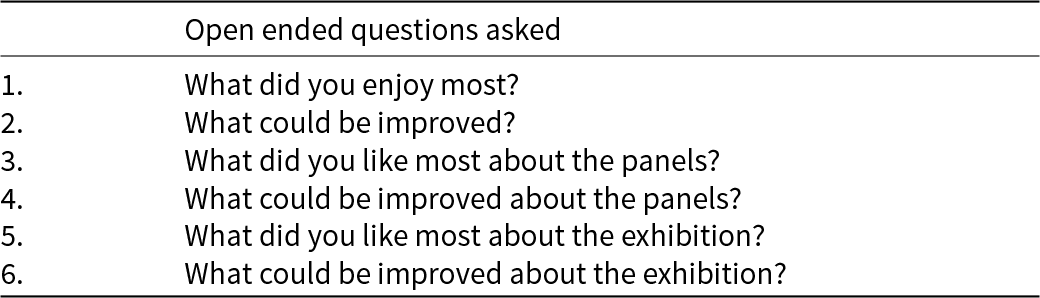
Both ‘Exploring Polar Environments’ events were evaluated by the organisers using a feedback survey with a mix of yes/no, Likert scale (1–5) and open-ended questions to discover what school groups enjoyed, learnt, and thought could be improved about their experience at the events (Table 2). Open-ended questions on the panels and exhibition were asked on the 2023 feedback sheets. Additionally, for the 2023 event, a complementary qualitative evaluation was carried out by colleagues from the Newcastle University Inclusive Newcastle Knowledge Centre (INKC, established to mitigate barriers to equity and support a collaborative approach to Inclusive Education). Feedback was collected anonymously. The feedback was originally collected for quality improvement and is presented here as an evaluation activity to reflect on the successes and challenges of the events. Formal ethical approval from Newcastle University is not required for evaluation activities for internally funded and low risk activities (i.e. not sensitive topics nor working with animals) (Research Policy, Intelligence and Ethics Team, Newcastle University, 2025). Evaluation methods are short term, measuring the school student and schoolteacher experiences of the events.
Open ended questions asked in the school feedback surveys.

Overall, the feedback was positive, indicating the school groups enjoyed the experience. For the 2022 event, 92% of school students enjoyed the panels (4 & 5 out of 5 on a Likert scale) and 82% enjoyed the Antarctic StoryMaps (4 & 5 out of 5). For the 2023 event, 28% of students rated the day as ‘just right’ (3 out of 5), and 64% rated the day more positively (4 & 5 out of 5). There were a wide range of ‘favourite’ aspects of the day (Fig. 1a), with students enjoying all aspects of the events (exhibition and StoryMap activities; geopolitics, careers and science talks/panels; and university tours). For the 2022 event, key areas for improvement identified by the feedback were increasing the interactive activities (22 comments, 64.7% of responses) and variety of science disciplines explored (4 comments, 11.8% of responses). For the 2023 event, the school groups did not like the catering provided (33 comments, 24.3% of responses). Feedback for both events indicated a need to improve the panel sessions (2022—4 comments, 11.8% of responses; 2023—17 comments, 12.5% of responses) (Fig. 1b).
Summary feedback for the questions ‘What did you enjoy the most?’ (a) and ‘What could be improved?’ (b). Eighty-nine feedback responses were received for the 2022 event, providing 116 comments to the question ‘What did you enjoy the most?’ and 34 comments to the question ‘What could be improved?’ One hundred and fifty-two feedback responses were received for the 2023 event, providing 173 comments to the question ‘What did you enjoy the most?’ and 136 comments to the question ‘What could be improved?’ Blank responses were not included.

Feedback from the schoolteachers indicated that they all enjoyed the event (all gave 4 & 5 out of 5 to the question ‘How much did you enjoy the day?’). Specific comments indicated that the teachers had a wide variety of favourite aspects, including the exhibition, interactive activities and hearing about the career pathways and fieldwork experiences. Two teachers wrote comments for improvement suggesting the incorporation of links between the research demonstrated and science taught within schools.
For the 2023 event, all volunteers were also given the opportunity to provide feedback on their experience; 13 volunteers responded (2 PhD students, 5 postdoctoral researchers, 6 academic staff). All respondents (100%) enjoyed the event, thought such outreach events are a good idea, thought volunteering helped build a more supportive and inclusive research culture, and said they would take part in future events. Open-ended questions provided more detailed answers, indicating that volunteers felt the event helped to develop their skills in science communication and leading interactive activities; improved their knowledge about career pathways, science and EDI; and provided a beneficial networking opportunity with academics, museum staff and schoolteachers.
2.2.1. Event location feedback
The ‘Exploring Polar Environments’ events were hosted at universities and an associated museum, taking school students to an external environment. Feedback from INKC identified a heightened enjoyment from the day through comparisons with school; for example, two students commented it was more interactive than school, and several commented they learnt greater detail (‘they go into more detail than school’). Only one student equated enjoying the day with missing a day of school.
The 2023 event was co-hosted with The Great North Museum: Hancock, Newcastle University’s museum of natural history, archaeology, geology and world cultures. The school feedback indicated that the exhibition (68 comments, 39.3%) and museum (27 comments, 15.6%) were the most popular aspects of the 2023 event. Feedback from INKC recorded specific comments by 17 students on their enjoyment of the museum; several students described it as ‘amazing’, and others specified what they enjoyed, e.g. ‘the museum was cool: whales have big teeth!’ It is unknown whether the students who wrote the museum as their favourite part were referring to the exhibition which was located in the museum or the museum itself. As the whale was not part of the organised event, rather in the main museum hall, this indicates that students did venture into the museum exhibits.
While organised with and hosted at universities, the ‘Exploring Polar Environments’ events were specifically designed to not be recruitment events. However, there were stalls at the 2023 event to allow students to ask about university level geography courses at the three North East universities (Newcastle, Northumbria and Durham) and representation from the Newcastle widening participation team. Feedback from INKC indicated that the students did not associate the event with university or higher education, although one student chose to write on their feedback sheet, ‘you’ll be seeing me at Northumbria Uni in about 6 years’. The university tours were mentioned as ‘favourites’ by 5 students from the 2022 event and 13 students from the 2023 event.
2.2.2. Diversity of science at the events
The ‘Exploring Polar Environments’ 2022 event focused on geopolitics and glaciology in the polar regions. Nineteen students (16.4% of responses) mentioned that learning about geopolitics was their favourite part, with fifteen students (12.9% of responses) listing the glaciology aspects as their favourite. Feedback on improving the 2022 event focused on more interactivity (22 students, 64.7% of responses), more variety (4 students, 11.8% of responses) and improving the panels (4 students, 11.8% of responses).
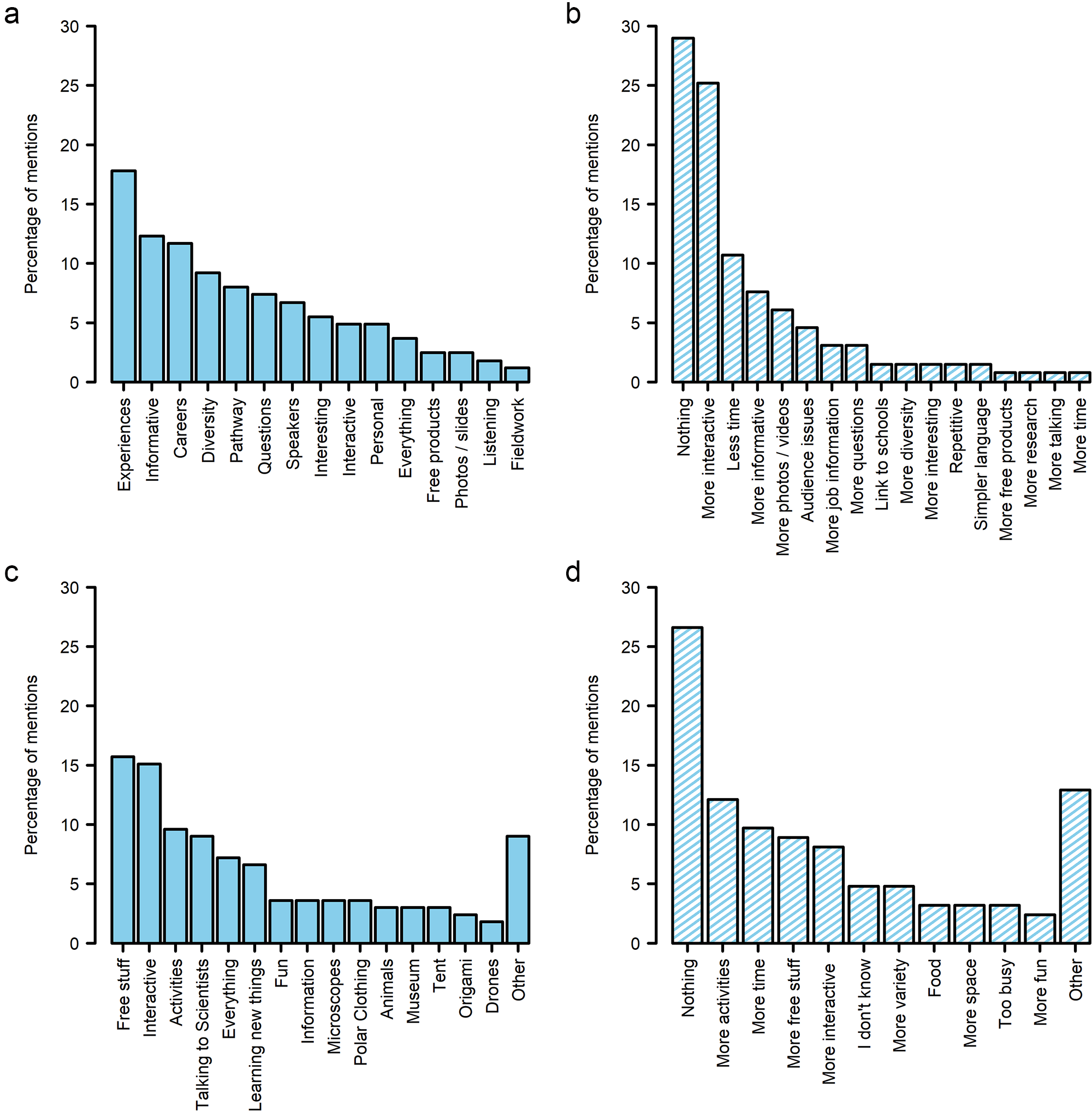
The ‘Exploring Polar Environments’ 2023 event panels and exhibitions were designed to promote the diversity of research and careers within polar sciences and increase interactivity. Fifteen students (9.2% of responses) indicated that they liked the diversity presented in the career and fieldwork panels (Fig. 2a), while two students (1.5% of responses) thought more diversity was needed (Fig. 2b). Eight students (4.9% of responses) enjoyed the interactivity of the panels, while thirty-three students (25.2% of responses) thought more interactivity was needed. Feedback on the exhibition did not specifically mention diversity; however, 34 students (20.5% of responses) listed their favourite activity (microscopes, field clothing, animals, tent, origamis and drones), while 12 students (7.2% of responses) wrote ‘everything’ (Fig. 2c). Twenty-five students (15.1% of responses) commented on the interactivity of the exhibition and sixteen students (9.6% of responses) wrote ‘activities’ in their response to ‘What did you like most about the exhibition?’ To improve the exhibition, 61 students (49.2% of responses) commented on the need for ‘more’, e.g. 15 students (12.1%) wrote ‘more activities’ and 10 students (8.1% of responses) wanted more interactivity (Fig. 2d).
Summary feedback for the questions ‘What did you like most about the panels?’ (163 comments) (a), ‘What could be improved about the panels?’ (131 comments) (b), ‘What did you like most about the Exhibition?’ (166 comments) (c) and ‘What could be improved about the exhibition?’ (124 comments) (d) for the 2023 ‘Exploring Polar Environments’ event. Blank responses were not included.

2.2.3. Volunteer feedback on the event
Volunteers who provided feedback on the 2023 event indicated their enjoyment of the day; all responded ‘yes’ to the question ‘Did you enjoy it?’ Many volunteers commented that the day was ‘good fun’ and they ‘really enjoyed’ it. Written comments indicated volunteers were ‘excited to share research’ and enjoyed giving ‘back to the community’ and the ‘opportunity to engage with school children and their teachers’. PhD student volunteers commented they ‘gained the confidence to communicate’ and they learnt about other people’s research and how to ‘translate that to activities for younger audiences’. More senior academic volunteers commented on their enjoyment of day, including expanding their outreach experiences. One senior volunteer commented in their feedback that outreach events are a ‘huge time and resource “sink”’. Of the 13 respondents, 12 said they would want to be involved in a second ‘Exploring Polar Environments’ event, with 1 volunteer writing ‘potentially’ with the reason of ‘time constraints’. Volunteers who attended both events commented on their enjoyment of both events.
Seven of the volunteers provided comments on improvements for future events. Five of these related to time, i.e. more time for the sessions, time for the volunteers to explore the event themselves or the volunteers not being able to dedicate the whole day to the event due to other work commitments; one volunteer suggested having shorter sessions. Other comments included making future panels more engaging and interactive (from a panellist), pushing a recruitment angle to event (one suggestion) and one volunteer identified hosting the event jointly at the museum and university as a negative.
3. Evaluation of successes and areas for improvements from the ‘Exploring Polar Environments’ events
The purpose of the ‘Exploring Polar Environments’ events was to introduce students from schools with high proportions of BAME backgrounds and FSM recipients to polar science and associated career pathways. Feedback on the ‘Exploring Polar Environments’ events was primarily positive, indicating the participants found the days enjoyable and educational. The feedback also provides an opportunity to reflect on the successes and challenges of the events and identify areas for improvement.
The 2023 ‘Exploring Polar Environments’ built upon the success and lessons learnt from the 2022 event. Organisers Jenkins and others (Reference Jenkins, Davies, Dodds and Lea2022) identified the importance of developing close working relations with schools and their teachers and maintaining contact in the run up to the event to sustain engagement. This was implemented in the organisation of the 2023 event; however, it was met with challenges due to schoolteachers having limited time to interact and respond to organisers, and unexpected events causing two schools to withdraw from the event with days’ notice. Other feedback from the 2022 event indicated the desire for more interactive activities. The interactive exhibition at the 2023 event was designed to address this. The exhibition was a clear favourite of the students, demonstrating this was successful; however, some students still indicated a desire for more interactive activities in their feedback. In this section, we reflect on the combined successes and areas for improvement from both ‘Exploring Polar Environments’ events.
3.1. Hosting the events at universities and associated museums
The ‘Exploring Polar Environments’ events were hosted at universities and an associated museum, taking school students to an external environment. Out-of-school events can have many benefits, such as promoting authentic learning environments (Herrington and others, Reference Herrington, Reeves and Oliver2014), separating learning from pressure to produce formal outputs or grades (Suter, Reference Suter2016) and enabling students to have greater autonomy in their learning (Rennie, Reference Rennie, Abell and Lederman2007). This provides the theoretical basis for hosting outreach events outside of formal school settings, as such experiences enable learning to occur unconsciously which can improve students’ attitudes towards Science, Technology, Engineering and Mathematics (STEM) (Vennix and others, Reference Vennix, den Brok and Taconis2018). The authors saw hosting the events at the universities as a benefit, while feedback did not specifically mention the university locations; students from both events mentioned the university tours as ‘favourites’, suggesting some students felt interest in the universities themselves. The students used positive adjectives in their feedback when talking about the science, such as ‘amazing’, ‘cool’ and ‘fascinating’, and commonly used verbs included ‘enjoy’, ‘find out’, ‘learn’ and ‘look’. Such terms indicate a positive attitude to learning during the events based on the environmental setting. Having freedom to explore the exhibition stalls and museum exhibitions provided a degree of autonomy to the students’ experience, allowing them to explore at their own pace. Such autonomy of learning has the potential to increasing students’ interest in STEM careers (Vennix and others, Reference Vennix, den Brok and Taconis2018). The positive feedback on the exhibition space and museum suggests the students enjoyed this part of the event, and thus the exhibition was a success.
Hosting outreach events at universities for schools from disadvantaged areas can provide students with insight and familiarity into universities (such as the physical appearance, formal tertiary education and extracurricular experiences) which they may otherwise not experience, potentially increasing their likeliness of considering attending a university later in their education or career journey (Hunt and others, Reference Hunt, Collins, Wardrop, Hutchings, Heaslip and Pritchard2018; Kaggwa and others, Reference Kaggwa, Blevins, Wester, Arango-Caro, Woodford-Thomas and Callis-Duehl2023). Thus, hosting the ‘Exploring Polar Environments’ events at universities offers an informal insight into university education. It is difficult to ascertain whether students acknowledged any discrete benefits of visiting the universities, especially as the event was specifically designed to not be a recruitment event. The INKC feedback indicated that the students did not associate the event with decision-making about progressing to higher education but were more actively engaged with the scientific content of the day, in keeping with the events’ objectives. Six individual students commented explicitly on how interested they were to learn about the academics’ career trajectory and prior experiences.
Evidence suggests that students with more formal education and higher socioeconomic backgrounds are more likely to visit informal science institutions, such as museums, than those with less formal education and lower socioeconomic backgrounds (Varner, Reference Varner2014; O’Neill, Reference O’Neill2021). By hosting the 2023 ‘Exploring Polar Environments’ exhibition in the museum, it was hoped that this would encourage students to visit the museum in their own time (museum has free entry). The students were able to explore the museum exhibits in addition to the event exhibition stalls, and the feedback indicated the students did enter and enjoy the museum, with one student commenting they wished they could spend more time there.
A further benefit to hosting the event jointly with a local museum was building collaborative relationships between the local museum and volunteers, providing additional outreach opportunities. By working with the museum staff, the organisers gained access to additional space, museum collections and knowledge from the museum’s outreach programme. This facilitated the organisation of the event. Another anticipated benefit of hosting the event with the local museum was initiating relationships for future outreach activities. For example, volunteers commented on the opportunity to engage with the museum staff. The schoolteachers were provided with an information pack on the museum’s outreach programme for further information.
3.2. Demonstrating the diversity of science careers
Schools have a responsibility to ensure their students are exposed to a wide range of career options. The Gatsby Benchmarks (Gatsby, 2014), an evidence-based framework providing careers guidance, are used by schools across England to guide schools in supporting their students in career planning. Outreach events can facilitate career exposure by demonstrating the wide range of science-based jobs (such as polar science) which exist in the real world (Barmby and others, Reference Barmby, Kind and Jones2008). However, Ofsted (Office for Standards in Education, Children’s Services and Skills, 2025) recently released a report which highlighted that the quality of careers guidance for post-16 students from lower socioeconomic backgrounds can be very variable, further driving unequal opportunities.
This event aimed to showcase some of the many potential career paths associated with polar science. Both events hosted panels on career pathways, which were listed as favourites by 28 students (24.1% of responses) from the 2022 event and 24 students (13.9% of responses) from the 2023 event. Particularly, the students enjoyed hearing about the 2023 panellists’ experiences (29 comments, 17.8% of responses) and careers (19 comments, 11.7% of responses) including their career pathway (13 comments, 8.0% of responses). Twenty students (12.3% of responses) commented that the panels were informative. This feedback suggests that the panels were successful in demonstrating existing careers. The panellists were specifically selected for personal-EDI characteristics or having had nonlinear pathways to their academic/research positions. Fifteen students (9.2% of responses) commented on the diversity of the panellists and their experiences; this shows a degree of success in representing diversity within current scientists’ careers. Suggestions for improving the panels mostly focused on ‘more’, e.g. interactivity (33 comments, 25.2% of responses), information (10 comments, 7.6% of responses) and other aspects (24 comments, 18.5% of responses, Fig. 2b).
The panels had a strong focus on academic pathways, with limited industry representation. This is a limitation of the events and has also been recognised as a limitation in recruitment to higher degrees; wider promotion of career pathways outside academic faculty positions is needed to promote diversity in glaciological research (Robel and others, Reference Robel, Ultee, Ranganathan and Nash2024). School students attending the 2023 event nonetheless made their own links with real-world applications of technology and experimentation, for example seven students mentioned their interest in the application of satellite and drone technologies, and the majority of students who spoke to INKC actively enjoyed sediment-sampling. The separation between academic and applied study nonetheless remains a barrier to many careers in science, and there needs to be greater awareness provided at an earlier stage of scientific careers which do not require degrees or higher degrees. This lack of representation of types of careers was identified in post-event reflections and by volunteer feedback. It is something the authors would change at future events, for example, including nonacademic volunteers such as conservationists, engineers, expedition guides, laboratory technicians, museum curators or policymakers, particularly to promote the need for a wide range of employment sectors to understand the global importance of the polar regions (IPCC, 2023).
3.3. Promoting diversity of science at outreach events
The ‘Exploring Polar Environments’ events were designed to promote a wide range of polar sciences: glaciology, palaeoecology and limnology, biomarker trace fossils, biological adaptations, plastic in the Arctic, geopolitics, indigenous communities, mapping and the role of satellites, artificial intelligence and machine learning in polar research. Wide-ranging knowledge and understanding are needed in polar sciences to mitigate the physical, biological and social repercussions of climatic and environmental change in the polar regions (IPCC, 2023). One student recognised the interdisciplinary nature of the field at the 2023 event, commenting ‘every subject is relevant for studying the polar environment’. Providing engaging activities which encourage creative inquiry can enable students to identify links between STEM subjects studied at school and real-life scenarios or potential STEM careers (Jahn and Myers, Reference Jahn and Myers2015; Blatti and others, Reference Blatti2018). Thus, the 2023 exhibition was designed to showcase the diversity of polar science and provide an environment for the students to freely explore the stalls.
Feedback from both events demonstrated student interest in the science subjects and interactive activities. The interactive computing session was a favourite activity for the 2022 event (22 comments, 19.0% of response), while more interactivity was the most suggested improvement (22 comments, 64.7% of response). The feedback on the 2023 event indicates success in demonstrating the diversity of subjects within polar science. The ‘exhibition’ was the most written response to ‘What did you enjoy the most?’ about the whole event. Specifically, the ‘interactive’ aspects (25 comments, 13.5%) and ‘activities’ (16 comments, 8.6%) were the most enjoyed, after the free products (26 comments, 14.1%). Seven stalls were mentioned as favourites (total 34 comments, 18.3% of all responses), demonstrating an interest in the variety of science. However, the ‘improvements’ feedback demonstrates a desire for ‘more’ (activities, time, free products, interactivity, variety and fun, total 57 comments, 33%), indicating that the students wanted even more of these activities. Continuing with interactive activities at the core of these events would therefore be effective, particularly at encouraging student engagement. However, time, space, money and available volunteers are potential challenges to providing more exhibition stalls that would need to be considered.
3.4. Links between secondary school science and event content
School teachers are essential in inspiring students’ interest in STEM subjects (Shabudin and others, Reference Shabudin, Rahim and Ng2016); therefore, capturing and encouraging the teachers’ interest in ongoing scientific research are crucial. Participating in STEM outreach activities can help teachers maintain and reinforce their own sense of identity as STEM professionals by providing opportunities for teachers to interact with scientists and learn about current and developing research (Aslam and others, Reference Aslam, Adefila and Bagiya2018). While there are benefits (and disadvantages) of developing outreach events alongside school curricula (Eilam and others, Reference Eilam, Bigger, Sadler, Barry and Bielik2016), it is noted that the majority of university-led outreach events are run by volunteers in addition to their full-time job. Considering the range of topics covered by Key Stage 4 and 5 science and geography curricula, it is likely difficult to design such an event with detailed parallels to the curricula of all schools: the 2022 event hosted eight schools, while the 2023 event hosted nine schools. The 2022 event identified the importance of developing close working relations with schools and their teachers and maintaining contact in the run up to the event to sustain engagement. However, during the organisation of the 2023, event communication was challenging; none of the schoolteachers responded to the offer of pre-submitting questions for the panels, while two schools accepted the offer of receiving a postcard from a scientist in Antarctica. Lack of school response to outreach organisers presents a further challenge to tailoring outreach events to school curricula. Feedback from the school students indicated that the students themselves identified links between a range of their school subjects with polar sciences—particularly geography but also the discrete sciences, computing, technology and mathematics.
3.5. Barriers to organising outreach events
Considering the importance of outreach events to educate and motivate school students about STEM careers and the enthusiasm and enjoyment of STEM professionals, many barriers exist in relation to the organisation of outreach events, particularly time and money (Andrews and others, Reference Andrews, Weaver, Hanley, Shamatha and Melton2005).
3.5.1. Time and financial constraints
Outreach events are time intensive; time is required to create and develop activities, cultivate relationships between organisations and schools, organise event logistics (agenda, space, timings, refreshments), recruit volunteers and school groups, and host the day. Lack of time is a commonly recognised barrier to outreach participation (Vennix and others, Reference Vennix, den Brok and Taconis2018; Woitowich and others, Reference Woitowich, Hunt, Muhammad and Garbarino2022). To facilitate the success of the ‘Exploring Polar Environments’ events, both events paid an administrator to undertake the time-consuming task of organising the events (330 hours in 2022 and 160 hours in 2023, paid at an administrator rate). Having a dedicated person to organise the events ensured the process was smoother, as one person had dedicated working hours to action tasks, recruit school groups and volunteers, and arrange logistics. However, this was financially expensive, representing approximately 70% of the 2022 budget and 22.2% of the 2023 budget.
Both events provided catering for the school groups to ensure everyone was fed; a specific concern regarding school students living near or under the child poverty line in lower socioeconomic areas. This cost £1260 for the 2022 event (18.0% of the budget) and £3543 for the 2023 event (35.4% of the budget). Considering the unpopularity of the lunches provided during the 2023 event, this is an area for further thought. The 2023 event budgeted £200 per school to help with transportation costs (e.g. coach hire or public transport fees). These costs highlight a sizable challenge; lack of funding is another commonly recognised barrier to outreach participation (Vennix and others, Reference Vennix, den Brok and Taconis2018; Woitowich and others, Reference Woitowich, Hunt, Muhammad and Garbarino2022). These expenses were possible due to financial support from the host universities (Royal Holloway University of London, Newcastle University, University of Northumbria and Durham University) and external funders (Foreign, Commonwealth & Development Office, Quaternary Research Association, UK Polar Network, Centre for Polar Observation and Modelling).
3.5.2. Volunteer recruitment
A strong motivating factor for scientists to take part in outreach is their desire to share their knowledge and enthusiasm for science (Andrews and others, Reference Andrews, Weaver, Hanley, Shamatha and Melton2005). For PhD students and early career researchers, outreach events can provide the opportunity to improve their teaching and communication skills (Andrews and others, Reference Andrews, Weaver, Hanley, Shamatha and Melton2005). Yet it is rare to receive formal training on how to communicate with a diverse public (Varner and others, Reference Varner2014). No formal training was associated with the ‘Exploring Polar Environments’ events. Twelve volunteers (out of thirteen responses) provided feedback on what they learnt from the event, including delivering outreach activities, peer science/experiences and EDI issues. This shows the importance of hosting events with scientists with mixed career backgrounds and stages, as the community has the opportunity to learn from each other. Ten volunteers commented on their enjoyment of mixing with people from other universities and the museum staff allowing them to further develop their professional network and engage with the local polar community. This is seen as an indirect benefit of the event, improving local research networks and building a supportive and inclusive research culture.
A common barrier to outreach volunteer participation is recognition and perceived value; outreach activities are often undervalued within academic settings (The Wellcome Trust, 2006; Johnson and others, Reference Johnson, Ecklund and Lincoln2014; Woitowich and others, Reference Woitowich, Hunt, Muhammad and Garbarino2022). If participation in outreach has limited recognition in career progression, indirect benefits such as networking and enjoyment become even more crucial for future outreach events. It is noted that four of the authors on this paper included their involvement with these outreach events in academic promotion and job applications, indicating a shift in the recognition and perceived value of outreach. Museum and INKC colleagues used insights gained and evaluation outcomes from this event in the ongoing development of outreach events, widening participation and inclusive education research and practice. There is recent movement within UK academic institutions to recognise the increasing importance of engagement with science education, regional visibility and the recruitment of local students (as stated on various university websites).
4. Guidance and best practice for future events
There is a recognised lack of socioeconomic and ethnic diversity within polar science and inequity in higher education attainment in the UK. Outreach events targeted at schools with students from lower socioeconomic backgrounds and wider ethnic diversity have the capacity to remove some of the barriers to opportunity. Following feedback and reflection on the successes and challenges of the ‘Exploring Polar Environments’ events, a list of recommendations was collated to guide the organisation of future events.
Guidance based on event successes:
• Working with the local museum outreach team provided additional knowledge, experiences and exhibits, which facilitated the organisation of the 2023 event and school feedback identified visiting the museum as a positive feature. Developing and maintaining fair working relationships with local public spaces, including museums, can provide benefits for both parties. It is recommended that such collaborations are considered for future events, including museums, galleries and science centres, and appropriate industry settings.
• Interactive and experiential learning was highly valued by the school groups, from simply trying on field clothing and going in tents to more complex and involved scientific experiments, such as sediment sampling. Interactive activities were among the most popular aspects and some of the most common suggestions for improvements related to a desire for more of these. It is recommended that as much ‘hands-on’ learning as possible be included in future events, as well as verbal/visual interactivity enabling students to learn about unfamiliar environments or living conditions in the field.
• Diversity of science was valued by the school students. Having a wide range of scientific areas represented is beneficial as it can capture a wide range of student interests. It also provides clear links with the intersecting scientific and societal challenges required to understand, monitor, protect and utilise the polar regions. It is recommended that future events continue to show school age learners the wide range of disciplinary relevance in this field of scientific work.
• Diversity of scientists (e.g. career stage, gender, experience, background, ethnicity, route into their career, etc.) provides a greater depth of experience for school students to learn from. Events should represent diversity at its best, ensuring students can relate to volunteers, through having a mix of scientists at different career stages, backgrounds and entry pathways. Feedback indicated that students did identify diversity within the panellists’ backgrounds. It is recommended that future events continue to present diversity in the volunteers, as well as in the attendees.
Guidance based on challenges identified in post-event reflections:
• Developing and maintaining positive working relationships with local schools can facilitate events and encourage attendance. Discussion with schools can enable tailoring of topics or themes to be included at events; however, we found that schoolteachers had little time to engage in conversation prior to the event. It is recommended that efficiency of communication is prioritised as a feature of event planning.
• Organisers endeavoured to host a wide range of science topics and panellists; however, greater diversity outside of academic pathways could have been included. It is recommended that complementary professional input is included in future events to ensure a broad range of career opportunities within the polar sciences is visible, in addition to academic pathways. For example, nonacademic volunteers should be included, such as laboratory technicians, engineers, policymakers, museum curators, conservationists or expedition guides.
• The career and fieldwork panels received positive feedback indicating students’ enjoyment of gaining new knowledge from the talks; however, many students also commented on the lack of interaction during these talks. It was observed during the panels that many students were reluctant to ask questions in front of the audience. The addition of a variety of ways to ask questions, for example, using Post-it notes, may encourage the anonymous submission of questions to be answered in front of a larger audience. Agreement on a more favourable methodology for Q&A sessions could be agreed in advance with schools as part of the planning phase.
• Recognition for volunteers: it is recommended that there be further encouragement for university systems to give recognition to the discretionary effort made by volunteer staff who contribute to events of this kind.
5. Conclusions
The polar regions are fundamental parts of the global climate system and yet are highly sensitive and vulnerable to climatic, environmental and anthropogenic stresses. Polar science incorporates a wide range of physical, biological and sociological research to address these critical challenges. Traditionally, the polar science community has lacked diversity and this lack of diversity, particularly socioeconomic and ethnic diversity, is mirrored within UK higher education systems. Research has shown STEM outreach events can create positive experiences for secondary age students’, influencing their further education and career pathways. Here, we reflect on the successes and challenges of organising and hosting two ‘Exploring Polar Environments’ events which aimed to engage secondary school students from disadvantaged backgrounds in polar science. Feedback collected and analysed demonstrated clear successes, with students enjoying the interactive activities and opportunities to speak with scientists. Areas for improvement were identified to improve future events, for example increasing interactivity during panel sessions and including examples of associated nonacademic/research focused careers. This analysis provides key guidance for anyone planning to host similar outreach events in the future.
Acknowledgements
The authors would like to thank everyone who makes outreach events successful; the organisers, scientists, volunteers, conference, administration and technical teams, caterers and cleaners. Thank you to the organisations who helped fund the two ‘Exploring Polar Environment’ days: Royal Holloway University of London, Newcastle University, University of Northumbria and Durham University, Foreign, Commonwealth & Development Office, Quaternary Research Association, UK Polar Network and Centre for Polar Observation and Modelling. Thank you to all the organisations who provided ‘goodies’ for the goody bags, and all those who generously gave their time, energy, enthusiasm and commitment to make the events a success.
Author contributions
RM: Data curation, formal analysis, funding acquisition, investigation, methodology, project administration, visualisation, writing—original draft preparation. HJ: Data curation, project administration, writing—review & editing. RMc: Funding acquisition, project administration, writing—review & editing. AS: Data curation, writing—review & editing. KH: Project administration, resources, writing—review & editing. RC: Project administration, writing—review & editing. SJ: Funding acquisition, project administration, writing—review & editing. BD: Conceptualisation, data curation, funding acquisition, project administration, supervision, writing—review & editing.



 Open access

