Childhood adversities are the leading preventable environmental risk factors in cognitive and mental health development (Benjet et al., Reference Benjet, Borges and Medina-Mora2010; Clark et al., Reference Clark, Caldwell, Power and Stansfeld2010; Kessler et al., Reference Kessler, McLaughlin, Green, Gruber, Sampson, Zaslavsky and Williams2010; McLaughlin et al., Reference McLaughlin, Greif Green, Gruber, Sampson, Zaslavsky and Kessler2012; Wade et al., Reference Wade, Fox, Zeanah and Nelson2019). There are many sources/types of adversities (e.g., Aber, Reference Aber2013; Cicchetti et al., Reference Cicchetti, Toth, Maughan, Sameroff, Lewis and Miller2000) – at the family, socioeconomic, and community levels – which despite interacting and often cooccurring, may have unique impacts on development. Here, we focus on caregiving-related early adversities (crEAs), which include adverse experiences that directly undermine the parent-child relationship, including caregiver-involved maltreatment and separations from caregivers. In contrast to other childhood adversities, crEAs represent interruptions, separations, and/or dysfunctions in the parent-child transactional system (Cicchetti & Rizley, Reference Cicchetti and Rizley1981; Sameroff & Chandler, Reference Sameroff and Chandler1975) and can disrupt the developmental processes that play a foundational role in emotional and cognitive health (discussed in Cicchetti & Toth, Reference Cicchetti and Toth2005; Tottenham, Reference Tottenham2020). Yet, there is heterogeneity within crEAs that may predict unique outcomes. (e.g., Manly et al., Reference Manly, Kim, Rogosch and Cicchetti2001; McLaughlin et al., Reference McLaughlin, Sheridan and Lambert2014; Trickett & McBride-Chang, Reference Trickett and McBride-Chang1995). Here, we aimed to parse the heterogeneity of crEAs by identifying stable patterns of cooccurrence in a heterogeneous sample highly enriched for crEA exposure.
Experiential heterogeneity is a significant and long-recognized challenge in the literature on childhood adversity (Cicchetti & Rizley, Reference Cicchetti and Rizley1981; see Smith & Pollak, Reference Smith and Pollak2021). One common approach for reducing this heterogeneity is to identify patterns of experiential cooccurrences. At the variable level, studies of community samples that use factor analysis (FA) often identify a household dysfunction type factor (Green et al., Reference Green, McLaughlin, Berglund, Gruber, Sampson, Zaslavsky and Kessler2010; Scott et al., Reference Scott, Burke, Weems, Hellman and Carrión2013), but findings can differ for other factors. These differences may reflect study-specific definitions of adversity and/or assessment methods, demographic characteristics, and/or unstable factor structures. At the individual level (i.e., subtypes) latent class/profile analysis (LCA) has most often been used and has identified (i) multiple-item subtypes (commonly involving indices of household dysfunction), (ii) the presence/absence of sex abuse being a defining subtype feature, and (iii) emotional maltreatment and/or neglect being common across subtypes (Berzenski & Yates, Reference Berzenski and Yates2011; Brown et al., Reference Brown, Rienks, McCrae and Watamura2019; Hazen et al., Reference Hazen, Connelly, Roesch, Hough and Landsverk2009; Pears et al., Reference Pears, Kim and Fisher2008; Petrenko et al., Reference Petrenko, Friend, Garrido, Taussig and Culhane2012; Warmingham et al., Reference Warmingham, Handley, Rogosch, Manly and Cicchetti2019). Dimensions/subtypes of cooccurrence serve the function of identifying crEAs homogeneity based on which experiences are likely to cooccur for a given child. The goal of this type of heterogeneity reduction is different from process-oriented approaches that aim to identify homogeneity based on distinct “kinds” (e.g., psychological/physical; threat/deprivation; abuse/neglect; predictability; fragmentation) with the aim of revealing pathways through which various experiences operate (Baram et al., Reference Baram, Davis, Obenaus, Sandman, Small, Solodkin and Stern2012; Belsky et al., Reference Belsky, Schlomer and Ellis2012; Herzog et al., Reference Herzog, Thome, Demirakca, Koppe, Ende, Lis and Steil2020; Infurna et al., Reference Infurna, Reichl, Parzer, Schimmenti, Bifulco and Kaess2016; Ivy et al., Reference Ivy, Brunson, Sandman and Baram2008; Sheridan & McLaughlin, Reference Sheridan and McLaughlin2014). Thus, consideration of both parameterized crEA cooccurrences and of parameterized “kinds” may improve investigations of crEA effects by contextualizing crEAs in their naturally occurring state (i.e., which crEAs are likely to occur together for a child) and identifying the mechanisms through which crEAs predict outcomes, respectively.
Here, we took advantage of new advances in statistical approaches to focus specifically on cooccurrences of adversities that exist within the context of the caregiver-child relationship. To better characterize the heterogeneity of crEA exposure and associated polyvictimization (Finkelhor et al., Reference Finkelhor, Ormrod and Turner2007; Ney et al., Reference Ney, Fung and Wickett1994), children included in this sample were broadly sampled for crEAs, and included children with a history of foster care (nonfamilial, domestic), kinship care (domestic), foster care (abroad), previous institutional care (abroad), and/or caregiving disruptions followed by reunion with biological parents. These groups may commonly be understood as belonging to separate experiential categories, defined by socio-legal boundaries (SLgroups), yet they all share the experience of significant disruptions to the parent-child relationship. Without a formal examination of cooccurrences across SLgroups, we are left asking whether findings from on SLgroup (e.g., institutional care) could generalize to another (e.g., domestic foster care). Experiential cooccurrences have not been examined across these groups; here, we bring these groups together in a single investigation because by doing so, we may uncover experiential crEA dimensions and subtypes that transcend SLgroups and provide new insight into the properties of crEAs that transcend these socio-legal boundaries.
An important limitation of using SLgroups (or other investigator-defined groups) in research is they may not recognize within-population differences (e.g., the prevalence of one type of crEAs may vary within one population), and at the same time, they may not recognize between-population similarities (e.g., domestic foster care experiences may share features with institutional care abroad experiences). Such approaches may also fail to adequately represent the full set of crEAs a child experienced (Smith & Pollak, Reference Smith and Pollak2021). For example, children who have experienced institutional care have also experienced multiple other crEAs, including (a) abandonment/parental separation, (b) emotional neglect, (c) physical neglect, and/or (d) supervisory neglect (among other possible adversities) (Groark & McCall, Reference Groark and McCall2011; Groark et al., Reference Groark, McCall, Fish and Team2011; Gunnar et al., Reference Gunnar, Bruce and Grotevant2000; van IJzendoorn et al., Reference van IJzendoorn, Bakermans-Kranenburg, Duschinsky, Fox, Goldman, Gunnar and Skinner2020). Here, we apply data-driven approaches to both the reported and coded information about all possible crEA experiences encountered, regardless of SLgroup, and subject these crEAs to empirically based tools to define homogenous crEA subtypes.
Examining crEAs at the level of SLgroups (or other investigator-defined groups) also increases the risk of introducing sociodemographic confounds (i.e., socioeconomic status [SES], race (Lacey et al., In Press; Maguire-Jack et al., Reference Maguire-Jack, Lanier and Lombardi2020)) that might be mechanistically distinct from crEAs. Using network science, we characterized the cooccurrence of crEA experiences across a highly heterogeneous sample to represent the comorbidity of crEA experiences (Finkelhor et al., Reference Finkelhor, Ormrod and Turner2007; Ney et al., Reference Ney, Fung and Wickett1994) in both dimensional and subtype form. While doing so, we also aimed to weaken the link with sociodemographics (e.g., SES; race). Univariate approaches are not designed for this task because: (i) there is a tradeoff between model simplicity and adequate representation of variance in the data, (ii) sociodemographics are typically embedded into a given SLgroup (note: regressing these variables “out” is insufficient and does not really remove their effect), (iii) SES is itself highly dimensional, (iv) there is heightened potential for statistical inflation due to high comorbidity between variables (although see counterresponse in McLaughlin et al., Reference McLaughlin, Sheridan, Humphreys, Belsky and Ellis2021; Smith & Pollak, Reference Smith and Pollak2021), and (v) it is unknown whether the regressed-out variable is the actual agentic variable.
Network science can identify stable dimensions/subtypes of crEA cooccurrence that transcend traditional socio-legal nosologies (Cohodes et al., Reference Cohodes, Kitt, Baskin-Sommers and Gee2021; Fair et al., Reference Fair, Nigg, Iyer, Bathula, Mills, Dosenbach and Milham2012; Insel & Cuthbert, Reference Insel and Cuthbert2015; Karalunas et al., Reference Karalunas, Fair, Musser, Aykes, Iyer and Nigg2014; Sheridan et al., Reference Sheridan, Shi, Miller, Salhi and McLaughlin2020) and address the challenge of confounding sociodemographics (Kim & Drake, Reference Kim and Drake2018). Dimensional approaches posit that dimensions (e.g., psychological/physical; threat/deprivation; abuse/neglect; predictability/unpredictability; fragmentation) have specific developmental effects on distinct neural circuits (McLaughlin et al., Reference McLaughlin, Sheridan, Humphreys, Belsky and Ellis2021). Dimensions operate by creating continua of variables, unlike subtyping which creates groups of individuals; thus subtyping is a step necessary for making predictions and tailoring treatments/support for the individual (Pears et al., Reference Pears, Kim and Fisher2008). The utility and explanatory power of dimensions (variable level) are enhanced via creation of homogenous subtypes (subject level) (Feczko & Fair, Reference Feczko and Fair2020; Feczko et al., Reference Feczko, Miranda-Dominguez, Marr, Graham, Nigg and Fair2019), which can be used in conjunction with dimensions for predictive modeling (Chabernaud et al., Reference Chabernaud, Mennes, Kelly, Nooner, Di Martino, Castellanos and Milham2012; Nikolaidis, DeRosa, et al., Reference Nikolaidis, DeRosa, Kass, Droney, Alexander, Di Martino and Paksarian2021; Nikolaidis, Paksarian, et al., Reference Nikolaidis, Paksarian, Alexander, Derosa, Dunn, Nielson and Merikangas2021; Tang et al., Reference Tang, Sun, Floris, Zhang, Di Martino and Yeo2020).
Our Aim 1 was to characterize the dimensionality of crEA cooccurrence (variable level) in a broad range of SLgroups at greatest risk for significant and heterogeneous crEA experiences. Towards this end, we used FA to identify the crEAs dimensional structure (and confirmed it with separate PCA). In addition, to ensure that factors were robust to within-sample heterogeneity, we incorporated bootstrap resampling (“bagging”-enhancement with cross-validation). Bootstrap resampling assesses variability in the variable loadings for each dimension, providing an estimate of which variables reliably contribute to each component/factor and thus increasing the stability of crEA dimensions. Aim 2 was to find subtypes of crEA cooccurrence (individual level) that are independent from SES and also show reduced subgroup heterogeneity compared to SLgroups. Towards this end, we used graph-based Louvain community detection (Blondel et al., Reference Blondel, Guillaume, Lambiotte and Lefebvre2008) to identify homogeneous subtypes based on similar crEA profiles. This network analytic approach can discover groups of individuals that have experienced similar crEA exposures regardless of SLgroup. Louvain community detection uses an iterative modularity-optimizing procedure to identify homogenous groups of individuals, and subtypes are data-driven rather than based on a priori assumptions. We then tested whether associations between the observed dimensions/subtypes and specific outcomes (mental health, academic skills) were strengthened by the use of these data-driven approaches. The window of crEA exposure for this sample occurred anytime between birth and middle childhood, and the outcomes were measured during the school-age period (ages 6–12 years). Finally, Aim 3 was to compare prediction of mental health and academic skills outcomes using crEA dimensions and subtype information. To accomplish this, we conducted a conditional random forest analysis predicting measures of mental health and academic skills. We applied this approach using different subsets of predictor variables and assessed the relative predictive accuracy of these models as well as the ranked variable importance of each of the models in predicting mental health and academic skills.
Method
Participants
258 children (6–12 years old) were part of a larger, ongoing longitudinal neuroimaging study on crEA (see Supplemental Material for details on recruitment). Children with a history of significant crEA exposure (n = 184) were recruited from SLgroups that were expected to be enriched for crEAs (i.e., maltreatment and/or disruptions in caregiving) (see Table 1 and Supplementary Table 2). Additionally, a comparison group (n = 74) was included who had no reported crEA exposure. Exclusion criteria included autism or severe intellectual disability that precluded study participation and significant neonatal complications. The sample was racially/ethnically diverse (35% European-American/White, 30% African-American/Black, 15% > 1 race, 10% Asian-American, 1% Native American, 10% “other”; 29% Hispanic/Latinx). Median yearly household income was $95,000 (range: $10,000–$800,000) for the crEA-exposed sample and $75,000 (range: $10,000–$780,000) for the nonexposed comparison sample. Mean parental education was 16 (crEAs) and 16.25 years (comparisons), indicating that the average parent had completed a 4-year college degree. Primary caregivers who were interviewed and completed questionnaires included biological parents (16%), adoptive parents (80%), or other formal caregivers (2%) for the crEA-exposed youth, and biological parents (100%) for the comparison group.
Sample information

Note. We summarize the relevant demographic, clinical, and cognitive characteristics of the current sample. Rows describe these characteristics in the full sample and across each of the individual SLgroups. The sample was comprised of a roughly even split across the sexes, with most children between 6–12 years of age. CBCL = Child Behavioral Checklist; DA = domestic adoption; DC = disrupted caregiving; FSIQ = full scale intelligence quotient; IFC = International Foster Care; PI = previously institutionalized; SLgroups = sociolegally defined groups; WASI = Wechlser abbreviated scale intelligence; WIAT = Wechsler individual achievement.
Materials
Caregiving-related early adversities
crEAs were assessed through semistructured interviews and a questionnaire (see Supplementary Table 1 for description of crEAs used in this paper). The Maternal Interview for Childhood Maltreatment (MICM; Cicchetti et al., Reference Cicchetti, Toth and Manly2003) assesses the lifetime presence of maltreatment subtypes through an interview with the parent. For the purpose of this paper’s focus on crEAs, we only included endorsements if they involved a primary caregiver. The term “parent” in this paper refers to any adult who was the primary caregiver of the child. crEAs were coded from parents’ narratives using the manualized Maltreatment Classification System (Cicchetti & Toth, Reference Cicchetti and Toth1993). The MICM provides information on subtype, timing, relationship to child, occurrence of separations and placements, and severity of incidents. Note, in this paper, emotional abuse (acts of commission) and emotional neglect (acts of omission) were coded separately (rather than the MICM’s combined score for emotional maltreatment). The Traumatic Events Screening Inventory (TESI; Ford et al., Reference Ford, Racusin, Rogers, Ellis, Schiffman, Ribbe and Edwards2002) is a 24-item parent-completed questionnaire that measures lifetime occurrence of exposure to trauma. We also added two items relating to children living with a caregiver with severe mental illness or problematic alcohol/drug use. The TESI also assesses developmental timing and relationship of child to perpetrator (when relevant). Only events related to the caregiver (i.e., crEAs) were used in the current paper. Additionally, parents were interviewed about their children’s caregiving placement histories with an in-house calendar-style instrument that provided information about number and timing of caregiving placements. Interviews were administered by trained master’s students in Clinical Psychology, with supervision by C.H. For the purpose of the current study, we used the dichotomous variables (presence/absence) of crEAs (see Figure 1 for variables included, Supplementary Table 1 for descriptions of crEAs, and Supplementary Table 2 for frequency of crEAs). Variables labeled “TESI/MICM” are crEAs endorsed either through the TESI and/or MICM. Note that crEAs were coded as such regardless of parental agency or intent.
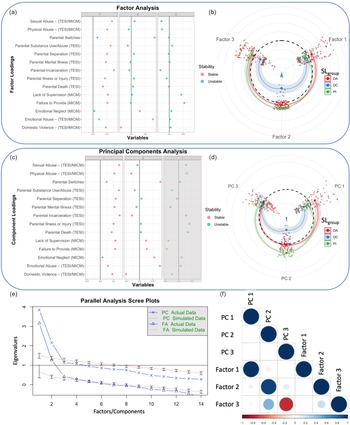
Full sample FA and PCA: (a) Factor analysis (FA). Caregiver-related early adversities (crEA) variables are shown on the y-axis, and variable loadings are shown across the first four principal factors on the x-axis. Note that the scree plot in E indicated that the first four were all significant. We labeled variables as unstable (blue) if the 95% confidence interval of the loading distribution across 1000 bootstraps included zero. We labeled variables as stable (red) when they did not. (b) Individual participant loadings on each of the FAs grouped by SLgroup (DA = domestic adoption; DC = disrupted caregiving; PI = previous institutional care) (note: IFC was not included here due to small sample size. Dashed circle represents the sample average score. (c) Principal component analysis (PCA). Variable loadings of the first four components. Note that the scree plot in E indicated that the first two factors were significant. (d) Individual participant loadings on each of the FAs grouped by SLgroup. Dashed circle represents sample average score. (e) Parallel analysis scree plot showing only the first two PCs have greater eigenvalues than the null distribution while the FA eigenvalues are greater than null for the first four factors. (f) Correlation matrix between the first four PCs and FAs. We see a very high correspondence (Pearson’s r = .899; r = .905) between the first two FA/PCs, respectively and moderate correlation between FA and PCs 3. Factor One: Additive Exposure. Factor Two: Emotional Maltreatment (without Domestic Violence) Factor Three: Physical/Supervisory Neglect. Sexual Abuse, Physical Abuse, and Emotional Abuse were all coded as either experiencing or witnessing through either TESI or MICM. Domestic Violence was coded as either experience or threat through either TESI or MICM. MICM = Maternal Interview of Childhood Maltreatment; TESI = Traumatic Events Screening Inventory.

Demographics and income
Parents provided information about their child’s race and ethnicity, education of current primary caregiver, and current household income. Children were also administered two subtests (vocabulary and matrix reasoning) of the Wechsler Abbreviated Scale of Intelligence (Wechsler, Reference Wechsler1999) to obtain estimated IQ for demographic purposes only.
Child outcomes
To index the overall extent of mental health symptoms, the Total Score from the parent-completed Child Behavior Checklist (CBCL; Achenbach & Rescorla, Reference Achenbach and Rescorla2001) was used. Children’s academic achievement was assessed with the Wechsler Individual Achievement Test (WIAT-III; Vaughan-Jensen et al., Reference Vaughan-Jensen, Adame, McLean and Gámez2011). Outcome scores used (CBCL and WIAT-III) were age-standardized before analysis.
Procedure
Families visited the laboratory where parents completed questionnaires and interviews about their child, while children were administered task assessments and participated in MRI scanning in separate rooms. Based on scanner availability, some children completed task assessments before scanning, while others completed task assessments afterward.
Multivariate models of crEA heterogeneity
Aim 1
To identify dimensions of crEA cooccurrence, we applied a bagging-enhanced FA and principal components analysis (PCA) approach with 10,000 bootstrap resampled models aggregated. Bagging allowed us to address problems of sample variance in multivariate models and thereby improve their stability (Breiman, Reference Breiman1996; Nikolaidis et al., Reference Nikolaidis, Solon Heinsfeld, Xu, Bellec, Vogelstein and Milham2020). Through aggregating factor loadings across multiple models, the most important and robust crEAs within each factor can be determined, improving interpretability of our models. To choose the number of significant factors to assess in our study we used parallel analysis, a permutation testing method for FA and PCA (Horn, Reference Horn1965). We used individual items from the MICM and TESI to calculate the FA and PCA. When items were highly redundant, we counted either endorsement. Physical abuse, sexual abuse, domestic violence, and emotional abuse were coded in this way.
Aim 2
To examine whether homogenous crEA cooccurrence subtypes could be created, we applied Louvain community detection using the Phenograph package in R to the patterns of crEA exposure across all participants. LCA is an established probabilistic clustering method developed over 70 years ago (Vermunt & Magidson, Reference Vermunt and Magidson2004). LCA has been known to be sensitive to group differences but can be problematic when data are more variable (Green, Reference Green2014). LCA is a top-down approach that makes assumptions of the distribution of the data and the existence of latent (unobserved) classes in the data, for which each individual is given a probability of assignment. More recently, many researchers have become interested in the use of Louvain community detection as a graph-based algorithm for discovering clusters of individuals. We have previously established a pipeline for creating highly reproducible clusters through Louvain community detection (Nikolaidis, DeRosa, et al., Reference Nikolaidis, DeRosa, Kass, Droney, Alexander, Di Martino and Paksarian2021; Nikolaidis, Paksarian, et al., Reference Nikolaidis, Paksarian, Alexander, Derosa, Dunn, Nielson and Merikangas2021), and in the current work, we have employed this reliability optimized pipeline to bear on the issue of subtypes in crEAs. Additional details on Louvain community detection are provided in the Supplemental Materials.
Aim 3
Finally, to investigate the relative importance of crEA exposure to later outcomes, we applied random forests to predict CBCL Total Score and WIAT Reading and WIAT Numbers. We used crEA dimensions, crEA subtypes, individual crEAs, and SES variables as predictors. Random forest assesses out-of-sample prediction accuracy – this means that the prediction of each tree is based solely on the participants not used to create the decision tree. Therefore, on average, by aggregating across all trees, random forest assesses the out-of-sample prediction accuracy. To compare the informativeness of our predictions against an appropriate “null,” we shuffled our predictor and target variables 1000× and repeated the prediction for each of our target variables.
Results
Aim 1. Identifying dimensions of crEAs across SL groups
FA revealed three dimensions of crEA exposure (Figure 1a), which held significantly more variance than would be expected due to chance (Figure 1e). The factor loadings shown in Figure 1a reveal a largely additive exposure factor, representing exposure to a majority of the crEAs (Factor 1: Additive Exposure), with a notable exception of emotional abuse, emotional neglect, and parental switches. Instead, the second factor selectively loaded onto these three crEAs (Factor 2: Emotional Maltreatment without Domestic Violence). High positive scores on Factor 2 reflected higher likelihood of exposure to emotional maltreatment, and more negative scores reflected higher likelihood of exposure to domestic violence. Notably, Factors 1 and 2 were uncorrelated (Figure 1f), suggesting orthogonality of the two experiential dimensions. Factor 3 (Physical/Supervisory Neglect) showed large positive loadings on failure to provide and lack of supervision, although the bagging enhancement indicated that this factor was not stable. The pattern of factor loadings was largely reproduced in a parallel PCA (Figure 1b). Notably, the first two principal components, which were determined to be significant based on the Parallel Analysis (Figure 1e), were nearly identical to the first two factor loadings (PC1-FA1 Pearson correlation = 0.899; PC2-FA2 Pearson Correlation = 0.905) (Figure 1f), suggesting that these crEA dimensions were robust across different dimensional approaches. The factors/components showed some discrimination between SLgroups and also showed distribution across SLgroups. For example, in Figure 1b and d note that the domestic adoption group scored on average highest in the first factor/component, but also showed the highest within-group heterogeneity (spread of individual participant loadings).
Aim 2. Creating homogeneous subtypes using specific crEA exposures
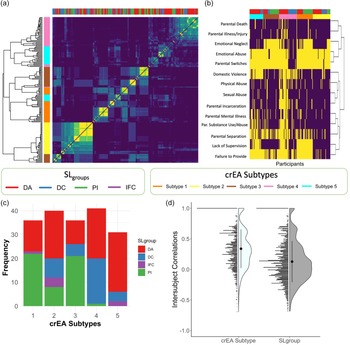
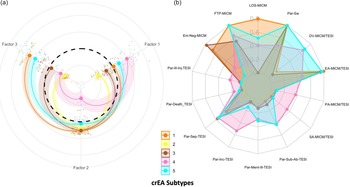
In addition to identifying crEA dimensions, we created crEA subtypes. Subtyping individuals by crEAs is important because it facilitates prediction at the individual level. That is, we may find that one previously institutionalized child has more in common, in terms of crEAs, with a child who experienced domestic adoption than she/he does with another previously institutionalized child. Louvain community detection was used to find subtypes of archetypal “exposure profiles” that explained the heterogeneity in crEAs. The LCD solution had a modularity Q score of 0.51, reflecting the considerable heterogeneity of the crEA data. Figure 2a shows a correlation matrix of crEA profiles with the rows and columns ordered according to agglomerative hierarchical clustering. Columns are colored according to the initial SLgroups, while the rows are colored according to resulting crEA profile clusters from Louvain community detection. These clustering approaches highlight the experiential heterogeneity between individuals within the same SLgroup. For example, Figure 2a shows that the crEA Subtype 1 (orange) was composed of individuals from each SLgroup, a point made more explicit by Figure 2c. Figure 2b shows the distribution of crEAs across the subtypes and SLgroups (colored in the top two rows). Figure 2c shows the subtype heterogeneity across SLgroups, which were well-distributed across the five crEA subtypes. We calculated intersubject crEA profile correlations to assess if crEA subtypes resulted in improved group homogeneity, and Figure 2d shows that the SLgroups had significantly higher heterogeneity (p < .05) and lower inter-subject crEA profile correlation than the crEA subtypes. Figure 3a shows how each of the 5 subtypes loaded onto each of the three (dimensionalized) factors. Notably, we see that the three factors were more easily able to distinguish between crEA subtypes than SLgroups (comparing Figure 3a to Figure 1b and d). The clearer separation of subtypes in Figure 3a relative to the overlap of SLgroups within each factor in Figure 1b and d indicates the enhanced homogeneity of the crEA subtypes over the SLgroups, thus highlighting the large heterogeneity of SLgroups.
Subtyping. (a) Louvain community detection is used to find clusters of participants with similar exposure profiles to caregiver-related early adversities (crEAs). We show a correlation matrix across all participants. Yellow indicates two participants are highly similar in crEA exposure profiles. Cell(i,j) corresponds to the similarity in exposure profile between participant i and participant j. The topmost row color codes participants by their socio-legal groups (SLgroups) (DA: red, DC: green, PI: blue, IFC: purple), while column to the left of that color codes participants by their exposure profile cluster (Cluster 1: purple, Cluster 2: light blue; Cluster 3: brown; Cluster 4: yellow). Rows and columns are organized by hierarchical agglomerative clustering. Notably we see that all crEA profile clusters are made up of individuals from multiple SLgroups, demonstrating heterogeneity of adversities in each exposure environment. (b) Hierarchical clustering was applied to show how crEAs cluster together and how these crEAs clusters are distributed across the individual participants, across the crEAs profile clusters, and SLgroups. The Y-axis shows all crEAs, and the X-axis shows the crEAs scores (yellow=presence, purple=absence) for each individual participant. The topmost row color codes participants by their SLgroups, while the row underneath color codes participants by their crEA exposure profile cluster. Yellow indicates subjects are endorsed for a particular crEA. (c) We show how the four SLgroups are distributed across the four crEA profile clusters. (d) We show the intersubject correlations in crEA exposure profiles across the four SLgroups and crEA profile clusters. Sexual abuse, physical abuse, and emotional abuse were all coded as either experiencing or witnessing through either TESI or MICM. Domestic Violence was coded as either actual or threat through either TESI or MICM. MICM = Maternal Interview of Childhood Maltreatment; TESI = Traumatic Events Screening Inventory.

crEA subtypes. (a) Factor 1: Additive Exposure; Factor 2: Emotional Maltreatment without Domestic Violence; Factor 3: Physical/Supervisory Neglect. Subtype 1 showed highest scores on Factor 3. Subtypes 2 and 3 showed low scores on Factor 3 and Factor 1 but higher than average scores on Factor 2. Subtype 4 had the highest scores on Factor 1 and lowest on Factor 2, suggesting high exposures to domestic violence. Subtype 5 showed second highest scores in the Factor 1 and Factor 3. The dashed circle indicates the sample average for each factor score. (b) We show how the five crEA subtypes loaded onto each of the individual crEA exposures. MICM = Maternal Interview on Child Maltreatment; TESI = Traumatic Events Screening Inventory. LOS-MICM = Lack of Supervision (MICM); Par-Sw = Parental Switches; DV-MICM/TESI = Domestic Violence – Threat or Actual (MICM/TESI); EA-MICM/TESI = Emotional Abuse (MICM/TESI); PA-MICM/TESI = Physical Abuse – Threat or Actual (MICM/TESI); SA-MICM/TESI = Experiencing and/or Witnessing Sexual Abuse (TESI); Par-Sub-Ab-TESI = Parental Substance Use/Abuse (TESI); Par-Ment-Ill-TESI = Parental Mental Illness (TESI); Par-Inc-TESI = Parental Incarceration (TESI); Par-Sep-TESI = Parental Separation (TESI); Par-Death-TESI = Parental Death (TESI); Par-Ill-Inj-TESI = Parental Illness or Injury (TESI); Em-Neg-MICM = Emotional Neglect (MICM); FTP-MICM = Failure to Provide (MICM). Sexual abuse, physical abuse, and emotional abuse were all coded as either experiencing or witnessing through either TESI or MICM. Domestic Violence was coded as either actual or threat through either TESI or MICM.

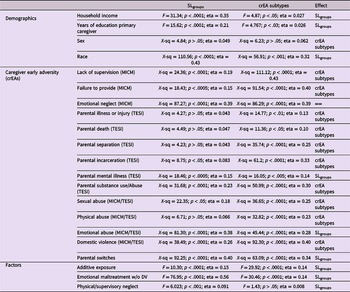
crEA subtyping not only identified greater experiential homogeneity, but it also avoided third variable confounds of noninterest. In other words, Table 2 shows that SLgroups were significantly associated with non-crEA variables (e.g., current parental income and education, race) that are known to have substantial impact on children’s development, but may exert distinct impacts from crEAs on child outcome. These sociodemographic variables were more strongly linked to SLgroup than crEA subtype, and at the same time, the majority of crEAs tested (10 out of 14) were more strongly linked to crEA subtype than to the SLgroups.
Group comparisons

Note. Summary of key demographic variables, caregiver-related early adversities (crEAs), and factor scores across all sociolegally defined groups (SLgroups) and data-driven crEA subtypes. Compared to crEA subtypes, SLgroups were more strongly linked to key SES related variables: Household Income, Years of Education for Primary Caregiver, while showing smaller effect sizes on 10/14 individual crEAs. MICM: sexual abuse, physical abuse, and emotional abuse were all coded as either experiencing or witnessing through either TESI or MICM. Domestic violence was coded as either actual or threat through either TESI or MICM. Maternal Interview on Child Maltreatment; TESI: Traumatic Events Screening Inventory.
Aim 3. Predicting childhood outcomes: Comparing methods
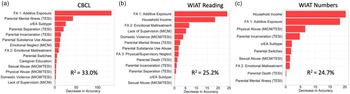
We compared the empirically derived crEA dimensions and crEA subtypes in their power to predict mental health symptoms (CBCL Total Score) and academic performance (WIAT Reading & Numbers) relative to SLgroups, individual crEAs, current household income, and caregiver education (Figure 3). We were able to predict out-of-sample outcomes with an R-squared of 33.2%, 24.9%, and 25.8% in predictions of CBCL Total Score, WIAT Reading, and Numbers, respectively (Figure 3). Prediction accuracy for these outcomes was all significantly higher than what would have been expected due to chance.
The variable importance plots clearly show that overall, dimensions were the most predictive of all outcomes. Factor 1: Additive Exposure was the most important in predicting scores across most outcomes, while Factor 2: Emotional Maltreatment without Domestic Violence and Factor 3: Physical/Supervisory Neglect varied in their relative importance depending on the outcome of interest. Note that household income by itself was also a reliable predictor of academic outcomes, independent of the crEA factors.
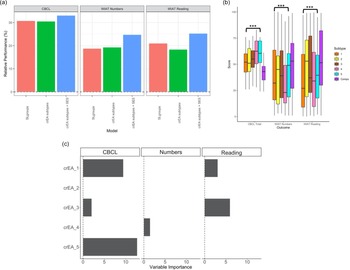
Figure 4 shows that the subtypes, while predicting CBCL, did not perform as well as the factors (i.e., dimensions). However, because subtypes are a necessary variable to complement dimensions in that they operate at the child level (rather than the variable level), we then assessed the predictive value of each subtype separately. Figure 5a compares their performance in predicting outcomes (i.e., variable importance) relative to SLgroups. crEA subtypes alone underperformed SLgroups in predicting outcomes (most likely because SLgroups are highly confounded with SES, which was a strong predictor). However, when crEA subtypes were tested with the addition of SES, prediction of outcomes was greatly improved (subsequently outperforming SLgroups). Whereas variable importance data tell us how accurately each variable predicts outcomes, Figure 5b presents the actual outcome scores per subtype. Relative to the comparison group (Comps) included for reference, crEA subtypes showed elevated scores on the CBCL and lower scores on the WIAT Numbers and WIAT Reading. We then compared each subtype to each other using random forests, which showed unique patterns of prediction (i.e., variable importances) across crEA subtypes, such that individual subtypes showed unique predictions depending on outcome of interest (Figure 5c).
The individual crEAs and FA scores were used to predict three key outcomes (CBCL Total Score, WIAT Reading percentile, and WIAT Numbers percentile) in the sample using Random Forest. Each plot shows the ranking of variable importance in making the prediction in out-of-bag data. Note: Caregiver Education and Household Income reflect current values. Sexual abuse, physical abuse, and emotional abuse were all coded as either experiencing or witnessing through either TESI or MICM. Domestic Violence was coded as either actual or threat through either TESI or MICM.

(a) We show the performance of SLgroups and crEA subtypes with and without adding in SES variables (Current Household Income, Parental Years of Education) in predicting CBCL, WIAT Numbers and WIAT Reading. (b) Distributions of crEA subtypes relative to a comparison group without crEA exposure across the three outcomes variables. ANOVA comparing comparison group to all crEA subtypes p < .0001 (***). (c) Variable importance values for each of the individual crEA subtypes in RF predictions with current SES. CBCL = Child Behavior Checklist; WIAT = Wechsler Individual Achievement.

Discussion
Aim 1. crEA dimensions show stability and cross sociolegally defined boundaries
Examining cooccurrences of crEAs through dimension reduction is an important first step towards understanding the natural patterns of crEA cooccurrence, especially in understudied and heterogeneous samples which may not be fully reflected in other studies. Three crEA cooccurrence dimensions were empirically derived. Even though aspects of the current study differed from the extant literature – by sampling from a broad range of SLgroups and exclusively focusing on caregiving-related adversities rather than a broader range of early adversities – we still found that the main dimensions of crEAs share similarities with previously established dimensional approaches. For example, Factor 1: Additive Exposure closely resembles the maladaptive family functioning identified in other samples (Green et al., Reference Green, McLaughlin, Berglund, Gruber, Sampson, Zaslavsky and Kessler2010; Scott et al., Reference Scott, Burke, Weems, Hellman and Carrión2013) and conceptually aligns with cumulative risk models (e.g., Sameroff & Chandler, Reference Sameroff and Chandler1975). Factor 2: Emotional Maltreatment without Domestic Violence also resembles the “emotional abuse and emotional neglect” maltreatment subtype identified by Matsumoto et al. (Reference Matsumoto, Piersiak, Letterie and Humphreys2020) in a recent meta-analysis. When comparing our work to previous results, it is important to note two things. First, the current sample may have included a broader range of SLgroups than what might have been used in other studies. This was an intentional decision that would allow for identifying dimensions that could transcend multiple and seemingly disparate SLgroups. Second, the dimensional and subtyping approaches used here exclusively focused on crEAs, whereas early adversity is often studied through a broader lens (e.g., other studies might include metrics of extrafamilial and/or sociodemographic adversities).
These three empirically derived dimensions revealed which events were more likely to occur together. Factor 3: Physical/Supervisory Neglect was the least stable, suggesting it was not as robust to sampling variability. Factor 1: Additive Exposure was largely an additive crEA exposure factor in that it contained all crEA items (except for those in Factor 2: Emotional Maltreatment without Domestic Violence – see Figure 1), as higher scores indicated a greater number of distinct crEA exposure types. Thus, the identification of Factor 1 supports the idea that grouping individuals by a single exposure do not accurately represent the range of crEAs experienced by a child. The loadings in this factor were robust within sample, as well as being consistent with other samples (Green et al., Reference Green, McLaughlin, Berglund, Gruber, Sampson, Zaslavsky and Kessler2010; Scott et al., Reference Scott, Burke, Weems, Hellman and Carrión2013). The robustness of this factor reflects the unfortunate reality that polyvictimization may be more common than singular exposures (e.g., Wolfe, Reference Wolfe2018). Looking beyond the additive exposure factor, we found that some crEAs did not aggregate into the additive exposure factor. Namely, emotional abuse, emotional neglect, and caregiver switching (coded from interviews) loaded instead onto Factor 2: Emotional Maltreatment without Domestic Violence, perhaps reflecting the threats to attachment-related representations common across these items (Hornor, Reference Hornor2012; Spinazzola et al., Reference Spinazzola, Hodgdon, Liang, Ford, Layne, Pynoos and Kisiel2014; Tonmyr et al., Reference Tonmyr, Draca, Crain and Macmillan2011). Unlike Factor 1, where one crEA exposure was more likely to cooccur with another crEA exposure, Factor 2 (which was uncorrelated with Factor 1) suggests that for some individuals, emotional maltreatment may be likely to occur in the absence of crEAs that load onto Factor 1.
Emotional maltreatment, despite being one of the most prevalent forms of child maltreatment (Pears et al., Reference Pears, Kim and Fisher2008), is often the most hidden form of maltreatment (Barnet et al., Reference Barnet, Miller-Perrin and Perrin2005; Hart & Brassard, Reference Hart and Brassard1987) and is considered by some to be the “core” issue in childhood trauma (Hart & Brassard, Reference Hart and Brassard1987). We deviated from the MICM coding by splitting emotional maltreatment into emotional abuse and emotional neglect for greater precision; nonetheless, Factor 2 supports the MICM’s combination of emotional neglect and emotional abuse. To be clear, our coding system included separation from a primary caregiver – regardless of the parental intent or agency (e.g., abandonment, death, or incarceration) or developmental timing as an incident of “emotional abuse,” which is often not coded as a form of emotional abuse. Our decision is consistent with the approach of coding the experience rather than parental intent/agency (Cicchetti et al., Reference Cicchetti, Toth and Manly2003), motivated by the importance of considering the even from the child’s perspective (Smith & Pollak, Reference Smith and Pollak2021). Thus, our definition of emotional abuse, while describing a caregiving-related adversity, does not necessarily mean the abuse is perpetrated by the caregiver. Separation from/abandonment by parents might be the most emotionally traumatic event in a child’s life (even if it is deemed necessary for the child’s well-being), yet it is unlikely to be reported by adoptive parents or court records as one of the many traumas experienced by a child (especially if the child experienced other forms of maltreatment)Footnote 1 . Note for example, that the frequency of “Separation from parent” as measured by parental questionnaire (i.e., TESI) was lower than “Parental Switches” frequency, which was coded from interviews with parents, although these measured the same type of event. From the young child’s perspective, the separation/removal would be a major threat to emotional well-being, consistent with the MICM’s code for emotional maltreatment. Note that emotional neglect did not load with physical/supervisory neglect (i.e., failure to provide and supervisory neglect) consistent with previous reports (Lambert et al., Reference Lambert, King, Monahan and McLaughlin2017); this lack of association provides empirical motivation to caution against treating neglect generically but instead recognizing that emotional neglect may have different phenomenological properties than physical/supervisory neglect. Bagging enhancement showed that Factor 2 was robust, and indeed, Factor 2 in this sample is highly consistent with a recent meta-analysis of the self-reported childhood maltreatment literature that also identified emotional maltreatment as a unique dimension of cooccurrence (Matsumoto et al., Reference Matsumoto, Piersiak, Letterie and Humphreys2020). Taken together, these findings motivate continued inquiry into the merits of a caregiving-related emotional maltreatment dimension.
Leveraging best-practices in robust multivariate analysis to assess crEA cooccurrences, dimension reduction methods (FA, PCA) demonstrated that patterns of crEA cooccurrence not only replicated some aspects of previously established models but are also robust within our heterogenous sample. There was correspondence between the FA and PCA results, and the bagging enhancement provided confidence about the factor structure in the present sample. It is worth noting that variability in sampling of crEAs across studies may lead to differential crEA dimensions, but similarly broadly enriched samples for crEAs are more likely to yield similar results. We found that crEA dimensions (i.e., factors) both differed within a given SLgroup and transcended SLgroup borders, indicating that a given SLgroup is not homogeneous. Moreover, this transcendence indicates that seemingly distinct SLgroups may have common experience profiles that can inform our understanding of how to generalize findings from one crEA population to another. Indeed, homogeneity analysis of the crEA subtypes showed that there was greater cross-SLgroup than within-SLgroup similarity (i.e., a child with a history of domestic adoption could have more in common (in terms of crEAs) with a child previously institutionalized abroad than he/she might with another who experienced domestic adoption).
Aim 2. crEA subtyping shows increased homogeneity and reduced conflation with sociodemographics
Subtyping is an old and essential approach in medicine. Like dimensions, subtypes try to reduce experiential heterogeneity (Shorter & Tyrer, Reference Shorter and Tyrer2003; Wardenaar & de Jonge, Reference Wardenaar and de Jonge2013), but operate at the level of the individual rather than the variable. When describing dimensionality in a heterogeneous sample, subtyping provides valuable additional information on the organization of the sample. While dimensionality type analyses (FA/PCA) summarize the main patterns of the sample as a whole, subtyping allows for a breakdown of the data to examine more detailed patterns among subgroups. We found that the SLgroups were distributed across the crEA subtypes (i.e., crEA subtypes transcended SLgroups). The crEA subtypes demonstrated improved homogeneity over SLgroups, and they corresponded very well to the crEA dimensions (Figures 2 and 3a). These findings imply that the replicability of crEAs results will be improved by using crEA subtypes rather than SLgroups. These results also indicate that it is possible to translate back and forth between empirically defined dimensions and empirically derived subtypes, depending on the research question at hand (Chabernaud et al., Reference Chabernaud, Mennes, Kelly, Nooner, Di Martino, Castellanos and Milham2012; Tang et al., Reference Tang, Sun, Floris, Zhang, Di Martino and Yeo2020). Overall, the results of the data-driven community detection used in this study corresponded with many of the subtypes identified with other methods (e.g., logistic regression, latent class analysis) (Brown et al., Reference Brown, Rienks, McCrae and Watamura2019; Hazen et al., Reference Hazen, Connelly, Roesch, Hough and Landsverk2009; Pears et al., Reference Pears, Kim and Fisher2008; Petrenko et al., Reference Petrenko, Friend, Garrido, Taussig and Culhane2012; Warmingham et al., Reference Warmingham, Handley, Rogosch, Manly and Cicchetti2019). In future work, researchers may look to benchmark different methodological approaches and address the strengths and weaknesses of discrete (Louvain, k-means) versus probabilistic (latent class analysis, Gaussian mixture models).
We also found that data-derived subtypes of crEAs were less dependent on SES compared to SLgroups (Table 2), implying this data-driven approach is optimal when examining links between crEAs and outcomes because it avoids potentially misinterpreting crEAs’ effects that are actually SES effects. Diving deeper into these results through conditional random forest makes these implications clearer. Figure 5a shows that the performance of the crEA subtypes and the traditional SLgroups did not greatly differ. However, the SLgroups were highly correlated with sociodemographics (parental income, education, race) (Table 2). In contrast, data-driven subtypes largely reduced or even circumvented these confounds (while at the same time were more sensitive to crEAs than the SLgroups). Indeed, Figure 4 shows that household income had independent effects from crEA dimensions on mental health and academic outcomes, and Figure 5a shows that model prediction of the crEA subtypes with the addition of a separate SES variable outperformed SLgroups (which themselves were highly conflated with SES). This finding suggests that data-driven subtyping may be better suited to parse the specific impact of crEAs (without sociodemographic confounds). These results show that it is possible to examine crEAs separately from sociodemographic factors and offer an approach that circumvents the pitfalls associated with traditional statistical methods of “regressing out” variables.
Aim 3. crEA dimensions and subtypes robustly predict outcomes
Conditional random forests assessed the statistical predictive value of the data-driven dimensions and subtypes (Note: the statistical “prediction” here does not imply deterministic forecasting of the impact of crEAs on future outcomes). This approach (relative to traditional regression) is robust to high-dimensional data, nonlinear associations, and extreme values, and it allows for crEA cooccurrence. We found that CBCL total score was most strongly predicted by parental mental illness, crEA subtype, and Factor 1 score (Additive Exposure), suggesting that each of these are highly informative of mental health symptoms in this sample. On the other hand, WIAT performance for both reading and numbers was strongly predicted by household income as well as Factor 1, demonstrating the importance of accounting for SES when discussing outcomes, and suggesting that models using SLgroups may be conflating effects of crEAs with those of SES. We found that it was more informative to predict CBCL and WIAT outcomes by using data-derived groups that are independent from SES, and then using SES separately rather than using SLgroups which are associated with SES. This allows for more segregation between crEAs and SES in the conditional random forest model and enables better performance.
Variable importance, which indexes a variable’s predictive worth for a given outcome (conditional on other variables present), is calculated across thousands of models. These models provided strong evidence for both crEA-specific and crEA-general associations with mental health symptoms (CBCL) and academic outcomes (WIAT Reading, WIAT Numbers). Relative to a non-crEA comparison group (Figure 5b), the data-driven crEA subtypes were associated with a greater risk for CBCL symptoms (with each subtype showing greater risk – “crEA-general”), consistent with results identified with latent profile analysis indicating that a subtype with the greatest polyvictimization had greater mental health risk (Pears et al., Reference Pears, Kim and Fisher2008). Academic achievement on the other hand showed more subtype specificity – “crEA-specific” – for example, Subtypes 1 and 3 being most informative for predicting reading and Subtype 4 being most informative for math. However, Figure 5c (which excludes the comparison group and examines only within the crEA sample) shows a deeper level of specificity. That is, we see crEA-general effects relative to a nonexposed group, but within the sample exposed to crEAs, we see crEA-specific effects, both of which are informative. For example, Subtypes 1, 3, and 5 were better at predicting CBCL symptoms relative to the other crEA subtypes, whereas Subtypes 1 and 3 were better at predicting reading relative to the other crEA subtypes. These comparisons suggest that while all children who experience crEAs may be at higher risk for mental health and academic difficulties, it is important to be aware that domain-specific risks may be especially elevated for some subtypes (even if all subtypes are at elevated risk). For example, Subtype 4, which was largely dominated by high scores on Factor 1, showed higher risk on CBCL and WIAT numbers compared to the other subtypes. This pattern of results indicates that in addition to specific experience-outcome associations, there may be final common pathways (i.e., developmental equifinality) (Cicchetti & Blender, Reference Cicchetti and Blender2004; Cicchetti & Rogosch, Reference Cicchetti and Rogosch1996; Hanson et al., Reference Hanson, Nacewicz, Sutterer, Cayo, Schaefer, Rudolph and Davidson2015) for CBCL scores. There are “common denominator” experiences shared across many crEA kinds (e.g., injury to trust-related process) that may give rise to a common pathway for the development of mental health difficulties (Tottenham, Reference Tang, Sun, Floris, Zhang, Di Martino and Yeo2020). That is, we should expect some developmental domains to show crEA-specific effects and other domains to show crEA-general effects within the same child.
Data-driven dimensions performed even better than the subtypes in predicting CBCL scores and academic achievement (Figure 4). This is perhaps not surprising since dimensions provide scores that more closely track an individual’s experience than categorical variables, and discretization inherent to subtyping may discard meaningful within-subtype variance. Nonetheless, subtypes are important for identifying groups, and past work suggests that hybrid approaches employing both dimensions and subtypes add even greater predictive value than either in isolation (Chabernaud et al., Reference Chabernaud, Mennes, Kelly, Nooner, Di Martino, Castellanos and Milham2012). Dimensions also outperformed individual crEA exposures. Factor 1: Additive Exposure predicted all three outcomes tested here, consistent with evidence that polyvictimization is associated with poorer outcomes (even relative to repeated instances of the same kind) (Finkelhor et al., Reference Finkelhor, Ormrod and Turner2007), and the large variable importance scores suggest robustness/replicability (in an out-of-sample fashion) of this crEA-general effect. In contrast, Factor 2: Emotional Maltreatment without Domestic Violence was a better predictor of reading skills than math skills. We note that Factors 1 and 3 (which included physical/supervisory forms of neglect) and Factor 2 (which included emotional neglect) predicted different outcomes, further supporting the separation of physical/supervisory from emotional neglect (i.e., combining physical/supervisory with emotional neglect introduces heterogeneity rather than reducing it).
Are these crEA endorsements reliable and valid? We cannot indicate how reliable parental reporting of crEAs was in this study. This is unfortunately the nature of crEAs assessments, which will always have the challenge of both omissions and commissions in reporting. Formal court, medical, or child protective services (CPS) records are sometimes believed to be the most reliable and valid measures. However, as Sierau et al. (Reference Sierau, Brand, Manly, Schlesier-Michel, Klein, Andreas and White2017) have summarized, CPS records are biased towards more “readily observable [crEAs] that call for urgent action (e.g., severe physical abuse or neglect),” but they are less sensitive to more “invisible” crEAs like emotional maltreatment. Consequently, reliance on CPS reports increases the risk of omitting certain crEAs (Trickett et al., Reference Trickett, Mennen, Kim and Sang2009). Reliance on parent reports likewise has merits and weaknesses. Parent reports may be valuable sources of crEA exposures that are missed by reliance on records; however, parents may also be unable or unwilling to provide veridical information. Note in the current sample of children with crEAs exposure, most of the reporting parents were not the biological parent. While this parent may have been less reluctant to report crEAs experienced by their child, they may also be less privy than biological parents to all crEAs experienced by their child.
The current study made decisions about how best to define crEAs. As is the case with all research on childhood adversities, the entire process of documenting maltreatment is fraught with decisions and inevitable bias – whether it is coming from the investigator, the official records, the case workers, the parents, and/or the children (Fluke et al., Reference Fluke, Yuan and Edwards1999; Kim et al., Reference Kim, Mennen and Trickett2017) – or the means through which experiences were coded/collected (e.g., what is/is not recorded in court documents, what is/is not reported by a biological versus adoptive parent). For example, a child who experienced physical neglect and subsequent placement in foster care may be described as experiencing “physical neglect” by court records, adoptive parents, and/or the investigator. However, this child also experienced separation from a primary attachment figure, which itself can be emotionally traumatic (Bowlby, Reference Bowlby1977; Bowlby et al., Reference Bowlby, Ainsworth, Boston and Rosenbluth1956) (note – separation from parents is often omitted as an adverse study variable despite the tremendous impact of this event on development).
In the current paper, we used two different types of parent report, questionnaire format (e.g., TESI) and semistructured parent interview (MICM) that was later coded for crEAs using the MCS. The MCS is a reliable and valid coding system (Manly, Reference Manly2005; Manly et al., Reference Manly, Oshri, Lynch, Herzog and Wortel2013) that differentiates between maltreatment subtypes by providing mutually exclusive subtype criteria and anchor examples. By doing so, the MCS codes generate crEA endorsements that may or may not match the parent’s crEAs endorsement (i.e., the objective coding does not rely on parental definitions, whereas a questionnaire might). In a direct comparison, Sierau et al. (Reference Sierau, Brand, Manly, Schlesier-Michel, Klein, Andreas and White2017) showed that parental interview (via MICM) corresponds with CPS records between a fair to substantial range.
Additional limitations
There are limitations that are worth discussing as they play a role in the interpretation of the current work. First, beyond the window of birth-to-middle childhood, we did not consider the timing of the crEA experiences in developing our subtyping or multivariate FA, which limits the specificity of the phenotypic profiles created here. It is well established that timing of these events plays an important role in their impact on later psychiatric, cognitive, and academic outcomes (Cowell et al., Reference Cowell, Cicchetti, Rogosch and Toth2015; Manly et al., Reference Manly, Kim, Rogosch and Cicchetti2001; Schalinski et al., Reference Schalinski, Teicher, Nischk, Hinderer, Muller and Rockstroh2016). Furthermore, we also did not consider the severity of each of these outcomes, although most crEAs were severe in our sample (not reported). Following our work here, it will be important for future work to consider integrating the chronicity and severity of crEA occurrence into multivariate subtypes and factor scores. With the current results, future work can also examine crEA exposure from an experience profile subtyping perspective, which may be useful for deriving homogeneous groups of participants.
Conclusions
The links between caregiving-related adversity and child outcomes are highly complex, and no single approach will sufficiently capture this complexity. Here, we provide some additional guidance to research that aims to investigate the heterogeneity inherent in the cooccurrence of early adversities that directly interfere with the parent-child relationship. Results indicate that despite substantial heterogeneity, greater homogeneity can be achieved via data-driven dimensionalizing and subtyping. These approaches applied to the current broad sample of children (from seemingly disparate SLgroups) provided evidence that the dimensions and subtypes were internally stable, transcended traditional sociolegally defined groups, and reduced statistical correlations with sociodemographic factors. They also showed predictive value for childhood outcomes in a both crEA-specific and crEA-general fashion, depending on behavioral domain and comparison groups. Assessments of cooccurrences provide one means of representing experiential complexity and do so by describing the context in which crEAs occur. Given the high-dimensional space within which crEAs exist, cooccurrence variables might be considered for use in parallel with other dimensions.
Supplementary material
The supplementary material for this article can be found at https://doi.org/10.1017/S0954579421001668
Acknowledgements
Michelle VanTieghem is now at Virta Health, San Francisco, CA; Nicolas Camacho is now at Duke University, Durham, NC; Tricia Choy is now at the University of California, Riverside, CA; Ian J. Douglas is now at the University of Texas, Austin, TX.
Author contributions
Michael P. Milham and Nim Tottenham shared senior authorship.
Funding statement
This work was supported by the National Institute of Mental Health of the National Institutes of Health (5RO1MH091864). AN is also supported by NIMH R21MH118556-01 and a Young Investigator award from the Brain and Behavior Research foundation. MPM is also supported by an endowment from Phyllis Green and Randolph Cowen. The content is solely the responsibility of the authors and does not necessarily represent the official views of the National Institutes of Health.
Conflicts of interest
We have no known conflicts of interest to disclose.