Introduction
Among the works commonly attributed to Euclid, two are related to the field of optics. The Optica deals with direct vision, while the Catoptrica deals with reflection of visual or solar rays. These two works are so inferior in style, semantics, logical relations between propositions, and accuracy of results compared to the clarity and perfection of the Elements that it was long held that they could not possibly be genuine Euclidean works.
At the end of the nineteenth century, the famous editor J. L. Heiberg surveyed the extant manuscripts and argued that at least one version of the Optica was genuinely Euclidean. He found no alternative text that allowed him a similar sparing of the Catoptrica. Based on a few arguments related to style and terminology, he concluded that the Catoptrica was a late compilation composed by the celebrated fourth-century mathematician Theon of Alexandria (Heiberg Reference Heiberg and Menge1895; all references to Catoptrica are to this edition). In the mid-twentieth century, Albert Lejeune assumed Heiberg's conclusions to be correct and attempted to identify different strata in the text. In his view, the first half of the work could be based on an actual Euclidean Catoptrica, the second part might have been added after Euclid, and later on, the whole would have been poorly edited by Theon, who included some propositions and principles of his own (Lejeune Reference Lejeune1957, 54–67 and 112–136, esp. 113).
Contemporary scholars, such as Wilbur Knorr, Alexander Jones, and Ken'ichi Takahashi, have doubted the proposals of Heiberg and Lejeune and were reluctant to consider Catoptrica a decadent treatise composed in late antiquity. Knorr and Takahashi tried to reinstate it as a Euclidean work, once allowances were made for certain minor interventions by later editors (Knorr Reference Knorr1985, chaps. 3 and 8; Knorr Reference Knorr1994, 4; Takahashi Reference Takahashi1992). Authorship, however, remains an unsettled issue and many of the singular features, obscurities, flaws, and technical lapses of the text remain a puzzle.Footnote 1 In particular, it is difficult to make any sense of some of the principles stated at the beginning of the work (the last of them is not even used in the propositional part of the text); some of the proofs are simply false (proposition 26, for example, presents an accurate result but a false proof); or present contradictory cases (the last proposition, for instance, presents two incompatible proofs); the overall objective of the treatise is not clear and it is uncertain whether or not the text is complete.Footnote 2
I wish to approach the subject from a wholly different perspective. My claim is that we are able to make more sense of (some parts of) Catoptrica if we recognize that the author or editor(s) of the text may have had astronomical applications in mind, such as providing an account for the formation of moonlight through reflected sunlight.
Two facts indicate precisely that the Catoptrica should (also) be appreciated within the broader context of astronomy. Firstly, the manuscript tradition is striking, since the Catoptrica appears systematically attached to texts of elementary astronomy.Footnote 3 Secondly, some of the known astronomical elementary treatises of Antiquity are surprisingly focused on optical and catoptrical issues. I am referring especially to those texts written by authors of around the first century, although the same applies to other more ancient and sophisticated treatises, such as Aristarchus’ On the Sizes and Distances of the Sun and Moon. The reasoning put forward in these sources is phrased mathematically and was certainly supported by geometrical content available in more technical treatises.
In the following pages, I compare some of Catoptrica's principles and propositions with sources such as, amongst others, Geminus, Theon of Smyrna, Plutarch and Cleomedes. This will show how several arguments of Catoptrica may have been interpreted around the first century.
The structure of this article is as follows. In section 1, I outline the difficulties felt by scholars in interpreting the principles of Catoptrica; the discussion concerning the fourth and fifth principles is presented in more detail because this discussion is especially helpful in relationship to the rest of the article. This section is included mainly for the sake of context and the reader familiar with the subject may skip it. In section 2, I show how statements very close to the principles of Catoptrica (specifically, the first, fourth, fifth, and sixth principles) were used by ancient authors in the study of the illumination of the moon. Although I have structured the article to reach a crescendo at the end, this section represents the strongest point of my argument: I will be happy if it is agreed that the authors cited would not have felt the fourth and fifth principle of the Catoptrica to be awkward, as modern scholars tend to do, and would have naturally applied them to the study of moonlight, as stated at the end of section 2. Originally the paper ended here, but the argument seemed to me so fruitful that I proceeded to the propositions and tried to understand how they could have been used in the study of moonlight; while doing so, I noticed that some issues concerning other principles (namely the third and sixth) could also be further developed. I gathered together all these issues in section 3, which required some gymnastics (especially in section 3.2) in order to reconcile the pieces of evidence scattered amongst the ancient sources. I hope that my hybris will be forgiven; after all, I am trying to uncover a broader context in which ancient catoptrics was interpreted; this context, by its very nature, is elusive to the modern reader.
Much of the argument is tentative, which means that I do not wish to prove something conclusively, I do not hope to be right about everything, and I certainly do not intend to explain all the loose ends. In any case, I do not argue that every line in every proposition of Catoptrica has an astronomical interpretation. What I am suggesting is that ancient astronomical texts can be mined for optical knowledge that supplements and may help to interpret what we know from the few specifically optical treatises that have survived from antiquity.
1. A closer look at the principles of Catoptrica
The Greek text of Catoptrica begins with six assertions listed without any explanation (The Euclidean Optics calls its initial assumptions “definitions”: ὅροι). The first proposition cites the third assertion as “This was assumed in the definitions” (τοῦτο γὰρ ἐν τοῖς ὅροις ὑπέκειτο [Heiberg Reference Heiberg and Menge1895, 288–289]); propositions 16–18 refer to the fourth and fifth assertions as “phenomena” (οὐκοῦν ἐπεὶ ὑπέκειτο ἐν τοῖς φαινομένοις [Heiberg Reference Heiberg and Menge1895, 312–315]). I will call them “principles.” Nearly all of them present specific difficulties of interpretation. The first one is a principle of optics and not catoptrics, the third one can hardly be called a principle, the fourth and fifth have puzzled scholars because it is difficult to make sense out of them, the sixth is about refraction and is not used within the treatise. Below, I collect the features of each of them which I consider essential for the main argument of the following sections.
1. First principle: “A visual ray is a straight line all of whose middle parts cover the extreme ends” (ὄψιν εἶναι εὐθεῖαν, ἧς τὰ μέσα πάντα τοῖς ἄκροις ἐπιπροσθεῖ [Heiberg Reference Heiberg and Menge1895, 286; my translation]).
Many translators, modern or medieval, did not give a proper translation of ἐπιπροσθεῖ. In the medieval Latin version the word is translated by the verbs “continuare” or “continere” (Takahashi Reference Takahashi1992, 320); the French translator Paul Ver Eecke translated “le rayon visuel est une droite dont toutes les parties medianes se butent à des limites”; G. Ovio, “il raggio è una linea retta di cui i mezzi toccano le estremità.”Footnote 4 Stressing the true meaning of the verb employed (“to cover”) is important, because the word is often used in the context of astronomy (as can be seen by reading the passages compiled by Charles Mugler in Mugler Reference Mugler1964, ad verbum). The corollary that follows from this principle (“if an obstacle is placed on a visual ray, then an object of sight cannot be seen” [Takahashi Reference Takahashi1992, 320]), also has a peculiar astronomical value which will be seen below, in section 3.
It is important not only to stress the correct translation of the principle, but also the fact that it seems to be misplaced here, due to its being a principle of direct vision, that is, of optics, and not of reflected (or refracted) vision, that is, of catoptrics.Footnote 5
2. Second principle: “All objects of sight are seen in a straight line” (τὰ ὁρώμενα ἅπαντα καθ΄εὐθείας ὁρᾶσθαι [Heiberg Reference Heiberg and Menge1895, 286; my translation]).
This is the least problematic of all principles (for an overview, see Lejeune Reference Lejeune1949, 603; Reference Lejeune1957, 58). It definitely belongs to the province of catoptrics and it is equivalent to Ptolemy's first law of image-location: images appear along the extension of the incident visual ray (Optics 3.3; Smith Reference Smith1996, 131). The first postulate applies straightness to direct vision; the second extends it to reflected vision. An experiment mentioned by Ptolemy makes this principle clear: if one covers the place on a mirror where reflection takes place (with wax, or something similar), the image ceases to appear (Optics 3.4; Smith Reference Smith1996, 132). The same experience is mentioned by Heron (prop. 6; Nix and Schmidt Reference Nix and Schmidt1976, 330). This covering will be further discussed below, when elaborating on principle 5.
3. Third principle: “When a mirror is placed on a plane and some height is seen which is perpendicular to the plane, there arises a proportion such that as the line between the mirror and an observer is to the intermediary line between the mirror and the height, so is the height of the observer to the height perpendicular to the plane” (Heiberg Reference Heiberg and Menge1895, 286; tr. Takahashi Reference Takahashi1992, 115).Footnote 6
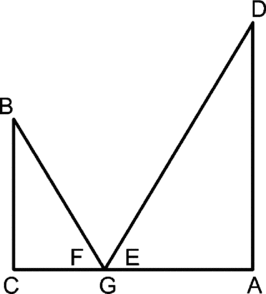
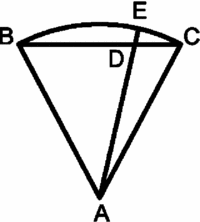
This is the principle that allows the deduction of the law of reflection in the first proposition. Discussion on this principle is extensive and I shall briefly refer to the topic I consider relevant to this paper. Ptolemy assumes that the law of reflection is a principle (Optics III.3; Smith Reference Smith1996, 131). The Catoptrica assumes some proportion as a principle so that similarity of triangles (= Elements VI.6) can be applied to demonstrate the law (see fig. 1).
An illustration of Catoptrica's third principle; CG:AG = BC:DA (where B is the observer and D is the object).

Knorr characterizes this move in the following way: “The procedure seems contrived, for the postulate is hardly a self-evident claim on which to base the proof of equal angles” (Knorr Reference Knorr1985, 73). Furthermore, in the Catoptrica the equality of the angles is derived from Elements VI.6, which is applied after the use of postulate 3; in the Euclidean Optics, the process is reversed, and the equality of the angles is used to prove that such proportion arises (the discussion over this alleged petitio principii within the Euclidean corpus is best summarized in Takahashi Reference Takahashi1992, 49 ff.). I believe that both problems are connected: they show that there was some hesitation as to whether the law of reflection should be considered a principle or a demonstrated proposition. This may even be the reason why it is very difficult to determine precisely when the fact that reflection occurs at equal angles was discovered.
4. Fourth principle: “In plane mirrors, when the place is occupied where the vertical falls from the object, the object is no longer seen (ἐν τοῖς ἐπιπέδοις ἐνόπτροις τοῦ τόπου καταληφθέντοςFootnote 7, ἐφ΄ὃν ἡ κάθετος πίπτει ἀπὸ τοῦ ὁρωμένου, οὐκέτι ὁρᾶται τὸ ὁρώμενον)”; the fifth principle asserts the same for convex and concave mirrors, but the expression “line drawn from the object to the centre of the sphere” is used instead of the term “vertical” (ἡ κάθετος) (Heiberg Reference Heiberg and Menge1895, 286; tr. Knorr Reference Knorr1994, 9).
We now enter a second series of principles. They are called “phenomena” in the propositions that use them. They are very obscure and difficult to understand; it is even hard to see how they contribute to the propositions in the treatise. Firstly, it is not clear what exactly occupies the foot of the perpendicular (that is, “the place . . . where the vertical falls from the object”); secondly, the principle appears to state a wrong fact because even if you cover the foot of the perpendicular, reflection still takes place.
Lejeune calls these principles awkward (Lejeune Reference Lejeune1949, 607; idem Reference Lejeune1957, 62) and dismisses the interpretations of Ver Eecke and Ovio, who hold that the foot of the perpendicular is occupied by the object or by the eye. He thought that these principles complement the second principle by adding that the position of the image lies in the perpendicular dropped from the object; “in other words,” he says, “the fourth and fifth postulates are the equivalent to Ptolemy's second law of reflection” (Lejeune Reference Lejeune1949, 618–619; idem Reference Lejeune1957, 63–65). Lejeune seems quite correct (his opinion was accepted by Jones Reference Jones1987, 6), but falls short of explaining in a satisfying manner what precisely the expression “occupied the foot of the perpendicular” means and what object is meant to cover this place.
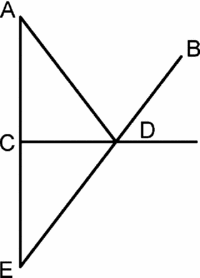
In 1985, Knorr confessed on his part that: “The claim being made is not quite clear, and on the simplest reading is in fact false. For the perpendicular from the object need not actually touch the mirror (that is, the mirror need not extend that far, or be clear at that point) in order for the image to be seen. I would suppose that the postulate intends the eye to be occupying the specified position, or to be set somewhere on the perpendicular; the failure to see the image from this position would thus indicate that the eye is blocking its formation, so that the image lies along that perpendicular” (Knorr Reference Knorr1985, 72). In 1994, he strengthened his opinion (see fig. 2): “As a general claim, this principle is false. It is valid only in the special case where the observer is positioned along the vertical drawn from the object to the mirror, as happens, for instance, when one inspects one's own image in a mirror held at right angles directly in front of one's face. Thus, in proposition 16 [Heiberg Reference Heiberg and Menge1895, 312–313], where the principle is applied for locating the image, if the mirror is obscured at point C, the foot of the perpendicular from the object A, then it will in general not be the case that the image cannot be seen from B, unless B happens to lie along CA. It seems plausible that the author has recognized this basic phenomenon of direct inspection and wrongly extrapolated it to the oblique case” (Knorr Reference Knorr1994, 9; I have changed the letter reference in accordance with figure 2).
Catoptrica, prop. 16 “In plane mirrors every object of sight is seen along a perpendicular drawn from an object” (Heiberg Reference Heiberg and Menge1895, 312–313; Takahashi Reference Takahashi1992, 154–155).
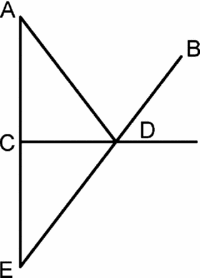
It is perhaps interesting to notice that Kepler had already expressed himself in exactly the same terms as Knorr (the text refers to the same figure):
In order to prove in theorems 16, 17, and 18 of the Catoptrics that each of the objects that fall in our line of vision are seen along the perpendicular [drawn] from them to the surface of the mirror, Euclid assumes a false [start]. Let CD be a mirror, B the visual ray, A the object, AC the perpendicular. Thus he proves that the image of the thing A is in AC, that is, in E, in the following way: “In fact,” he says, “if the place C of the mirror is taken, in which falls the perpendicular AC, the object A is no longer seen.” If you interpret “taken” as if the place C is “occupied” or “covered,” then the axiom is false, although Euclid included this among the other postulates discovered from experience (or whatever it is that he calls phenomenon in his treatise) and stated it in the beginning of his book. The truth is that, even if C is covered or taken, as long as D rests, surely A is seen in E by means of the eye B . . . In conclusion, the Euclidean axiom should be read as if it meant that if the visual ray is placed in A and C is covered, then A is not seen. Then is the axiom correct, but the conclusion does not follow, unless it refers to perpendicular vision. However, the argument does not proceed from the straight ray to the oblique [ray].Footnote 8
It has been noted that even in late antiquity this postulate was apparently difficult to interpret. We know this because one of Heron's propositions is quite similar: “in plane mirrors, there is a place such that when it is occupied (apprehensus) the image is no longer seen” (tr. Knorr Reference Knorr1985, 72). Heron, however, refers to a different occupied place. He does not mean the foot of the perpendicular here, but rather the place in the mirror where reflection takes place at equal angles and which he covers with wax for the demonstration of the proposition. There has been much discussion about the relationship between these passages of Catoptrica and (pseudo-)Heron. Lejeune thought that the principles stated at the beginning of Catoptrica (including the fourth and fifth) were late and decadent adaptations of Ptolemy's laws of reflection stated in Optics 3.3 (1957, 64 ff.). Knorr, Jones, and Takahashi opposed this view, and thought that the formulations of (pseudo-)Heron represented instead an improvement regarding those in the Catoptrica. Knorr summarized the idea as follows: “The view that Heron has taken an unclearly worded, yet very important, principle from E and recast it as a clear, yet unnecessary proposition in H is, I believe, more plausible than the hypothesis of a converse dependence of E on H” (Knorr Reference Knorr1985, 7; Knorr Reference Knorr1994, 11). Jones went in the same direction: “But is it plausible that an author even in late antiquity could have taken pseudo-Ptolemy's [= Heron's] enunciation, which is not only correct but proved to be so, and perverted it into the baldly asserted nonsense that we find in pseudo-Euclid? I suspect rather that the compiler of pseudo-Ptolemy, or his source (Heron?), had seen pseudo-Euclid's axiom, and retained its idiosyncratic phraseology while applying it to a sounder theory” (Jones Reference Jones1987, 6).
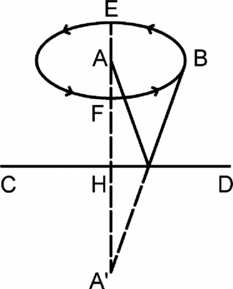
Takahashi could not keep silent about the difficulty of the text: “The Greek text is so helplessly ambiguous that it makes interpretation very difficult” (Takahashi Reference Takahashi1992, 20). However, following the lead of Lejeune and Knorr, Takahashi managed to propose a more sophisticated theory which implied movement, so that the principle could be spared. Lejeune had already noticed that the covering of the perpendicular is not something static but dynamic and that it implied movement (this had led him to criticize Ver Eecke's translation of the fourth postulate; see Lejeune Reference Lejeune1949, 608; idem Reference Lejeune1957, 63). Takahashi defends his theory with the following argument (see fig. 3):
the key to our interpretation is the idea that the eye of an observer is not fixed at a certain place, but rather is moving. . . . Now let us imagine a situation where the observer's eye B is moving around the object of sight A, looking at its image A’ in the plane mirror CD. During this movement, a peculiar phenomenon occurs to him twice: when his eye comes to E and F, the image A’, that was visible all the while, is now invisible. That is, within his visual field the observer cannot see the image A’ either when he comes to E so that the object A itself prevents him from viewing the image, or when he comes to F so that he himself becomes an obstacle. . . . In this way it is possible to understand what “the subject that covers the place in question is,” which is tacitly understood in Postulate 4 (and 5). The subject is either the object itself or the observer himself in our interpretation, and not necessarily some material body such as wax, as imagined by Heiberg and Lejeune [who were following Heron's text].” (Takahashi Reference Takahashi1992, 24–25; I have slightly changed the reference to letters in the figure in order to match figure 3)
Takahashi's interpretation of postulates 4–5 of Catoptrica (Takahashi Reference Takahashi1992, 25).
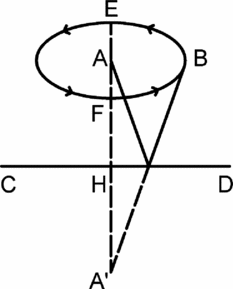
Takahashi's solution is a combination of the writings of Ver Eeck (the object occupies the foot of the perpendicular), Ovio (the eye occupies the foot of the perpendicular), Lejeune (as seen immediately above), and Kepler-Knorr (the postulate applies to perpendicular view).
I believe that Takahashi's solution is correct and that the moving perspective will reveal its importance in the next section of this article. The difficulties of interpretation felt by modern scholars are due, I believe, to lack of context. As we shall see, authors of the first century, embedded as they were in a different scientific culture, would have immediately recognized Takahashi's solution and considered it against an astronomical background.
5. Sixth principle: “If something is placed into a vessel and a distance is so taken that it may no longer be seen, with the distance held constant if water is poured, the thing that has been placed will be seen [again]” (Heiberg Reference Heiberg and Menge1895, 286; tr. Takahashi Reference Takahashi1992, 115).
This assumption formulates the principle of refraction which is not used within the propositional portion of the text. Several hypotheses were presented in order to justify its inclusion in the preface of the Catoptrica. Ver Eecke (Reference Ver Eecke1938, xxxi) and Lejeune (Reference Lejeune1957, 55–56) thought this to be a sign of the bad editing behind the Catoptrics. Knorr argued that portions of the work were lost in the course of its transmission: “The extant form of the Catoptrics is incomplete, however, for the last of the postulates which preface the work formulates the principle of refraction, and this has no relevance to any of its propositions” (Knorr Reference Knorr1985, 35 and 38). Takahashi thought Knorr's interpretation to be more natural than the one by Lejeune-Heiberg, but added a third hypothesis of his own: “I cannot deny a third possibility of interpretation, even less probable, that the postulate might have played the same historical role as the unused definitions and postulates towards the formation of the genuine Euclidean Elements” (Takahashi Reference Takahashi1992, 18).Footnote 9
In the next section I will show how the astronomical context can shed new light upon some of the principles of Catoptrica. Special attention is given to the first, the fourth, and the fifth principles, but the sixth is also referred to. In the third section, other arguments are added that may explain the complicated way in which the law of reflection is demonstrated in the Catoptrica (by means of the third principle) and may justify the inclusion of the sixth principle.
2. Astronomical formulations of the principles of Catoptrica
At some point in Plutarch's dialogue On the Face of the Moon (first century), a character states that the moon is more closely related to earth than to the other heavenly bodies; his argument is that the stars are far removed from the earth, while the moon can even be sometimes eclipsed by its shadow; his precise words are the following: “Frequently she [= the moon] does not even surmount the earth's shadow . . . but she seems to revolve so close . . . as to be screened by it from the sun. . . . Therefore we must boldly declare, I think, that the moon is within the confines of the earth in as much as she is occulted by its extremities” (διὸ λεκτέον οἶμαι θαρροῦντας ἐν τοῖς τῆς γῆς ὅροις εἶναι τὴν σελήνην ὑπὸ τῶν ἄκρων αὐτῆς ἐπιπροσθουμένην; On the Face of the Moon 925 C; tr. Cherniss Reference Cherniss and Henderson1957, 73–75). One easily recognizes the play on words involving the first principle of Catoptrica. In this case, the extremities cover the middle parts and not the other way around; the moon is said to belong to the (region of the) earth due to being covered by the two endpoints of earth, which are the body of the earth and the vertex of the cone formed by its shadow.
The same principle is again alluded to in chapters 19–20, while explaining how we fail to see the sun during eclipses and during the night, only this time no puzzles are involved:
For the rest, I think that it has been reduced by the precision of mathematics to the [clear] and certain [formula] that night is the shadow of earth and the eclipse of the sun is the shadow of the moon whenever the visual ray encounters it. The fact is that in setting the sun is screened from our vision by the earth and in eclipse by the moon; both are cases of occultation, but the vespertine is occultation by the earth and the ecliptic [= eclipse] by the moon with her shadow intercepting the visual ray. (931 F-932 A; tr. Cherniss Reference Cherniss and Henderson1957, 119–121; italics added)
Passages in italics allude to visual rays not as defined in Euclid's Optics, but in Catoptrica; the definition is used to ground a specific phenomenon: the visual ray cannot reach the sun during an eclipse because the shadow of the moon covers it (the word used is not ἐπιπρόσθησις but a synonym: ἐπισκότησις); the same cannot happen during night either because earth acts as a covering body. The more interesting expression, however, is the last in italics, which corresponds to the Greek expression ἡ δ΄ἐκλειπτικὴ τῆς σελήνης τῇ σκιᾷ καταλαμβανούσης τὴν ὂψιν. The verb used is the same that can be read in the fourth and fifth principles of Catoptrica, but the expression adds the object that blocks our vision of the sun: it is the shadow of the moon in its interception (καταλαμβανούσης) of the visual ray. Again, for someone acquainted with Catoptrica, it is unavoidable to detect the play on words. Plutarch further clarifies that this description of solar eclipses comes from Posidonius of Apameia (c. 135–51 BC): “Posidonius gave this definition: ‘The following condition is an eclipse of the sun, conjunction of the moon's shadow with whatever [parts of the earth it may obscure], for there is an eclipse only for those whose visual ray the shadow of the moon intercepts and screens from the sun’.” (ἂν ἡ σκιὰ τῆς σελήνης καταλαβοῦσα τὴν ὂψιν ἀντιφράξῃ πρὸς τὸν ἥλιον; ed. and tr. Cherniss Reference Cherniss and Henderson1957, 123; italics added).
The intermingling of astronomy and optics in the first century is not unique to Plutarch. Theon of Smyrna (fl. 100 AD), for instance, makes clear the importance of the first principle of Catoptrica within astronomy: it offers a criterion to establish the order of the spheres of the heavenly bodies.Footnote 10 Although only direct vision is directly at issue, the definition of visual ray stated at the beginning of Euclid's Optics is not enough to hold the argument; only the one stated at the beginning of the Catoptrica can serve as an argument in this case. In another passage, Theon bases the explanation of a total eclipse on a variation of the fifth principle of Catoptrica:
When the sun remains in one of the nodes and the moon in the other; and the sun, the earth, the shadow [of the earth], and the moon remain in one straight line (ἐπὶ μιᾶς εὐθείας), then necessarily the moon falls into the shadow of the Earth, and due to the fact that it [the moon] is smaller than the earth and has no light of its own, it will become no longer seen and will be said to be in eclipse (ἀφανὴς καθίσταται καὶ λέγεται ἐκλείπειν). Given the fact, to be more precise, that they remain in the diameter, so that the centre of the sun, the centre of the earth, and the centre of the moon remain in the same straight line, as we said, the whole of the moon passes through the middle of the shadow and is totally eclipsed (ὥστε ἐπὶ τῆς αὐτῆς, ὥς φαμεν, εὐθείας καταστῆναι τό τε τοῦ ἡλίου κέντρον καὶ τὸ τῆς γῆς καὶ τὸ τῆς σελήνης, διὰ μέσου τοῦ σκιάσματος σελήνη ἰοῦσα ὅλη ἐκλείπει). (Hiller Reference Hiller1878, 197–198; my translation)
The mention of a line unifying the centers of the earth, moon, and sun points to the fifth principle of Catoptrica, although in this context it is unclear whether reflection is at stake (I will come back to this below).
Cleomedes (first or second century?) enforces the writings above. Again a version of the first principle of Catoptrica explains the eclipse of the sun and a version of its fifth principle is used to account for the explanation of a total eclipse (and not just an eclipse) of the moon, as in Theon of Smyrna.Footnote 11 Additionally, Cleomedes suggests an astronomical interpretation of the sixth postulate of Catoptrica. At some point, he reports the strange case of eclipses that occur while both the moon and the sun are seen above the horizon.Footnote 12 He then offers an explanation of such a paradoxical phenomenon based on a formulation of the sixth principle of Catoptrica:
But the ray that flows out from our eyes could also be refracted on encountering air that is damp and moist, and encounter the Sun after it is already concealed below the horizon. Something similar to the latter is also observed happening in our ordinary experience. For example, if a gold ring is placed in a cup, or in some other vessel, then if the vessel is empty, the object placed within is not visible at an appropriate distance because the visual pneuma runs unimpeded down from the brim of the vessel in a straight line. But when the vessel is filled with enough water to become level with the brim, then from the same distance the ring lying within the vessel is visible. This is because the visual pneuma no longer runs [straight] down from the brim, but comes into contact with the water that has filled [the vessel], and is thus refracted, goes to the bottom of the vessel, and encounters the ring. . . . Perhaps something much like this could also on occasion produce an image in us of the two [heavenly] bodies being above the horizon after the sun has already set. (Todd Reference Todd1990 83; tr. Bowen and Todd Reference Todd and Bowen2004, 162)
Geminus (first century BC or second century AD?) argues similarly.Footnote 13 For him, the novelty appears while discussing the difference between total and partial eclipses. The way in which he expresses himself points to the fourth principle of Catoptrica, where the covering of the perpendicular accounts for the disappearance of the image:
. . . the eclipses are not equal for all [observers]; rather, there are great variations in the magnitudes of the eclipses, in accordance with the differences of the klimata. For at the same time the whole Sun is eclipsed to some, half [is eclipsed] for others, less than half for others, while for still others no part of the Sun is observed to have been eclipsed at all. For those dwelling vertically beneath the covering, the whole Sun is invisible (ὅσοι μὲν γὰρ κατὰ κάθετον οἰκοῦσι τῆς ἐπιπροσθήσεως, τούτοις ὅλος ἀθεώρητος γίνεται ὁ ἥλιος); for those dwelling partly outside the covering, a certain part of the Sun is seen to have been eclipsed; and for those dwelling wholly outside the covering not one part of the Sun is observed to have been eclipsed. (Aujac Reference Aujac2002, 61–62; tr. Evans and Berggren Reference Evans and Berggren2006, 189–190)
This account of eclipses was standard in late Antiquity. Proclus (fifth century) explains the phenomenon in this way: “This is why astronomers say that the sun is in eclipse at the time when both it and the moon are on a straight line (ἐπὶ μιᾶς εὐθείας) with our eye; for then our view of it is intercepted by the moon which has come between it and us” (τότε γὰρ ὑπὸ τῆς σελήνης ἐπιπροσθεῖσθαι μέσης αὐτοῦ καὶ ἡμῶν γενομένης; Friedlein Reference Friedlein1967, 109–110; tr. Morrow Reference Morrow1992, 89). Philoponus does the same, while commenting on Aristotle's Posterior Analytics:
Also, that the sun and moon move in the ecliptic is a cause of the eclipse of the sun, but not the proximate cause. However, that a solar eclipse occurs when the moon passes underneath the sun in its course and comes to be perpendicularly (κατὰ κάθετον) below it is the appropriate and proximate principle of the demonstration concerned with the eclipse of the sun. Also, the progression of the demonstration must make its beginning from things that are causes and primary and must end up at things that are effects and posterior. For example, beginning from screening and ending up at the eclipse: “the sun is screened by the moon, what is screened is eclipsed, therefore the sun is eclipsed.” For if we go backwards from the effect to the cause, such a thing is no longer a demonstration but a sign. For example, “the sun is eclipsed, that which is eclipsed is screened, therefore the sun is screened.” (Wallies Reference Wallies1909, 26; tr. Mckirahan Reference Mckirahan2008, 37)Footnote 14
The concept of perpendicularity became standard in explanations of the phases of the moon. Again, Geminus provides us with a fine example of this:
When the Sun rises at the [time of] winter solstice, then the middle of the illuminated [portion] faces toward the Sun, so that the straight line joining the horns of the Moon is cut in half and at right angles by the straight line leading from the center of the Sun to the [line of] bisection of the Moon (ὥστε τὴν τὰς κεραίας ἐπιζευγνύουσαν τῆς σελήνης εὐθεῖαν δίχα καὶ πρὸς ὀρθὰς τέμνεσθαι ὑπὸ τῆς εὐθείας τῆς ἀγομένης ἀπὸ τοῦ κέντρου τοῦ ἡλίου ἐπὶ τὴν διχοτομίαν τῆς σελήνης). And when the Sun rises at the [time of] summer solstice, again the middle of the illuminated [portion] is turned toward the middle of the Sun, so that, in the same way, the aforementioned straight line is bisected and cut at right angles (ὥστε ὁμοίως διχοτομεῖσθαι καὶ πρὸς ὀρθὰς τέμνεσθαι τὴν προειρημένην εὐθεῖαν). (Aujac Reference Aujac2002, 58–59; tr. Evans and Berggren Reference Evans and Berggren2006, 186–187; italics added)Footnote 15
Another example comes from Vitruvius. In De Architectura 9.2.1, he says:
According to the teaching of Berosus, who came from the state, or rather nation, of the Chaldees, and was the pioneer of Chaldean learning in Asia, the moon is a ball, one half luminous and the rest of a blue colour. When, in the course of her orbit, she has passed below the disc of the sun, she is attracted by his rays and great heat, and turns thither her luminous side on account of the sympathy between light and light. Being thus summoned by the sun's disc and facing upward, her lower half, as it is not luminous, is invisible on account of its likeness to the air. When she is perpendicular to the sun's rays, all her light is confined to her upper surface, and she is then called the new moon (“Cum ad perpendiculum ea sit ad eius radios, totum lumen ad superiorem speciem retineri, et tunc eam vocari primam”). (Rose and Müller-Strübing Reference Rose and Müller-Strübing1867, 225; tr. Morgan Reference Morgan1914, 311; italics added)
Vitruvius is quite clear as to what he means by ad perpendiculum: he means that the plane holding the terminator (that is, the line that separates the illuminated part of the moon from the non-illuminated one) is perpendicular to the rays of the sun.Footnote 16
Sometimes the sources refer to ancient authors but in such cases we cannot be sure that anachrony is not garbling the original theory. For instance, in the Life of Zenon, Diogenes Laertius (who lived somewhere between 200 and 500 AD) refers to the definition of an eclipse:
An eclipse of the sun takes place when the moon passes in front of it on the side towards us (ἐκλείπειν δὲ τὸν μὲν ἥλιον ἐπιπροσθούσης αὐτῷ σελήνης κατὰ τὸ πρὸς ἡμᾶς μέρος), as shown by Zeno with a diagram in his treatise On the Whole. For the moon is seen approaching at conjunctions and occulting it and then again receding from it. This can best be observed when they are mirrored in a basin of water (γνωρίζεται δὲ τοῦτο διὰ λεκάνης ὕδωρ ἐχούσης). (Translation by Hicks Reference Hicks1979, 249–251)Footnote 17
Be that as it may, verticality is a primeval concept in ancient astronomy and it appears to have been immediately related to moonlight, although cautiousness is mandatory when evaluating the data available. It is common knowledge that some pre-Socratics stated that the moon gets its light from the sun. Plato attributes this to Anaxagoras (Cratylus 409 A) characterizing it as a recent discovery. Parmenides is quoted as having depicted the moon as “fixing her glance forever on the sun” (Plutarch, On the Face of the Moon 929 B; Heath Reference Heath1932, xxx). Democritus appears to have realized that if the imaginary straight line extending from the moon to the sun is intercepted, an eclipse occurs; this is probably the sense of his expression: “standing in a straight line (κατὰ στάθμην) with her illuminant, she [the moon] sustains and receives the sun,” which Plutarch cites when speaking of a conjunction (On the Face of the Moon 929 C; tr. Cherniss Reference Cherniss and Henderson1957, 102–103). The expression κατὰ στάθμην is used in the sense of “perpendicular” in Aristotle (De Caelo 2.14.6). The same expression applied to the alignment of the earth, moon, and sun is also used in De Placitis, in a passage related to Thales (883 A-884 C). Thales's prediction of an eclipse must be the reason for this attribution to him of the true cause of an eclipse, but in any case the use of the word “perpendicular” in reference to the alignment of heavenly bodies is attested before Aristotle.Footnote 18
Summary
Both Catoptrica and astronomical elementary texts of around the first century use similar formulas to ground their deductions. Cross references are explicit when these formulas are in use. Astronomical arguments go beyond simple abstract geometry and refer to visual and solar rays, allowing optics an explanatory role;Footnote 19 in the case of Catoptrica, the astronomical import can be detected in a very tiny but significant detail: the fourth and fifth principles are called “phenomena,” a very strong word pointing to a very distinct and peculiar concept from the province of astronomy.Footnote 20
The sources suggest that mathematicians applied catoptrics (that is, the laws of reflection and the results depending on them) to the study of the illumination of the moon, whereas natural philosophers thought that mathematics (in this case, optics and/or catoptrics) was based on principles by no means evident and that it could not by itself fully explain the phenomenon (more about this in the beginning of the next section).Footnote 21 Cleomedes, for instance, thinks that the illumination of the moon is not caused by reflection of light; Geminus and Theon prefer to remain ambiguous in their exposition (stating that the moon receives its light from the sun can go either way). Plutarch presents both alternatives in dispute. This explains why the citations above fail to allude to anything like the second postulate of Catoptrica and use variations of the fourth and fifth principles that imply direct vision only.
However, for a mathematician trying to explain the illumination of the moon by means of catoptrics, principles 1–3 of Catoptrica indeed are able to specify the conditions under which the light of the sun is directly seen from the earth or seen by reflection on the moon (the first principle alone grounds the explanation for our viewing the sun; principles 1–3 account for the reflection of light on the moon), while principles 4–5 may be used to ground the explanation for absence of reflection during eclipses due to interposition of an opaque body and principle 6 may help to explain paradoxical eclipses, where displacement of images occurs (however, a far more interesting and not so elaborate explanation for the inclusion of this principle in the Catoptrica is presented in the next section).
This is not to say that the received text of the Catoptrica is an astronomical treatise; it suggests that ancient catoptrics provided astronomers with a corpus of mathematical results which could be applied to the study of the illumination of the moon and that Plutarch, Cleomedes, Theon, and Geminus (and those coming after) would not have failed to recognize the astronomical implications of the assumptions stated in the preface of Catoptrica. In other words, for these authors some kind of treatise like the Catoptrica would also tackle astronomical problems as part of its subject matter (on the other hand, it seems natural to consider that astronomy, on its side, may have triggered specific research in the domain of optics and catoptrics).
The astronomical import amplifies the scope of the first principle (which is properly speaking a principle of optics and not of catoptrics, as seen in section 1); this allows for an interesting (and correct) interpretation of the fourth and fifth principles which needs no further qualification and supports Takahashi's solution; furthermore, this offers a possible justification for the inclusion of the sixth principle.
3. The catoptrical explanation of moonlight
3.1. The moon as a [kind of] mirror
Having established that first century authors would have recognized the astronomical implications of the preface of Catoptrica, it remains to be inquired what astronomical content they would have acknowledged in the propositions. I will focus on Plutarch and Cleomedes and occasionally refer to other sources.
When Plutarch introduces the theory of Clearchus of Soli (a student of Aristotle who flourished in the 3rd century BC), he says:
The man [= Clearchus], you see, asserts that what is called the face consists of mirrored likenesses, that is images of the Great ocean reflected in the moon, for the visual ray when reflected naturally reaches from many points objects which are not directly visible (ἥ τε γὰρ ὄψις ἀνακλωμένη πολλαχόθεν ἅπτεσθαι τῶν οὐ κατ΄εὐθεωρίαν ὁρωμένων πέφυκεν) and the full moon is itself in uniformity and luster the finest and clearest of all mirrors. Just as you think, then, that the reflection of the visual ray to the sun accounts for the appearance of the rainbow in a cloud where the moisture has become somewhat smooth and condensed, so Clearchus thought that the outer ocean is seen in the moon, not in the place where it is but in the place whence the visual ray has been deflected to the ocean and the reflection of the ocean to us (οὐκ ἐφ΄ἧς ἐστι χώρας ἀλλ΄ὅθεν ἡ κλάσις ἐποίησε τῇ ὄψει τὴν ἐταφὴν αὐτῆς καὶ τὴν ἀνταύγειαν). (On the Face of the Moon 920 F-921 B; tr. Cherniss Reference Cherniss and Henderson1957, 40–41; italics added)
The above passage implies that: a) postulates 1 and 2 of Catoptrica are applied (objects can be seen directly – κατ΄εὐθεωρίαν; or by means of reflected rays – οὐ κατ΄εὐθεωρίαν); b) the shift of position in (convex) mirrors as dealt with in Catoptrica (props. 7–12 and 19–28) was known immediately after Aristotle and this set of results was used to account for the image appearing on the face of the moon; c) Clearchus assumed that the moon was some kind of mirror.
Vitruvius also refers to the moon as if it were a sort of mirror, whilst explaining the theories of Aristarchus of Samos: “But Aristarchus of Samos, a mathematician of great powers, has left a different explanation in his teaching on this subject, as I shall now set forth. It is of no secret that the moon has no light of her own, but is, as it were, a mirror, receiving brightness from the influence of the sun.”Footnote 22
As already seen, the fact that the moon is illuminated by the sun is ancient knowledge. However, the idea that moonlight is caused by reflection of light coming from the sun is by no means evident and faced strong criticism in Antiquity. Anaxagoras is said to have been the first to state this; sometimes, the same achievement is attributed to Empedocles (On the Face of the Moon 929 A-E; for a discussion, see O'Brien Reference O'Brien1968, 114–127). However, sources of the first century indicate that such a theory was not unanimously accepted. Some authors considered that the moon's illumination was a combination of light from its own body and from the sun's light; that is, the moon would be similar to iron: when fully heated, it would also produce light. This alternative idea can be read in Plutarch and Cleomedes (On the Face of the Moon 929 B-C; Cherniss Reference Cherniss and Henderson1957, 100–103; Lectures of Astronomy 2.4.79; Todd Reference Todd1990, 69–70; Bowen and Todd Reference Todd and Bowen2004, 141 n. 19). Both alternatives resounded through the centuries.Footnote 23
3.2. Arguments against derived light of the moon as caused by reflection
There were several arguments presented against the doctrine of reflection in antiquity. Some of them were taken from natural philosophy; for instance, if the moon is rarefied enough, it is then impossible for it to reflect light. One of the arguments is catoptrical in nature and leads to the so-called “problem of the half-moon.” Both Plutarch and Cleomedes refer to this argument, but state it differently. Plutarch explains it in On the Face of the Moon, chap. 17 (929 E-F):
Sulla then broke in and said: “No doubt this position [the moonlight that we see coming from the moon's reflection of the sun] has its plausible aspects; but what tells most strongly on the other side, did our comrade explain that away or did he fail to notice it?” “What's that?” said Lucius, “or do you mean the difficulty with respect to the half-moon?” “Exactly,” said Sulla, “for there is some reason in the contention that, since all reflection occurs at equal angles, whenever the moon at the half is in mid-heaven the light cannot move earthwards from her but must glance off beyond the earth. The ray that then touches the moon comes from the sun on the horizon and therefore, being reflected at equal angles, would be produced to the point on the opposite horizon and would not shed its light upon us, or else there would be great distortion and aberration of the angle, which is opposite.” (Tr. Cherniss:1957, 104–107)
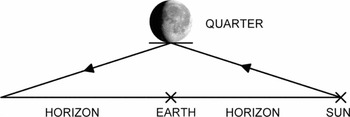
No diagrams accompany Plutarch's On The Face of the Moon; Görgemanns proposes the picture above (see fig. 4, taken from: Görgemanns Reference Görgemanns1970, 72).
Görgemanns’ interpretation of On the Face of the Moon 929 E-F (Görgemanns Reference Görgemanns1970, 72).

It should be noticed that, according to another passage of Plutarch, the difficulty regarding the half-moon could be expanded so as to include all other phases of the moon: “‘Speaking generally,’ he [= Lucius] said, ‘I marvel that they [= the Stoics] adduce against us the moon's shining upon the earth at the half and at the gibbous and at the crescent phases too’.” (Tr. Cherniss Reference Cherniss and Henderson1957, 110–111; emphasis added)
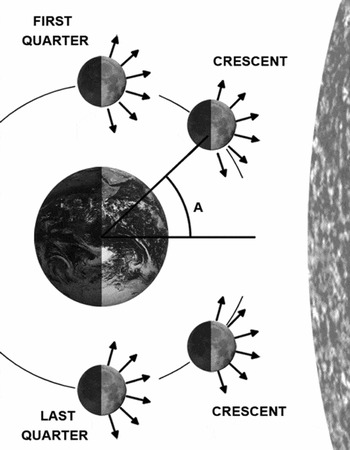
Cleomedes argues in similar terms (see fig. 5):
A diagram illustrating Cleomedes, Lectures on Astronomy II.4.56–61, according to Bowen and Todd (Reference Todd and Bowen2004, 189; slightly adapted). When angle A is 90° or less, the sun's rays reflected on the moon cannot reach the earth.

It is in addition quite evident that if the Moon caused illumination by reflection, it would not illuminate the Earth at either the crescent or the quarter. That is because objects that illuminate by reflection send out their light at right angles, and so, since the Moon is spherical, its light would be sent out to the west in the phases just mentioned, and thus straight toward the Sun. Indeed not even when full would it cause illumination with the whole of its circle. It would do so if its shape were flat, but since it is a sphere and thus has the extremities of the circle that is visible to us sloping around, illumination from these sloping [extremities] will be sent out at equal and right angles, with the result that only the very middle of the Moon will illuminate the Earth, not its whole circle. In other words, the light from the very middle of the Moon can be sent toward the Earth at right angles, but the light from its sloping [extremities], which do not face the Earth, cannot. So if the Moon caused illumination by reflection, its whole circle would not illuminate the Earth. (Tr. Bowen and Todd Reference Todd and Bowen2004, 139–140; emphasis added)
It has been noted that the text of Cleomedes seems clumsy and awkward. Apparently, either the text is corrupt or its author garbled a good argument using reflection at equal angles (as stated in Plutarch), rephrasing it in terms of reflection at right angles (Bowen and Todd Reference Todd and Bowen2004, 140, n. 14).
Be that as it may, both Plutarch and Cleomedes are appealing to mathematical content which was certainly available to them in more technical catoptrical texts. Much of ancient catoptrics is lost; however, a survey of the extant texts detects arguments which could support the passages cited above. I believe that the mathematical reasoning involved is similar to that found in the proofs concerning spherical (burning) mirrors which can be read in the closure of Catoptrica and in Diocles' On Burning Mirrors.
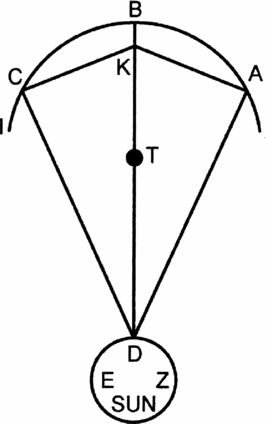
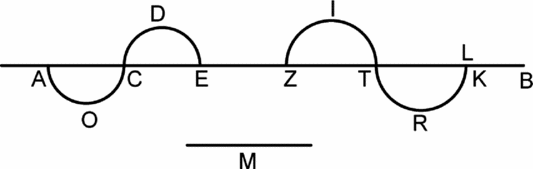
Let us take a look at the final demonstration of Catoptrica (I will refer to different cases of a demonstration with capital letters; in this case, 30A and 30B). The first part of the proof states as follows (see fig. 6):
Let there be a mirror AB, the sun EZ, and the centre of a mirror T. And from some point D to the centre T draw DT and extend it to B. Let a solar ray DC be incident [on the mirror] and be reflected to K. It will be reflected above the centre T, since the angle ICD formed at the circumference is smaller than the remaining angle BCD formed at the circumference. Further let circumference AB be equal to circumference BC, and another solar ray DA be incident from point D. Thus it is obvious that DA, when reflected, will fall on K, because circumference AB is equal to circumference BC. Moreover, it will be demonstrated in a similar manner that [solar rays], incident on the mirror from D and coming upon the circumferences equal [in length], will in general meet BT at the same [point] higher above T. (Tr. Takahashi Reference Takahashi1992, 194–197; I have changed the letter reference to accord with fig. 6 above).
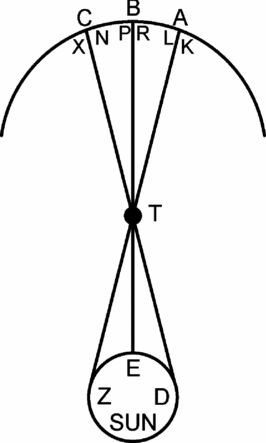
As to the second part of the proof, it reads (fig. 7):
Furthermore let there be a concave mirror ABC, and the sun DEZ. And let ETB be a solar ray [radiated] from some point such as E through T, and DTC and ZTA be solar rays [radiated] from other points videlicet D and Z. Now we have already shown [in proposition II] that solar rays [radiated] from E would fall on themselves, because angles P and R would be equal (for they are diameters), while on themselves would fall solar rays [radiated] from Z, because of angles K and L [being equal], and solar rays [radiated] from D on DC because angles N and X are equal. It is obvious that all of those [rays] are reflected on themselves: for they, drawn from the centre, form semicircles [with the mirror]; and the angles of semicircles are equal; besides, reflections occur at equal angles; they [i.e. aforesaid rays] are consequently reflected on themselves. Therefore all rays [radiated] from all points [on the sun] will fall on those solar rays that pass through the centre and [back] to the centre. (Tr. Takahashi Reference Takahashi1992, 196–199; I have changed the letter reference to accord with fig. 7 above)
Catoptrica, proposition 30A (Heiberg Reference Heiberg and Menge1895, 340–341).

Catoptrica, proposition 30B (Heiberg Reference Heiberg and Menge1895, 340–343).

Proposition 30A is compatible with Plutarch's passage cited above if point T is taken as the earth and point A (or C) as the moon, the mirror being transformed (by analogy) into an orbit. Plutarch's text mentions one single ray of the sun, as depicted in the diagram of Catoptrica for each symmetrical phase of the moon (some symmetry is also called for in order to tally with two similar lunar phases at once by Cleomedes, as cited above: “at either the crescent or the quarter”). Special cases are also covered. The proposition of Catoptrica applies not only to the half-moon but also to other phases of the moon. If the moon, earth, and sun are aligned, an eclipse occurs (Catoptrica, fifth principle); if they are not aligned, due to the inclination of the moon's orbit, the problem rests the same, but belongs to three-dimensional geometry (a catoptrical solution for this difficulty can be found below in section 4.3.). The deductive chain of Catoptrica also fits well with this interpretation. Proposition 30A employs proposition 1 (law of reflection, based on postulate 3) and proposition 3 (derived from props. 1 and 2: “In any [type of] mirrors, when an incident visual ray makes unequal angles [i.e. falls obliquely], it will be reflected neither on itself, nor on [the side of] the smaller angle” (tr. Takahashi Reference Takahashi1992, 121).
As to Cleomedes, his text may combine two possible cases of reflection of solar rays on the surface of the moon. Cleomedes may have understood that there is always at least one ray that is bounced back to the sun (= to the west) on the surface of the moon (assuming that the moon is a mirror), and that this ray may be said to be reflected at right angles if a specific tangent to the circle representing the moon is considered. Other rays would be reflected at equal angles (to the earth or in the direction opposite the sun).
It is also interesting to relate the rays depicted in the diagram illustrating Catoptrica 30B to this line connecting the sun to the middle point of the illuminated part of the moon and it is even more exciting to relate this depicted line to the opinions of Parmenides describing the moon as “fixing her glance forever on the sun” or of Democritus saying that “standing in a straight line (κατὰ στάθμην) with her illuminant, she [the moon] sustains and receives the sun” (cited above, section 1). In some context which escapes us, Catoptrica 30B could have been interpreted as illustrating the illumination of the moon as well, again T being the earth and A/B/C the moon at different stages of its orbit around the earth but near to full moon. According to the proof, the lines joining the sun to other points in the orbit close to the position of half-moon, crescent, or new moon would not reach the eye (= earth).
Finally, it is perhaps fruitful to go through the peculiarities of Catoptrica's proposition 30 having in mind that it may have been used to illustrate catoptrical issues other than burning mirrors.Footnote 24 It is distinct from all other propositions in Catoptrica because it deals with solar rays (ἀκτῖνες, radii) and not visual rays (ὄψεις, visus). Secondly, it presents two solutions for constructing burning mirrors which are not only contradictory, but false. As summarized by Takahashi: “the first solution is correct, though primitive, designating a burning point as lying on the axis of the spherical concave mirror between the centre and the mirror, and the second is false, designating the burning point as being identical with the centre. And even the correct solution is insufficient for constructing the burning mirror, since all rays falling on the whole surface are reflected to different points on the axis, although all rays falling on a given circle about the axis of the mirror are reflected to the same point” (Takahashi Reference Takahashi1992, 338; emphasis added).
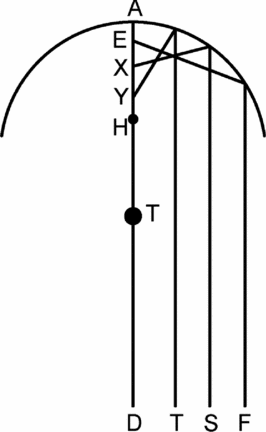
Apparently, the falsity of both proofs was already known to Diocles, who, in propositions 2–3 of his tract On Burning Mirrors showed that solar rays converge along the line (but do not meet at a single point) between the mirror at A and the midpoint H of radius AT (see fig. 8; Toomer Reference Toomer1976; Rashed Reference Rashed2002, 108–112; Knorr Reference Knorr1985, 79).
A diagram illustrating Diocles' proof that solar rays converge along the line between the mirror at A and the midpoint H of radius AT (according to Knorr Reference Knorr1985, 79; see also: Rashed Reference Rashed2002, 108–112).
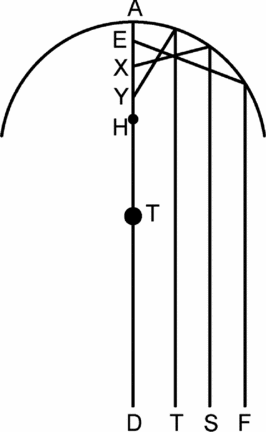
To some, this indicates that proposition 30B represents an ancient proof presenting an erroneous result accepted by geometers preceding Diocles.Footnote 25 The first case would be an intermediate step between the second case and the correct solution by Diocles. If so, we might reasonably ask why were such primitive and false proofs preserved in the closure of Catoptrica; as a matter of fact, it would have made sense to at least incorporate Diocles' correction in the text.
In this regard, it should be recalled that Diocles' correction is meant to show that spherical mirrors cannot be made to collect fire in a point; only parabolic mirrors can produce fire. A proposal for constructing spherical burning mirrors would always be an incorrect solution. However, if someone was willing to illustrate a different catoptrical problem, like the problem of the half-moon at an elementary level, a solution resembling Catoptrica 30A, would make sense. On the other hand, it is not even certain that Catoptrica 30A was added in order to provide a way to build a burning mirror, since it does not confirm that there is one single convergent point for all pairs of rays (in other words, a burning point) and it does not even refer to burning mirrors. Ptolemy himself uses the same diagram in order to show how rays converge in concave mirrors without any reference to burning mirrors (Optics, book IV, 81–82; Smith Reference Smith1996, 198). And even if it does refer to burning mirrors, it remains an interesting hypothesis that the different stages in the development of the theory of spherical burning mirrors (Catoptrica 30B > Catoptrica 30A > Diocles' Burning Mirrors 2–3), or of ancient catoptrics in general, may have corresponded to different stages in the explanation of moonlight through reflection.Footnote 26
I would not readily dismiss the hypothesis that the two cases of Catoptrica proposition 30 were preserved in the closure of Catoptrica (although an alternative and correct solution for constructing burning mirrors had become available in Antiquity), because authors felt these proofs (especially Catoptrica 30A) to be more or less appropriate to illustrate specific problems that we are no longer able to recognize, such as the problem of the half-moon (and its history), as stated by Plutarch and Cleomedes (even though it remains unclear how Cleomedes’ text is to be interpreted). Be that as it may, even if the hypothesis is wrong, my main argument rests the same: I am sure that for ancient authors the astronomical significance of catoptrical results would have been immediately recognized.
To sum up, the closest thing we have to a mathematical proof illustrating the problem of the half-moon seems to rest on Catoptrica proposition 30 (especially on the first case) and on propositions 2–3 of Diocles' Burning Mirrors. It is possible that, after the time of Plutarch and Cleomedes, authors studying the phenomenon of moonlight associated this specific issue with the closure of Catoptrica. The problem of the half-moon as an intersection between astronomy and catoptrics can be found in many medieval sources, one need only mention the philosopher and optician Roger Bacon (Burke Reference Burke1928, 150) or the Byzantine scholar Symeon Seth (Delatte Reference Delatte1939, 52–59, esp. 56). The subject appears to have been too big a scientific problem to not be addressed in catoptrical writings at some point.
The next section explains how Catoptrica could have been used to meet the objections raised by natural philosophers against an explanation of the illumination of the moon based on the laws of reflection.
3.3. Arguments in favor of derived light of the moon as caused by reflection
The arguments presented in On the Face of the Moon that could support the idea that the illumination of the moon is caused by reflection indicate how some propositions of Catoptrica should be interpreted within this broader context. There are four arguments. The first puts forward the scenario that the law of reflection is not a valid law:
In your presence, my dear Menelaus, I am ashamed to confute a mathematical proposition, the foundation, as it were, on which rests the subject of catoptrics. Yet it must be said that the proposition, “all reflection occurs at equal angles,” is neither self-evident nor an admitted fact (οὔτε φαινόμενον[!] αὐτόθεν οὔθ΄ὁμολογούμενόν ἐστιν). It is refuted in the case of convex mirrors when the point of incidence of the visual ray produces images that are magnified in one respect;Footnote 27 and it is refuted by folding mirrors, either plane of which, when they have been inclined to each other and have formed an inner angle, exhibits a double image, so that four likenesses of a single object are produced, two reversed on the outer surfaces and two dim ones not reversed in the depth of the mirrors. (On the Face of the Moon 930 A-B; tr. Cherniss Reference Cherniss and Henderson1957, 106–109)
The arguments are not clear, but it is beyond doubt that the law of reflection was under attack by the time Plutarch wrote his dialog. Plutarch's text explains such attacks: “Consequently some people take direct issue with the mathematicians and maintain that they confute the equality of the angles of incidence and reflection by the very streams of light that flow from the moon upon the earth, for they deem this fact to be much more credible than that theory” (On the Face of the Moon 930 C-D; Cherniss Reference Cherniss and Henderson1957, 108–109). We can see here the impact of astronomy in the field of catoptrics around the first century. The scientific knowledge about mirrors was in need of sophisticated arguments in order to be transformed into a sounder theory that could also account for the derived light of the moon. The derived light of the moon endangered the law of reflection, and this may well explain why in Catoptrica the law is proved by means of a complex principle based on the theory of proportions, rather than being assumed as a principle. This makes it natural to inquire: if the law of reflection was to be maintained, what arguments could preserve reflection as the cause of the derived light of the moon?
Plutarch's text presents three arguments that could save the law of reflection:
Nevertheless, suppose that this must be conceded as a favour to geometry, the dearly beloved! In the first place, it is likely to occur only in mirrors that have been polished to exact smoothness; (1) but the moon is very uneven and rugged, with the result that the rays (τὰς αὐγὰς) from a large body striking against considerable heights which receive reflections (ἀντιλάμψεις) and diffusions (διαδόσεις) of light from one another are multifariously reflected and intertwined and the refulgence itself combines with itself, coming to us, as it were, from many mirrors (οἷον ἀπὸ πολλῶν φερομένην πρὸς ἡμᾶς κατόπτρων). (2) In the second place, even if we assume that the reflections on the surface of the moon occur at equal angles (κἂν πρὸς αὐτῇ τῇ σελήνῃ τὰς ἀντανακλάσεις ἐν ἴσαις γωνίαις ποιῶμεν), it is not impossible that the rays as they travel through such a great interval get fractured and deflected (τὰς αὐγὰς κλάσεις ἴσχειν καὶ περιολισθήσεις) so as to be blurred and to bend their light. (3) Some people even give a geometrical demonstration that the moon sheds many of her beams upon the earth along a line extended from the surface that is bent away from us (κατὰ γραμμὴν ἀπὸ τῆς ἐκκεκλιμένης ὑποταθεῖσαν); but I could not construct a geometrical diagram while talking, and talking to many people too. (On the Face of the Moon 930 D-E; tr. Cherniss Reference Cherniss and Henderson1957, 108–111; emphasis added; I have inserted numbers to correspond to references in the following paragraph)
If this passage is compared with Catoptrica, it is interesting to verify that we actually find a match with some of its propositions. The first argument is about a very important aspect of the theory of catoptrics; it deals with the opposing concepts of specular reflection in smooth surfaces and of diffuse reflection on rough surfaces. One of the ways to preserve the law of reflection would be to admit that the moon is not a perfectly polished mirror, having instead an uneven surface. The question we could ask is the following: how is ancient catoptrics able to account for diffuse reflection? The answer is surprisingly stated in the passage quoted above: by using propositions 13–15 and 29 of Catoptrica, which explain how a combination of mirrors can “receive reflections and diffusions of light from one another” or can reflect “multifariously” and combine “the refulgence itself” with itself, redirecting the light of the sun back to us “as it were, from many mirrors,” to use Plutarch's expression. Here are the enunciations as translated by Takahashi:
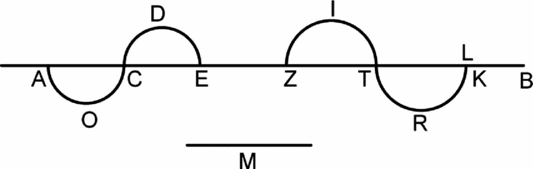
Prop. 13: It is possible to see the same object by means of several plane mirrors;
Prop. 14: It is [always] possible to see the same thing by means of as many plane mirrors [emphasis added] as one may perceive. For this purpose, however, it is requisite to construct an equilateral and equiangular polygon of mirrors;
Prop. 15: It is possible for the same thing to be seen by means of concave and convex mirrors;
Prop. 29: It is possible to construct such a mirror that there may appear [at the same time] several faces in it, of which some are larger while others are smaller; some are nearer [to the mirror] while others are farther; and some are right-side [faces] while others are left-side. (Takahashi Reference Takahashi1992, 145, 149, 153 and 193; emphasis added) (see fig. 9, above)
The figure illustrating Catoptrica, proposition 29 (Heiberg Reference Heiberg and Menge1895, 338).
The second argument assumes a different solution. According to the text, the distance between the Moon and the Earth may disturb the direction of the rays while they travel. Now, distance is a fundamental notion included in the formulation of the principle of refraction in Catoptrica. As we have already seen, Cleomedes suggests that atmospheric refraction may help to explain paradoxical eclipses; however, it may also complement the explanation of moonlight through reflection, due to its involving image displacement. Therefore, the principle may have been included in the text to prevent criticism against the law of reflection that originates in the study of moonlight. In other words, atmospheric refraction was useful to someone who wished to apply the propositions of Catoptrica in another context (as in the study of moonlight), despite its irrelevance for the propositional part of the treatise.Footnote 28
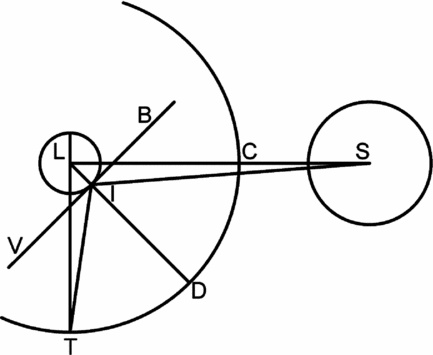
The final argument draws attention to the fact that the law of reflection tout-court, that is, with no additional propositions or principles to secure its application to the light of the moon, still accounts for some reflection of solar rays on the moon (this is exactly the same point Cleomedes makes when he says that if the light of the sun is reflected toward the earth, then it should be reflected in one point and one point of the moon only). However, here the text of Plutarch gets mysterious and although a mathematical demonstration and diagram is referred to, the idea is not developed. Kepler provided the missing proof and diagram (see fig. 11): “There is always a point on the half-moon from which the Sun's rays are reflected down to Earth. Join S, T, L, centres of Sun, Earth, Moon; with centre L and distance LT describe a circle; bisect the arc CT in D; join DL; I is the point required (VIB is in a plane which touches the Moon's circumference at I)” (KGW 11.2, 418; paraphrase by A. O. Prickard Reference Prickard1911, 76).
A diagram illustrating Aristotle, De Caelo 2.4 287b 4–14 (Heath Reference Heath1949, 172).

Kepler's illustration of Plutarch's On the Face of the Moon 930 E (KGW 11.2, 418).

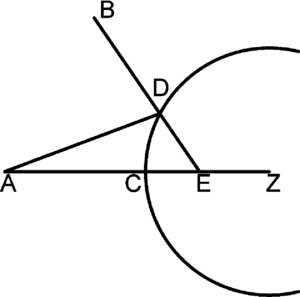
There is a very similar demonstration in Catoptrica that can play the same role as this one. It is proposition seventeen, although Kepler did not realize it. The proposition says (see fig. 12):
The figure illustrating Catoptrica, proposition 17 (Heiberg Reference Heiberg and Menge1895, 315).

In convex mirrors every object of sight is seen along the straight line drawn from the object to the centre of the sphere. Let there be a convex mirror CD and an eye B. And let visual ray BD be reflected to A, and [thus] A would be seen. Further let the centre of the sphere be Z, and visual rays, AZ and BD, be convergent on E. Therefore, since it has been assumed in appearances [i.e. in the fifth assumption] that if the place C is covered A is not seen, it will consequently be seen on a line straight with AC at the intersection E of visual rays BD and AC, just as in plane mirrors. (Tr. Takahashi Reference Takahashi1992, 157; lettering slightly changed to correspond with fig. 12)
Kepler's proof indicates that reflection of a solar ray in the direction of earth is possible and it further indicates the precise place of such reflection. Plutarch speaks less precisely and is not worried about the precise place of reflection. His contention is that there is a place in the illuminated curvature of the moon turned toward us at half-moon in which solar rays are indeed reflected to earth. Demonstration seventeen is enough to indicate that this place exists. The convex mirror should be taken as the moon, the eye as the earth, and the object as the sun.
I believe that something similar to proposition seventeen of Catoptrica may constitute the proposition referred to in On the Face of the Moon. In any case, Plutarch must have known some text on catoptrics close to the extant Catoptrica (if not the Catoptrica itself) while he was writing On the Face of the Moon.
We are now in possession of sufficient tools to address the problem of moonlight. If the moon, the earth, and the sun are aligned, an eclipse occurs; in other circumstances, proposition seventeen of Catoptrica accounts for reflection of the sun's rays toward the earth in at least one point (a partial solution admitted both by Cleomedes and Plutarch). Propositions 13–15 and 29 (as well as a postulate referring to refraction as described in the sixth principle of Catoptrica) explain how solar rays can reach the earth after reflection in several other points of the moon (polemical solution in the first century and for centuries to come).
Summary
The reading of sources like Plutarch and Cleomedes suggests that a version of the propositions of Catoptrica was studied and interpreted in the context of first-century elementary astronomy. Specifically, evidence suggests that by the time of Plutarch a version of the principles and of propositions 13–17 (and probably of propositions 29–30, as well) of Catoptrica was used in discussions on the illumination of the moon and related issues (problem of the half-moon; theory of eclipses; phases of the moon).Footnote 29
Again, it is not probable that later authors did not recognize the astronomical implications of these propositions. Evidence suggests they did. Medieval treatises on catoptrics also deal with the illumination of the moon. An author as important as Ibn al-Haytham, to give one example, intermingles experimental considerations and geometrical demonstrations clearly related to those mentioned above, in his treatise On the Light of the Moon (Kohl Reference Kohl1924–1925; Sabra Reference Sabra1989, xl-xli).
Conclusion
Authors of around the first century fiercely discussed the nature of the illumination of the moon. Their discussion involved arguments for, against, and from catoptrics. If one compares these sources with the Catoptrica attributed to Euclid, a non-literal interpretation of some of its arguments emerges. The extant text of Catoptrica incorporates principles and propositions that can be applied to the study of moonlight.
An ancient author wishing to explain the illumination of the moon by means of reflection (that is, by applying the laws of reflection and the results depending on them) had in the Catoptrica a powerful tool at his disposal. He could use principles 1–3 to specify the conditions under which the light of the sun is seen directly or seen by reflection on the moon (the first principle alone grounds the explanation of our viewing of the sun; principles 1–3 account for the reflection of light on the moon); and could use principles 4–5 to ground the explanation for absence of reflection during eclipses; he could use propositions 16–17 to prove that there is at least one point on the surface of the moon where light coming from the sun can be reflected to earth; and finally, he could present propositions 13–15 and 29 (as well as a postulate referring to refraction as described in the sixth principle of Catoptrica) to explain the illumination of a complete half of the moon, by means of diffuse reflection (or atmospheric refraction). An adversary could, on the other hand, present something similar to proposition 30A and argue for some essential property of the moon in order to dismiss the argument based on diffuse reflection.
The intermingling of catoptrics and astronomy (when dealing with topics related to the illumination of the heavenly bodies) is an historical scientific trend which can be observed in medieval authors, although we can trace it back to Antiquity.
This case study stresses that sometimes the categories we apply to the study of ancient science may vitiate our perspective of its more sophisticated and subtle results. We do not really know how scientific texts were interpreted over the centuries. The simple fact that Catoptrica uses such technical words as “phenomenon” should alert us to the fact that astronomy may be another underlying subject in it; but because authors were only focused on a theory of mirrors tout-court, the fact that the text helps to explain a different kind of object was never carefully investigated. As seen above, Kepler was surprised by the fact that Catoptrica calls some principles “phenomena,” but simply ignored the fact. However, this minor detail and the manuscript context indicate that at least parts of Catoptrica were applied to the study of astronomical phenomena. Therefore, it seems misleading to state that the agenda behind Catoptrica is to indicate a method of building “wonderful or bizarre mirrors”;Footnote 30 the received text includes material with which authors could address a complex scientific problem that took quite a while to solve: the nature of the illumination of the moon. It is natural to assume that other propositions of ancient and medieval optical treatises were used as astronomical arguments, which topic demands further research.
Acknowledgments
I would like to thank Eberhard Knobloch, Henrique Leitão, Harald Siebert, and two referees for their detailed comments and criticism on earlier versions of this paper. I would like to thank Samuel Gessner, Carlos Sá, Armando Martins, and again Henrique Leitão, who comprise the Group for the Study of Ancient Scientific Texts (Center for the History of Science, University of Lisbon), and with whom I first read and discussed the problems of Catoptrica. All the figures were drawn by my brother, André Mota; Orla Baumgarten was of great assistance with the English; to both I am deeply grateful. This research was funded by a Fellowship for Postdoctoral Researchers granted to me by the Alexander von Humboldt Stiftung/Foundation. I also acknowledge the support of the Max Planck Institute for the History of Science, where I spent the period from October 15 to November 30, 2010, as a postdoctoral fellow and where I completed the final version of the manuscript.