Introduction
Crow (Reference Crow2008) examines the current evidence for genetic associations with schizophrenia and concludes that there are ‘no grounds for regarding these genes separately or in combination as having any specific relation’ with the disease, and that the ‘emphasis on polygenes of small effect that permeates this literature obscures a challenge with implications within and outside the boundaries of psychosis research’. The basis for this conclusion is that linkage studies have failed to identify any replicated loci, and that large, well-powered studies (in particular Sanders et al. Reference Sanders, Duan, Levinson, Shi, He, Hou, Burrell, Rice, Nertney, Olincy, Rozic, Vinogradov, Buccola, Mowry, Freedman, Amin, Black, Silverman, Byerley, Crowe, Cloninger, Martinez and Gejman2008) have failed to detect association with any of the supposed susceptibility genes for schizophrenia. The counter arguments from the polygene emperors (or polygene princesses) are dismissed.
It is true that the use of small sample sizes, which are underpowered to detect loci of realistic effect size, together with over-liberal declarations of association have resulted in few of the claimed complex-trait associations being genuine (McCarthy et al. Reference Frayling, Timpson, Weedon, Zeggini, Freathy, Lindgren, Perry, Elliott, Lango, Rayner, Shields, Harries, Barrett, Ellard, Groves, Knight, Patch, Ness, Ebrahim, Lawlor, Ring, Ben-Shlomo, Jarvelin, Sovio, Bennett, Melzer, Ferrucci, Loos, Barroso, Wareham, Karpe, Owen, Cardon, Walker, Hitman, Palmer, Doney, Morris, Smith, Hattersley and McCarthy2008). However, while there is more than a grain of truth in Crow's assertions, his arguments are flawed. Over 50 genes for complex genetic disorders have been identified by association analysis, and while few are yet unequivocally confirmed for schizophrenia, there is no reason to think that polygenes are not involved and that it is a unique complex genetic disorder with its own special genomic susceptibility.
The pond is half full, not empty
One of the arguments put forward by Crow is that linkage has failed to identify any genetic loci for schizophrenia, based on the evidence that ‘two meta-analyses of the genome scans of schizophrenia and bipolar disorder revealed no strong findings and failed to agree on loci of interest even though they examined largely the same body of studies’. However, the fact that differences exist between these two meta-analyses is not damning of linkage. The Genome Scan Meta Analysis method (GSMA) which was developed by Cathryn Lewis and colleagues (Wise et al. Reference Wise, Lanchbury and Lewis1999) involves dividing the genome up in chunks or ‘bins’ and ranking these according to the evidence of linkage within each of them. It can be thought of as like a Grand Prix racing season: each genome scan is a race, with a winner, second place, etc., and each ‘driver’ (i.e. bin) is given points appropriate to their place at the end of the race. Over the ‘season’ of say 20 or 30 genome-wide scans, the bin which accumulates the most points will emerge as winner, the next in second place, and so on. This method should be unbiased, so that a locus which does consistently well, even though it does not win any races, will finish high up the table. Take the 2006 Grand Prix season for example; Kimi Raikkonen did not win a single race, and indeed failed to even finish in six races. But overall he still came fourth out of 27 drivers.
On the other hand, the Multiple Scan Probability (MSP) method (Badner & Gershon, Reference Badner and Gershon2002a) is more like the English Football Association Cup. Finishing fourth in the FA Cup will not get you noticed, but for the heroic winners it is more about whether they can also win the league to make it a ‘double’, and how well they go on to do in Europe. So GSMA will bring out consistency of linkage, and MSP the outstanding champions. It is therefore not surprising to find differences, given that these two methods measure different aspects of linkage, and some of the loci, such as 8p and 6p, are of course identified by both (Badner & Gershon, Reference Badner and Gershon2002b; Lewis et al. Reference Lewis, Levinson, Wise, DeLisi, Straub, Hovatta, Williams, Schwab, Pulver, Faraone, Brzustowicz, Kaufmann, Garver, Gurling, Lindholm, Coon, Moises, Byerley, Shaw, Mesen, Sherrington, O'Neill, Walsh, Kendler, Ekelund, Paunio, Lönnqvist, Peltonen, O'Donovan, Owen, Wildenauer, Maier, Nestadt, Blouin, Antonarakis, Mowry, Silverman, Crowe, Cloninger, Tsuang, Malaspina, Harkavy-Friedman, Svrakic, Bassett, Holcomb, Kalsi, McQuillin, Brynjolfson, Sigmundsson, Petursson, Jazin, Zoëga and Helgason2003). Furthermore, evidence in favour of linked loci was actually quite substantial, especially for GSMA analysis, where genome-wide significance (i.e. after correction for the number of tests) was clearly reached for a number of loci. Linkage is now deeply unfashionable, because blinding new technology has come along. But its results are valid, and will continue to be useful in terms of informing genome-wide association studies and identifying genes and epigenetic signals.
Absence of evidence is not evidence of absence
The first argument of the polygene emperors, that the ‘polygenes are more numerous and of smaller effect than had been thought’, and therefore have not yet been detected, is claimed by Crow to approach unfalsifiability and therefore breach Ockham's principle. But this is not correct, because the hypothesis that weak polygenes are undetectable is untrue; they are very difficult to detect, because of the issues of sample size and statistical power, and the precise genetic markers used. For example, one might think that obesity would be an easy nut to crack, as fat is easier to measure than thought disorder, and getting very large sample sizes is relatively easy. But if anything the genetics of common obesity (http://obesitygene.pbrc.edu/) has, at least until recently, fared less well than psychosis. Even now, after genome-wide association, there are still only at most a couple of true genes for the common, complex form of obesity. The most robust association is with the FTO gene, but in order to truly confirm it as a risk factor for obesity and type 2 diabetes, it took around 30 000 research subjects (Frayling et al. Reference Frayling, Timpson, Weedon, Zeggini, Freathy, Lindgren, Perry, Elliott, Lango, Rayner, Shields, Harries, Barrett, Ellard, Groves, Knight, Patch, Ness, Ebrahim, Lawlor, Ring, Ben-Shlomo, Jarvelin, Sovio, Bennett, Melzer, Ferrucci, Loos, Barroso, Wareham, Karpe, Owen, Cardon, Walker, Hitman, Palmer, Doney, Morris, Smith, Hattersley and McCarthy2007), and the index-associated polymorphism has a relatively high odds ratio, at 1.67; most associations in complex disorders have odds ratios in the range 1.1–1.4. For type 2 diabetes, joint analysis of three genome-wide association (GWA) scans (4700 cases and 5700 controls when combined) was necessary to identify several novel susceptibility variants, and allow confirmation of previously associated variants of modest effect size (McCarthy et al. Reference Frayling, Timpson, Weedon, Zeggini, Freathy, Lindgren, Perry, Elliott, Lango, Rayner, Shields, Harries, Barrett, Ellard, Groves, Knight, Patch, Ness, Ebrahim, Lawlor, Ring, Ben-Shlomo, Jarvelin, Sovio, Bennett, Melzer, Ferrucci, Loos, Barroso, Wareham, Karpe, Owen, Cardon, Walker, Hitman, Palmer, Doney, Morris, Smith, Hattersley and McCarthy2008). Sanders et al. (Reference Sanders, Duan, Levinson, Shi, He, Hou, Burrell, Rice, Nertney, Olincy, Rozic, Vinogradov, Buccola, Mowry, Freedman, Amin, Black, Silverman, Byerley, Crowe, Cloninger, Martinez and Gejman2008), with 1800 schizophrenia cases and controls, accept that they have insufficient power to detect genes with low odds ratios, so cannot be sure that these genes are excluded.
Not only are these effect sizes small, but genetic association studies (particularly genome-wide studies), mainly detect risk variants through indirect association, i.e. using genetic markers instead of actual risk polymorphisms. This proxy association reduces the odds ratio (in effect making risk genes look even weaker than they really are), and thus cuts statistical power. Crohn's disease is a useful example; single nucleotide polymorphisms (SNPs) were used as genetic markers to detect association. However, these were not the causative polymorphisms, but in linkage disequilibrium with them; when the true causative alleles were found, they had a higher odds ratio (Lewis et al. Reference Lewis, Whitwell, Forbes, Sanderson, Mathew and Marteau2007).
Of course it would be foolish to pretend that the main candidate genes for schizophrenia analysed by Sanders et al. (Reference Sanders, Duan, Levinson, Shi, He, Hou, Burrell, Rice, Nertney, Olincy, Rozic, Vinogradov, Buccola, Mowry, Freedman, Amin, Black, Silverman, Byerley, Crowe, Cloninger, Martinez and Gejman2008) are all true, but just vanishingly weak. However, some are probably true susceptibility genes; even if they are not, that does not preclude the existence of others, as yet undetected. Of course, when geneticists say they simply need more samples (and thus much more money) there is sighing and rolling of eyes. But these genes really are of small effect, and big samples really are needed.
Around the world in 80 genes
The polygene emperor argument 2, that different genes are present in different populations ‘gives no account of constancy of incidence across populations or relative uniformity of the spectrum of psychosis, e.g. with respect to sex differences, structural brain change and relationship between form of illness and age of onset’ is dismissible, because, in general population terms, this is consistent with the polygene theory and, when examining sub-populations, untrue. Thus, the existence of very many genetic risk factors for schizophrenia could lead to roughly equal risk worldwide, and some of these weak risk genes might be represented differently between populations. This is because of substantial population differences in the allele frequencies of genetic markers, and link linkage disequilibrium and haplotype patterns (www.hapmap.org) which is likely to lead to difficulties in geographical replication, especially when indirect associations rather than causative alleles are used.
These observations are commonplace in plant and animal genetics, and well established in human single gene disorders and some complex traits. Since >30% of genetic polymorphisms are very different in frequency between human geographically distinct populations, and many rare mutations are ‘private’ to a given ethnic group, this would not be surprising to see for schizophrenia. Even the robust association between the FTO gene and obesity was not replicated in all populations worldwide, indicating genetic or perhaps environmental differences between populations. In schizophrenia, risk haplotypes for the NRG1 gene and schizophrenia are different between European and Chinese Han populations, and this would clearly complicate replication analyses were population differences not considered (Tosato et al. Reference Tosato, Dazzan and Collier2005).
The wrong trousers
Crow states that argument 3 is now directly testable, i.e. ‘with technical advances genome-wide association studies are possible with half a million or more markers on populations measured in thousands’. This is true, and the results of these tests will emerge over the coming years, so we shall see. However, the arrays currently used (300 000–550 000 markers) and samples sizes (<2000) in the existing or forthcoming GWA studies are not in any case expected to provide a definitive final answer, but are a first step. Only about 60% of common genetic variation resulting from SNPs is sampled on these arrays, and there are more than 1 million SNPs not interrogated (Mägi et al. Reference Mägi, Pfeufer, Nelis, Montpetit, Metspalu and Remm2007). Other types of genetic variation, such as SNPs with rare minor alleles, which are now attracting interest (Iyengar & Elston, Reference Iyengar and Elston2007; Gorlov et al. Reference Gorlov, Gorlova, Sunyaev, Spitz and Amos2008; Ji et al. Reference Ji, Foo, O'Roak, Zhao, Larson, Simon, Newton-Cheh, State, Levy and Lifton2008), microsatellites, variable number of tandem repeats, and copy number variation, are largely ignored. The paper by Sanders et al. (Reference Sanders, Duan, Levinson, Shi, He, Hou, Burrell, Rice, Nertney, Olincy, Rozic, Vinogradov, Buccola, Mowry, Freedman, Amin, Black, Silverman, Byerley, Crowe, Cloninger, Martinez and Gejman2008), for example, assesses the NRG1 gene for association with schizophrenia in a large sample; but it does not assess microsatellite markers in this gene, which make up part of the putative risk haplotype in European populations (Stefansson et al. Reference Stefansson, Sigurdsson, Steinthorsdottir, Bjornsdottir, Sigmundsson, Ghosh, Brynjolfsson, Gunnarsdottir, Ivarsson, Chou, Hjaltason, Birgisdottir, Jonsson, Gudnadottir, Gudmundsdottir, Bjornsson, Ingvarsson, Ingason, Sigfusson, Hardardottir, Harvey, Lai, Zhou, Brunner, Mutel, Gonzalo, Lemke, Sainz, Johannesson, Andresson, Gudbjartsson, Manolescu, Frigge, Gurney, Kong, Gulcher, Petursson and Stefansson2002).
Genotyping arrays as discovery tools for disease risk alleles are intermediate technology; they can only capture a proportion of genetic variance. The proof will, of course, be in the pudding, but GWAs will not be the instant panacea that some might expect; in the end, genome-wide sequencing may be needed to see the full story. These associations are real, and worth finding even if they have a small effect on risk, as they are the best hope of understanding the underlying aetiology of schizophrenia. When there are many associations, clinically useful tools such as risk prediction and patient stratification will arise. In short, the polygene emperors may be wearing the wrong trousers but at least they still have their underpants on.
The environment is the elephant in the room
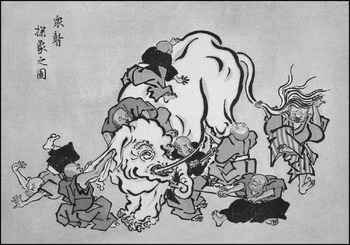
Famine, cannabis, migration, obstetric complications, viruses; the polygene emperors are not against these, indeed they might extend our careers. As the the European Network of Schizophrenia Networks for the Study of Gene–Environment Interactions (EU-GEI) notes, heritability estimates derived from twin studies do not model gene–environment interactions (G×E) – there is simply no E data to model. Thus, although the heritability of schizophrenia may be 80%, gene–environment interactions might make up the bulk of this proportion, but cannot be easily accessed. This obvious problem is generally ignored by geneticists (Fig. 1) because of the absence of reliable environmental data in genetically informative samples, and instead the hope is that we may be able to detect the genetic side of G×E using brute force and huge sample sizes. But a better approach would be for geneticists and social scientists to remove their blindfolds and address G×E in schizophrenia properly.
Blind men and an elephant: the need for integration of genetic and environmental research into schizophrenia. Many genetic effects in schizophrenia, and indeed some of the heritability effects see in twin studies, may relate to gene-environment interactions, as well as rare events and unusual genomic mechanisms, rather than simple, common genetic associations. Thus three types of genomic susceptibility factors could be envisaged: first, rare, recurrent, deleterious and high risk copy number variants or other rare mutations partly dependent on the environment for their expression; second, common, weak risk variants which are usually dependent on interaction with the environment and may have unusual features, such as sex-specificity; and third, epigenetic modifications of the genome involving DNA methylation or chromatin modification, caused by environmental events such as in utero insults. All are difficult to detect because they are either rare (as in the case of recurrent CNVs) or will not be obvious unless environmental factors are included in the analysis. (Artwork by Banksy.)

Quark, strangeness, and charm … or risk, Jim, but not as we know it
Crow is very right, at least in part. But so are the rest of us, in part. Genetic predisposition to psychosis reflects variation not only in the DNA sequence, but also in modification of the sequence itself. The search for genetic variants has not failed, but is not necessarily all as we think it will be. Complex genetic association will not only explained by regular genetic polymorphisms conferring classical increased risk. Unusual genetic mechanisms exist, such as male-specific homozygote risk for schizophrenia at the GNB1L locus on chromosome 22q11, an as yet rare example of ‘over-dominance’ or heterozygote advantage in a human disease, are being replicated (Williams et al. Reference Williams, Glaser, Norton, Williams, Pierce, Moskvina, Monks, Del Favero, Goossens, Rujescu, Giegling, Kirov, Craddock, Murphy, O'Donovan and Owen2008). It is also becoming clear that copy number variation is a probable cause of schizophrenia (Kirov et al. Reference Kirov, Gumus, Chen, Norton, Georgieva, Sari, O'Donovan, Erdogan, Owen, Ropers and Ullmann2008), as it is for autism (Sebat et al. Reference Sebat, Lakshmi, Malhotra, Troge, Lese-Martin, Walsh, Yamrom, Yoon, Krasnitz, Kendall, Leotta, Pai, Zhang, Lee, Hicks, Spence, Lee, Puura, Lehtimäki, Ledbetter, Gregersen, Bregman, Sutcliffe, Jobanputra, Chung, Warburton, King, Skuse, Geschwind, Gilliam, Ye and Wigler2007); deletions in genome sequence may segregate in the population, they may arise de novo in gamete formation, or they may arise somatically in the developing body and even explain discordance between DZ twins (Bruder et al. Reference Bruder, Piotrowski, Gijsbers, Andersson, Erickson, de Ståhl, Menzel, Sandgren, von Tell, Poplawski, Crowley, Crasto, Partridge, Tiwari, Allison, Komorowski, van Ommen, Boomsma, Pedersen, den Dunnen, Wirdefeldt and Dumanski2008). Epigenetic factors such as DNA methylation or chromatin modification have the extraordinary scope of being able to have their effect over several minutes or several generations in response to environmental factors; there is microRNA, and more strange fruit to come.
It is widely thought that these unusual genomic or epigenetic factors are not consistent with the high heritability and linkage signals seen for schizophrenia, but this is not the case. De novo mutations can be transmitted for a few generations before they are extinguished by strong negative selection pressure. They arise most commonly during gamete formation (Turner et al. Reference Turner, Miretti, Rajan, Fiegler, Carter, Blayney, Beck and Hurles2008), and thus would tend to be concordant in MZ twins and discordant in DZ twins, but of course they can also arise somatically and will account for differences in MZ twins as well (Bruder et al. Reference Bruder, Piotrowski, Gijsbers, Andersson, Erickson, de Ståhl, Menzel, Sandgren, von Tell, Poplawski, Crowley, Crasto, Partridge, Tiwari, Allison, Komorowski, van Ommen, Boomsma, Pedersen, den Dunnen, Wirdefeldt and Dumanski2008); the overall tendency, however, will be to contribute to evidence for heritability, but not to linkage, where they might be too rare at any given locus to show up as a linkage peak except in individual large families. On the other hand, increased risk of a disease caused by a common environmentally caused epigenetic modification of the foetal genome at a specific locus would not contribute to heritability as MZ and DZ twins should be equally affected, but could contribute to linkage peaks if transmitted across several generations, as seems possible, as the epigenetic label could segregate with the disease in families. This could lead to a ‘ghost’ locus, where a linkage peaks occurs but appears to have no underlying causative genetic variation when tested by association. Efforts are already underway to explore this hypothesis (Mill et al. Reference Mill, Tang, Kaminsky, Khare, Yazdanpanah, Bouchard, Jia, Assadzadeh, Flanagan, Schumacher, Wang and Petronis2008).
So we can see that the house of biology is a large and many-splendoured palace, where there is room for polygene emperors, copy number kings, epigenetic evangelists, heterotic heathens, overdominant autocrats, and the understanding they will bring to the aetiology of schizophrenia will all will benefit the patient in the end. However, as Hans Christian Andersen said, only a real princess possesses the delicacy to feel a pea through twenty mattresses and twenty feather beds. In the case of schizophrenia, we need polygene princesses to detect the peas through the intervening and obscuring mattresses.
Acknowledgements
David Collier is funded by the European Commission Framework VI programmes SGENE and MICROSAT.
Declaration of Interest
David Collier has received research funding and consultancy fees from pharmaceutical companies.