Atrial septal defect is a common congenital heart disease detected in adults.Reference Campbell 1 Percutaneous closure of secundum atrial septal defect has become an accepted alternative to surgical closure, with a procedural success rate of 95%.Reference Du, Hijazi, Kleinman, Silverman and Larntz 2 Transcatheter atrial septal defect closure provides decreased hospital stays, decreased surgical morbidity, quick recovery from the procedure, and lack of surgical wound as compared with surgical closure.Reference Du, Hijazi, Kleinman, Silverman and Larntz 2 , Reference Thomson, Aburawi, Watterson, Van Doorn and Gibbs 3
In 1948, the World Health Organization defined health as “being not only the absence of disease and infirmity but also the presence of physical, mental, and social well-being”. 4 The “quality of life” is a subjective phenomenon, which refers to the individual perception of physical, psychological, and social domains of health, which are influenced by a person's experiences, beliefs, and expectations.Reference Testa and Simonson 5 In the last decade, assessment of quality of life in patients with congenital heart disease undergoing invasive treatment has become an important outcome measure in addition to mortality and morbidity.Reference Lane, Lip and Millane 6 – Reference Moons, Van Deyk and Marquet 8 Several studies investigated the quality of life in patients with congenital heart disease,Reference Lane, Lip and Millane 6 – Reference Simko and McGinnis 10 but little is known about the quality of life in adult patients with atrial septal defect undergoing percutaneous closure.
The aim of this study was to compare the quality of life of adult patients who underwent percutaneous atrial septal defect closure with that of matched healthy control participants.
Materials and methods
Adult patients who had undergone percutaneous atrial septal defect closure between 2008 and 2012 in a tertiary centre in Turkey and their matched healthy controls were invited to participate in the study. A total of 69 atrial septal defect patients who were in follow-up after percutaneous closure and 69 matched healthy controls were recruited. Patients were matched with healthy controls according to age, gender, educational level, perception of economic status – low, middle, or high level of income – and marital and employment status – 1:1matching. Data on socio-demographic characteristics concerning age, gender, educational level, employment, marital, and economic status were recorded for every participant. Clinical data including atrial septal defect device size, pre- and post-procedural echocardiographic findings, and data concerning co-morbidities and current medications were also recorded. We excluded patients who were < 18 years old, were not literate or were not willing to participate in the study, as well as patients with a history of another congenital heart disease accompanying atrial septal defect. Patients who had undergone percutaneous atrial septal defect closure within the last 3 months were also excluded.
Control subjects participated voluntarily in the study and were obtained from a random community sample. Independent researchers visited universities, companies, and houses in our geographic region. They explained the aim and the procedure of the study, and persons who were willing to participate in the study were recruited. Control subjects were matched by age, gender, perception of economic status – low, middle, or high level of income – and education, marital, and employment status – 1:1matching.
Quality of life
Short Form-36 was used to assess the quality of life. Short Form-36 is a widely used generic quality of life scale with 36 items combined into eight domains to measure physical functioning, role functioning, social functioning, mental health, vitality, pain, and general health perceptions.Reference Ware and Sherbourne 11 The Short Form-36 generates a score for each domain, ranging from 0 to 100. Higher scores indicate better perceived health status. The Short Form-36 has been extensively used to assess quality of life in patients with congenital heart disease.Reference Lane, Lip and Millane 6 , Reference Kamphuis, Ottenkamp and Vliegen 12 , Reference Fteropoulli, Stygall, Cullen, Deanfield and Newman 13 The Turkish version of Short Form-36 has been validated.Reference Kocyigit, Aydemir, Fisek, Ölmez and Memi 14
The study was approved by the local ethics committee and was conducted in accordance with the Declaration of Helsinki. Patients and healthy controls provided informed consent before participating in the study.
Statistical analysis
Data are presented as frequencies or mean values ±standard deviation. For continuous variables, the difference between the groups was examined by an unpaired Student's t-test or one-way ANOVA. In case of categorical variables, comparisons were made with χ2 test. The association between age, educational level, economic status, and the quality of life outcome measures was examined with Pearson's correlation. All tests were two sided, and a p-value < 0.05 was considered statistically significant.
Results
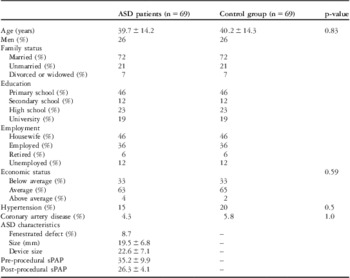
The mean age of the patients with atrial septal defect was 39.7 ± 14.2, and 26% were male. Table 1 shows the socio-demographic and clinical characteristics of the patients and the control group. Percutaneous atrial septal defect closure was successfully performed in all patients. There were no major complications or need for reverting from percutaneous approach to surgical closure in the study population. There was one patient who had atrial fibrillation attack after the procedure, which was electrically cardioverted and did not recur during the follow-up.
Socio-demographic and clinical characteristics of the patients and the control group.

ASD = atrial septal defect; sPAP = systolic pulmonary artery pressure.
The mean follow-up time was 18.0 ± 13.8 months. There was no residual shunt on transthoracic echocardiography in any of the patients. In all, 31% of the patients reported atypical chest pain, 16% reported palpitations, and 11% reported shortness of breath at the time of quality of life assessment. Patients who had palpitations were further investigated with Holter monitoring and no serious arrhythmia was detected.
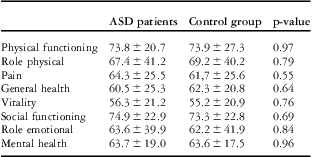
The scores of the Short Form-36 instrument are presented in Table 2. The mean scores of the eight domains of the Short Form-36, namely, physical functioning, role physical, social functioning, mental health, vitality, pain, role emotional, and general health were similar in atrial septal defect patients and the control group.
The Short Form-36 domain scores in ASD patients and the control group.

The association of socio-demographic factors – that is, age, gender, educational level, economic, marital, and employment status – of the patients with the quality of life measurement parameters was investigated. The only socio-demographic variable that was found to be associated with quality of life outcome parameters in the patient group was educational level. Higher educational level was significantly associated with better mental health and better general health perception (r = 0.248, p = 0.04; r = 0.315, p = 0.008, respectively).
Discussion
Transcatheter closure can be performed in most of the adult patients with secundum atrial septal defect.Reference Spies and Timmermanns 15 , Reference Fischer, Stieh, Uebing, Hoffmann, Morf and Kramer 16 Successful closure is achieved in 95% of patients with excellent intermediate and long-term clinical results.Reference Du, Hijazi, Kleinman, Silverman and Larntz 2 , Reference Spies and Timmermanns 15 In this study, we evaluated the patients’ perspective and found that adults who had undergone percutaneous atrial septal defect closure perceive their quality of life to be as good as their healthy counterparts.
Quality of life of adult congenital heart disease patients has been investigated in previous studies.Reference Lane, Lip and Millane 6 – Reference Simko and McGinnis 10 , Reference Kamphuis, Ottenkamp and Vliegen 12 Patients with a broad spectrum of congenital heart diseases and treatment attitudes have been evaluated in these studies reporting controversial results. A recent review explored the quality of life of adult congenital heart disease patients and reported that the evidence indicates that adult patients with congenital heart disease have diminished quality of life in terms of physical functioning and perception of general health.Reference Fteropoulli, Stygall, Cullen, Deanfield and Newman 13 Moons et alReference Moons, Van Deyk, De Geest, Gewillig and Budts 17 reported that severity of the congenital heart disease, which was defined according to the initial diagnosis, illness course, and current functional status, was marginally associated with the patients’ quality of life. However, there are little data about the quality of life and perceived well-being of adult atrial septal defect patients undergoing percutaneous intervention. Cohen et al investigated the quality of life and psychological well-being of 27 elderly patients that is > 60 years old who underwent percutaneous atrial septal defect closure.Reference Cohen, Daniela, Yalonetsky, Gagin and Lorber 18 Although depressive and anxiety symptoms of the patients were not different from those of controls, they reported worse quality of life. However, employment and economic status of the patients were significantly different from the control group in this study. Most of the control group were active and well-functioning old people, which hampers the comparability of the results with regard to quality of life. Quality of life is a multidimensional construct that includes disease-related symptoms and physical functioning, as well as psychological and social functioning.Reference Swenson and Clinch 19 , Reference Kovacs, Sears and Saidi 20 It is known that socio-demographic factors have influence on quality of life in both healthy and chronically ill individuals.Reference Hemingway, Nicholson, Stafford, Roberts and Marmot 21 , Reference Vigl, Niggemeyer, Hager, Schwedler, Kropf and Bauer 22 Therefore, the present study compared the perceived quality of life of the patients with that of the control subjects matched according to age, gender, economic, education, and marital status in order to strengthen the comparability of the results. We found that adult patients who underwent percutaneous atrial septal defect closure have quality of life as good as their healthy counterparts. In accordance with our results, Van De Bruaene et alReference Van De Bruaene, Buys, Vanhees, Delcroix, Moons and Budts 23 found that patients with repaired atrial septal defect perceive health in an almost similar manner to that of the general population. Another study that included congenital heart disease patients who were operated on mainly atrial septal defect had quality of life similar to that of age- and gender-matched standard population.Reference Immer, Althaus, Berdat, Saner and Carrel 24
This study showed that higher educational level was significantly associated with better quality of life outcome parameters in atrial septal defect patients. Vigl et alReference Vigl, Niggemeyer, Hager, Schwedler, Kropf and Bauer 25 demonstrated that congenital heart disease patients with higher educational level perceive their quality of life to be better than those with lower level of education. Higher education might facilitate in coping with the difficulties related to the disease.
Limitations
All the patients who underwent percutaneous atrial septal defect closure in our centre could not be enrolled in the study, as some of them were followed up in other local centres after the procedure. In addition, illiterate patients were not included in the study. This may have caused a selection bias. Second, pre-procedural quality of life assessment was not performed. Comparison of the pre- and post-procedural quality of life outcomes would have reflected the possible change that may have occurred following atrial septal defect closure. However, to the best of our knowledge, this is the first study that investigated the quality of life in adult patients who underwent percutaneous atrial septal defect closure compared with matched healthy controls. This study assessed the results of percutaneous atrial septal defect closure from the patient's perspective and showed that there are no limitations in subjective quality of life in atrial septal defect patients following percutaneous closure.
Acknowledgements
The authors gratefully thank Sabriye Kahya and Kübra Kadan for their assistance in recruiting control subjects.
Financial Support
This research received no specific grant from any funding agency, commercial or not-for-profit sectors.
Conflicts of Interest
None.