1 Introduction
In many languages, consonant clusters are targeted by phonological processes that in some intuitive sense make them simpler. Familiar examples include consonant deletion and vowel epenthesis. One language with a rich array of consonant-cluster processes is the variety of English spoken in Singapore (Tay Reference Tay and Pride1982, Mohanan Reference Mohanan1992, Bao Reference Bao, Foley, Kandiah, Bao, Gupta, Alsagoff, Lick, Wee, Talib and Bokhorst-Heng1998, Poedjosoedarmo Reference Poedjosoedarmo, Brown, Deterding and Ee Ling2000, Lim Reference Lim2007). Singapore English consonant-cluster processes are theoretically interesting for two main reasons. First, the processes involve extensive variation: one word may have several variant pronunciations, typically with systematic preferences among the variants. Second, the processes interact in ways that result in phonological opacity: a process may apply even if its structural conditions are not met on the surface (overapplication), or it may not apply even if its structural conditions are met on the surface (underapplication). This raises two questions: what explains the variation and systematic preferences for individual variants and how do the processes interact? Our goal in this paper is to give principled answers to these questions.
We start with a brief sociolinguistic note. A former British colony, self-governed since 1959, briefly unified with Malaysia, and independent since 1965, Singapore is a city state of approximately 4 million people. The population is made up of approximately 77% Chinese, 14% Malay, 8% Indian and 1% persons of other races (Leow Reference Leow2001, cited in Lim & Foley Reference Lim and Foley2004: 2). In the 1980s, the Singapore government moved to establish a school system with English as the medium of instruction in all schools. By 1987, all schools were converted to become English-medium (Lim & Foley Reference Lim and Foley2004: 5). The educational policy is one of ethnicity-based bilingualism: every child is educated in English and in one of the three other official languages, Mandarin, Malay or Tamil, depending on the student's ethnicity. This means that English is the only bond shared by everybody, at least in the younger generation (Schneider Reference Schneider2003: 264), and serves as the lingua franca for interethnic communication, especially among the younger and more educated, particularly in more formal settings (Lim & Foley Reference Lim and Foley2004: 5–6). Today's Singapore English is a stabilised variety, with distinctive phonological, syntactic and lexical properties. It has undergone ‘structural nativisation’ and has emerged as the symbolic expression of the country's novel multicultural identity (Schneider Reference Schneider2003: 265–266). For an overview of various aspects of Singapore English, we refer the reader to the collection of articles in Lim (Reference Lim2004b).
Our discussion is structured as follows. §2 provides the background by reviewing Mohanan's (Reference Mohanan1992) study of consonant-cluster processes in Educated Singapore English. This study establishes the underlying representations, identifies the main cluster processes and works out their interactions in terms of rule ordering. §3 presents new quantitative results from an elicitation study of /sp/ clusters. The study focuses on Metathesis, which is one of the central rules in Mohanan's system and one that exhibits both variation and opacity. §4 uses these results to assign cluster processes to morphological levels. §5 proposes an optimality-theoretic analysis of variation and opacity. Two main conclusions emerge. First, the structure of variation and preferences follows from the phonological grammar. The key observation is that factorial typologies impose strict limits on possible variation patterns that hold independently of constraint rankings and independently of specific assumptions about how the grammar represents variation. Second, the evidence is consistent with the hypothesis that phonological opacity has only one source: the interleaving of phonology and morphology. §6 concludes the paper.
2 A rule-based analysis of consonant-cluster processes
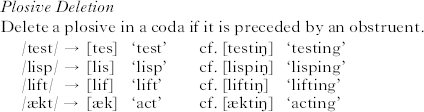
Mohanan (Reference Mohanan1992: 117–123) describes five major consonant-cluster processes in Educated Singapore English, stating them as five rules. He starts his discussion by identifying the rule of Plosive Deletion, given in (1). Note that the underlying final plosive is motivated by its appearance in the ing-form.Footnote 1
(1)

The rule of Metathesis is stated in (2). The rule only applies to /sp/ clusters.
(2)
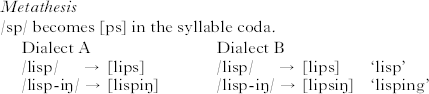
Metathesis involves two kinds of variation. First, there are two Metathesis dialects: speakers who metathesise only in lisp (Dialect A) and speakers who metathesise even in lisping (Dialect B). Mohanan points out that these data alone do not warrant positing an underlying /lisp/ in Dialect B. If this is all the data we have, we must conclude that the underlying form is simply /lips/. Insisting that it should be /lisp/ and positing a rule of Metathesis would be an instance of ‘colonialism in phonological description’ (Mohanan Reference Mohanan1992: 111). Second, the environments of Plosive Deletion and Metathesis overlap: /lisp/ yields either [lis] or [lips], depending on which rule applies. In addition, there is opacity: in dialects where /test/→[tes], but /lisp/→[lips] (*[lis]), Plosive Deletion counterbleeds Metathesis. This means that Metathesis must be ordered before Plosive Deletion.
The next two rules are Voicing Assimilation and Epenthesis, stated in (3). Both rules are familiar from standard varieties of American and British English.
(3)
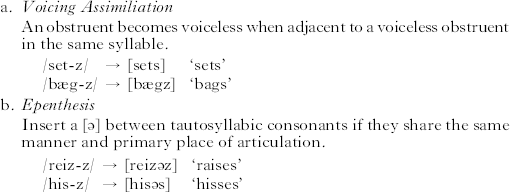
These rules enter into various opaque interactions. First, according to Mohanan, Epenthesis counterbleeds Voicing Assimilation: /his-z/→hiss→[hisə s] (*[hisə z]). Second, Metathesis counterfeeds Epenthesis: /grasp-z/→grasps→grapss→[graps] (*[grapsə s]). Mohanan uses the second fact to argue for Metathesis even in Dialect B: if the underlying form were simply /lips/, with no Metathesis, it should behave identically to /læps/ ‘lapse’ before a following /z/. Mohanan notes that this is not the case: Epenthesis applies in [læpsə s] ‘lapses’, but not in [lips] ‘lisps’. This contrast can be explained if the underlying forms are /læps/ vs. /lisp/, and Dialect B has a Metathesis rule. We will come back to this argument shortly.
Finally, Mohanan identifies the rule of Degemination, stated in (4). This rule applies transparently at the end of the derivation. The following examples show that Voicing Assimilation feeds Plosive Deletion and Metathesis, which in turn feed Degemination.
(4)

These process interactions entail the following rule ordering: Voicing Assimilation<Epenthesis<Metathesis<Deletion<Degemination. This is illustrated in (5) for five underlying forms. All processes are assumed to be obligatory.
(5)

The opaque interactions are summarised in (6):
(6)

The system exhibits remarkably deep opacity. Voicing Assimilation must precede Epenthesis, Epenthesis must precede Metathesis, and Metathesis must precede Deletion. This observation is theoretically interesting, as it appears to provide an argument against Stratal Optimality Theory (Kiparsky Reference Kiparsky2000, Reference Kiparsky, Nelson and Manninen2003), which hypothesises that opacity always involves pairs of processes across morphological levels, of which there are three: the stem level, the word level and the postlexical level. For Singapore English, four levels appear to be required: Level 1 (Voicing Assimilation), Level 2 (Epenthesis), Level 3 (Metathesis) and Level 4 (Deletion). Mohanan's analysis is thus incompatible with Stratal Optimality Theory. We now turn to a richer empirical data set that will allow us to test Mohanan's generalisations and help us better understand the variation and interaction of cluster processes in Singapore English.
3 Quantitative patterns in /sp/ clusters
In this section, we report the results of a quantitative study of Metathesis in /sp/ clusters. The data come from an elicitation experiment conducted by K. P. Mohanan and Tara Mohanan in collaboration with the second author at the National University of Singapore in the spring of 2000. The subject pool consisted of 56 undergraduates, all participants in a linguistics course at the Department of English Language and Literature. A reading experiment was chosen, because /sp/ clusters are relatively rare in naturalistic conversations. Metathesis was a natural choice for many reasons: it is variable, it interacts opaquely with both earlier and later processes, it is typologically rare compared to e.g. plosive deletion, which is attested in most dialects of English, and it is easy to hear and therefore easy to study.
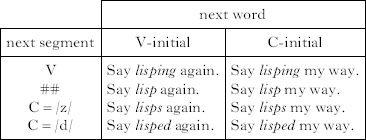
Given the results of earlier studies of consonant-cluster processes (e.g. t, d-deletion; Guy Reference Guy and Labov1980, Reference Guy1991a, Reference Guyb, Labov Reference Labov, Hinskens, van Hout and Wetzels1997), the experiment focused on the effect of the segment immediately after the /sp/ cluster. Each stimulus word contained an /sp/ cluster followed by a vocalic suffix (/-iŋ/), a word boundary or a consonantal suffix (/-z, -d/). The words were embedded in a carrier sentence where the first segment of the following word was either a vowel (again) or a consonant (my). The stimuli are shown in Table I.
The stimuli.
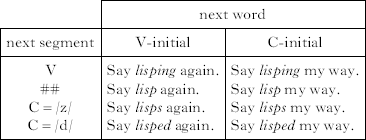
The eight stimuli were embedded in a list of 17 sentences (Appendix A). The subjects were asked to read through the list twice in the same order. The procedure was designed to yield a total of 896 tokens (8 stimuli×56 speakers×2 repetitions). In reality, only 883 tokens were obtained: one speaker did not repeat the stimuli, and another only repeated the first three. Note that a reading task of this kind yields data from a fairly formal register of the language, suggesting that the observed cluster processes persist even under conditions where the subjects are speaking carefully.
The recordings were transcribed by the third and fourth authors, with the aid of Praat (Boersma & Weenink Reference Boersma and Weenink2008). Of the 883 tokens, 68 were excluded for various reasons. 42 were discarded at the transcription stage: there were 23 tokens where the transcribers disagreed and 19 tokens that they found uninterpretable. We further excluded 26 tokens that occurred only once (listed in Appendix B). This resulted in 815 remaining tokens, which cover about 92% of the elicited data. Finally, the corpus was annotated for phonological and morphological variables.
We found evidence for eleven cluster processes. Examples are listed in (7). The right-hand column indicates how many times each process occurs in the aggregate data. Perhaps the most striking novelty is p-copy, e.g. /lisp-iŋ/→[lipspiŋ], a process not described by Mohanan (Reference Mohanan1992), but robustly present in our data. What makes p-copy surprising is that it complicates the cluster instead of simplifying it.
(7)

The processes fall into three broad categories, based on their phonetic characteristics: reordering (Metathesis, Copy), epenthesis and lenition (Fricativisation, Assimilation, Deletion, Degemination). In the present study, we focus on reordering and epenthesis, abstracting away from lenition. This is motivated by both theoretical and practical considerations. On the theoretical side, we will argue that epenthesis and reordering are part of the lexical phonology of the language, whereas all lenition processes are postlexical. On the practical side, epenthesis and reordering tend to be easier to hear, suggesting that the transcriptions are probably most reliable in this domain.
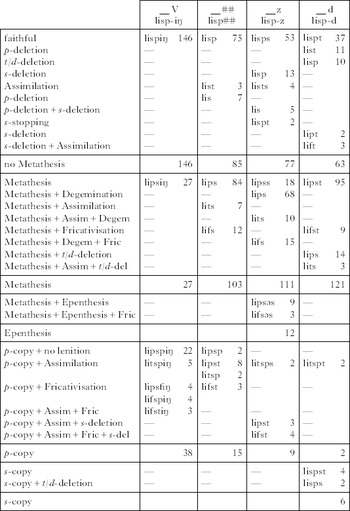
Table II breaks down the data by the segment immediately following the cluster within the word. The data are divided into five major groups: no Metathesis, Metathesis, Epenthesis, p-copy and s-copy. Most groups contain further subdivisions based on lenition processes. For the purposes of our analysis, these variants will be treated as equivalent.
Cluster data classified.

Data classification is not always straightforward. For example, we have treated /lisp-z/→[lips] as Metathesis+Degemination instead of e.g. medial s-deletion. Such ambiguities can be hard to resolve conclusively. The best we can do is to be explicit about the way we classified the data. Our classification procedure is given in Appendix C. Abstracting away from lenition, we are left with the forms in (8).
(8)
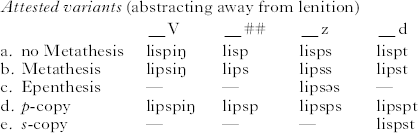
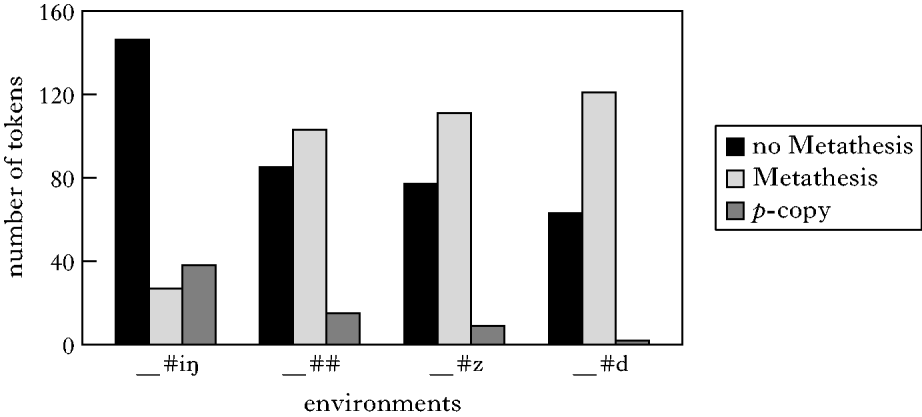
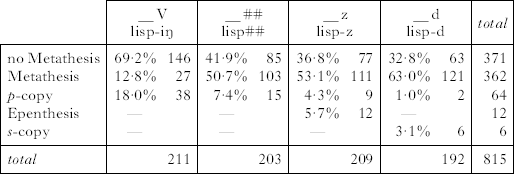
We now examine the effect of the following segment within a word. This effect is visible from the statistics in Table III, depicted graphically in Fig. 1. We observe the following patterns: (i) Metathesis is most common before /-d/, slightly less common before /-z/, again slightly less common at the word boundary and least common before /-iŋ/; (ii) p-copy shows the reverse pattern.
The following segment effect within a word. Epenthesis and s-copy do not occur in all environments and have been omitted.
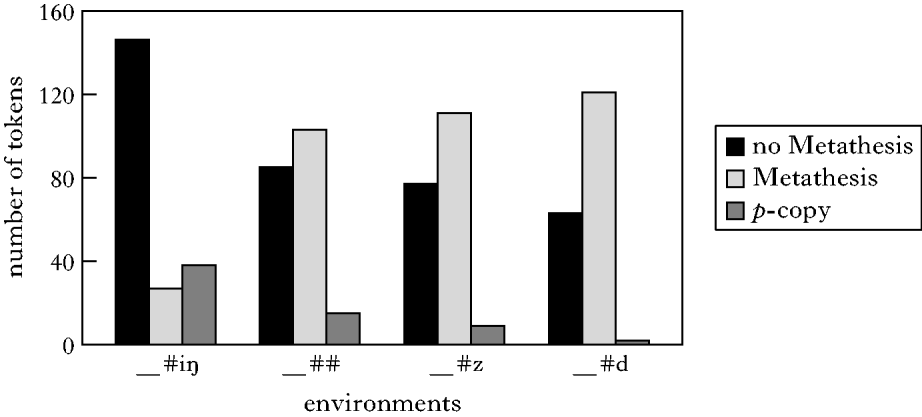
The following segment effect within a word (aggregate data).
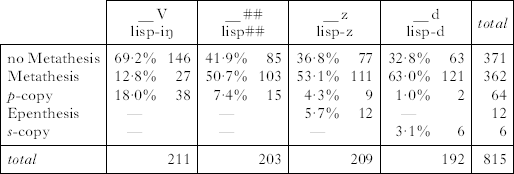
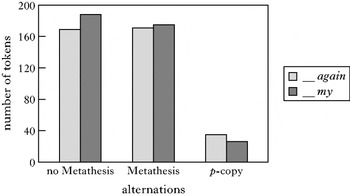
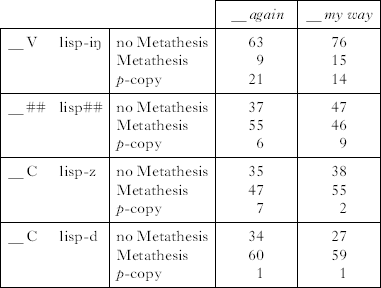
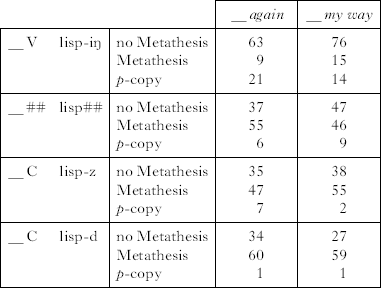
Next, we examine the following segment effect across words. Table IV breaks down the data by the following word: again with an initial vowel vs. my with an initial consonant for each word-internal environment. The graph in Fig. 2 shows the overall picture, with all word-internal environments collapsed together. We observe that the following word has no obvious effect on Metathesis and p-copy.Footnote 2
The absence of the following segment effect across words: all environments.

The absence of the following segment effect across words.
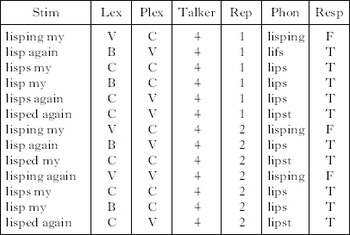
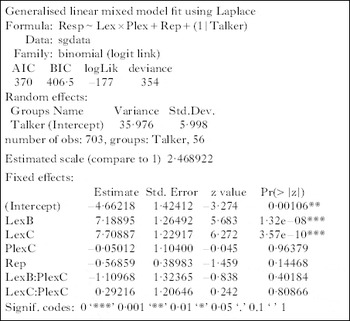
In order to better understand the quantitative structure of the data, we used mixed-effects logistic regression to predict the presence vs. absence of metathesis from a number of predictor variables.Footnote 3 We were primarily interested in the effects of the following lexical segment, the following postlexical segment and their interaction. Since the subjects read each stimulus twice, we included repetition in the model in order to tease apart any possible effect it may have on the outcome. Finally, we included speaker in the model as a random variable. The modelling was done in the R computational statistics programming environment (Baayen Reference Baayen2008). The structure of the dataframe is illustrated in Table V for one speaker. A summary of the model is shown in Table VI.
The dataframe.
Stim=stimulus; Lex=lexical environment (V=vowel; C=consonant; B=boundary); Plex=postlexical environment; Talker=speaker identifier; Rep=repetition (1=1st repetition; 2=2nd repetition); Phon=what the transcribers heard; Resp=response (T=Metathesis; F=no Metathesis).

Model summary.

The regression coefficients are listed under ‘Estimate’ in Table VI. We see that the following lexical segment matters to Metathesis: the positive coefficients of LexB and LexC indicate a strong positive correlation between Metathesis and the following boundary or consonant (p=0). In contrast, the following postlexical segment (PlexC), repetition (Rep) and lexical–postlexical interactions (LexB:PlexC, LexC:PlexC) contribute nothing to the model. The absence of postlexical effects is not surprising in the case of lisping, lisped and lisps, where there is intervening material between /sp/ and the first segment of the next word, but the same holds true even in lisp, where there is no such intervening material. In fact, in this case there is slightly more Metathesis before vowels than consonants, although the difference is not statistically significant (p=0·1847; Fisher's exact test). The evidence is thus consistent with the hypothesis that Metathesis is lexical, not postlexical.
We conclude that Metathesis is sensitive to the phonological environment within words, but not across words. In terms of Lexical Phonology and Morphology (e.g. Kiparsky Reference Kiparsky and Yang1982, Mohanan Reference Mohanan1986), this finding implies that Metathesis is a lexical, not a postlexical process.Footnote 4 Combined with Mohanan's (Reference Mohanan1992) analysis, this fact has immediate consequences for the analysis of opacity. We will explore these consequences in the following section.
4 Process interaction
4.1 First approximation
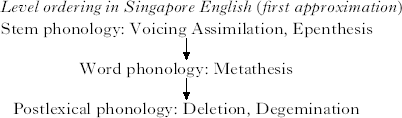
Lexical Phonology and Morphology (see e.g. Kiparsky Reference Kiparsky and Yang1982, Mohanan Reference Mohanan1986; cf. Goldsmith Reference Goldsmith and Goldsmith1993) and Stratal Optimality Theory (Kiparsky Reference Kiparsky2000, Reference Kiparsky, Nelson and Manninen2003; see also McCarthy & Prince Reference McCarthy and Prince1993, Kenstowicz Reference Kenstowicz1995, Bermúdez-Otero Reference Bermúdez-Otero1999, Rubach Reference Rubach2000, Ito & Mester Reference Ito, Mester, Féry and van de Vijver2003, Anttila Reference Anttila2006, among others) are grammatical theories where phonology and morphology are interleaved. Phonological processes are assigned to morphosyntactic levels and apply in tandem with morphosyntactic operations. In the context of Stratal Optimality Theory, Kiparsky (Reference Kiparsky2000) proposed three morphosyntactic levels: the stem level, the word level and the postlexical level. The levels are serially ordered: the output of stem-level phonology is the input to word-level phonology, and the output of word-level phonology is the input to postlexical phonology.
These interleaving theories entail that a phonological process may be sensitive to morphosyntactic material introduced at the same or an earlier level, but not to material introduced at a later level. This allows us to conclude that Metathesis is a word-level process. The conclusion is based on two facts: (i) Metathesis is sensitive to the following segment within a word, but not across words, hence it must be lexical, not postlexical; (ii) Metathesis is sensitive to the word-level suffixes /-iŋ/, /-z/ and /-d/, hence it must belong to the word level, not to the stem level.
Putting this together with Mohanan's (Reference Mohanan1992) analysis, we arrive at two predictions: (i) all processes preceding Metathesis must be stem-level; (ii) all processes following Metathesis must be postlexical. These predictions are summarised in (9).
(9)
Stratal Optimality Theory puts forward a strong hypothesis about phonological opacity. The theory assumes that stems, words and phrases are subject to distinct optimality-theoretic grammars, which may differ in the ranking of constraints. This predicts that interactions within a level should be transparent (feeding, bleeding), whereas interactions across levels may be opaque (counterfeeding, counterbleeding). Opacity arises from the serial ordering among levels: stem-level processes may become opaque by word-level and postlexical processes, and word-level processes may become opaque by postlexical processes. In the case of Singapore English, this yields a rich set of predictions.
(10)

Are these predictions correct? Based on the data we have seen, there appear to be three problems. These problems are listed in (11). All involve Epenthesis. In the following sections, we will deal with these problems in turn.
(11)

4.2 Voicing Assimilation and Epenthesis
The first problem is Mohanan's (Reference Mohanan1992) observation that Epenthesis and Voicing Assimilation interact opaquely. This goes against prediction (10a.i). The apparent counterbleeding interaction between Epenthesis and Voicing Assimilation ([reizə z, hisə s]) is striking. It is a counterexample to one of the few universals of rule ordering proposed by Kenstowicz & Kisseberth (Reference Kenstowicz and Kisseberth1977):
Many languages possess a rule which assimilates an obstruent to the voicing of a following obstruent, and in addition an epenthesis rule, which breaks up certain consonant clusters by the insertion of a vowel. … Examples of a bleeding order in such cases are easy to cite. For example, they occur in Lithuanian, Latvian, Hebrew, and most of the Slavic languages. But we know of no cases of a counterbleeding interaction between these rules (Kenstowicz & Kisseberth Reference Kenstowicz and Kisseberth1977: 163).
Evidence from Singapore English itself renders the opacity questionable. Gupta (Reference Gupta1995) states that the contrast between voiced and voiceless fricatives and affricates is neutralised word-finally, even in careful speech, e.g. edge=etch, rice=rise, leaf=leave=live, this=these. This implies that raises is in fact not pronounced [reizə z], but [reizə s]. Lim (Reference Lim2004a: 29) reports that in Colloquial Singapore English voiced obstruents are realised as voiceless in syllable-final position, but maintain voicing in syllable onsets. This is consistent with the dialect described by Tara Mohanan (personal communication).
(12)

If these descriptions are correct, the problem disappears: [hisə s] is transparent. Several analyses are possible. One analysis would posit a lexical devoicing process that applies at the end of the word (Gupta). Another analysis would posit a postlexical devoicing process that depends on syllable structure (Lim) or the voicing of adjacent segments (T. Mohanan). This analysis is particularly attractive, as it yields a streamlined system where all phonetically similar processes are grouped together at the same morphological level: all lenition processes would be postlexical, including Voicing Assimilation and Fricativisation, which counterbleeds Metathesis (/lisp/→lips→[lifs]), leaving only Epenthesis, Metathesis and p-copy in the lexical phonology. This is the analysis we will be tentatively assuming in the rest of the paper. It is also possible that the plural suffix has been reanalysed as /s/ (Michael Kenstowicz, personal communication). Finally, a reviewer proposes two transparent reanalyses that are consistent with Mohanan's (Reference Mohanan1992) original data: the contrast between [reizə z] and [hisə s] could be the result of long-distance agreement (Rose & Walker Reference Rose and Walker2004), or the epenthetic schwa could be a transparent vowel, possibly devoiced between the two sibilants. All these analyses would be unproblematic for Stratal Optimality Theory: Voicing Assimilation would be surface-true and the interaction between Voicing Assimilation and Epenthesis would be transparent, not opaque. However, given the subtle and controversial data, a detailed phonetic study of obstruent voicing in Singapore English would be most welcome.
4.3 Epenthesis and Metathesis
The second problem is that Epenthesis exhibits a mixture of stem-level and word-level properties. On one hand, Epenthesis seems to belong to the stem level, because it is counterfed by Metathesis. This implies that Epenthesis must take place at a morphological level before Metathesis, and given our evidence that Metathesis is located at the word level, it follows that Epenthesis must be located at the stem level. The counterfeeding argument crucially rests on Mohanan's evidence, repeated in (13):
(13)
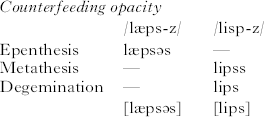
On the other hand, Epenthesis seems to belong to the word level, because it is sensitive to the word-level suffix /-z/, contrary to prediction (10a.ii). Epenthesis is also optionally fed by the word-level process of Metathesis ([lipsə s, lifsə s]), contrary to prediction (10b.i). The feeding variants are clearly not an idiosyncrasy: the 12 tokens come from seven different speakers.
How can we reconcile these facts? The key observation is that Epenthesis is optional. This appears to be true not only across speakers, but also within speakers: several subjects produced both [lips] and [lipsə s] (or their lenition variants). The following reanalysis now suggests itself. Assume that both Metathesis and Epenthesis are word-level processes and that Metathesis feeds Epenthesis, i.e. the interaction is transparent, but that Epenthesis is optional. The following output variants are now predicted.
(14)
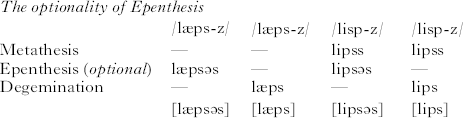
Both [lips] and [lipsə s] are now correctly predicted. But why is [lipsə s] so rare? In our corpus, this variant only occurs 12 times, accounting for 5·7% of the variants for the input /lisp-z/. This is not a problem if our goal is simply to account for the existence vs. non-existence of forms. However, quantitative patterns are not arbitrary. We will return to this puzzle shortly. The analysis also predicts that both [læps] and [læpsə s] should be possible. Are both attested? Mohanan (Reference Mohanan1992: 122) only mentions the [læpsə s] variant, and unfortunately our experiment did not contain /læps/-type stimuli. However, it is independently known that word-final /-z/ is optional in Singapore English. This is well documented for both the number suffix /-z/ in nouns (Wee & Ansaldo Reference Wee and Ansaldo2004: 63–65) and the number/person suffix /-z/ in verbs (Fong Reference Fong2004: 77). The analysis is thus consistent with the facts.Footnote 5
Before leaving the topic of Epenthesis–Metathesis interaction, we consider an alternative hypothesis brought up by a reviewer: could the apparent opacity of [lips] (cf. [læpsə s]) be a spelling effect? The hypothesis is simple: schwa is pronounced when it is written. The reviewer cites a parallel contrast that involves h-aspiré words in French. The relevant minimal pair is cette housse ‘this cover’ vs. sept housses ‘seven covers’. Tranel (Reference Tranel1981) argues that schwa is optional in both cette and sept, i.e. [sεtʔus]~[sεtœus], but preferred with cette, because it is present in the spelling. It seems that Mohanan's contrast [læpsə s] <lapses> and [lips] <lisps> might be amenable to a similar analysis. However, more than spelling is clearly involved. Consider the minimal pair lisps vs. lisped. If epenthesis were merely a spelling effect, we would expect less epenthesis in lisps than in lisped. In fact, the opposite is the case: we find 12 tokens of epenthesis in lisps ([lipsə s, lifsə s]), but only one token in lisped ([lispə t]).The pattern is the opposite of what one would expect if epenthesis were merely a spelling effect. This suggests that epenthesis is phonologically real.
4.4 Summary
The interaction of cluster processes in Singapore English is summarised in (15):
(15)
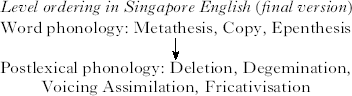
The analysis of opacity requires only two levels: the word level and the postlexical level. This has been accomplished by reanalysing two opaque interactions as transparent. In the resulting system, all reordering and epenthesis processes apply at the word level, and all lenition processes apply postlexically. With this picture of process interaction in place, we now turn to the phonology of word-level cluster processes in Singapore English.
5 Analysing variation
In this section, we will derive the patterns of variation and opacity in Singapore English from a small set of phonological constraints. Following Optimality Theory (Prince & Smolensky Reference Prince and Smolensky1993), we will assume that (i) constraints can make potentially conflicting structural demands, (ii) conflicts among constraints are resolved by strict ranking and (iii) constraints are universal, while rankings are language-specific. The last assumption entails that the possible constraint rankings define the space of possible languages. This space is called the factorial typology (Prince & Smolensky Reference Prince and Smolensky1993: 33). Our main conclusion is that factorial typologies play an important role in phonological variation within a single language: they impose strict quantitative limits on possible types of variation that hold true independently both of constraint rankings and of specific assumptions about how the grammar represents variation.
5.1 Defining the candidates
A phonological grammar defines a set of mappings between input forms and output forms. For example, a phonological grammar may license the mapping in (16a), that in (16b), both or neither, depending on the speaker.
(16)
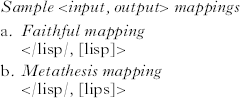
We adopt the Correspondence Theory of Faithfulness (McCarthy & Prince Reference McCarthy, Prince, Beckman, Dickey and Urbanczyk1995), where input and output segments stand in a correspondence relation. Notating the correspondence relation by coindexation, the faithful mapping is </l1 i2 s3 p4/, [l1 i2 s3 p4]>, whereas the metathesis mapping is </l1 i2 s3 p4/, [l1 i2 p4 s3]>, where the output correspondents of the third and fourth input segments have been reversed. To keep the notation simple, we will follow the customary practice of omitting subscripts if they are clear from the context.
In Optimality Theory, each input is mapped to a set of output candidates. The grammar designates one of these candidates as optimal. We can focus on the relevant candidate set by making the following assumptions. First, we ignore candidates where segment reordering crosses morpheme boundaries. This means, for example, that the mapping </lisp-z/, [lisp]> is interpreted as suffix deletion, i.e. </l1 i2 s3 p4 z5/, [l1 i2 s3 p4]>, not for example as medial /s/-deletion combined with /z/-devoicing and metathesis, i.e. </l1 i2 s3 p4 z5/, [l1 i2 s5 p4]>. Second, we interpret Copy as segment splitting, e.g. </l1 i2 s3 p4/, [l1 i2 p4 s3 p4]>, where the input /p/ has two output correspondents separated by a fricative. Third, we only consider candidates where the epenthetic schwa occurs between morphemes. Thus we will consider the mapping </lisp-z/, [lipsə s]>, but not the mapping </lisp/, [lisə p]> or </lisp/, [lispə ]>, with stem-medial or word-final schwa-epenthesis. Fourth, we will suppress all candidates where segments have been either deleted or their featural content changed. In other words, we are assuming that the constraints Max(seg) ‘Every input segment has an output correspondent’ and Ident[F] ‘Correspondent segments have identical values for the feature F’ are undominated in the lexical phonology. These assumptions are helpful because they allow us to focus on the relevant alternations.
We now construct the candidate set for /lisp/. The relevant candidates are all the possible arrangements of /p/ and /s/ after the initial /li/. This set is large because Copy allows the same segment to occur more than once, in principle an arbitrary number of times. Here we will limit the length of the string to three, which is the maximum length of stem-internal clusters in our data. Since Max and Ident are undominated, both /p/ and /s/ must be realised at least once. This yields the eight candidate stems in (17).
(17)

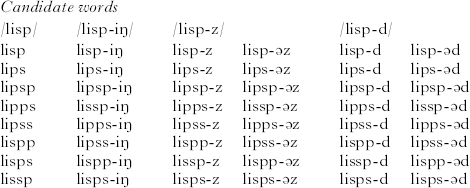
We also need to construct the candidate sets for /lisp-iŋ/, /lisp-z/ and /lisp-d/. Epenthesis is relevant here because it may occur between morphemes. If we assume that schwa epenthesis is blocked before vowel-initial suffixes due to high-ranked *Hiatus (*[lispə iŋ]), we only need to consider schwa with /-z/ and /-d/. The number of candidates will thus be eight for /lisp/ and /lisp-iŋ/ and 16 for /lisp-z/ and /lisp-d/. The complete list of candidates is given in (18).
(18)
5.2 Constraints
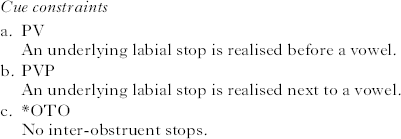
Why do cluster processes occur? Here, we will pursue the hypothesis that it is perceptually advantageous for a consonant to be adjacent to a vowel (see e.g. Hume Reference Hume1999, Côté Reference Côté2000, Steriade Reference Steriade, Hume and Johnson2001, Flemming Reference Flemming, Pisoni and Remez2005, among others). More specifically, we will assume that segment reordering in Singapore English occurs in order to enhance the perception of place cues in labial stops. The relevant cue constraints are stated in (19).
(19)
How do these constraints trigger Metathesis and p-copy? Consider the input /lisp-d/.
(20)
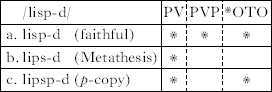
The faithful mapping </lisp-d/, [lispd]> violates all three constraints. Both Metathesis and p-copy improve the situation by mapping the underlying /p/ next to a vowel. Metathesis involves a wholesale reversal of two segments, whereas p-copy is more conservative, realising the underlying /p/ both in its underlying linear position and next to a vowel. These examples show that both Metathesis and p-copy beat the faithful candidate in terms of the perceptual constraints in (19).
We also need a markedness constraint to motivate schwa epenthesis between adjacent sibilants. For the present purposes we will use the constraint in (21) (Gussenhoven & Jacobs Reference Gussenhoven and Jacobs1998: 47; see also Baković Reference Baković2005).
(21) *SS
Sequences of sibilants are prohibited within the word.
We now turn to the faithfulness constraints. Since all deletion is postlexical, the antideletion constraint Max is undominated at the word level. In contrast, the optional schwa-epenthesis in [lipsə s] shows that the anti-epenthesis constraint Dep is optionally dominated.
(22) a. Max
No deletion (undominated at the word level).
b. Dep
No epenthesis.
The typologically most remarkable cluster processes in Singapore English are Copy and Metathesis. These processes involve violations of the anti-splitting constraint Integrity and the anti-reversal constraint Linearity.
(23) a. Integrity-IO (Int-IO)
Input segments are not split in the output.
b. Linearity-IO (Lin-IO)
If S1>S2 in the input, then S1 ′>S2 ′ in the output.
Our interpretation of the anti-metathesis constraint Lin-IO differs from the original formulation in McCarthy & Prince (Reference McCarthy, Prince, Beckman, Dickey and Urbanczyk1995).
(24) Linearity-IO (McCarthy & Prince 1995: 371)
S1>S2 in the input iff not S2′>S1′ in the output.
The difference is subtle, but important. Our Lin-IO (23b) is violated if the input ordering is not found in the output; McCarthy & Prince's Lin-IO (24) is violated if the input ordering is reversed in the output. The difference between the two interpretations is illustrated in (25) in terms of constraint-violation patterns.
(25)
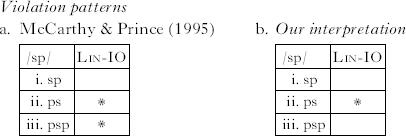
The interpretations are equivalent in the case of Metathesis, where the input ordering is simply reversed. They differ in the case of Copy, where the input ordering is simultaneously both reversed and retained in the output. It is precisely the rare cases of Copy that provide evidence for our interpretation of Lin-IO.
The constraints are summarised in (26). We use the input /lisp-z/ to illustrate the violation patterns. No ranking among the constraints is intended.
(26)

We have now stated a set of universal markedness constraints against consonant clusters and a set of universal faithfulness constraints against the deletion, epenthesis, splitting and reversal of segments. Several important questions arise. What kinds of cluster processes do these constraints predict to be possible? What kinds of cluster processes do they exclude? What does the analysis predict about variation and quantitative patterns? These questions will be addressed in the following sections.
5.3 The factorial typology
What kinds of cluster processes do our constraints predict to be possible? What kinds of cluster processes do they exclude? We will work out the answer by computing the factorial typology of the seven constraints using OTSoft (Hayes et al. Reference Hayes, Tesar and Zuraw2003). The program considers all the 5,040 possible total rankings, and returns the predicted patterns. The predicted forms are shown in (27). Variants that are predicted but not attested are starred. Variants that are attested but not predicted are listed in the right-hand column.
(27)
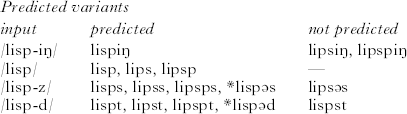
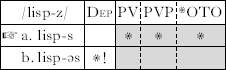
Two problems emerge. First, the system predicts two unattested outputs: *[lispə s] and *[lispə d]. Here the consonant cluster has been resolved by inserting an epenthetic vowel after a labial stop. The systematic absence of such variants provides evidence for the language-specific ranking Dep≫{PV, PVP, *OTO}, illustrated in (28). This ranking correctly eliminates both unattested variants.
(28)
Second, the system fails to predict four attested mappings.
(29)
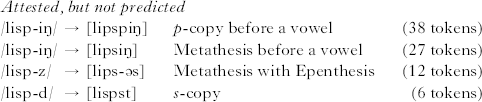
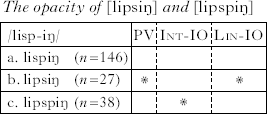
The last mapping is marginal and we will not attempt to account for it in this paper. In contrast, the first three are relatively common and form a natural class: they are all instances of overapplication opacity: the form incurs a faithfulness violation for no apparent surface reason (McCarthy Reference McCarthy1999). First, consider /lisp-iŋ/. The faithful variant [lispiŋ] has no constraint violations, rendering both [lipsiŋ] and [lipspiŋ] harmonically bounded.
(30)
Next, consider /lisp-z/. The variant [lipsə s] is harmonically bounded by the unattested *[lispə s], which itself loses against the faithful candidate [lisps], due to the ranking established in (28).
(31)
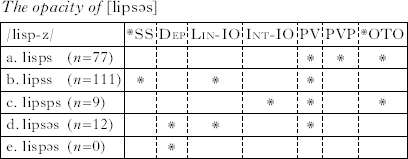
The problems in (30) and (31) are not accidents of the present analysis. They illustrate a general property of Optimality Theory: [lipsiŋ], [lipspiŋ] and [lipsə s] are blocked because they contain faithfulness violations that lead to no improvement in markedness (McCarthy Reference McCarthy2002: 101–103, Moreton Reference Moreton and McCarthy2004). This problem is characteristic of counterbleeding opacity. The question is how to derive these opaque forms. The answer will be given in §6.
5.4 Variation
What does the analysis predict about variation and quantitative patterns? In order to see this, we need to consider the space of possible languages predicted by the analysis. This space can be computed by OTSoft. The following factorial typology is based on the seven constraints in (26) and the partial ranking in (28).
(32)

A closer look at the factorial typology reveals several asymmetries. One such asymmetry is highlighted in grey: if Metathesis applies in /lisp-z/, it also applies in /lisp-d/, but not vice versa. This can be stated as the typological entailment in (33).
(33)

Typological entailments take the following general form: for all languages (=columns) in the factorial typology, if the mapping <input1, output1> belongs to the language, so does the mapping <input2, output2>. We call the set of all typological entailments in a factorial typology a Typological order, or T-order.
Typological entailments have deep consequences for variation and quantitative patterns. For the purposes of this illustration, let us assume the Multiple Grammars Theory of variation (Kroch Reference Kroch1989, Kiparsky Reference Kiparsky1994, Anttila Reference Anttila2007). We choose this theory because it makes no particular assumptions about the form or content of the underlying grammar. The Multiple Grammars Theory is stated in (34).
(34)

Optimality Theory defines a grammar as a total ranking of constraints. Optimality Theory and the Multiple Grammars Theory together define a grammar as a set of total rankings of constraints. Suppose that an individual can construct a grammar with complete freedom by selecting a set of total rankings from the factorial typology in whatever way. We may even assume that an individual can select multiple copies of the same total ranking. For example, an individual's grammar (competence) might consist of the four total rankings in (35): one ranking generates Output #1, one ranking generates Output #2 and two rankings generate Output #3.
(35)
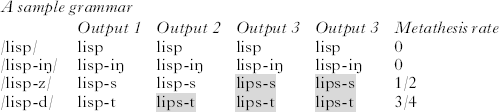
Assume that at the moment of speaking (performance) the individual selects a total ranking from the grammar at random. In the long run, the following pattern will emerge: Metathesis will apply half of the time before /z/ and three-quarters of the time before /d/. More generally, the typological entailment in (33) guarantees the following prediction: the rate of Metathesis before /z/ can never exceed the rate of Metathesis before /d/. This prediction is robust: it holds true no matter how the individual's grammar is constructed (competence) or how the total ranking is selected at the moment of speaking (performance).
Are the quantitative predictions made by our grammar true? In order to answer this question, we must first find all the typological entailments. This can be easily done with the help of T-Order Generator (Anttila & Andrus Reference Anttila and Andrus2006), a free open-source Python program for computing and visualising T-orders. The complete T-order is shown in (36) as pairs of <input, output> pairs. In all, 15 typological entailments are predicted.
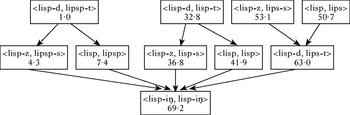
(36)

The structure in (36) is easier to understand if we visualise it as a directed graph. This graph is shown in Fig. 3. In the interest of visual clarity, all transitive arrows have been removed. Each <input, output> pair is annotated with a number. This number is the observed percentage of this particular output out of all the observed outputs for this particular input. The analysis predicts that the probability of <input, output> mappings should remain the same or increase as we move along the T-order, but never decrease. This prediction is confirmed: all the nodes in Fig. 3 are correctly ordered.
T-order as a directed graph.

T-orders are linguistically interesting in several ways. First, they are a consequence of standard Optimality Theory, not a new theoretical device: every optimality-theoretic grammar has an implicit T-order. This means that every optimality-theoretic grammar makes predictions about possible and impossible patterns of variation, including possible and impossible quantitative patterns. There are at least two methods of finding T-orders. Here we derived T-orders from factorial typologies. An alternative is to find the Elementary Ranking Conditions for each <input, output> mapping and to determine which mappings are entailed by which other mappings (Prince Reference Prince2006; see also Prince Reference Prince2002a, Reference Prince, Carpenter, Coetzee and de Lacyb, Reference Prince2007). Both methods are implemented in the current version of T-Order Generator (see Appendix D). The present paper provides a concrete illustration of the usefulness of these theoretical notions in empirical work on variation.
Second, a T-order with no rankings defines a set of typological entailments that are predicted to hold true of all languages. Such entailments are traditionally called implicational universals. Of the 15 typological entailments predicted by our analysis, 14 are implicational universals: they hold independently of rankings. The only non-universal typological entailment is <lisp, lips>→<lisp-d, lips-t>. This can be verified by taking the difference of two T-orders: one with rankings (=all entailments), the other without rankings (=only the universal entailments). In this way, the theory divides quantitative patterns into ranking-independent quantitative universals and ranking-dependent quantitative particulars. Only the latter have to be learned from the data.
Third, T-orders have general validity: they hold true under several theories of variation, including Multiple Grammars (e.g. Kiparsky Reference Kiparsky1994), Partially Ordered Grammars (e.g. Anttila & Cho Reference Anttila and Yu Cho1998) and Stochastic Optimality Theory (e.g. Boersma & Hayes Reference Boersma and Hayes2001). This is because in all these theories the factorial typology is the same. T-orders generalise over these theories by spelling out predictions that arise from Optimality Theory itself, independently of the specific representational assumptions of specific theories of variation. It is also important to see that T-orders are in no way limited to variation: they simply order <input, output> mappings in terms of their typological status. In this sense, T-orders are implicitly present in all domains of linguistics that involve typological and quantitative patterns. An example from phonotactics is discussed in Anttila (to appear).
6 Analysing opacity
In §5.3, we were left with the question of how to derive the opaque variants [lipsiŋ], [lipspiŋ] and [lipsə s]. The solution we will defend here is that these forms are in fact transparent and derive from an underlying /lips/. Recall that Mohanan (Reference Mohanan1992) rejected this alternative using the following reasoning: if the underlying form were /lips/, one would not be able to explain the contrast between [læpsə s] ‘lapses’ and [lips] ‘lisps’, hence the underlying forms must be /læps/ and /lisp/ respectively. However, this argument is weakened by the existence of variation: both [lips] and [lipsə s] are in fact attested.
What kinds of cluster processes can be derived from underlying /lips/? Again, we can work out the answer by computing the factorial typology of the seven constraints in (26) under the rankings in (28), using OTSoft. The predicted forms are shown in (37). The formerly opaque variants [lipsiŋ], [lipspiŋ] and [lipsə s] (underlined in (37)) are now transparent. The only variant that is still not predicted and that we will leave unanalysed is [lispst] (s-copy; six tokens).
(37)
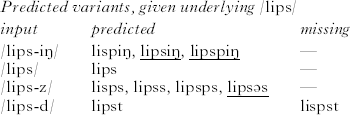
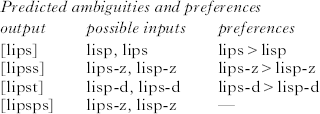
An important consequence of assuming both /lisp/ and /lips/ as underlying forms is that several variants can now be derived in two ways. For example, [lips] can be derived from /lips/ directly or from /lisp/ through Metathesis. The analysis thus predicts phonological ambiguity, i.e. one output has several inputs, along with phonological variation, i.e. one input has several outputs. This is illustrated in (38).
(38)
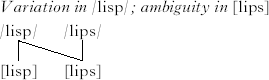
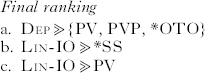
The analysis predicts two unattested mappings: <lips-z, lisp-s> and <lips-iŋ, lisp-iŋ>. Both outputs are attested, but the mapping involves ‘reverse metathesis’: /ps/→[sp]. We are not aware of any cases where Metathesis would reverse a stem-final /ps/, either to break up a sibilant cluster, e.g. /læps-z/→*[læsps], or to improve the perceptibility of /p/ by making it prevocalic, e.g. /læps-iŋ/→*[læspiŋ]. The systematic absence of such processes can be captured by the rankings Lin-IO≫*SS and Lin-IO≫PV, illustrated in (39).
(39)

We now compute the final T-order under the assumption that both /lisp/ and /lips/ are possible underlying forms. All the rankings summarised in (40) have been included.
(40)
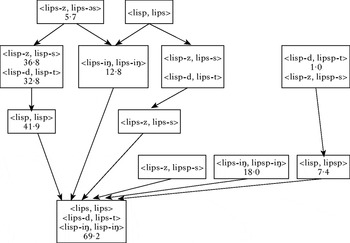
In all, 68 typological entailments are predicted. The T-order graph is shown in Fig. 4. In the interest of visual clarity, mappings that entail one another (= cycles) are enclosed in boxes.
T-order for both underlying forms (/lisp, lips/).

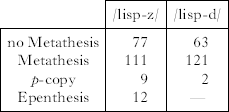
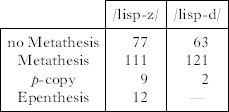
The graph shows the observed percentages for <input, output> pairs, but only if the output is unambiguous. An instance of an ambiguous output is [lips]: this variant can be derived from either /lisp/ or /lips/. While we know that 50·7% of the lisp-stimuli were pronounced [lips], we have no way of knowing which mapping was involved. Indeed, it is entirely possible that the same speaker has both /lisp/ and /lips/ as competing underlying forms. Among the unambiguous outputs, the quantitative predictions hold up almost perfectly: of the 17 arrows that connect mappings with unambiguous outputs, 16 are correct. There is only one misordered pair of nodes: <lisp-z, lisp-s=36·8>→<lisp-d, lisp-t=32·8>. The difference turns out not to be statistically significant; see Table VII.
/lisp-z/ vs. /lisp-d/ (p=0·1996; Fisher's exact test, p-copy and Epenthesis omitted).
The formerly opaque variant [lipsə s] ‘lisps’ is now transparent. However, recall that [lipsə s] ‘lisps’ is rare, occurring only 12 times in the complete corpus and accounting for only 5·7% of all the variants for ‘lisps’. The optional rule analysis offered no explanation for this quantitative asymmetry, but simply predicted that [lisps], [lips] and [lipsə s] are all possible output variants. Our analysis explains the marginality of [lipsə s]. The key observation is that [lipsə s] is high in the T-order: it has a great number of typological entailments and is thus predicted to occur under very limited conditions. First, our analysis predicts that if Epenthesis is possible ([lipsə s]), Metathesis should be possible in all other environments ([lipsiŋ], [lips], [lipst]). Second, our analysis predicts that the relative frequency of [lipsə s] (5·7%) cannot be higher than the relative frequency of any of the following variants: [lipsiŋ] (12·8%), [lispt] (32·8%), [lisps] (36·8%), [lisp] (41·9%) and [lispiŋ] (69·2%). The first prediction is hard to verify, since we have very limited data on individual speakers, but the second prediction is confirmed by the quantitative pattern in the aggregate corpus.
Finally, the analysis makes predictions about the probability of alternative inputs in the case of ambiguity. These predictions can be read off the T-order just as in the case of variation: the probability of <input, output> mappings should remain the same or increase as we move along the T-order, but never decrease. The difference is that variation involves comparing mappings with the same input and different outputs, whereas ambiguity involves comparing mappings with the same output and different inputs. For example, while the output [lips] can be derived from two distinct inputs, /lisp/ and /lips/, the second input has higher probability. This is guaranteed by the typological entailment (41), which is part of the T-order in Fig. 4.
(41) <lisp, lips> → <lips, lips>
This typological entailment states that if [lips] can be derived by Metathesis, it can be derived faithfully. More generally, the analysis predicts that if several possible inputs yield the same output, the input that entails fewest faithfulness violations is preferred. T-orders thus derive a quantitative version of Lexicon Optimisation (Prince & Smolensky Reference Prince and Smolensky1993: 225), as pointed out to us by Aaron Kaplan (personal communication). The full list of predicted ambiguities and preferences among inputs is given in (42).Footnote 6
(42)
The possibility that a language user may store multiple underlying forms for the same input is reminiscent of exemplar theories of the lexicon (see e.g. Johnson Reference Johnson, Johnson and Mullennix1997, Pierrehumbert Reference Pierrehumbert, Bybee and Hopper2001). However, the present theory goes beyond the view that whatever is heard is stored in the lexicon. The phonological grammar exists independently of the lexicon and imposes a preference ordering on possible underlying forms: an output may have multiple inputs, but inputs are not all phonologically equal. Of course, this in no way rules out the possibility that other factors such as usage frequency are involved as well.Footnote 7
All the Singapore English cluster opacities discussed by Mohanan (Reference Mohanan1992) have now been resolved. The upshot is that only one source of opacity exists: the interleaving of phonology and morphology. Several opacities disappeared as soon as we considered the whole range of output forms (variation) and the whole range of input forms (ambiguity). A summary is given in (43).
(43)

7 Conclusion
Singapore English consonant clusters exhibit a complex interaction of phonological processes that result in variation and opacity. The evidence discussed in this paper converges on two main conclusions. First, the variation is systematic and can be derived from a small set of perceptually motivated phonological constraints. Our explanation made crucial use of typological entailments (T-orders) that impose strict limits on possible variation patterns, including possible quantitative patterns, and reveal the intricate and almost completely unexplored quantitative structure hidden in optimality-theoretic grammars. Second, the Singapore English evidence supports the hypothesis that phonological opacity has only one source: the interleaving of phonology and morphology.
Appendix A: The script

Appendix B: Hapaxes
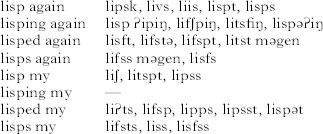
Appendix C: Data-classification procedure

Appendix D: T-Order Generator